
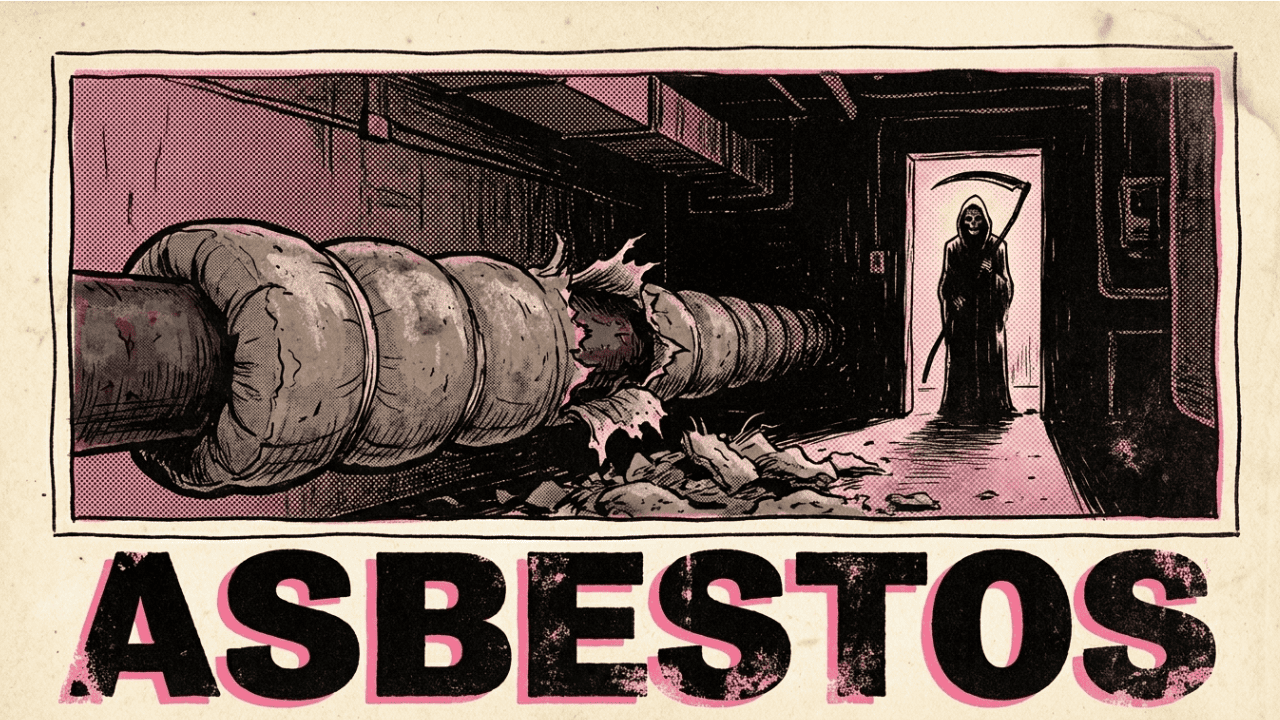

Asbestos in buildings is more common than most people expect. It sits in floor tile, pipe insulation, ceiling texture, and siding throughout buildings put up before the early 1980s. What follows covers what asbestos looks like, where it hides, what to do the moment somebody finds it, and what that discovery does to your schedule, your drawings, and your design.
This podcast is also available on YouTube, Spotify, and Apple Podcasts.
Test yourself! This episode has a free 10-question asbestos quiz at the bottom of this page.
Asbestos Can Shut Down a Job Site
Nine in the morning on a Tuesday.
Forty people on site. A full demolition crew working through an interior renovation, and the job is running two days ahead of schedule.
Everybody is in a good mood. The owner has stopped asking about the schedule. The superintendent is already thinking about what gets started early next week.
It’s the best morning the project has had.
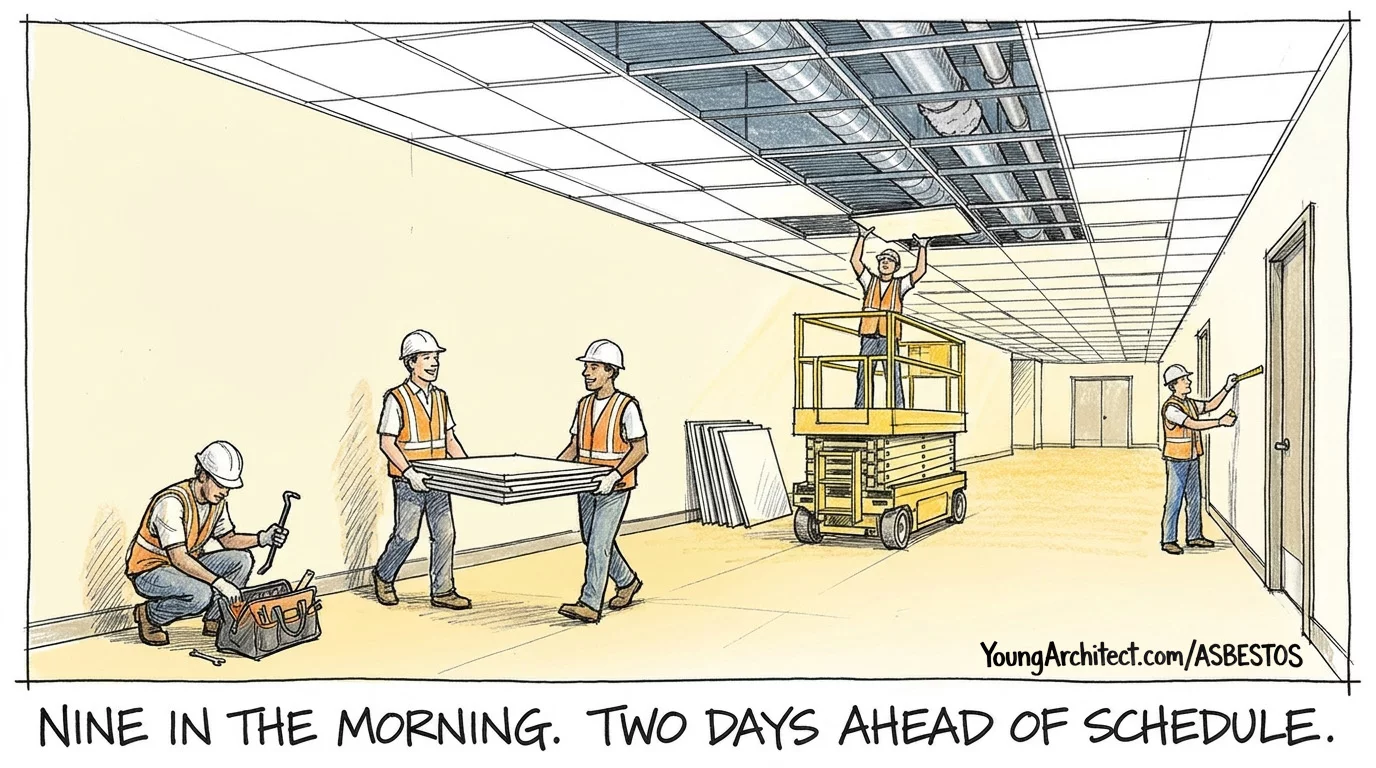
Then somebody pulls down a ceiling section and finds a gray chalky material wrapped around a pipe nobody knew was there.
Word gets around a job site fast.
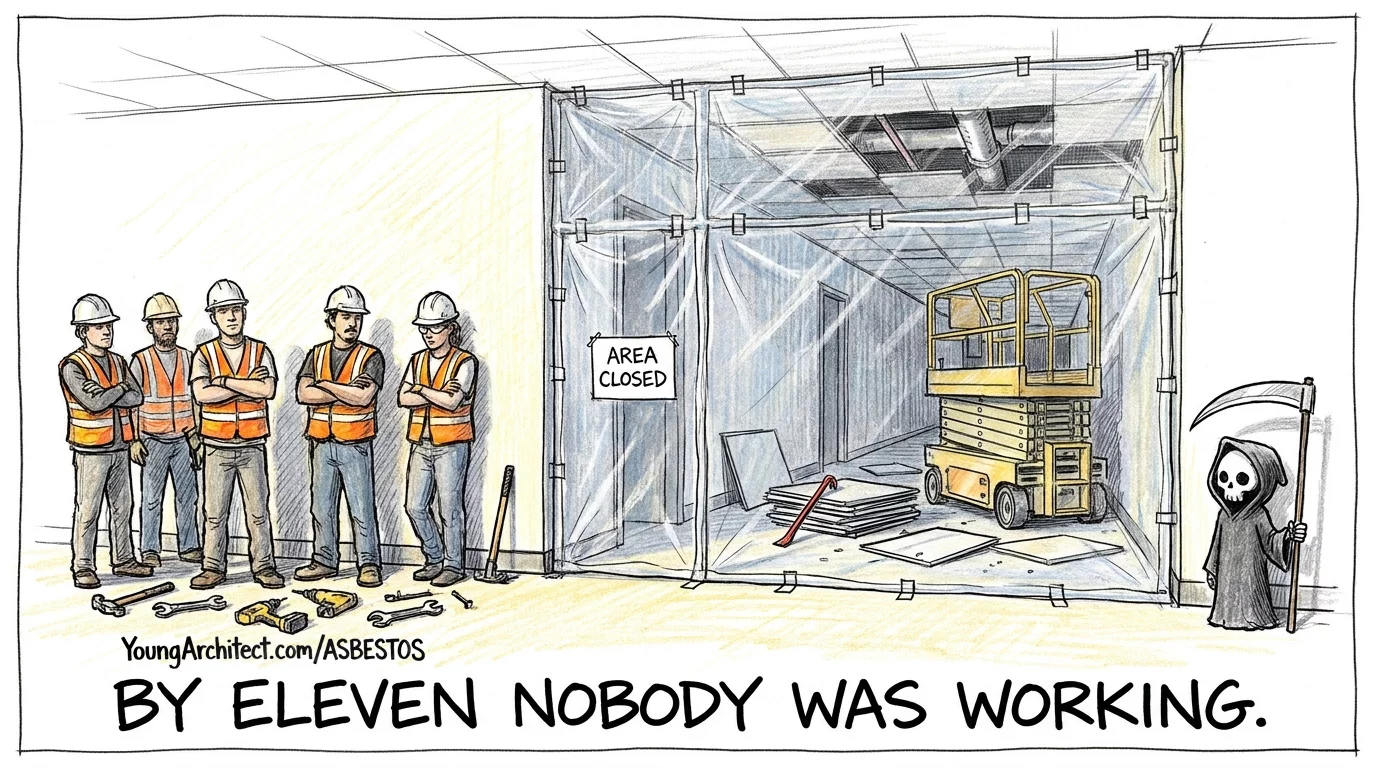
By eleven, nobody is working.
That wing is sealed off. The owner is on the phone with a lawyer. Nobody is going back inside for the better part of a month.
Now the part that gets overlooked.
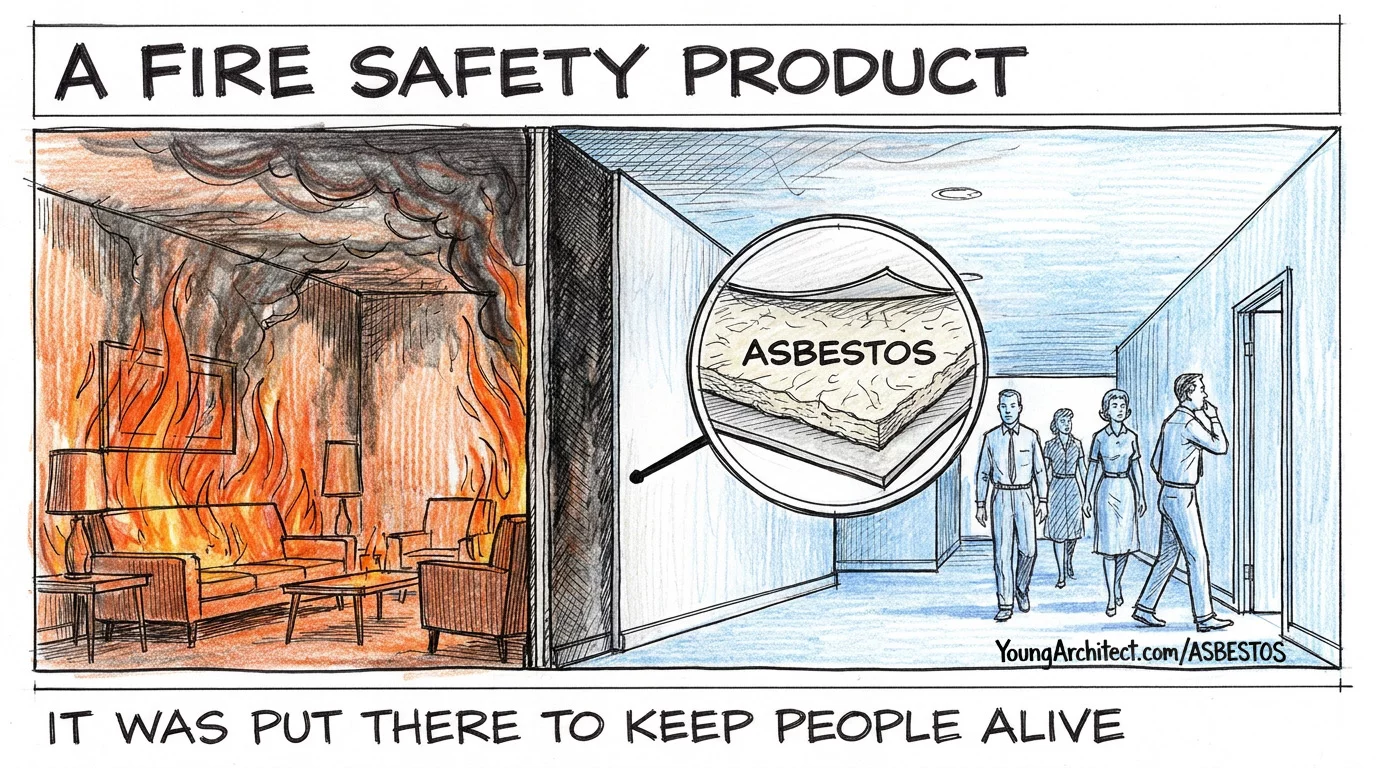
That material was put in that building on purpose. To keep people from burning to death.
It was a fire safety product. It was very good at its job.
It saved lives before it took them.
Which sets up the one idea that makes sense of everything else about asbestos in buildings.
The safest thing you can do with most of it is nothing at all. Leave it alone. Don’t touch it.
That sounds like terrible advice.
By the end of this page it should sound obvious.
What Asbestos Actually Is
What is asbestos, actually?
Not where it is. Not why it’s dangerous. What is it.
Almost nobody can answer that, and everything else depends on it.
It is not a chemical. Nobody invented it. There is no lab, no formula, nobody mixing something in a beaker.
Asbestos is a rock.
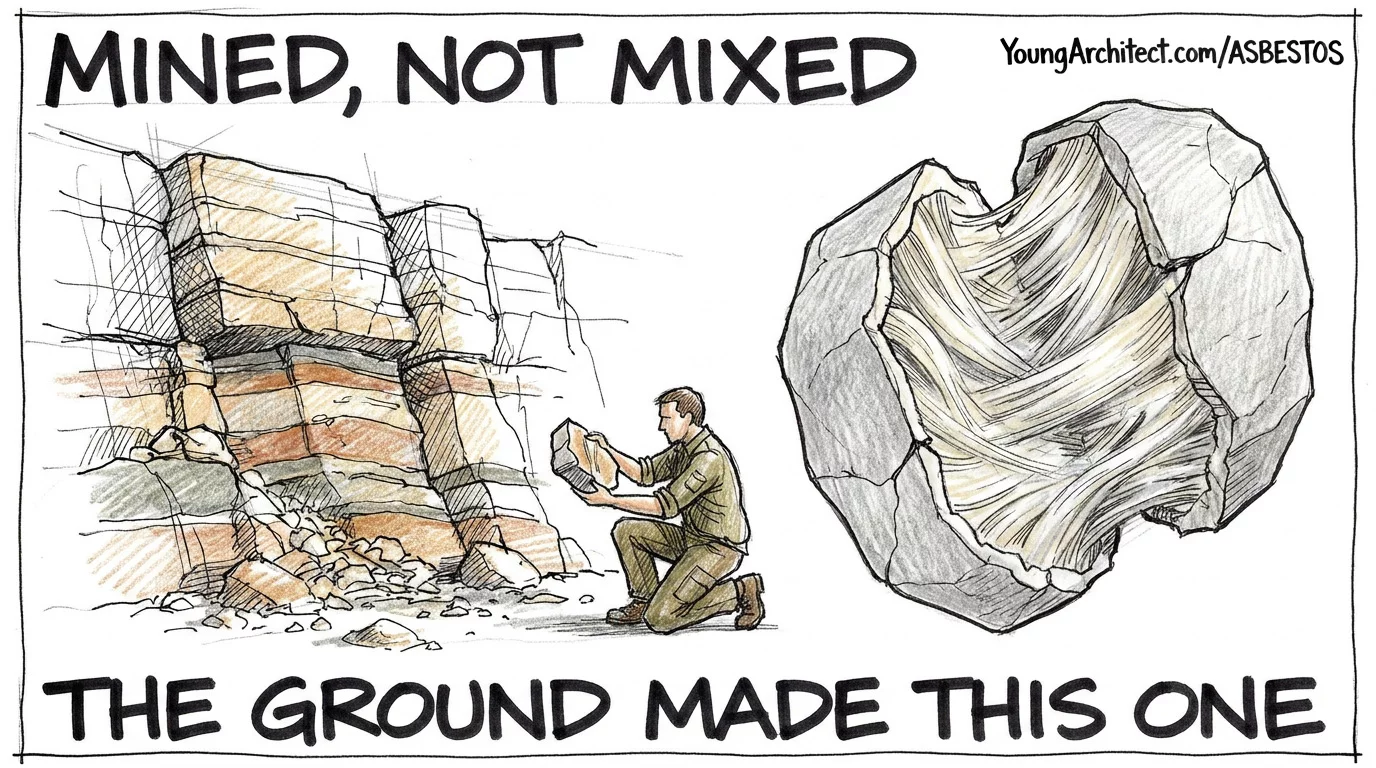
A family of minerals that come out of the ground with one strange property.
When they crystallize, they don’t grow in chunks the way most rock does. They grow in long, thin fibers.
Think about pulling apart string cheese. It’s one solid thing, and then it isn’t, because it comes apart into threads. Asbestos does that, except it’s stone.
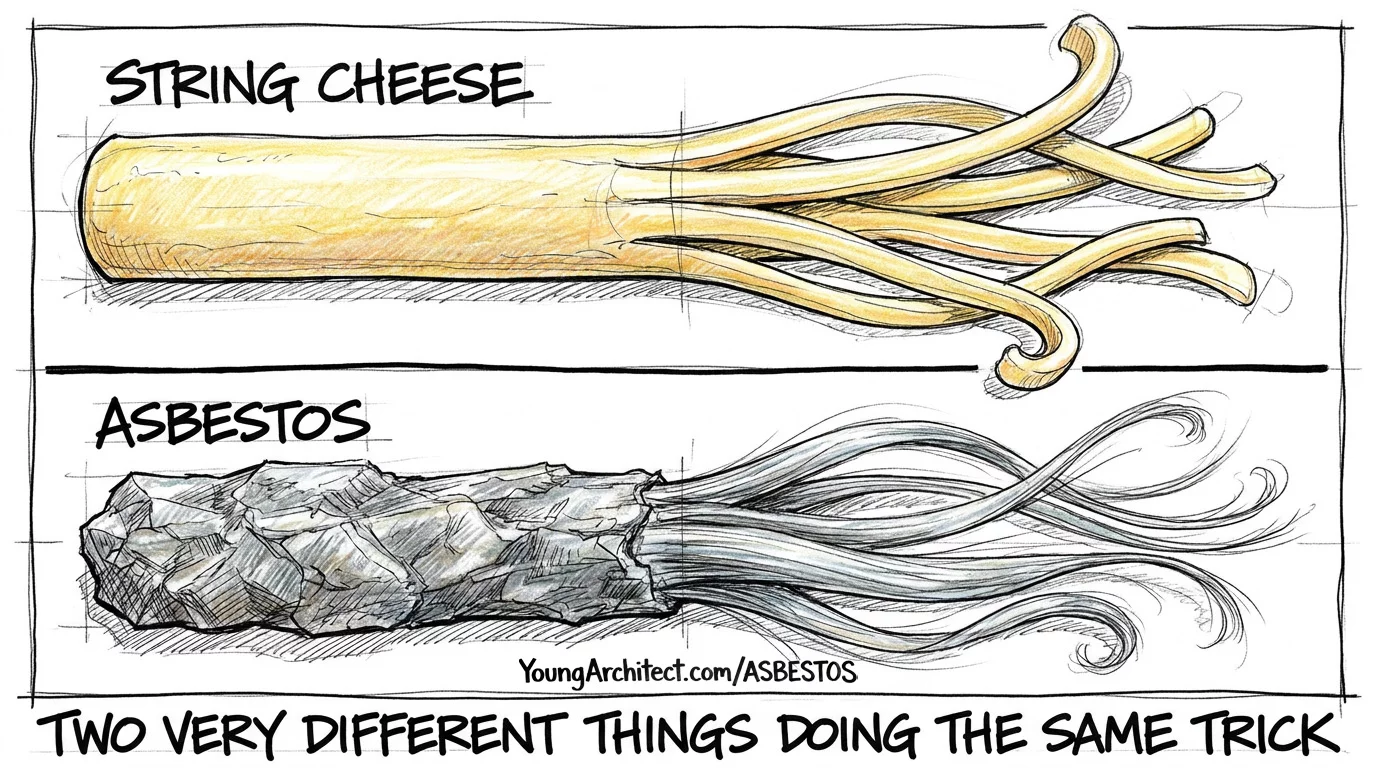
Work a piece apart with your hands and you end up holding something like hair.
Soft enough to spin. Soft enough to weave.
That fibrous structure is why asbestos was useful, and it is why it kills people. Same property, both times.
Now add up what this rock can do.
- It does not burn
- It doesn’t conduct heat
- It doesn’t conduct electricity
- It shrugs off acid and most chemicals
- It’s strong for its weight
- It doesn’t rot and insects won’t eat it
- It was dirt cheap
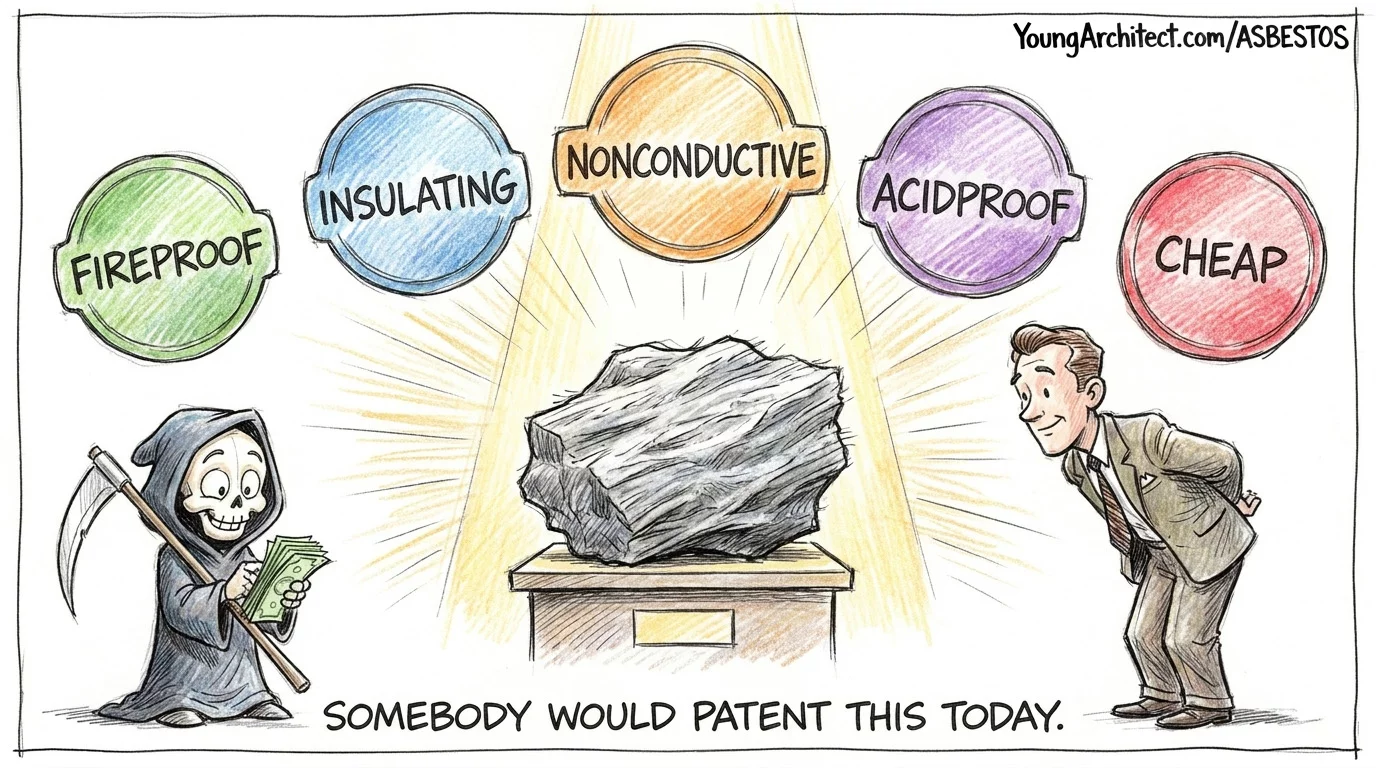
That’s more or less the list you’d write if you sat down to invent the perfect building material.
And the type you’ll meet most, chrysotile, checks every box on it.
Nobody had to invent any of it. It was already in the ground.
What Does Asbestos Look Like?
The honest answer first.
You cannot confirm asbestos by looking at it. Not from a photo, not across a room, not with thirty years in the field.
Anybody who says otherwise is guessing with confidence.
But there are tells.
Some are reliable enough to act on, and knowing them is the difference between walking into a renovation blind and walking in with a short list of things to test.
Start with the floor.
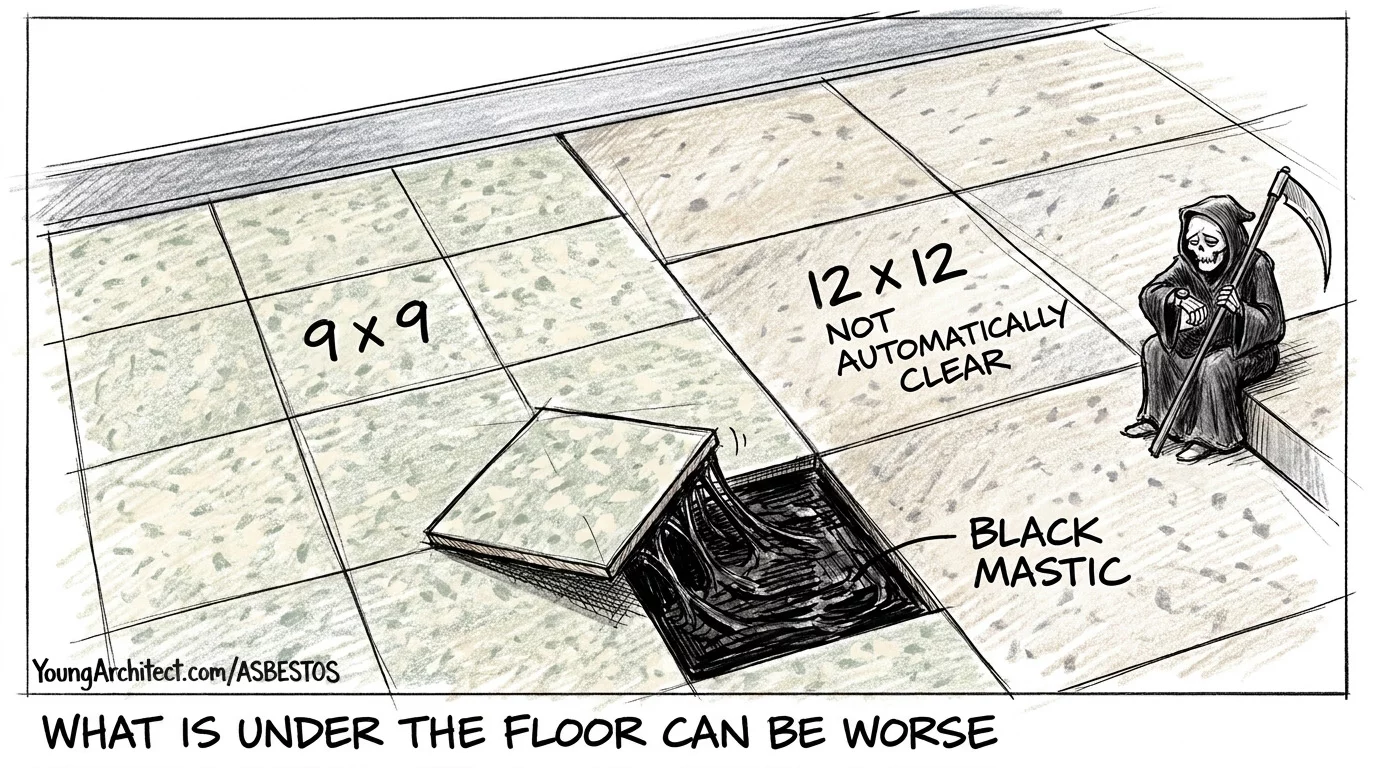
If the tile measures nine inches by nine inches, assume it’s asbestos until a lab says otherwise.
That dimension is the best single tell in the business, because nine by nine basically stopped getting made after a certain point.
Nine by nine means test it. It does not mean certainty and it does not mean panic. It means guessing is no longer acceptable.
Do not run that rule backwards.
Twelve by twelve does not mean you’re clear. Plenty of older twelve by twelve tile has asbestos in it. It just isn’t the dead giveaway that nine by nine is.
And there’s a second problem underneath the first.
Pull up that tile and you’ll often find black mastic, the adhesive holding it down.
That mastic is frequently a bigger problem than the tile was, and people who plan around the tile forget it exists.
What color is asbestos?
The answer is unsatisfying in a useful way.
There is no asbestos color.
The raw mineral runs white, gray, brown, blue, and green. More to the point, it got mixed into products manufactured in every color anybody wanted:
- Floor tile came in dozens of patterns
- Siding was painted whatever the owner liked
- Ceiling texture was white because ceilings were white
Color tells you nothing. If a page or a video is teaching you to identify asbestos by color, close it.
One distinction trips people up constantly. These are two different questions:
- What raw asbestos looks like. Fibrous rock, straight out of a mine. It’s a naturally occurring mineral, and it’s what fills the photographs.
- What asbestos tile and board look like. Tile, cloth, texture, and wrap, with the fibers mixed into something else and completely invisible.
The second one is what’s in your building. The first one is not.
So the real question isn’t what asbestos looks like.
It’s what condition it’s in.
Friable vs Non Friable Asbestos
Two words explain almost everything about how this material behaves.
They’re worth thirty seconds, because once you have them, every rule on the rest of this page makes sense.
Friable means you can crumble it with hand pressure.
Squeeze it and it falls apart. Which means it gives up fibers easily, and it’s the dangerous category.
Non friable means the fibers are locked into a hard matrix.
Cement, vinyl, asphalt. The fibers are in there, but trapped, and the material stays stable until somebody cuts, grinds, sands, or knocks it down.
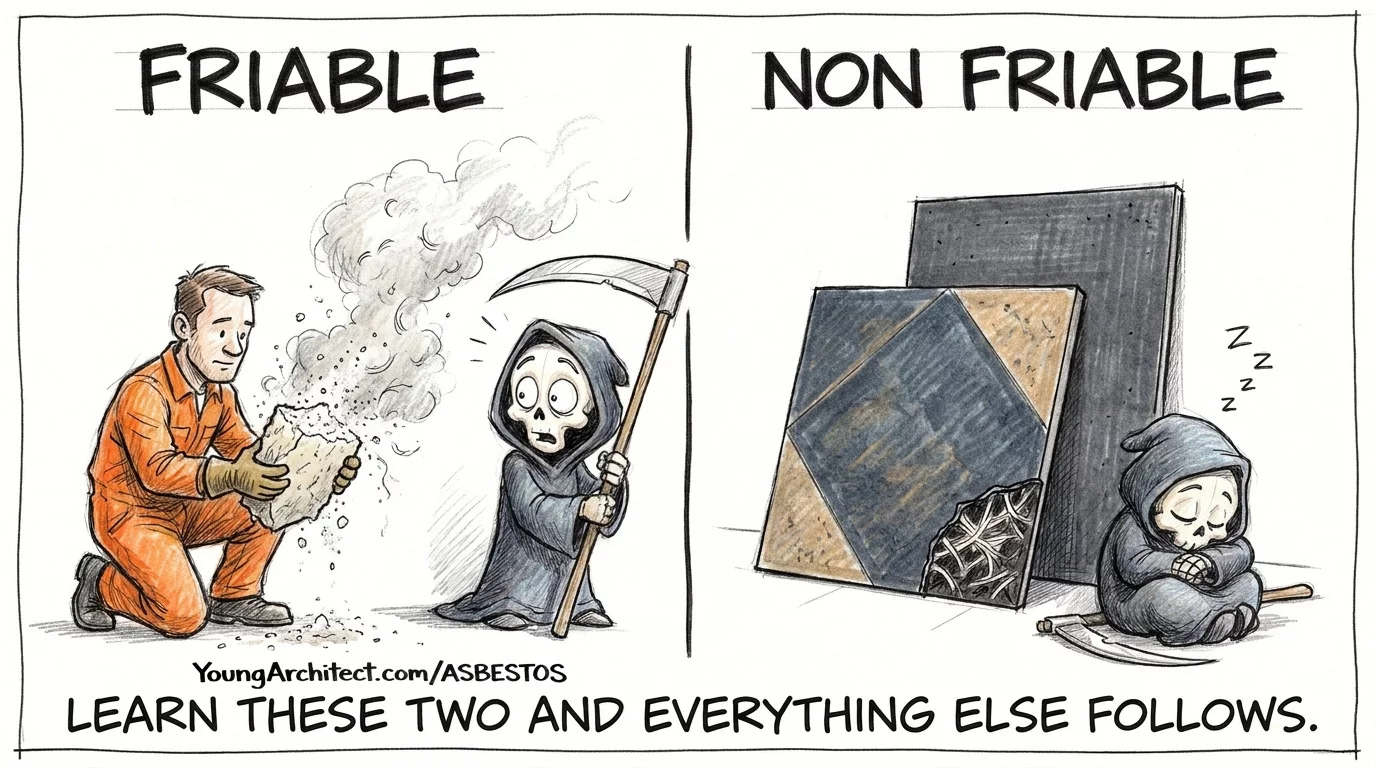
The difference isn’t about how much asbestos is in the material. It’s entirely about what’s holding it.
Which is easier to see with something you’ve handled.
Think about flour. Loose in the bag, you bump it and it puffs into the air and you’re breathing it. Bake that same flour into a loaf and it isn’t going anywhere.
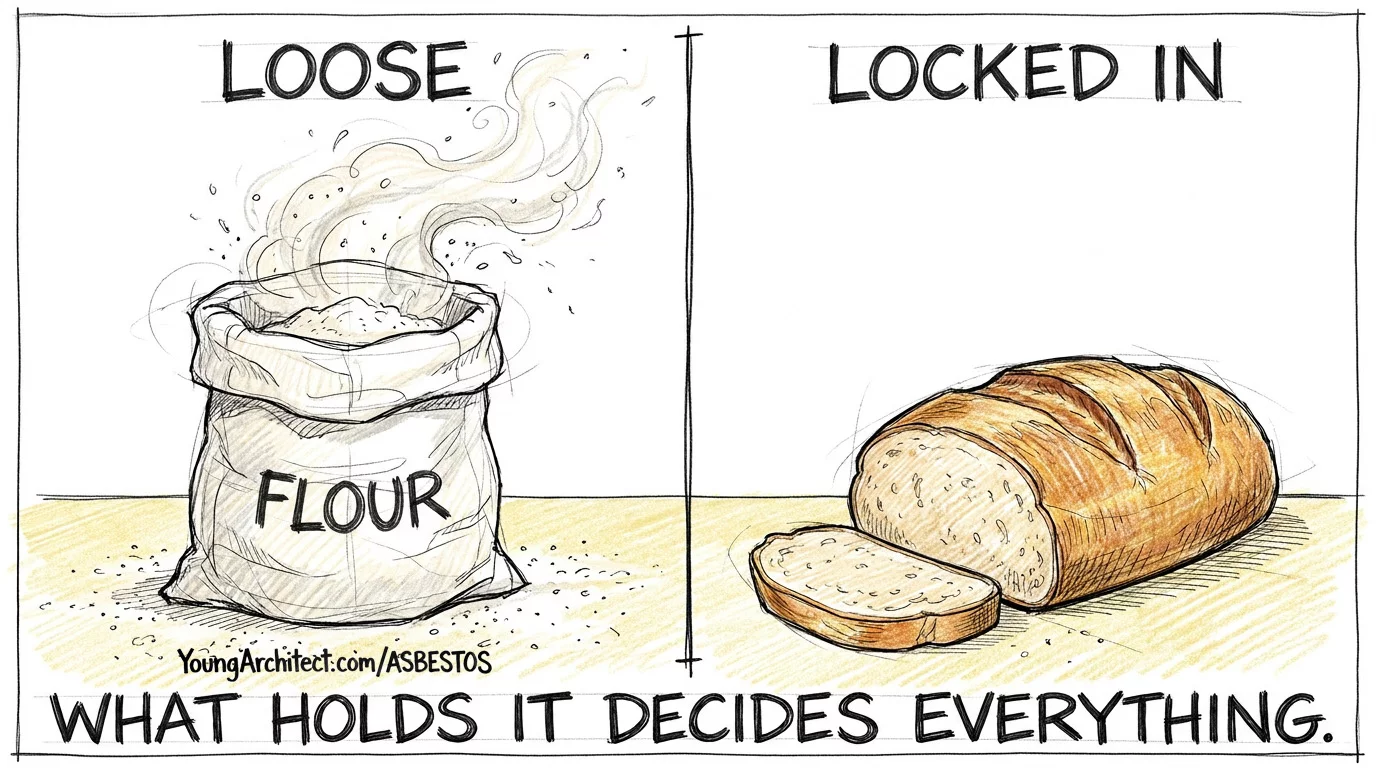
The flour didn’t change. It got locked into something.
Same fibers. Completely different behavior. Entirely because of what they’re stuck in.
Now the second half.
Asbestos in a building is a jar with the lid on. The jar on the shelf isn’t hurting anybody. It can sit there for fifty years.
The problem starts when somebody opens it.
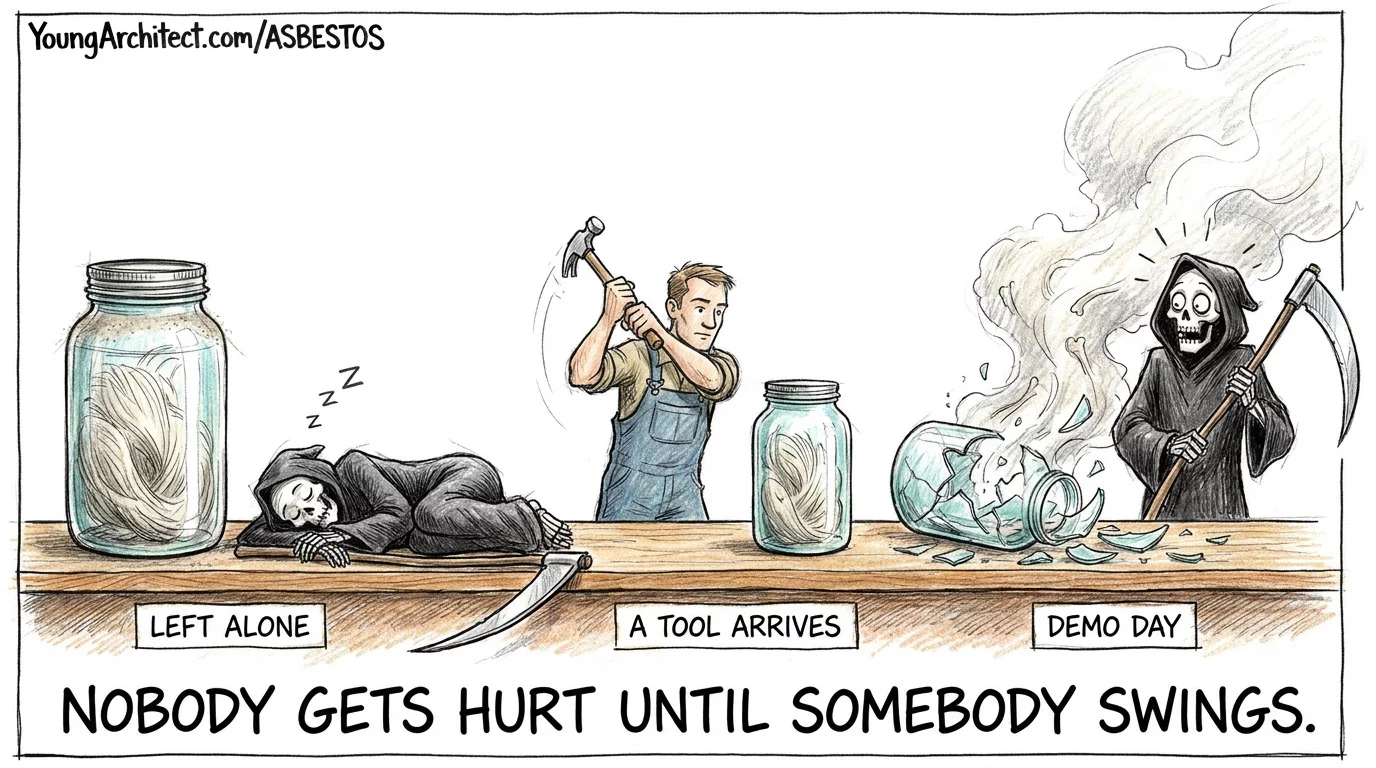
The jar never opens itself.
Asbestos never does anything on its own. It doesn’t leak. It doesn’t spread. It doesn’t come looking for anybody.
A person with a tool has to disturb it.
Which is why the dangerous moment is almost never the material sitting there. It’s the renovation.
And the most dangerous thing on a job site isn’t the asbestos. It’s an untrained guy with a grinder and good intentions.
So the question is never just whether there’s asbestos in the building. It’s where it is, what condition it’s in, and what you’re about to do to it.
Let’s go find it.
Where Asbestos in Buildings Hides
Where is asbestos found? Close to everywhere, in buildings of a certain age.
Anything built or renovated before the early 1980s is suspect, and the odds climb the older it gets.
But age confirms nothing on its own, and newer doesn’t guarantee clean, because old stock kept getting installed for years after it stopped being made.
Asbestos in buildings is a question about materials and condition, not about a date on a permit.
Here is the walk through, bottom to top.
Asbestos Pipe and Boiler Insulation
Start in the basement.
Old steam and hot water lines wrapped in a white chalky material that looks like plaster that gave up. That’s asbestos pipe insulation.
The same material shows up on the boiler itself and around old ductwork.
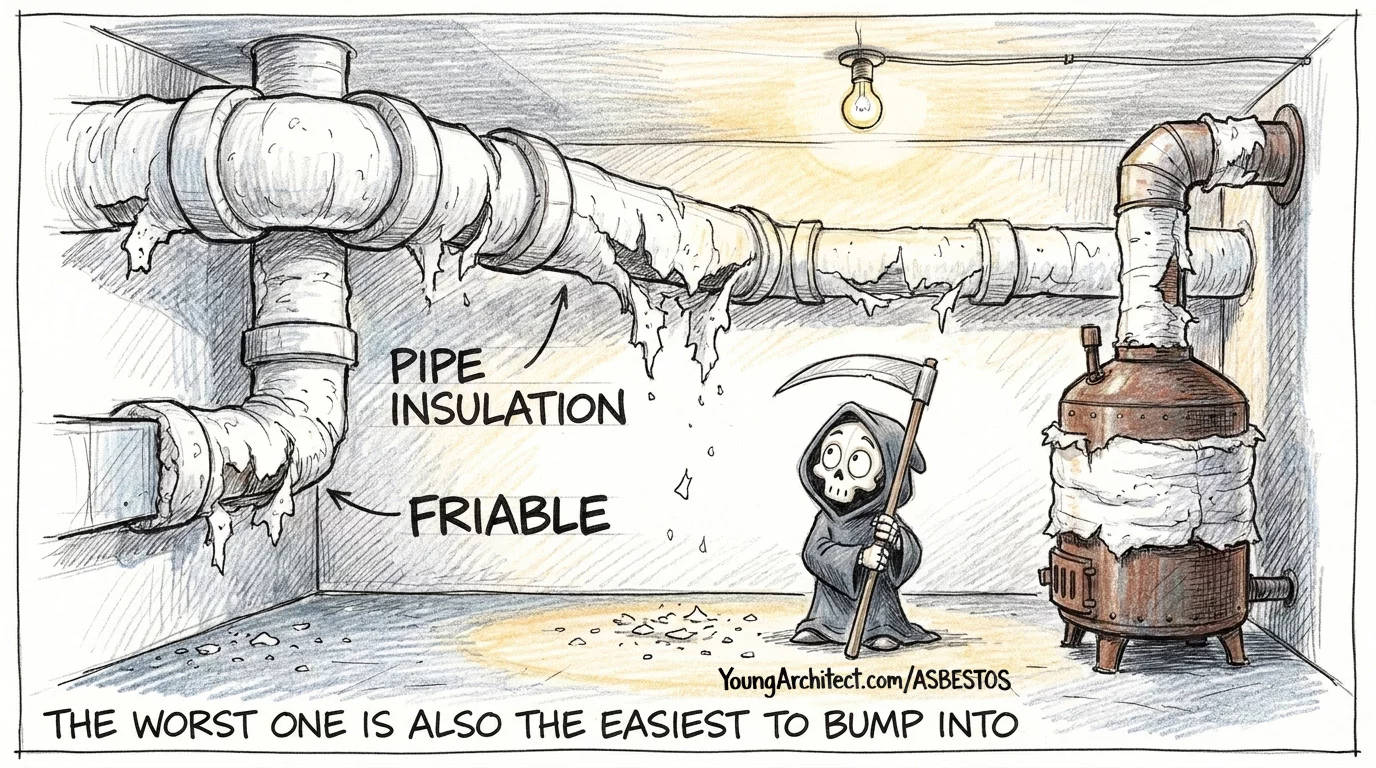
If you’ve ever pictured asbestos in your head, this is probably the image.
It’s also the worst one, because it is extremely friable.
It’s already crumbling. There is usually some of it on the floor.
Brush against it in a tight mechanical room, catch it with a ladder, run a cart past it, and you’ve disturbed it without ever deciding to.
Where is asbestos found in homes? Same place, in the same condition.
The boiler room of an older house is the highest-probability spot in the building. It’s also where people store things, run new wiring, and squeeze past.
This is the category where “leave it alone” stops being a slogan and becomes the actual instruction.
Spray Applied Fireproofing
Now go upstairs and look above the ceiling.
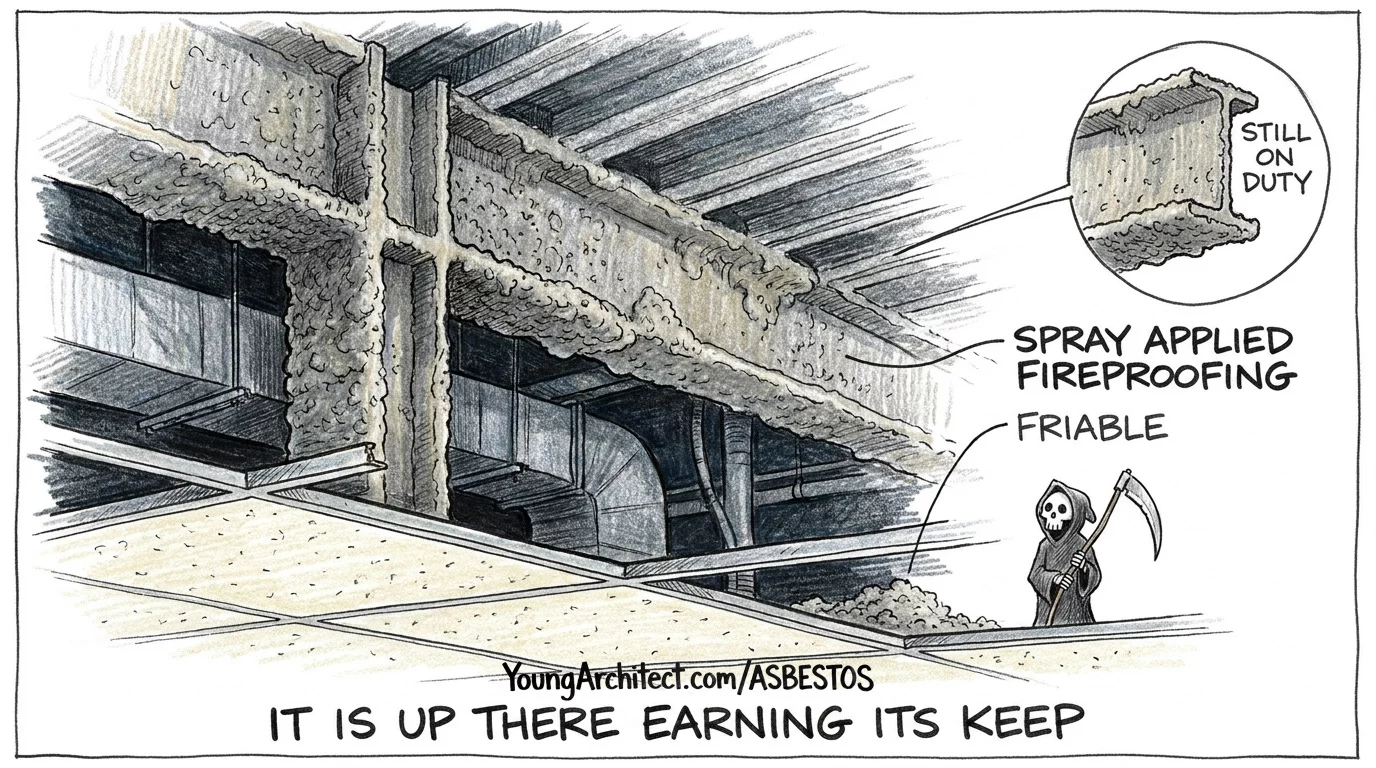
See that gray lumpy material sprayed over the structural steel? Kind of popcorn looking, definitely not meant to be seen?
That’s spray applied fireproofing.
Its entire job is keeping the steel from softening in a fire long enough for everybody to get out.
Sit with that one.
The material everybody is afraid of is up there right now, doing exactly the job asbestos was celebrated for in the first place.
It’s friable too, which makes the space above a ceiling one of the worst places in an old building to go poking around.
Every cable pull, every new diffuser, every ceiling tile lifted to take a quick look happens in that space.
And unlike the basement, this one is out of sight by design.
Nobody walks past it and notices it degrading, which means the first person to find out what condition it’s in is usually somebody already standing in it.
Asbestos Floor Tile and Black Mastic
You already know how to spot it. This is about where it is and why it’s still there.
Schools. Hospitals. Offices. Apartment buildings. Corridors and basements.
Anywhere that needed cheap durable flooring across a lot of square feet, which in practice meant almost everywhere from the 1950s into the early 1980s.
And it rarely got removed. It got covered.
- New vinyl over the old tile
- Carpet over that
- Another layer of vinyl over the carpet twenty years later
Each renovation took the cheap option. Each one put another surface between the tile and anybody who might have dealt with it.
Asbestos floor tile is the most common thing a demolition crew finds, because for forty years the cheapest move was always to leave it down and build on top of it.
Which means the day somebody finally takes the floor back to slab, it’s all still there. Along with the mastic under it.
Asbestos Ceiling Tile and Popcorn Ceilings
Look up.
Acoustic ceiling tile, the kind sitting in a grid. Or popcorn ceiling texture, which is the one every homeowner in America is searching for at two in the morning after watching a renovation video and getting an idea.
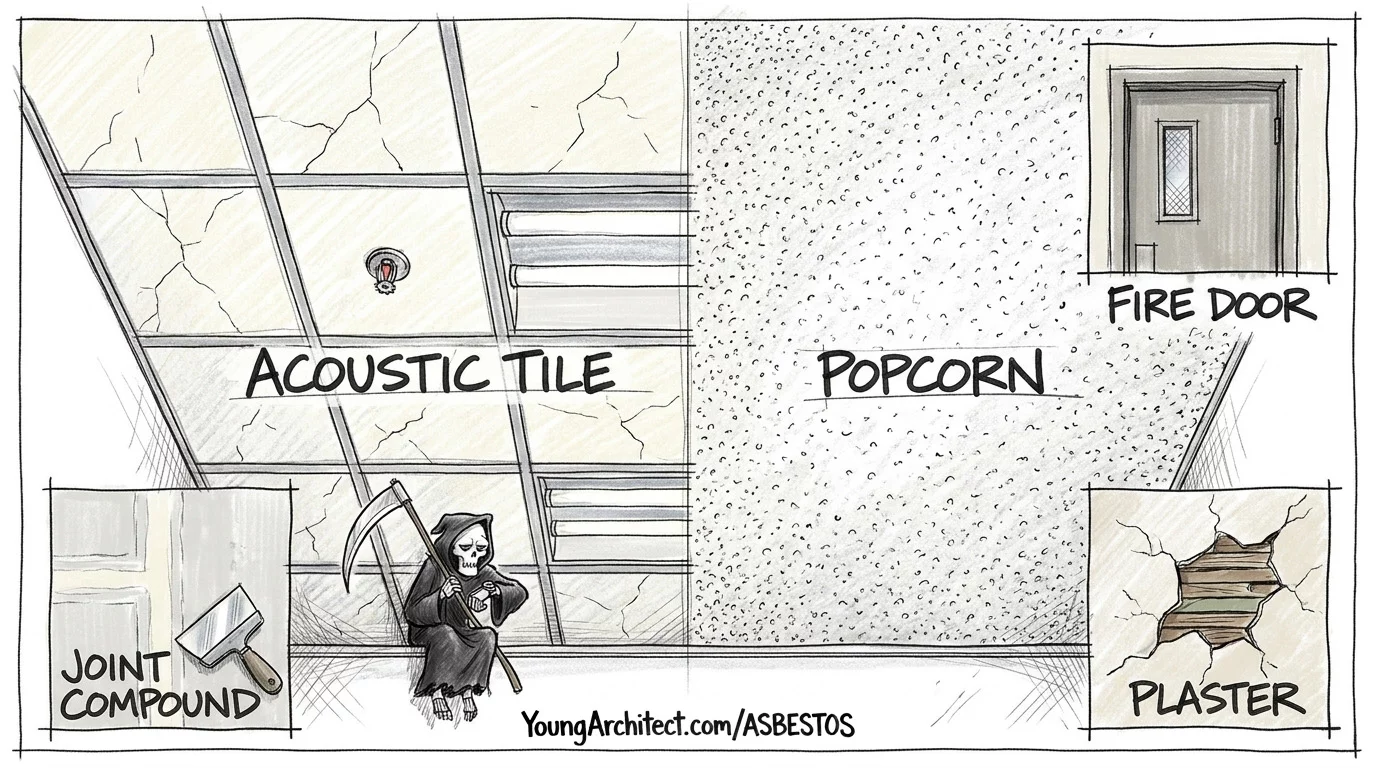
Not every popcorn ceiling has asbestos in it. Plenty don’t.
But the texture was a common place to put it, and there is no way to tell from the ground.
A material that might be hazardous, on a surface anybody can reach with a scraper and a ladder. That combination is what makes ceilings the most dangerous weekend project in an old house.
And the walk isn’t finished inside. The same material went on the outside of the building too.
Asbestos Siding, Shingles, and Roofing
Step out the front door and turn around.
Cement board siding. Shingles. Roofing felt and flashing up top.
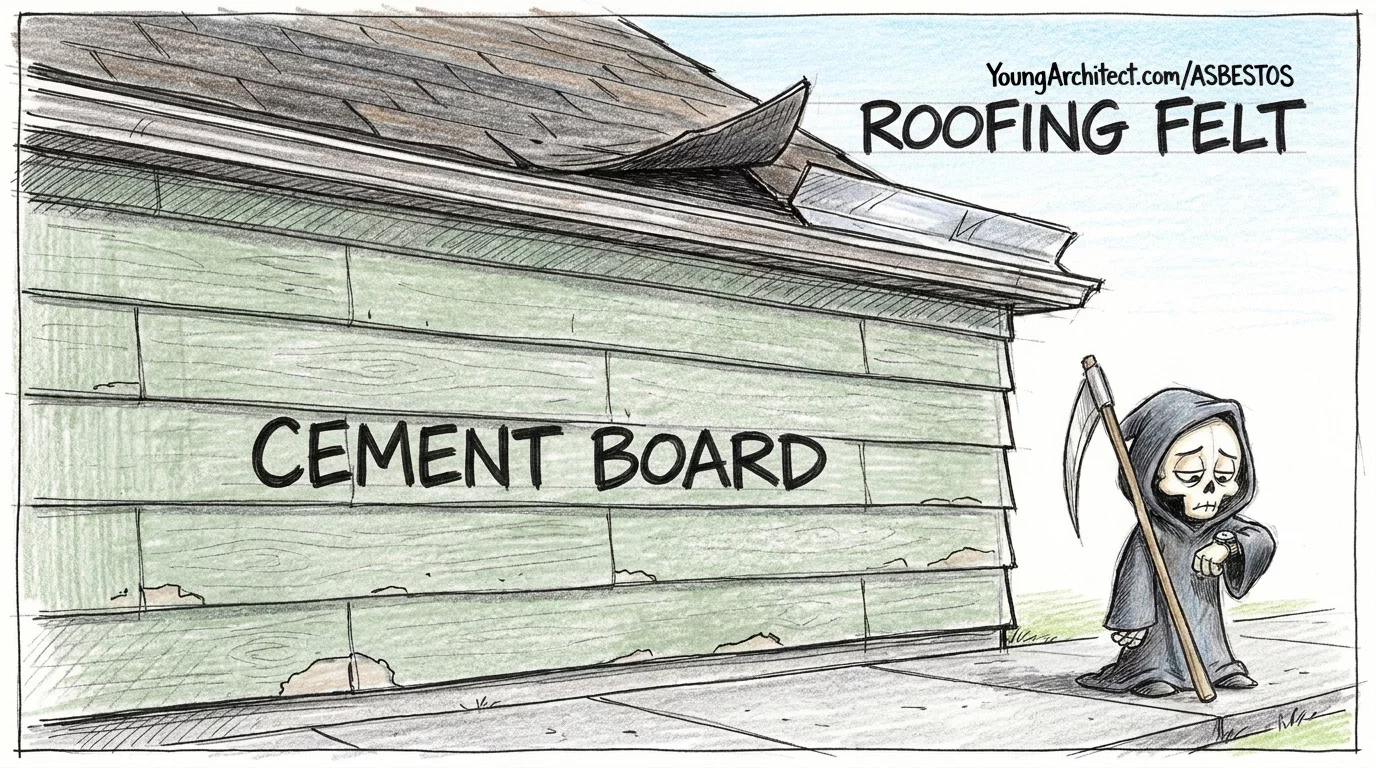
This is the category people forget, because it’s outside and it looks like ordinary building material.
Asbestos siding is still on an enormous number of houses. Holding up fine. Painted eight times. Doing nothing to anybody.
It’s non friable, hard, and stable. Left alone it will sit there another forty years.
Right up until somebody power washes it, cuts a new window opening through it, or pulls it off with a skid steer.
Roofing is the same story one level up.
Felt and flashing are stable until a tear-off starts, and a tear-off is exactly the kind of work that gets scheduled fast and cheap.
Joint Compound, Plaster, and the Odd Ones
The ones that don’t get their own picture.
- Joint compound at the drywall seams
- Plaster in older walls and ceilings
- Transite panels
- Glazing putty holding old window panes in their frames, which is also where you’d look at the sealants on a building of that era
- Fire doors
- The backing panel inside an electrical cabinet
None of these are dramatic. All of them are routine demolition targets.
Joint compound deserves a particular warning.
It’s the one that turns a small job into a big one, because sanding a wall seam in an old building is both completely ordinary and exactly the wrong move.
Nobody schedules a hazardous materials survey to patch drywall.
And the same pattern covers more than asbestos. Lead paint lives in buildings of the same vintage and follows the same logic, and it gets its own treatment another day.
The Ones That Are Not Buildings at All
Go back inside, into the bathroom, and pick up the hair dryer off the counter.
That too.
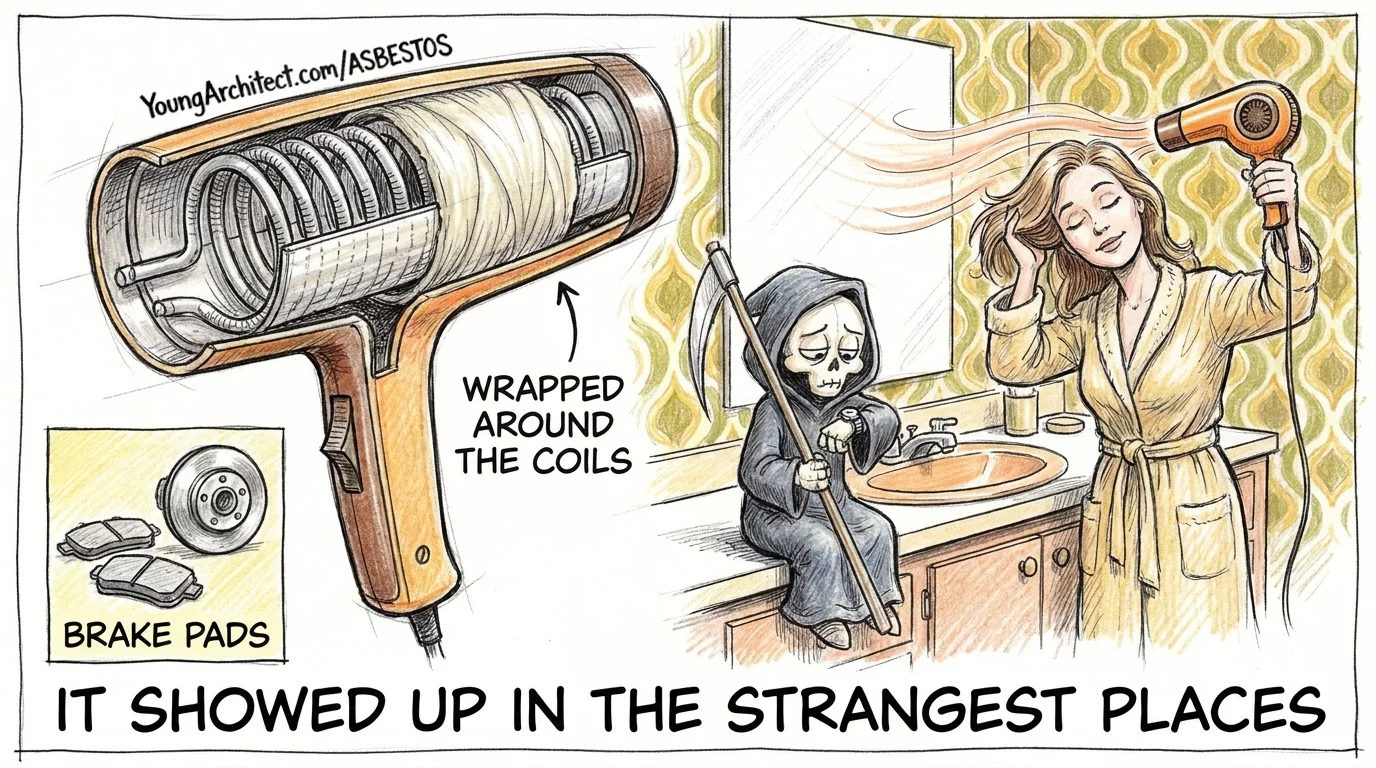
It was used to insulate the heating element, so for years people were running warm air over asbestos and pointing it directly at their own head.
The manufacturers pulled it at the end of the seventies.
And on your way out, the brake pads on the car in the driveway.
Which is a good reminder that this was never only a building problem.
Now notice something about almost everything on that walk.
The tile. The siding. The shingles. The cement board. The glazing putty.
It’s non friable. Hard, stable, locked up. Flour in the bread.
Which means it’s fine sitting there, and it becomes a serious problem the second somebody puts a saw through it.
That’s the real takeaway from the tour. Asbestos in buildings has been over your head and under your feet your entire life, probably today, and it didn’t matter.
It didn’t matter because nobody was cutting into it.
Which raises a fair question. If the stuff is in that many buildings, how did it get there in the first place?
Asbestos History: The Magic Mineral
People have been using this for thousands of years.
The Greeks and the Romans wove it into cloth. And when the cloth got dirty, they threw it in the fire.
The dirt burned off. The cloth came out clean.
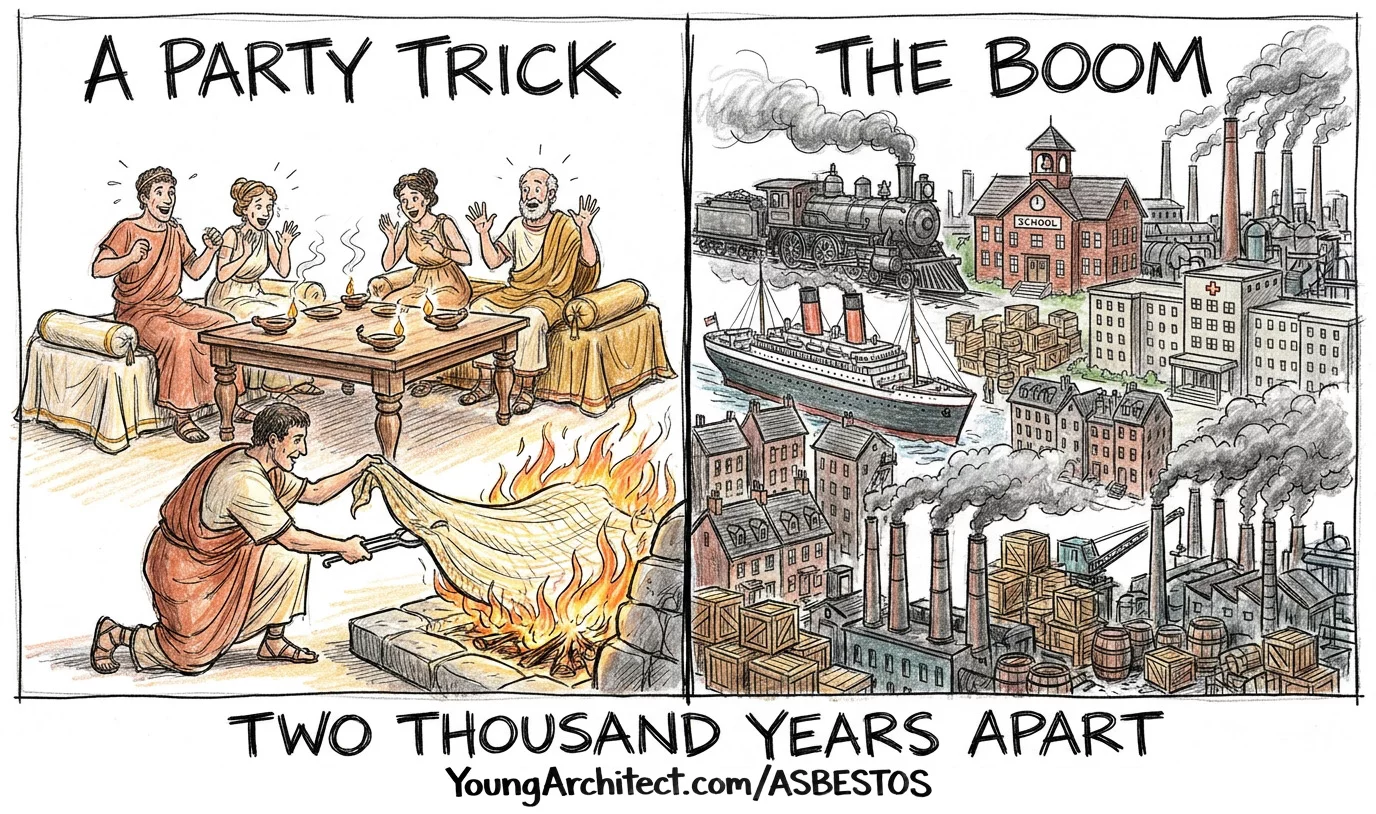
Then the machines showed up.
From the late 1800s into the mid 1900s, industrial mining made asbestos cheap at a scale nobody had seen, and it went into everything.
Ships. Trains. Schools. Hospitals. Houses.
The industry sold it exactly the way you’d expect. For decades it was marketed as the magic mineral.
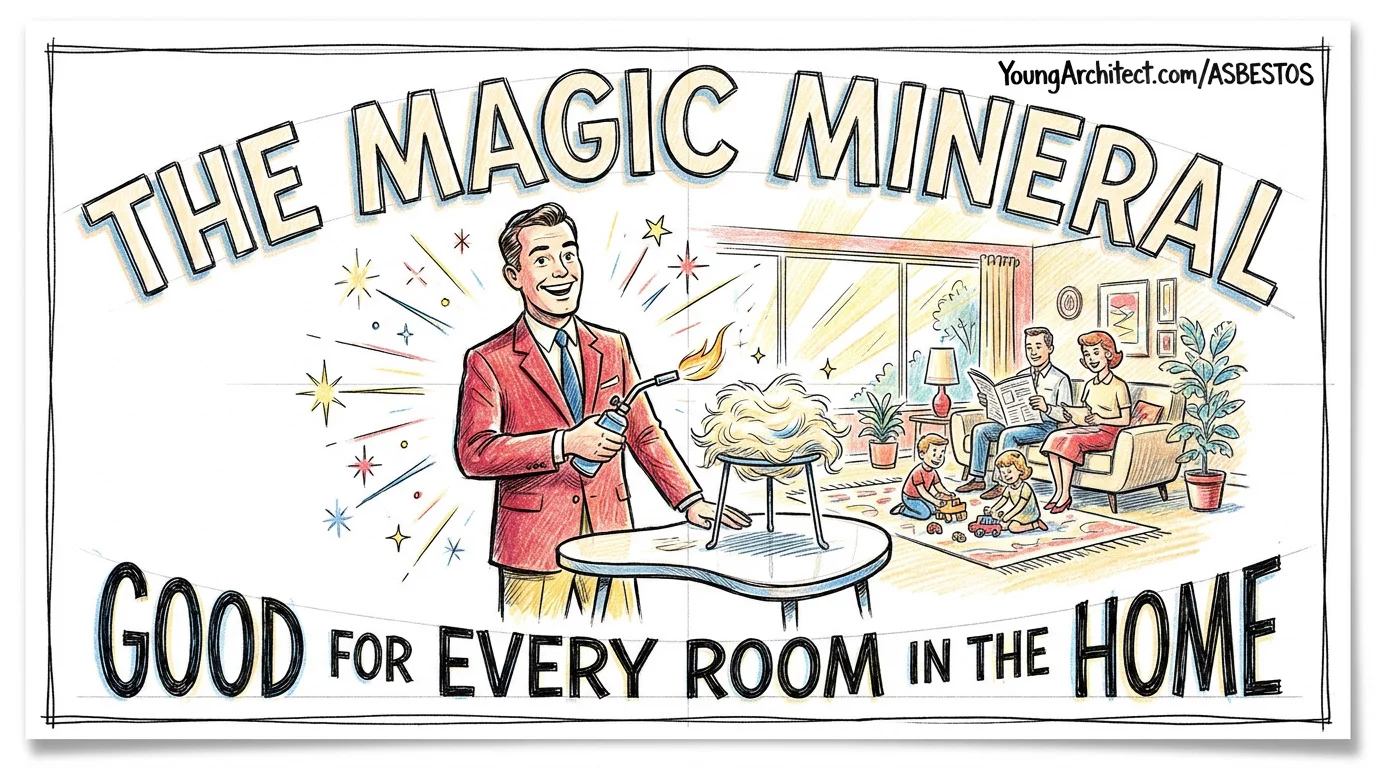
That’s not a phrase invented later to make a point. It was the actual language of the era.
There were live demonstrations. Hold a torch to a handful of fibers and nothing happens. Nothing burns, nothing chars.
You can see why people believed it.
The whole time, there was a problem.
Why Asbestos Fibers Are Dangerous
Asbestos sitting still is not hurting anybody. The danger is the fiber in the air.
Break, cut, sand, or crumble the material and it releases fibers too small to see. Long, thin, and sharp.
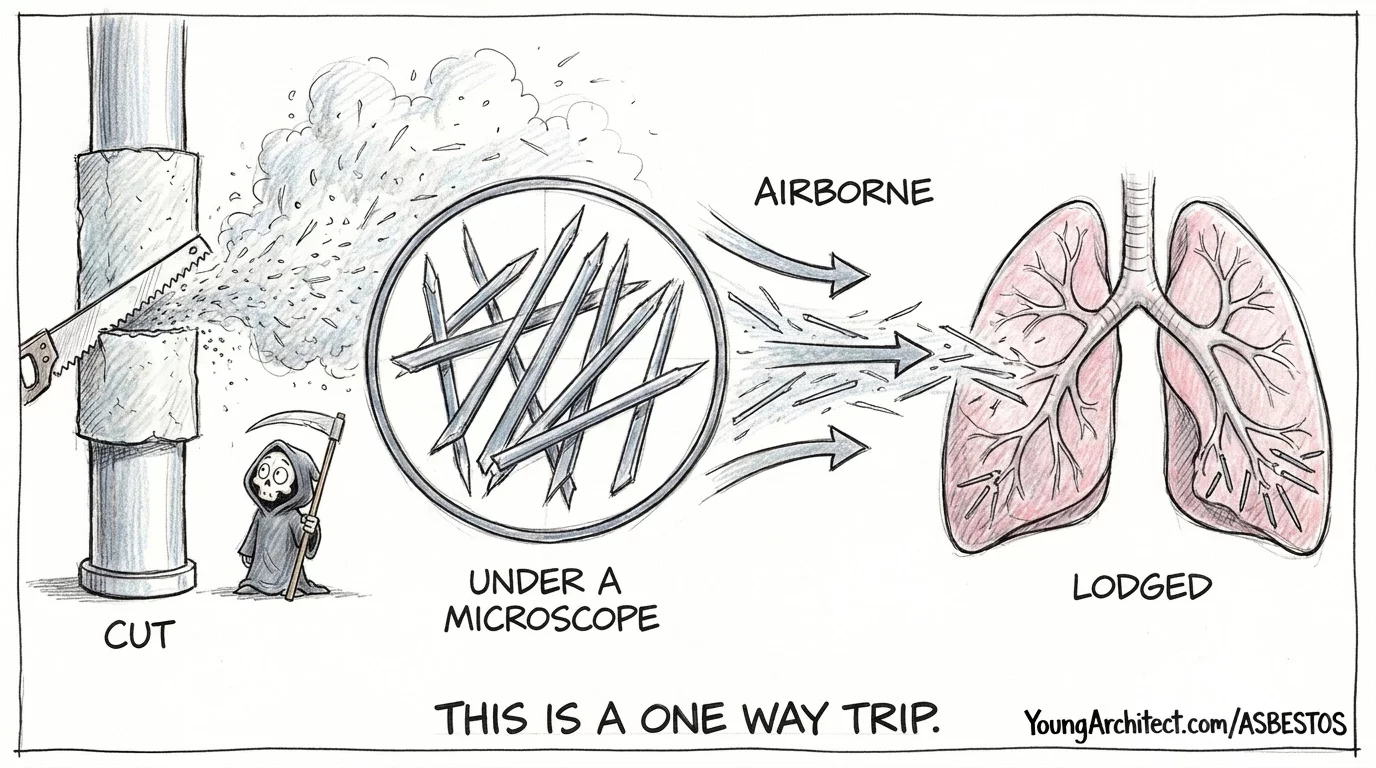
That shape is the whole problem.
Your lungs catch dust and clear it out. But these fibers are narrow enough to ride the air all the way down, and too tough to break down or push back out.
It’s a splinter your body can’t remove. Except it’s microscopic, there are millions of them, and the reaction takes thirty years.
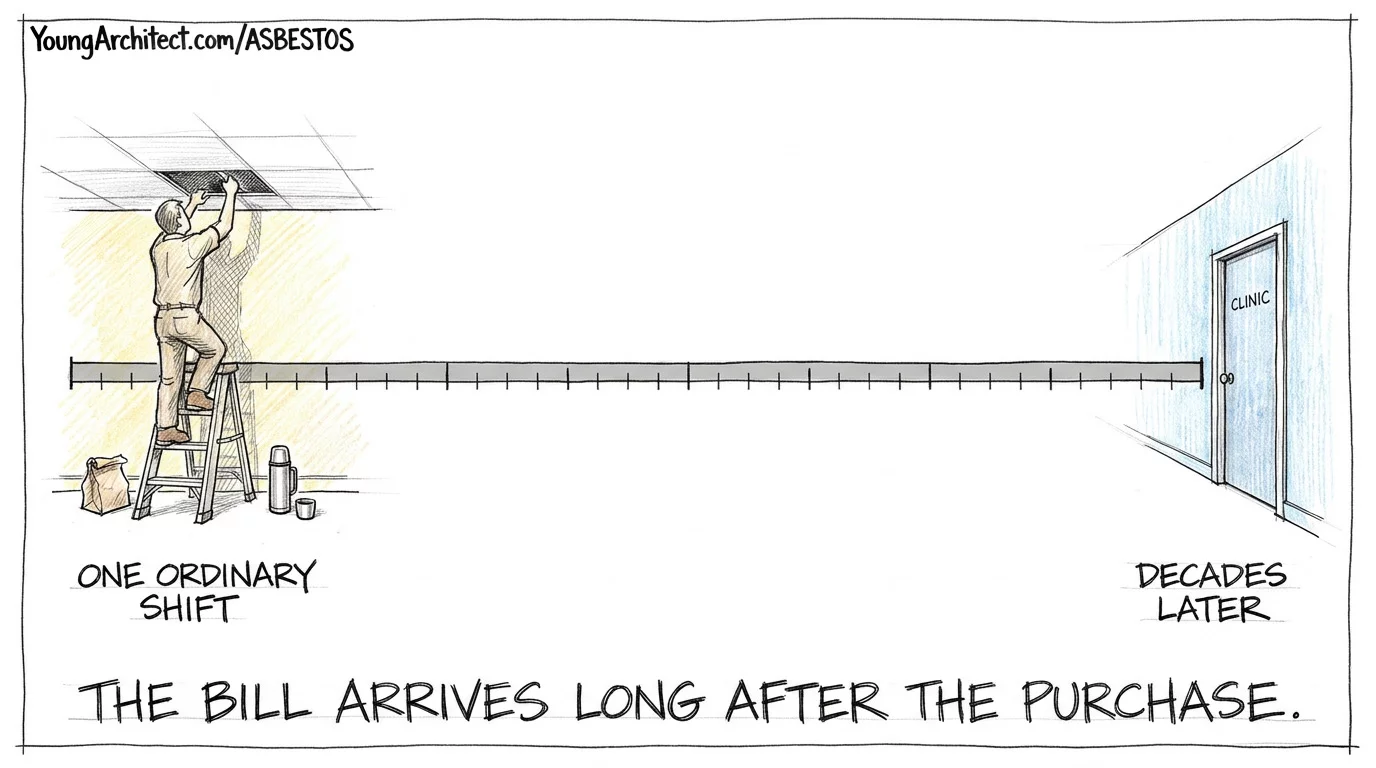
That delay is why this got ignored for so long.
Exposure today. Illness in twenty or thirty years.
Nobody coughs on the job site. No moment where your body says you just made a very bad mistake.
The diseases are asbestosis, lung cancer, and mesothelioma. The medical side of this belongs to doctors, and the workplace exposure rules belong to OSHA.
What matters here is what people knew, and when.
Doctors connected asbestos to serious lung disease early in the 1900s. The evidence kept stacking up while the material kept going into buildings.
The gap between what was known and what was said is the entire story.
To see what that gap did to people, search for the Libby, Montana documentary, a 2004 film about a town where contaminated ore was mined for decades while the people living there got sick.
Is Asbestos Banned in the US?
Most people believe asbestos was banned decades ago. Settled. Finished. Something their grandfather dealt with.
It was never fully banned.
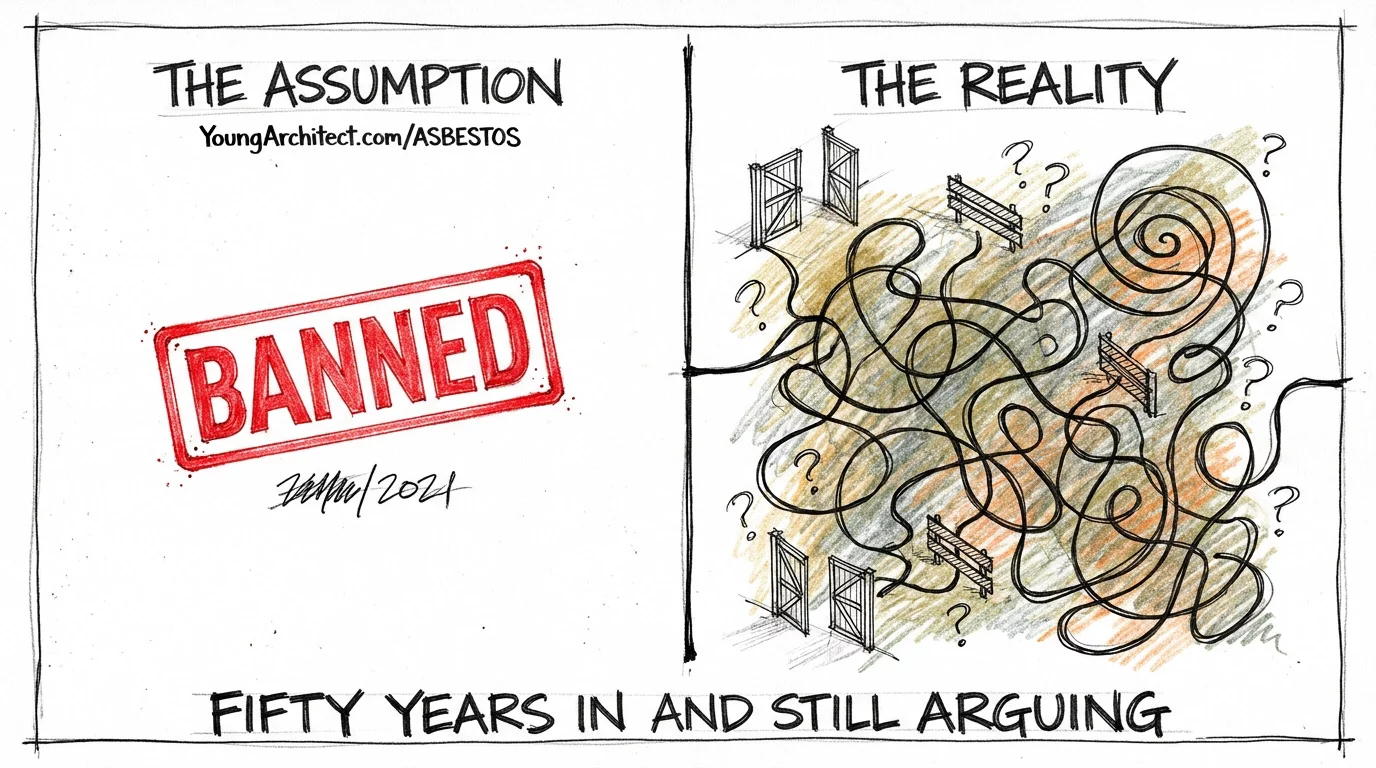
Certain uses were banned. New use is heavily restricted.
But a blanket ban has been a long, messy fight that keeps getting argued, challenged, and reconsidered, and it is still going on.
And none of that touches the material already in the buildings.
Restricting something today does nothing about the millions of tons installed back when nobody was listening.
Which is why the practical question was never whether it’s legal. It’s what happens on the morning somebody finds it.
What to Do When You Find Asbestos
Back to that Tuesday morning.
The crew pulls down a ceiling section, hits that gray chalky wrap, and it crumbles a little on the way down.
There’s dust in the work light.
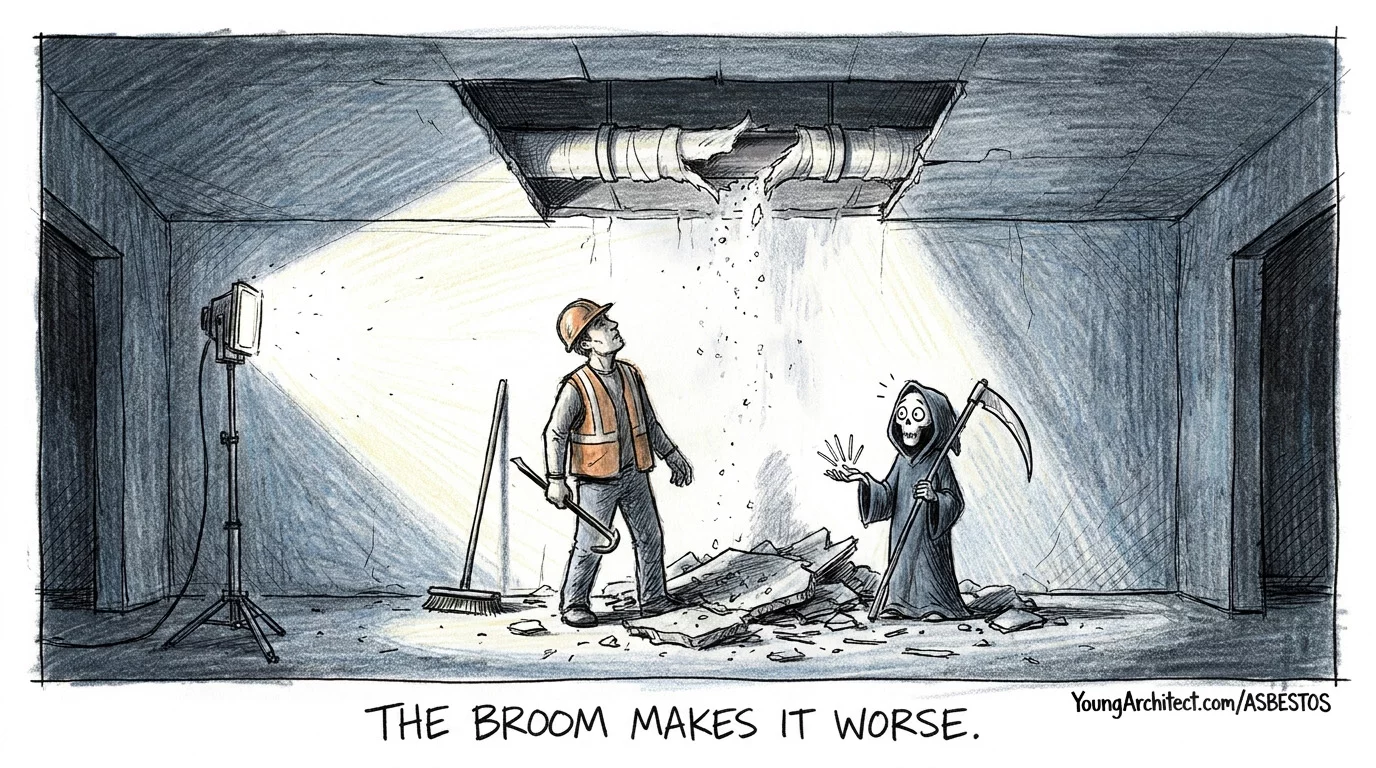
The first instinct is to clean it up. Grab a broom. Keep the job moving.
That is the worst possible thing anybody can do.
Sweeping is the most efficient method ever invented for putting fibers into the air.
Three rules. This is the next ten minutes.
- The contractor stops work in the affected area. Not the whole site. Nobody swings another hammer to find out what it is, nobody takes a sample to be helpful, and nobody touches a broom. It widens only if containment or shared air pathways put adjacent spaces at risk.
- You cannot tell by looking. Visual identification is a guess wearing a confident expression.
- The contractor secures the area and notifies the owner and the architect in writing. Both parties, named. Not a phone call. Not a conversation in the parking lot.
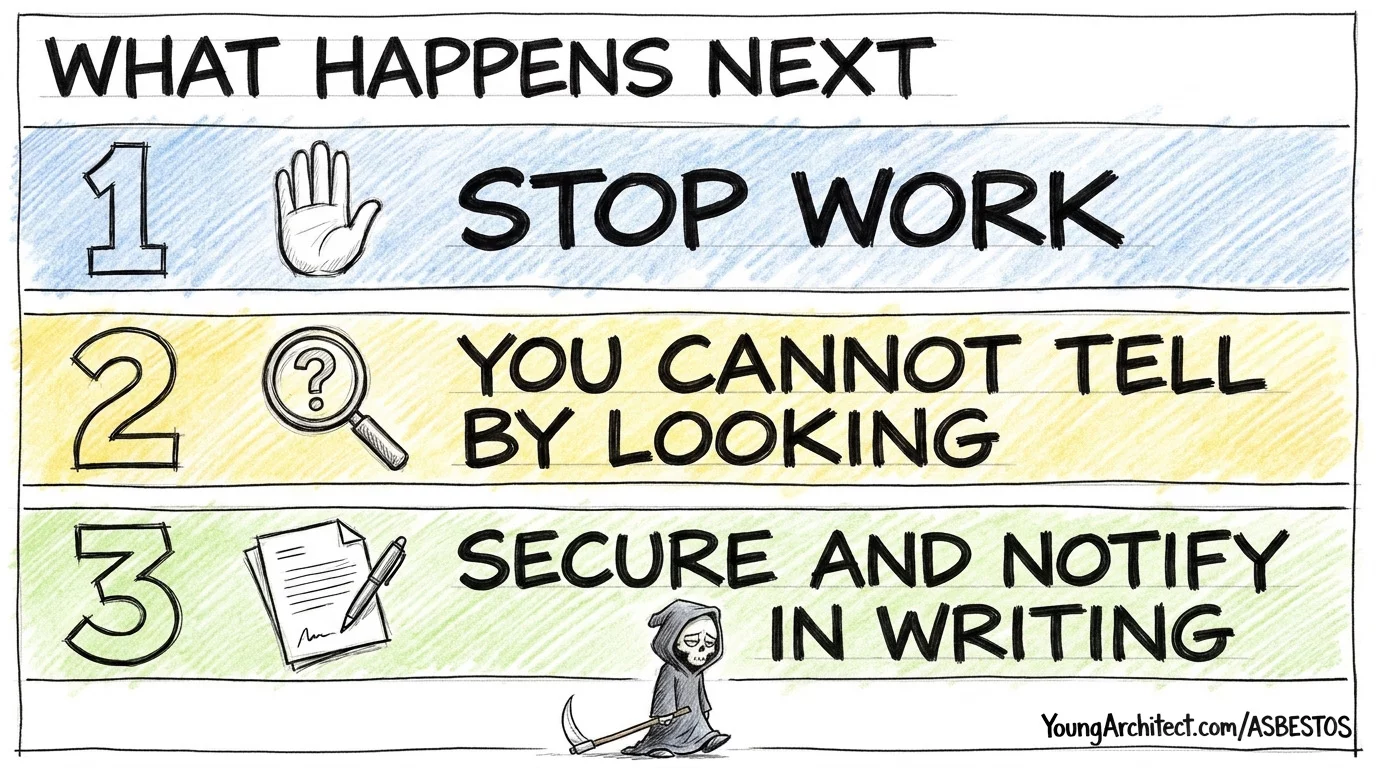
Written notice is the first habit people skip under pressure, and it’s what every later conversation about construction claims and disputes gets built on.
The Asbestos Abatement Schedule Impact
Most people in this industry can tell you abatement is expensive and holds up the job.
Far fewer can say what it actually does to a calendar, and that is the part a working architect has to be able to explain.
Step one. Find out what it is.
A licensed inspector takes samples. An accredited lab returns a percentage.
More than one percent and you have an asbestos containing material, with all the rules that brings.
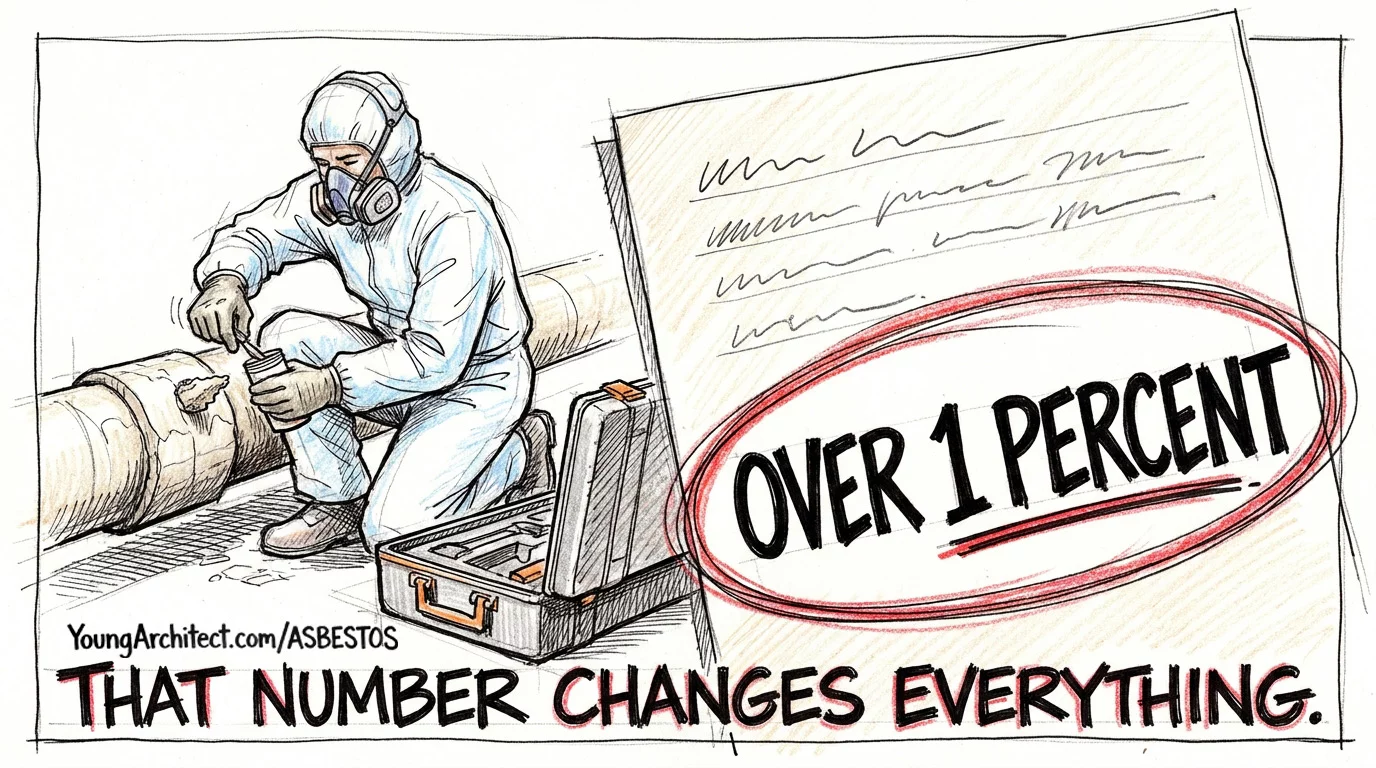
Then somebody decides what to do with it, and that decision gets its own section below.
Step two. Build the box.
This is licensed specialty work. Not the general contractor. Not the demolition crew. And definitely not the architect.
And before any of it starts, there is a mandatory notification period.
It does not run alongside the work. It runs before it.
That is a hard stop on the calendar, and no amount of pressure from anybody compresses it.
Then the containment goes up. The work area gets sealed and held at lower pressure than the rest of the building, so air flows into it through the filters and exhausts outside rather than back into occupied space.
You already know what this feels like. Think about a bathroom exhaust fan. When it’s running you can feel air getting pulled in under the door, which is why the smell stays in the bathroom and never reaches the hallway. Now scale that up to an entire sealed room.
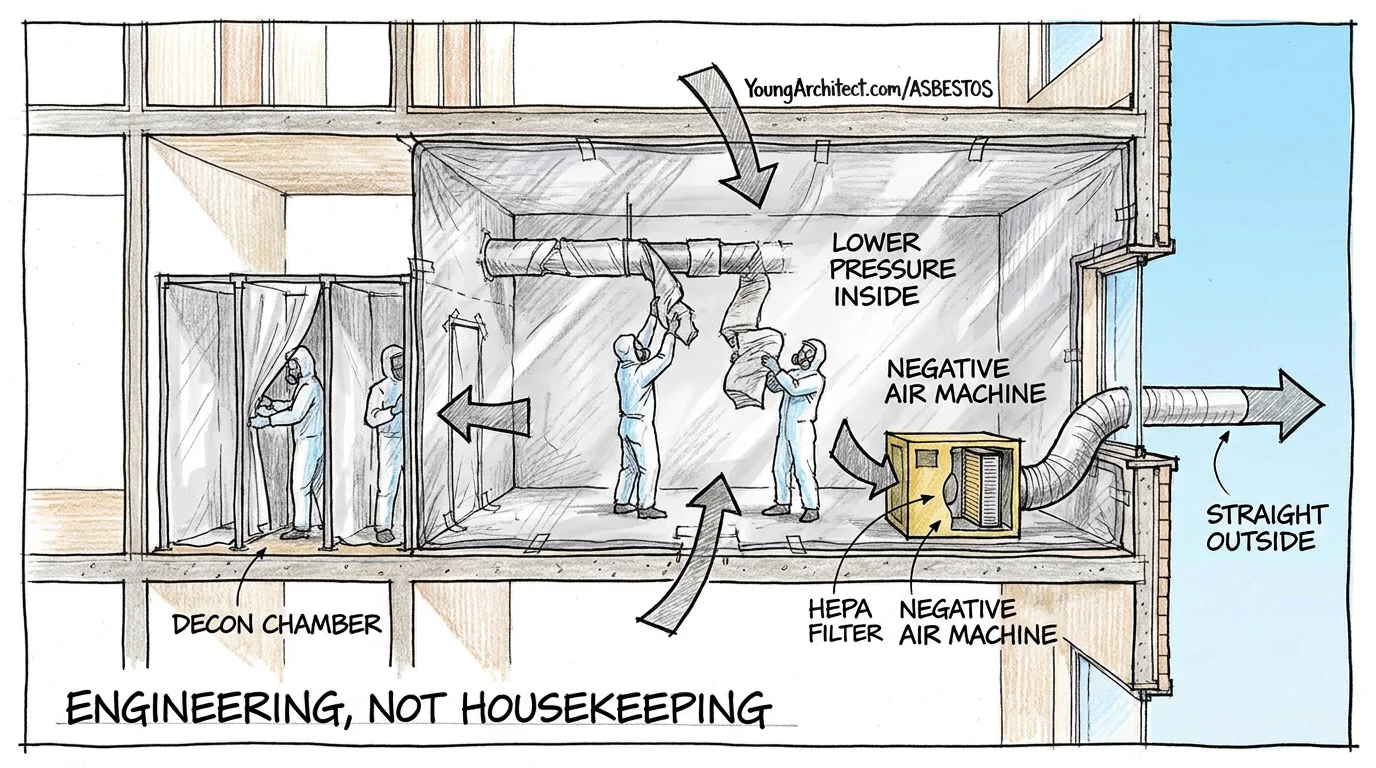
Now the part that wrecks schedules.
While that containment is up, other trades cannot work in that area. Not a preference. A requirement.
Vibration from ordinary construction nearby can compromise the containment, so the space is simply gone from the schedule until clearance passes.
The delay is not the abatement. It is everything downstream of it.
How long depends on what turned up.
- A small non friable discovery can be days
- A friable discovery with a full notification cycle is weeks
- Extensive contamination, or anything that forces a redesign, is longer
So when somebody asks why one lab result moved a completion date, that’s the answer.
It was never only the abatement. It was the waiting period in front of it and the trades that could not work around it, and keeping the rest of the job clear of all that is a real piece of construction administration.
Asbestos Encapsulation vs Removal
Back to that decision from step one.
The lab result is positive, and somebody has to decide what to do with the material. This is where most assumptions about asbestos in buildings fall apart.
You have four options, and removal is only one of them.
- Remove it. Taken out and carted off site.
- Encapsulate it. A coating that binds the fibers in place, sometimes sold as encapsulation paint.
- Enclose it. A permanent physical barrier built around the material.
- Manage it in place. An Operations and Maintenance plan, a written program for monitoring the material and protecting anybody who might disturb it later.
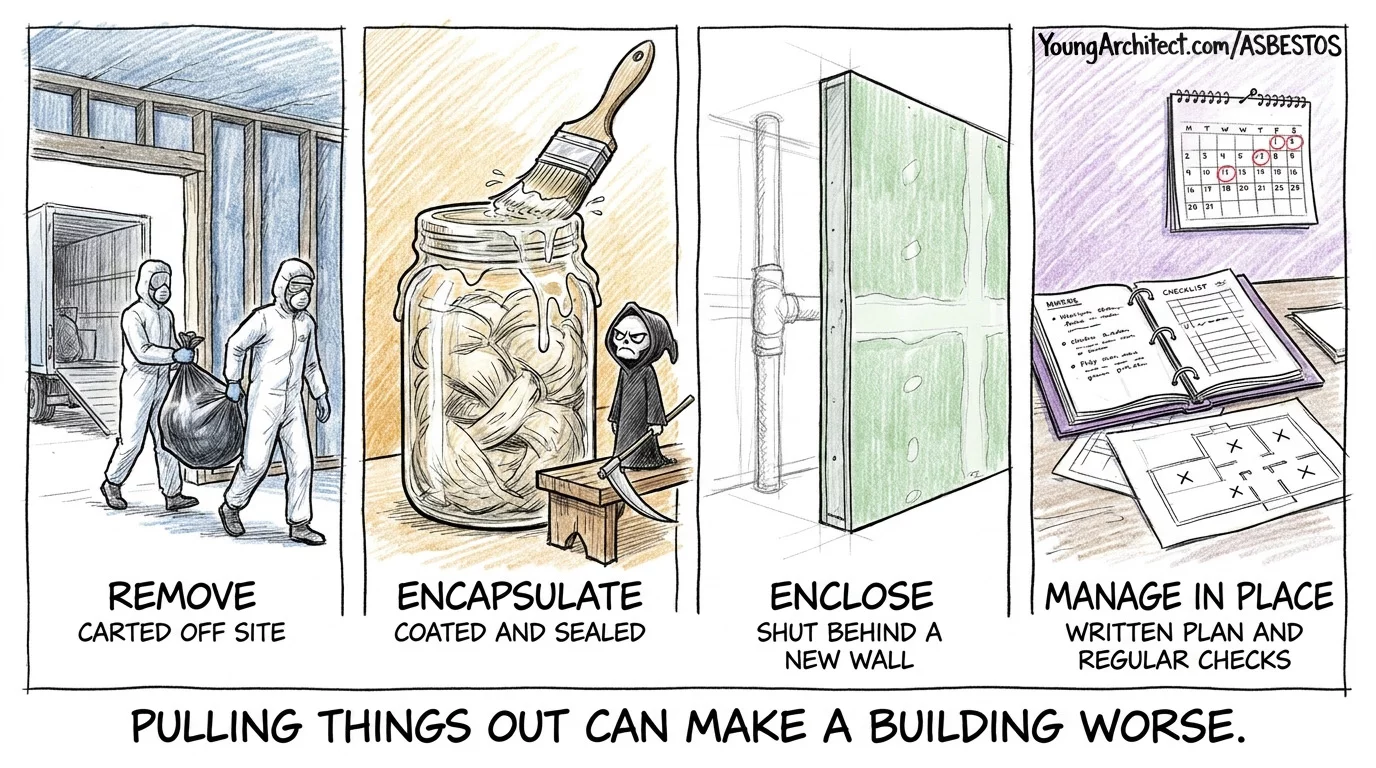
Go back to the jar. Encapsulation is putting the lid on tighter. The material is still in there. It just can’t get out.
And sometimes that’s the better answer, because of the thing nobody expects.
Disturbing it can be worse than leaving it.
Stable, non friable material in a floor nobody is cutting into may be safest exactly where it is.
Rip it out and you’ve opened the jar on purpose, created an airborne hazard that didn’t exist that morning, and spent money to make the building more dangerous.
Which is the claim from the top, holding.
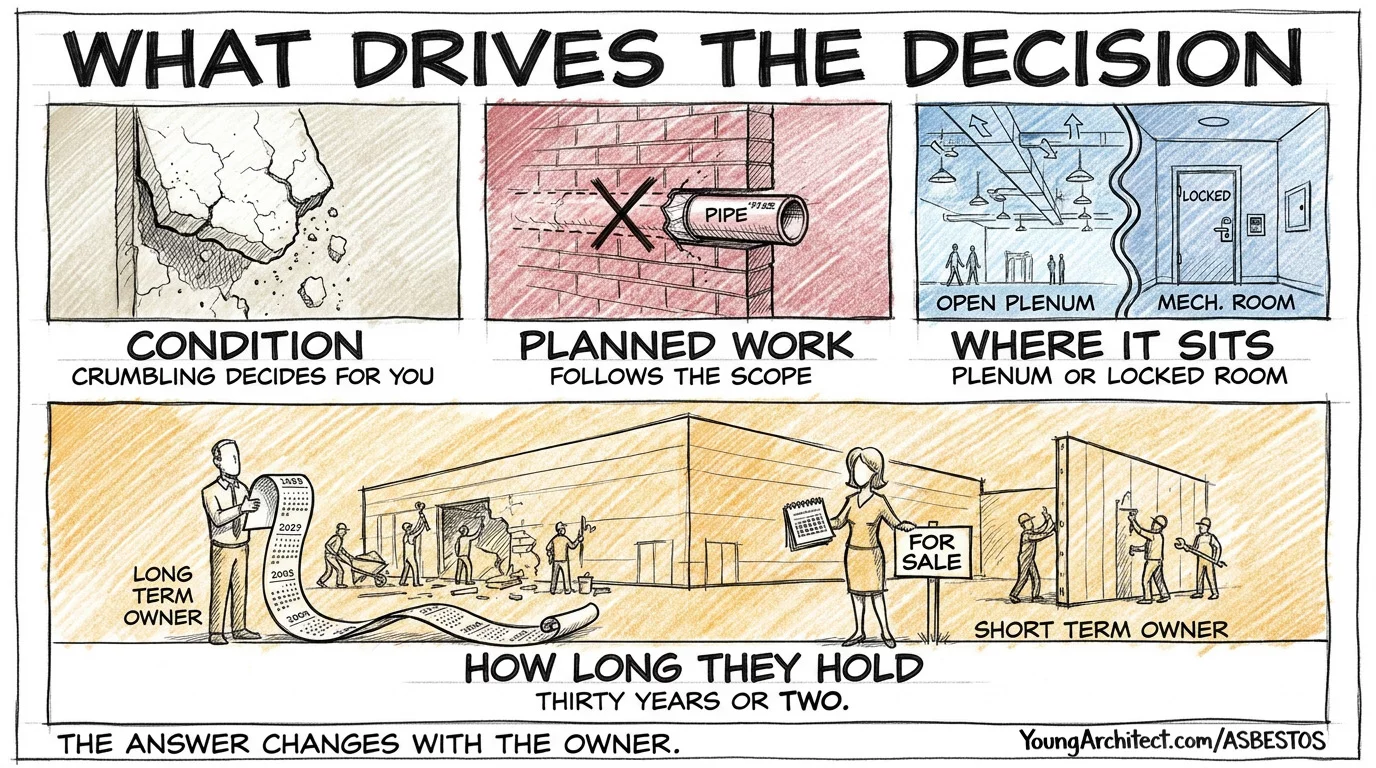
Four things drive the choice.
- Condition. Crumbling, delaminating, or chalky material cannot be left and cannot be sealed. That one makes the decision for you.
- What work is planned. Anything in the path of demolition or new systems gets abated. The decision follows the scope.
- Where it sits. Material in a return air plenum, a high traffic corridor, or next to vibrating equipment cannot be managed in place the way material above a locked mechanical room can.
- How long the owner intends to hold the building. This is the one nobody expects.
That last one settles more of these than any technical factor does.
An owner holding for thirty years often removes, because the recurring management cost never ends. Every renovation, every tenant fit out, every time somebody runs a cable, you are back in it.
An owner repositioning for sale in two years often encloses or manages in place.
Same material. Same condition. Different answer. Because the question was never only technical.
One more thing about the two middle options.
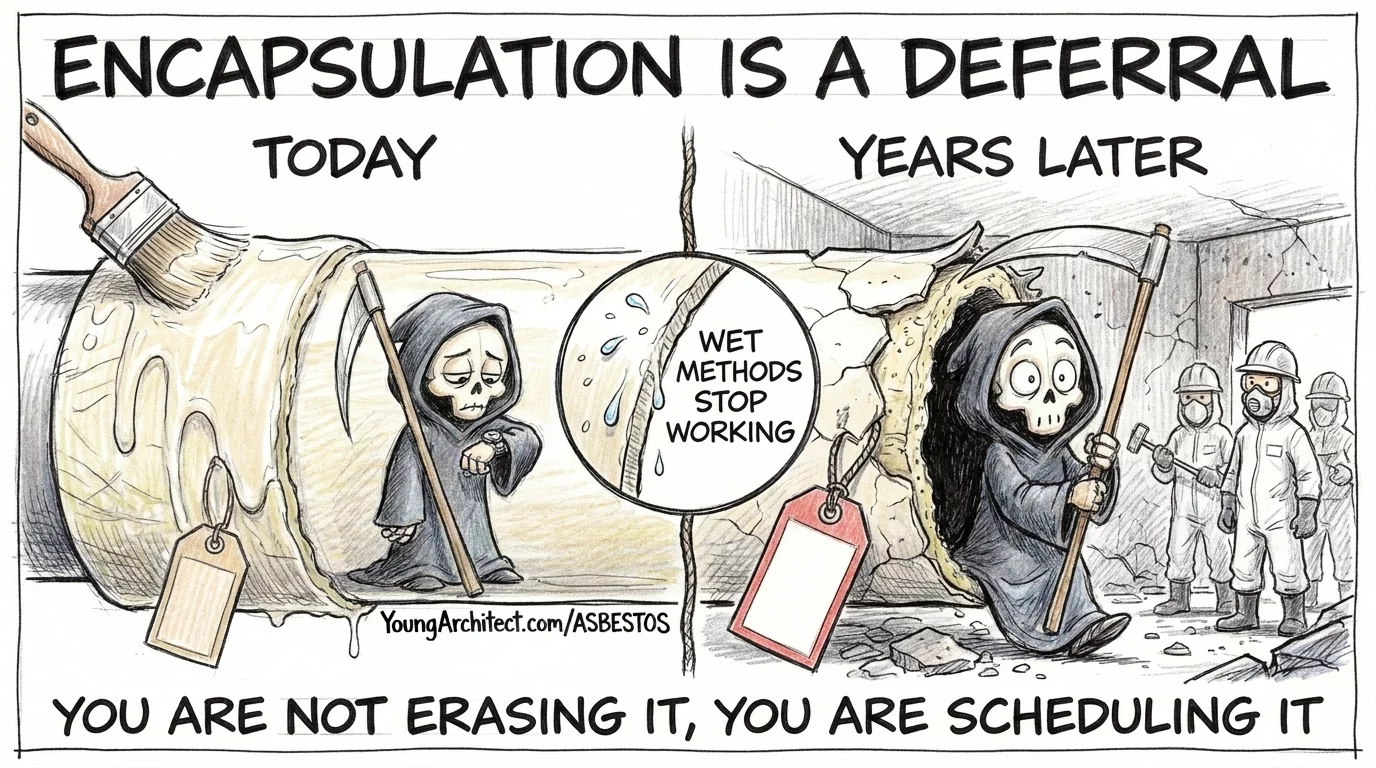
Encapsulation and enclosure are deferrals, not eliminations. The material is still there. When the building eventually gets renovated or demolished, it still has to come out.
And there is a sting.
A penetrating encapsulant hardens the material, so later the standard wet methods that keep fibers down do not soak in anymore. That removal is harder, slower, and more expensive than the original would have been.
So encapsulation can be exactly right. It can also be borrowing against a bill that comes back larger. The difference is whether you are deferring for a reason or deferring to avoid a number.
And there are four places it is simply wrong.
- If the material is pulling away from what it is stuck to, a coating adds weight and that weight brings the whole sheet down. Trying to seal it causes the release it was supposed to prevent.
- If it is already soft or chalky, there is nothing to bond to. A coating over a powder is a skin over nothing.
- If there is water, the coating traps it and it fails.
- And the one that actually happens on buildings: somebody punches through that coating years later to run a cable or hang a fixture. The material that was sealed is now open, in a spot nobody is watching.
Whichever way it goes, the decision gets written down and follows the building through project closeout.
And if that material is staying, it changes what you are about to draw.
Designing Around Asbestos That Stays
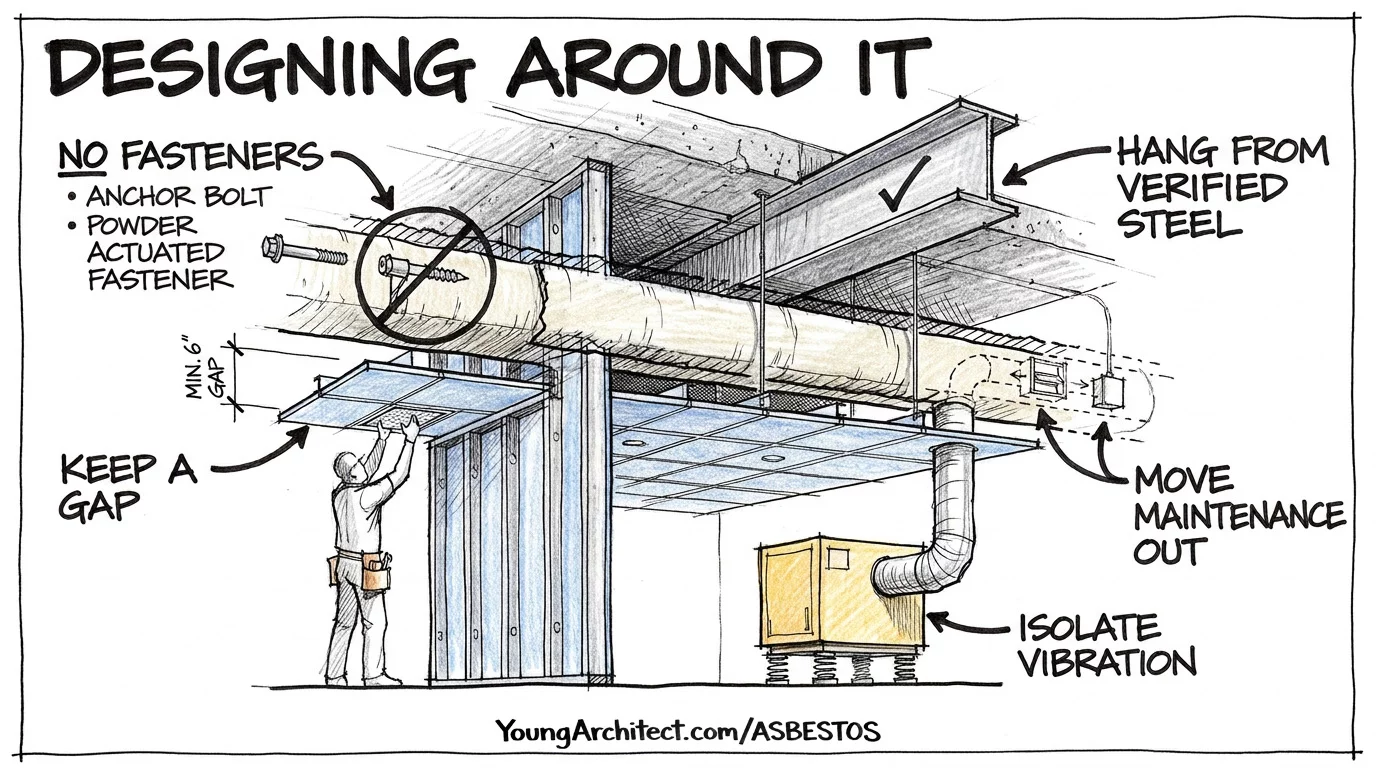
If the material stays, that is not the end of your involvement. It becomes a set of constraints that has to show up in the drawings.
A caveat worth keeping in front of all of it. These are the high level moves, not a complete set and not a detailing standard.
This page is not anybody’s hazardous materials consultant, and a blog post is no substitute for one. Their project, their consultant, their call.
Five constraints, and they all end up on a sheet.
- Nothing fastens into it. No anchors, no powder actuated fasteners, no drilling into a substrate carrying asbestos containing material.
- New enclosures hang from clean structure. Verified clean, not assumed clean.
- Keep a gap. A ceiling or chase built near the material needs enough clearance that somebody changing a filter or a lamp is not brushing against it.
- Move the maintenance items out. A valve, a damper, or a junction box inside that boundary gets relocated. Do not detail a nice access door. An access door is an invitation.
- Isolate vibration. New equipment near aging material gets spring isolators and flexible connections, because structure borne vibration works material loose over years.
None of those are exotic. They are ordinary coordination moves that only look obvious once somebody tells you the material is staying.
Then there is the note on the drawing.
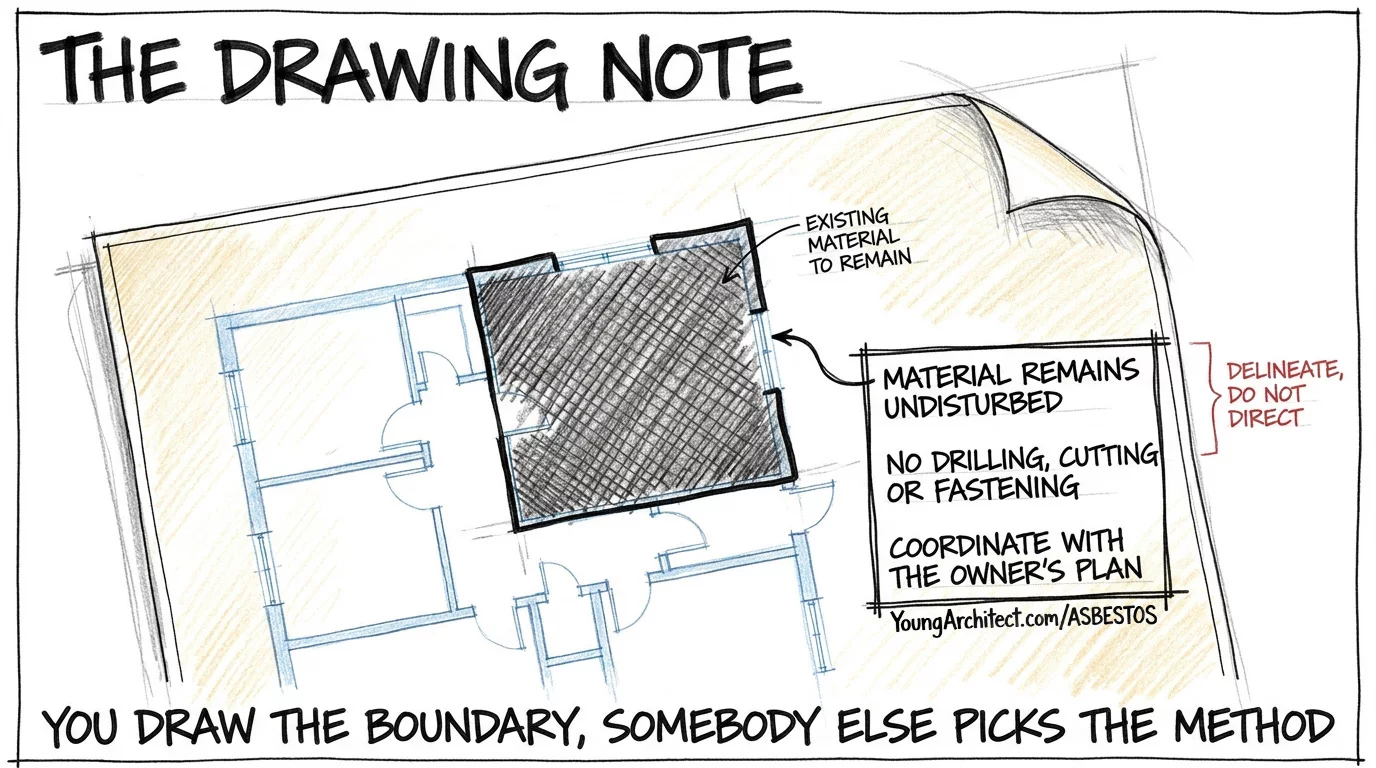
A clear boundary. A note saying the material remains undisturbed. No drilling, no cutting, no fastening within it. Coordinate with the owner’s management plan.
That note is the posture of this entire page in one place on a sheet.
You delineate the hazard. You do not direct the work.
It tells everybody downstream exactly where the boundary is without specifying one thing about how the material gets handled.
Asbestos Floor Tile, Cover or Remove
Renovation work lives in the finishes, and the finishes are where this material turns up most. Floor tile. The mastic under it. Ceiling tile. Joint compound. Cove base adhesive.
Which sets up a trap that catches good projects.
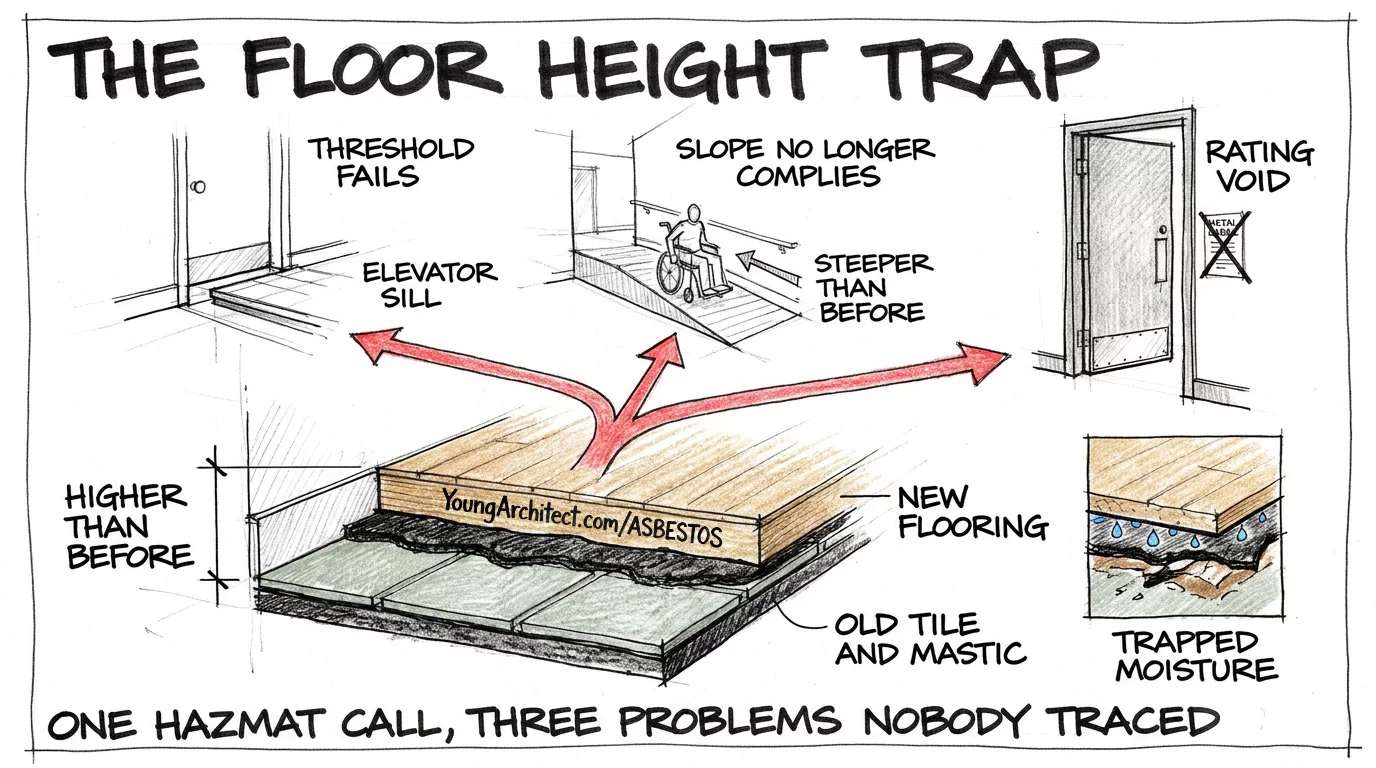
Somebody decides to leave the old tile and mastic in place and put new flooring over the top. Reasonable on its face. Cheaper, faster, no abatement.
Then the floor comes up. Not much, but enough.
- Thresholds change. Transitions at doors and elevators stop working.
- Accessibility slopes that were compliant are not anymore.
- And when somebody trims the bottom of the doors to fix it, the fire rating label on every rated door they cut is void.
One decision about a hazardous material, and now there is an accessibility problem and a life safety problem, neither of which anybody was thinking about when the floor went in.
The hazmat call was defensible. The downstream consequences are what nobody traced.
There is a second failure in the same decision.
Trapping moisture under new non breathable flooring can break down the old adhesive underneath, which is its own failure on its own timeline.
Which is the pattern worth carrying out of this section.
The material stops being a hazmat question and becomes a design question.
And every one of those calls has a cost attached to it. Which puts a plainer question on the table: who carries it?
Who Pays for Asbestos Abatement
The answer lives in the contracts, and it’s clearer than you’d expect.
The A201 general conditions set the rules of engagement between owner and contractor, and they handle hazardous material in a specific sequence.
The contractor is responsible for safety on the site. That’s their lane and it’s a big one.
But hazardous material already in the building before they showed up is not their problem to solve.
They stop work in that area and give written notice.

From there it’s the owner’s responsibility to get it tested and, if necessary, remediated by qualified people.
Four details matter, and they’re the ones that usually get paraphrased into mush.
- Work resumes on written agreement of the owner and the contractor. Those two parties. The architect is not a party to that agreement.
- The adjustment happens by Change Order, and the contract names what gets paid: the contractor’s reasonable additional costs of shutdown, delay, and start-up. A specific list, which is why the change order is the mechanism rather than a handshake.
- The owner must furnish, in writing, the names and qualifications of whoever will test or remove the material. The contractor and the architect each hold a right of reasonable objection. If either objects, the owner proposes somebody else.
- Indemnification runs from the owner to the contractor and the architect, with one carve-out: it does not cover damage caused by the fault or negligence of the party seeking indemnity. Your professional liability insurance exists for the gap that carve-out leaves.
The owner architect agreement points the same direction.
The architect has no responsibility for the discovery, presence, handling, removal, or disposal of hazardous materials. And the owner furnishes surveys and reports on existing conditions.
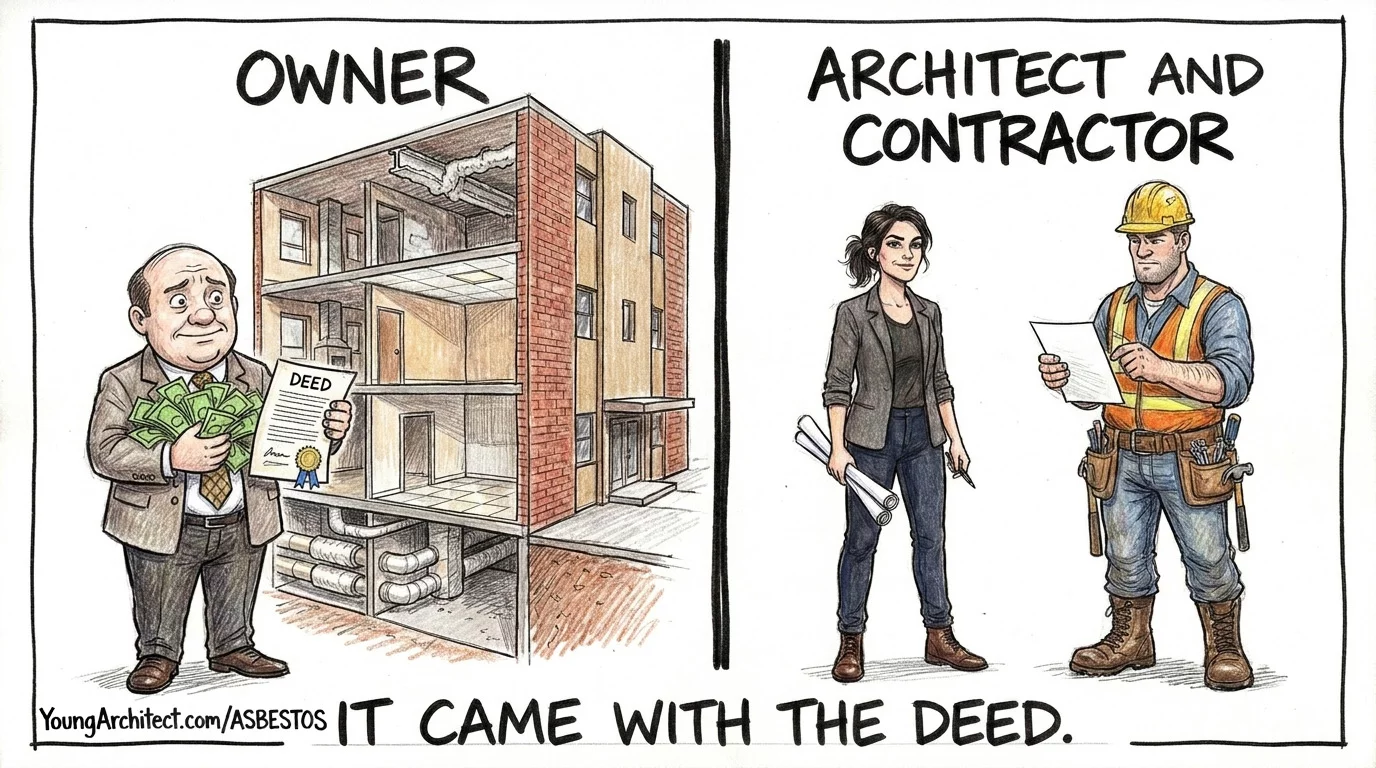
Hazardous materials belong to the owner. The owner owns the building and everything inside it, including this.
So the owner hires the consultant and the owner pays for the abatement. Not the architect. Not the contractor.
The whole structure is built so asbestos in buildings isn’t a risk the architect is holding.
And the same logic covers lead paint, mold, PCBs, and silica.
Learn the pattern once and it works for all of them.
Why the Asbestos Survey Comes Before the Design
Your position is the same before construction as during it.
Hazardous materials are not your scope, not your expertise, and not your lane.
That does not mean you say nothing.
It means what you say is a recommendation, and it goes in writing.
On any existing building project, recommend the owner retain an independent licensed or certified hazardous materials professional to survey, inspect, and test during due diligence.
Before the design is finished, and long before a crew opens a wall.
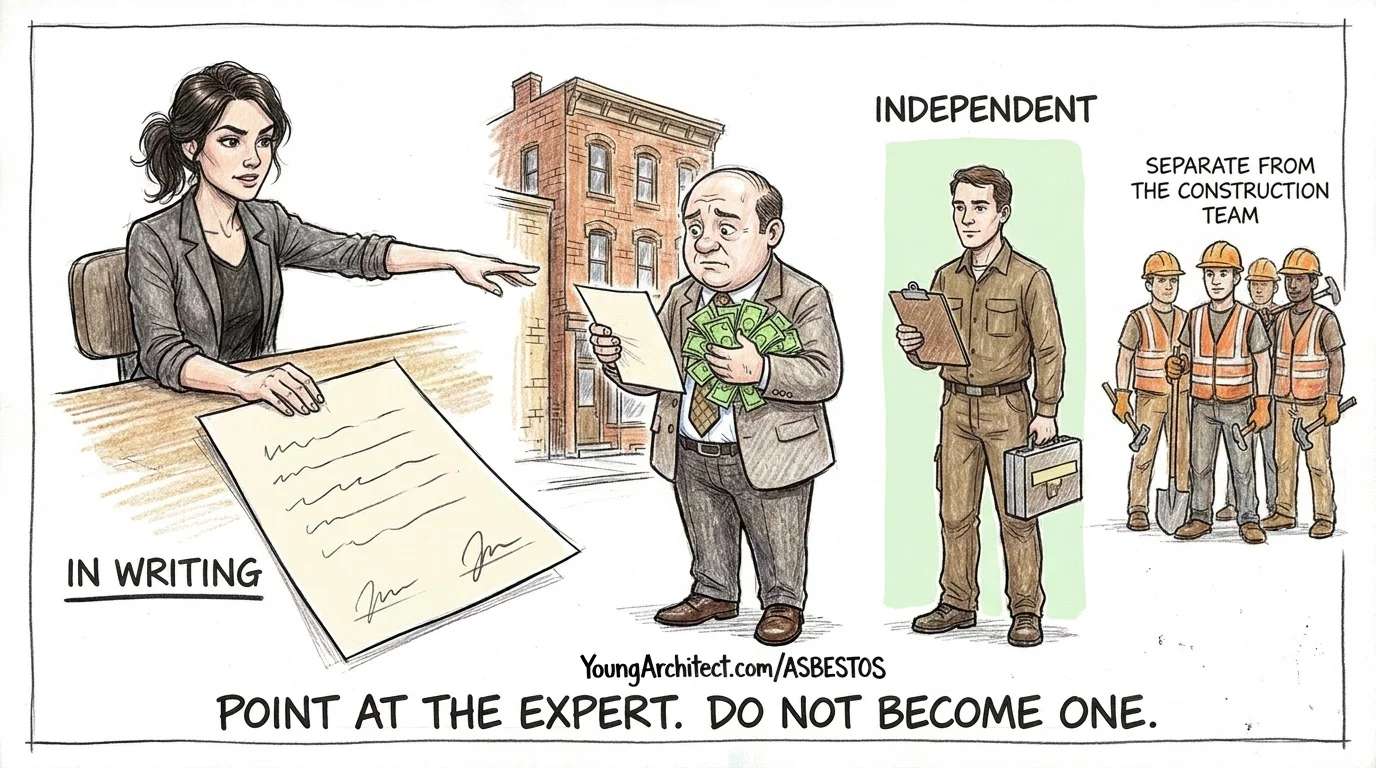
Independent matters. Not the general contractor. Not the demolition crew.
Not somebody who stands to get the abatement work if the test comes back positive.
That instinct shows up twice in one project. During design it’s your recommendation. During construction it’s the right of reasonable objection. Same judgment, two moments.
You’re recommending a qualified professional.
Not telling the owner how to handle the material. Not specifying the abatement. Not supervising it.
That’s most of what standard of care means here.
One thing owners say constantly: the environmental assessment from the purchase already cleared the building.
It did not. That assessment looks at the site.
Hazardous building materials inside the structure are a separately contracted scope.
Three things decide whether that survey is worth anything.
First. Get it early, and get it destructive.
A survey done while the building is still occupied can only look at what is visible. The inspector cannot open a chase or get above a hard ceiling.
So the survey comes back clean and demolition finds material anyway. It has to include authorization to open things up, and it has to happen in early design, not at bidding.
Second. Keep the drawings and the survey matched.
Design scope changes late. It always does. If the survey covered five walls and a revision adds three more, those three stop the job.
Every time the demolition scope changes, the survey scope has to follow it.
Third, and this is the sharp one. Never specify removal of a suspect finish.
A note saying the contractor shall grind the slab clean of residual adhesive sounds like ordinary finish work.
If that adhesive contains asbestos, you have just directed abatement without containment.
That is stepping into the exact lane this whole page says to stay out of, in a routine finish note somebody added without thinking about it.
Now the cost conversation. Walk the owner forward through their own project:
- You design it
- Permitting and construction documents
- The contractor gets hired and mobilized
- Demolition starts
That’s when somebody finds it. With a crew standing on site, on the worst possible schedule at the worst possible price, against whatever construction contingency is left.
The second reason is easy to miss.
A survey done early can change the design. Know where the material is before the drawings are finished and you can route around it, leave it out of scope, and note it on the documents.
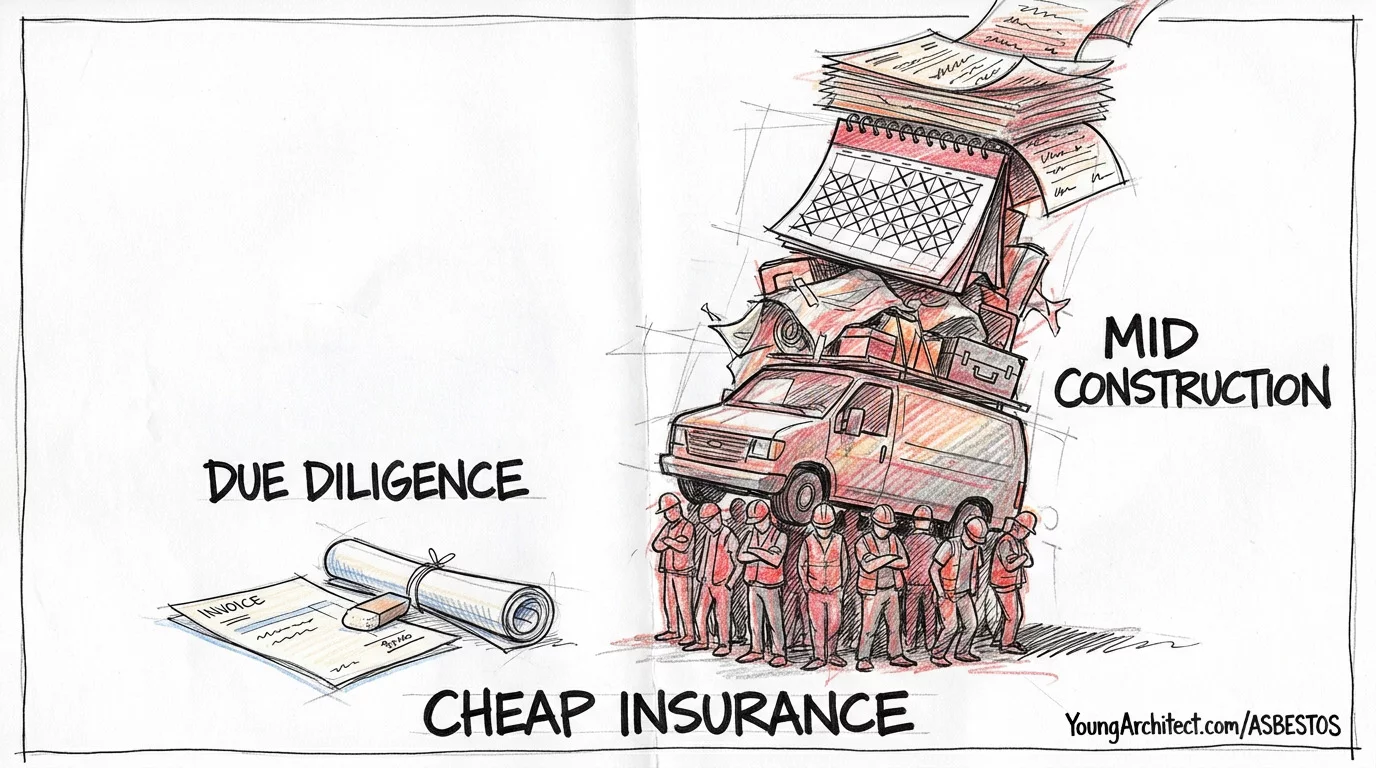
Nobody skips a home inspection to save a few hundred dollars, because the thing they’re buying is too expensive to guess about.
An existing building is the same bet with another zero on it.
A survey is a small number. Forty people standing around getting paid, an abatement contractor to find and hire, and a change order fight nobody wanted is a very large one.
Cheap insurance.
Hazardous Materials and Your Exam
You might reasonably ask why an exam prep page spent this long on asbestos in buildings.
Because hazardous materials appears in the published objectives and content areas for essentially every credential in this industry. Not one of them. All of them.
It appears under a different published objective on each one, tied to a different phase of practice. Same substance, different place in the work.
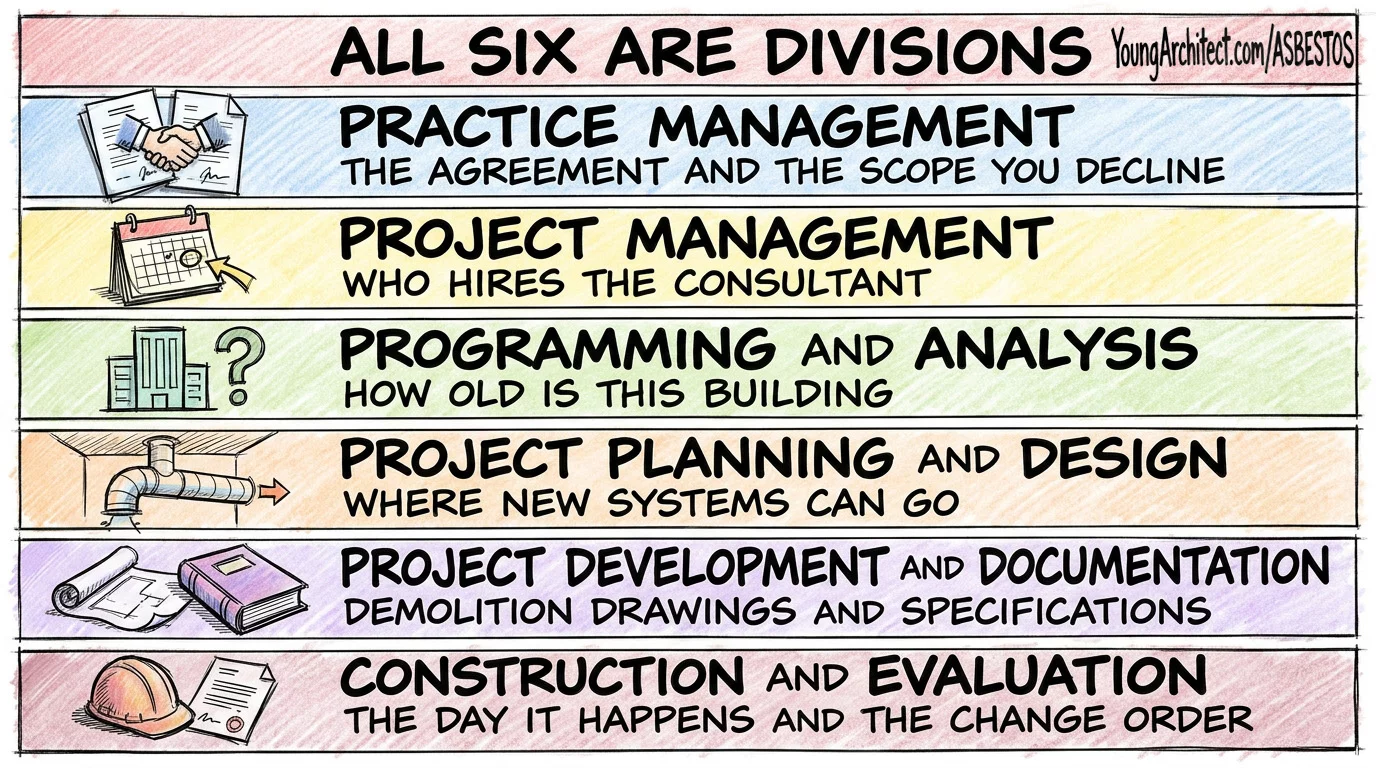
Start with the six architect exams.
Practice Management is where it’s written into the owner architect agreement and the firm level decision not to take that scope at all.
Project Management is planning for it before it happens and figuring out who hires the consultant.
Programming and Analysis is the preliminary question of when this building went up and whether to investigate before anybody designs anything.
Project Planning and Design is the interesting one. Existing material dictates where your new systems can go.
You cannot route new ductwork through a plenum full of spray applied fireproofing without triggering an abatement, which means the material you aren’t even touching still shapes the design.
Project Development and Documentation is where it lands in the demolition drawings and the specifications.
Construction and Evaluation is the day it happens and the change order that follows.
And this isn’t only an architect exam topic.
For interior designers, the NCIDQ covers it on all three exams:
- On the IDFX, it’s named under evaluating existing building conditions
- On the IDIX, it’s named again under developing demolition plans
- On the IDPX, it lives in due diligence and change management
It runs through the CSI certifications too.
The CDT® covers project delivery and the documents where all of this lands. The CCS® is where you write the specification for it. The CCCA® is the stop work order and the change order. The CCPR® covers product representation and substitutions, which is the lane you’re in when a material specified for an existing building has to be swapped for something else.
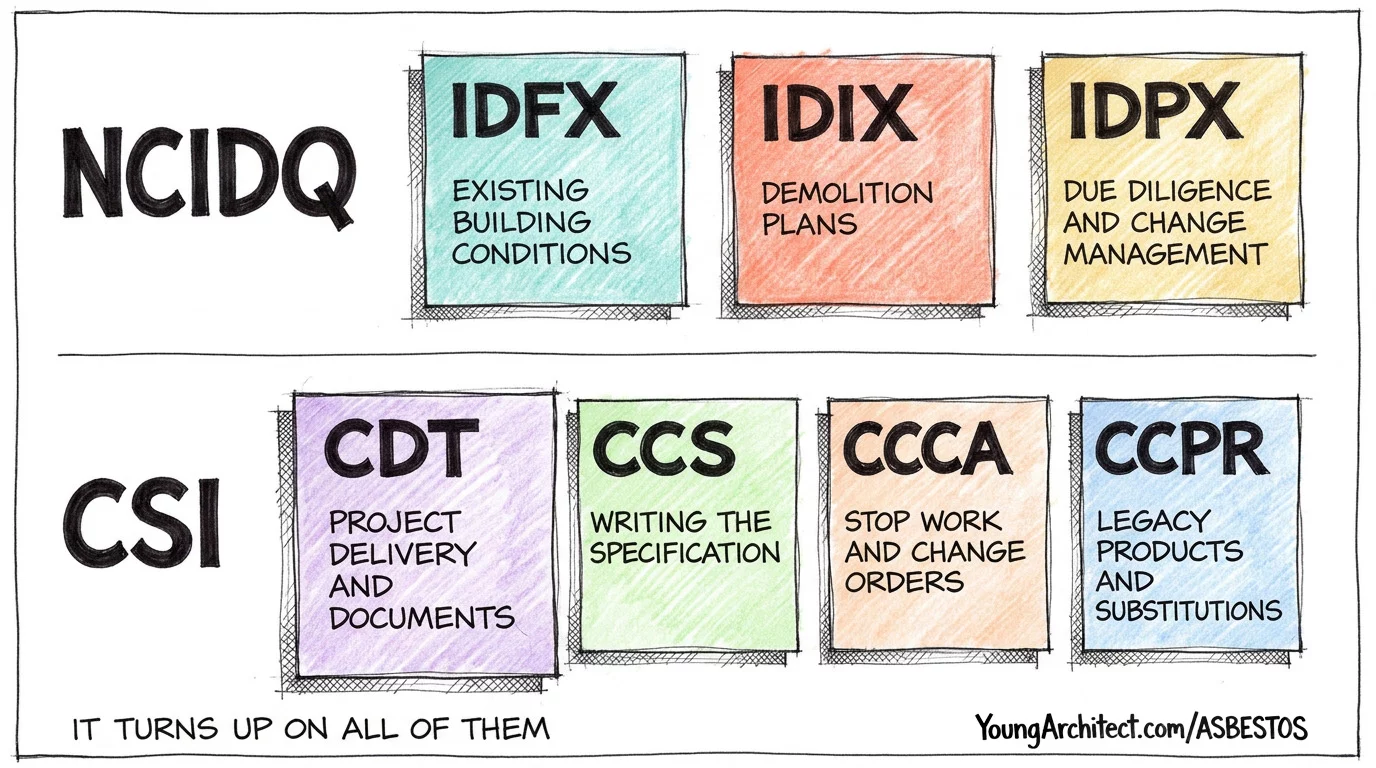
Every credential. Every phase. Different wrapper, same material.
For the clearest view of how those phases connect to each other, that’s the ground PA, PPD, and PDD share, and it’s worth having straight before you sit for any of them.
What to Remember About Asbestos in Buildings
Five things.
- It’s a rock we mined, not a chemical anybody invented, and it grows in fibers. That structure is why it was useful and why it’s deadly.
- The danger is airborne fibers, which means the danger is disturbance, not presence.
- Friable versus non friable explains everything. Flour in the bag or flour in the bread. And the jar never opens itself.
- When it turns up, removal is one of four options. It is not automatically the right one.
- Put it in writing. Stop work the moment somebody finds it, and recommend the survey before you design.
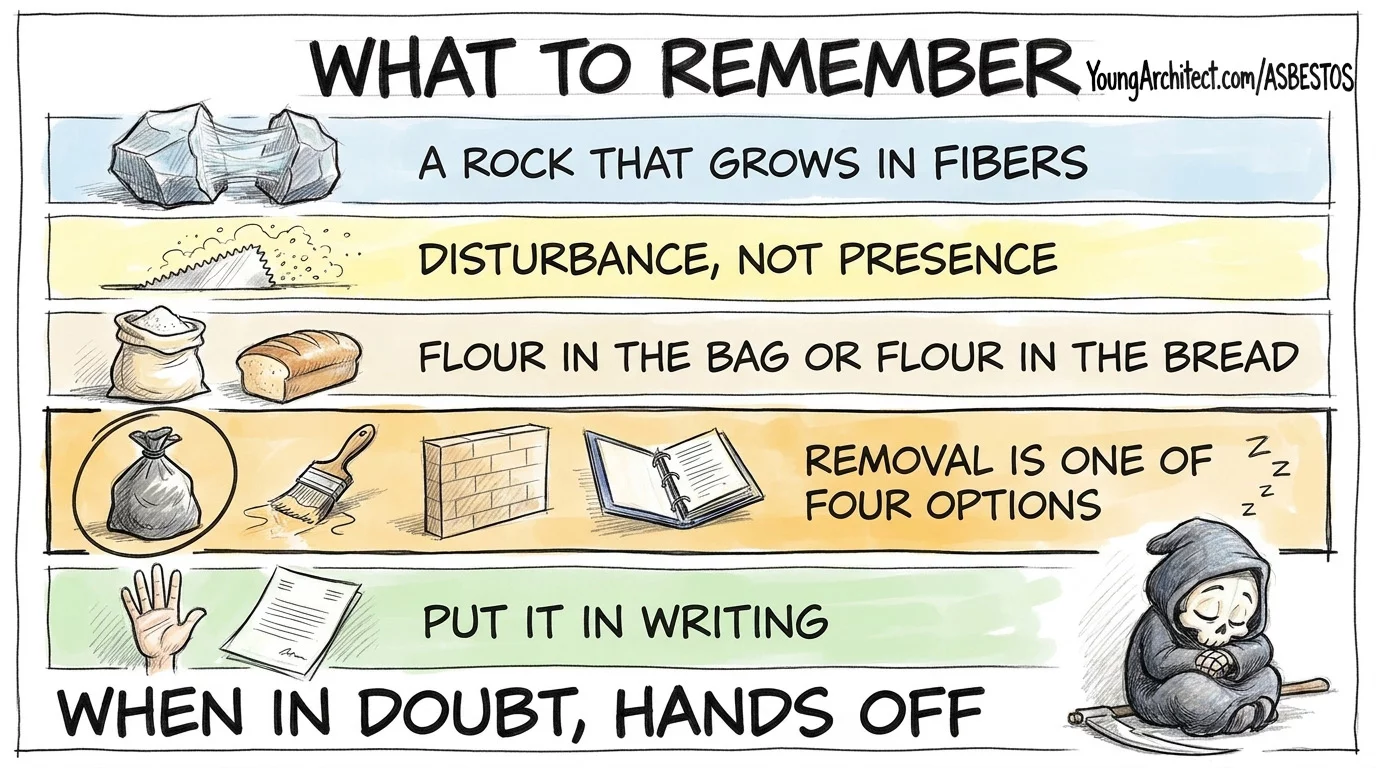
And that claim from the top, which should sound obvious now instead of wrong.
Most of the time, the right move is to leave it alone.
Frequently Asked Questions
Is asbestos man made?
No. Asbestos is a naturally occurring mineral that comes out of the ground as rock. Nobody invented or synthesized it. What’s unusual is that these particular minerals crystallize into long thin fibers instead of solid chunks, which is what made them useful in manufacturing.
When did they stop using asbestos in homes?
Use in building products dropped off sharply in the early 1980s, which is why anything built or renovated before then gets treated as suspect. That’s a manufacturing timeline, not a legal one. Old stock kept getting installed for a while after it stopped being made, so a date on a building permit is a starting point rather than an answer.
Do all popcorn ceilings have asbestos?
No. Plenty have none at all. But the texture was a common place to put it, and there is no way to tell from the ground. A lab result on a sample taken by somebody licensed to take it is the only way to know.
Is asbestos still used in the United States?
It was never fully banned. Certain uses were banned and new use is heavily restricted, but a blanket ban has been argued, challenged, and reconsidered for decades and that fight is still going. None of it changes the material already installed, which is the part that affects your projects.
When is asbestos dangerous?
When it’s disturbed. Exposure happens when asbestos containing material is damaged or disturbed in a way that releases fibers into the air: cutting, sanding, grinding, breaking, or demolition. Material that’s intact and undisturbed is not releasing fibers. That’s the entire reason the default answer is to leave it alone.
Can you tell if something is asbestos just by looking at it?
No, and this is the most useful sentence on the page. There are tells worth knowing, like nine by nine floor tile. But a tell tells you to test it, not that you know. The only way to confirm asbestos is a lab analyzing a sample taken by somebody licensed to take it.
Is it safe to be in a building that has asbestos in it?
Generally, yes, which surprises people. Asbestos in buildings doesn’t leak, spread, or do anything on its own. Intact, undisturbed, non friable material sitting in a floor or a wall is not putting fibers into the air. The risk arrives with renovation and demolition, which is why the rules are built around what you’re about to do to the material rather than its presence.
Where to Study Hazardous Materials Next
Hazardous materials comes up across almost all of our courses, and it comes up hardest in the contracts material.
That’s where the liability conversation actually lives.
If you’re studying for the architect exams, the ARE Boot Camp is the guided path, and the ARE 101 Membership includes all six division courses together.
And if the contracts section was the part that landed, AIA Contracts 101 is where asbestos in buildings stops being a story and starts being something you can answer cold.