
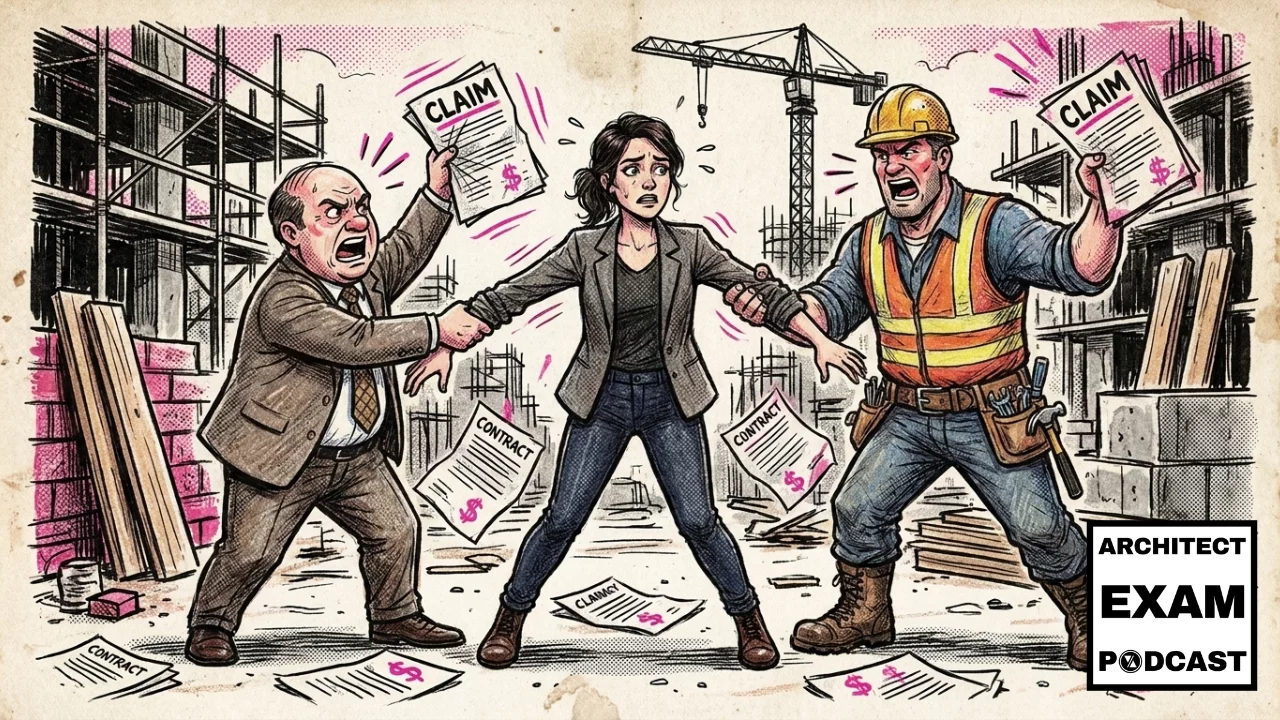
Construction disputes and construction claims are an unavoidable part of working in the AEC industry. Whether you’re managing an active project or preparing for the ARE exam, knowing how to prevent, navigate, and resolve these situations is one of the most valuable skills you can develop.
This podcast is also available on YouTube, Spotify, and Apple Podcasts
It starts like any other job.
You’re six months into what started as a straightforward office building project. The owner just discovered the structural drawings don’t match the architectural plans. The contractor is demanding additional payment for “unforeseen conditions.” And your phone won’t stop ringing because everyone wants answers you don’t have yet.
Sound familiar? Welcome to the world of construction claims and disputes.
Here’s the reality nobody talks about in architecture school: every construction project will face some form of claim or dispute. It’s not a matter of if. It’s a matter of when.
The difference between professionals who thrive and those who barely survive often comes down to how well they handle these situations when they inevitably show up.
Whether you’re studying for the ARE, working toward your CDT certification, or already in practice, understanding claims and disputes isn’t just helpful. It’s essential.
The good news? Construction claims and disputes are predictable and manageable when you understand the patterns, the costs, and the resolution methods. That’s exactly what we’re covering here.
If you’re working toward your architecture license and want a structured roadmap for getting there, check out ARE Boot Camp. It’s the coaching program we’ve built specifically for candidates who are serious about getting licensed.
What Are Construction Claims and Disputes?
Before we can effectively handle claims and disputes, we need to understand what they actually are. These terms get thrown around interchangeably all the time, but they represent different stages of project conflict.
Understanding Construction Claims
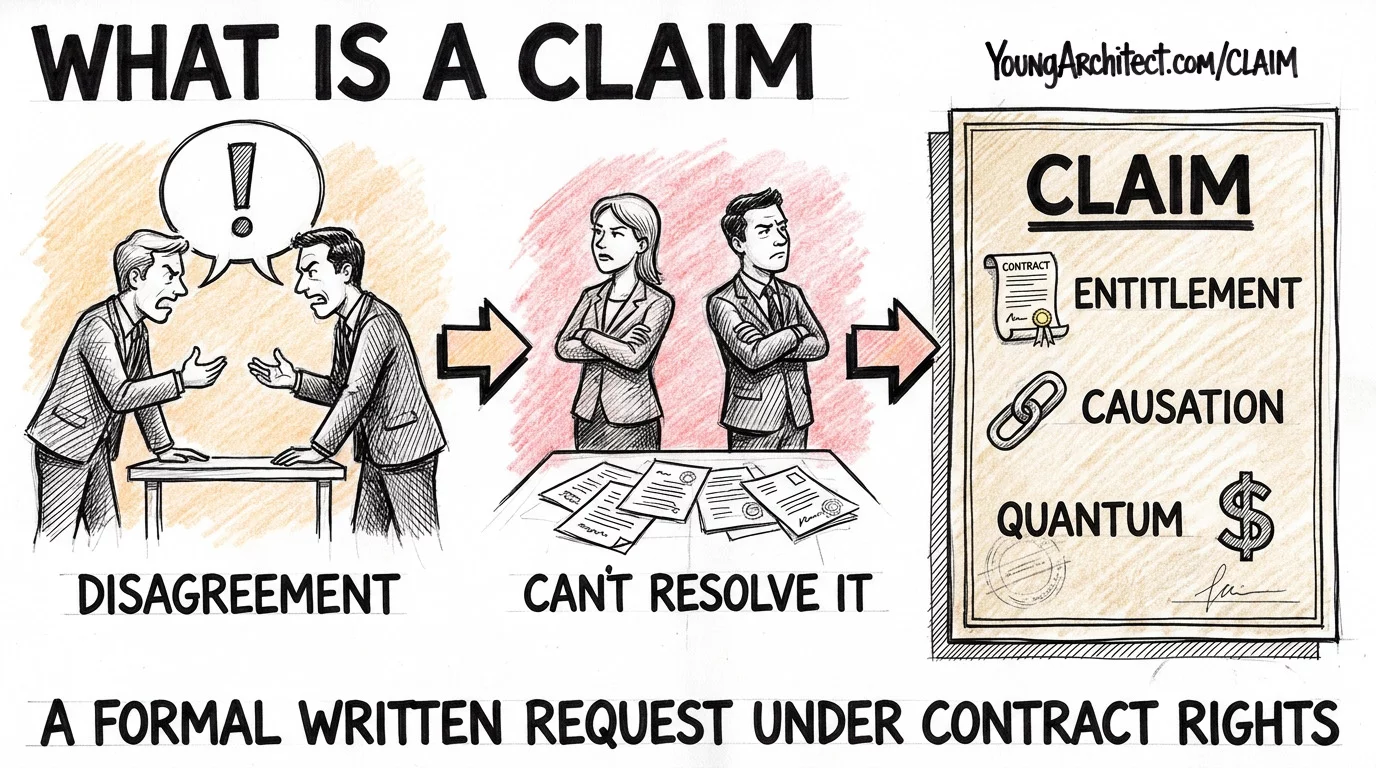
A construction claim is a formal written request or demand with supporting documentation, submitted as a contractual right. Think of it as a formal “we need to talk” backed up with paperwork and legal standing.
For a claim to be valid, you generally need to demonstrate four key elements:
- Entitlement: you have a contractual right to what you’re requesting
- Causation: you can show how the other party’s actions (or inactions) caused the issue
- Quantum: you can quantify the specific amount of damages or compensation being sought
- Notice: you provided proper notice as required by the contract
That last one trips people up. Under AIA A201, claims must be initiated within 21 days of the event giving rise to the claim, or within 21 days of when the claimant first recognizes the condition. Miss that window and your claim may be invalid regardless of merit. This timeline is a high-probability topic on the CE and PjM divisions.
When Claims Become Construction Disputes
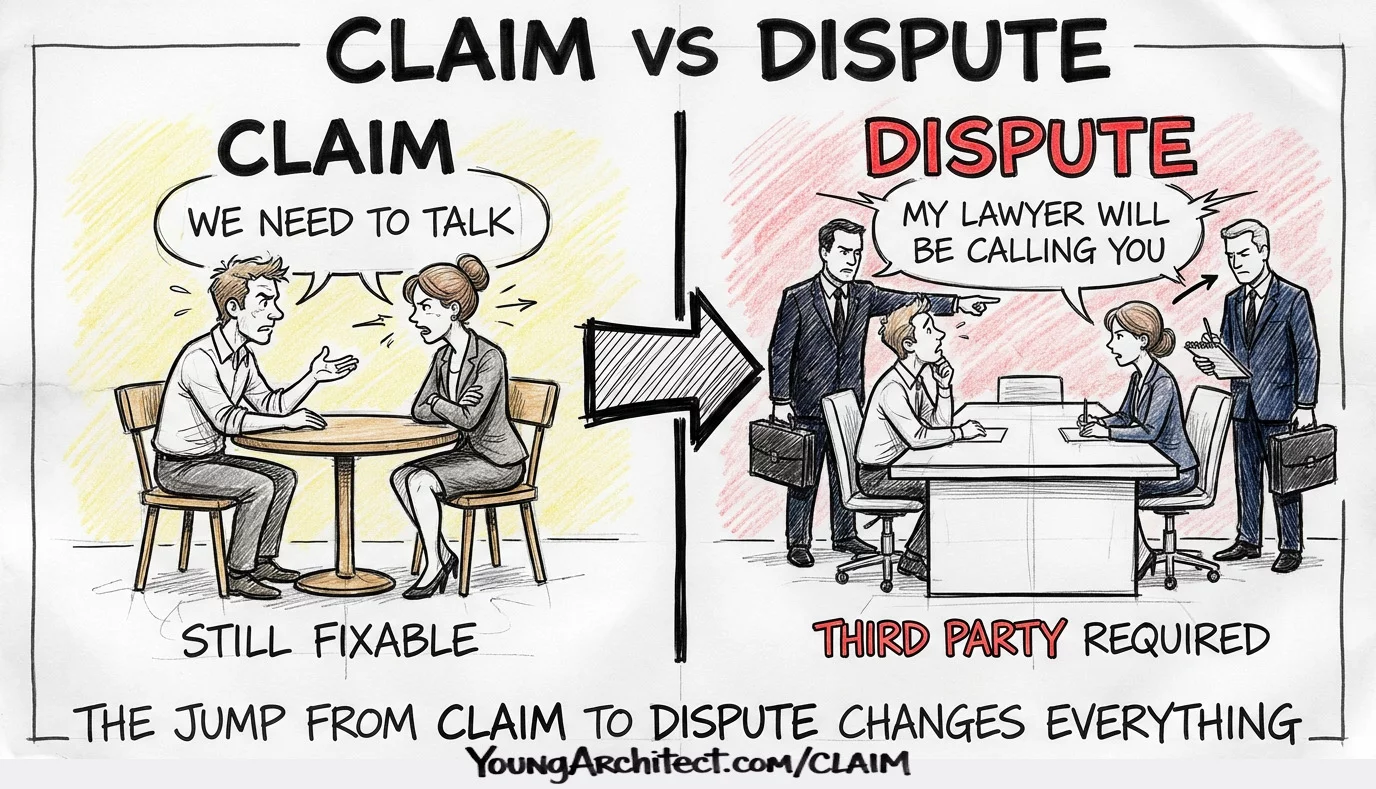
A construction dispute occurs when a claim can’t be resolved between the parties and requires third-party intervention. It’s the difference between “we need to talk” and “my attorney will be in touch.”
Disputes represent a formal impasse between contracting parties. They often involve multiple claims bundled together and require more formal resolution processes as defined in the contract documents.
The critical distinction: claims can exist without disputes, but disputes always involve at least one unresolved claim. You can learn more about how construction disputes play out in practice over at Autodesk’s construction disputes guide.
What Claims Are NOT
Just as important as knowing what a claim is: knowing what it isn’t.
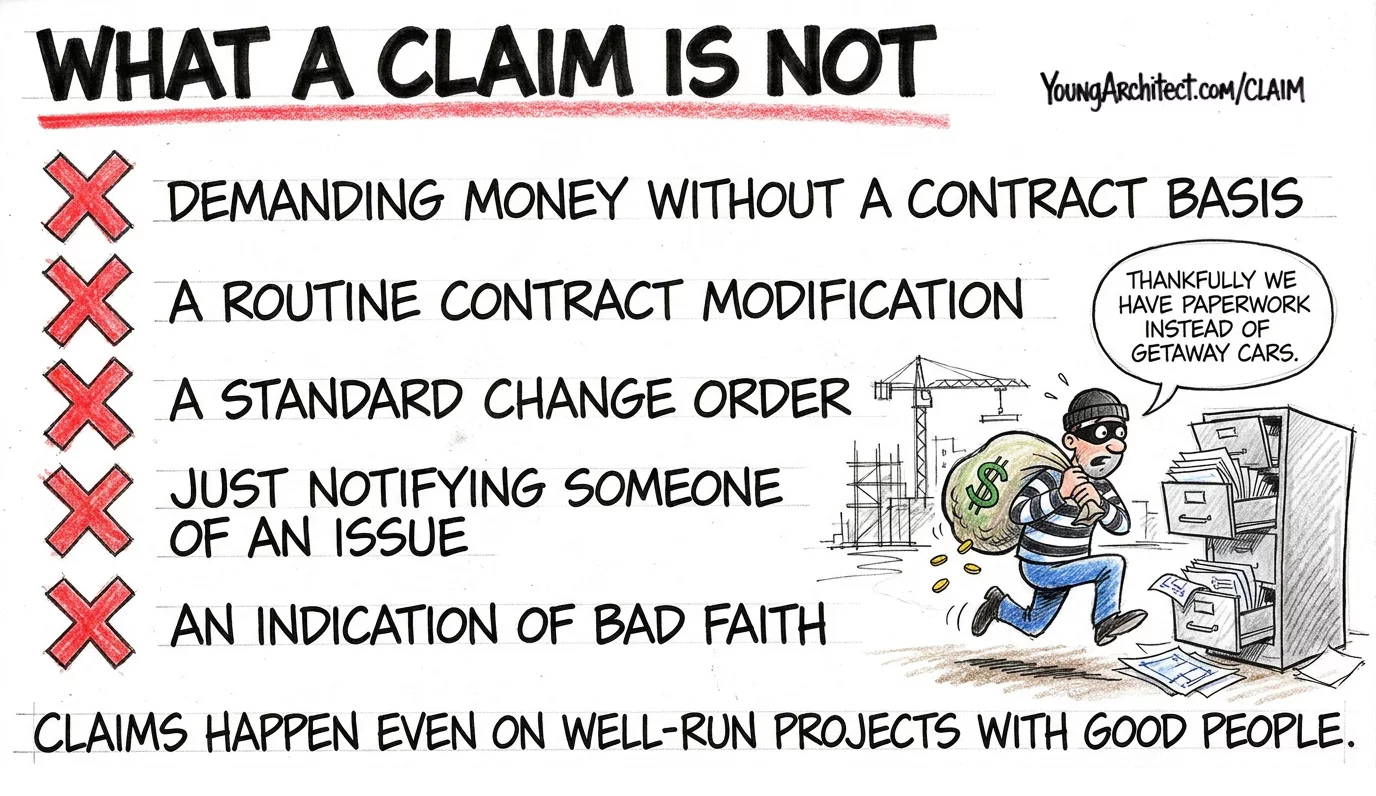
- Not demands without a contractual basis
- Not routine change orders that both parties agree to
- Not simple notifications of issues (those should happen before a claim ever forms)
- Not automatic signs of bad faith. Claims happen on well-run projects with good people.
Common Construction Claim Patterns
Understanding who typically makes claims, and why, helps with both prevention and early identification. Here’s how it breaks down.
Claims Against Architects
These are the ones you need to take most seriously, because they put your license and your firm at risk.
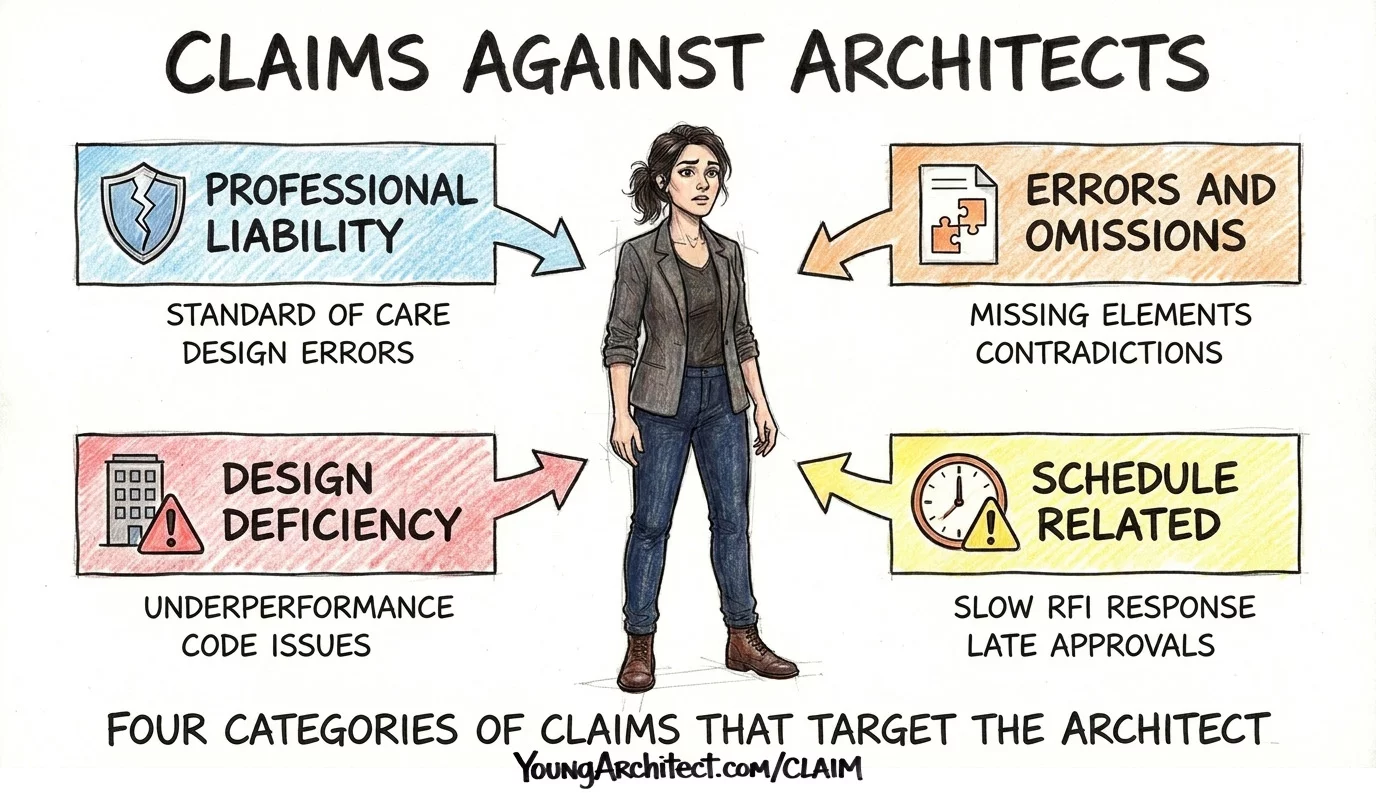
- Professional liability and errors and omissions, the most common category
- Specification writing mistakes and document coordination failures
- Design deficiencies: systems that don’t perform as intended
- Schedule-related issues: slow submittal reviews, delayed RFI responses
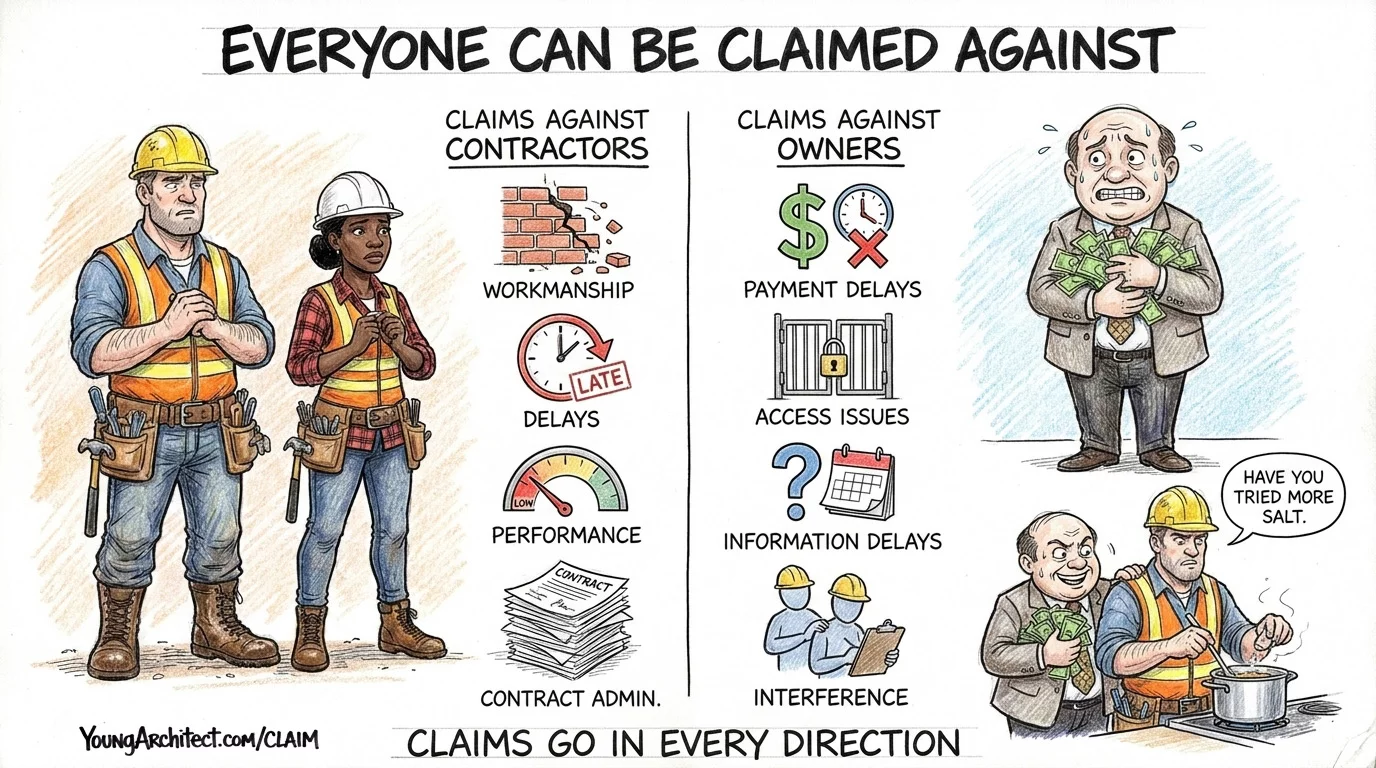
Claims Against Contractors
- Workmanship problems: failure to meet the specifications
- Schedule failures: poor trade coordination, missed milestones
- Performance issues: testing failures, warranty problems
Contractor Claims Against Owners
- Payment delays and retention disputes
- Site access restrictions
- Information delays and scope changes
- Excessive project interference
Construction Delay Claims
Construction delay claims deserve their own category because they’re one of the most common and most contentious types of construction claims you’ll encounter.
A delay claim arises when a party argues that someone else’s actions (or failures) caused the project to fall behind schedule. Common triggers include:
- Owner-directed scope changes that weren’t properly accounted for in the schedule
- Differing site conditions: unforeseen subsurface or physical conditions that stopped or slowed work, one of the most common claim triggers on any project
- Late information delivery: unanswered RFIs, slow submittal approvals, missing design decisions
- Weather events beyond normal expectations
The framework you need for the ARE starts with a single split: every delay is either excusable or non-excusable. Excusable delays then break down further:
- Excusable non-compensable delay: the contractor gets more time but no additional money. Think abnormal weather or events outside anyone’s control.
- Excusable compensable delay: the contractor gets both more time and additional compensation. This happens when the delay is caused by the owner or design team, such as a late design decision that holds up a critical trade.
Beyond direct claims between the owner, architect, and general contractor, projects frequently generate third-party claims. Subcontractors, material suppliers, and adjacent property owners can all bring claims when project activities cause them delays or damages.
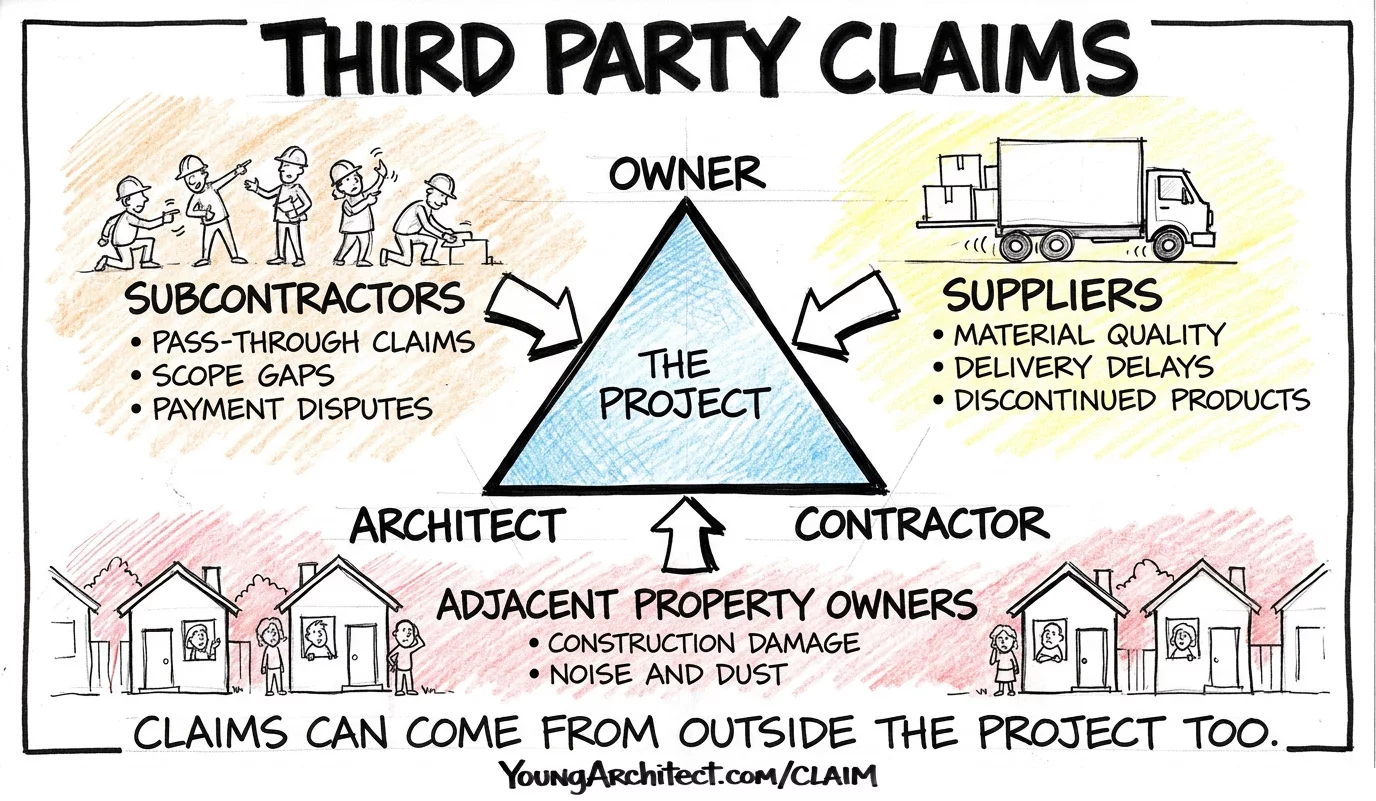
The fastest path to a delay claim is a backlogged RFI process. When the design team is slow to respond to RFIs, contractors can’t keep work moving, and that’s a compensable delay waiting to happen.
Prevention starts with documentation. Track every decision, every information request, and every schedule impact in real time. You can’t reconstruct this later with any credibility.
The Real Cost of Construction Disputes
The costs go way beyond the settlement amount. Like an iceberg, most of the damage is below the surface.
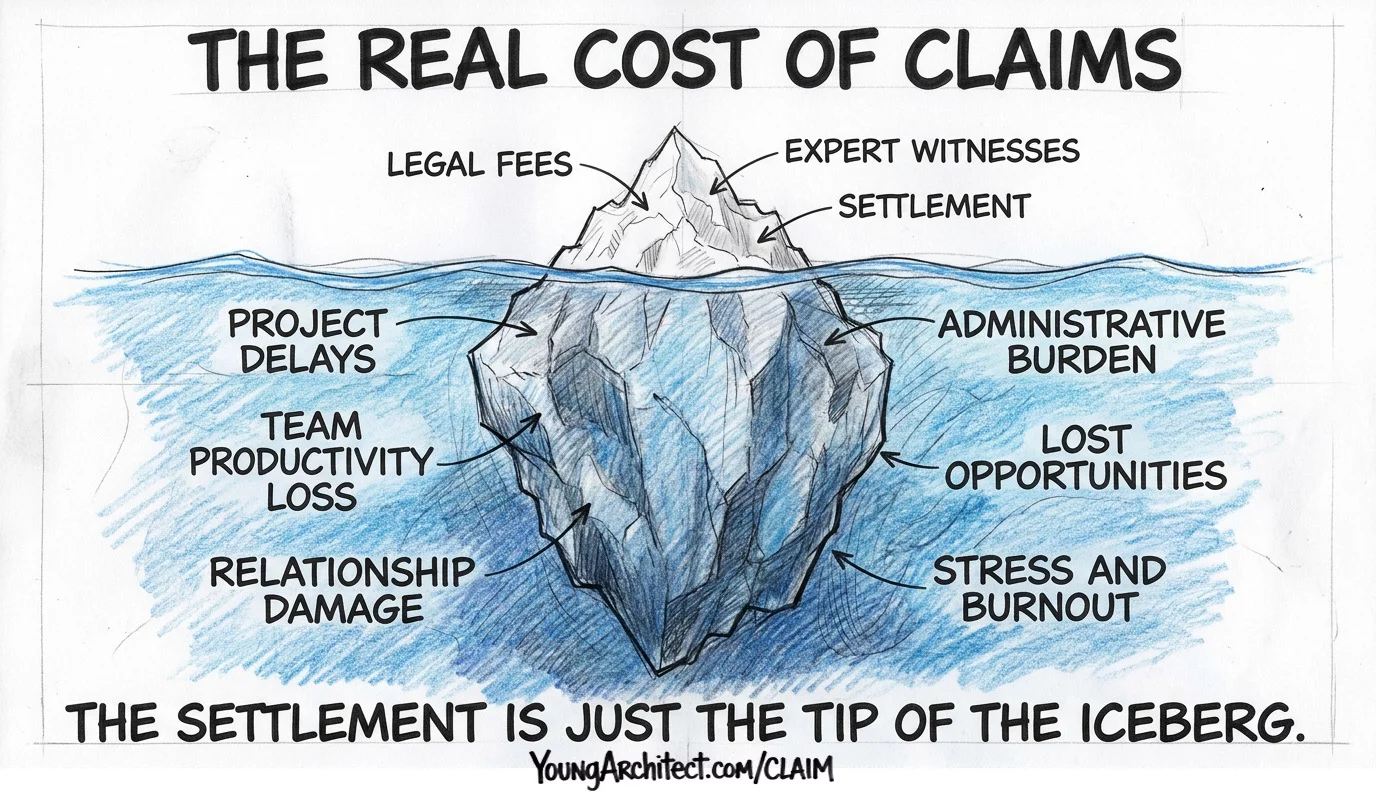
Direct Financial Impact
Legal fees run $300 to $800 per hour. Expert witnesses add another $200 to $500 per hour. The settlement or judgment typically lands at 5 to 15 percent of the contract value before you add all the supporting costs on top.
Additional direct costs include:
- Internal staff time dedicated to claim preparation
- Document retrieval and e-discovery management
- Depositions and strategy meetings
Project and Team Impact
Project delays create extended overhead costs of 5 to 15 percent of direct costs, plus acceleration expenses and lost opportunity costs.
Team productivity takes a serious hit:
- Management gets pulled off current projects to deal with the dispute
- Efficiency drops as documentation requirements multiply
- Morale deteriorates as an adversarial atmosphere replaces normal collaboration
- Stress and burnout can lead to staff turnover at the worst time
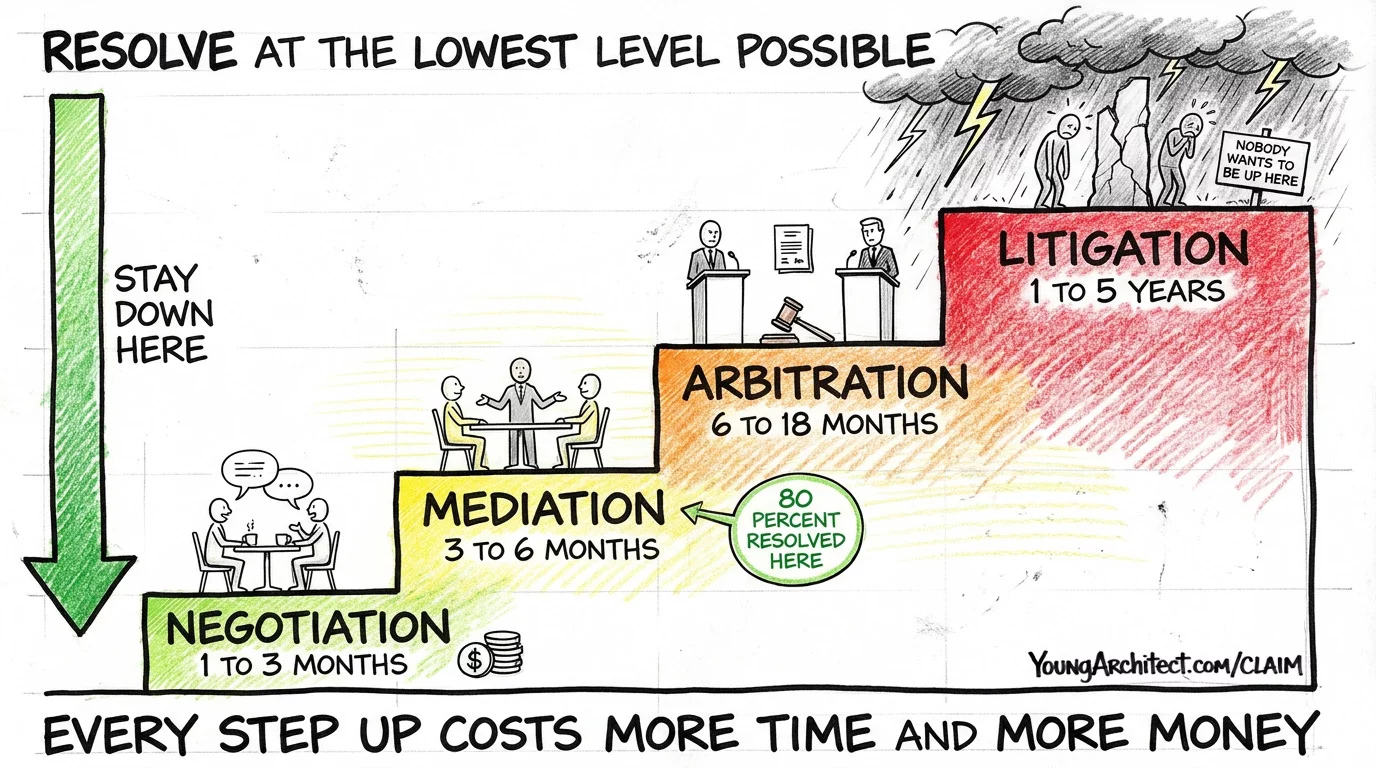
Resolution timelines vary dramatically depending on the path you take:
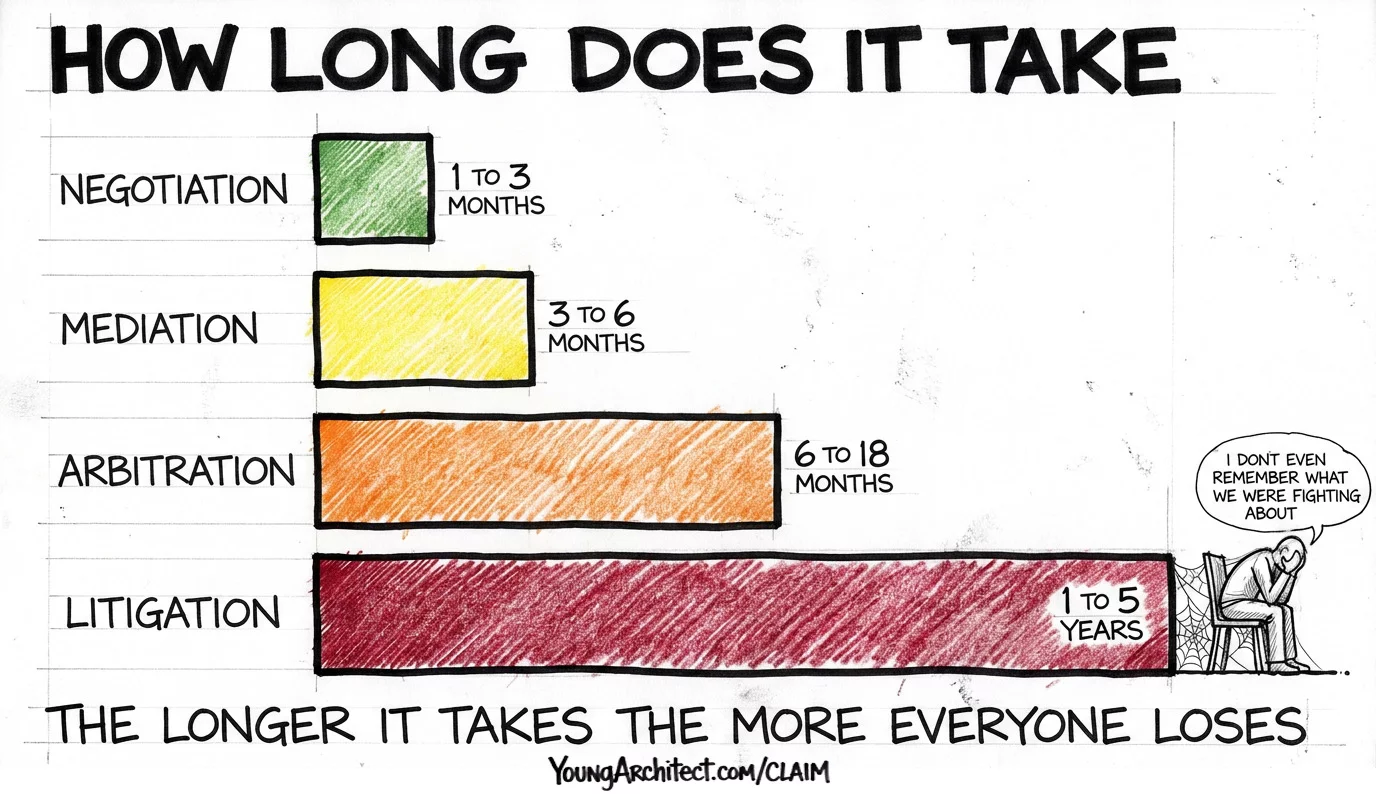
- Negotiation: 1-3 months
- Mediation: 3-6 months
- Arbitration: 6-18 months
- Litigation: 1-5 years
Long-Term Relationship Costs
This is the one people underestimate most. The construction industry is smaller than you think. A drawn-out dispute can mean:
- Loss of repeat business from owners you’ve worked hard to build relationships with
- Difficulty partnering on future projects with contractors or consultants
- Strained negotiations on every project that follows
- Damage to your professional reputation that follows you for years
Focus on project success rather than “winning” individual disputes. The professionals who thrive long-term are the ones who know when to hold firm and when to find common ground.
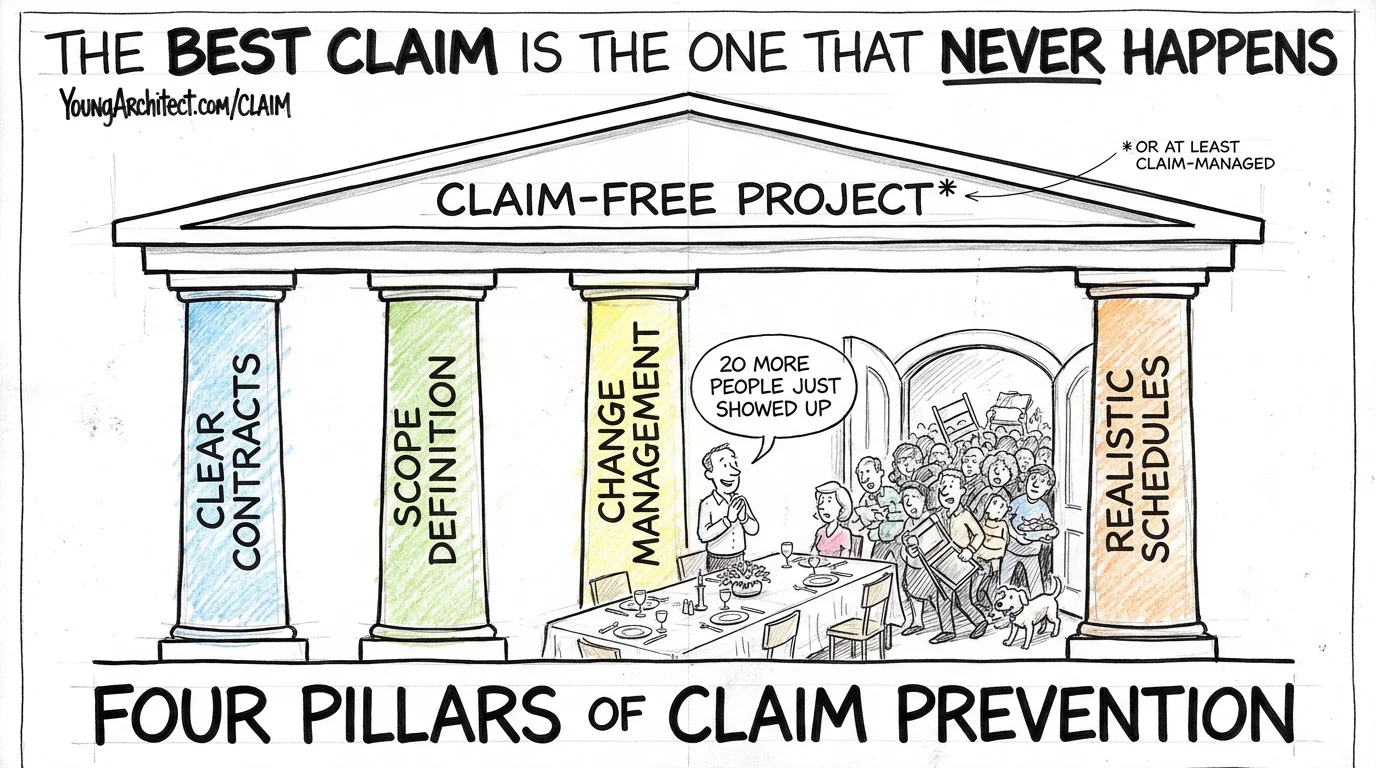
Prevention: Your Best Defense Against Construction Claims
Prevention is always cheaper than resolution. It also preserves the professional relationships that keep your practice functioning. Here’s how to do it.
Documentation and Communication
The golden rule: document everything as it happens, not after the fact. Six months from now, everyone will remember events in a way that favors their own position. Real-time documentation is the only thing that cuts through that.
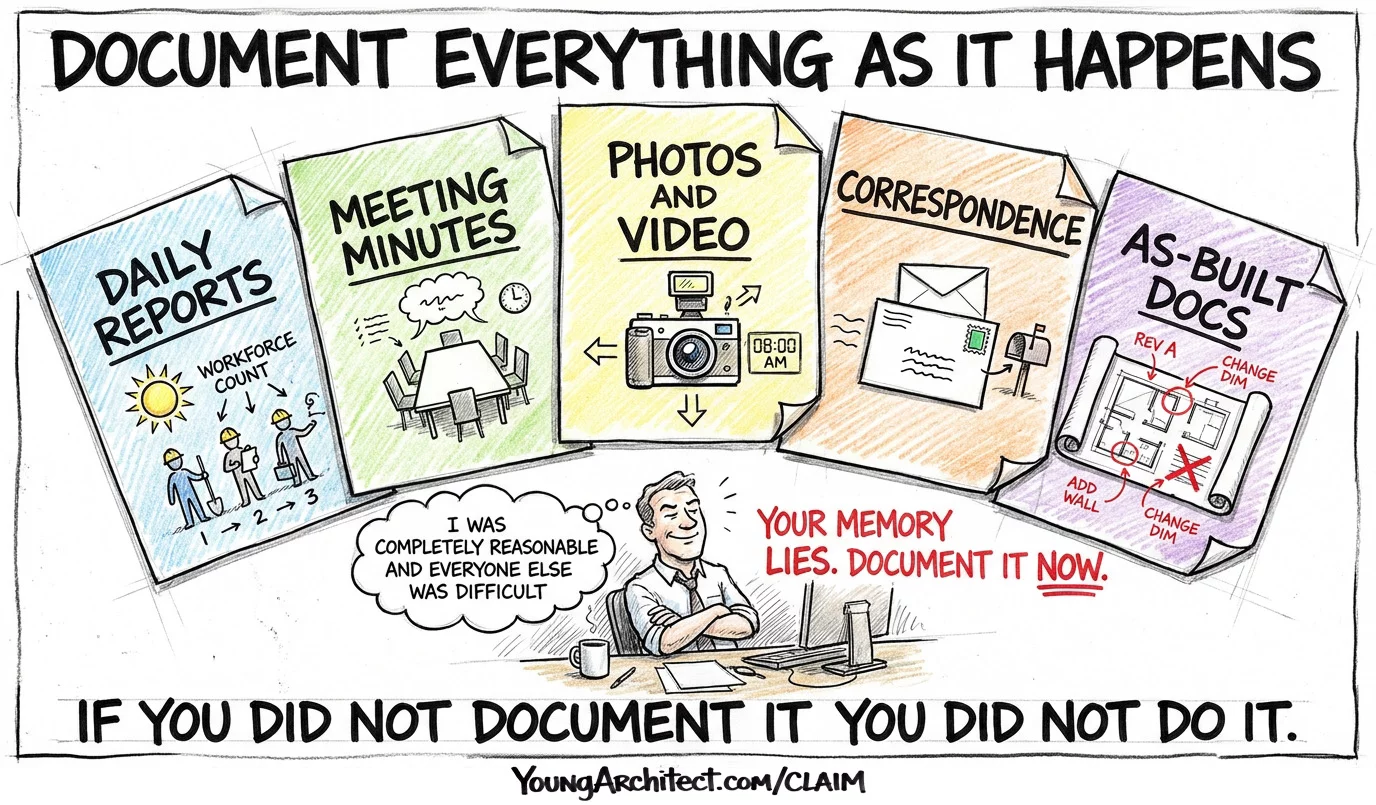
Essential documentation practices:
- Detailed daily reports: weather, workforce numbers, material deliveries, work performed
- Prompt meeting minutes with clear decisions and action items
- Time-stamped photos and video of key activities before, during, and after
- Centralized email management with consistent subject line conventions
- Real-time as-built tracking: updated and verified regularly, not reconstructed at the end
Effective communication requires:
- Regular project meetings with minutes distributed promptly
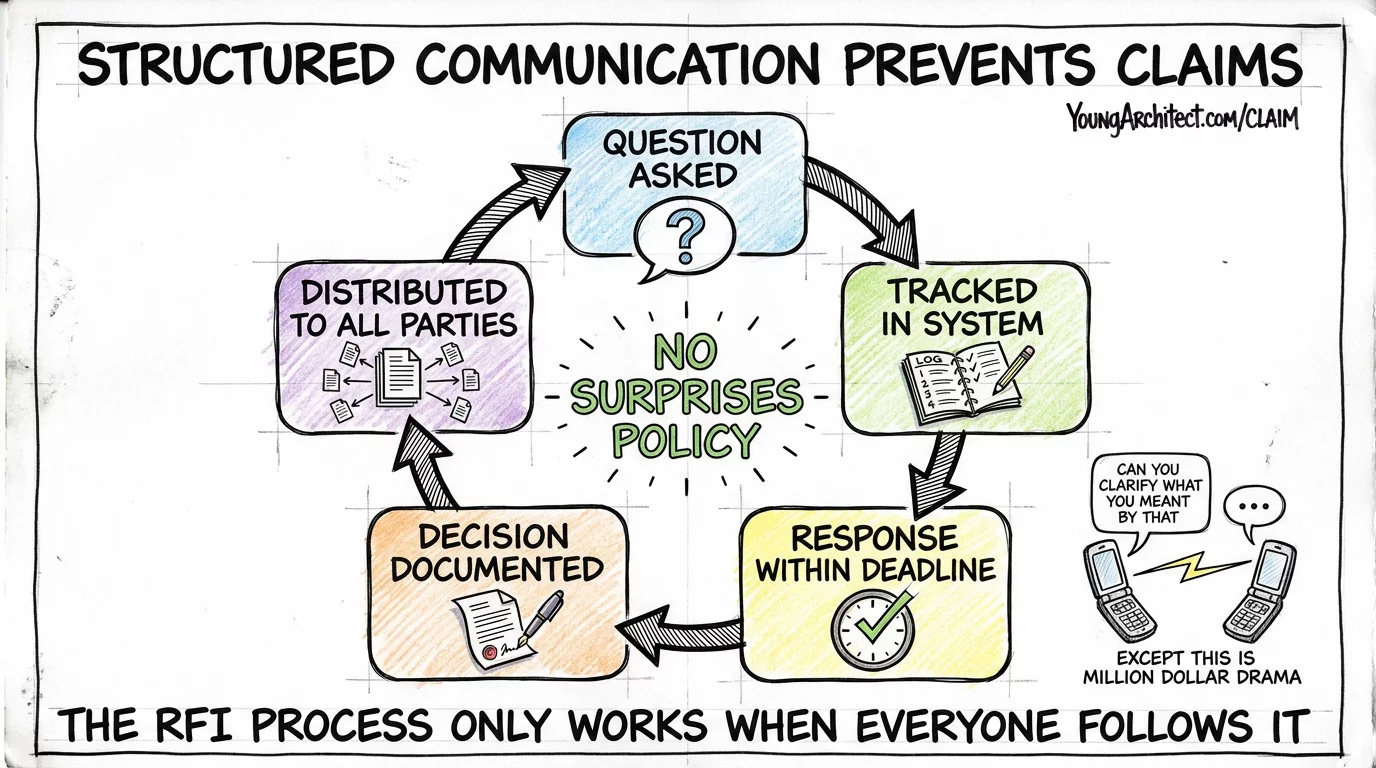
- Structured RFI processes with clear response time expectations
- A “no surprises” policy: early notification of any issue before it escalates
- Written confirmation of verbal discussions: if it wasn’t documented, it didn’t happen
Contract Language and Scope Definition
Ambiguous contracts create disputes. Precise language prevents them.
- Comprehensive scope definitions: spell out what’s included and what’s explicitly excluded
- Clear boundaries between trades: address potential overlaps and gaps before work starts
- Well-defined change management procedures: specific processes for requesting, documenting, and approving changes, with time limits
- Realistic schedule requirements: adequate float for critical activities, clearly defined milestones
AIA contracts like A201 and B101 provide industry-standard frameworks for risk allocation and dispute resolution. The AIA contract documents framework governs how claims are made, who has authority to respond, and what happens when parties can’t agree.
If you want to understand how these contracts actually work, AIA Contracts 101 breaks down B101, A201, C401, and more in plain language.
Proactive Claim Management
Create your claim resolution plan before you need it, not during a crisis. That means:
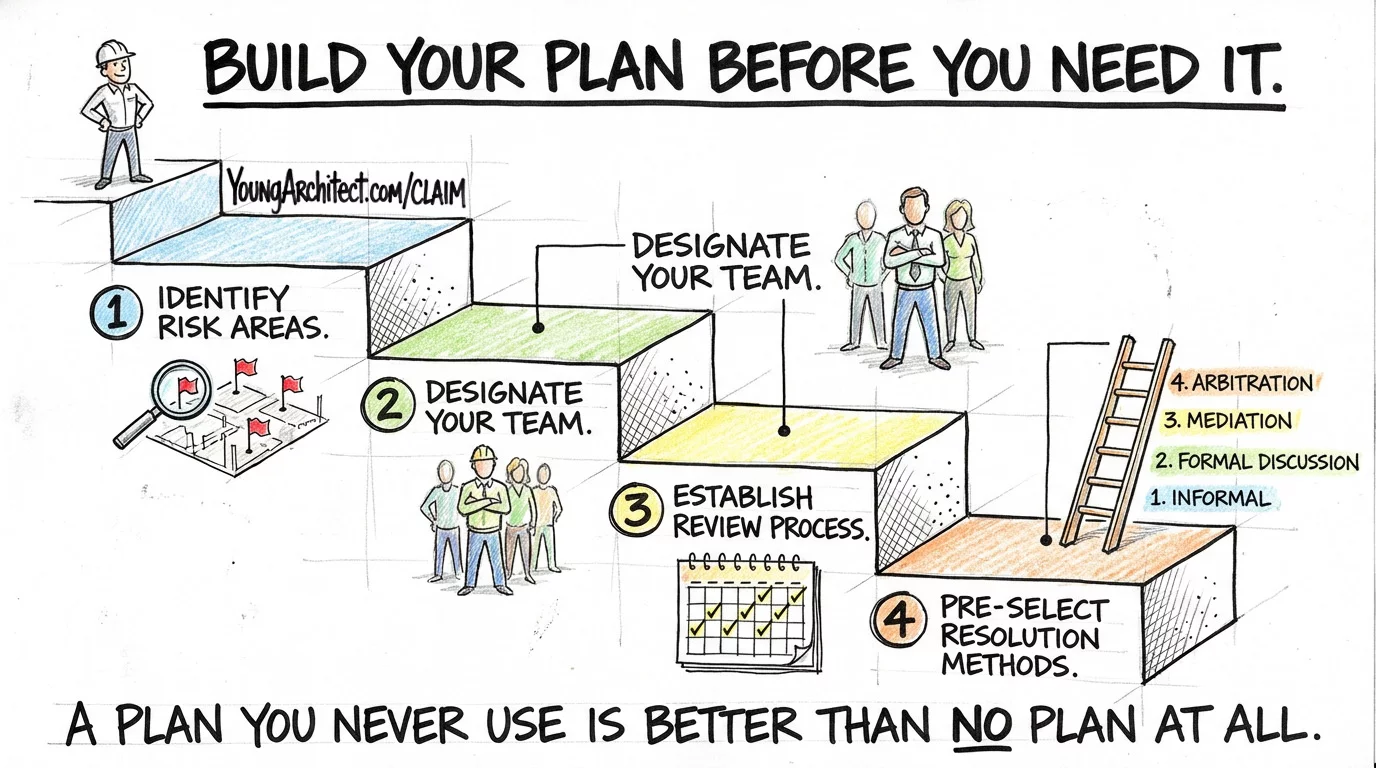
- Risk assessment during preconstruction: identify potential claim areas before work starts
- Designated team members for claim management with clear roles and decision-making authority
- Regular review timelines for evaluating potential claims throughout construction
- Established escalation procedures with defined timeframes at each step
Construction Dispute Resolution: From Negotiation to Litigation
Even with the best prevention efforts, disputes still happen. When they do, AIA contracts set up a sequential escalation ladder. Each step is more formal and more expensive than the last.
Good Faith Negotiations
This is always the first step: direct party-to-party resolution without third parties. Most AIA contracts require a good faith negotiation attempt before any other process can begin.
- Fastest and cheapest resolution path (weeks to months)
- Preserves relationships better than any other method
- Requires open communication and genuine willingness to compromise
- Focus on project success, not blame
The Initial Decision Maker (IDM)
This is one of the most important concepts under the CE and PjM objectives, and one of the most misunderstood in practice.
Under AIA A201, the architect serves as the default Initial Decision Maker. When a contractor submits a claim against the owner, or the owner against the contractor, the architect is contractually required to:
- Review the claim and request any supporting data needed
- Issue an initial decision within a defined timeframe
- Act impartially: this role is separate from your role as the owner’s design professional
This step is mandatory. A claim cannot proceed to mediation or binding resolution until the IDM has issued (or failed to issue) a decision. The parties can agree to replace the architect as IDM, but the architect is the default unless the contract says otherwise.
One more thing worth knowing for the exam: under A201, the architect cannot be held liable for decisions made in good faith as IDM. That protection exists specifically because the role requires the architect to render impartial judgments that one party may not like.
The IDM role puts the architect in an uncomfortable position: you’re being asked to render an impartial decision on a dispute where your own documents may be part of the issue. That’s exactly why it falls under the CE and PjM objectives, which cover both the obligation and the protection that comes with it.
Construction Mediation
Construction mediation brings in a neutral third-party facilitator who helps the parties reach a mutual agreement. The mediator doesn’t impose a decision. They help people find common ground.
- Non-binding: both parties must agree to any resolution
- Resolves approximately 80% of construction disputes before they go further
- Timeline: 1-3 months
- Cost: $5,000-$15,000 shared between parties
It’s worth noting that liquidated damages provisions in the contract often become a central issue during mediation. The parties are frequently arguing about exactly how much a delay cost the project, and the liquidated damages clause is where that number lives.
Construction Arbitration
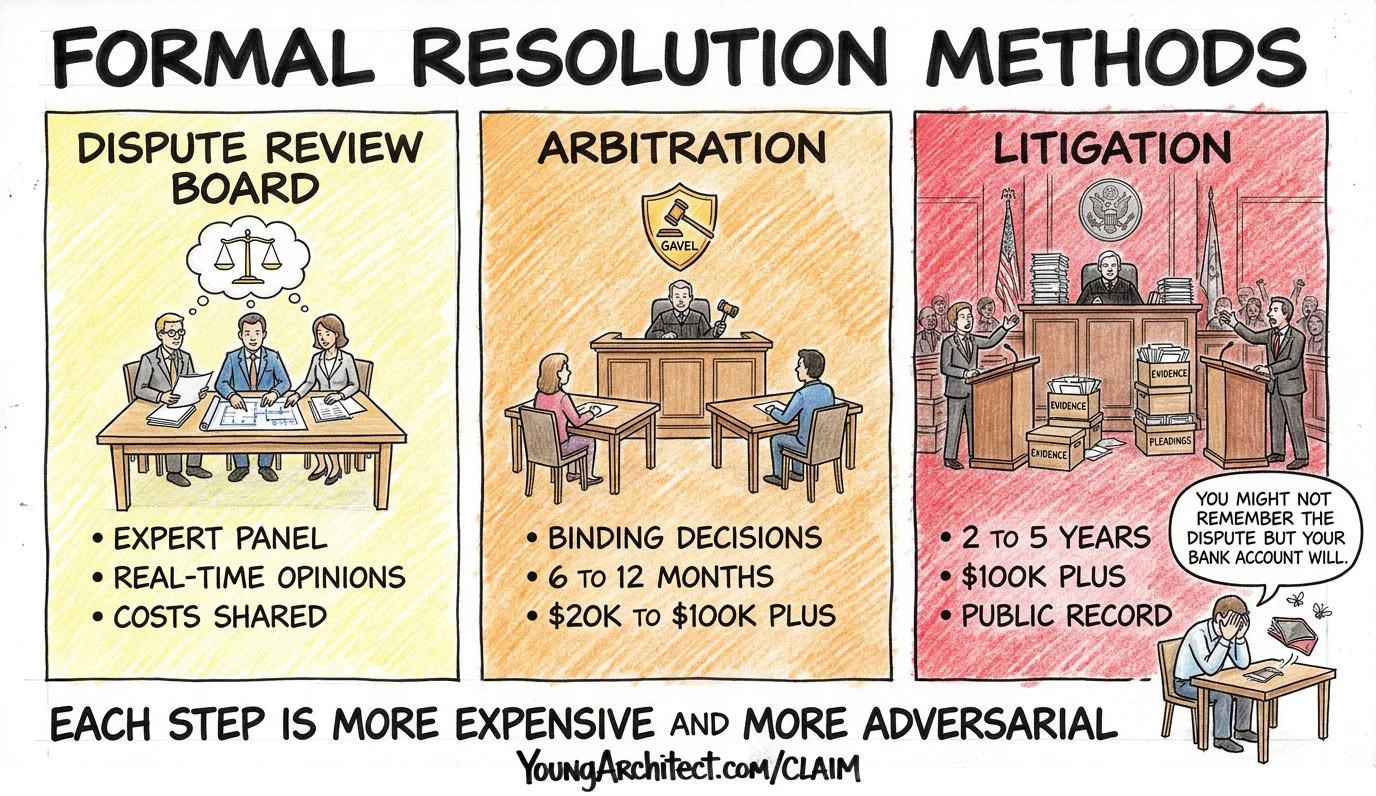
Arbitration is a private, binding process where an arbitrator, usually someone with real construction industry experience, reviews the evidence and renders a final decision.
- Binding: the decision is enforceable like a court judgment
- Limited appeals: much harder to challenge than a court ruling
- Timeline: 6-18 months
- Cost: $20,000-$100,000+, depending on complexity
Mediation vs Arbitration: Key Differences
Mediation vs arbitration is one of the most confused comparisons in dispute resolution. Here’s the short version:
- Mediation is non-binding. The mediator facilitates. You both have to agree to settle.
- Arbitration is binding. The arbitrator decides. You live with it.
- Mediation is faster and cheaper. Arbitration takes longer and costs significantly more.
- AIA contracts require mediation before any binding resolution. The binding method, either arbitration or litigation, is selected in the contract.
Construction Litigation
Litigation is the last resort, and for good reason.
- Timeline: 2-5 years
- Cost: $100,000+ even for modest claims
- Public record: everything becomes accessible
- Massive resource drain on everyone involved
By the time a construction dispute reaches litigation, the legal costs often exceed the original claim amount. Almost any resolution earlier in the process is better than litigation.
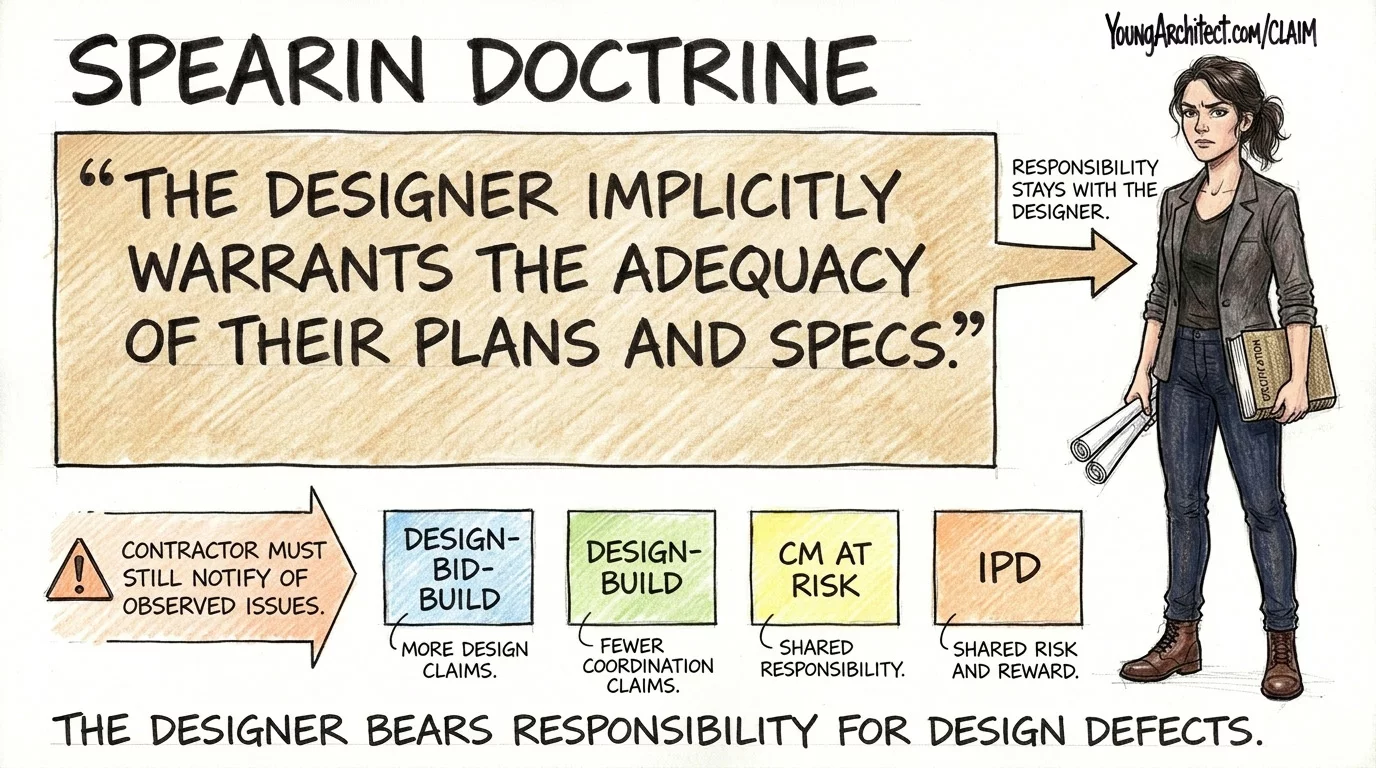
The Spearin Doctrine: What It Means for Design Professionals
The Spearin doctrine is one of the most important legal concepts in construction and a critical concept for understanding design liability. If you understand it, you understand a huge piece of how design liability works. You can read more about it at Procore’s Spearin doctrine overview.
Background and the Implied Warranty
The doctrine comes from the 1918 Supreme Court case United States v. Spearin. A contractor was hired to build a sewer system based on government-provided plans and specs. He followed them exactly, and the system failed due to a design flaw he had nothing to do with.
The Supreme Court ruled in his favor, establishing an implied warranty: when an owner or design professional provides detailed plans and specifications, those documents are implicitly warranted to be adequate and suitable for their intended purpose.
In plain English: if you hand a contractor your drawings and say “build this,” you’re implicitly promising those drawings will work. If they don’t, that’s on you, not them.
How It Works in Practice
Here’s a concrete example:
A contractor builds a foundation exactly as shown on the structural drawings. Six months after occupancy, the foundation cracks, not because of poor workmanship, but because the structural engineer’s calculations were wrong. Under the Spearin doctrine, the contractor isn’t responsible for the redesign and repair costs. That liability falls on the design professional who provided the flawed documents.
This is why defective specifications and coordination errors carry real financial risk. They don’t just create RFIs and change orders. They can create claims under an implied warranty you didn’t know you were making.
What the Spearin Doctrine Does NOT Cover
The implied warranty has limits. It does not protect contractors who:
- Deviate from the plans and then claim a design defect
- Ignore obvious design errors they should have flagged before construction
- Work under performance specifications where the contractor has design responsibility for the outcome
It also applies differently depending on project delivery method and varies by state, which is why you’ll see it come up across multiple exam divisions.
Why Architects Need to Pay Attention
The Spearin doctrine shifts significant financial liability to design professionals when construction documents contain errors. But here’s the nuance that matters for the exam:
Spearin implies adequacy, not perfection. The architect’s defense against a Spearin-based claim is demonstrating they met the standard of care, that a reasonably competent architect in the same situation would have produced similar documents. Minor errors don’t automatically equal liability if the standard of care was met.
This is exactly why professional liability insurance is non-negotiable, and why careful document coordination isn’t just a best practice. It’s your primary defense against this type of claim.
Project Delivery Methods and Risk Allocation
The Spearin doctrine and the claim patterns we’ve covered don’t apply the same way on every project. The project delivery method changes the liability picture significantly. Who owns the design risk, who can make claims against whom, and how disputes get structured all shift depending on how the project is contracted. This looks especially different when comparing public and private sector projects, where the procurement rules are fundamentally different.
- Design-Bid-Build: clear separation between design and construction creates more design-related claims. The Spearin doctrine is most directly applicable here.
- Design-Build: single-point responsibility changes the liability picture. The design-builder assumes both design and construction risk.
- CM at Risk: shared responsibility creates complex claim matrices. Who owns what gets complicated fast.
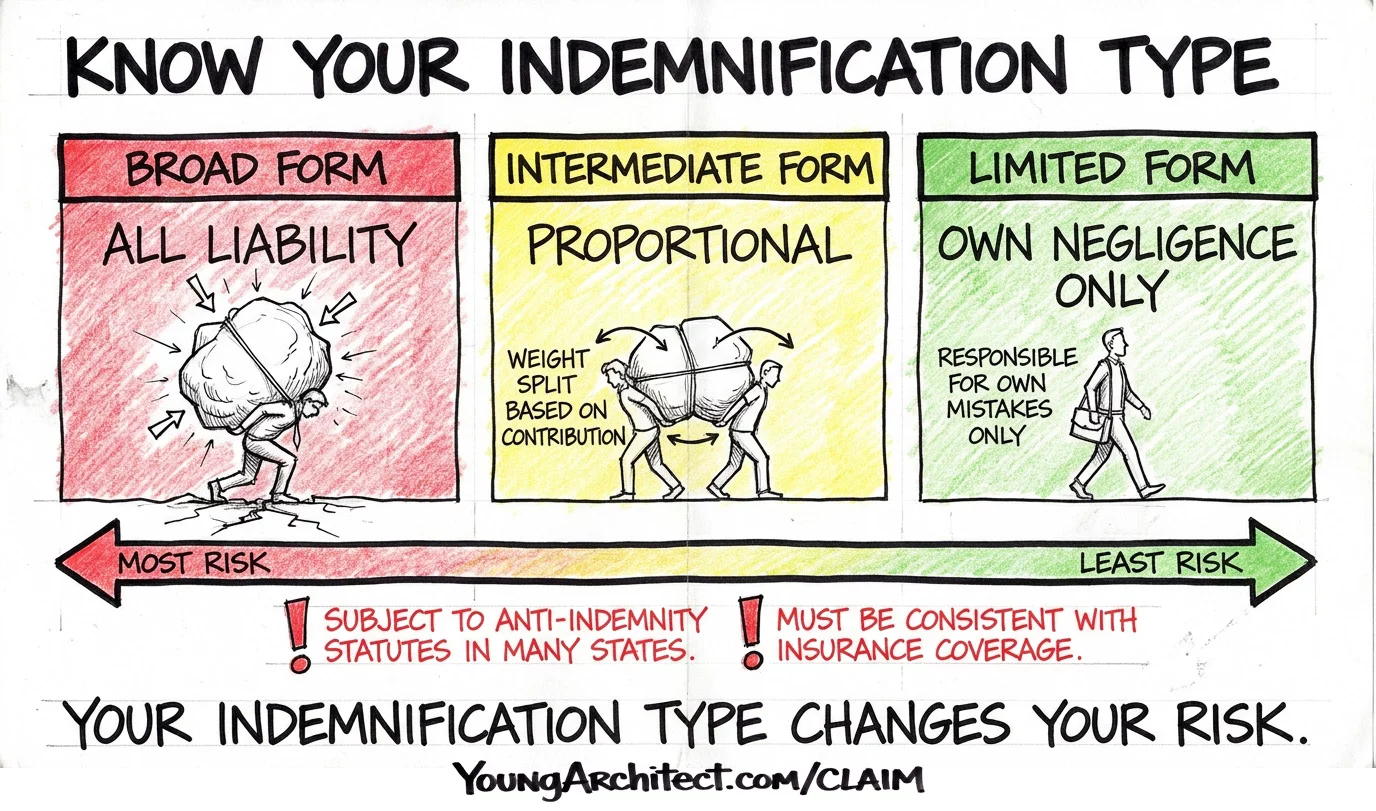
Risk transfer mechanisms like indemnification clauses vary significantly by state due to anti-indemnity statutes. Always consult local legal counsel familiar with your jurisdiction before relying on specific contract language.
Construction Claims and Disputes on the ARE Exam
This topic shows up across multiple ARE divisions. Here’s where to expect it.
Where This Shows Up by Division
- PcM: firm-level risk management, professional liability, and business structure. For a deeper dive into the firm-level picture, PcM 101 covers all of it.
- PjM: contract language, consultant coordination, claims processes, and the IDM role. PjM 101 walks through the contract frameworks in depth.
- CE: construction administration responsibilities, documentation standards, the 21-day notice rule, and observation requirements. CE 101 is built specifically around these topics.
Key AIA Documents to Know
- AIA A201: the backbone of construction relationships. Defines dispute resolution procedures, the IDM role, and the 21-day notice requirement.
- AIA B101: defines the architect’s scope, standard of care, and liability limitations.
AIA Contracts 101 covers all of these documents in depth. It’s one of the most useful courses for candidates who are working through PcM, PjM, and CE at the same time.
Study Focus Areas
- Contract language interpretation: especially how claims are defined and initiated
- Professional liability concepts: standard of care, Spearin, E&O insurance
- Change order processes: how scope changes trigger claims
- Quality control procedures: how QA/QC failures become claims
- Construction observation responsibilities: what you’re required to do and what you’re not
Frequently Asked Questions
What is the difference between a construction claim and a construction dispute?
A construction claim is a formal written request for additional compensation or time, submitted as a contractual right. A construction dispute occurs when that claim cannot be resolved between the parties and requires third-party intervention. Claims can exist without disputes, but every dispute involves at least one unresolved claim.
What are the most common types of construction claims?
The most common include delay claims (schedule impacts from owner changes, unforeseen conditions, or late information), differing site conditions claims, change order disputes, design error claims under the Spearin doctrine, and payment claims. Delay claims and scope disputes account for the majority of construction claims on commercial projects.
What is construction mediation and how does it work?
Mediation is a voluntary, non-binding process where a neutral third party helps the contracting parties reach a mutual agreement. The mediator facilitates. They don’t impose a decision. Mediation resolves approximately 80% of construction disputes and typically takes 1-3 months at a shared cost of $5,000-$15,000, making it far less expensive than arbitration or litigation.
What does the Spearin doctrine mean for architects?
The Spearin doctrine creates an implied warranty that plans and specifications provided by design professionals will be adequate for their intended purpose. If a contractor follows the design exactly and problems arise from a design error, liability falls on the design professional. Architects’ best defense is demonstrating they met the standard of care. Spearin implies adequacy, not perfection.
How does construction arbitration differ from litigation?
Construction arbitration is a private, binding process where an arbitrator renders a final decision after reviewing evidence. Litigation involves the full court system with judges or juries, public records, and significantly longer timelines. Arbitration typically takes 6-18 months and costs $20,000-$100,000+. Litigation can take 2-5 years and often exceeds $100,000 even for modest claims. Under AIA contracts, mediation is required before any binding resolution. The parties select either arbitration or litigation as their binding method in the contract.
Construction claims and disputes are a reality of this industry. They’re going to happen. But they’re manageable when you understand the patterns, document consistently, and know the resolution tools available to you.
Prevention through clear documentation and proactive communication is always your most powerful tool. When prevention isn’t enough, knowing the escalation ladder: negotiation, IDM, mediation, and binding resolution (arbitration or litigation), gives you a framework to navigate even the messiest situations professionally.
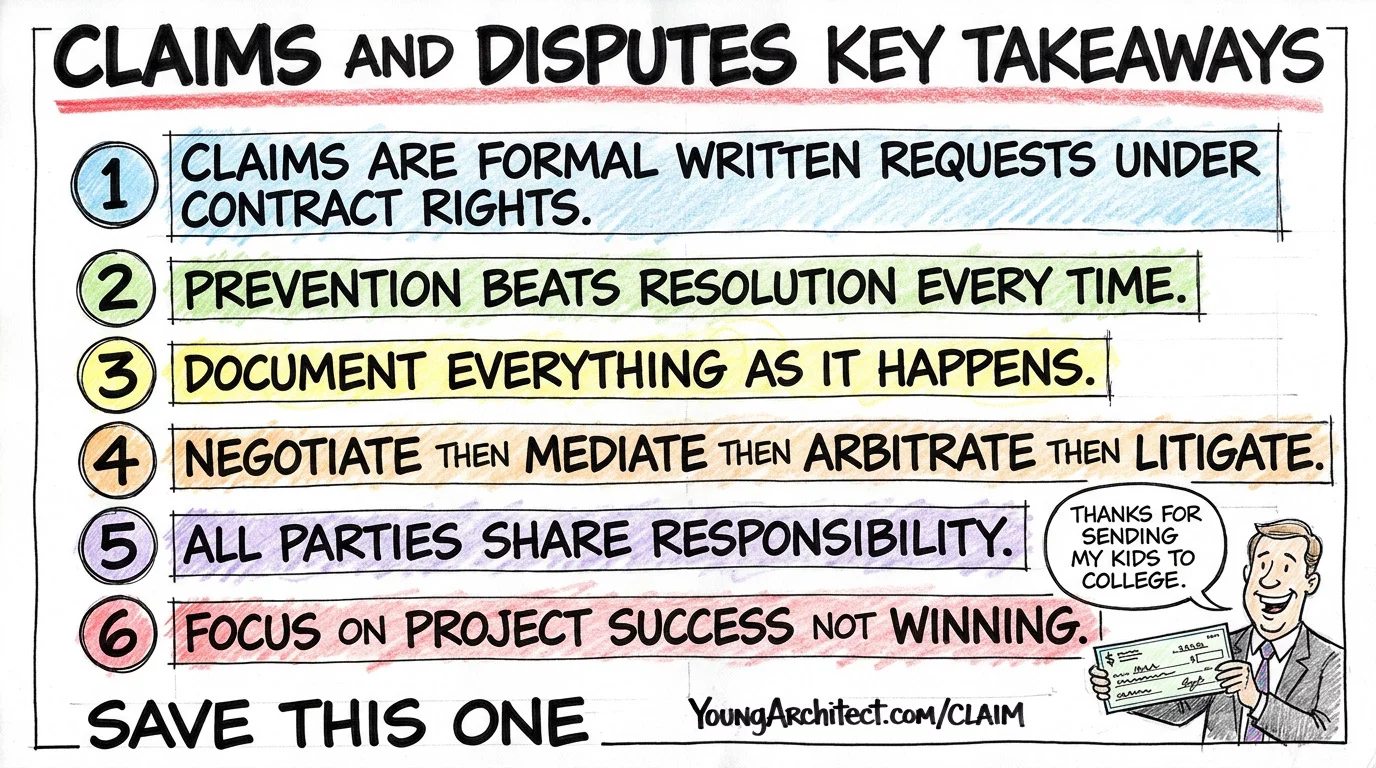
Start implementing documentation best practices on your current projects. Review your contracts to understand the dispute resolution procedures. Develop the communication habits that stop issues from escalating before they need to.
These aren’t just exam topics. They’re the foundation of a long career in this profession.
Ready to take this further? Check out the ARE 101 Membership for comprehensive exam prep across all six divisions, or CDT 101 if you’re working toward your CSI® certification.