
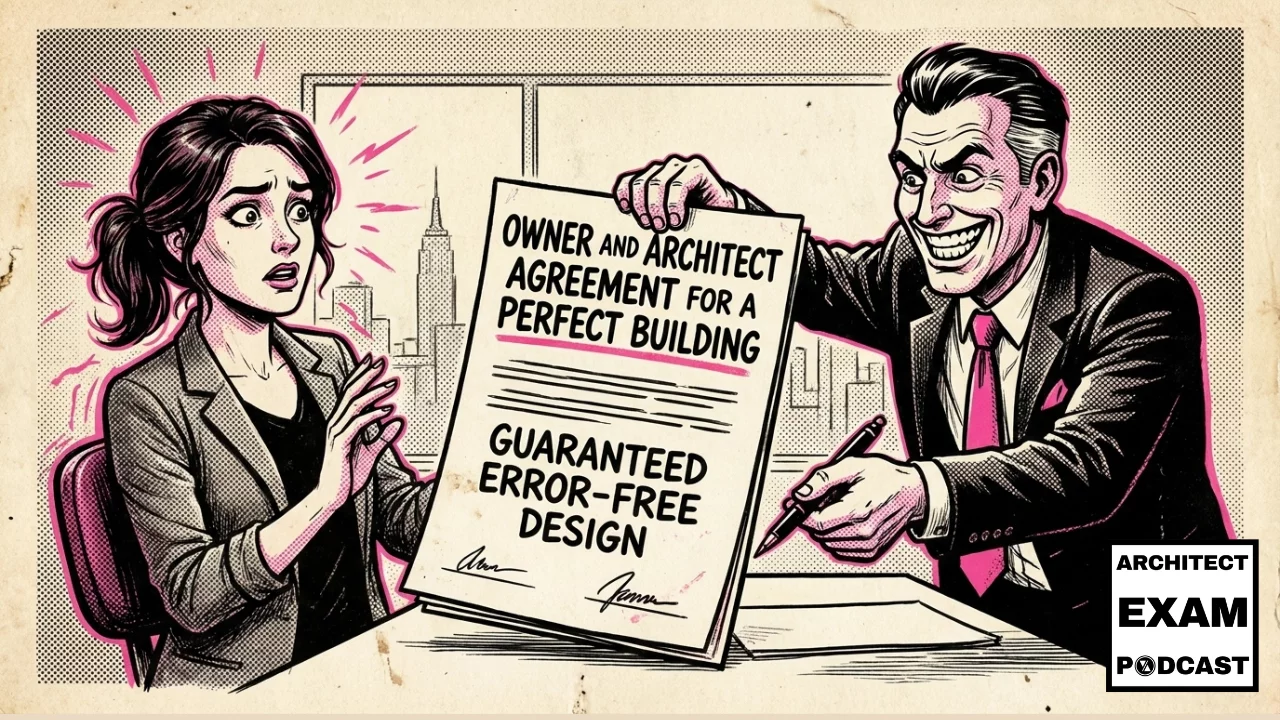

The architect standard of care doesn’t mean perfect work. It means the level of skill and care that a reasonably competent architect would exercise under similar circumstances. If you’re studying for the ARE or practicing architecture, this single concept governs every contract you sign, every design decision you make, and every claim that could ever be filed against you. It’s the legal benchmark for measuring your performance, and understanding it is one of the most important things you can do to protect your career.
This podcast is also available on YouTube, Spotify, and Apple Podcasts
What Is the Architect Standard of Care?
You just got served with a lawsuit. The claim says your design was “defective” because a minor coordination issue required a change order during construction. The client demands you pay for every penny of the additional cost because they expected “perfect” documents.
This scenario plays out more often than you’d think, and it highlights a fundamental misunderstanding about what architects actually owe their clients.
The legal concept that governs this relationship is called standard of care, and it’s probably different from what you expect.
The architect standard of care is the level of professional skill and diligence that reasonably competent architects would exercise under similar circumstances. It requires ordinary professional competence, not perfection. And it serves as the legal benchmark for measuring an architect’s performance in professional negligence claims.
Whether you’re studying for your ARE exams or running your own practice, understanding standard of care isn’t just academic theory.
It’s essential for protecting your career and maintaining healthy client relationships. This concept appears across all ARE divisions, governs every contract you’ll sign, and influences how you approach daily design decisions.
Breaking Down the AIA B101 Definition
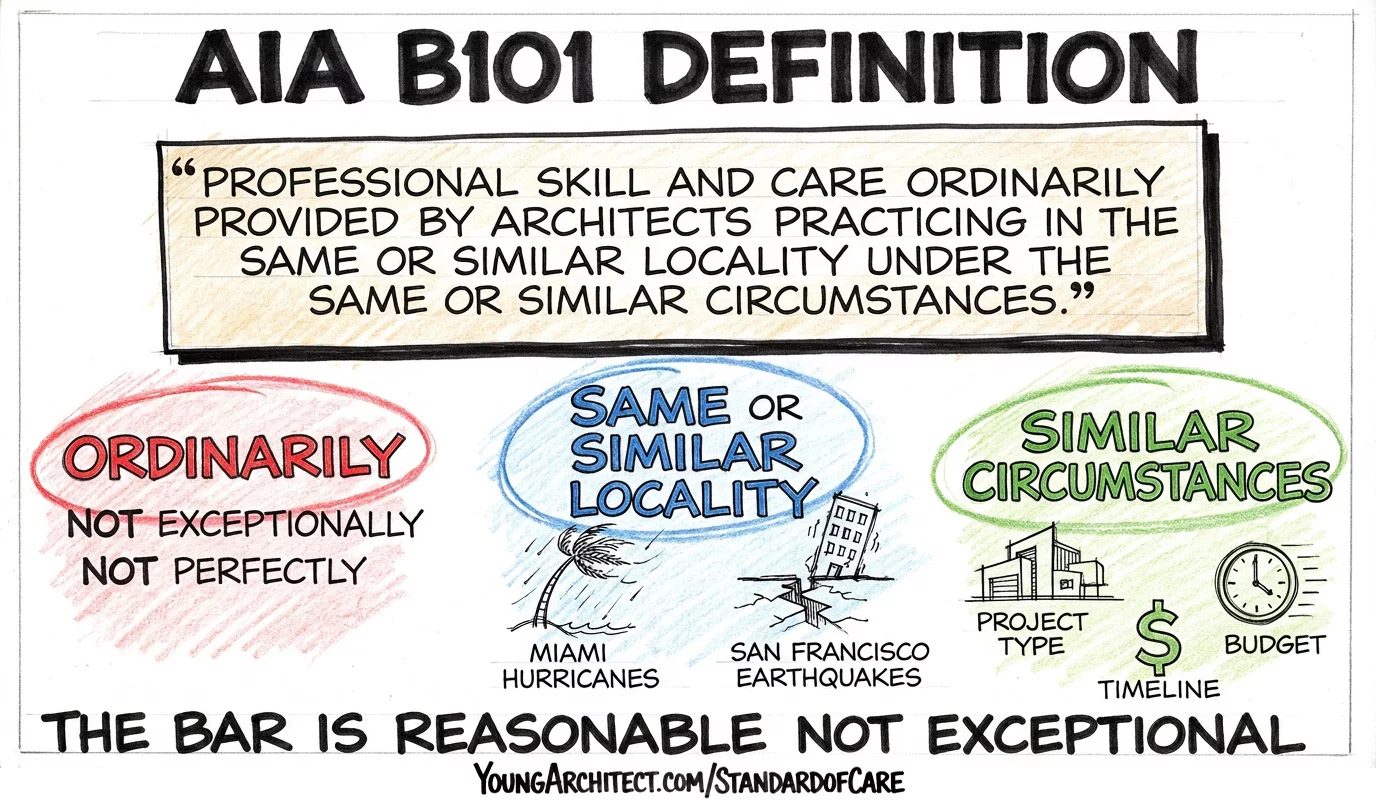
The AIA standard of care definition comes from AIA B101 Section 2.2:
“professional skill and care ordinarily provided by architects practicing in the same or similar locality under the same or similar circumstances.”
Three key components matter here:
- “Ordinarily” = not exceptionally, not perfectly. Just what typical architects do.
- “Similar locality” = regional considerations matter. Hurricane design in Florida is different from earthquake design in California.
- “Similar circumstances” = project type, budget, complexity, and timeline all factor in.
The 1896 Case That Started It All
The legal foundation for standard of care goes back more than 125 years. The 1896 Beede vs. Coombs case established that architects don’t guarantee results. The court ruled that architects must use “skill and ability reasonably and without neglect” but don’t warrant a satisfactory outcome.
The court’s decision included an important clarification:
“an error in judgment is not necessarily evidence of a want of skill or care, for mistakes and miscalculations are incident to all of the business of life.”
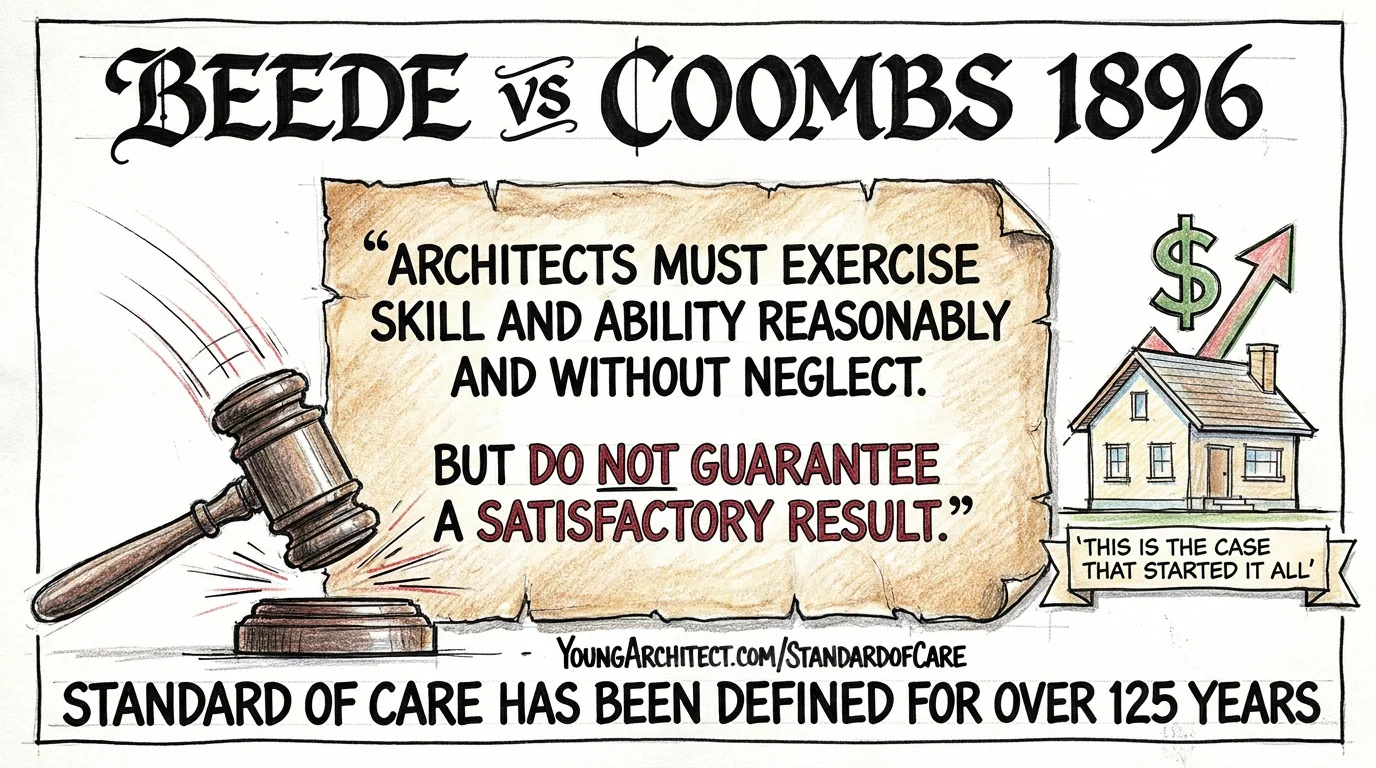
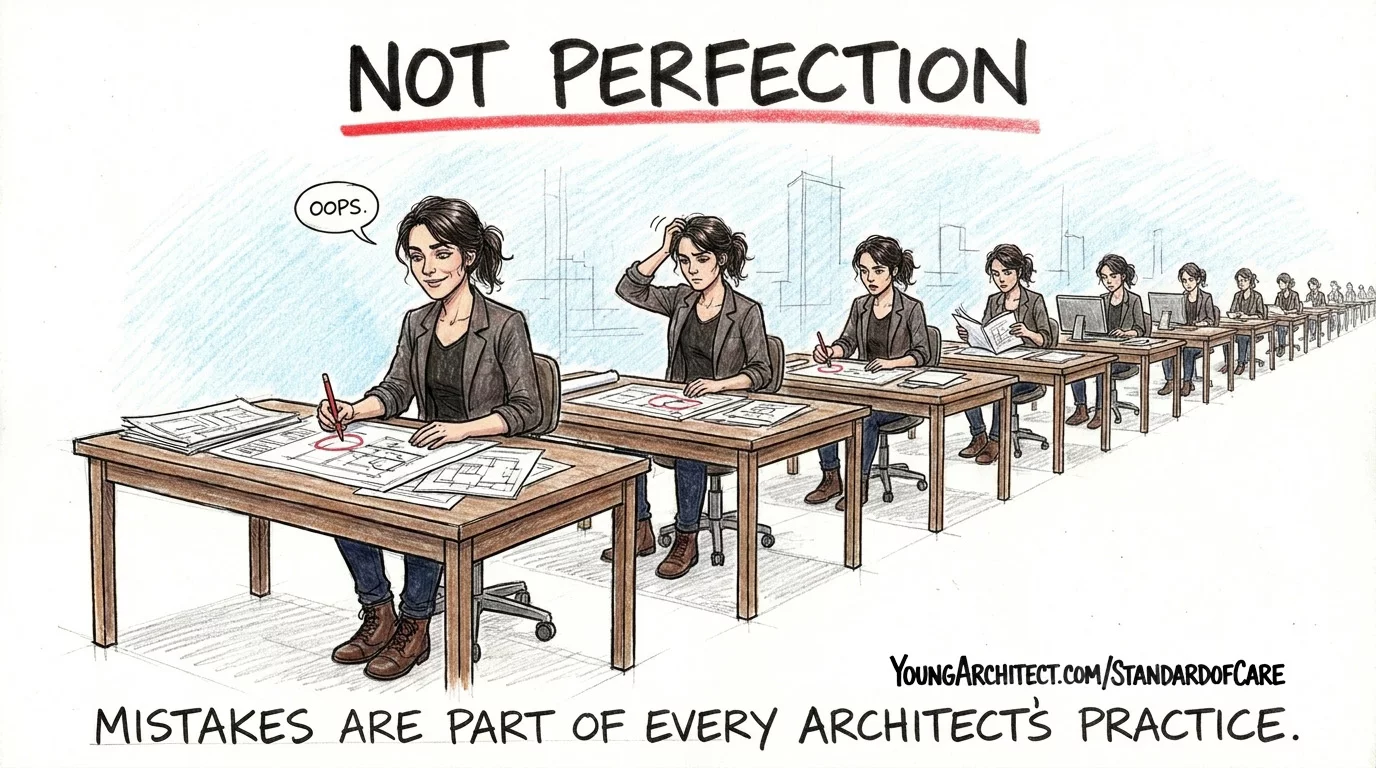
Perfection has never been the standard of care for architectural practice. This was settled law before your great-grandparents were born. Promising your clients perfection is unrealistic and can lead to serious liability problems.
The Chef Analogy: Process Over Outcome
Think of it like a chef at a restaurant. A chef is expected to follow proper cooking techniques and food safety protocols. Separate cutting boards for raw meat and vegetables. Proper hand washing. Correct cooking temperatures.
A slightly overcooked steak despite proper technique? That’s not negligence. The chef followed the right process. The outcome wasn’t perfect, but the process was sound.
Now picture a chef cutting raw chicken on the same board as salad greens with no hand washing in between. That’s negligence. The process itself was below the acceptable standard, regardless of whether anyone got sick.
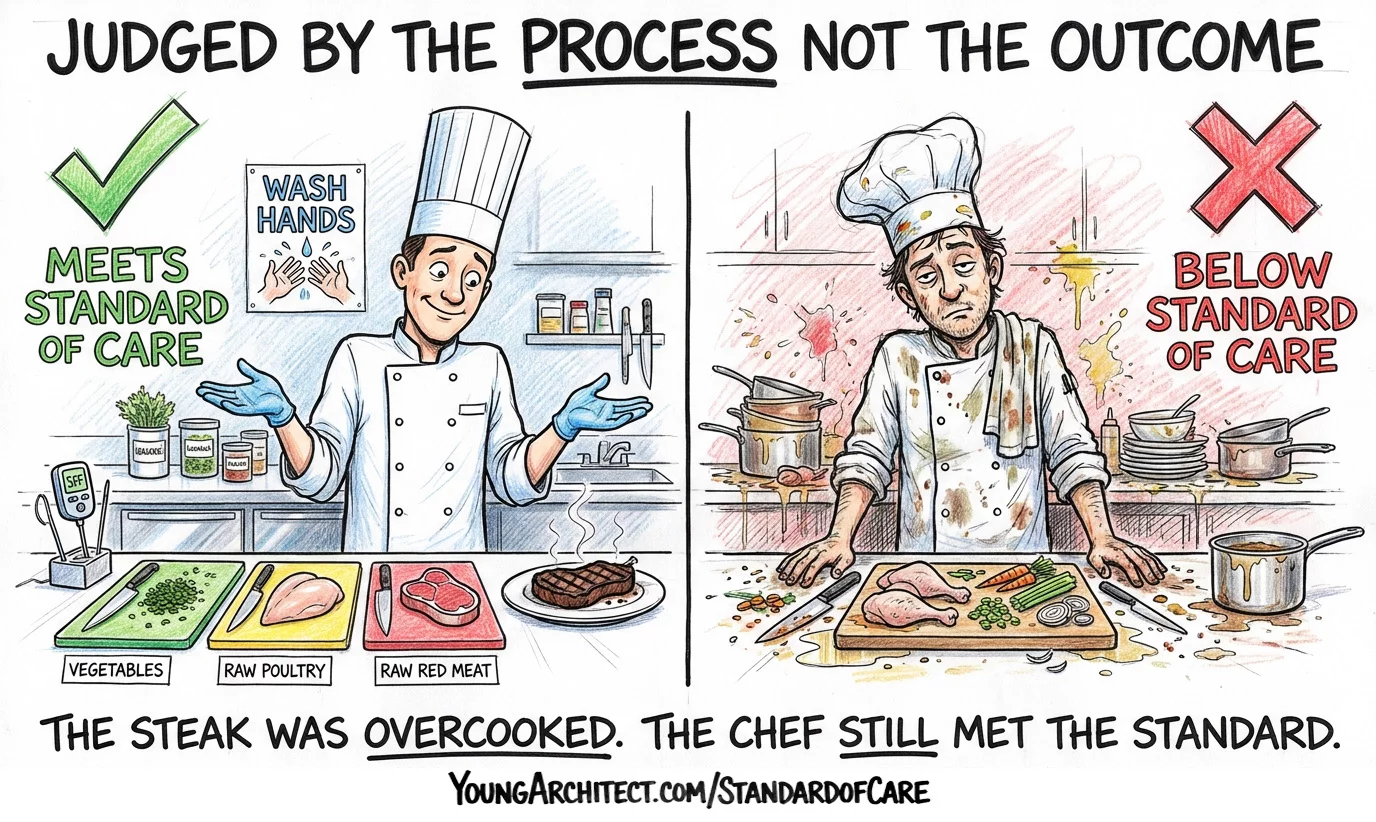
That’s standard of care in architecture: you’re judged by the process, not the outcome. Did you follow reasonable professional procedures? Did you exercise the judgment that a competent architect would use in the same situation?
This concept isn’t exclusive to architecture. Doctors, lawyers, accountants, and other professionals are all held to the same fundamental standard: ordinary competence within their field, not guaranteed perfect outcomes.
Architect Negligence: The Four Elements
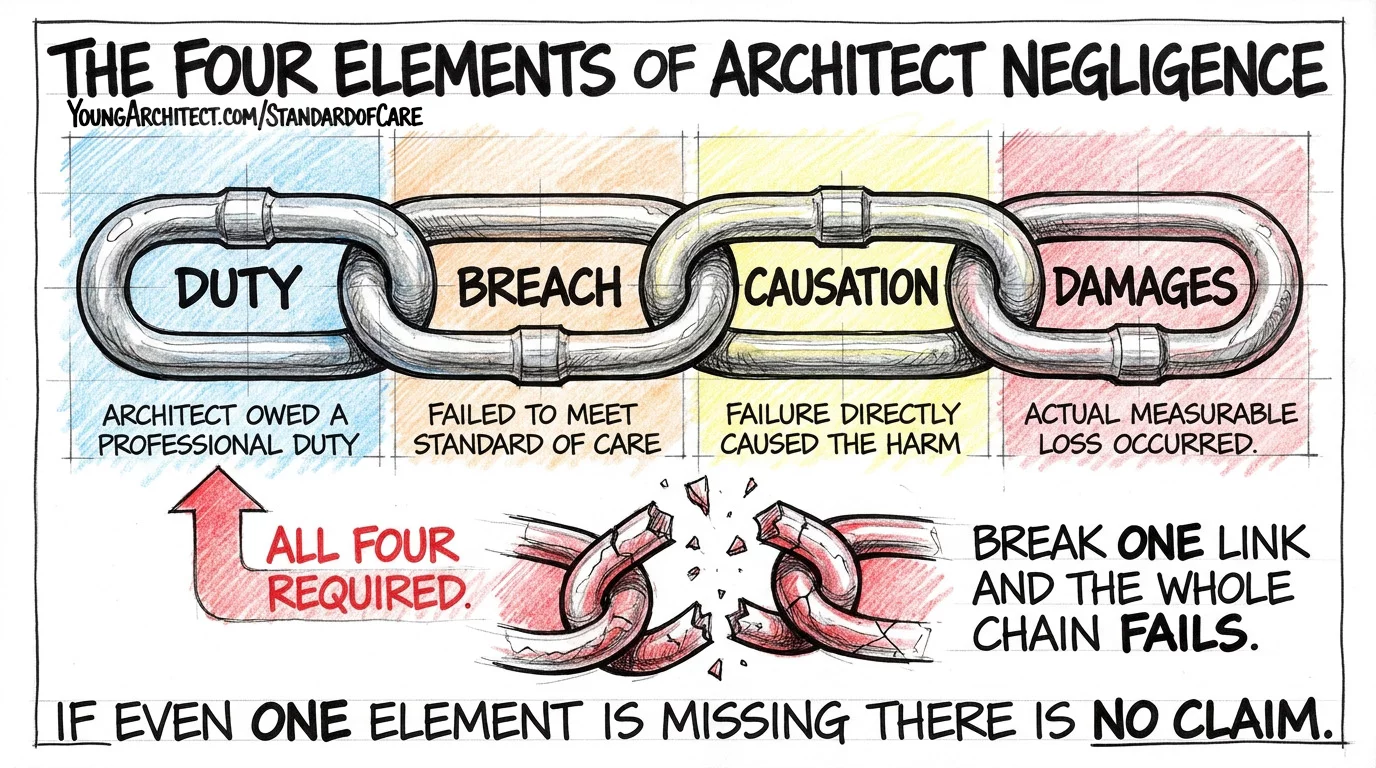
When someone files a professional negligence claim against an architect, four elements must all be proven for the claim to succeed. Think of them as four links in a chain. Break one link, and the entire claim falls apart.
- Duty: The architect owed a professional duty to the claimant. This is usually established through the contract itself.
- Breach: The architect failed to meet the standard of care. Not that they made a mistake, but that they performed below what a reasonably competent architect would have done.
- Causation: That failure directly caused the harm. There has to be a clear connection between what the architect did (or didn’t do) and the resulting problem.
- Damages: Actual, measurable harm occurred. The claimant has to prove real financial loss, not just dissatisfaction.
This is a critical concept for ARE candidates, especially in PcM 101 and CE content where architect professional liability questions come up frequently.
For a deeper dive into how each element gets applied in real negligence claims, check out AIA’s breakdown of how standard of care is applied in professional negligence.
Perfection vs. Standard of Care
The most dangerous misunderstanding in architecture is confusing professional competence with guaranteed perfection.
Every Building Is a Prototype
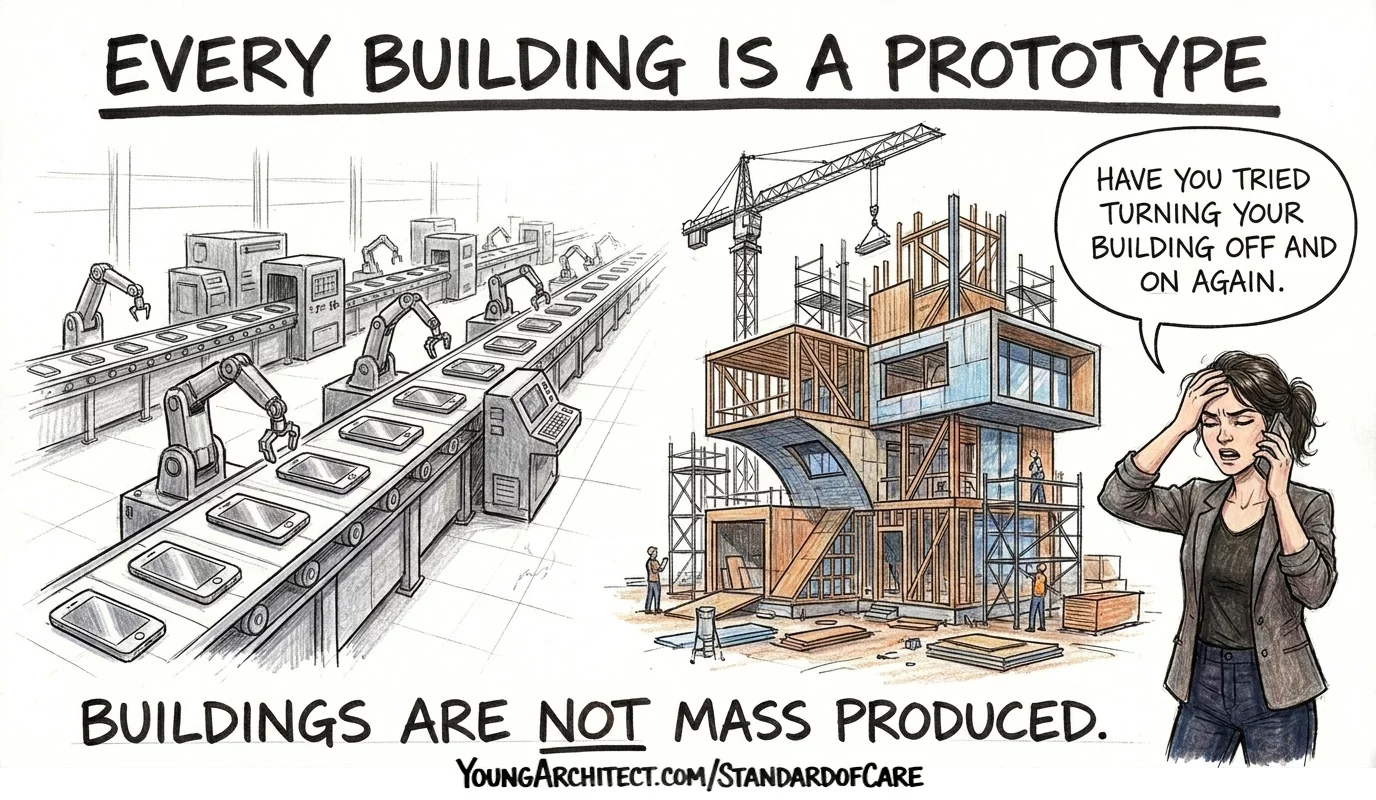
Many clients approach architecture projects with a product mindset. They expect architectural services to work like buying a smartphone that comes with a warranty and guaranteed performance. This leads to expectations of flawless plans and zero construction issues.
Architecture operates differently. It’s a professional service, similar to medical care or legal counsel.
Each building represents a custom prototype that’s never been constructed exactly that way before. Unlike mass-produced products that benefit from thousands of iterations and refinements, every architectural project involves unique variables, site conditions, and design challenges that can’t be fully anticipated during design.
The Leaking Wall Example
Here’s a scenario that drives this point home. An architect designs a wall assembly. She researches the climate conditions. She follows the manufacturer’s recommended details. She uses industry-standard waterproofing practices. She coordinates with the structural engineer on the backup wall.
The wall still leaks.
Is she negligent? No. She followed a competent process. She did what a reasonably skilled architect would do under similar circumstances. The outcome wasn’t perfect, but the process met the standard of care. Her documentation proves she exercised reasonable professional judgment at every step.
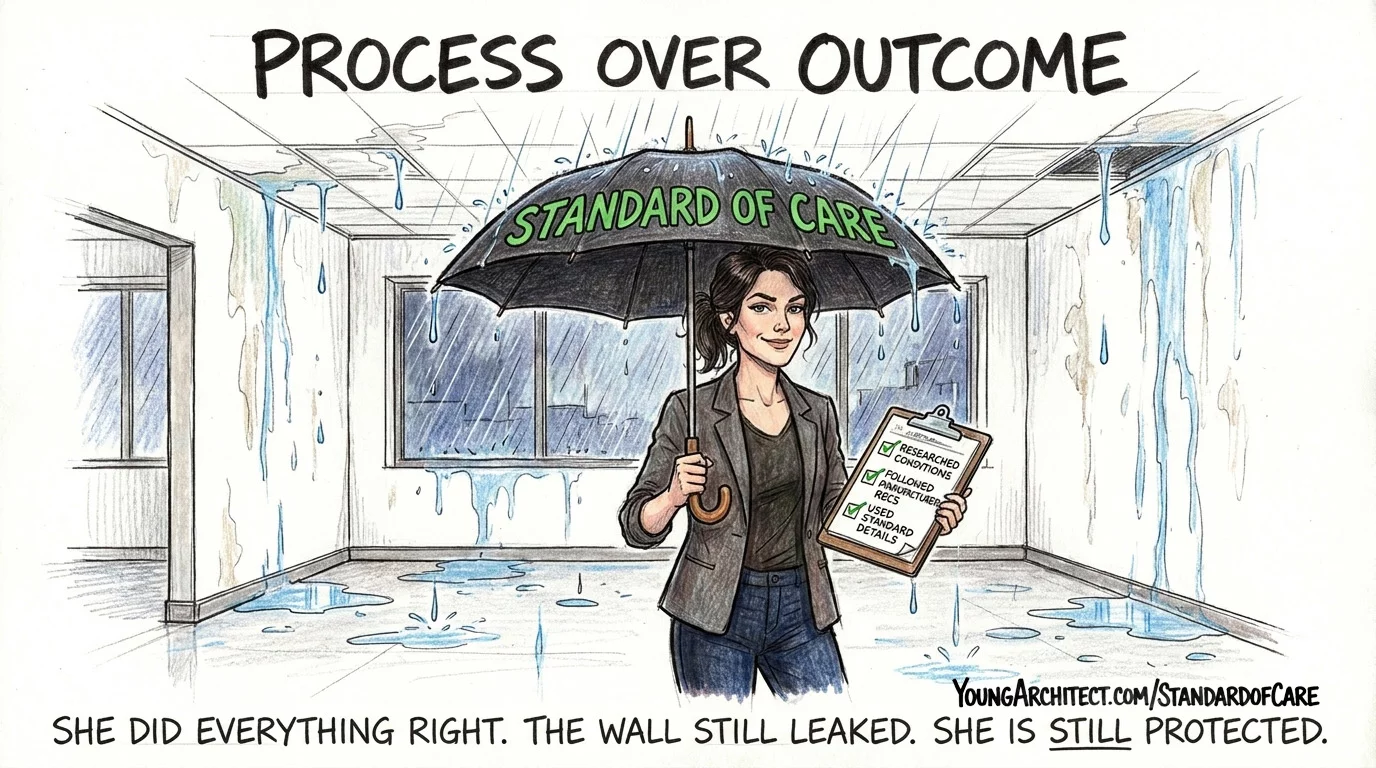
Standard of care protects the architect who does the work correctly, even when the result isn’t perfect. It’s about the process, not the outcome.
What Standard of Care Does NOT Mean
- Error-free documents: Impossible for complex, custom designs
- Perfect outcomes: Not guaranteed in professional services
- Zero change orders or RFIs: Normal part of the construction process
- Best practices: That’s aspirational, not legally required
What It DOES Mean
- Reasonable competence: Performing like a typical qualified architect
- Professional diligence: Following established processes and procedures
- Industry norms: Doing what peers would do in similar circumstances
- Sound judgment: Making decisions based on professional knowledge and experience
There’s an important distinction here. Standard of care is the legal floor. It’s what you’re required to meet. Best practices are aspirational. They represent what’s ideal, not what’s legally mandated.
An architect who doesn’t follow every best practice isn’t automatically negligent. Negligence only occurs when performance drops below the standard of care, which is a lower and more realistic bar than industry best practices.
Contingency Funds Prove the Point
Here’s more proof that perfection was never the expectation. Every well-managed construction project includes contingency funds in the budget. For new construction, a contingency of 5 to 10 percent is typical. For renovations involving existing conditions, contingencies run 7 to 10 percent or higher due to the greater unknowns.
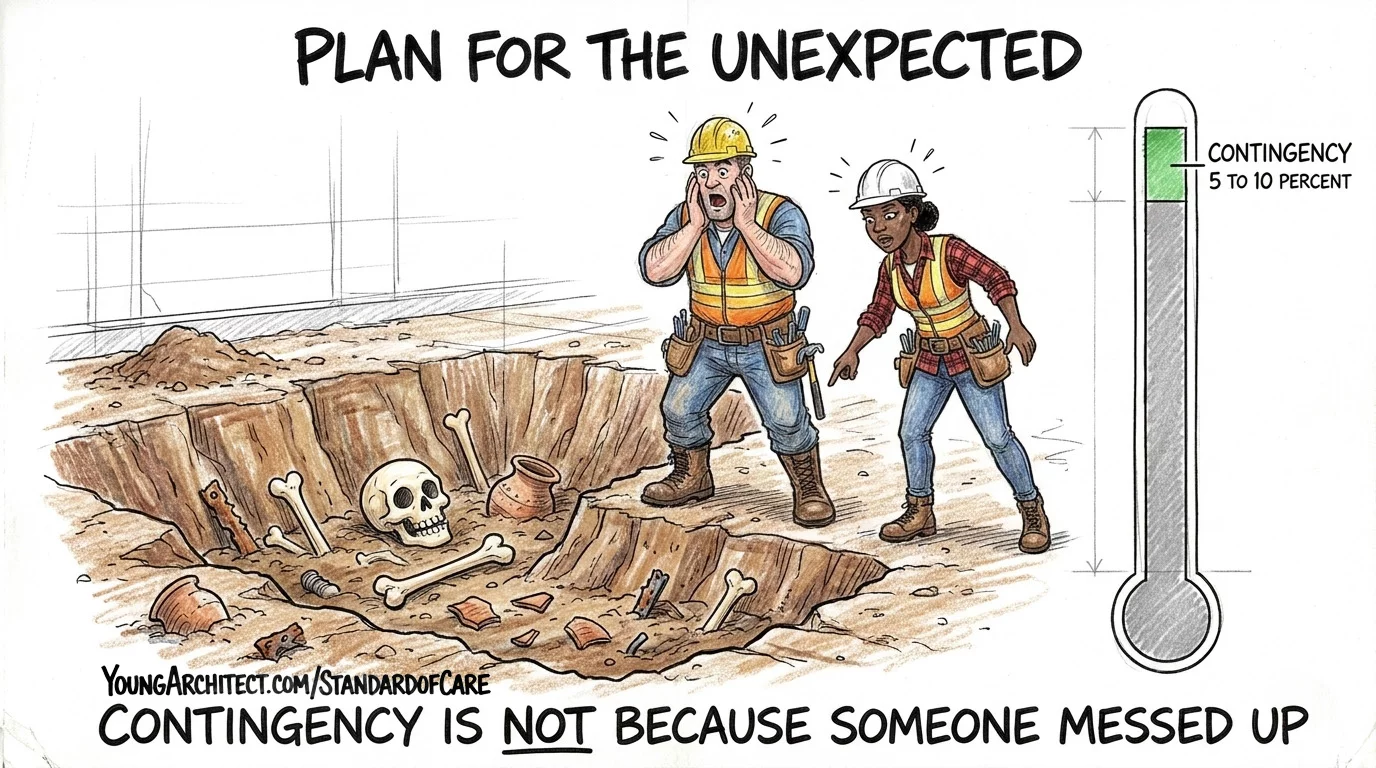
These funds exist because the entire industry acknowledges that no set of construction documents can anticipate every condition. Contingency isn’t an admission of failure or poor design. It’s a built-in recognition that construction involves uncertainty, and that the standard of care does not require predicting the unpredictable.
If you want to understand how construction contingency funds are structured and managed across different project phases, that post breaks down the three distinct types and how they decrease as design progresses.
When clients expect perfection and architects fear any mistake constitutes negligence, projects become adversarial instead of collaborative. Understanding that some level of refinement and adjustment is normal, including managing change orders as part of the natural project evolution, creates better outcomes for everyone.
Understanding how architect insurance actually protects you when standard of care claims arise is also crucial. Coverage assumes you’ll be held to ordinary professional standards, not impossible perfection.
How AIA Contracts Protect Your Standard of Care
Standard AIA contract language serves as your legal safety net, establishing realistic expectations and protecting you from unreasonable claims.
The Contract Language That Matters
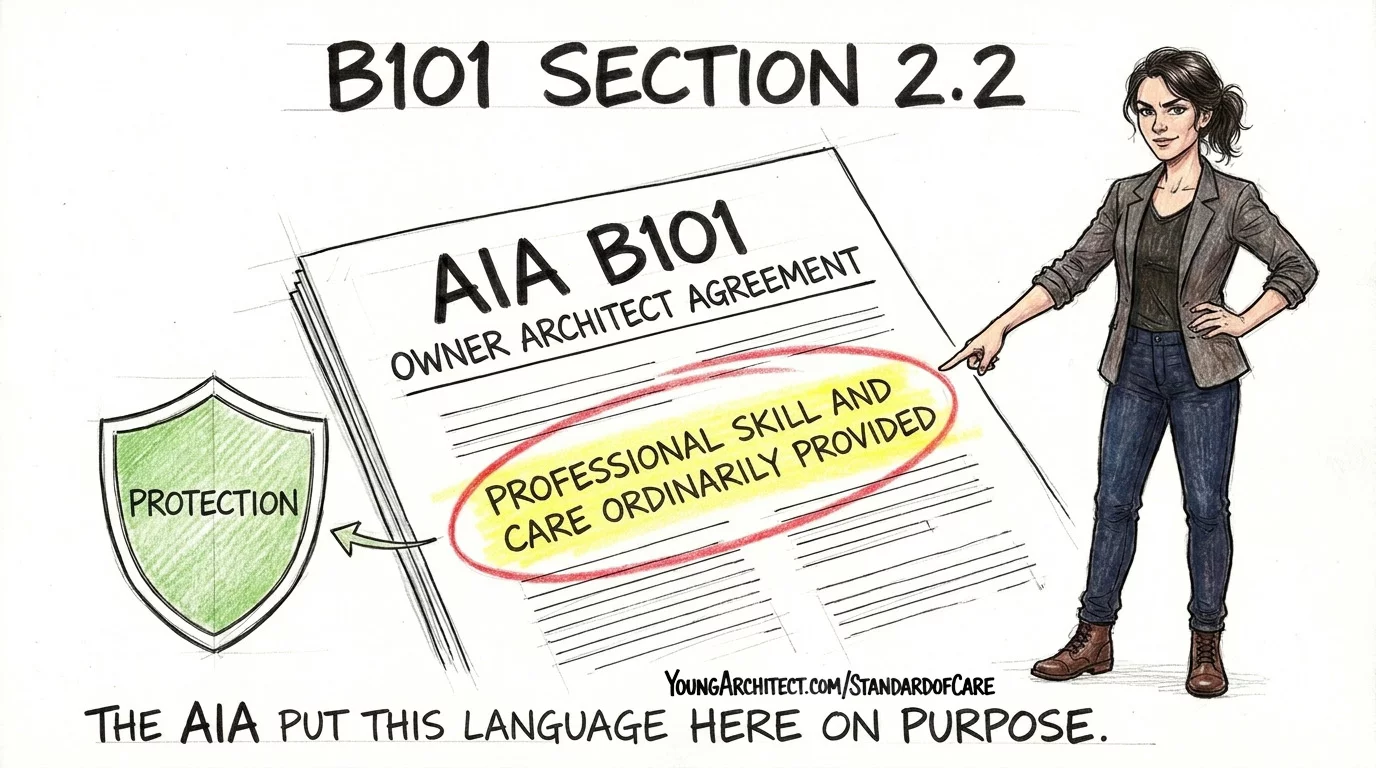
AIA B101 Section 2.2 explicitly defines your obligation:
“The Architect shall perform its services consistent with the professional skill and care ordinarily provided by architects practicing in the same or similar locality under the same or similar circumstances.”
The AIA didn’t bury this language in a footnote. It’s in Section 2.2 for a reason. It’s one of the first things established in the owner-architect agreement because it sets the foundation for every obligation that follows.
One Standard Across All Contracts
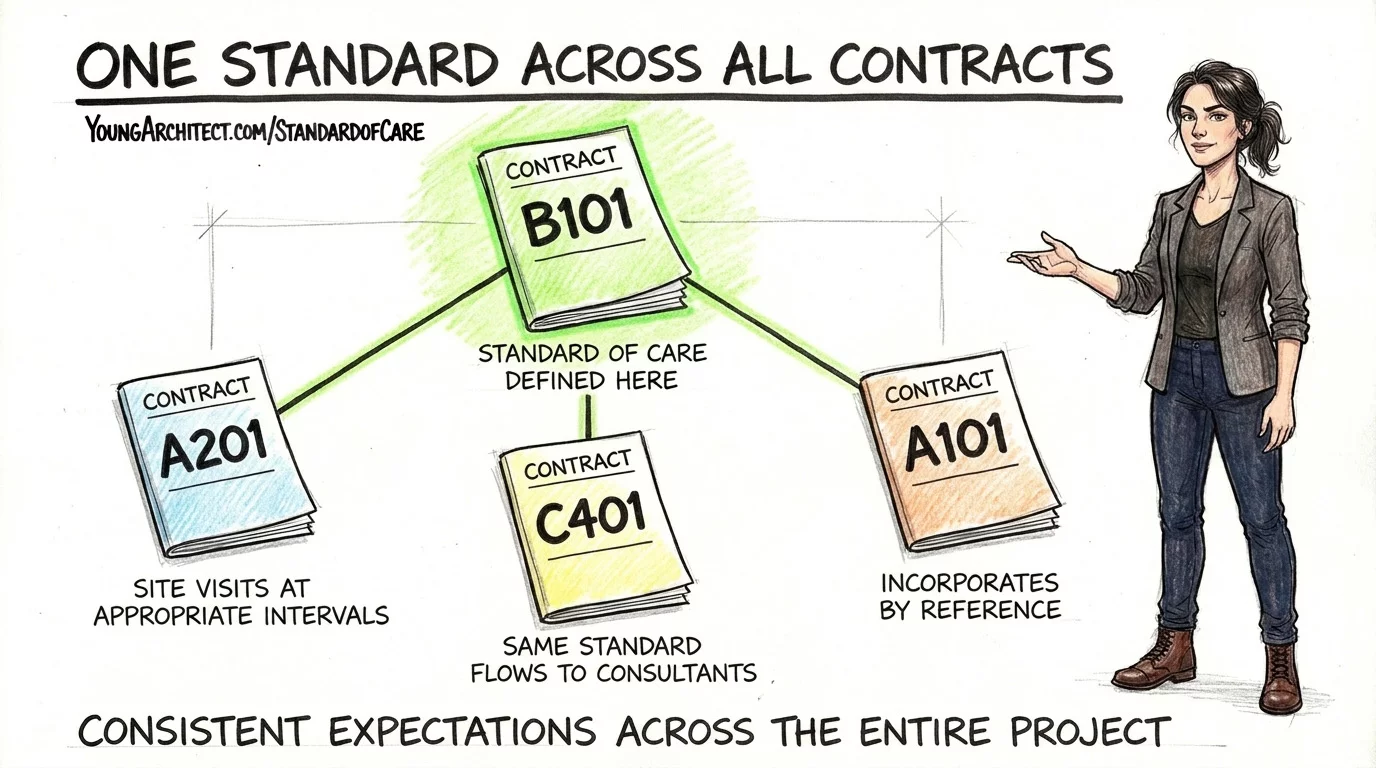
This language flows through the entire AIA contract family, creating consistent expectations across the entire project:
- B101 defines the standard of care in the owner-architect agreement
- A201 governs your construction administration role with the same reasonable standard
- C401 ensures consultants operate under the same professional standard
- A101 incorporates these principles for the overall project framework
What Happens Without Proper Contract Language
Without standard language, clients might later claim you promised:
- “Perfect” or “error-free” documents
- Guaranteed project outcomes
- Performance beyond industry norms
Your professional liability insurance assumes ordinary standard of care. Choosing the right business entity type for your architecture practice can provide additional liability protection when standard of care claims arise. But agreeing to higher standards through contract language can void coverage when you need it most.
Real-World Protection Example
Consider two identical projects with similar coordination issues during construction.
The difference? Contract language.
Architect A uses standard AIA B101 language. When a minor duct-beam conflict arises, the architect provides a solution, and the owner pays for the field change as a normal part of construction. The standard of care was met.
Architect B agreed to “highest professional standards” in a modified contract. The same coordination issue becomes grounds for a breach of contract claim because the contract promised performance beyond ordinary professional competence. The client demands the architect pay for all change order costs.
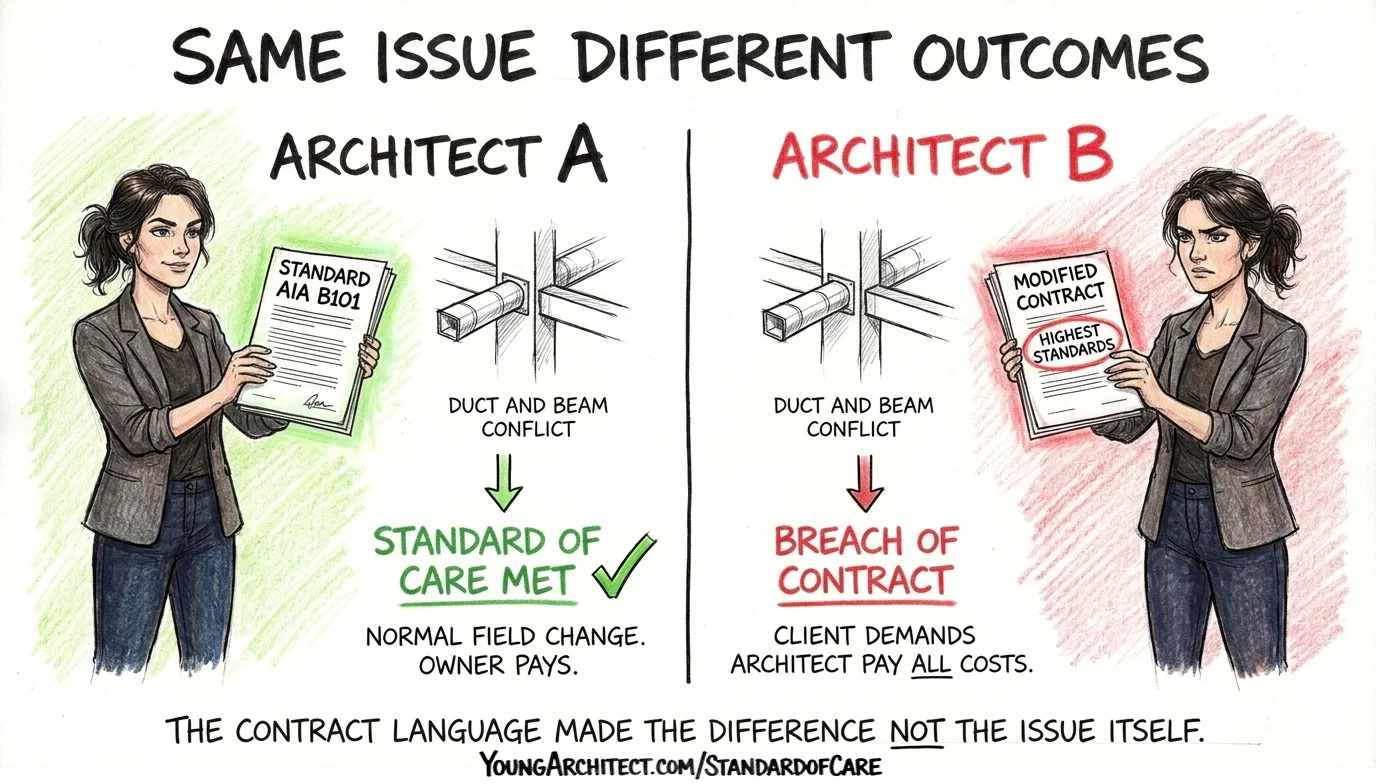
Same issue. Dramatically different outcomes. All because of contract language.
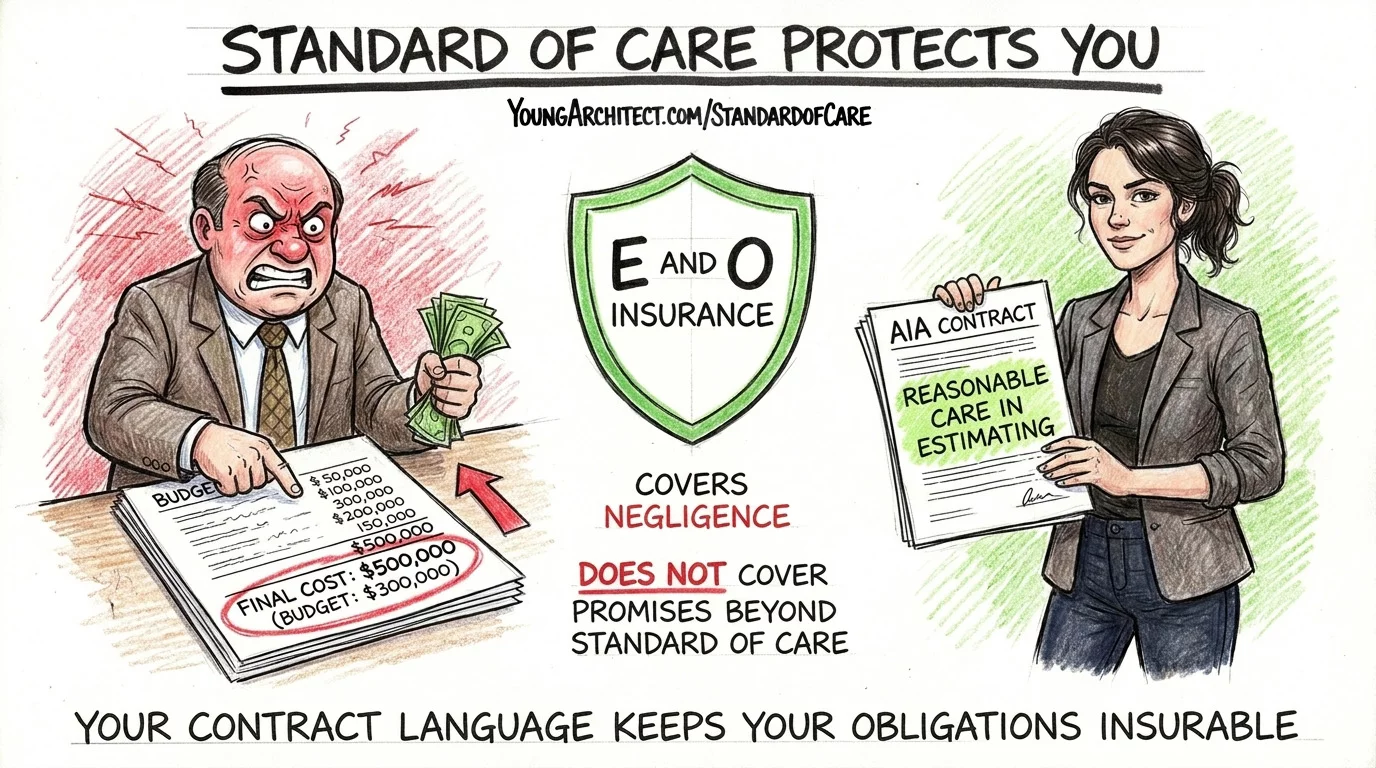
This is especially relevant when it comes to project costs. Construction cost estimates carry inherent uncertainty at every phase, and accuracy improves as design develops, but it’s never exact. Standard AIA language protects the architect who uses reasonable care in estimating, not the architect who guarantees a final number.
Elevated Standard of Care: Dangerous Contract Language
Well-meaning architects often accidentally create liability nightmares by agreeing to language that sounds flattering but creates legal problems.
Red Flag Contract Language
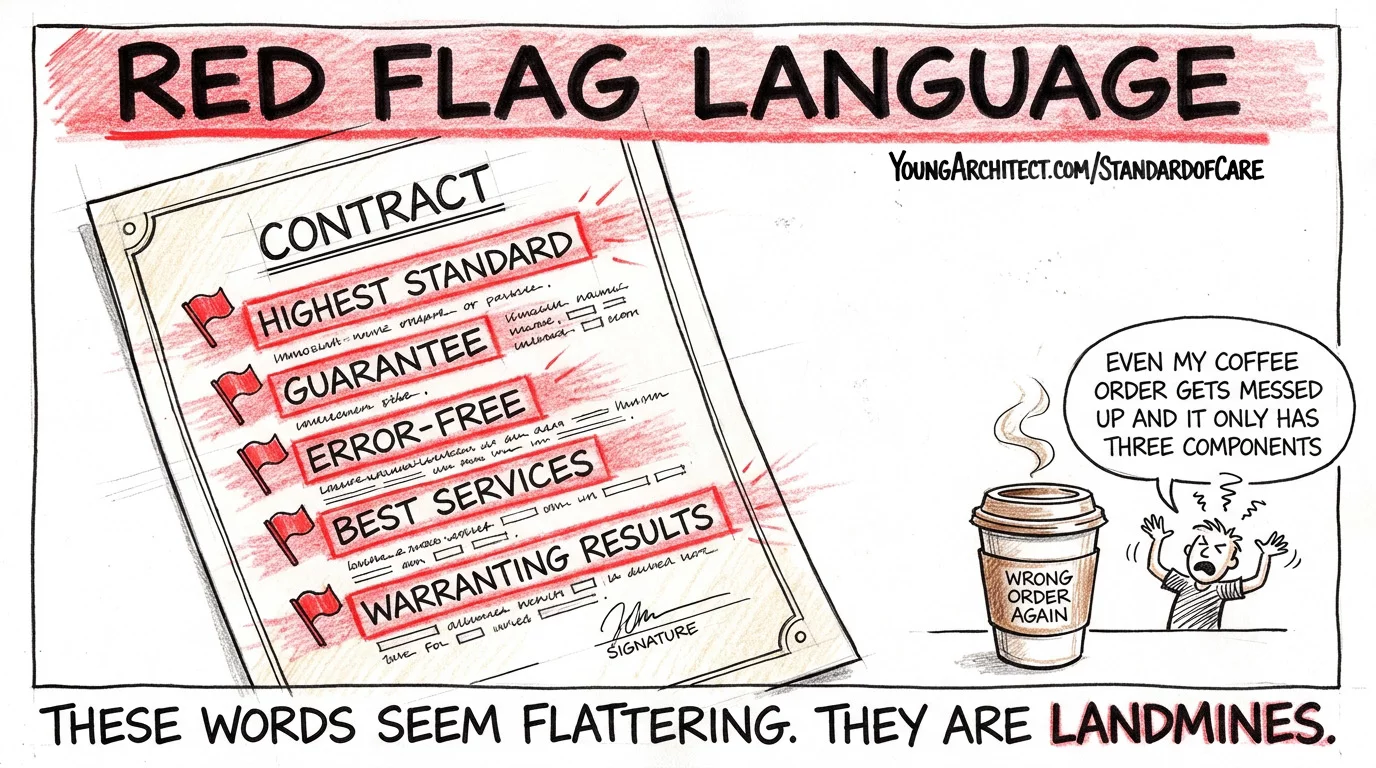
Watch for these terms that elevate your standard beyond the insurable norm:
- “Highest standard” or “best efforts”
- “Error-free documents” or “perfect performance”
- “Guarantee” or “ensure” specific outcomes
- “State-of-the-art” or “superior” services
- “Warrant” any results
These words seem flattering. They’re landmines.
How You Accidentally Elevate Your Standard
Beyond contract language, architects can inadvertently raise expectations through their own marketing and behavior.
Marketing Materials and Proposals:
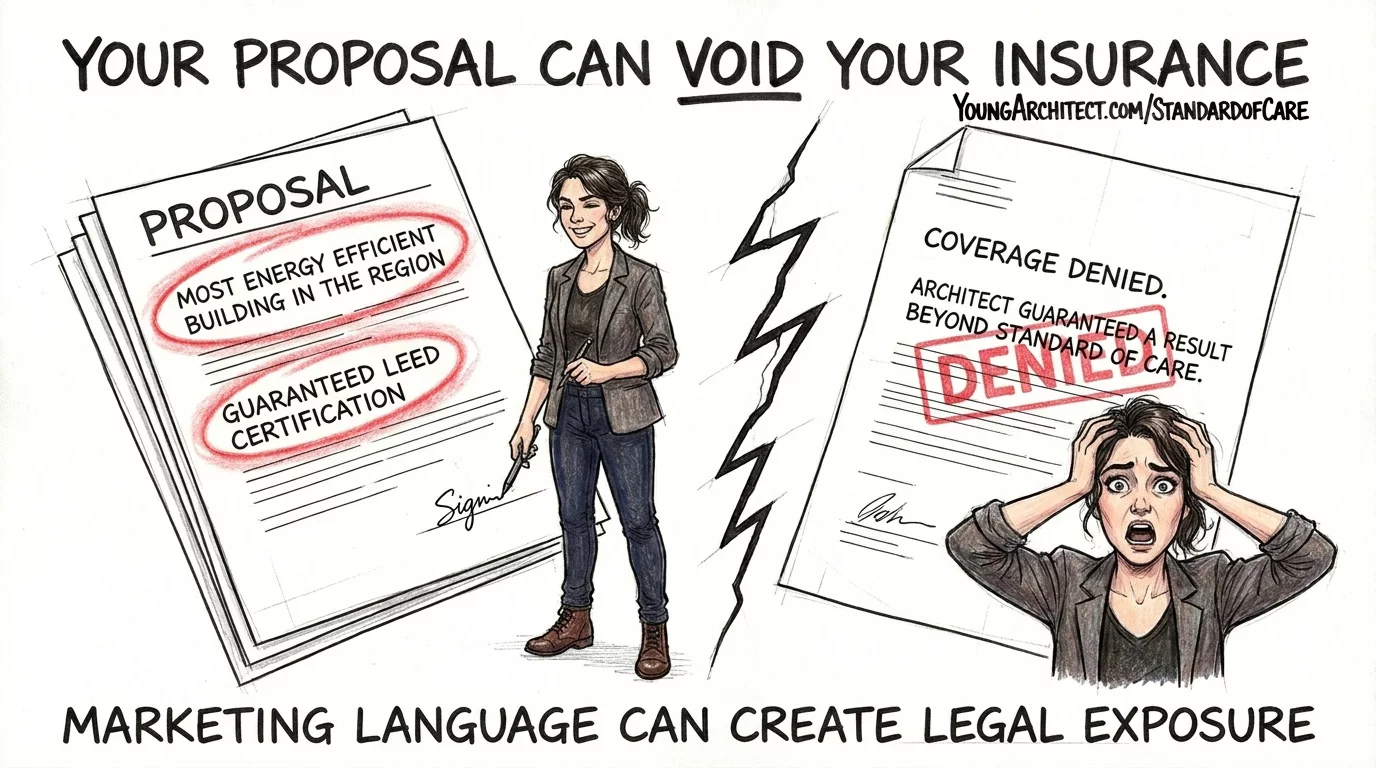
Proposals promising problematic language create contractual obligations beyond ordinary professional care. Compare these:
Dangerous: “We guarantee the most energy-efficient design in the region”
Safe: “We will design with energy efficiency as a primary consideration”
Dangerous: “100% LEED Platinum certification assured”
Safe: “We will target LEED Platinum certification”
Specialized Expertise Claims: Positioning yourself as an expert in sustainable design may hold you to specialist standards, not general practitioner standards.
Scope Creep: Taking on responsibilities typically handled by contractors (like supervising means and methods) can create new duties you never intended.
Specific Performance Promises: Guaranteeing energy savings percentages or specific project costs creates contractual obligations that go beyond the standard of care.
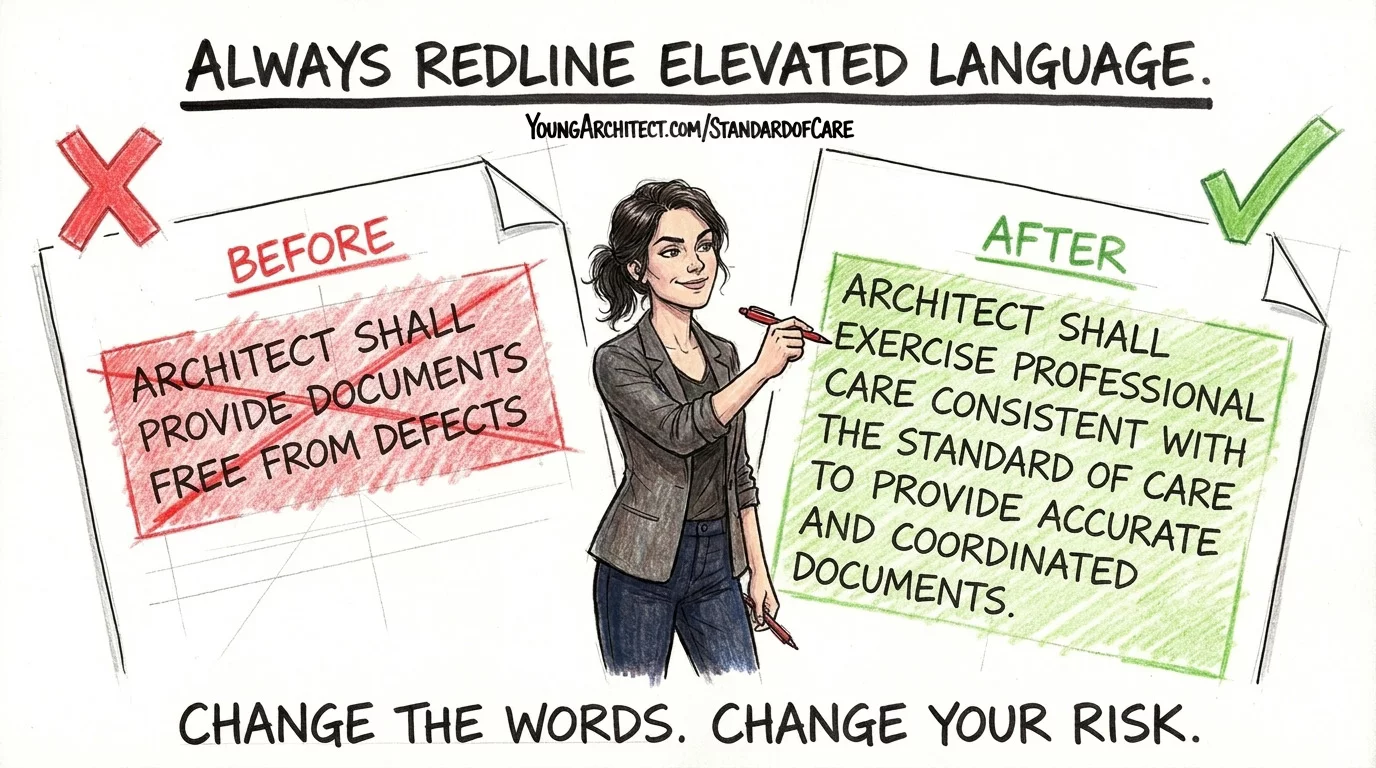
Always Redline Elevated Language
When you see elevated language in a contract, redline it immediately. Replace it with standard of care language that keeps your obligations insurable.
The AIA Code of Ethics and Professional Conduct reinforces this framework. Rule 1.101 requires “a consistent pattern of reasonable care and competence,” using the same ordinary standard framing. The ethical obligation and the legal standard align: reasonable care, not impossible perfection.
The Insurance Problem
Here’s the critical issue: professional liability insurance covers negligence, which means failing to meet the ordinary standard of care. This type of coverage is also called errors and omissions (E&O) insurance, and it’s specifically designed for the mistakes and oversights that happen in complex design work.
Architect errors and omissions coverage does not extend to contractual guarantees of specific outcomes. E&O insurance typically excludes:
- Contractual guarantees beyond the common law standard
- Express warranties of specific outcomes
- Strict liability for any defect regardless of care exercised
Real-World Insurance Denial
An architect agreed to “ensure” a building would achieve 30% energy savings. When the building fell short due to occupant behavior and operational factors beyond the architect’s control, the client sued.
The insurance company denied coverage because the architect had contractually guaranteed an outcome rather than promised reasonable professional care.
The architect faced personal liability despite exercising competent professional judgment throughout the project.
When you promise a specific result instead of reasonable care, your insurance carrier has no obligation to protect you. You’re on your own.
Protection Strategies
- Stick to standard AIA language whenever possible
- Review all contract modifications with your insurance carrier
- Be careful with proposal language: avoid superlatives and guarantees
- When pressured by clients, explain that elevated standards can void insurance protection, ultimately leaving them less protected
- Consult legal counsel before accepting any non-standard performance language
Standard of Care in Daily Practice
Understanding standard of care isn’t just legal theory. It shapes how you approach every aspect of architectural practice from the first code analysis through final construction observation.
Design Phase Applications
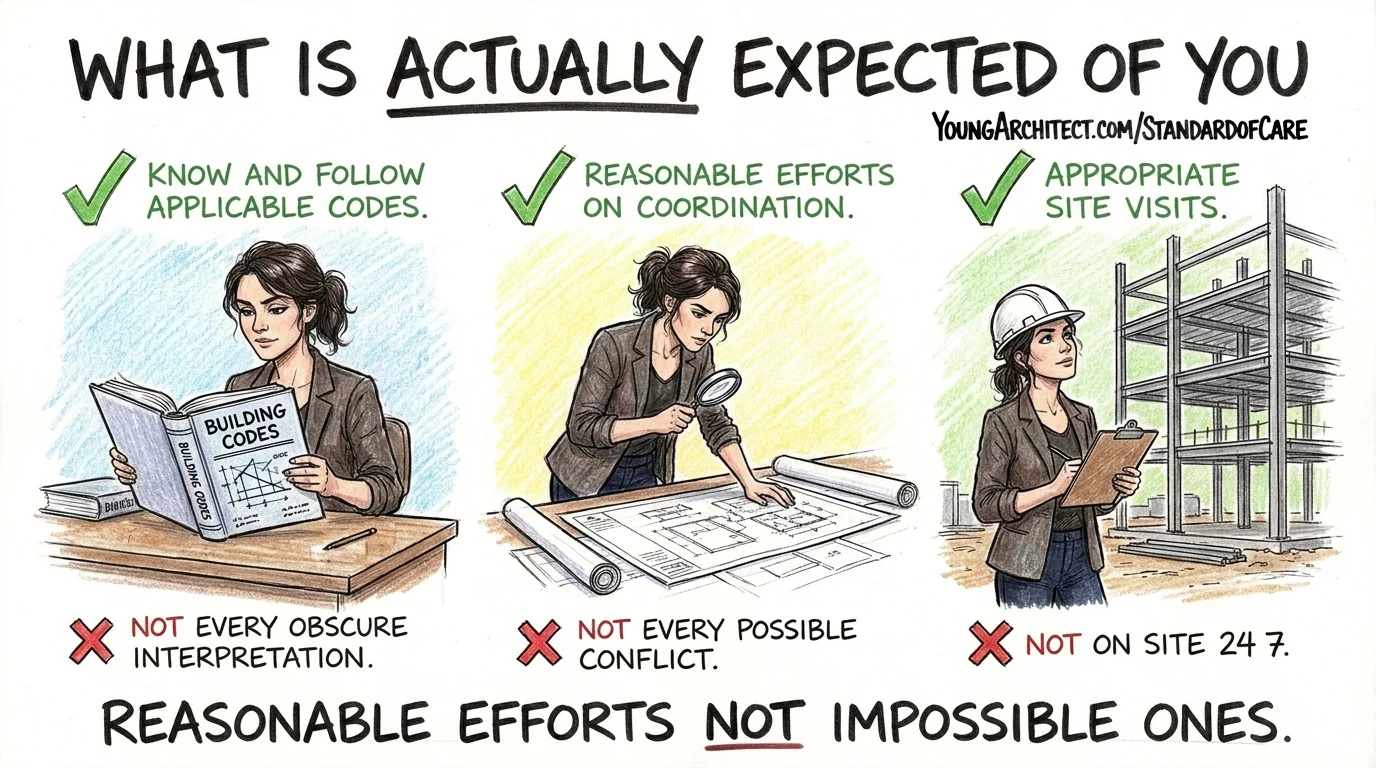
Code Compliance: You must exercise reasonable care to research, interpret, and apply relevant codes. This doesn’t mean guaranteeing zero code issues, but demonstrating diligent research and professional judgment.
Design Coordination: You’re expected to make reasonable efforts to coordinate between disciplines and catch major conflicts. Minor coordination issues that slip through despite reasonable processes don’t automatically constitute negligence.
Client Communication: Documenting design decisions, client approvals, and project constraints shows you’re exercising professional care in managing the design process.
Construction Administration Standards
Site Visits: A201 requires “visits at appropriate intervals,” not continuous supervision. What’s “appropriate” depends on the project type, complexity, and phase of construction.
Submittal Review: Managing construction submittals through the complete review process means reviewing for general conformance with design intent, not guaranteeing contractor performance or verifying every manufacturer specification.
RFI Responses: Timely, professional responses to requests for information, with clear documentation of decisions and rationale.
Stay on Your Side of the Line
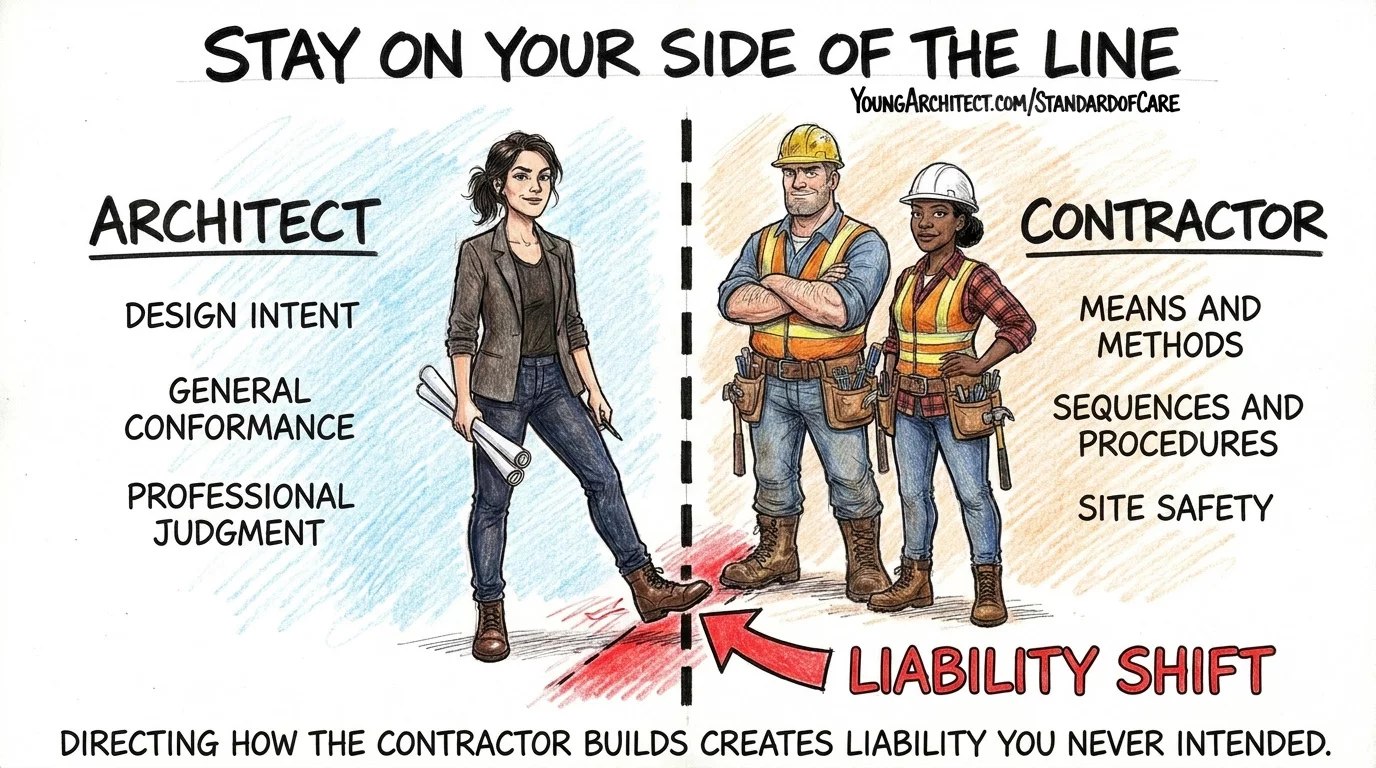
Means and Methods is a critical boundary. AIA A201 explicitly states the architect is not responsible for the contractor’s means, methods, techniques, sequences, or procedures of construction, and not responsible for job site safety.
An architect who starts directing how the contractor builds something accidentally takes on contractor liability and elevates their own standard of care. If you tell a contractor how to shore a trench or sequence a concrete pour, that’s a liability shift you never intended.
Documentation Is Your Best Defense
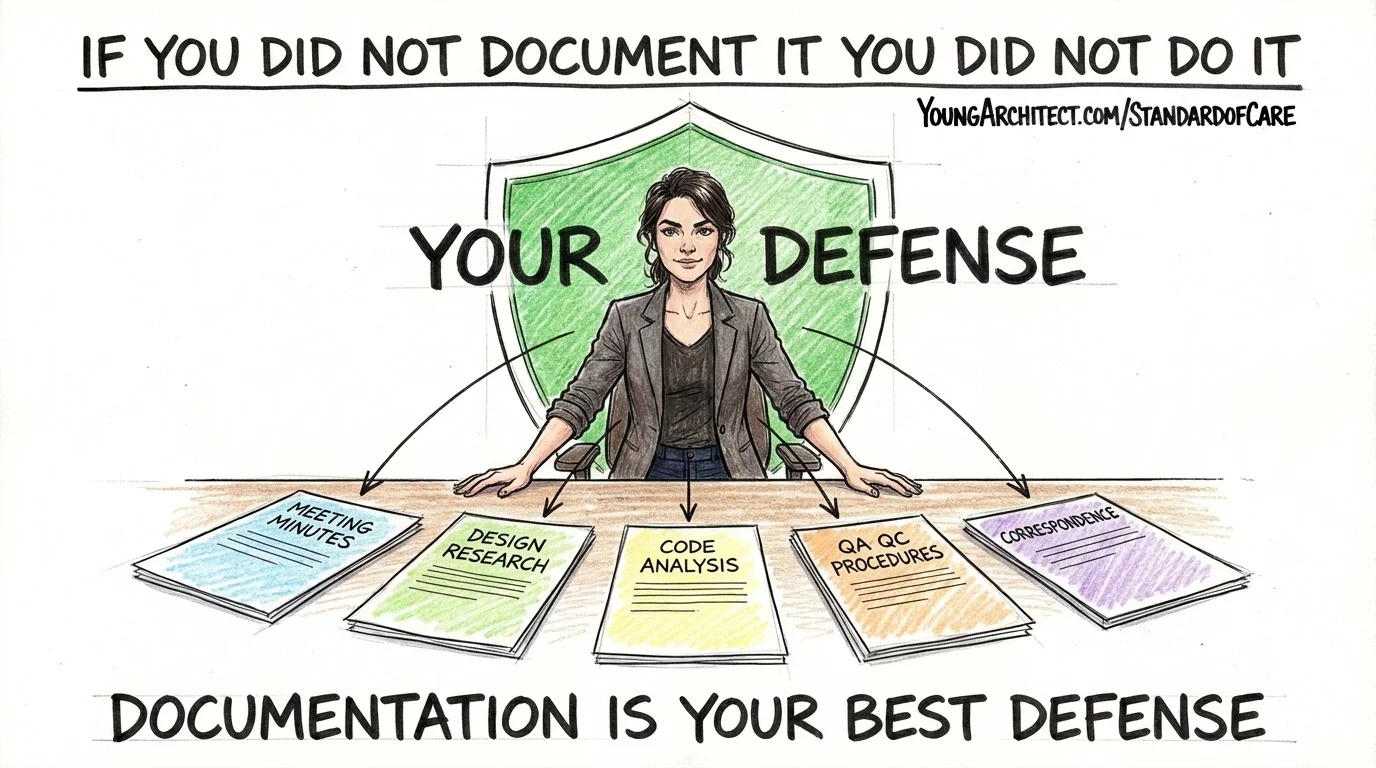
The best defense of your standard of care is showing your work. Documentation proves you exercised reasonable professional judgment, even when things don’t go perfectly.
If you didn’t document it, you didn’t do it.
Meeting Minutes: Record key decisions, client directions, and project milestones.
“Client approved Option B after architect explained the cost and performance implications of each alternative.”
Design Rationale: Document why specific approaches were chosen, alternatives considered, and client input received.
“Structural system selected based on seismic requirements, budget constraints, and owner’s operational preferences as discussed in the March 15 meeting.”
Code Analysis: Show your research process, interpretations made, and consultations with authorities having jurisdiction.
Consultant Coordination: Track information exchanges, coordination meetings, and conflict resolutions to demonstrate systematic professional communication.
Quality Control Records: Evidence of peer reviews, checking procedures, and systematic quality management.
Common Practice Scenarios
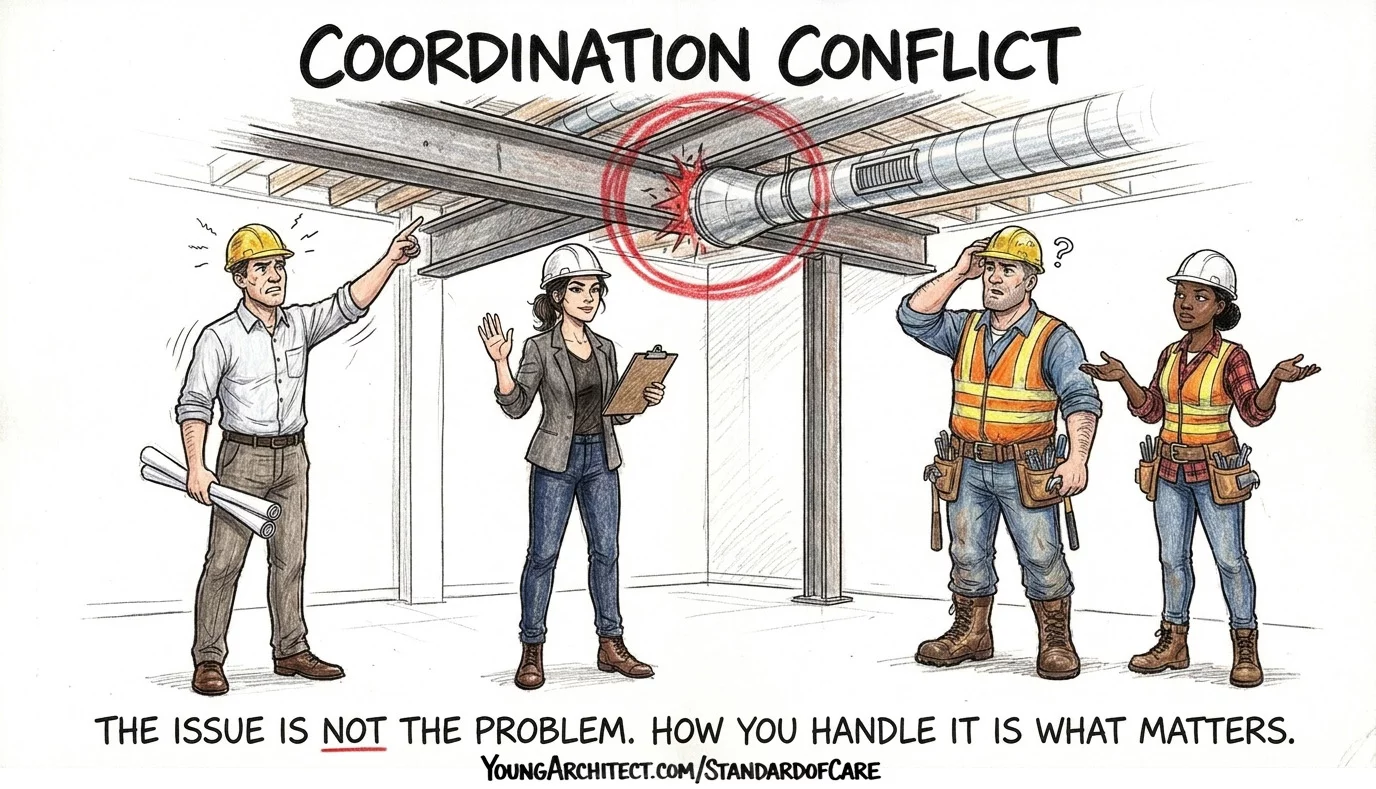
Beam-Ductwork Conflict During Construction
If structural and mechanical systems conflict in the field, the architect who meets the standard of care acknowledges the issue promptly, researches solutions with the design team, provides clear resolution options, and documents the decision-making process thoroughly. The conflict itself doesn’t indicate negligence. It’s how you handle it professionally.
Client Cost-Cutting Requests
When clients want to eliminate fire-rated assemblies or other safety features to save money, documenting your professional recommendation and their informed decision protects both parties. Your obligation is to advise, not control the final decision. Understanding fire-rated wall assemblies and their code requirements helps you articulate exactly why these elements exist.
Unforeseen Site Conditions
When soil conditions differ from available geotechnical reports, foundation changes become a normal part of the project. This isn’t architect negligence. It’s a project reality that requires professional response and clear communication about scope changes.
Quality Assurance Connection
Understanding the complete quality assurance and quality control process directly supports standard of care compliance. Systematic checking procedures, peer reviews, and coordination protocols provide evidence that you’re exercising reasonable professional care.
Quality Assurance (prevention-focused) shows you have procedures in place to meet professional standards before problems occur.
Quality Control (detection-focused) demonstrates you’re catching and addressing issues through systematic review processes.
Together, these create a documented approach that supports your professional standard of care defense while improving project outcomes.
Architect Standard of Care on the ARE Exam
Understanding standard of care is crucial for ARE success because this concept appears across all exam divisions, either directly or indirectly.
Where Standard of Care Appears
To understand how standard of care fits within the bigger picture of the ARE’s professional practice divisions, it helps to first understand the difference between PcM, PjM, and CE and how they each approach similar topics from different angles.
Practice Management (PcM): Direct questions about professional liability, architect insurance, contract terms, and risk management
Project Management (PjM): Scenarios involving client expectations, consultant coordination, and project delivery methods
Programming & Analysis (PA): Exercising proper due diligence during predesign, including establishing realistic budgets, defining appropriate scope, and conducting thorough code assessments
Project Planning & Design (PPD): Standard of care considerations when making early design decisions and balancing client wishes with professional judgment
Project Development & Documentation (PDD): Issues related to document coordination, avoiding common specification writing errors that create liability, and quality control procedures
Construction & Evaluation (CE): Questions about construction administration responsibilities, submittal review, and field observation duties
Key Considerations for ARE Success
When analyzing scenarios on any ARE division, ask yourself: “What would a competent architect typically do in this situation?” rather than “What’s the ideal outcome?”
- Did the architect follow reasonable coordination procedures during design?
- Is this type of field adjustment normal for projects of this complexity?
- How does the architect standard of care apply to document completeness expectations?
- What documentation would support the architect’s professional performance?
Focus on reasonableness, not perfection. Understand the four elements required to prove architect negligence: duty, breach of standard of care, causation, and damages.
Recognize elevated standard language in contract excerpts and identify why certain terms create additional liability.
Putting Standard of Care Into Practice
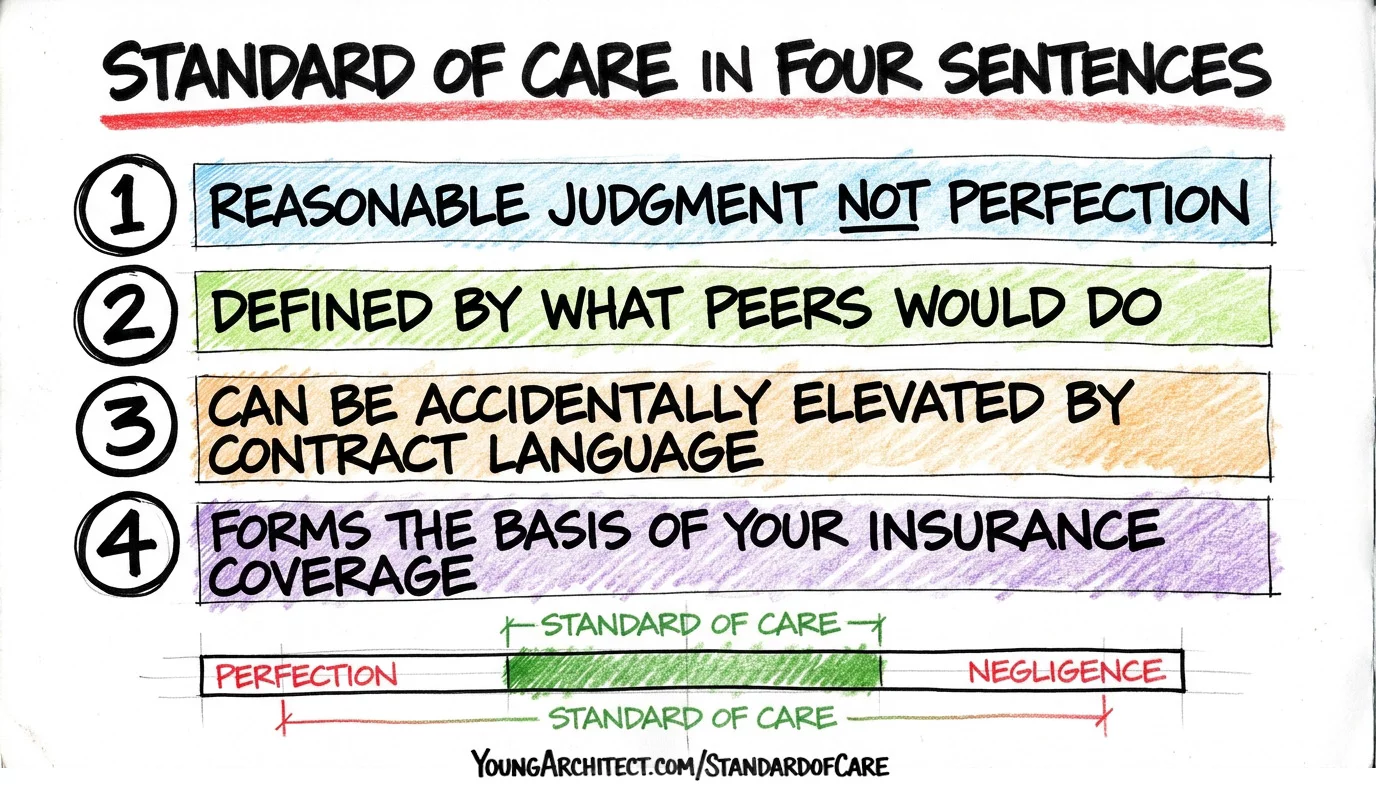
For ARE Candidates
Understand the Definition: Standard of care means ordinary professional competence, not perfection. Focus on what reasonable architects would do in similar circumstances.
Recognize Contract Language: Be able to identify terms that elevate standards (“highest,” “guarantee,” “error-free”) and understand why they’re problematic.
Know the Legal Framework: Understand the four elements required for professional negligence claims and how standard of care serves as the breach benchmark.
Apply Across Divisions: This concept influences questions about project delivery, risk management, construction administration, and client relations.
For Practicing Architects
Use Standard Contract Language: Stick with proven AIA language that aligns with common law and insurance coverage.
Document Your Process: Keep records that show you exercised professional judgment and followed reasonable procedures.
Communicate Expectations: Have honest conversations with clients about the realities of design and construction processes.
Maintain Professional Boundaries: Don’t promise outcomes you can’t control or take on responsibilities outside your expertise.
Action Items for Your Practice
Review Your Contract Templates: Examine current agreements for elevated standard language and replace them with standard AIA terms.
Create a Documentation Checklist: Develop systematic procedures for recording design decisions, client communications, and professional recommendations.
Schedule an Insurance Review: Meet with your professional liability carrier to discuss how your contract language affects coverage and whether your QA/QC procedures qualify for premium discounts.
Update Proposal Language: Review marketing materials and proposals to eliminate guarantees and replace them with professional service commitments.
Building Your Standard of Care Knowledge
Standard of care is the foundation of professional architectural practice. It acknowledges that architecture involves complex judgment calls, unforeseen challenges, and inherent uncertainties while still maintaining high professional standards.
This concept protects the integrity of our profession by establishing realistic benchmarks based on peer performance rather than impossible perfection. It enables innovation and problem-solving by recognizing that reasonable professionals can reach different conclusions and that errors in judgment don’t automatically constitute negligence.
In ARE Boot Camp, we dive deep into these practical applications because understanding standard of care isn’t just about passing exams. It’s about building a foundation for successful, sustainable practice.
Ready to strengthen your understanding of professional practice concepts? Our ARE 101 membership includes comprehensive coverage of standard of care applications across all exam divisions, with practice questions that help you apply these principles to real-world scenarios.
Want to dive deeper into the contract language that defines and protects your standard of care? Our AIA Contracts 101 course breaks down B101, A201, C401, and the other critical contract documents you need to understand for both professional knowledge and daily practice.
For the CE 101 course, we cover how standard of care applies specifically to construction administration, from submittal review to site observations to handling field conflicts.
Frequently Asked Questions
What is the architect standard of care?
The architect standard of care is the level of professional skill and diligence that a reasonably competent architect would exercise under similar circumstances. It does not require perfect work or error-free documents. It requires ordinary professional competence, consistent with what peers would do in the same situation under the same conditions.
What are the four elements of architect negligence?
To prove architect negligence, four elements must all be established: the architect owed a duty to the claimant, the architect breached that duty by failing to meet the standard of care, the breach directly caused harm, and actual measurable damages resulted. If any one of these four elements is missing, there is no liability. Understanding these elements is critical for ARE candidates studying PcM and CE content.
What is the AIA standard of care language in B101?
AIA B101 defines the standard of care as “professional skill and care ordinarily provided by architects practicing in the same or similar locality under the same or similar circumstances.” The key word is “ordinarily,” which means typical, not exceptional. This definition aligns with the common law standard established in the 1896 Beede vs. Coombs case and has remained the legal baseline for measuring architect performance ever since.
What contract language elevates the architect’s standard of care?
Terms like “highest standard,” “guarantee,” “ensure,” “error-free,” “warrant,” and “best efforts” all raise the standard beyond ordinary professional competence. The problem is that professional liability insurance only covers the ordinary common law standard. Agreeing to a higher standard through contract language can void coverage exactly when an architect needs it most, leaving them personally exposed.
What is the difference between standard of care and best practices?
Standard of care is the legal minimum: what a reasonably competent architect would do under similar circumstances. Best practices are aspirational standards that go beyond the legal minimum. An architect who fails to follow best practices is not automatically negligent. Negligence only occurs when performance falls below the standard of care, which is a lower and more realistic bar than industry best practices.
Why do construction projects include contingency funds?
Contingency funds account for the inherent uncertainties in construction. They are not an admission of failure or poor design. For new construction, a contingency of 5 to 10 percent is typical. For renovations involving existing conditions, contingencies run 7 to 10 percent or higher due to the greater unknowns. These funds reflect the reality that no set of construction documents can anticipate every condition and that the standard of care does not require perfection.