



















ARE 5.0 Mechanical Systems Exam Prep

Master Mechanical Systems for PPD and PDD Success

We break down intimidating HVAC systems into clear, practical knowledge that helps you pass PPD and PDD exams with confidence.

*Pictures of our actual students

Our Students Are Now Registered Architects at These Firms:

Conquer PPD and PDD With HVAC Mastery

Our proven method transforms complex mechanical systems into understandable concepts you can apply immediately.

Picture yourself walking into PPD and PDD exams completely confident with every HVAC question.

That’s exactly what happens.

Mechanical Systems Topics You'll Master:

Understanding heat transfer fundamentals including psychrometric charts and thermal comfort principles

Mastering HVAC equipment from chillers and boilers to air handling units and VRF systems

Learning system configurations including central vs. local and all-air vs. all-water approaches

Applying ventilation strategies with energy recovery and heat recovery systems

Connecting theory to practice with real building examples and interactive problem-solving

Your Complete Mechanical Systems Toolkit

Everything you need to master HVAC for ARE exam success.

NCARB-Focused Video Lessons

10+ hours of expert instruction covering equipment, systems, and ventilation strategies

Heat Transfer Fundamentals

Build your foundation with psychrometric charts, sensible vs. latent heat, and thermal comfort principles

System Analysis Framework

Learn to evaluate central vs. local systems and all-air vs. all-water approaches with detailed diagrams

Equipment Deep Dives

Master chillers, boilers, air handling units, heat pumps, and VRF systems with clear explanations

Digital Flashcards

Mobile-friendly study materials for key mechanical systems terminology

Interactive Learning Sessions

Engage through Q&A, diagram analysis, and step-by-step problem solving
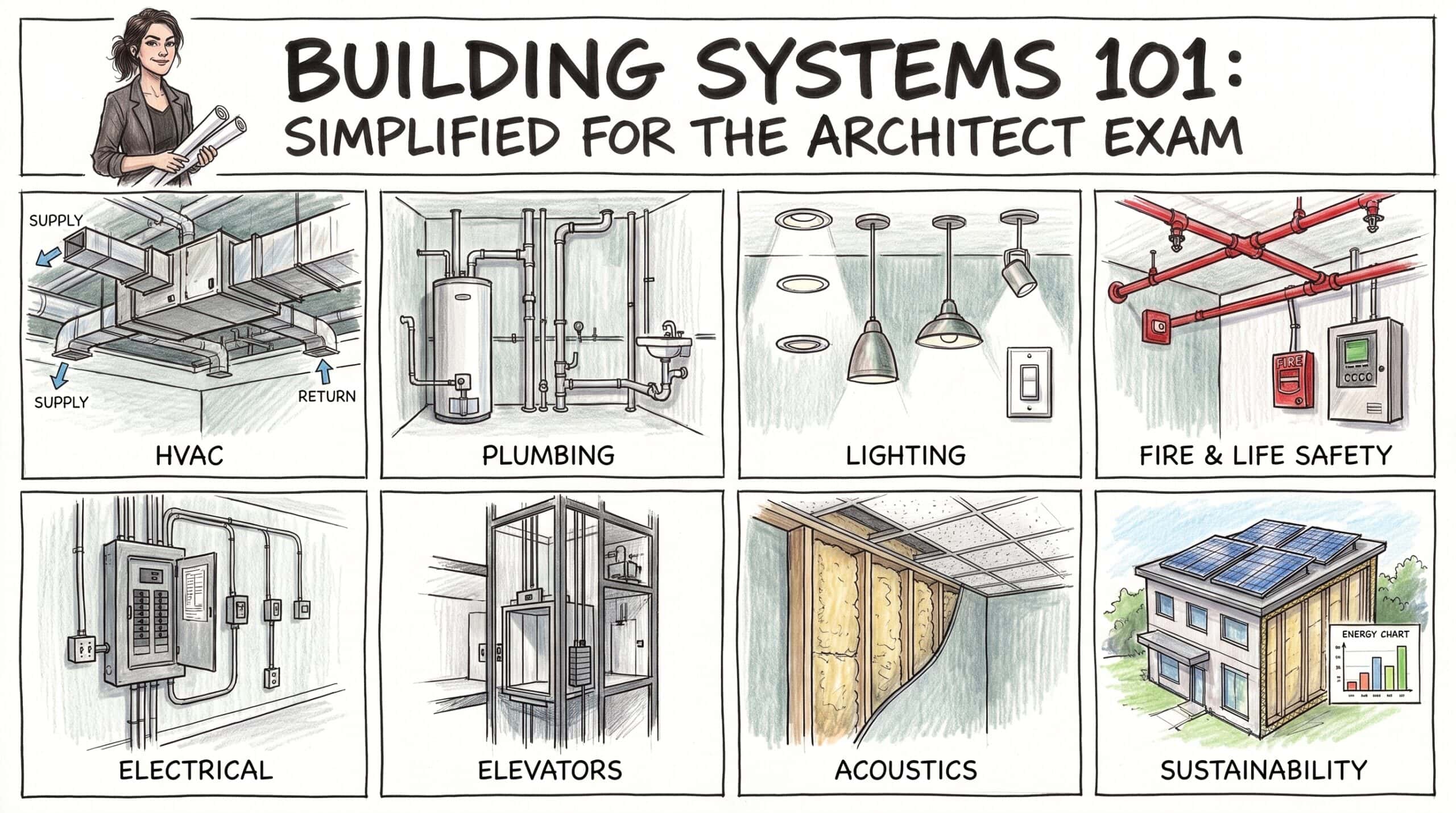
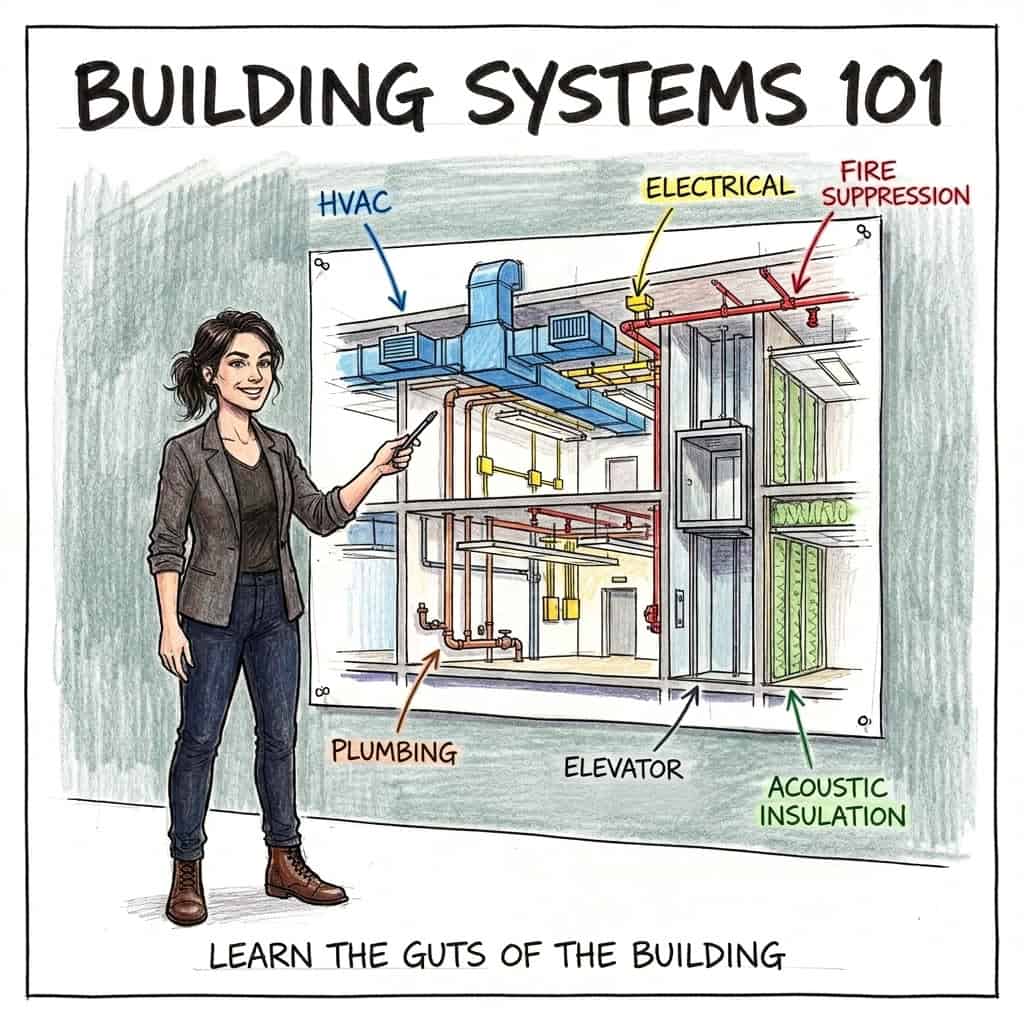
Building Systems 101 topics: HVAC, plumbing, lighting, fire safety, electrical, elevators, and acoustics

What Our Customers Our Saying About Mechanical 101

Mechanical systems knowledge unlocks multiple exams.

Get Mechanical Systems 101 Plus Every ARE Course

HVAC concepts appear across PPD and PDD exams. Your membership gives you everything because mastering mechanical systems means understanding how they integrate with project planning and construction documentation.

Why This Matters for Your Mechanical Systems Prep

Mechanical systems knowledge supports your entire technical exam preparation. Here’s what your membership includes:

PPD and PDD Courses - See how mechanical systems integrate with project planning and construction documentation

Building Codes 101 - Understand how HVAC design and code compliance requirements work together

Complete ARE Prep System  - Master mechanical systems once and apply them across multiple exam divisions

ARE 101 Course Membership

Ideal for independent learners

129/mo

Includes: 

7-day money-back guarantee badge for ARE 101 Membership Study materials

Try ARE 101 Risk-Free for 7 Days

We're confident you'll love our approach to PcM prep. If you're not completely satisfied within your first week, just contact our support team and we'll process your full refund. No questions asked.
ARE 101 Course Membership

Over 140 hours of video lessons, 2,000+ practice questions, and everything you need to pass all ARE exams.

Click any course below to see what's included

Architect Vanlim Ma, Adjunct Professor at Young Architect Academy

Vanlim Ma
RA

A registered Architect in Massachusetts, Vanlim is passionate about teaching technical topics for Young Architect Academy. She specializes in making complex subjects like mechanical systems more approachable for ARE candidates.

Meet Your Mechanical Systems Instructor

Learn from a licensed architect who makes complex HVAC concepts approachable.


Your Mechanical Systems Success Starts Here

Join thousands of ARE candidates who’ve used this comprehensive approach
to pass the ARE.

Mechanical Systems 101 FAQs

Get answers to common questions about the Mechanical Systems course.

10+ hours of expert video instruction covering equipment, systems, and ventilation strategies that appear on PPD and PDD exams.

You’ll get complete coverage of heat transfer fundamentals, psychrometric charts, chillers, boilers, air handling units, heat pumps, VRF systems, system configurations, and ventilation strategies.

Plus interactive learning sessions, equipment deep dives, system analysis frameworks, digital flashcards, and 24/7 access to our virtual tutors.

You get ALL our ARE 101 courses – Mechanical Systems 101 + PA, PPD, PDD, CE, PcM, PjM, Building Codes 101, AIA Contracts 101. We only sell one membership.


Here’s why: Mechanical systems knowledge isn’t tested in isolation. You’ll apply what you learn here across PPD and PDD exams. Understanding HVAC equipment and system configurations once makes both exams easier.

Because mechanical systems are essential for passing PPD and PDD.


Understanding HVAC fundamentals unlocks everything. When you know how chillers, boilers, and air handling units work, questions about building systems integration and equipment selection make sense.


Without this foundation, you’re guessing. With it, you’re applying knowledge you actually understand.

Mechanical systems knowledge appears on PPD and PDD exams in case studies and scenario questions.


PPD tests your understanding of system selection and integration with project planning. PDD requires you to know equipment layouts and mechanical coordination for construction documentation.


Master mechanical systems once, apply them across two exams. That’s the most efficient path to passing.

We cover the HVAC concepts that appear most frequently on PPD and PDD exams:


Heat Transfer Fundamentals – Psychrometric charts, sensible vs. latent heat, and thermal comfort principles


HVAC Equipment – Chillers, boilers, air handling units, heat pumps, VRF systems, and package units


System Configurations – Central vs. local systems, all-air, all-water, and air-water approaches


Ventilation Strategies – Energy recovery ventilators (ERV) and heat recovery ventilators (HRV)


Real-World Applications – Building examples and interactive problem-solving that mirrors exam scenarios


These are the mechanical systems topics NCARB tests across PPD and PDD.

Take Mechanical Systems 101 early in your technical exam preparation, ideally before or alongside PPD or PDD.


Think of it this way: We teach HVAC fundamentals and equipment types in depth here. Then in PPD and PDD, we show you how to apply them to specific project scenarios. If you skip this course, you’re missing the foundation and trying to learn application without understanding the basics.


Most successful students go through Mechanical Systems 101 before their first technical exam.

It depends on your familiarity with HVAC systems and mechanical equipment. Some people need more time than others, and that’s completely okay.

The course includes 10+ hours of video instruction, plus time to work through interactive sessions, review equipment diagrams, and really understand how everything connects.

This isn’t something you cram in a weekend. Mechanical systems take time to digest. But once you understand them, they make PPD and PDD significantly easier.

No. Thousands of recent graduates with zero MEP experience have used this course successfully.


We explain everything from the ground up. You don’t need to have coordinated with mechanical engineers or designed HVAC systems to understand how mechanical systems work.


In fact, sometimes having less experience is actually helpful because you don’t have bad habits to unlearn from how systems are handled (or mishandled) in real offices.

Yes. You can cancel your membership anytime. There are no contracts or commitments.


Your membership will continue to work until your next billing date.

Absolutely. Understanding mechanical systems makes you a better architect.


You’ll know how to evaluate HVAC equipment options, coordinate with mechanical engineers, understand system layouts, and make informed decisions about building systems integration.


This knowledge helps you design better buildings and communicate more effectively with consultants. The ARE tests real-world knowledge you’ll use throughout your career.

Learning mechanical systems alone is overwhelming. We teach you what matters and why.


Vanlim breaks down each concept with real-world context and ARE-focused applications. You’ll understand not just what equipment does, but how it connects to system selection, energy efficiency, and building design.


We spent years figuring out the most efficient way to learn this. You get that roadmap instead of wandering through technical manuals trying to figure out what’s important.

Think of the ARE 101 membership as joining a gym. Think of signing up for ARE Boot Camp as hiring a personal trainer.


ARE 101 is self-guided access to study materials. You go through it on your own at your own pace.


ARE Boot Camp is a coaching program with scheduled meetings, weekly curriculum, accountability, and community. You’re meeting on Zoom 3-4 times a week with other candidates working through content together.


All ARE prep study materials talk at you. ARE Boot Camp talks with you through conversation and dialogue.

This will still help you. We’ve learned that most students use multiple resources.


Our approach is different. We focus on teaching you how mechanical systems actually work rather than just what to memorize. Vanlim’s teaching style makes complex HVAC concepts approachable and accessible.


A lot of people tell us they finally “got it” after going through our mechanical systems course, even after studying with other companies first.

Get the ARE Results You Need

PcM 101

The business side of architecture nobody taught you in school, broken down objective by objective.

What’s inside:

  • 17+ hours of video, organized by NCARB objective
  • 490+ practice questions sorted into beginner, intermediate, and hard
  • 60 financial calculation questions plus 6 deep dive videos on the math
  • 15 case studies built like the real ones, with reference documents
  • The AHPP reading chart plus companions that show you how to get the most out of each reading
  • 200+ flashcards
  • AIA Contracts 101, covering the contracts PcM actually tests

PjM 101

Everything that happens after the client signs, broken down objective by objective. PcM is how you run the business. PjM is how you run the project.

What’s inside:

  • 16+ hours of video, organized by NCARB objective
  • 300+ practice questions sorted into beginner, intermediate, and hard
  • 15 case studies built like the real ones, with reference documents
  • The AHPP reading chart plus companions that show you how to get the most out of each reading
  • AIA Contracts 101, covering the contracts PjM leans on hardest

CE 101

What the architect actually does once construction starts, broken down objective by objective. Submittals, site visits, change orders, payment, and closeout, all governed by A201.

What’s inside:

  • 15+ hours of video, organized by NCARB objective
  • 200+ practice questions sorted into beginner, intermediate, and hard
  • 15 case studies built like the real ones, with reference documents
  • The AHPP reading chart plus companions that show you how to get the most out of each reading
  • AIA Contracts 101, where A201 gets taught article by article

PA 101

Before anybody designs anything, somebody has to figure out what the problem actually is. PA is site analysis, codes and zoning, and building the program, broken down objective by objective.

What’s inside:

  • 14+ hours of video, organized by NCARB objective
  • 240+ practice questions sorted into beginner, intermediate, and hard
  • 2 case studies built like the real ones, with reference exhibits you have to read
  • 260+ flashcards
  • Building Codes 101, where the code and zoning material gets taught from the ground up

PPD 101

The program is set. PPD is where you actually design the building: the structure, the envelope, the systems, and making all three agree.

What’s inside:

  • 18+ hours of video, organized by NCARB objective
  • 500+ practice questions sorted into beginner, intermediate, and hard
  • 375+ flashcards
  • Building Systems 101, covering the systems PPD asks you to select and size
  • Building Codes 101, covering the code questions that run through the whole division

PDD 101

The design is settled. PDD is about turning it into drawings, details, and specifications somebody can actually build from.

What’s inside:

  • 16+ hours of video across 17 objectives
  • 500 practice questions sorted into beginner, intermediate, and hard
  • 250+ flashcards organized by section and level
  • Building Systems 101, covering the systems PDD asks you to detail and coordinate
  • Building Codes 101, covering the code questions that run through the whole division

Mechanical 101

Plumbing, lighting, fire protection, electrical, conveying, acoustics, sustainability, and mechanical. You don’t need to be a master plumber, you need to be a master coordinator.

What’s inside:

  • 24+ hours of video across 8 system modules
  • Plumbing, lighting, fire and life safety, electrical, conveying, acoustics, sustainability and energy, and mechanical systems
  • Every video flags which ARE objectives it connects to
  • Built to support PPD, PDD, and PA, where the systems questions actually show up

Codes 101

Occupancy, heights and areas, construction types, rated walls, egress, and fixture counts, taught from the ground up. Not a tour of the IBC, an actual working knowledge of it.

What’s inside:

  • 4.5+ hours across three live workshop sessions, with candidates working real problems out loud
  • Occupancy classification and why the stringency rankings are built the way they are
  • Building heights and areas, and how to read all three tables against a construction type
  • The five construction types and the five rated wall types, sorted by where each one stops
  • Means of egress, occupant load, and sizing stairs and doors
  • Plumbing fixture counts
  • 180+ practice questions sorted into beginner, intermediate, and hard
  • Flashcards covering code vocabulary across all three levels
  • Built to support PA, PPD, and PDD, where the code questions actually show up

AIA Contracts 101

The contracts define how a huge number of processes on a project actually work. Which means a lot of exam questions that don’t sound like contract questions are contract questions. That’s why we built an entire course to sit alongside PcM, PjM, and CE. Once you understand how the contracts work, everything else gets a lot easier. This is the most thorough resource anywhere for understanding AIA contracts for the architect exam.

What’s inside:

  • 15 hours of video, organized by contract document instead of by exam division
  • B101 and A201 in depth, article by article, the two documents everything else is built on
  • A101, C401, A701, A305, A133, the G-series forms, and the IPD family
  • Built to be watched with the contract open in front of you