
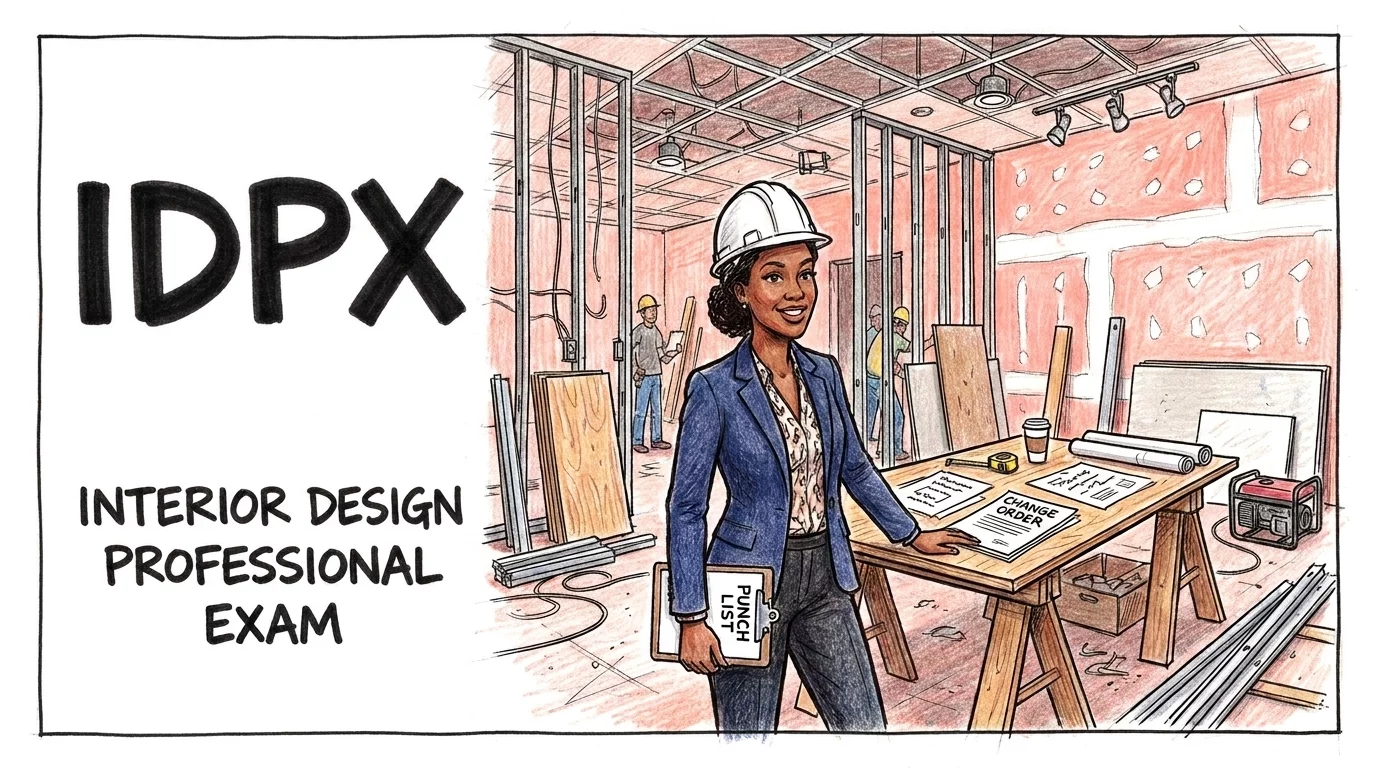
What Is the IDPX Exam?
The IDPX (Interior Design Professional Exam) is one of three exams you need to pass to earn your NCIDQ Certificate. It’s administered by CIDQ and focuses on construction administration and project management.
This is the business and professional practice side of interior design. The IDFX tests whether you can design it. The IDIX tests whether you can document it. The IDPX tests whether you can manage it. Budgets, schedules, contracts, procurement, construction, and closeout.
The IDPX is 115 questions over 3 hours. It covers five content areas, with an emphasis on health, safety, and welfare.
If you’ve studied for or passed the ARE, a lot of this will feel familiar. The IDPX covers contracts, procurement, submittals, RFIs, change orders, construction observation, and project closeout. These are the same topics tested on the architect exam (especially PjM and CE). The concepts are the same; the NCIDQ just frames them from the interior designer’s perspective.
What Does the IDPX Test?
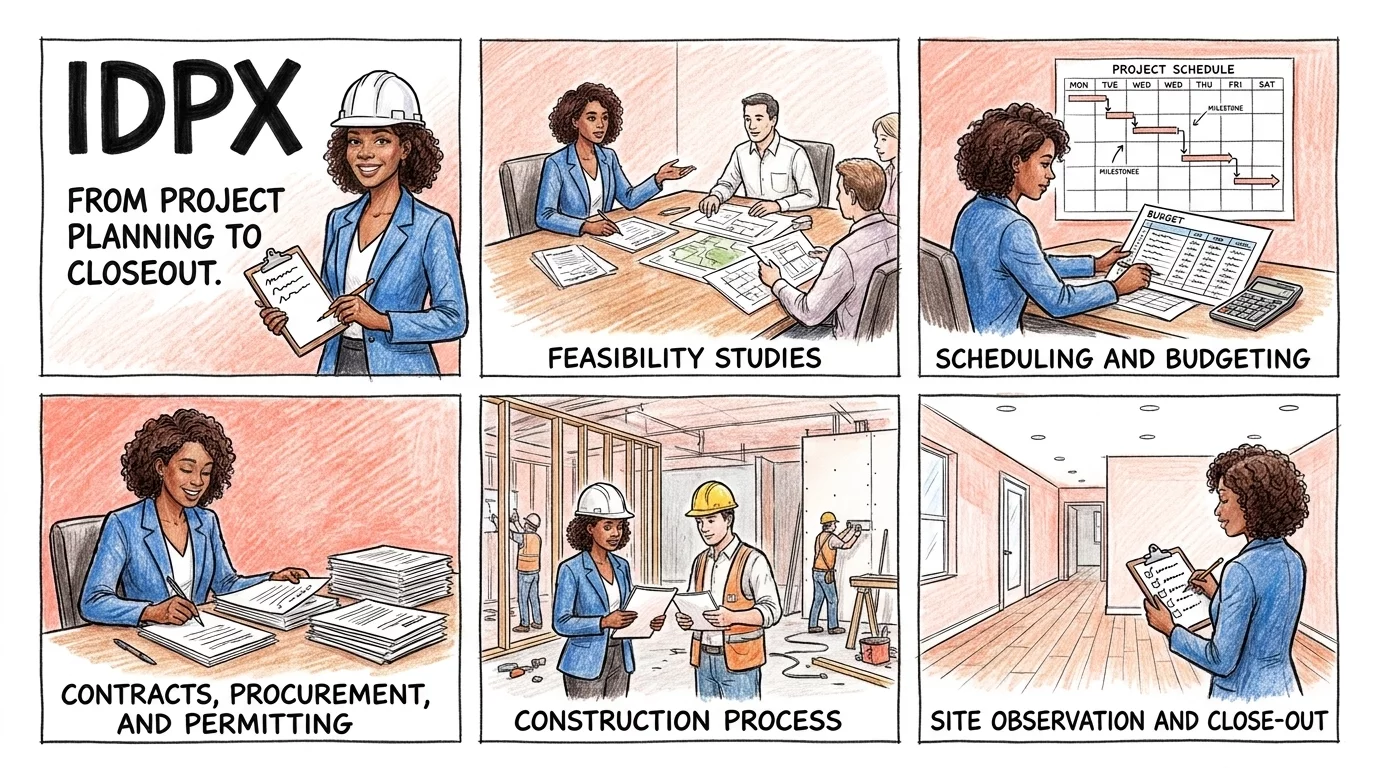
The IDPX covers everything that happens after the documents are done. From evaluating whether a project is even feasible, all the way through handing over the keys at closeout. Here’s what each content area covers and how much of the exam it represents.
Feasibility Studies (17%)
Before a project gets off the ground, someone has to determine whether it’s viable. You’re evaluating project feasibility through codes, zoning, building types, energy requirements, existing conditions, square footage requirements, and funding sources.
You’re also identifying project stakeholders (types, requirements, surveys, participatory design) and managing the project team (internal staffing, outsourced consultants, owner’s representatives, code officials, construction managers, brand representatives).
Scheduling and Budgeting (17%)
Managing the project schedule and budget. On the schedule side: critical path, milestones, dependencies, lead times, project phasing, construction process timing, inspection checkpoints, staffing availability, and approval management.
On the budget side: cost estimating (labor, product, market), allowances and contingencies, soft costs vs. hard costs, value engineering, tax credits, preferred pricing, product sourcing, and how socioeconomic conditions and market variations affect costs.
Contracts, Procurement, and Permitting (28%)
The largest section on the exam. You need to understand how procurement and bidding work, including bid structure (design-bid-build, design-build), alternates and allowances, FF&E vs. construction procurement, purchase orders, value engineering, and liability.
You need to understand contracts and proposals: fee structures, scope of services, exclusions and additional services, types of agreements (owner-architect, architect-consultant, FF&E, leasing), the RFP and RFQ process, and legal considerations.
You also need to understand the approval process (budget approvals, design phase approvals, building permits, change approvals, client sign-offs) and how the permit process works (jurisdictional processes, code required drawings, timing, roles and responsibilities).
Construction Process (21%)
Facilitating construction. This covers submittals, shop drawings, RFIs, product data, samples, mockups, prototypes, construction meetings, and the approval process for all of these.
You also need to understand change management: change orders, change directives, bulletins, substitutions, the approval process for changes, cost implications, schedule impacts, how to record changes in contract documents, client management, and liability.
Site Observation and Close-Out (17%)
Performing site visits: field reports, quality of work, pay applications, mockups, construction safety, means and methods, and liability.
Conducting project closeout: punch lists, certificates of occupancy (temporary and final), commissioning, maintenance manuals, post-occupancy evaluation, project archiving, substantial completion vs. final completion, progress inspections vs. final inspections, and project record management.
Reference standards you need to know. CIDQ expects candidates to understand when to reference standards including ASHRAE, ASTM, BIFMA, ETL, OSHA, and UL. You’ll also need conceptual knowledge of ANSI, NEC, and NFPA and when these codes apply.
CIDQ reference books. CIDQ publishes a list of books used by exam writers when developing questions. This list covers interior design textbooks across professional practice, project management, estimating, construction detailing, and building systems. You can find the current list in the CIDQ Exam Reference Materials PDF.
IDPX Exam Details
Format: 115 questions (100 scored, 15 unscored pre-test questions)
Duration: 3 hours
Question types: Multiple Choice, Drag and Place, Fill in the Blank, and Hot Spot. The exam includes vignettes (scenario-based question sets with 3-5 questions per scenario).
Scoring: Scale of 200 to 800. Passing score is 500. CIDQ uses the Angoff Method to set passing scores. Official score reports are available approximately 6-8 weeks after the exam window closes.
Testing windows: Exams are offered twice per year during a spring cycle and a fall cycle.
Exam fees: Exam fees are set by CIDQ and can change between cycles. Check the CIDQ Exam Dates and Deadlines for current pricing.
Building codes on the exam: IBC 2021, IRC 2021, IPC 2021, and ICC A117.1 (2017). The code content is provided as a searchable document during the exam.
Pass rates over recent testing cycles:
- Spring 2026: 60%
- Fall 2025: 65%
- Spring 2025: 61%
- Fall 2024: 56%
- Spring 2024: 63%
- Fall 2023: 58%
- Spring 2023: 62%
- Fall 2022: 58%
- Spring 2022: 59%
Who Can Take the IDPX?
Route 1: Apply for all three NCIDQ exams at once. You need a qualifying interior design education AND the required work experience. Eligibility period is 10 exam administration periods (about 5 years to pass all three).
Route 2, Part 2 (IDIX & IDPX): If you already passed the IDFX under Route 2, Part 1 and have now completed the required work experience, you can apply for the IDPX and IDIX together. Eligibility period is 10 exam administration periods.
The IDPX requires work experience. Unlike the IDFX, you cannot take the IDPX while still in school. You need both a qualifying education and documented work experience.
You can take the three NCIDQ exams in any order. But if you want to follow the project lifecycle (the way a real project flows), the sequence is: IDFX first, then IDIX, then IDPX.
What Changed on the IDPX in 2026?
CIDQ published updated exam blueprints in December 2025 that took effect in 2026. The IDPX was restructured to specifically cover the construction administration and project management phases of interior design.
What’s different in the 2026 version:
- Each exam now covers two design phases with reduced overlap between them. The IDPX is focused on construction administration and project management. Topics that used to appear across multiple exams are now assigned to the exam that matches their design phase.
- Vignettes replaced the old question format. Scenario-based question sets with 3-5 questions per scenario, presented in a split screen format with the scenario on one side and associated questions on the other. All three exams now use this format.
Topics removed from NCIDQ exams in 2026:
- Professional Development and Ethics is no longer tested. CIDQ determined this content isn’t specific to any design phase and is better demonstrated through continuing education.
- BOMA methods of calculation are no longer tested. The exam still covers square footage concepts, but the specialized BOMA measurement standards are gone.
- Business structures (sole proprietor, partnership, corporation, joint ventures) are no longer tested. CIDQ determined this doesn’t substantially impact health, safety, and welfare.
Free IDPX Study Content
The IDPX has the most overlap with our free ARE Podcast. If you’ve ever listened to our episodes on professional practice and construction administration, you’ve already been studying IDPX material without realizing it.
Topics you’ll find that apply to the IDPX:
- AIA B101 owner-architect agreement
- Construction cost estimates and hard costs vs. soft costs
- Project delivery methods (DBB, design-build, CMAR)
- Construction bidding process and procurement
- Construction submittals, RFIs, and change orders
- Construction observation and site visit documentation
- Claims, disputes, and liquidated damages
- Project closeout, punch lists, and substantial completion
No need to take notes while you listen. For many episodes, we’ve already made a free two-page set of study notes for you. Just go to the episode page and grab them.
Browse IDPX Podcast Episodes →
How Does the IDPX Fit Into the NCIDQ?
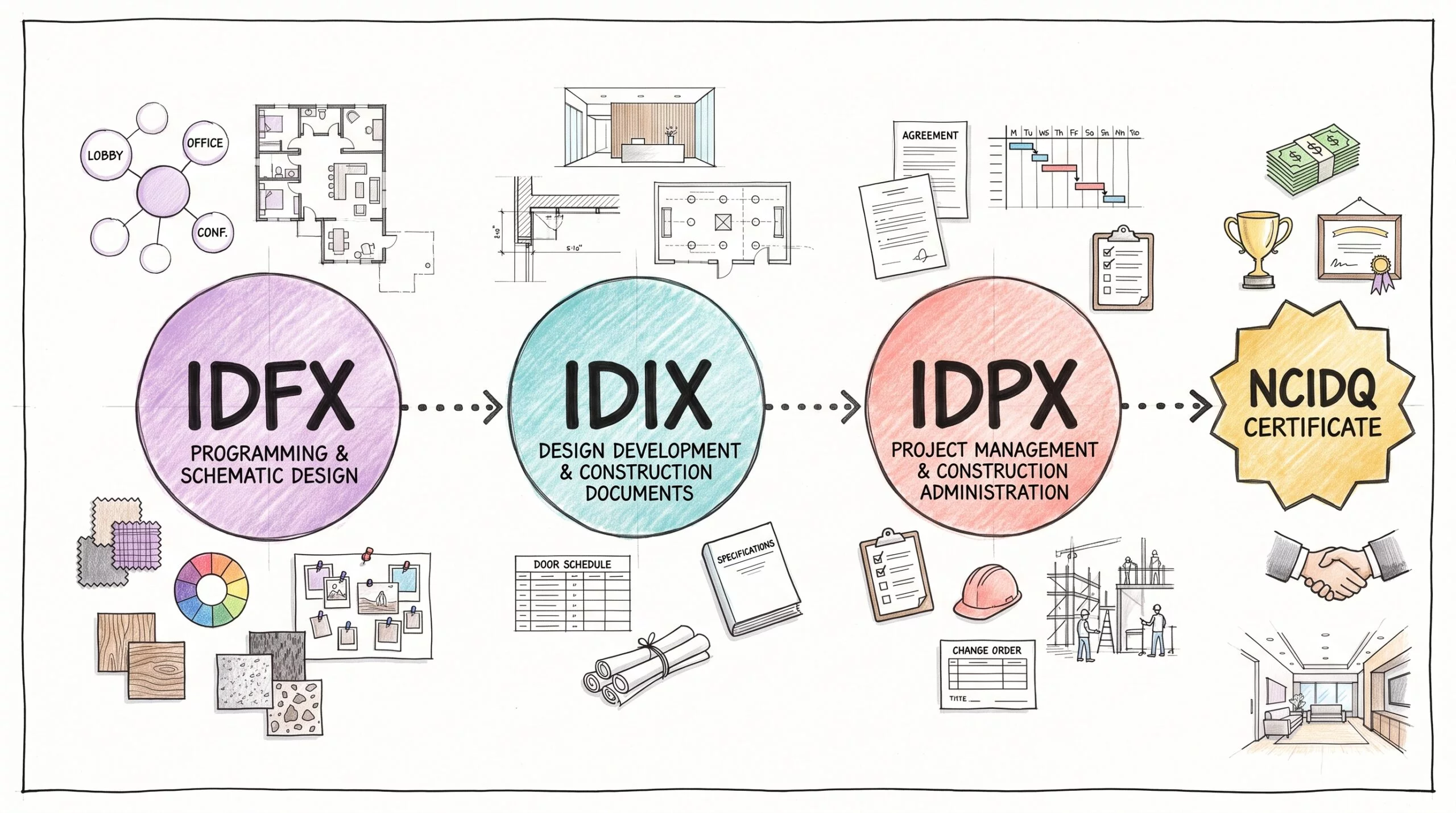
The NCIDQ certification requires passing three exams. The IDPX covers the final phases of the project lifecycle. The other two cover what comes before:
- IDFX (Interior Design Fundamentals Exam) covers programming and schematic design
- IDIX (Interior Design Implementation Exam) covers design development and construction documents
Together, all three exams span the complete interior design project lifecycle from the first site visit through construction closeout.
Learn About the IDFX → Learn About the IDIX →
Back to NCIDQ Certification Overview →
Want Free NCIDQ Study Content?
Join our email list to get free study tips, new podcast episode alerts, and exam prep content delivered to your inbox.