
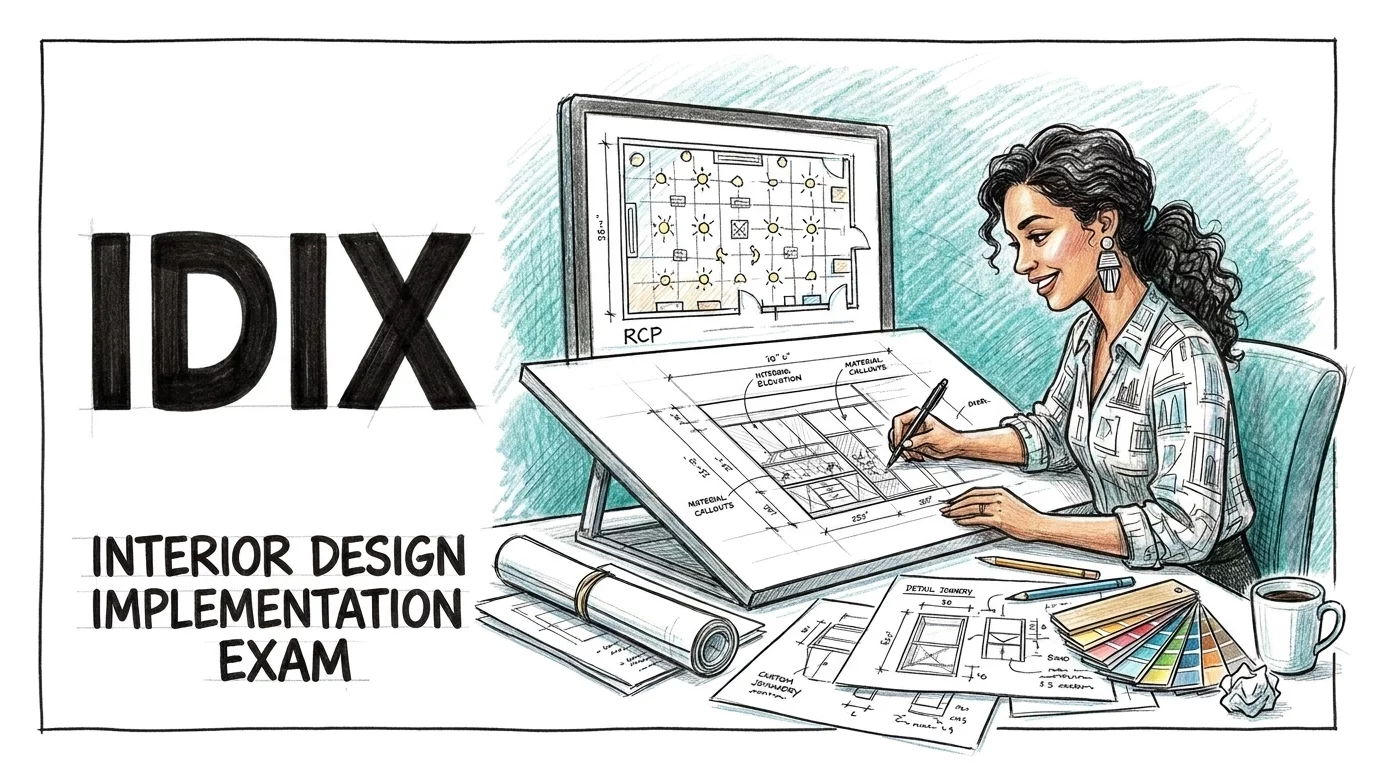
What Is the IDIX Exam?
The IDIX (Interior Design Implementation Exam) is one of three exams you need to pass to earn your NCIDQ Certificate. It’s administered by CIDQ and focuses on the design development and construction documentation phases of interior design.
If the IDFX is where you figure out the design, the IDIX is where you turn it into a buildable set of documents. You’re developing construction details, writing specifications, coordinating with consultants, and making sure every decision gets communicated clearly on paper.
The IDIX is 130 questions over 4 hours, making it the longest of the three NCIDQ exams. It covers five content areas, with an emphasis on health, safety, and welfare.
The IDIX is new as of 2026, replacing the old PRAC (Practicum) exam with updated blueprints and a new format. More on that below.
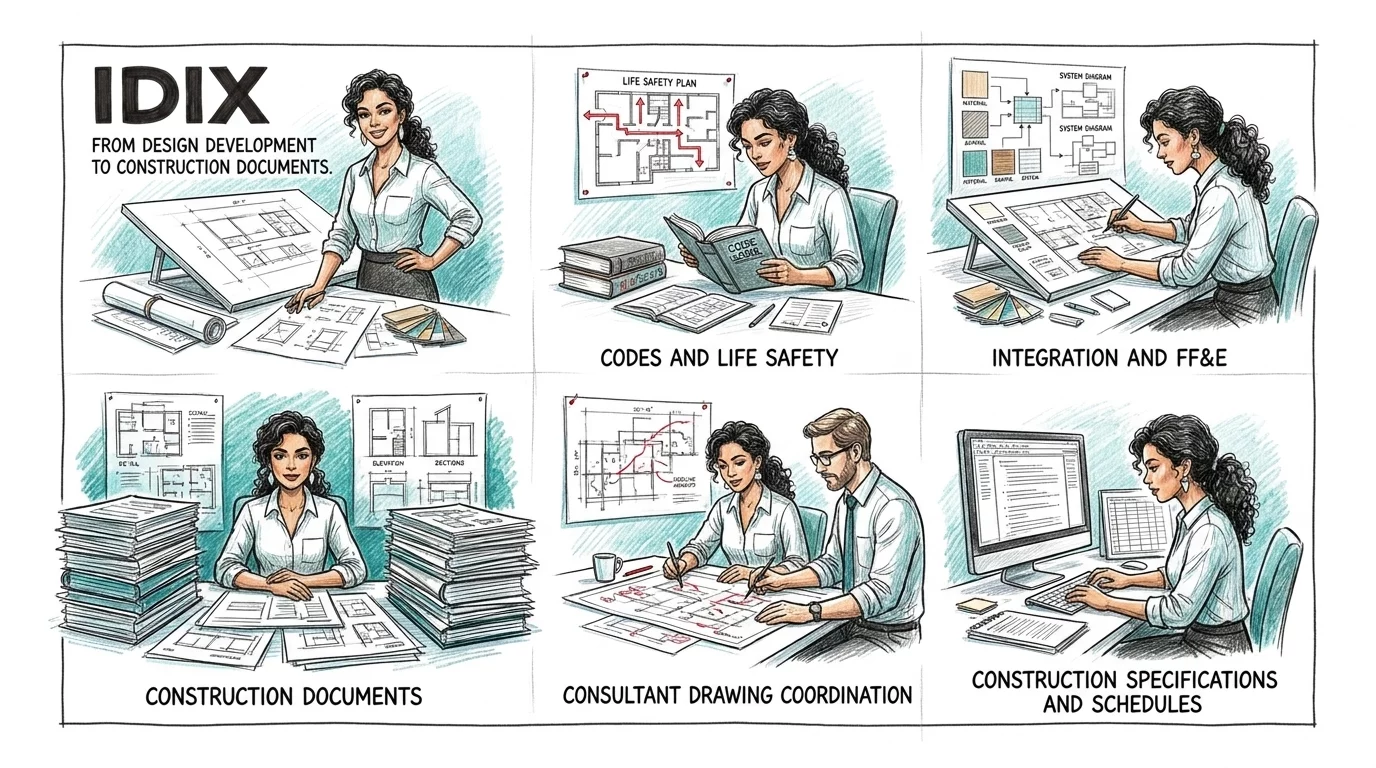
What Does the IDIX Test?
The IDIX picks up where the IDFX leaves off. You’ve got a schematic design. Now you need to develop it into a fully coordinated set of construction documents. Here’s what each content area covers and how much of the exam it represents.
Codes and Life Safety (16%)
Before you start producing documents, you need a solid code foundation. You’re initiating life safety and occupancy plans, performing code review, and confirming egress requirements, fire ratings, occupancy loads, plumbing fixture counts, and travel distances.
You also need to understand material testing standards, permit requirements, code required signage, and the QA/QC process. Universal design runs through this entire section.
Integration and FF&E (19%)
Integrating building systems into the design. Electrical, mechanical, plumbing, lighting, acoustics, fire protection, structural, and vertical/horizontal transport systems. You also need to understand home automation and low voltage systems.
On the finishes side, you’re developing finish plans with annotations, enlarged plans, flooring transitions, vertical wall transitions, and graphic representation of materials.
On the furniture side, you’re developing furniture plans and specifications including layouts, clearances, coordination with electrical and data, quantity takeoffs, sourcing, textiles, and types of specifications.
Construction Documents (32%)
The largest section on the exam by a wide margin. This is where CIDQ puts the most weight, and it makes sense. The ability to produce clear, accurate, and coordinated construction documents is at the core of protecting health, safety, and welfare.
Details and sections: construction techniques, custom assemblies, millwork, substrates, transitions, wall types (fire rating, acoustics, moisture barrier), and window and door details.
Elevations: critical elevations (feature walls, wet walls, green walls), glazing, toilet rooms, material heights, mounting heights, and millwork.
Demolition plans: abatement, construction phasing, hazardous materials, structural constraints, and existing conditions.
Construction plans: accessible routes, door types, partition types, fire ratings, plumbing types, enlarged plans, and general/key/sheet notes.
Reflected ceiling plans (RCPs): ceiling systems and types, lighting layouts and specifications, switching and controls, headers, plenum, acoustics, and relevant consultant ceiling systems.
If you’re going to focus your study time anywhere on this exam, start here.
Consultant Drawing Coordination (18%)
Coordinating your drawings and specifications with engineers and specialty consultants. Structural, mechanical, electrical, plumbing, lighting, and other disciplines. You need to understand consultant deliverables, the hierarchy of information, and how to resolve conflicts between drawings.
You’re also developing power, data, and communication plans (outlet types, AV integration, security, low voltage, energy code). And developing signage and wayfinding documents.
Construction Specifications and Schedules (15%)
Writing construction specifications and developing schedules. On the spec side, you need to understand specification divisions, specification format, types of specifications (open, closed, proprietary), basis of design, and how to write specs for concrete, metals, openings, finishes, equipment, window coverings, and woods/plastics/composites.
On the schedule side, you’re developing door schedules, finish schedules, hardware schedules, equipment schedules, furniture schedules, plumbing schedules, room schedules, accessory schedules, and window schedules.
Reference standards you need to know. CIDQ expects candidates to understand when to reference standards including ASHRAE, ASTM, BIFMA, ETL, OSHA, and UL. You’ll also need conceptual knowledge of ANSI, NEC, and NFPA and when these codes apply.
CIDQ reference books. CIDQ publishes a list of books used by exam writers when developing questions. This list covers interior design textbooks across construction detailing, specifications, building systems, lighting, codes, and materials. You can find the current list in the CIDQ Exam Reference Materials PDF.
IDIX Exam Details
Format: 130 questions (115 scored, 15 unscored pre-test questions)
Duration: 4 hours
Question types: Multiple Choice, Drag and Place, Fill in the Blank, and Hot Spot. The exam includes vignettes (scenario-based question sets with 3-5 questions per scenario).
Scoring: Scale of 200 to 800. Passing score is 500. CIDQ uses the Angoff Method to set passing scores. Official score reports are available approximately 6-8 weeks after the exam window closes.
Testing windows: Exams are offered twice per year during a spring cycle and a fall cycle.
Exam fees: Exam fees are set by CIDQ and can change between cycles. Check the CIDQ Exam Dates and Deadlines for current pricing.
Building codes on the exam: IBC 2021, IRC 2021, IPC 2021, and ICC A117.1 (2017). The code content is provided as a searchable document during the exam.
Pass rates over recent testing cycles:
(Listed as PRAC through Fall 2025, IDIX beginning Spring 2026)
- Spring 2026: 61%
- Fall 2025: 67%
- Spring 2025: 63%
- Fall 2024: 69%
- Spring 2024: 65%
- Fall 2023: 69%
- Spring 2023: 62%
- Fall 2022: 65%
- Spring 2022: 54%
Who Can Take the IDIX?
Route 1: Apply for all three NCIDQ exams at once. You need a qualifying interior design education AND the required work experience. Eligibility period is 10 exam administration periods (about 5 years to pass all three).
Route 2, Part 2 (IDIX & IDPX): If you already passed the IDFX under Route 2, Part 1 and have now completed the required work experience, you can apply for the IDIX and IDPX together. Eligibility period is 10 exam administration periods.
The IDIX requires work experience. Unlike the IDFX, you cannot take the IDIX while still in school. You need both a qualifying education and documented work experience.
You can take the three NCIDQ exams in any order. But if you want to follow the project lifecycle (the way a real project flows), the sequence is: IDFX first, then IDIX, then IDPX.
What Changed on the IDIX in 2026?
The biggest change: the IDIX is a new exam. It replaced the old PRAC (Practicum) exam starting in 2026. CIDQ published updated exam blueprints in December 2025 that restructured all three exams.
What’s different from the old PRAC:
- Case studies are gone. The PRAC was built around case studies. The IDIX uses vignettes instead (scenario-based question sets with 3-5 questions per scenario, presented in a split screen format).
- The content is reorganized by design phase. The IDIX now specifically covers the design development and construction documentation phases. CIDQ reduced overlap between the three exams so each one focuses on its own portion of the project lifecycle.
- All three exams now use the same question format. Multiple Choice, Drag and Place, Fill in the Blank, and Hot Spot across all three.
Topics removed from NCIDQ exams in 2026:
- BOMA methods of calculation are no longer tested. The exam still covers square footage concepts, but the specialized BOMA measurement standards are gone.
- Business structures (sole proprietor, partnership, corporation, joint ventures) are no longer tested.
Free IDIX Study Content
Our free ARE Podcast has episodes that apply directly to the IDIX. This is the Architect Exam Podcast, but don’t let the name fool you. The construction documentation, specification writing, and building systems content tested on the IDIX is the same material architects study for the ARE.
Topics you’ll find that apply to the IDIX:
- Means of egress, travel distance, and egress calculations
- Fire rated walls, fire barriers, and fire partitions
- Construction specification types and spec writing
- Smoke and heat detectors
- Vapor barriers, air barriers, and moisture control
- Sealant types, backer rod, and joint design
- Plumbing fixtures and plumbing valves
- Types of HVAC systems
- Electrical fundamentals and lighting calculations
No need to take notes while you listen. For many episodes, we’ve already made a free two-page set of study notes for you. Just go to the episode page and grab them.
Browse IDIX Podcast Episodes →
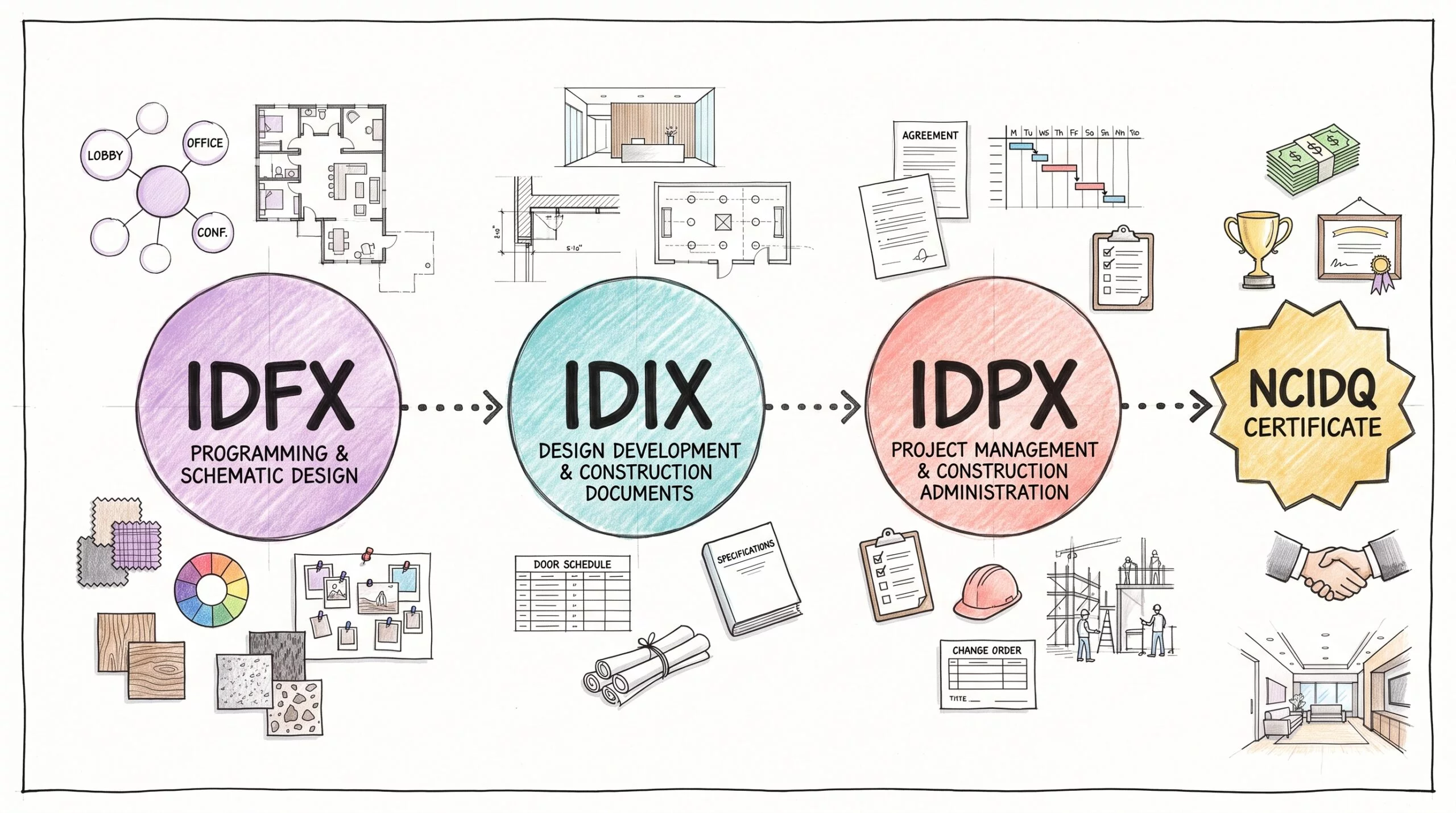
How Does the IDIX Fit Into the NCIDQ?
The NCIDQ certification requires passing three exams. The IDIX covers the middle of the project lifecycle. The other two cover what comes before and after:
- IDFX (Interior Design Fundamentals Exam) covers programming and schematic design
- IDPX (Interior Design Professional Exam) covers project management and construction administration
Together, all three exams span the complete interior design project lifecycle from the first site visit through construction closeout.
Learn About the IDFX → Learn About the IDPX →
Back to NCIDQ Certification Overview →
Want Free NCIDQ Study Content?
Join our email list to get free study tips, new podcast episode alerts, and exam prep content delivered to your inbox.