
What Is the IDFX Exam?
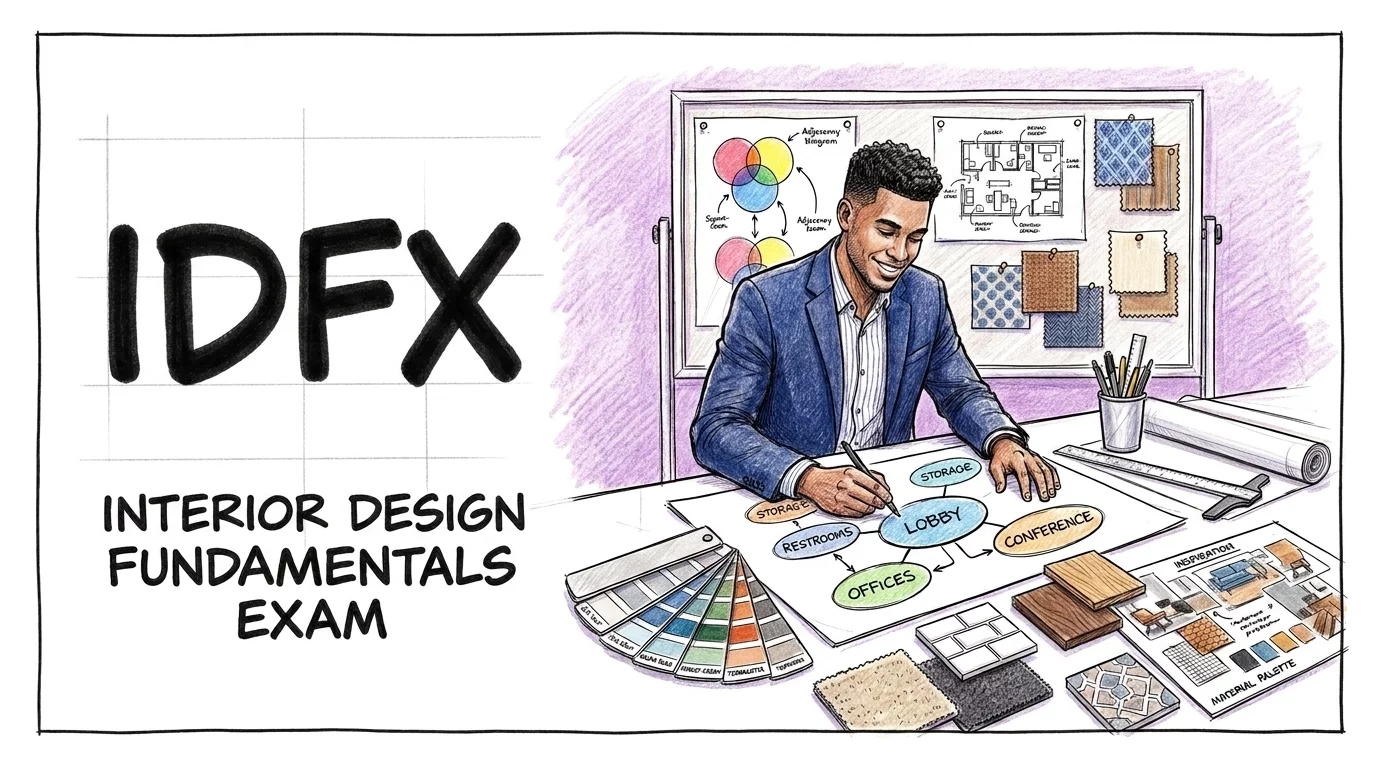
The IDFX (Interior Design Fundamentals Exam) is the first of three exams you need to pass to earn your NCIDQ Certificate. It’s administered by CIDQ and focuses on the early phases of interior design: programming, conceptual design, and schematic design.
Think of the IDFX as the starting line. You’re assessing what exists, figuring out what the client needs, planning the space, selecting preliminary materials, and developing the schematic design concept. Everything that happens before you start producing construction documents.
The IDFX is 115 questions over 3 hours. It covers six content areas, with an emphasis on health, safety, and welfare.
The IDFX is also the only NCIDQ exam you can take without work experience. If you’re a student in your final year of a qualifying bachelor’s or master’s program, you can sit for the IDFX through Route 2, Part 1. That means you can get one exam out of the way before you even graduate.
What Does the IDFX Test?
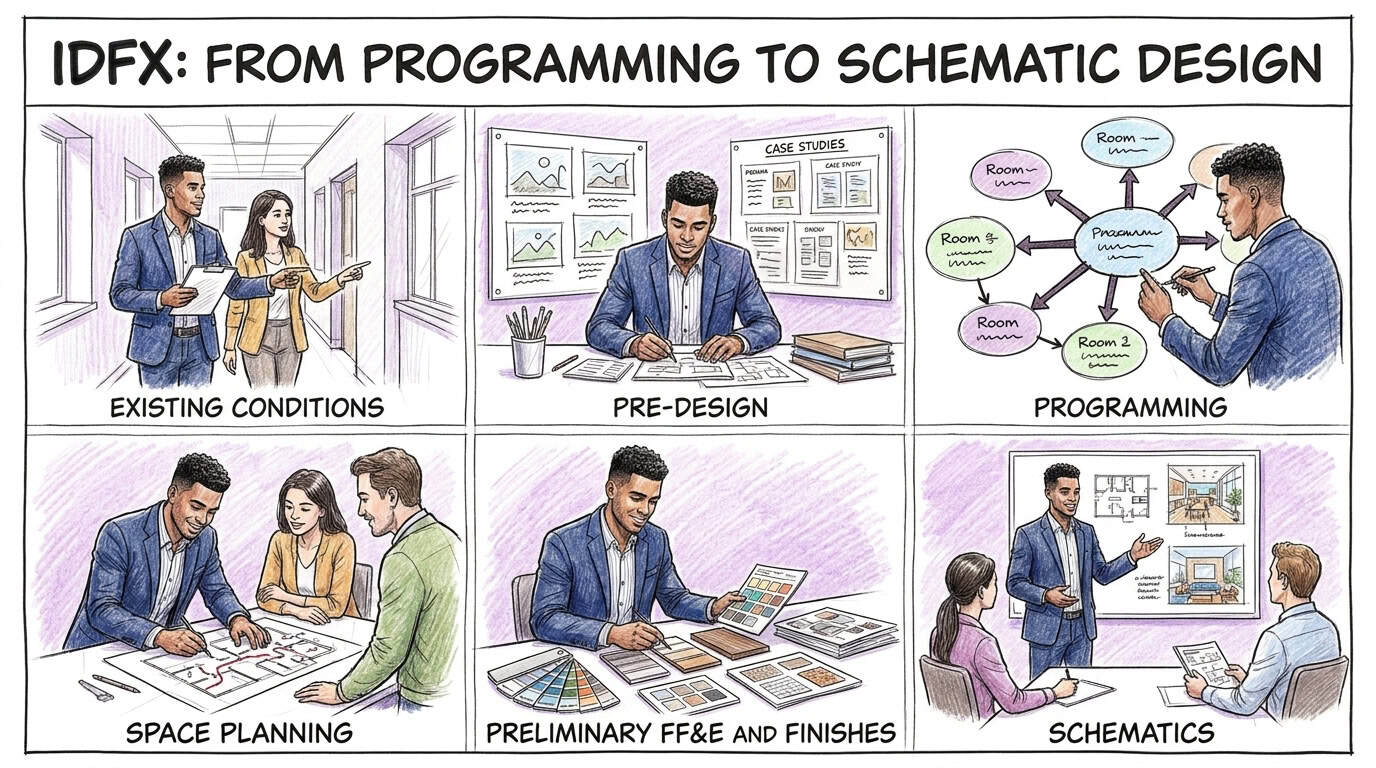
The IDFX follows the project from the very first site visit through a completed schematic design. Here’s what each content area covers and how much of the exam it represents.
Existing Conditions (14%)
You walk into a building and need to understand what you’re working with. Building location, construction types, zoning, solar orientation, views, environmental impacts, hazardous materials, and occupancy types.
You’re also performing your initial code analysis here: applicable codes, life safety requirements, and occupancy loads.
Pre-Design (15%)
Before you start designing, you need to establish the direction. This includes evidence-based design, sustainability and wellness, universal design, signage and wayfinding, and understanding different market sectors (workplace, hospitality, healthcare, government, retail, residential).
You’re performing research through case studies, benchmarking, and precedent studies. You’re establishing design intent, working with color theory, and defining the design concept.
Programming (16%)
Now you’re figuring out what the space actually needs. Validating the program through adjacency requirements, circulation, occupancy loads, and square footage allocations.
Creating programmatic diagrams: adjacency matrices, bubble diagrams, block diagrams, parti diagrams, and stacking diagrams.
Determining user needs through demographics, ergonomics, human factors, cultural context, and sensory considerations (acoustics, lighting, thermal comfort, visual stimuli).
Space Planning (19%)
Translating the program into a floor plan. Circulation, spatial relationships, structural limitations, natural daylight and views, life safety, and universal design all come into play.
You’re also creating initial drawings like elevations, RCPs, finish plans, and sections to communicate design intent. Preliminary lighting layouts start here too.
Preliminary FF&E and Finishes (16%)
Selecting materials, finishes, and furniture for the project. This covers aesthetics, budgets and lead times, color theory, material applications and sourcing, sustainability, reference standards, and universal design.
On the furniture side, you’re evaluating FF&E feasibility, customization options, special requirements, and the distinction between construction scope (millwork) and FF&E products.
Schematics (20%)
The largest section on the exam. You’re refining the design intent, performing a code review, and visualizing the design through presentation methods and tools. This is where everything from the previous five content areas comes together into a cohesive schematic design that you present to the client.
Reference standards you need to know. CIDQ expects candidates to understand when to reference standards including ASHRAE, ASTM, BIFMA, ETL, OSHA, and UL. You’ll also need conceptual knowledge of ANSI, NEC, and NFPA and when these codes apply.
CIDQ reference books. CIDQ publishes a list of books used by exam writers when developing questions. This list covers interior design textbooks across programming, space planning, materials, lighting, building systems, codes, and professional practice. You can find the current list in the CIDQ Exam Reference Materials PDF.
IDFX Exam Details
Format: 115 questions (100 scored, 15 unscored pre-test questions)
Duration: 3 hours
Question types: Multiple Choice, Drag and Place, Fill in the Blank, and Hot Spot. The exam includes vignettes (scenario-based question sets with 3-5 questions per scenario).
Scoring: Scale of 200 to 800. Passing score is 500. CIDQ uses the Angoff Method to set passing scores. Official score reports are available approximately 6-8 weeks after the exam window closes.
Testing windows: Exams are offered twice per year during a spring cycle and a fall cycle.
Exam fees: Exam fees are set by CIDQ and can change between cycles. Check the CIDQ Exam Dates and Deadlines for current pricing.
Building codes on the exam: IBC 2021, IRC 2021, IPC 2021, and ICC A117.1 (2017). The code content is provided as a searchable document during the exam.
Pass rates over recent testing cycles:
- Spring 2026: 53%
- Fall 2025: 55%
- Spring 2025: 53%
- Fall 2024: 53%
- Spring 2024: 49%
- Fall 2023: 51%
- Spring 2023: 55%
Who Can Take the IDFX?
Route 1: Apply for all three NCIDQ exams at once. You need a qualifying interior design education AND the required work experience. Eligibility period is 10 exam administration periods (about 5 years to pass all three).
Route 2, Part 1 (IDFX Only): This is unique to the IDFX. If you meet the education requirement but don’t have the work experience yet, you can take the IDFX on its own. Students in their final year of a qualifying bachelor’s or master’s program are eligible. Eligibility period is 4 exam administration periods (about 2 years).
You can take the three NCIDQ exams in any order. But if you want to follow the project lifecycle (the way a real project flows), the sequence is: IDFX first, then IDIX, then IDPX.
What Changed on the IDFX in 2026?
CIDQ published updated exam blueprints in December 2025 that took effect in 2026. A few topics were removed from the IDFX:
- Professional Development and Ethics is no longer tested. CIDQ determined this content isn’t specific to any design phase and is better demonstrated through continuing education.
- BOMA methods of calculation are no longer tested. The exam still covers square footage concepts (like the difference between rentable and usable area for occupancy load calculations), but the specialized BOMA measurement standards are gone.
- Business structures (sole proprietor, partnership, corporation, joint ventures) are no longer tested. CIDQ determined this doesn’t substantially impact health, safety, and welfare.
The exam also introduced vignettes (scenario-based question sets) for the first time in 2026. These replace the old case study format. Vignettes present a scenario on one side of the screen with 3-5 associated questions on the other.
Free IDFX Study Content
Our free ARE Podcast has episodes that apply directly to the IDFX. This is the Architect Exam Podcast, but don’t let the name fool you. Architects and interior designers share the same foundational knowledge when it comes to health, safety, and welfare.
Topics you’ll find that apply to the IDFX:
- Occupancy classifications and construction types
- ADA accessibility and door clearance requirements
- Types of insulation and building envelope performance
- Foundation types and structural systems
- Gross, rentable, usable, and net area calculations
- Passive heating and cooling strategies
- Lighting, lamp types, and foot candle calculations
- Building acoustics, STC, IIC, and NRC ratings
No need to take notes while you listen. For many episodes, we’ve already made a free two-page set of study notes for you. Just go to the episode page and grab them.
Browse IDFX Podcast Episodes →
How Does the IDFX Fit Into the NCIDQ?
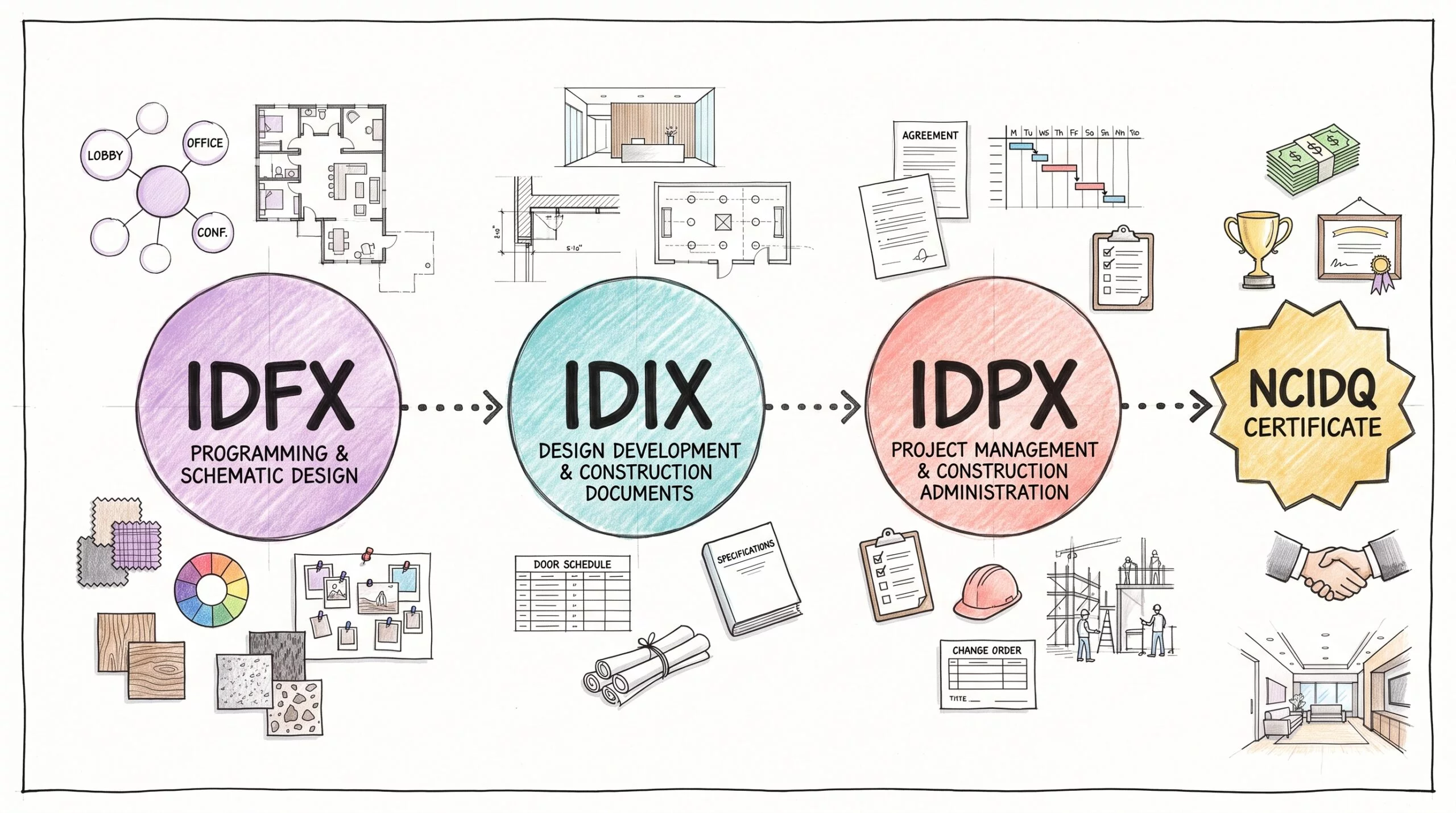
The NCIDQ certification requires passing three exams. The IDFX covers the beginning of the project lifecycle. The other two pick up where it leaves off:
- IDIX (Interior Design Implementation Exam) covers design development and construction documents
- IDPX (Interior Design Professional Exam) covers project management and construction administration
Together, all three exams span the complete interior design project lifecycle from the first site visit through construction closeout.
Learn About the IDIX → Learn About the IDPX →
Back to NCIDQ Certification Overview →
Want Free NCIDQ Study Content?
Join our email list to get free study tips, new podcast episode alerts, and exam prep content delivered to your inbox.