
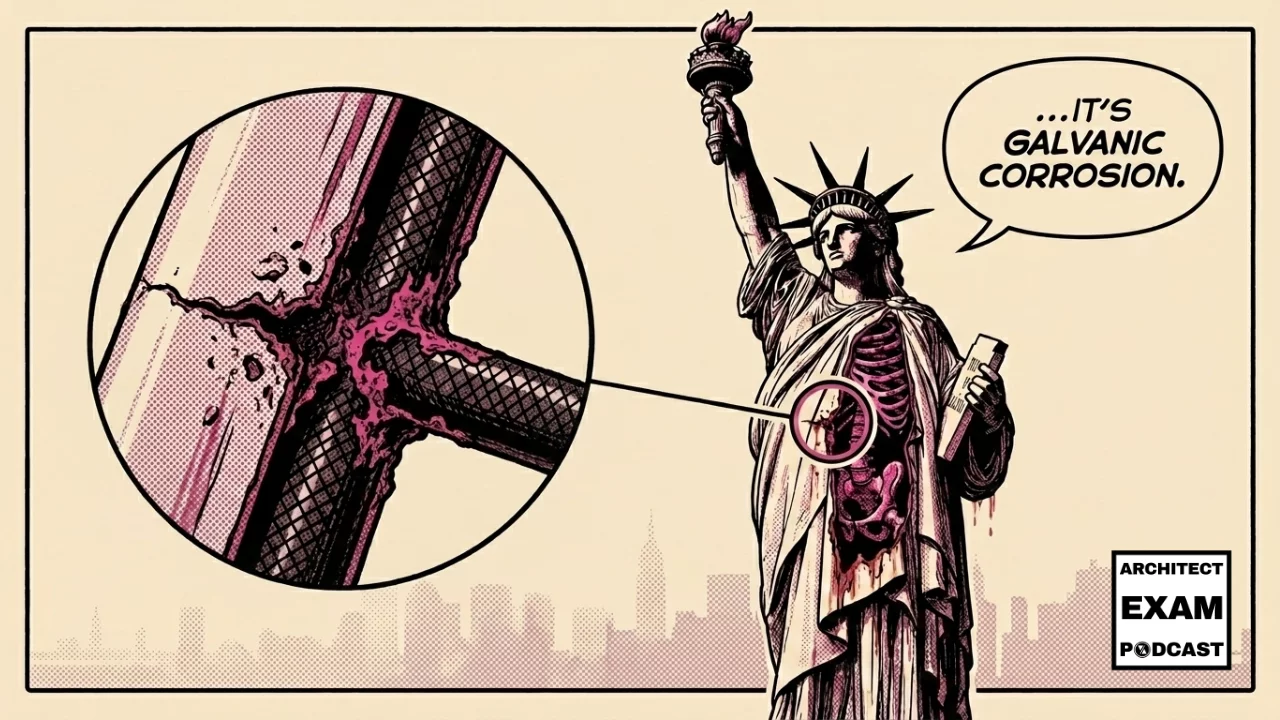

Galvanic corrosion occurs when two dissimilar metals are in contact and moisture completes the circuit. This guide explains how galvanic action works, walks through the galvanic series chart for common architectural metals, and covers the prevention strategies that stop dissimilar metal corrosion before it destroys your building details.
This podcast is also available on YouTube, Spotify, and Apple Podcasts.
Test yourself! This episode has a free 10-question galvanic action quiz at the bottom of this page.
The Statue of Liberty’s Galvanic Corrosion Problem
The Statue of Liberty is copper skin stretched over a wrought iron framework. Brilliant engineering for its time. One of the most iconic structures on the planet.
But there was a problem hiding inside.
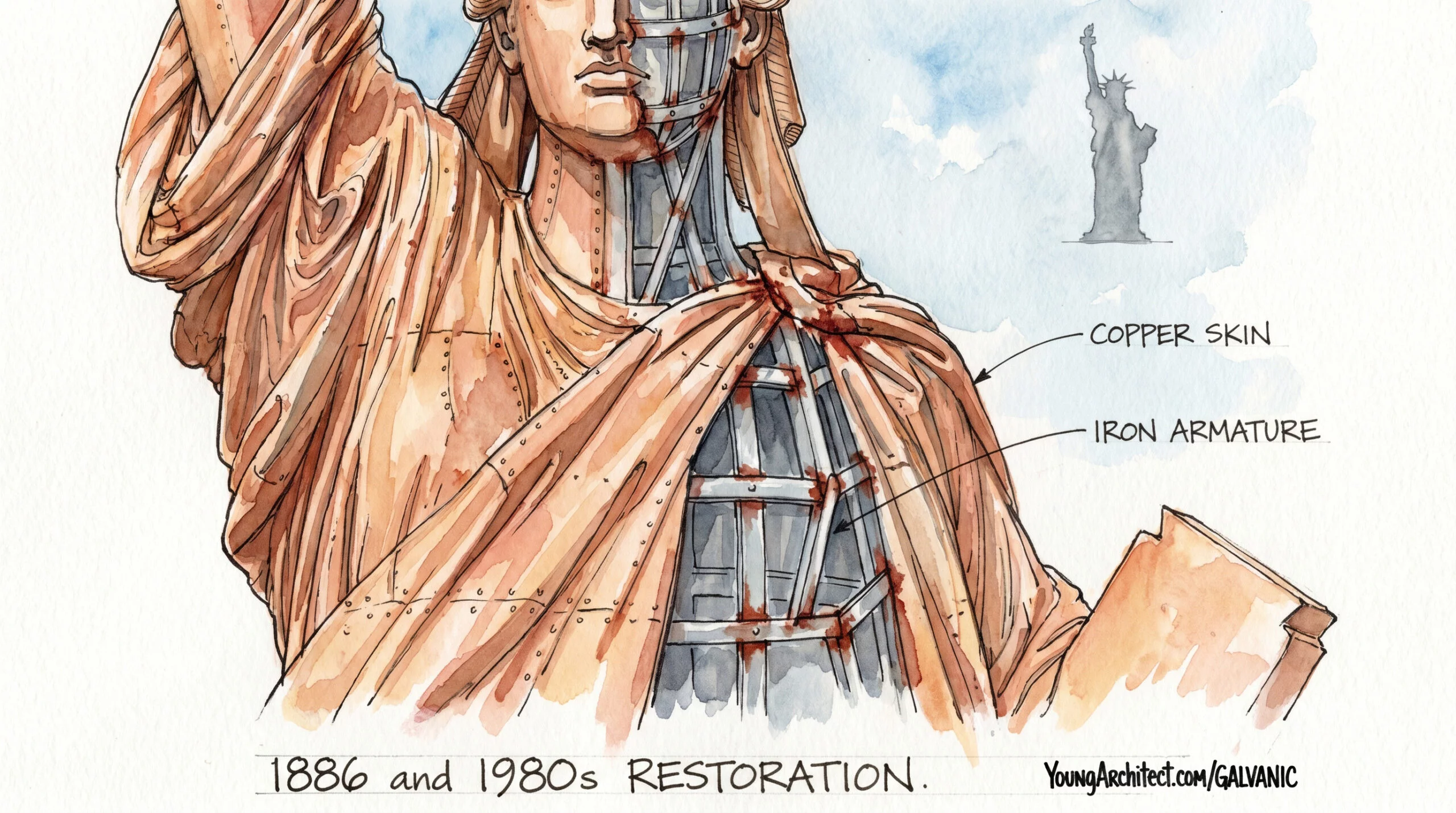
Over the decades, the barrier between the copper skin and the iron armature started to break down. Once those two metals were in direct contact with moisture, the iron started corroding aggressively.
Copper is far more noble than iron on the galvanic series. When those two metals touch in the presence of water, the iron loses. Every single time.
By the 1980s, the damage was so severe that the entire wrought iron armature had to be replaced with stainless steel during a massive historic preservation effort. The most famous structure in America had a galvanic corrosion problem that took nearly a century to fully reveal itself.
This same problem shows up in your projects.
You spec copper flashing over an aluminum storefront. Two years later, the aluminum is corroding and the client is calling. A contractor grabs whatever screws are in the truck to fasten metal panels. Six months later, rust streaks are running down the facade.
Galvanic action is one of those topics that feels like a chemistry problem until it becomes your problem. Understanding material compatibility matters for anyone working through building envelope details. In practice, getting this wrong means callbacks, remediation, and some really uncomfortable conversations.
A quick terminology note before we go further. You will see this called galvanic corrosion, galvanic action, bimetallic corrosion, and dissimilar metal corrosion. All four mean the same thing. We will use all of them throughout this post, and you should recognize all of them.
How Galvanic Corrosion Works
When two dissimilar metals are in contact and moisture is present, one metal corrodes faster than it normally would on its own.
That is the core concept. The entire topic builds from that single sentence.
When you put two different metals together in the rain, you are essentially creating a giant, accidental battery that is slowly eating your building. The metals generate a small electrical current, and that current drives the corrosion process.
The terms you need to know:
- The anode is the active, less noble metal. It corrodes. It gives up its electrons.
- The cathode is the noble metal. It gets protected. It receives those electrons.
Think of it like a bully relationship. The stronger metal steals electrons from the weaker one. The bully gets stronger. The victim gets weaker. That dynamic does not stop until you physically intervene or the weaker metal is consumed.
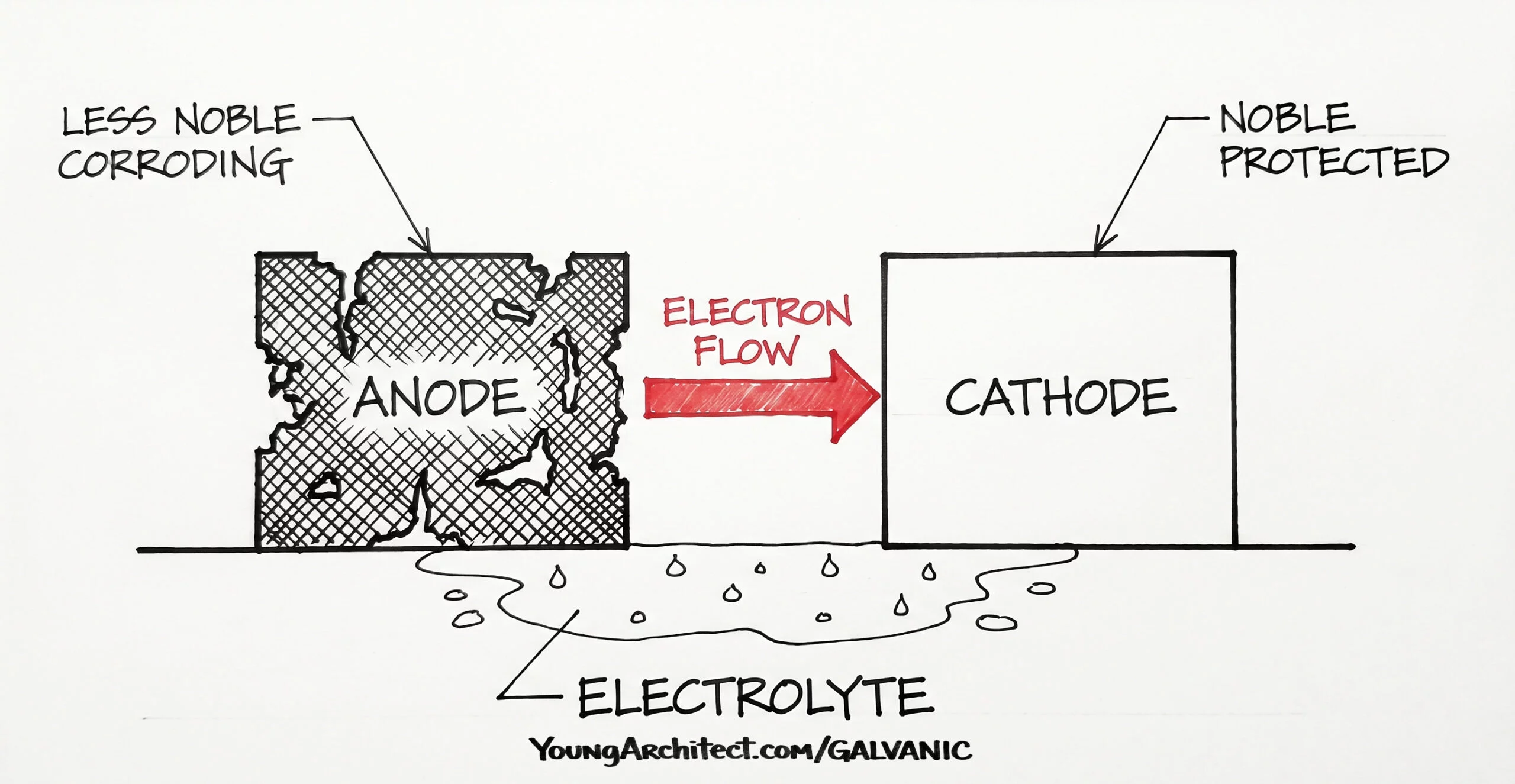
In architectural terms, noble means a metal that resists corrosion. Active means a metal that is prone to corroding. These are the standard terms across technical references, and the AMPP’s corrosion basics guide on galvanic corrosion is one of the best resources if you want to go deeper on the underlying electrochemistry.
The bully analogy will carry through the rest of this post. Once you understand who the bullies are and who the victims are, galvanic corrosion becomes predictable.
Three Ingredients for Galvanic Corrosion
Every case of dissimilar metal corrosion comes down to the same three ingredients. This framework is the structural backbone of everything that follows.
Ingredient #1: Two dissimilar metals. Two different types of metal in the same assembly.
Ingredient #2: Electrical contact. The metals are touching, connected through a fastener, or linked by some other conductive path.
Ingredient #3: An electrolyte. In the real world, that just means moisture. Rain, humidity, condensation.
Remove any one of these three ingredients and the reaction stops. That is the entire basis for every prevention strategy. If you can break one leg of this triangle, you win.
This framework is not just a way to understand the problem. It is the way to solve it. Every fix you will ever apply to a galvanic corrosion situation works by eliminating one of these three ingredients.
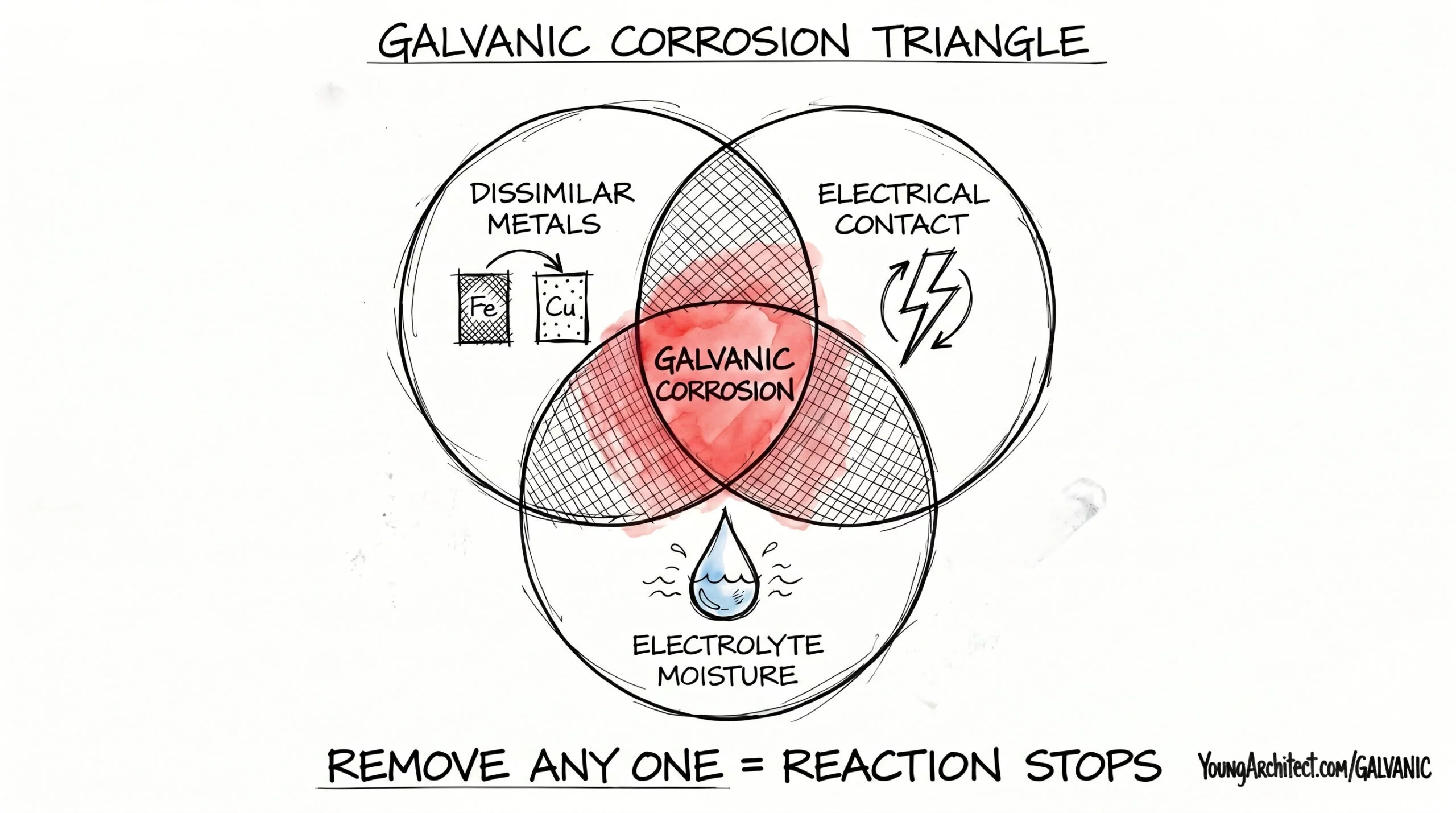
Keep that in the back of your mind as we move through the rest of the post. Every section connects back to this triangle.
A quick note on environment. Salt air acts like a super-electrolyte. Coastal and marine projects accelerate the entire galvanic process dramatically. If you are designing anywhere near the ocean, material compatibility becomes even more critical because ingredient #3 is supercharged. Understanding moisture control in the building envelope becomes doubly important in these environments.
Galvanic Series Chart Explained
Now that you understand the mechanism, the next question is: which metals are the bullies and which ones are the victims?
The galvanic series is a chart that ranks metals from noble (corrosion resistant) to active (corrosion prone). You do not need to memorize the entire thing. But you absolutely need to know where the common architectural metals fall.
At the noble end, the metals that resist corrosion:
- Gold
- Stainless steel
- Copper and bronze
These are the tough ones. These are the bullies.
In the middle: lead and tin.
At the active end, the metals most vulnerable to corrosion:
- Aluminum
- Zinc
- Steel and iron (most active)
These are the ones that lose the fight.
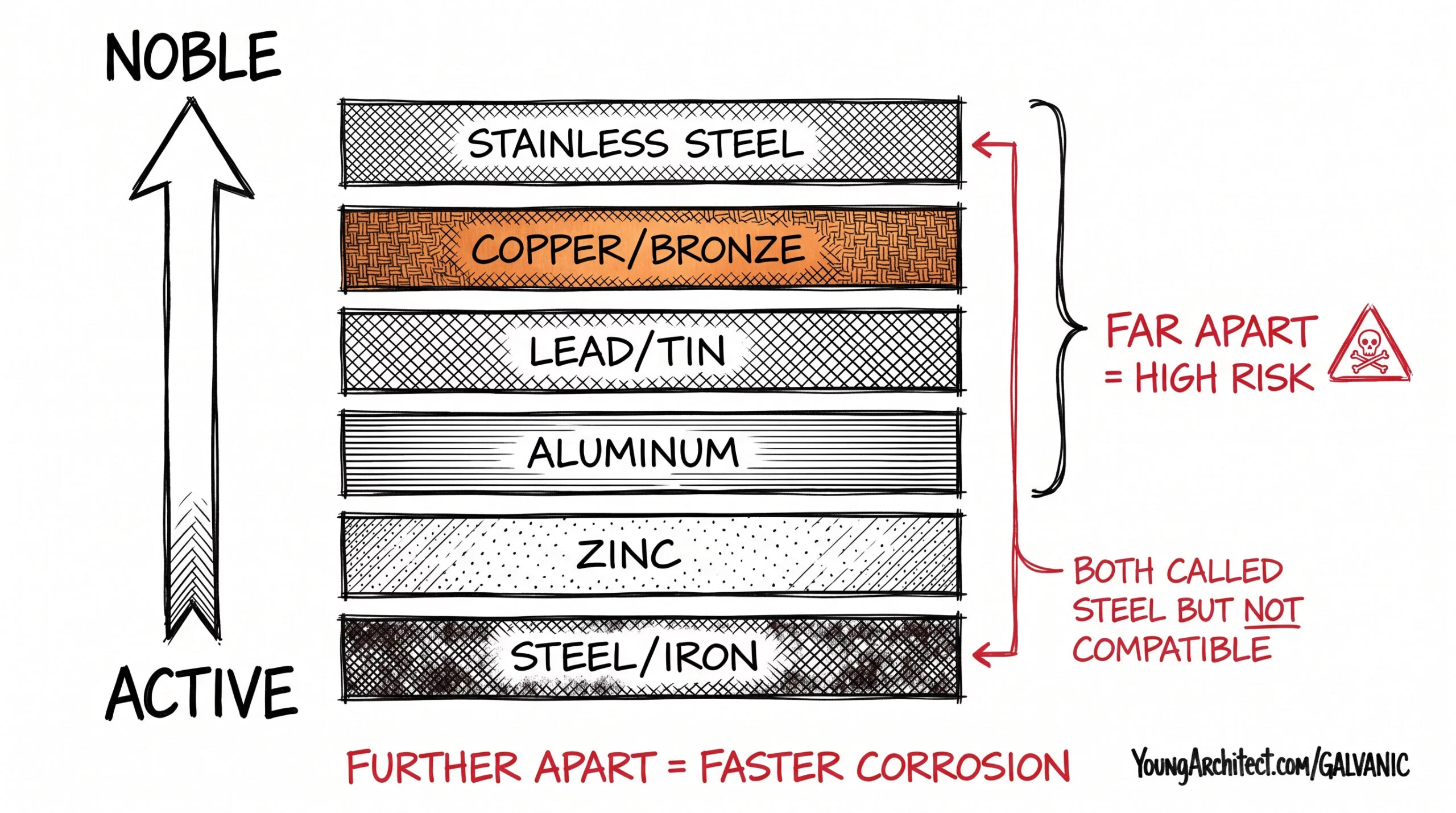
Now the distance rule, and this is critical.
The further apart two metals are on the galvanic series, the faster the active one corrodes. Copper and aluminum are far apart on the series. That is why copper absolutely destroys aluminum when they are in contact. Two metals that are close together? Much less risk. The galvanic reaction is weaker because the electrical potential between them is smaller.
This distance rule is what makes the galvanic series chart a practical design tool, not just a reference chart. When you are detailing an assembly with mixed metals, check the series. If the two metals are neighbors, the risk is low. If they are on opposite ends, you need galvanic isolation between them. The American Galvanizers Association’s guide to dissimilar metals in contact is an excellent resource for evaluating specific metal combinations.
Galvanized Steel Explained
The word “galvanized.” You have heard it a thousand times. Galvanized steel. But have you ever thought about where that word comes from?
It comes from galvanic. Same root word.
Galvanized steel has a zinc coating, and that zinc coating is literally a sacrificial anode. It is designed to corrode first so the steel underneath does not have to. The name is telling you exactly what is happening. The zinc sacrifices itself through galvanic action to protect the steel.
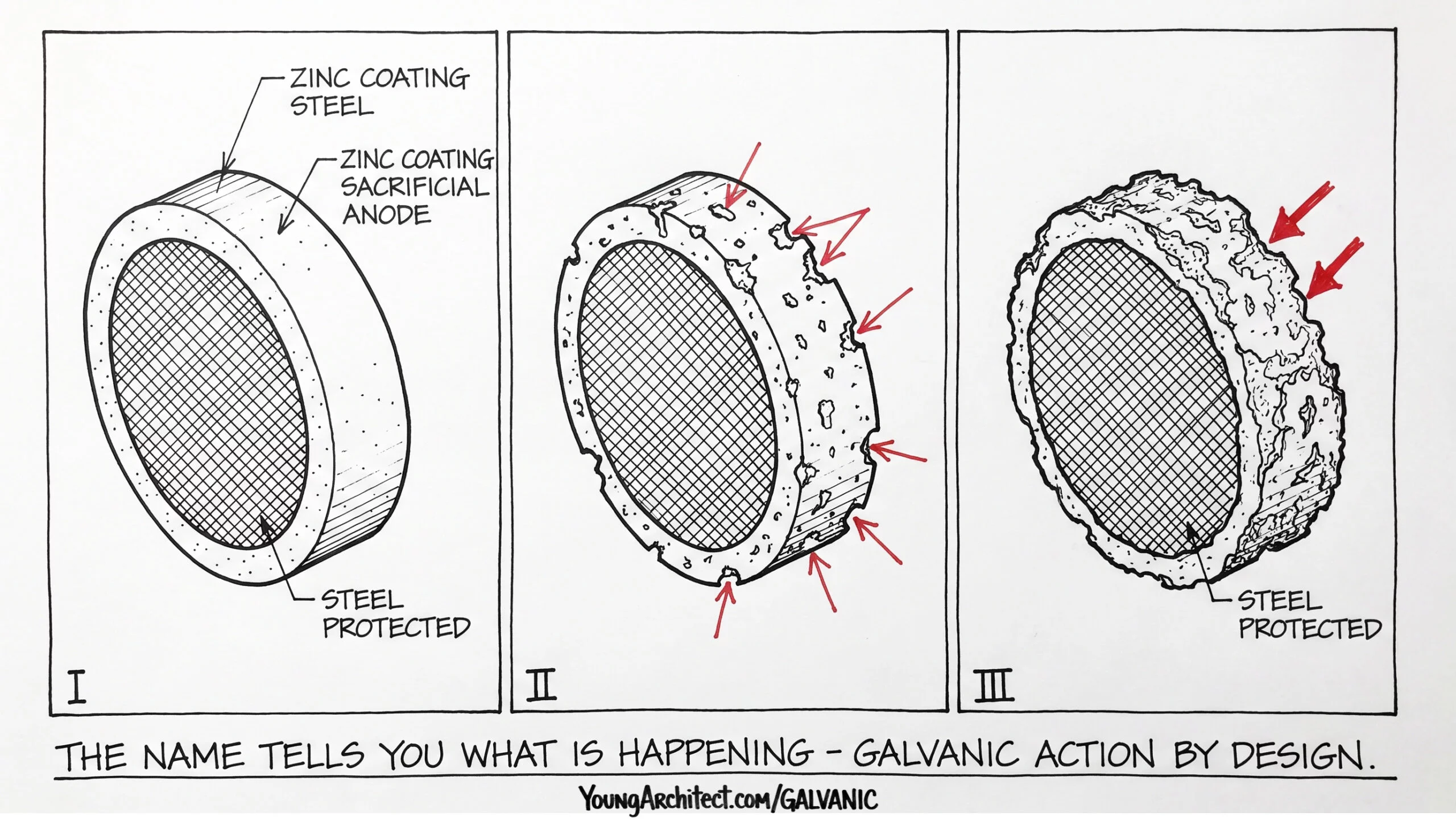
Every time you say “galvanized,” you are describing this exact process. The zinc is the victim on purpose. It takes the hit so the steel stays intact. That is galvanic corrosion being used as a deliberate protection strategy, not a flaw.
This also means anything that attacks zinc (like copper runoff) is effectively stripping the armor off galvanized steel. Once the zinc sacrificial layer is gone, the bare steel underneath is exposed and vulnerable.
Surface Area Ratio and Fastener Corrosion
This next concept gets overlooked constantly, but it explains why so many real-world galvanic failures happen at the smallest components in an assembly.
It is called the surface area ratio.
When a small piece of active metal is connected to a large piece of noble metal, corrosion accelerates dramatically. The small anode has to “serve” a much larger cathode. All of that electrical demand concentrates on a tiny piece of metal. It corrodes fast.
Flip it around. A large anode connected to a small cathode? Corrosion slows down. The workload spreads across a bigger surface area. No single spot gets hit too hard.
This is exactly why fastener selection matters so much.
Picture a tiny aluminum screw holding up a large stainless steel panel. That aluminum screw is the active metal. The stainless panel is the bully. And that tiny screw is taking the full force of the galvanic attack from a massive panel.
It dissolves. The connection fails. The panel is coming off the building.
That is the worst possible surface area ratio. Small anode, huge cathode.
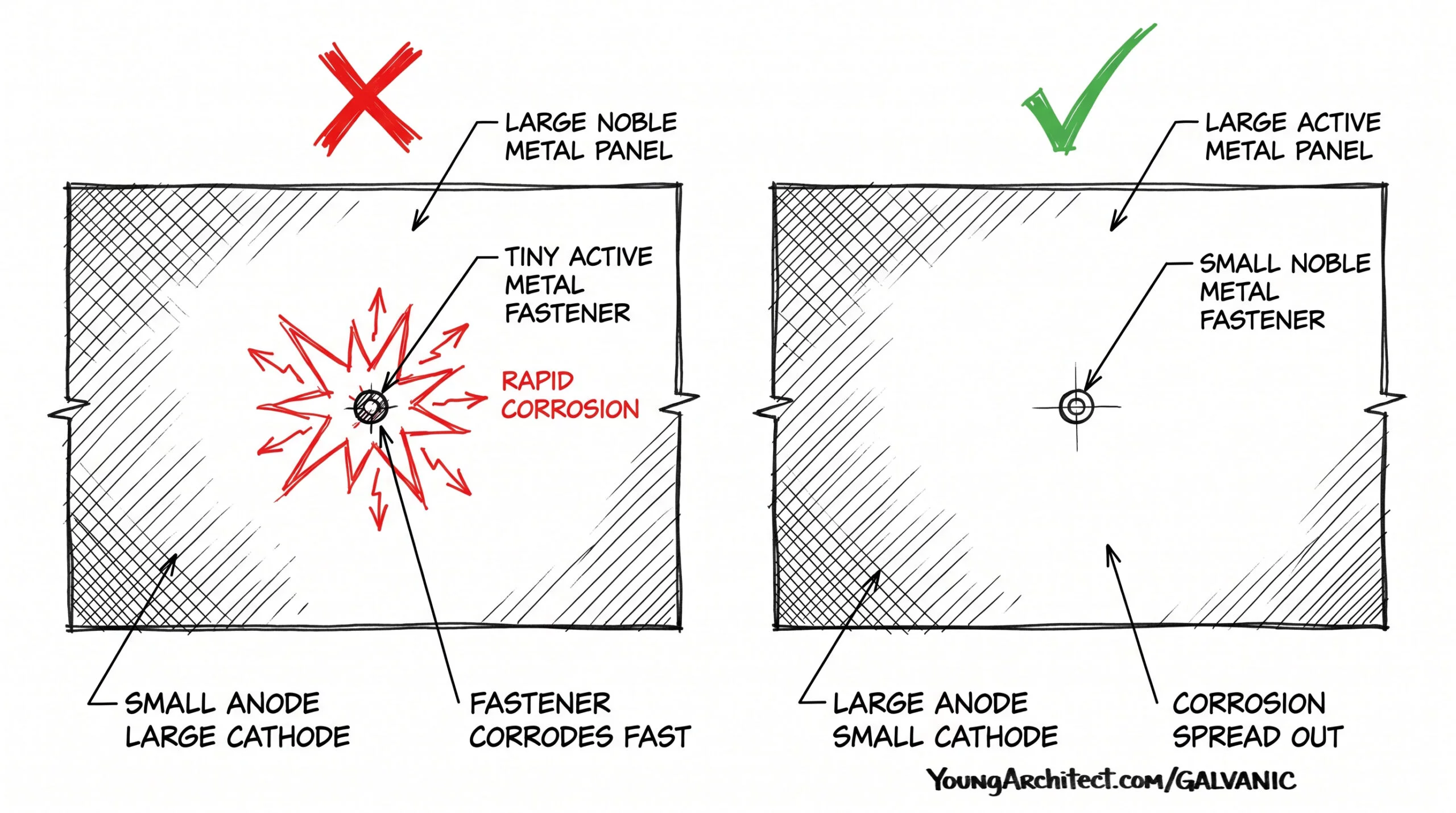
The fastener should always be the same material or more noble than the material being fastened.
A stainless steel screw in an aluminum panel works, as long as you use a neoprene washer to break the electrical contact. The fastener is the noble one, but you still want that isolation between the two metals (removing ingredient #2 from the triangle).
An aluminum screw in a stainless panel? Disaster. The fastener is the victim, it is tiny, and it will fail fast.
This kind of material detailing and fastener specification is exactly what gets covered in PPD 101 and PDD 101. Knowing which metal goes where in an assembly is not trivia. It is the difference between a detail that lasts and one that fails in the field.
Most real-world galvanic failures do not happen in the big dramatic assemblies. They happen at the fasteners. The little connections nobody thinks about until they fail.
Copper vs Aluminum vs Steel
There is a recurring villain in this section, and by now you already know who it is.
Copper.
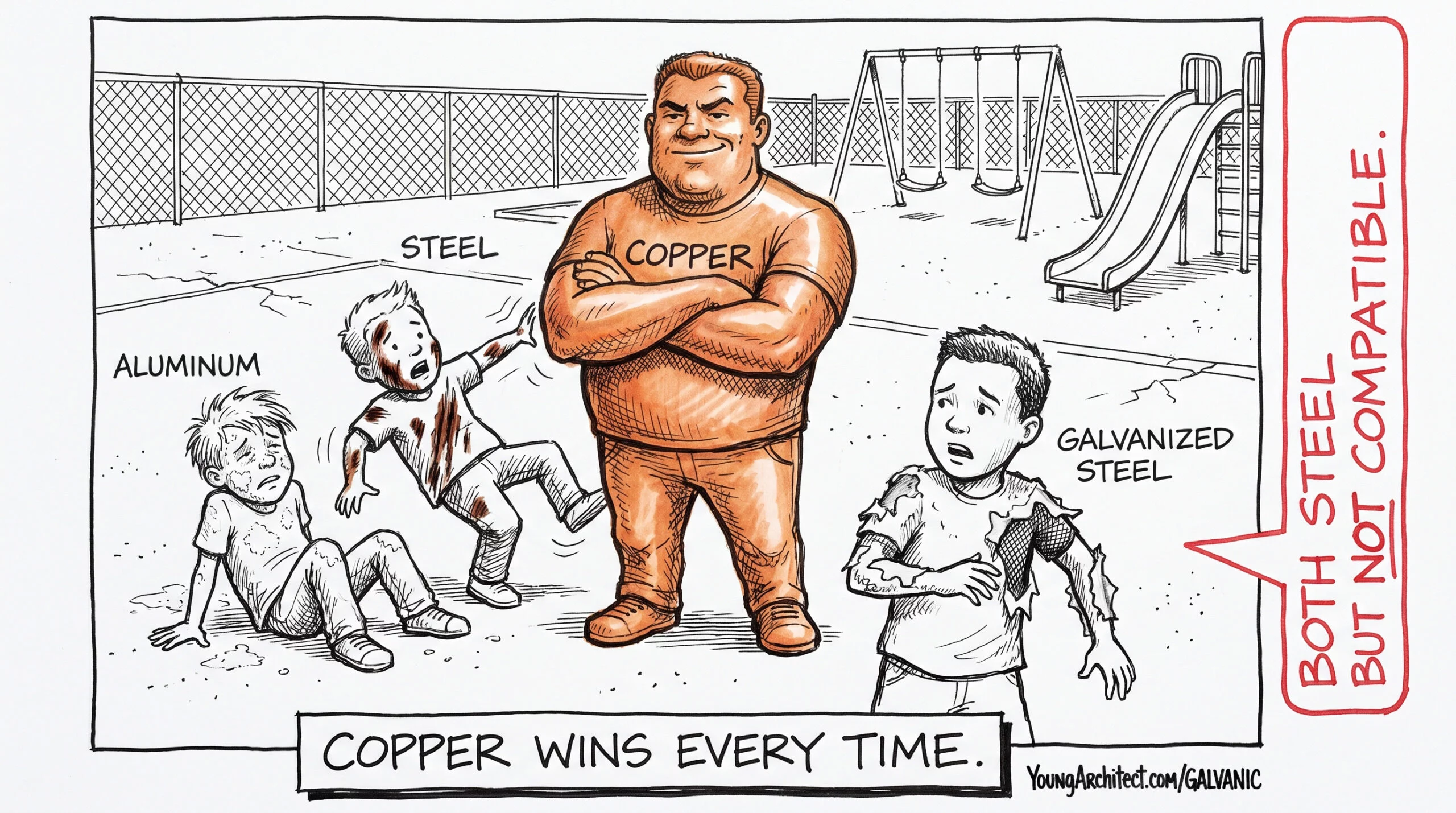
Copper is the bully of architectural metals. It sits high on the galvanic series as a noble metal, it is widely used in construction, and it beats up almost everything it touches.
Copper and Aluminum
Copper is far more noble than aluminum on the galvanic series. When they are in contact with moisture, the aluminum corrodes aggressively. White powdery oxidation, pitting, and eventually failure of the aluminum component.
The classic mistake: copper flashing that drips onto aluminum storefront framing below. The copper does not even have to be touching the aluminum directly. But we will get to that in the water runoff section.
Copper and Steel
Same story, same bully. Copper wins. Steel or iron corrodes.
Watch for copper pipes or copper flashing anywhere near steel lintels or steel supports. If moisture can bridge the gap between them, you have a problem. This shows up across multiple construction types wherever steel structural elements and copper components share the same assembly.
Copper and Galvanized Steel
Remember, galvanized steel has that zinc coating acting as a sacrificial anode. Copper accelerates zinc corrosion dramatically.
Water runoff from copper onto galvanized gutters or downspouts eats through the zinc coating fast. Once the zinc is gone, the steel underneath starts corroding too.
A classic galvanic corrosion example: a copper roof with galvanized gutters below. That combination is a ticking clock. When you are evaluating roof membrane types and metal components together, copper and galvanized steel should never be in the same drainage path.
Stainless Steel and Carbon Steel
A tricky one. People assume these are compatible because they are both “steel.”
They are not.
Stainless steel is significantly more noble than carbon steel on the galvanic series. The carbon steel will corrode at the contact point. Do not let the similar names fool you. “Steel” in the name does not mean they are in the same family on the galvanic series chart.
Water Runoff Corrosion
Direct contact is not the only way galvanic corrosion happens.
Water that touches a more noble metal picks up metal ions and carries them downstream. The water itself becomes a conductor, delivering those ions to whatever active metal is sitting below in the drainage path.
Copper runoff is especially aggressive. Water draining off a copper element onto aluminum, zinc, or steel below will cause corrosion even if the metals are never physically touching. No direct contact required. The water is doing the work.
This connects directly back to the three-ingredient framework. The water runoff acts as the electrolyte (ingredient #3), and the dissolved copper ions essentially bring ingredient #1 (the dissimilar metal) along for the ride. All three ingredients are created through drainage alone.
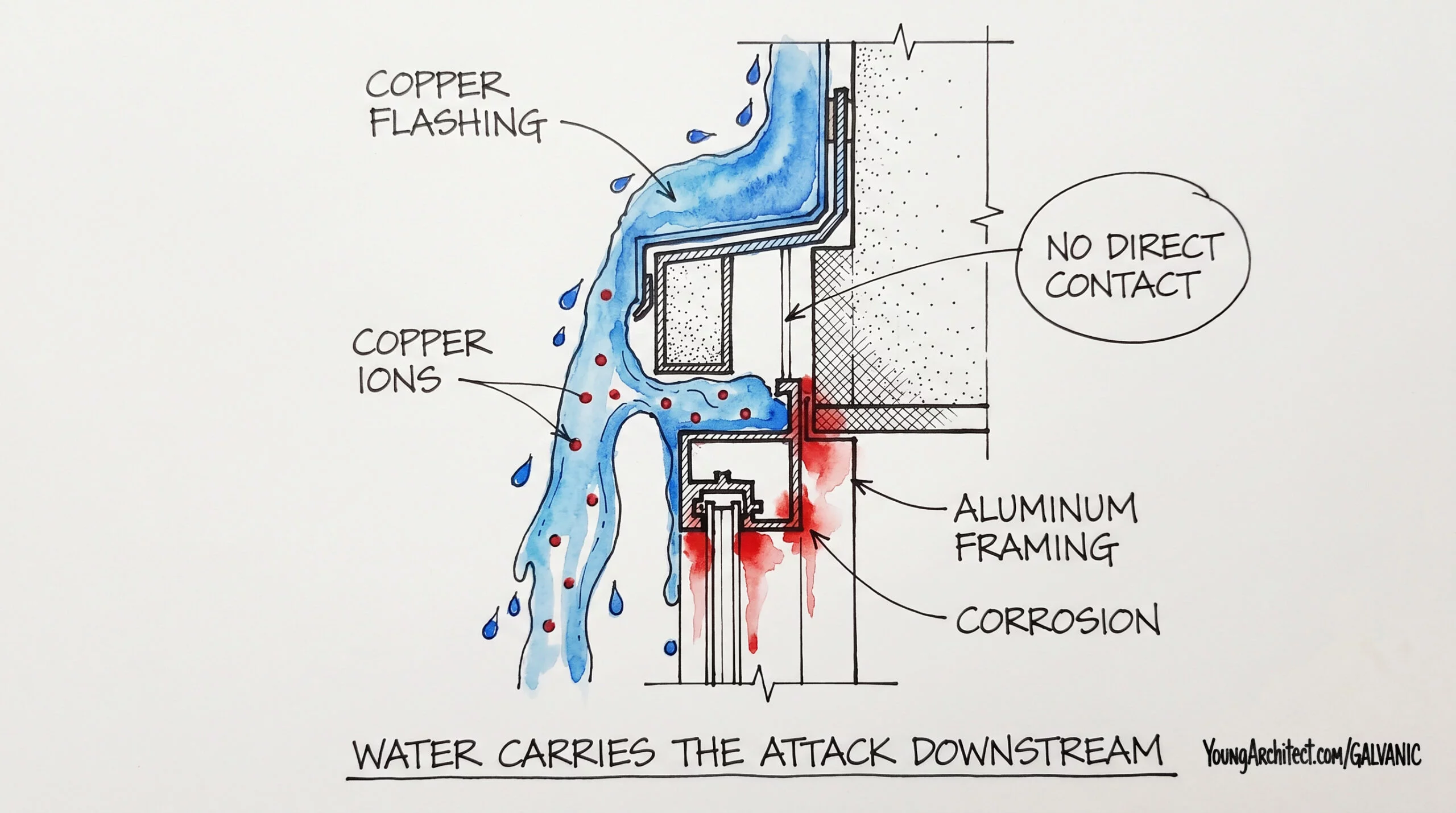
When you are designing, you cannot just think about what is touching what. You have to think about the entire drainage path:
- Where does the water go after it hits the copper?
- What metal is below it?
- What is downstream?
Every surface in that drainage path is potentially at risk.
The Water Flow Rule
Water should flow from active metals to noble metals, not from noble metals to active metals.
Water washing off an aluminum parapet onto a copper roof below? No problem. Aluminum is the active metal, and it is not going to deposit harmful ions onto the copper.
Water washing off a copper roof onto aluminum framing below? That is where the damage happens. The copper ions hitch a ride in the water and attack whatever active metal is downstream.
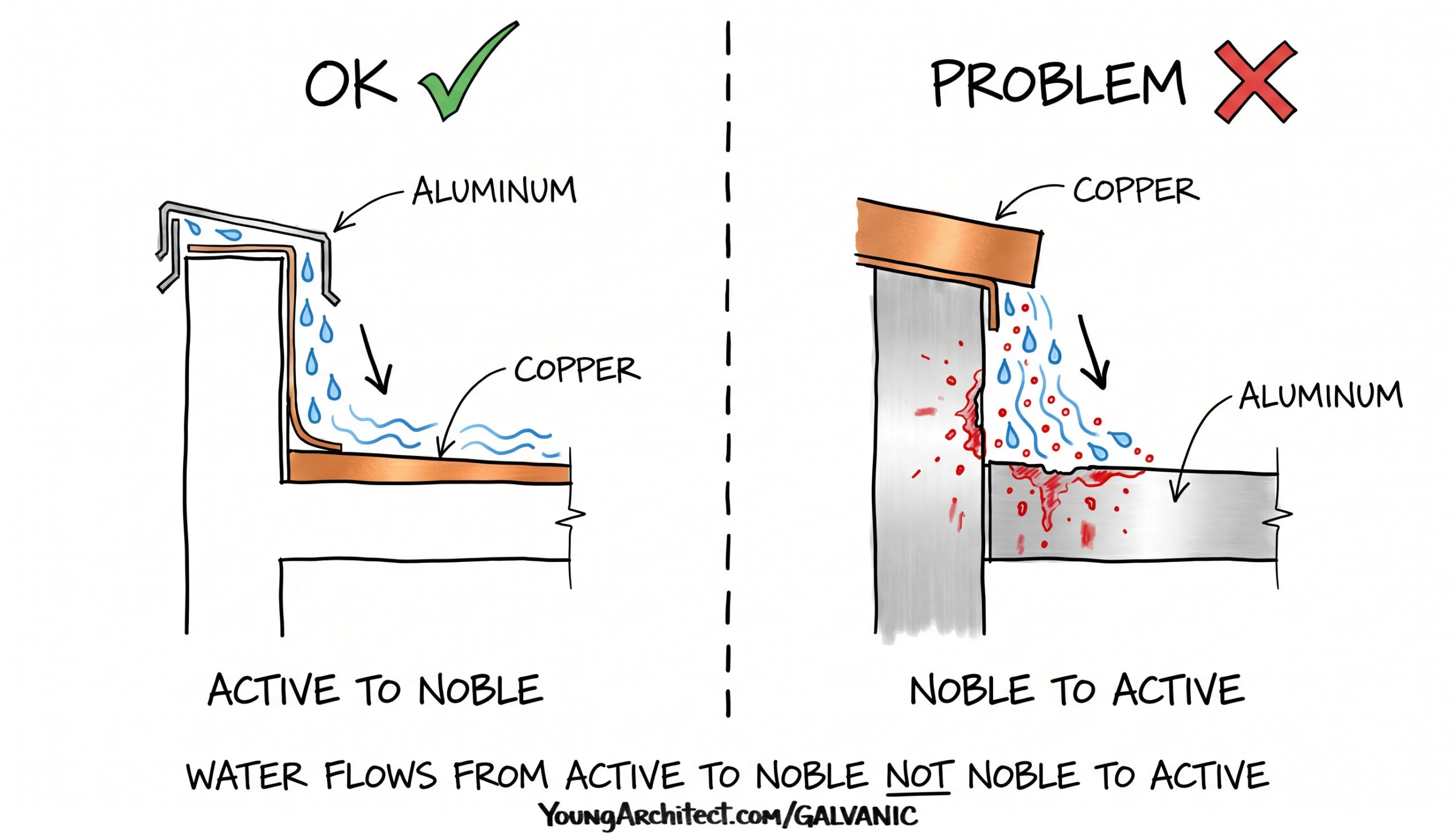
This detail separates someone who understands galvanic corrosion from someone who just memorized a chart. The chart tells you which metals fight. The water flow rule tells you the fight can happen without direct contact, as long as gravity and water create the path.
When you are laying out a building section with mixed metals, trace the water path from top to bottom. If a noble metal is draining onto an active metal below, you either need to change the metals, redirect the drainage, or add a physical barrier to break the electrolyte path.
How to Prevent Galvanic Corrosion
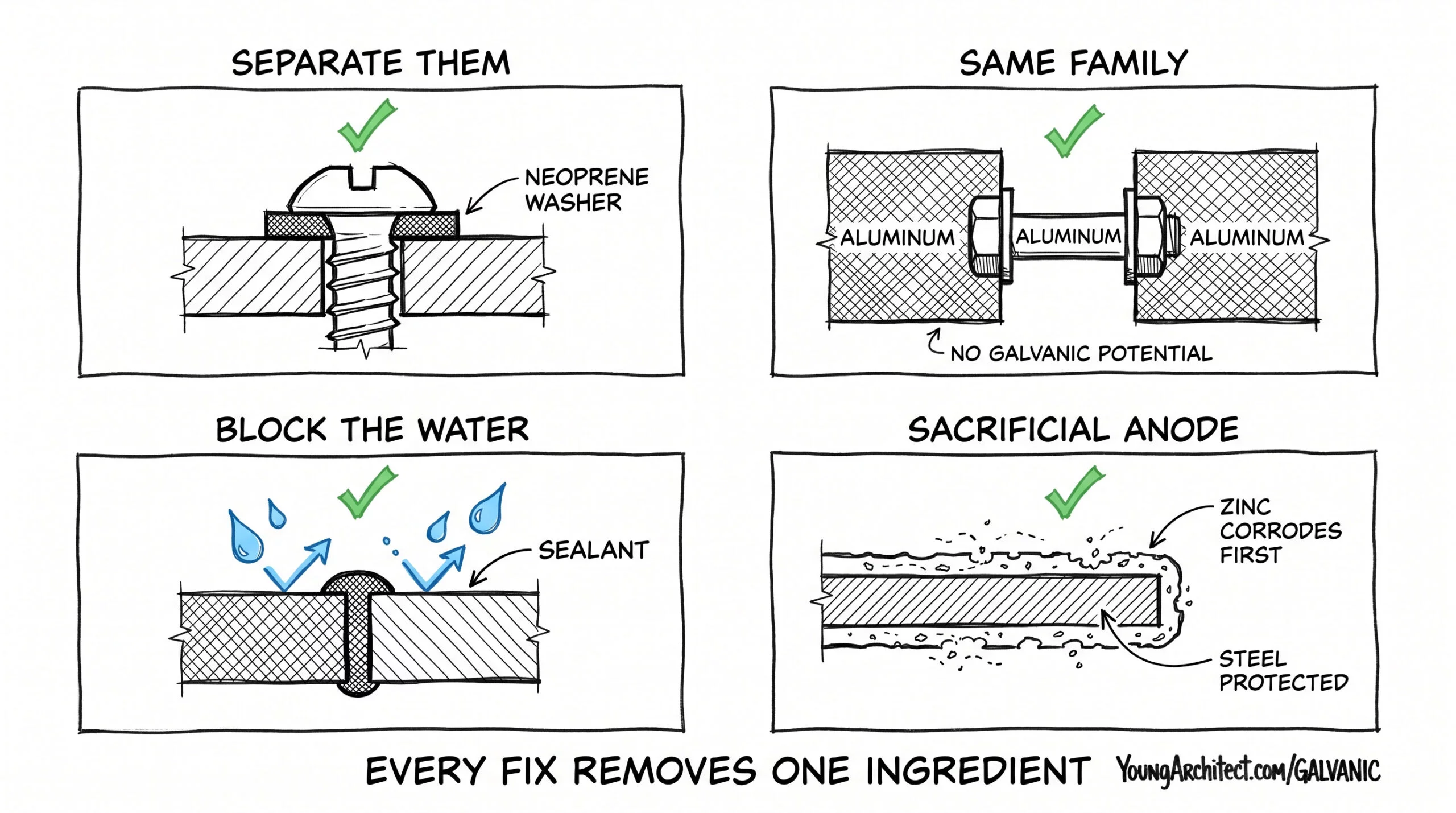
Every prevention strategy works by removing one of the three ingredients from the triangle. That is the entire playbook.
Strategy 1: Physically separate the metals.
Break the electrical contact. Use neoprene gaskets, plastic spacers, rubber washers, bituminous paint, tape, or coatings between the metals. This is common with aluminum panels and stainless fasteners where an isolating washer goes between the screw and the panel. This removes ingredient #2 from the triangle.
Strategy 2: Use compatible metals.
Choose metals that are close together on the galvanic series. Keep metals in the same family. If everything in your detail is aluminum with aluminum fasteners, there is zero galvanic potential. No dissimilar metals means no ingredient #1.
Strategy 3: Break the electrolyte path.
Remove the moisture. Proper sealant types and joint design can prevent moisture from bridging between two metals in an assembly. Proper drainage design and protective coatings work the same way. No electrolyte means no ingredient #3.
Strategy 4: Use a sacrificial anode.
Intentionally place a more active metal to protect the one you care about. This is exactly what galvanizing does. The zinc corrodes first so the steel does not have to. It is not a flaw. It is the design. This does not remove an ingredient. It redirects ingredient #1 to a metal you are willing to sacrifice.
And one more critical point: spec your fasteners.
Do not leave fastener selection to whatever the contractor has in the truck. Call out compatible fasteners in your construction specifications. Whether you are writing prescriptive vs performance specifications for the fasteners, the material compatibility requirement needs to be explicit. This is where reviewing construction submittals for the right materials becomes part of your quality control during construction administration.
A beautiful metal panel assembly ruined by the wrong screw is one of the most common and most preventable galvanic failures in the field. The Construction Specifier’s guide to galvanic corrosion in building design covers additional specification strategies for preventing dissimilar metal failures.
Coat the Cathode
If you can only coat one of the two metals in an assembly, which one do you paint?
Always coat the cathode. Paint the bully, not the victim.
If you paint the active metal and that paint gets a tiny scratch, you have just created the worst possible surface area ratio. A microscopic exposed anode against a massive noble cathode. That scratch will pit and drill a hole through the metal in record time.
But if you paint the noble metal and it scratches? The exposed spot is just a small cathode against a large anode. Much less damage. The corrosion spreads across the larger surface instead of concentrating on a pinpoint.
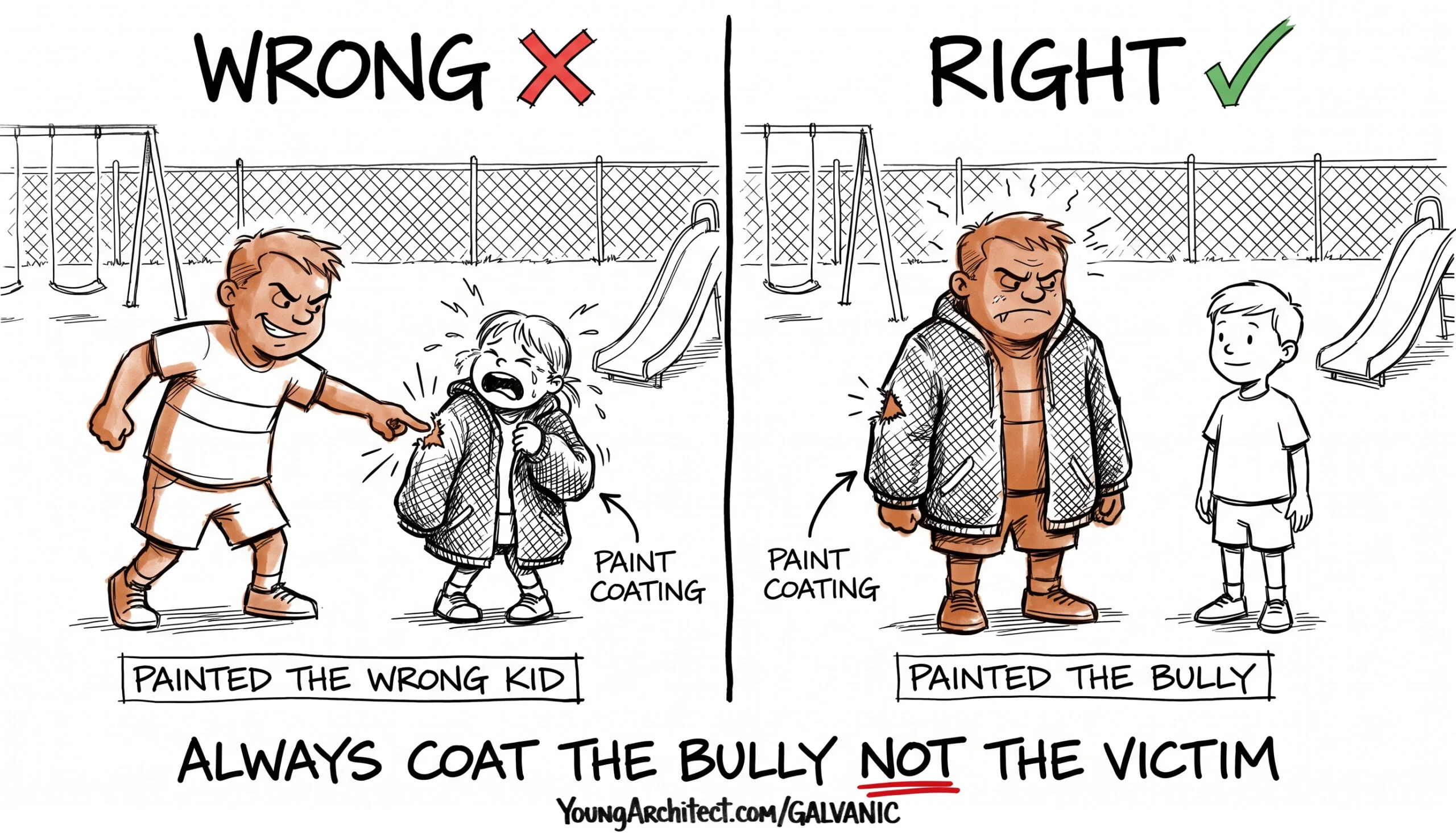
This is counterintuitive at first. Your instinct says to protect the weaker metal. But the science says to restrain the bully. Coating the cathode limits its ability to drive the galvanic reaction in the first place.
Galvanic Corrosion on the ARE Exam
NCARB’s published objectives for the PPD exam include building envelope design, material selection, and building systems integration. The PDD exam objectives cover material detailing, specification writing, and construction document coordination. Galvanic corrosion sits right at the intersection of both.
The phrase “dissimilar metals” is your trigger. When you encounter a scenario involving material selection for a cladding assembly, fastener specification for a mixed-metal connection, or flashing details at transitions between different metals, galvanic corrosion should be the first concept that comes to mind.
The professional scenarios where this knowledge applies:
- Selecting fasteners for a cladding detail where the panel and fastener are different metals
- Specifying flashing materials at connections between copper elements and aluminum or steel framing
- Reviewing submittals for material compatibility across an assembly with multiple metal types
- Evaluating roofing and wall details where water runoff from one metal drains onto another
- Identifying premature failure conditions in building envelope assemblies involving mixed metals
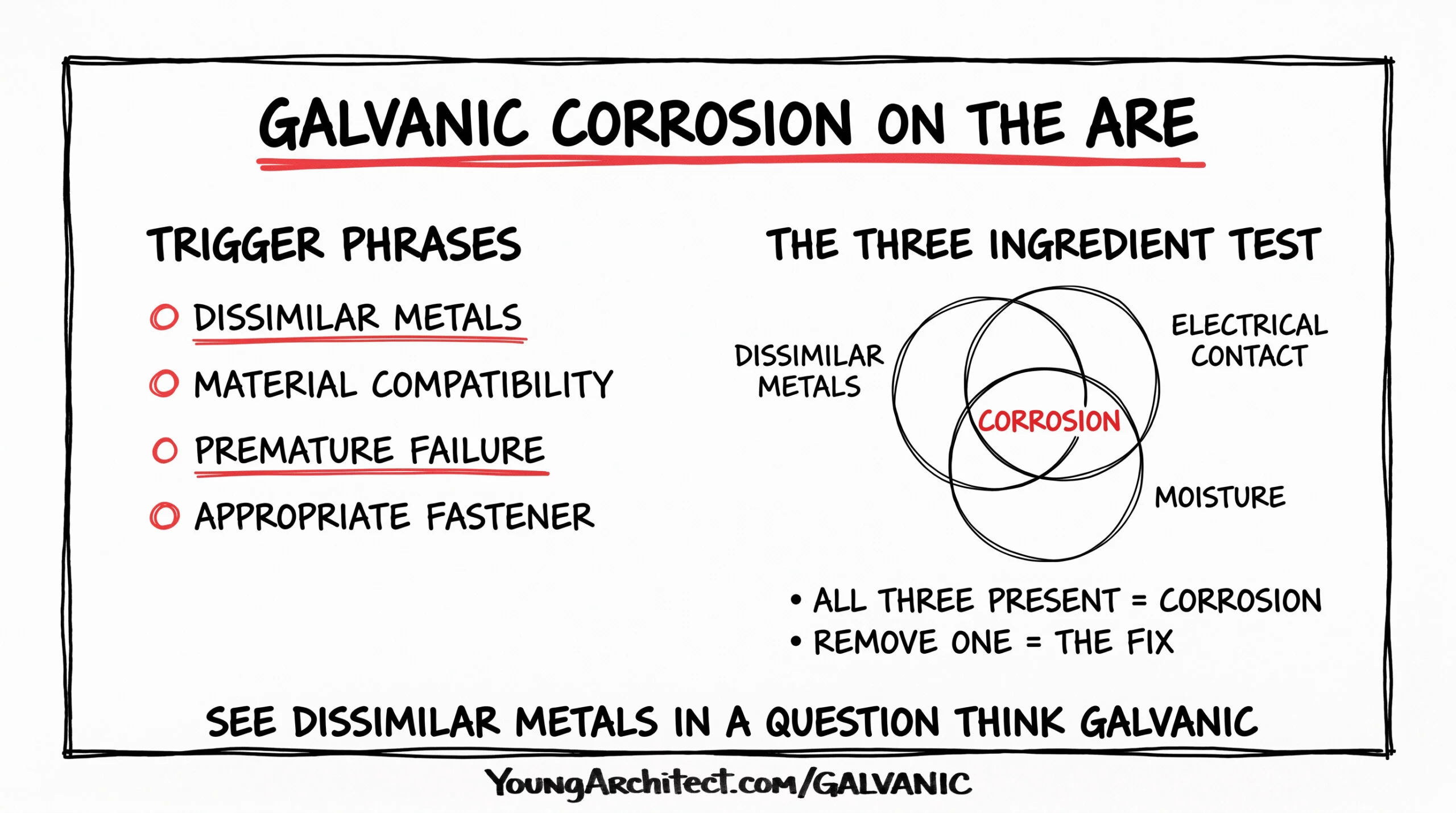
If you understand the three ingredients and you know that copper is the bully that beats up everything below it on the galvanic series, you can reason through any scenario. You do not need to memorize the entire chart. You need to understand the framework, know the common problem combinations, and apply the distance rule.
Three Rules Quick Reference
If you remember nothing else from this post, remember these three rules.
Keep it in the family. Use the same metal for everything in a detail if you can. Same family, no fighting.
Copper is a bully. Keep it away from aluminum and steel. Copper wins every time.
Fasteners are the weak link. The screw should always be tougher (more noble) than the thing it is holding. Do not leave fastener selection to the field.
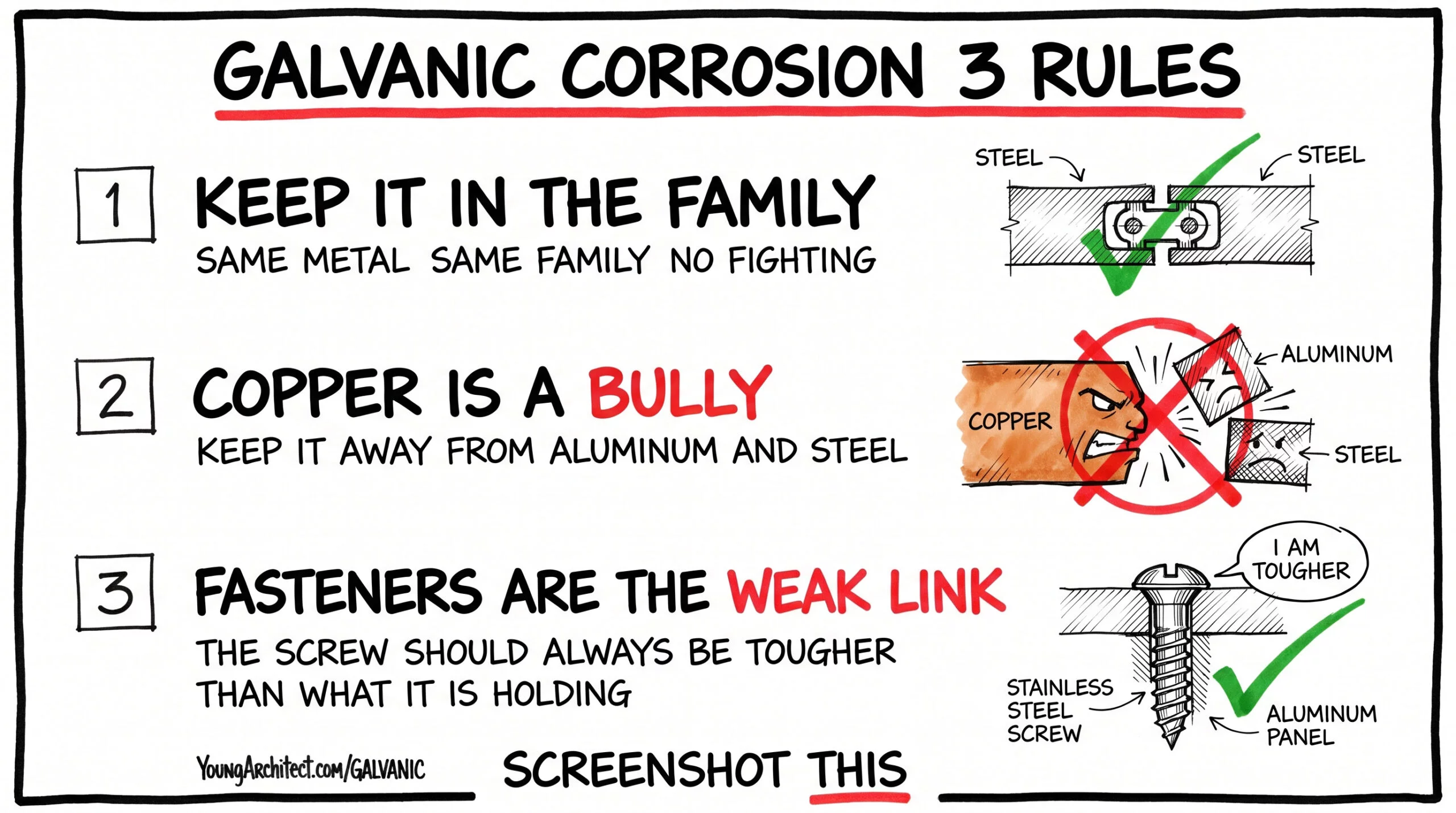
Those three rules cover most galvanic corrosion scenarios in practice and across multiple areas of your professional knowledge.
If galvanic corrosion clicked for you and you want to go deeper on materials, assemblies, and building envelope details, ARE Boot Camp gives you a structured study plan with live coaching, accountability, and a community of candidates pushing toward the same goal.
The ARE 101 Course Membership bundles all of our self-paced courses together, including PPD 101, PDD 101, Building Codes 101, and Building Systems 101. Material compatibility, envelope detailing, fastener specification, and structural concepts are covered in depth across those courses.
Frequently Asked Questions About Galvanic Corrosion
What is galvanic corrosion?
Galvanic corrosion happens when two dissimilar metals are in contact with moisture present. The more active metal corrodes faster than it normally would on its own because the metals create a small electrical current. The noble metal is protected while the active metal breaks down. It is also called galvanic action, bimetallic corrosion, or dissimilar metal corrosion.
How do you prevent galvanic corrosion?
You can prevent galvanic corrosion by removing any one of the three required ingredients. Physically separate the metals with neoprene gaskets, plastic spacers, or coatings. Use compatible metals that are close together on the galvanic series. Or break the moisture path with sealants and proper drainage design. If you can only coat one metal, always coat the noble metal (the cathode), not the active metal.
What metals cause galvanic corrosion?
Any two metals that are far apart on the galvanic series can cause galvanic corrosion when they touch in the presence of moisture. The most common problem combinations in construction are copper with aluminum, copper with steel, copper with galvanized steel, and stainless steel with carbon steel. The further apart two metals sit on the galvanic series, the faster the active metal corrodes.
What is the galvanic series?
The galvanic series is a chart that ranks metals from noble (corrosion resistant) to active (corrosion prone). In construction, the common ranking from noble to active is stainless steel, copper and bronze, lead and tin, aluminum, zinc, and steel or iron (most active). Metals that are far apart on the series have a higher risk of galvanic corrosion when they are in contact.
Why is copper a problem for galvanic corrosion?
Copper sits high on the galvanic series as a noble metal, meaning it resists corrosion and beats up almost everything it touches. Copper in contact with aluminum, steel, or galvanized steel causes aggressive corrosion of the less noble metal. Even water runoff from copper surfaces can carry copper ions downstream and corrode metals below without any direct contact.
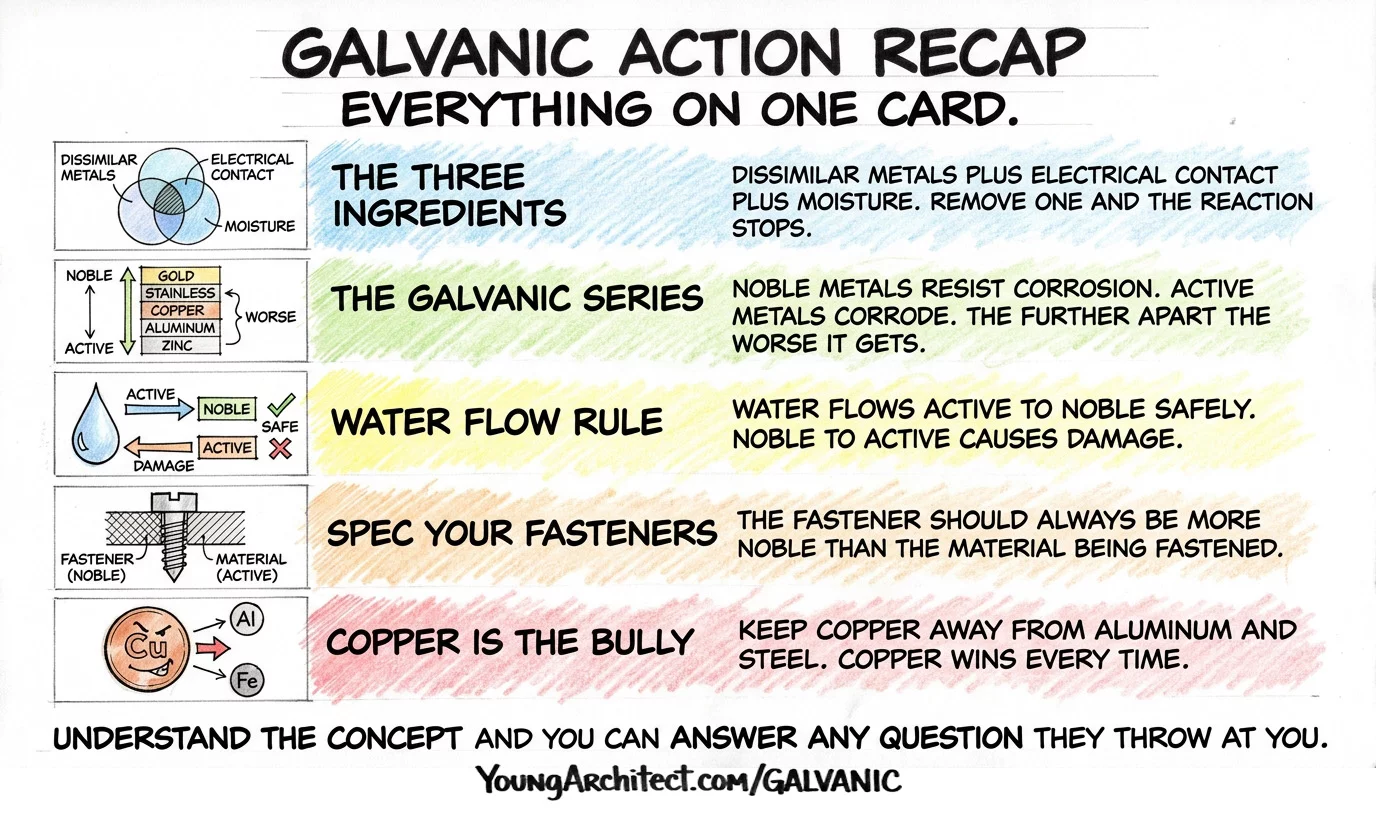
Galvanic Action Recap
Galvanic action is predictable. Know the three ingredients. Know the galvanic series. Spec your fasteners. And always think about where the water goes.
In practice, understanding galvanic corrosion saves you from callbacks, failures, and some really awkward conversations with clients and contractors.
Galvanic Action Quiz Time: