
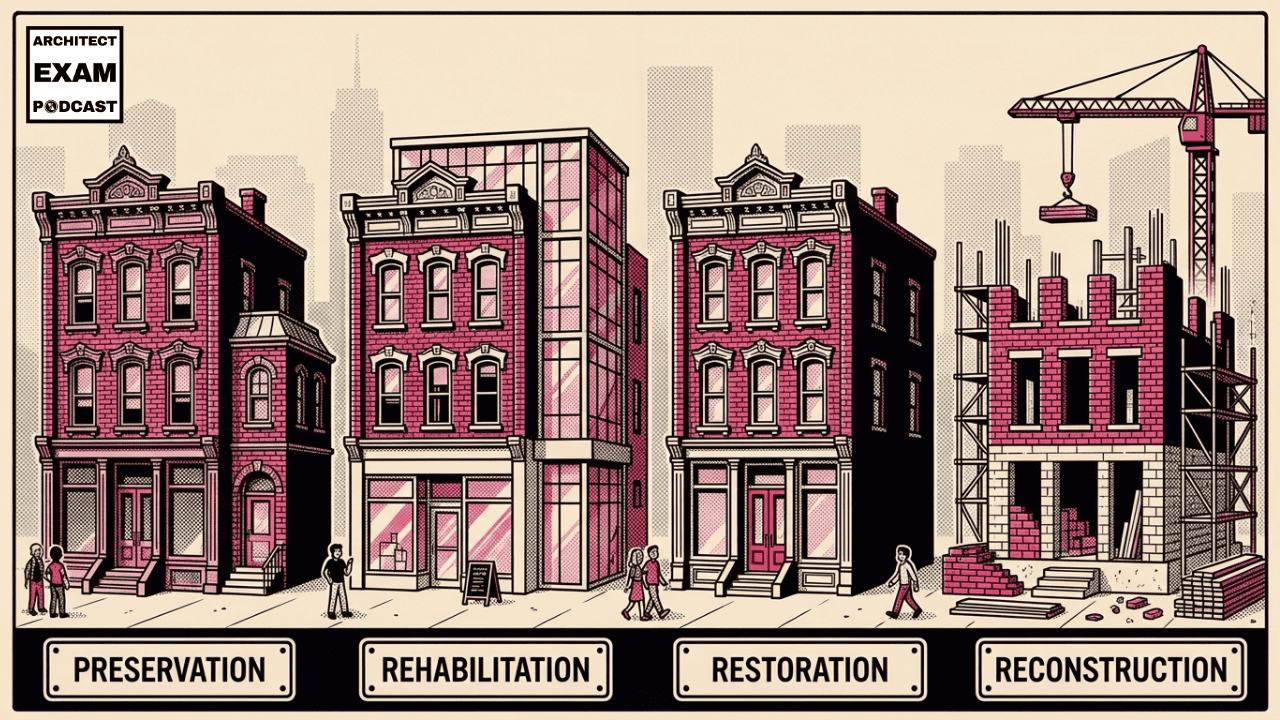

Historic preservation defines four distinct approaches to working on historic buildings, and most people confuse at least two of them. A design team once spent weeks building a restoration plan for a beautiful old brick building in Chicago because the client kept saying they wanted to “restore” it. When they presented the plan, the client’s face dropped. They didn’t want to strip anything out. They wanted to turn it into a restaurant. The client wanted rehabilitation, not restoration, and this post breaks down all four approaches so you understand what each one allows, what it doesn’t, and how to tell them apart.
This podcast is also available on YouTube, Spotify, and Apple Podcasts
What Is Historic Preservation?
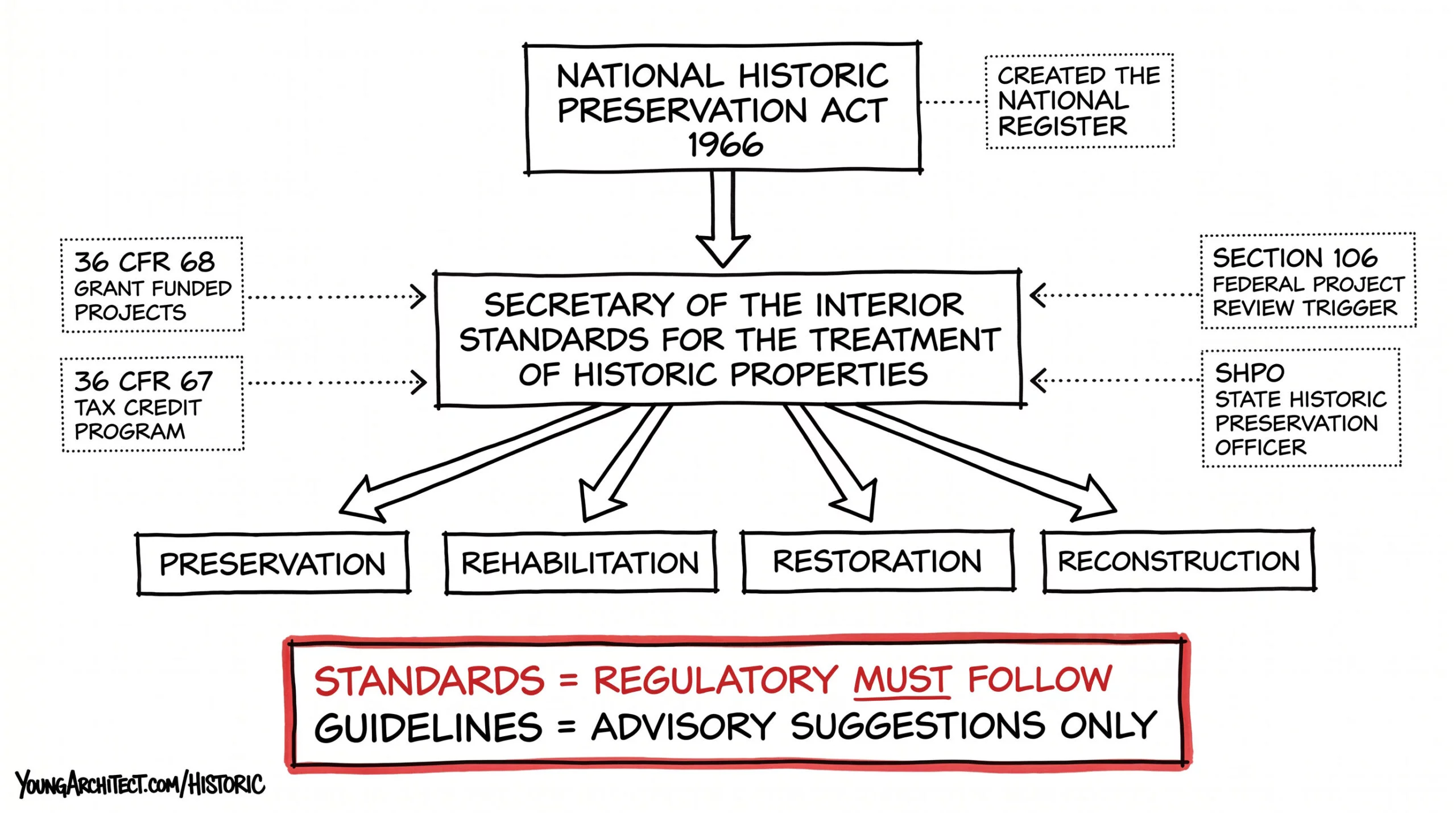
The governing document behind all of this is called the Secretary of the Interior’s Standards for the Treatment of Historic Properties. It’s published by the National Park Service, and it defines four distinct treatment approaches for working on historic buildings.
Those four approaches are Preservation, Rehabilitation, Restoration, and Reconstruction.
These aren’t just vocabulary words. These are federal standards with real legal weight. The Standards are codified in federal regulations under 36 CFR 68 (for grant-funded projects) and 36 CFR 67 (for the tax credit program). You can find the full overview on the Secretary of the Interior’s Standards for the Treatment of Historic Properties page at the National Park Service.
Here’s a distinction that matters:
The Standards themselves are regulatory. You must follow them on qualifying projects. The Guidelines that accompany the Standards are advisory. They help you apply the standards, but they’re not enforceable on their own.
Standards are the rules. Guidelines are the guidance for how to follow the rules.
The whole framework goes back to the National Historic Preservation Act of 1966, which created the National Register of Historic Places and set up the system we still use today.
Section 106 of that act is the trigger that brings historic preservation review into play. Anytime there’s federal involvement in a project, whether through funding, permits, or licensing, Section 106 requires the agency to consider the effects on historic properties before moving forward. Private projects without federal involvement typically don’t trigger Section 106, though local landmark designations may have their own review requirements.
The person you’ll be coordinating with on these projects is the SHPO, the State Historic Preservation Officer. They review projects for compliance and act as the bridge between federal requirements and what’s happening at the local level. If you’re working on a National Register property, a property inside a historic district, or a project seeking federal historic tax credits, the SHPO is your point of contact.
Understanding how building codes and regulations interact with preservation standards is important context here, because the regulatory framework for historic buildings adds a layer on top of the standard code research you’d do on any project.
One more thing before we move on. The word “renovation” is NOT one of the four treatment approaches. It’s a general construction term. It might sound like it belongs alongside preservation, rehabilitation, restoration, and reconstruction, but it doesn’t. We’ll come back to this distinction later.
The Four Historic Preservation Approaches
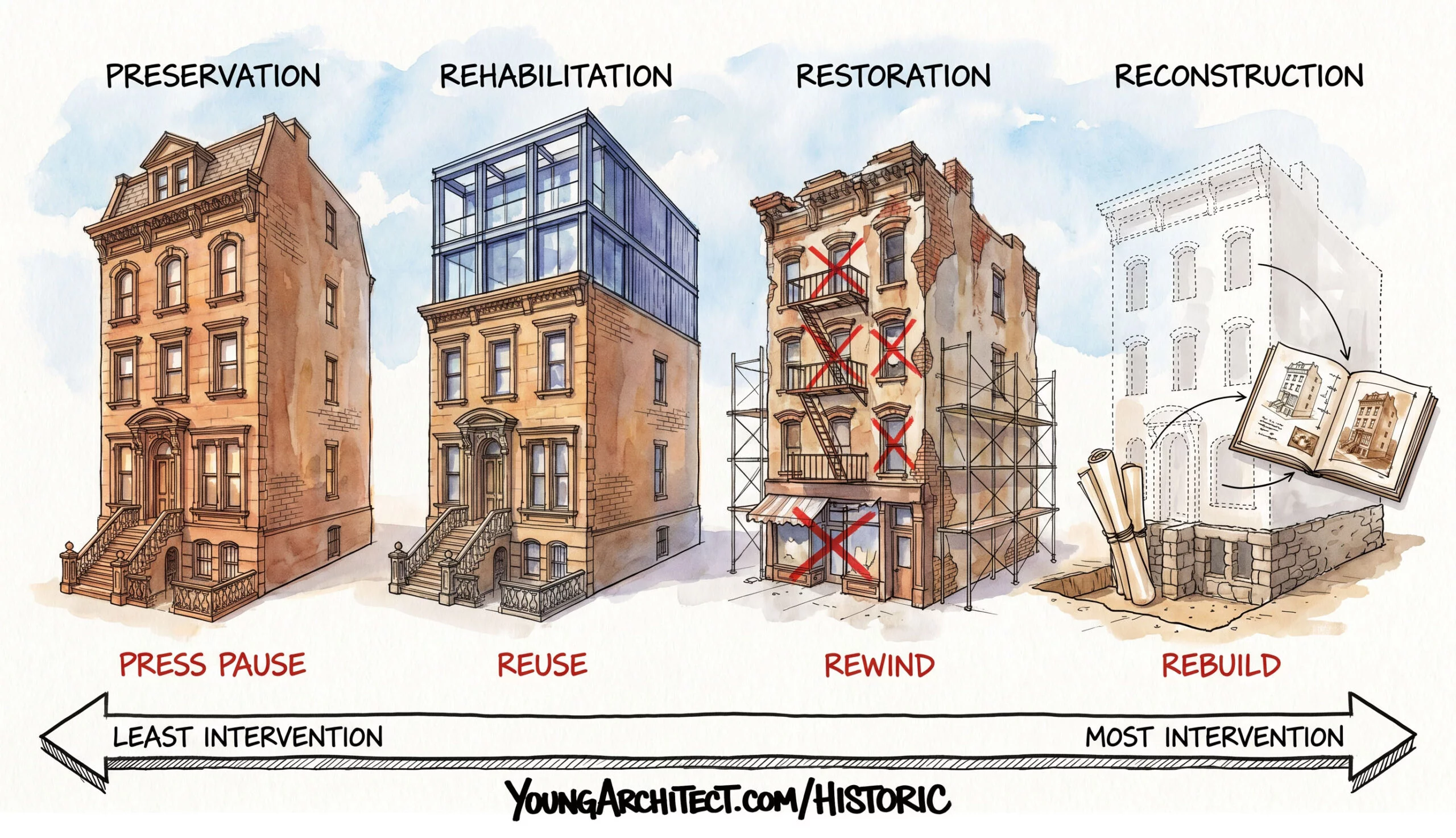
Think of the four approaches on a spectrum from least intervention to most intervention.
On the far left, the most conservative approach, is Preservation.
Then Rehabilitation.
Then Restoration.
And on the far right, the most extreme, is Reconstruction.
Here’s a memory hook for each one that you can use to keep them straight:
- Preservation = Press Pause
- Rehabilitation = Reuse
- Restoration = Rewind
- Reconstruction = Rebuild
As we walk through each one, pay attention to what makes each approach different from the others. Understanding the distinctions matters just as much as knowing the definitions.
Preservation: Maintaining a Building As-Is
Starting at the far left of the spectrum. The most conservative approach.
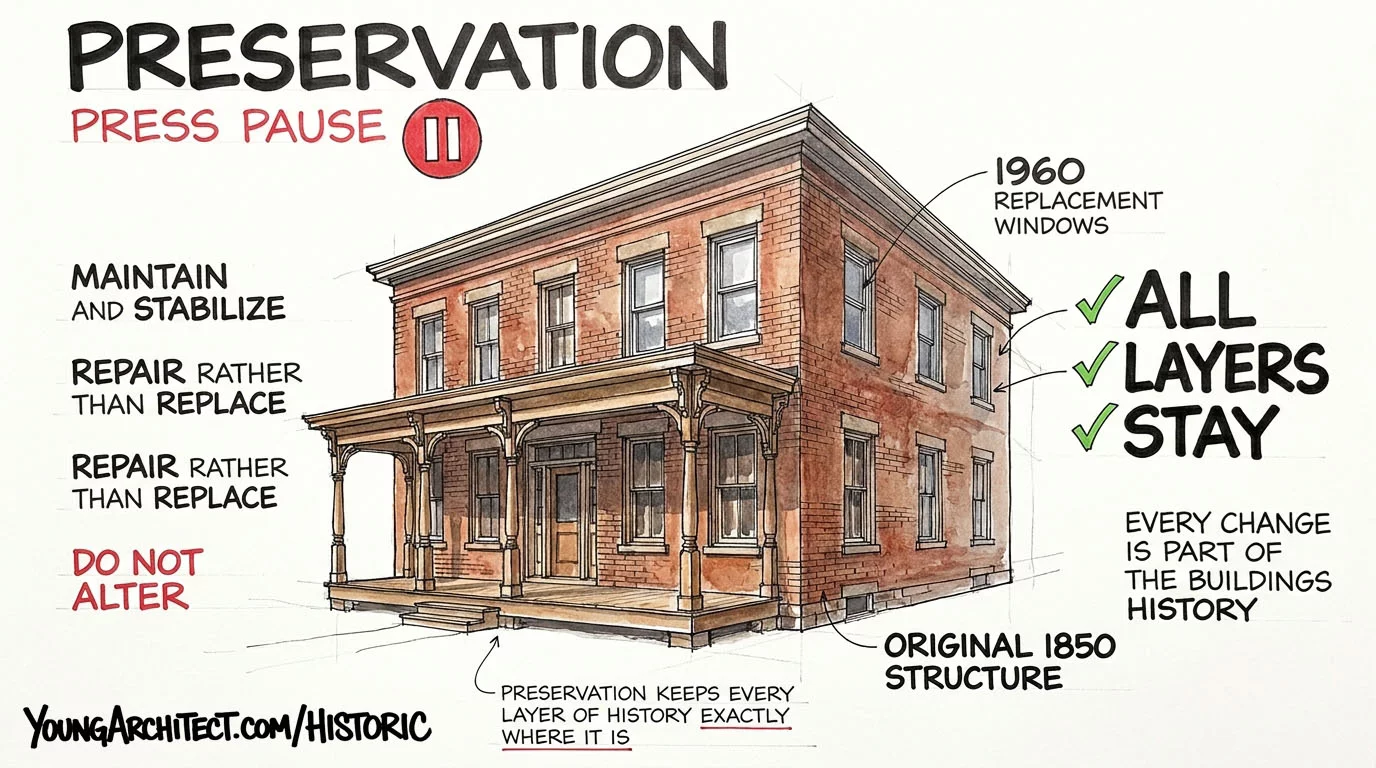
The goal with preservation is to maintain the building exactly as it exists today. You’re stabilizing and conserving existing historic materials. You’re protecting what’s there from further deterioration.
And you’re doing as little as possible to change anything. Repair rather than replace. If it’s not failing, you leave it alone.
Here’s what makes preservation unique. It accepts that a building has changed over time, and it treats all of those changes as part of the building’s story.
So if you’ve got a building from 1850 that had a porch added in 1920 and got new windows in 1960, preservation says keep all of it. Every layer of history stays.
You don’t pick a favorite era. You maintain the building as the full record of its own evolution.
Hold onto that idea, because when we get to restoration, you’ll see the exact opposite approach. The contrast between the two is one of the most commonly confused concepts in historic preservation.
Mothballing and When to Use Preservation
There’s a specific preservation practice worth knowing called mothballing. When a historic building is sitting vacant and there’s no immediate funding for a full rehabilitation, the owner will stabilize the structure, secure it from vandalism and weather, and modify the ventilation to control moisture, all without altering the architecture.
You’re literally pressing pause on the building until a long-term plan comes together. It’s preservation in its purest form.
When would you use preservation? When the building retains most of its original historic fabric, when the goal is to stabilize and maintain rather than change or adapt, and when the physical material of the building itself is the most important thing to protect. Think house museums, landmark properties, significant structures where the fabric tells the story.
Memory hook: Preservation = Press Pause. Freeze it. Keep it as-is. Least intervention.
Rehabilitation and Adaptive Reuse
Now what if the building needs to actually function for a new purpose?
That’s where we move up the spectrum to rehabilitation.
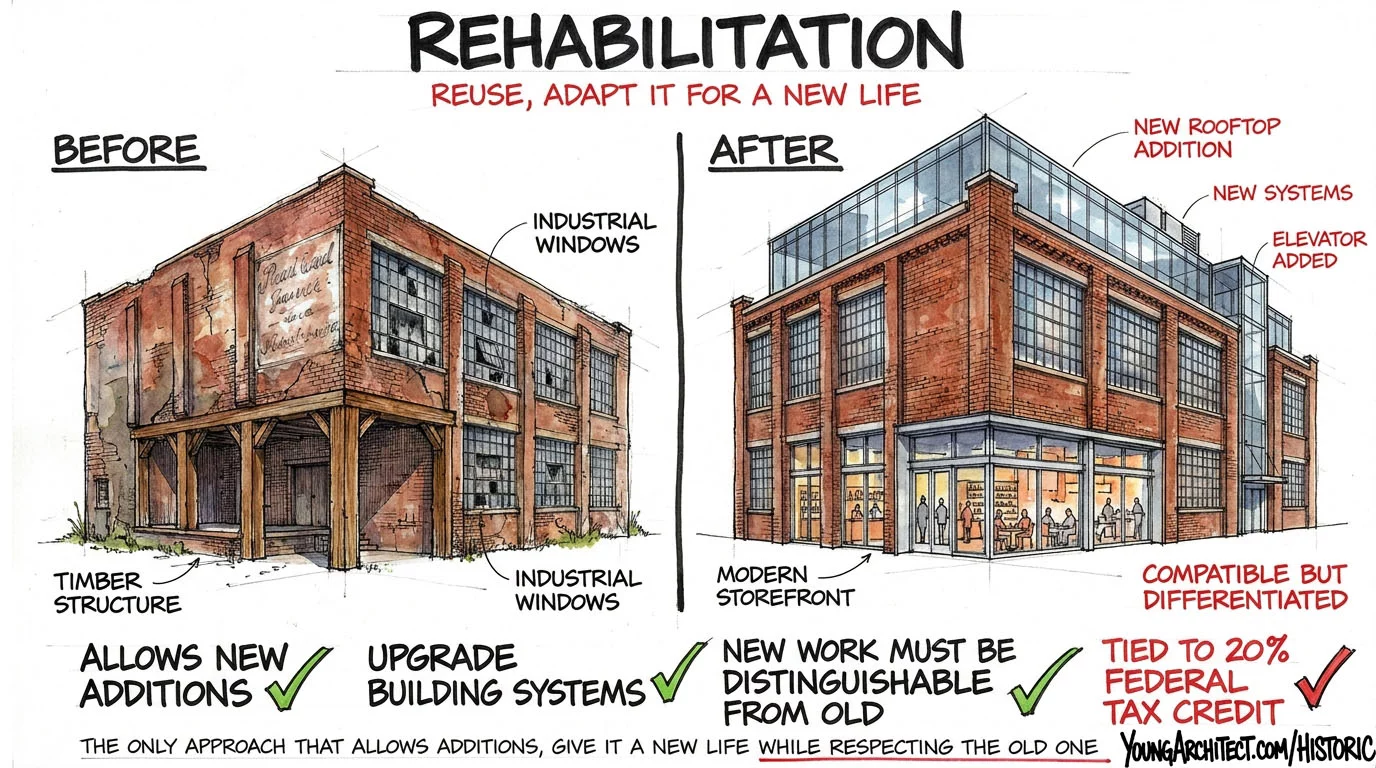
Rehabilitation is the approach that gives you the most flexibility. The goal is to make the building usable for a contemporary purpose while retaining its historic character. This is the most commonly used approach overall.
When people talk about adaptive reuse, this is the treatment approach they’re talking about. Turning an old warehouse into apartments. Converting a factory into a restaurant. Transforming a historic school into office space. Those are all adaptive reuse projects, and they all fall under rehabilitation.
Here’s what rehabilitation allows:
- Upgrade building systems. HVAC, electrical, plumbing, fire protection.
- Make code-required changes for accessibility, egress, and life safety.
- New additions. This is the big one. Rehabilitation is the ONLY approach that allows new additions.
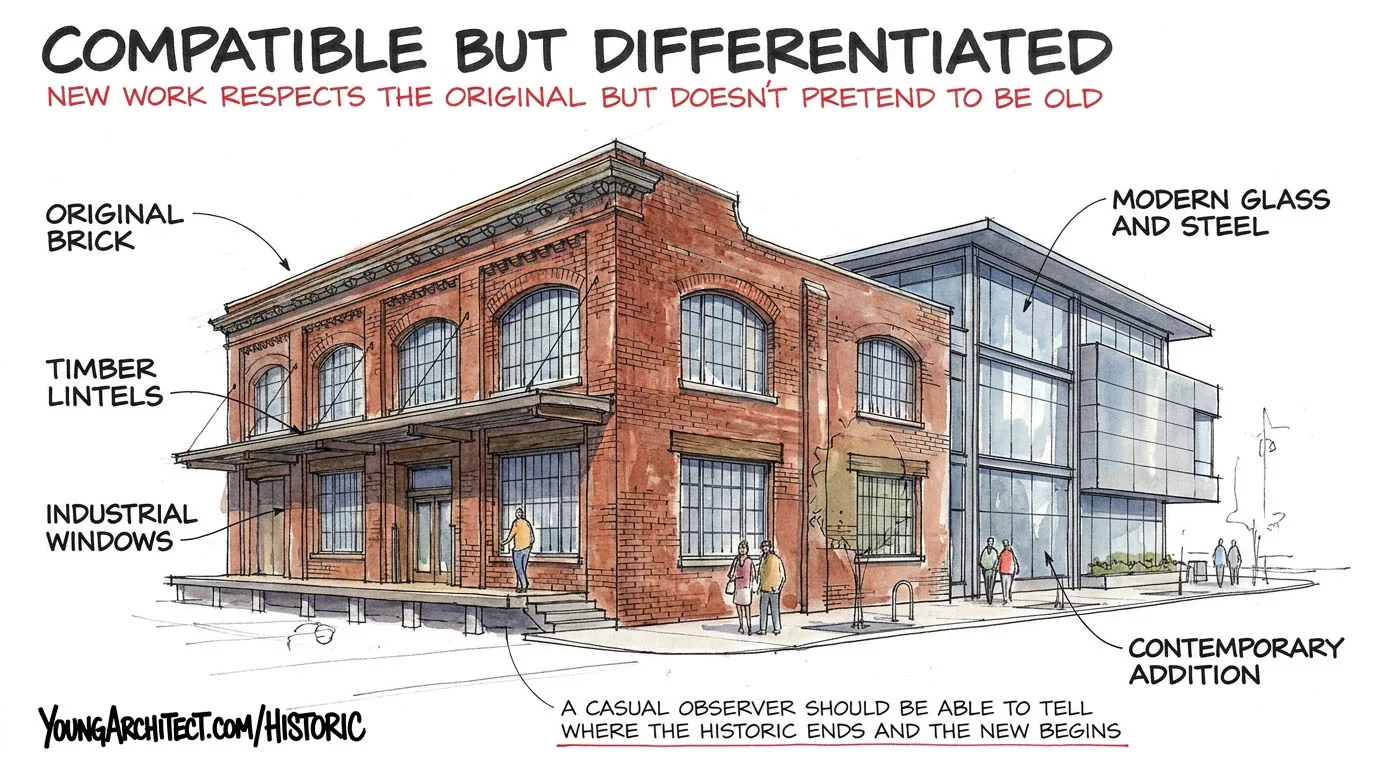
But those additions have to meet two criteria, and this is critical. The industry phrasing you need to know is “compatible but differentiated.”
The addition has to be compatible with the historic building, meaning it respects the massing, the scale, and the material palette.
But it also has to be differentiated, meaning a casual observer standing on the street should be able to tell where the historic fabric ends and the new addition begins.
And here’s the part that trips people up. If the new work mimics the old work so well that you can’t tell them apart, that actually violates the Standards. It creates a false sense of history.
The new stuff is supposed to look new. Just respectfully new.
Additionally, new work under rehabilitation should ideally be reversible. If someone fifty years from now decides to remove your addition or undo your modern intervention, the original historic building underneath should still be intact and unharmed. You’re not just building on top of history. You’re building in a way that protects it for the next team that comes along.
Remember the opening story about the old brick building in Chicago? The client who wanted to turn it into a restaurant? That’s rehabilitation. You keep the character, you upgrade the systems, you make it work for a new use.
If you’ve ever walked through Chicago’s Fulton Market or the West Loop, you’ve seen this in action. Old meatpacking warehouses where the weathered brick and heavy timber columns are still standing, but they’re paired with clean modern glass and steel storefronts at street level. That’s compatible but differentiated playing out across an entire neighborhood.
The IEBC and Historic Buildings
Designing a compatible addition is only half the battle. You also have to make sure the local code enforcement official will let you build it.
Your local building inspector doesn’t enforce the Secretary of the Interior’s Standards. They enforce the building code. And sometimes modern code requirements for means of egress, accessibility, or structural capacity would force changes that destroy the very historic fabric you’re trying to protect.
That’s where the International Existing Building Code (IEBC) comes in. It has an entire chapter dedicated to historic buildings that grants design flexibility and variances, as long as you’re not increasing the hazard.
Think of it as the architect’s shield. It gives you permission to protect historic materials without getting shut down by modern code requirements that weren’t written with 150-year-old buildings in mind. This is worth understanding for anyone working through PDD content, because the IEBC intersects with construction types and fire-rated assemblies in ways that create real design flexibility for historic structures.
When a building changes from a warehouse to apartments, that’s also a change of occupancy classification, and understanding how occupancy drives code requirements is foundational knowledge for any adaptive reuse project.
Adaptive Reuse vs Rehabilitation
One important distinction to lock in:
“Adaptive reuse” is a project type, not a technical treatment standard. In practice, adaptive reuse projects fall under rehabilitation. If you’re trying to identify the correct historic treatment approach for a warehouse-to-loft conversion, the answer is rehabilitation, not “adaptive reuse.”
Same deal as “renovation.” It’s a real concept, but it’s not one of the four defined approaches under the Secretary of the Interior’s Standards.
Memory hook: Rehabilitation = Reuse. Give it a new life while respecting the old one.
Historic Tax Credits and Contributing Structures
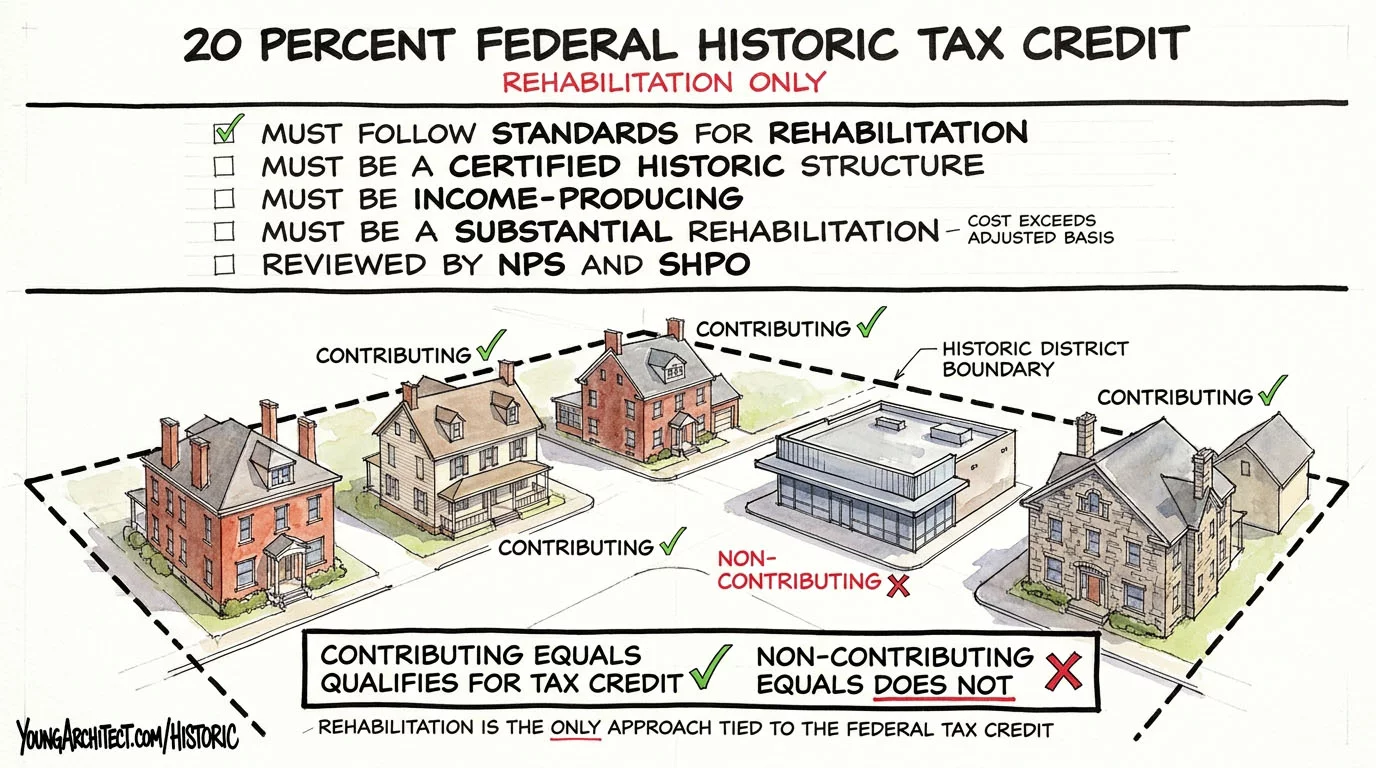
Rehabilitation is also the approach tied to federal tax credits.
The Federal Historic Preservation Tax Incentives program provides a 20% income tax credit for the rehabilitation of historic, income-producing buildings.
To qualify, the project has to meet several requirements:
- Must follow the Standards for Rehabilitation
- Must be a certified historic structure
- Must be income-producing
- Must be a “substantial” rehabilitation (the cost of the rehab has to exceed the building’s adjusted basis)
- Reviewed by the NPS and the SHPO
That term “certified historic structure” means one of two things. Either the building is individually listed on the National Register of Historic Places, or it’s a contributing structure inside a National Register-listed or NPS-certified historic district.
Contributing vs Non-Contributing Structures
Not every building inside a historic district boundary has the same status.
A contributing structure is one that shares the historic significance and character of the district. It helps tell the story of why that district matters.
A non-contributing structure is a building that happens to be inside the boundary but doesn’t share that significance. Think of a 1980s gas station sitting in the middle of an 1890s Victorian neighborhood. It’s in the district, but it’s not contributing to the district’s character.
Non-contributing structures don’t qualify for the historic tax credit.
There are actually 10 numbered standards that spell out what a qualifying rehabilitation looks like under the federal program. The key themes are: keep the historic character, don’t create a false sense of history, don’t destroy significant materials, and make sure new work is distinguishable from old. You can read the full list on the NPS Standards for Rehabilitation page.
Restoration: Returning to a Period of Significance
So preservation freezes the building as-is with every layer of history intact. Rehabilitation adapts it for a new use with flexibility for additions.
Now what if the goal is to take the building back to a specific moment in history?
That’s restoration.
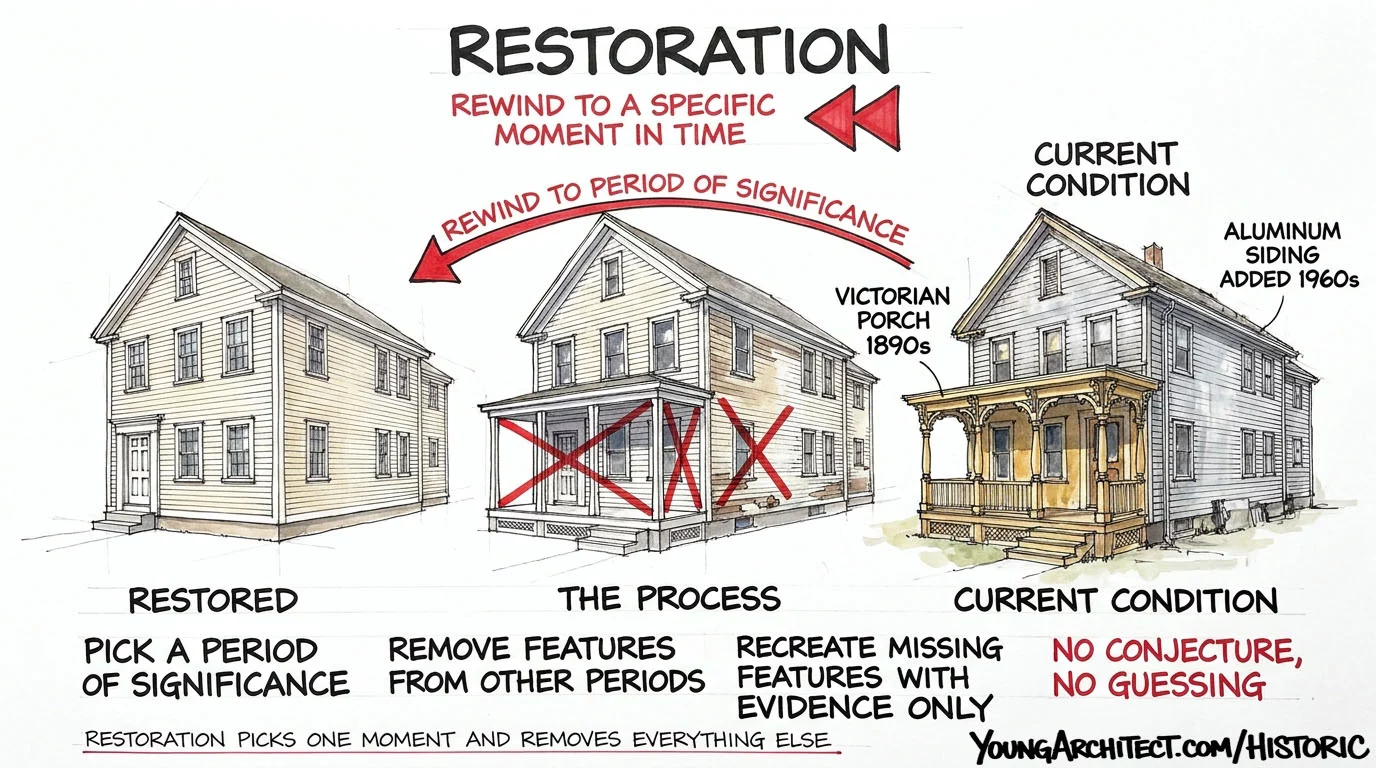
The goal with historic restoration is to return a building to its appearance at a specific period of significance. That means removing features from other periods and recreating missing features from the target period.
Here’s how it works. You pick a significant date or era. Maybe the building was the home of a prominent figure in the 1850s, or maybe a significant historical event happened there during a specific decade. That becomes your target period.
You strip away anything that was added after that period, and you recreate elements that have been lost, but only if you have the evidence to support it.
The Conjecture Trap
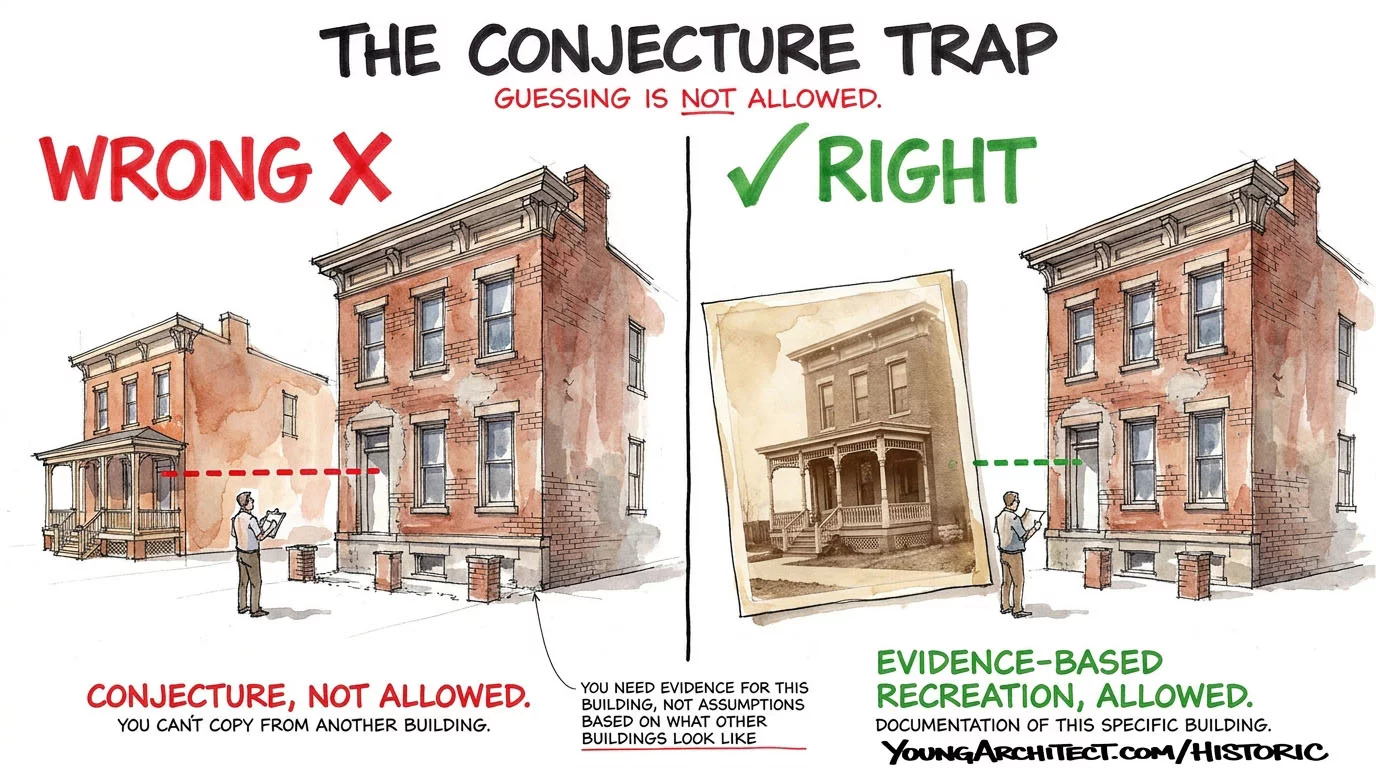
That evidence requirement is where a lot of people run into trouble.
If a historic porch from the target period is missing, you might be tempted to look at a similar building down the street that appears period-accurate and copy those details onto your building.
That’s conjecture. That’s guessing. And the Standards explicitly forbid it because it creates a false sense of history.
If there is no physical, photographic, or documentary evidence for that specific building’s missing feature, you cannot recreate it based on what other buildings look like.
Restoration requires evidence-based recreation. You cannot speculate and add back.
The Trade-Off
Now here’s the trade-off that makes restoration a really deliberate choice.
When you restore a building to one specific period, you are removing legitimate history from other periods. That Victorian porch that was added 50 years after the original building? If it’s not from the target period, it comes off. That aluminum siding from the 1960s? Gone.
You’re choosing one moment as the most significant and sacrificing everything else.
Preservation vs Restoration
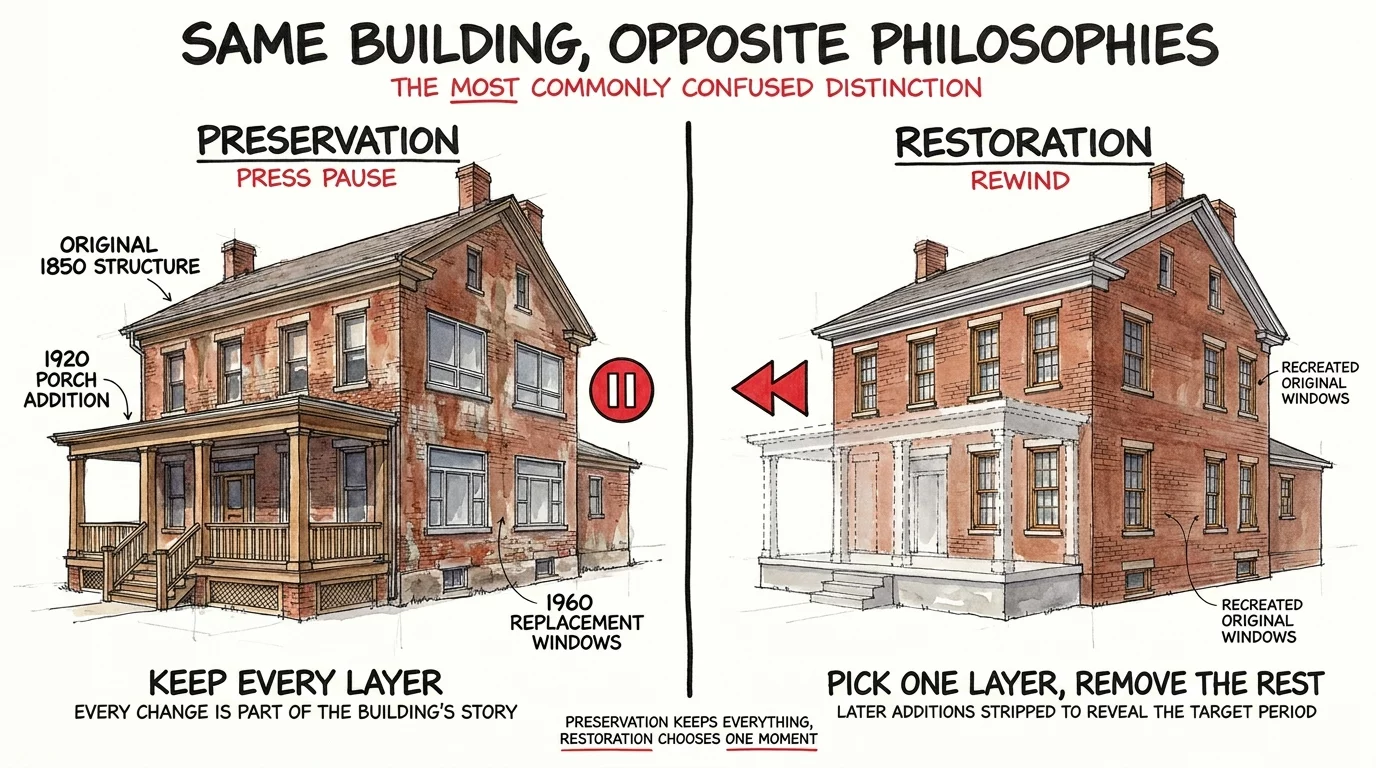
This is the distinction I really want you to lock in, because it’s one of the most commonly confused concepts in historic preservation.
Preservation keeps every layer. Every change the building has been through is part of its history, and it all stays.
Restoration picks one layer and removes the rest. It decides that one specific period matters more than everything else and strips away the rest of the building’s story to get back to that moment.
Same building, completely opposite philosophies. If a project is maintaining a building with all its accumulated changes, that’s preservation. If a project is removing later additions to return to a specific era, that’s restoration.
Don’t let the words sound similar. They lead to opposite outcomes. This distinction between preservation and restoration is exactly the kind of concept that PPD and PDD test on the ARE.
Think of a president’s home being returned to its appearance during the years they lived there, or a historically significant church being restored to its original design after decades of incompatible alterations.
Memory hook: Restoration = Rewind. Take it back to a specific moment in time.
Reconstruction: Rebuilding What No Longer Exists
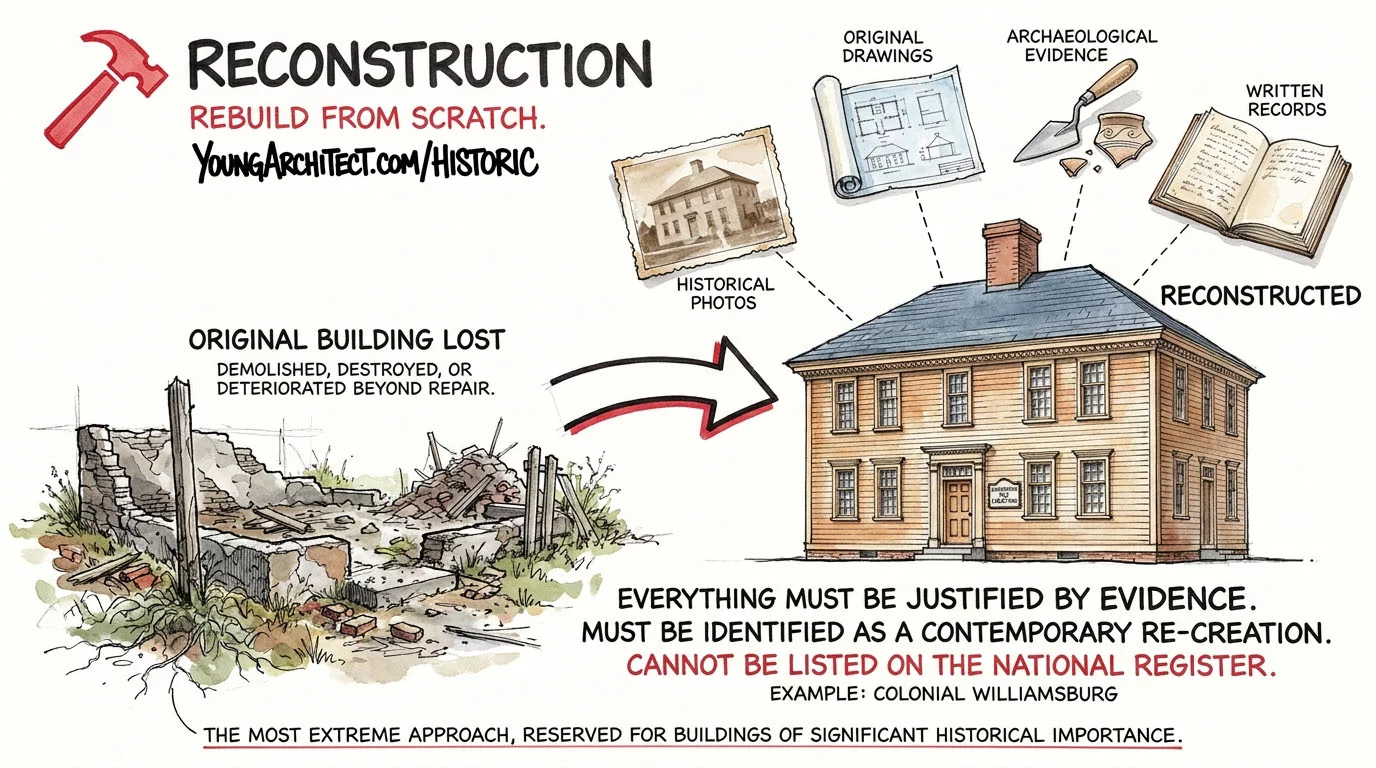
The last approach on the spectrum. The most extreme, and the rarest.
Reconstruction is what happens when the original building is gone. Demolished. Destroyed. Collapsed. Deteriorated beyond any possibility of repair. There’s nothing left, or maybe nothing but a foundation.
The goal is to recreate that building using new construction that replicates what was there before. You rebuild based on historical documentation: original drawings, photographs, written descriptions, archaeological evidence.
The same conjecture rules we talked about with restoration apply here too, except the bar is even higher. With restoration, you at least have some of the original building to work with. With reconstruction, you’re starting from scratch. Everything you build has to be justified by evidence.
Additionally, a reconstructed building must be clearly identified as a contemporary re-creation. It cannot pretend to be original.
The most well-known example is Colonial Williamsburg in Virginia. Many of the buildings there are reconstructions of structures that had been demolished centuries ago. They were rebuilt using archaeological evidence, historical records, and period construction techniques. They serve an educational purpose, helping visitors understand colonial life.
Because a reconstruction is a replica built with new materials, it is not an original. As a result, a reconstructed building generally cannot be listed on the National Register of Historic Places. It’s new construction, regardless of how accurate it is.
Reconstruction is rare for a reason. It’s the most intervention-heavy approach, and because the documentation burden is so high, it’s typically reserved for buildings of significant historical importance where there’s an educational or interpretive purpose.
Memory hook: Reconstruction = Rebuild. The original is gone, so you recreate it from scratch. Most intervention.
Renovation vs Restoration vs Rehabilitation
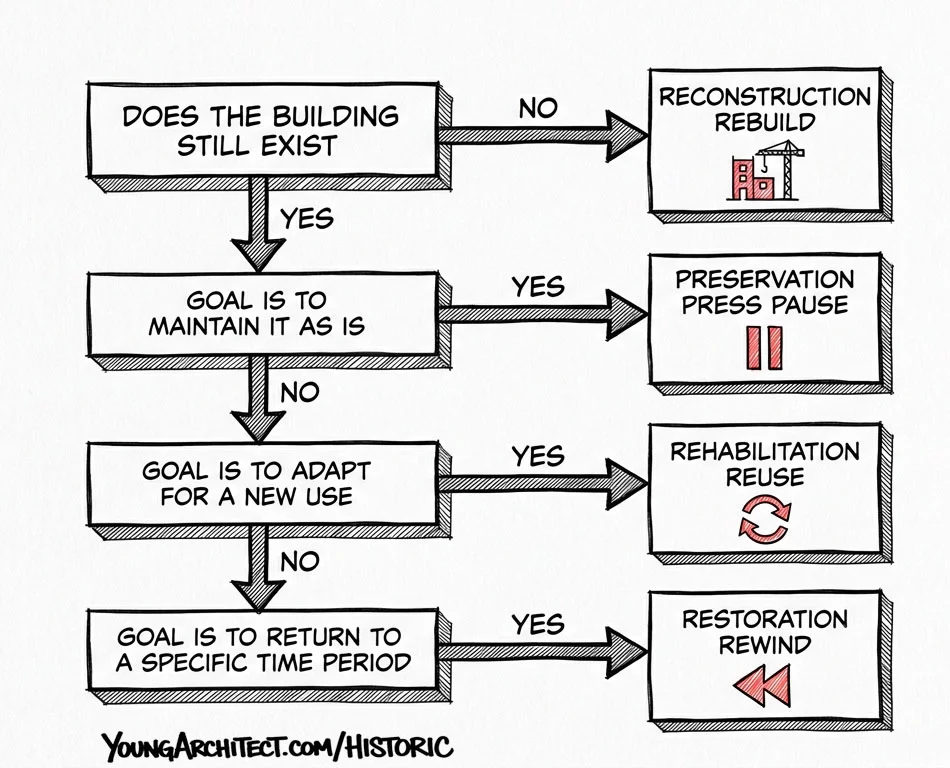
So those are the four. Now let’s talk about how to tell them apart when you’re looking at a real project or sitting in the exam.
Here’s a simple decision tree you can run through:
Does the building still exist? If no, that’s Reconstruction.
Is the goal to maintain it as-is? If yes, that’s Preservation.
Is the goal to adapt it for a new use? If yes, that’s Rehabilitation.
Is the goal to return it to a specific time period? If yes, that’s Restoration.
Four questions. Four answers.
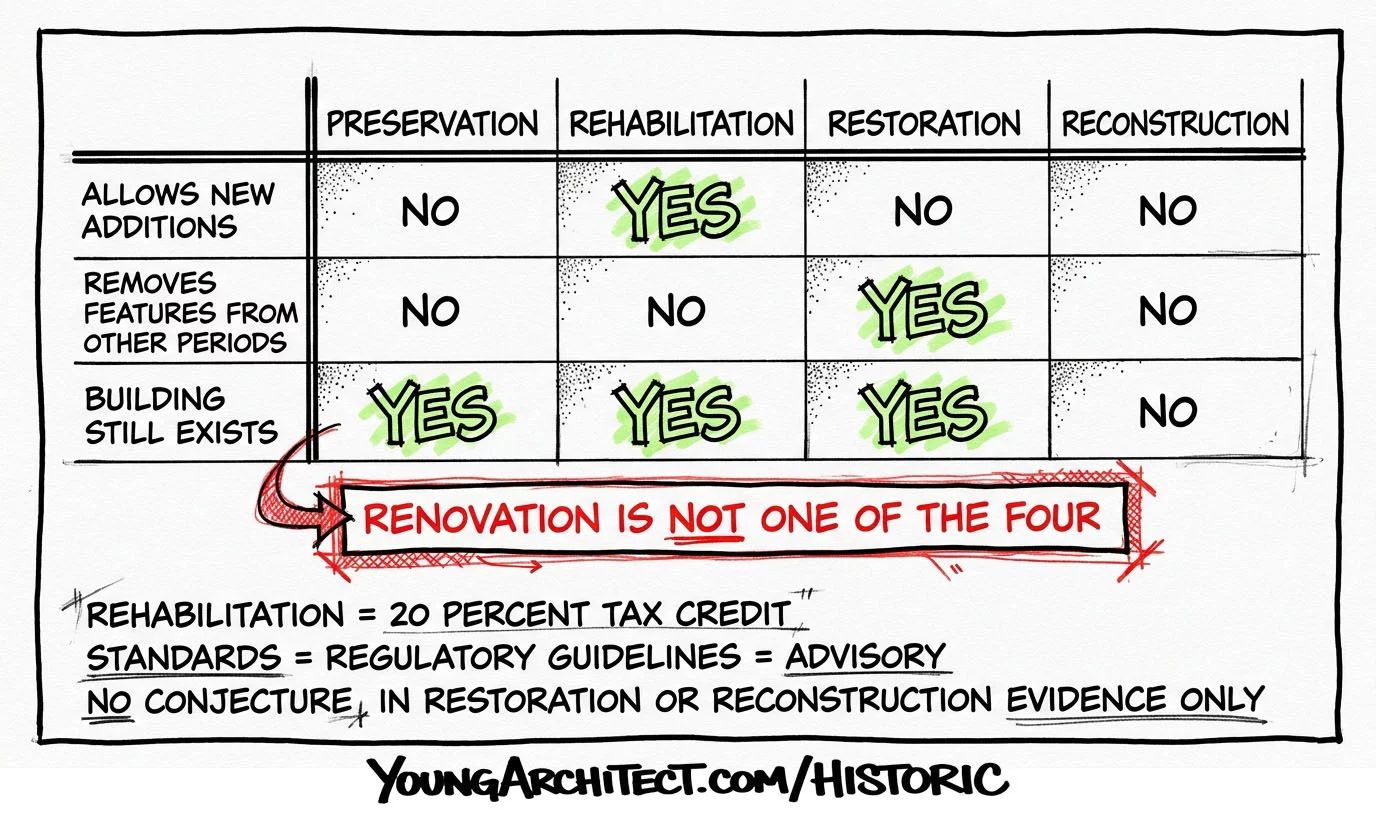
Key Distinctions
Here are the key distinctions that separate them:
- Only rehabilitation allows new additions
- Only restoration intentionally removes features from other periods
- Only reconstruction involves building something that no longer exists
- “Renovation” is NOT one of the four defined treatment approaches. It’s a general construction term for updating a building.
- “Adaptive reuse” is a project type. The treatment approach is rehabilitation. If a question asks you to identify the correct treatment for a warehouse-to-loft conversion, the answer is rehabilitation, not “adaptive reuse.”
- Rehabilitation is the one connected to the 20% federal historic tax credit
- Standards are regulatory. Guidelines are advisory.
- No conjecture in restoration or reconstruction. Evidence only.
Understanding how these four historic preservation approaches differ gives you the foundation to work through PA, PPD, and PDD exam scenarios involving historic buildings. NCARB references historic preservation in PDD Objective 4.2 (specialty regulatory requirements at the detail level) and PPD Objective 1.3 (neighborhood context including historic preservation requirements).
Four Approaches Recap
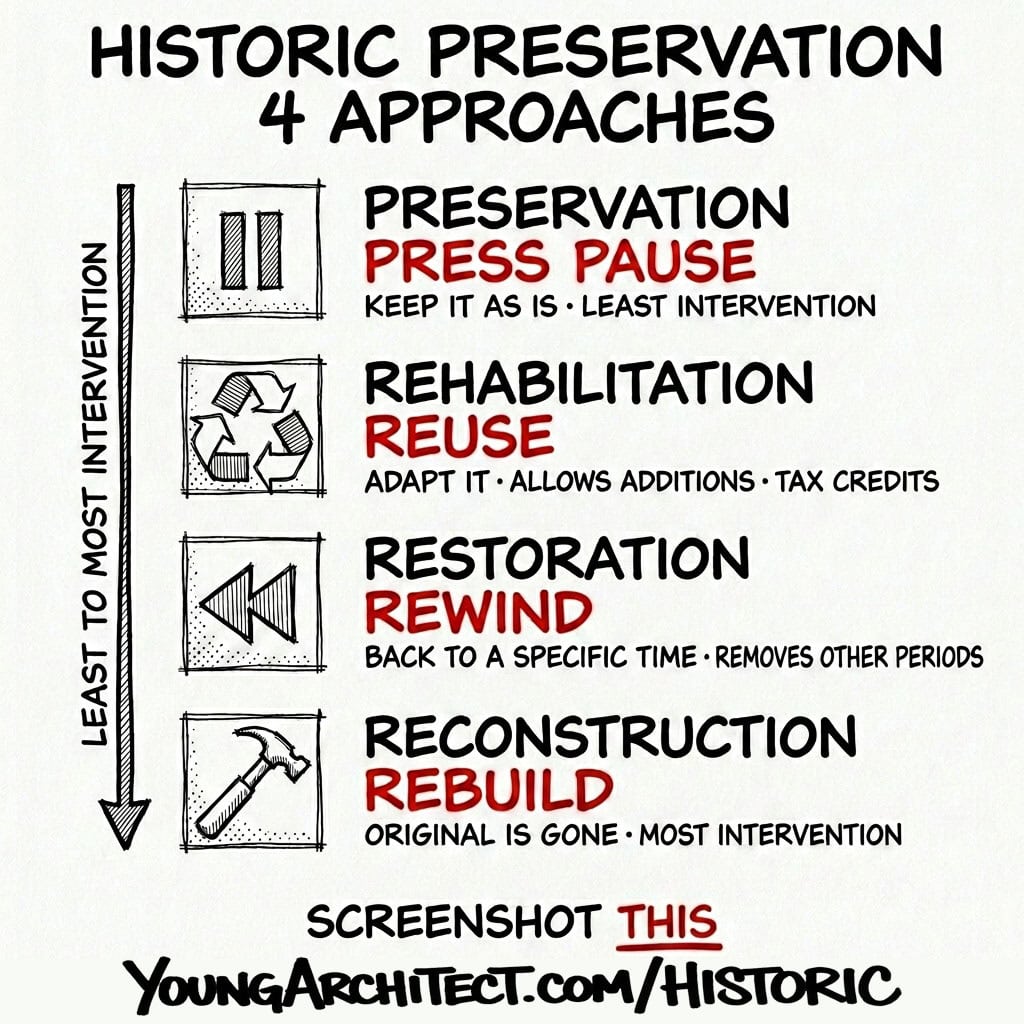
Let’s lock it in. Four approaches, four memory hooks:
- Preservation: Press Pause. Keep it as-is. Least intervention.
- Rehabilitation: Reuse. Adapt it for a new purpose. Allows additions. Tied to the federal tax credit.
- Restoration: Rewind. Return to a specific time period. Removes features from other eras. Evidence only.
- Reconstruction: Rebuild. The original is gone. Recreate it from scratch. Most intervention.
Study Historic Preservation with Young Architect
Understanding historic preservation approaches is just one piece of the PPD and PDD puzzle. If you want to build that knowledge systematically, that’s exactly what our courses and programs are designed for.
The fastest way in is the ARE Boot Camp, our 10-week coaching program that gives you a study plan, accountability, and a community of candidates working through the exams alongside you. It’s more than study materials. It’s the structure that keeps you actually studying.
If you’d rather go self-paced, the ARE 101 Membership gives you access to every one of our courses for one low monthly price, cancel anytime. For this topic specifically, start with:
- PDD 101 for specialty regulatory requirements and construction documentation
- PPD 101 for neighborhood context and historic preservation requirements
Now go pass this exam.
Frequently Asked Questions
What are the four types of historic preservation?
The four treatment approaches defined by the Secretary of the Interior’s Standards are preservation (maintaining a building as-is with all its layers of history intact), rehabilitation (adapting a building for a new use while retaining its historic character), restoration (returning a building to its appearance at a specific period of significance), and reconstruction (rebuilding a lost structure from scratch using historical evidence). These four approaches range from least intervention (preservation) to most intervention (reconstruction).
What is the difference between restoration and rehabilitation?
Restoration picks one specific period of significance and removes everything that doesn’t belong to that era. Rehabilitation keeps the historic character but adapts the building for a new contemporary use, and it’s the only approach that allows new additions. They lead in opposite directions. Restoration strips things away to go back in time. Rehabilitation adds new life while respecting what’s there.
What is adaptive reuse in architecture?
Adaptive reuse is a project type that describes converting an existing building to a new function, like turning a warehouse into apartments or a factory into a restaurant. The formal treatment approach under the Secretary of the Interior’s Standards is rehabilitation. When you’re identifying the correct historic treatment for an adaptive reuse project, the answer is rehabilitation.
Is renovation the same as restoration?
No. Renovation is a general construction term for updating or improving a building. Restoration is one of the four defined treatment approaches under the Secretary of the Interior’s Standards, with specific rules about returning a building to a specific period of significance based on documented evidence. They have different goals and different rules. Renovation is not one of the four treatment approaches.
Can a reconstructed building be listed on the National Register?
Generally no. A reconstruction is new construction built with new materials, regardless of how historically accurate it is. Because it’s not original, a reconstructed building typically cannot be listed on the National Register of Historic Places. Reconstructions must be clearly identified as contemporary re-creations and cannot pretend to be original structures.