A contractor shows up on day one with a stack of drawings and a list of questions those drawings can’t answer. What material is the window frame? What paint finish is required? How does the waterproofing get installed? That’s exactly what construction specifications are for. They’re the written instructions that make drawings complete, and as legally binding contract documents, they carry just as much weight in a dispute as anything shown on the plans.
This podcast is also available on YouTube, Spotify, and Apple Podcasts
What Are Construction Specifications?
Let’s be honest. Nobody gets excited about specifications.
Drawings get all the love. They’re visual, they’re creative, and they’re the thing clients want to see pinned up on the wall. Specs? They sit on a shelf collecting dust until someone desperately needs them.
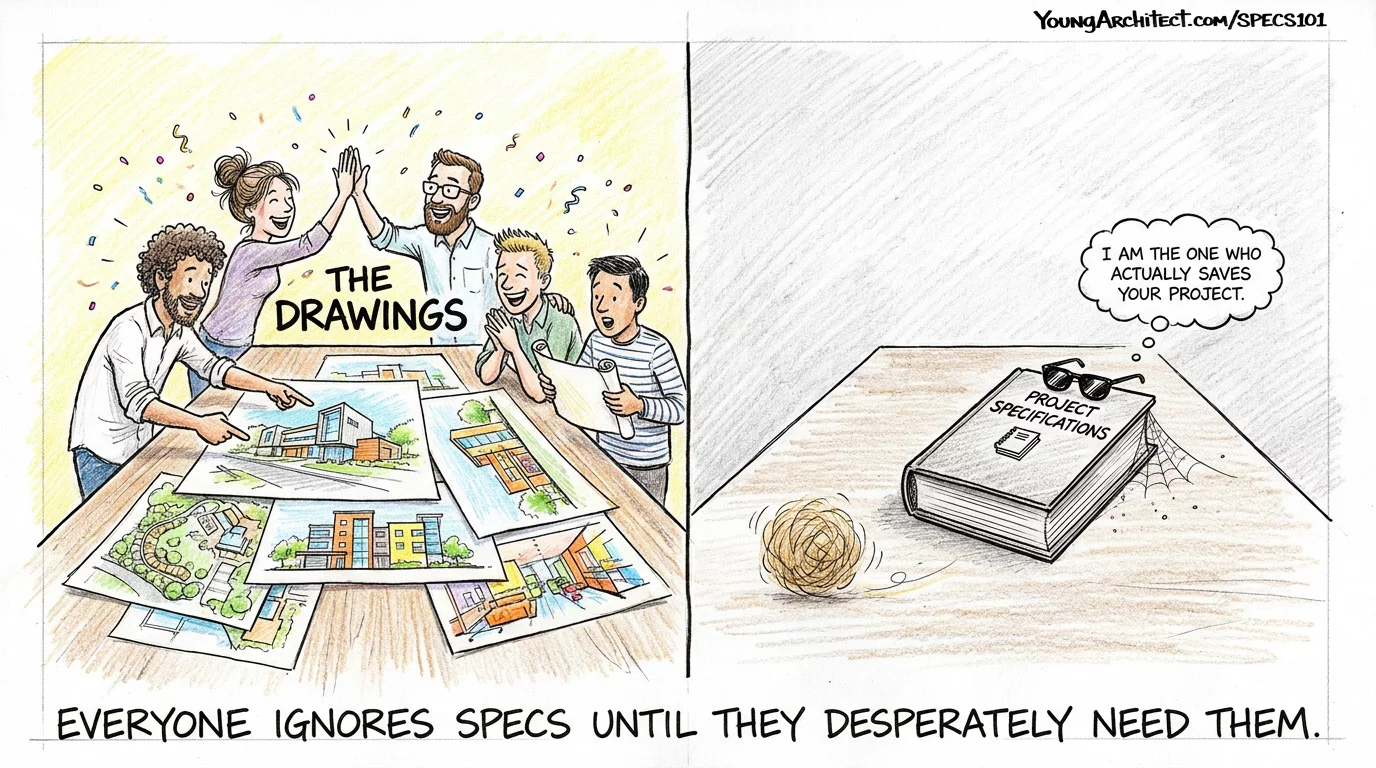
But here’s the thing. When something goes wrong on a construction project, the specs are usually the first document everyone reaches for. Not the drawings. The specs.
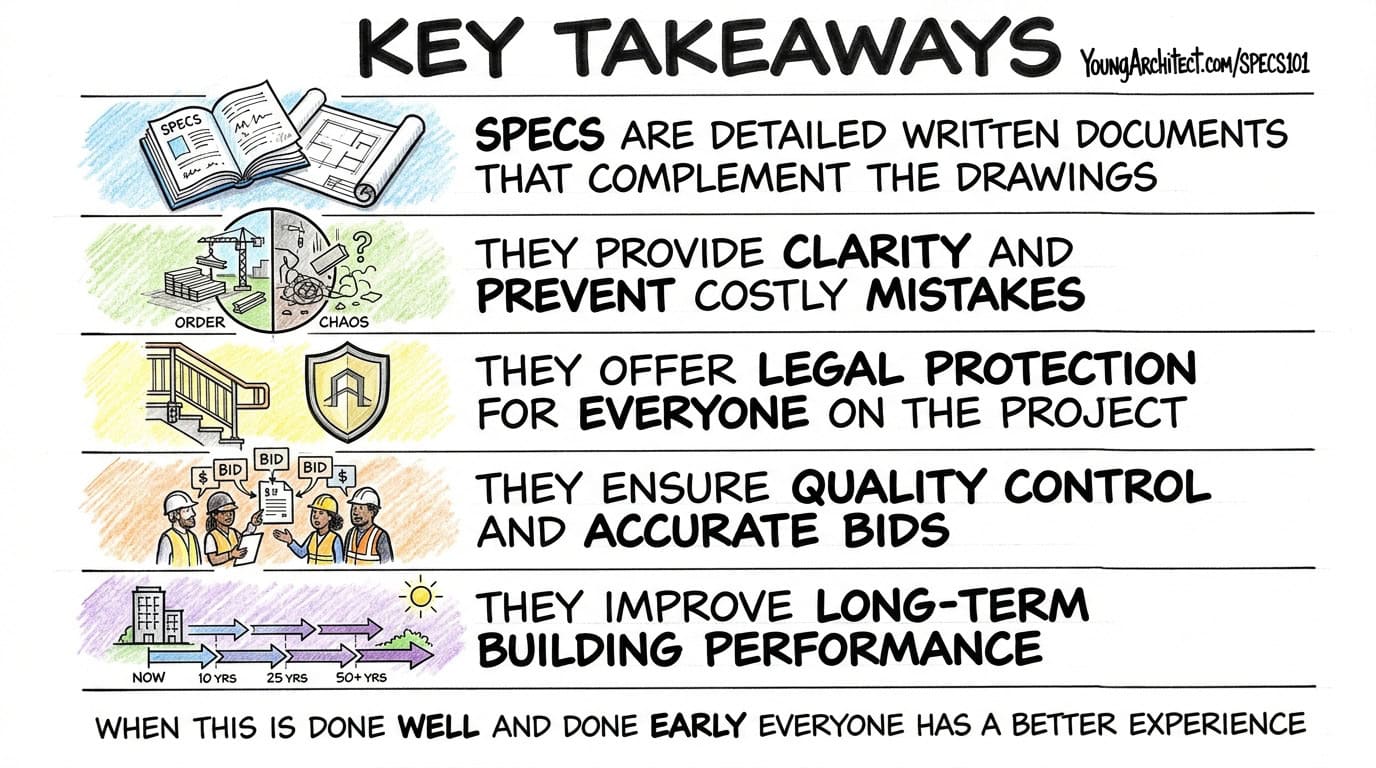
Construction specifications are legally binding contract documents. They’re not guidelines, suggestions, or helpful paperwork. They carry the same legal weight as the drawings, and when a dispute lands on someone’s desk, the specs are often where you look first.
More specifically, architectural specifications are the detailed written instructions that describe what the drawings can’t show. Spec writing is the process of putting all of that into a structured, standardized format that every contractor, subcontractor, and supplier can navigate.
Construction specifications describe:
- Specific materials and products to be used
- Required quality standards for all elements
- Methods for proper installation and execution
- Testing and inspection requirements
- Administrative procedures for the construction process
We’ll get to a real-world story later in this post that shows exactly how specs saved a project when the drawings fell short. It involves a missing handrail, a frustrated contractor, and a spec book that had all the answers.
Drawings vs Specifications: What Goes Where
The easiest way to understand construction specifications is to compare them to drawings. The core difference between drawings and construction specifications:
- Drawings show you what and where: dimensions, locations, the overall shape and spatial relationships.
- Construction specifications tell you how something gets built and with what: the exact materials, products, and installation methods required.
The drawing shows it. The spec defines it. There’s simply too much detail to fit on the drawings.
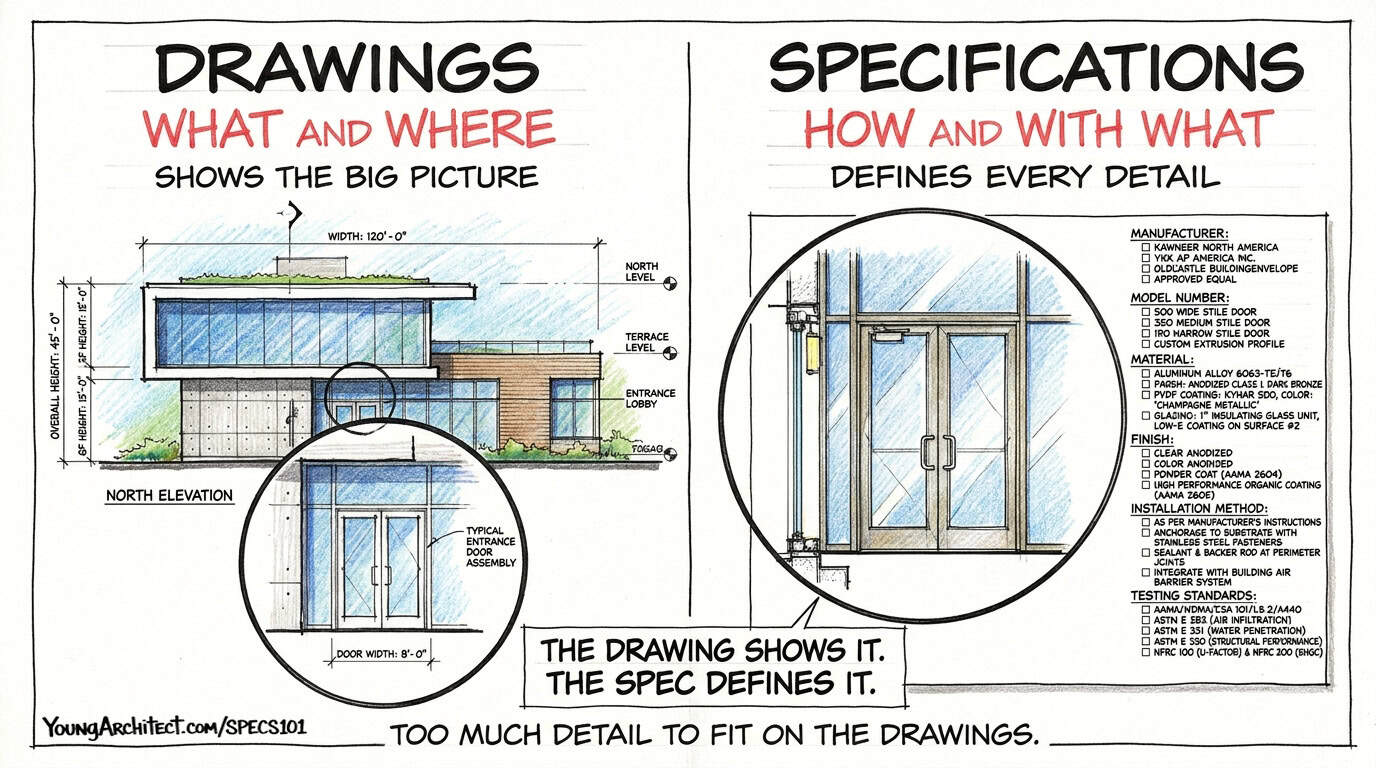
Two analogies that make this click:
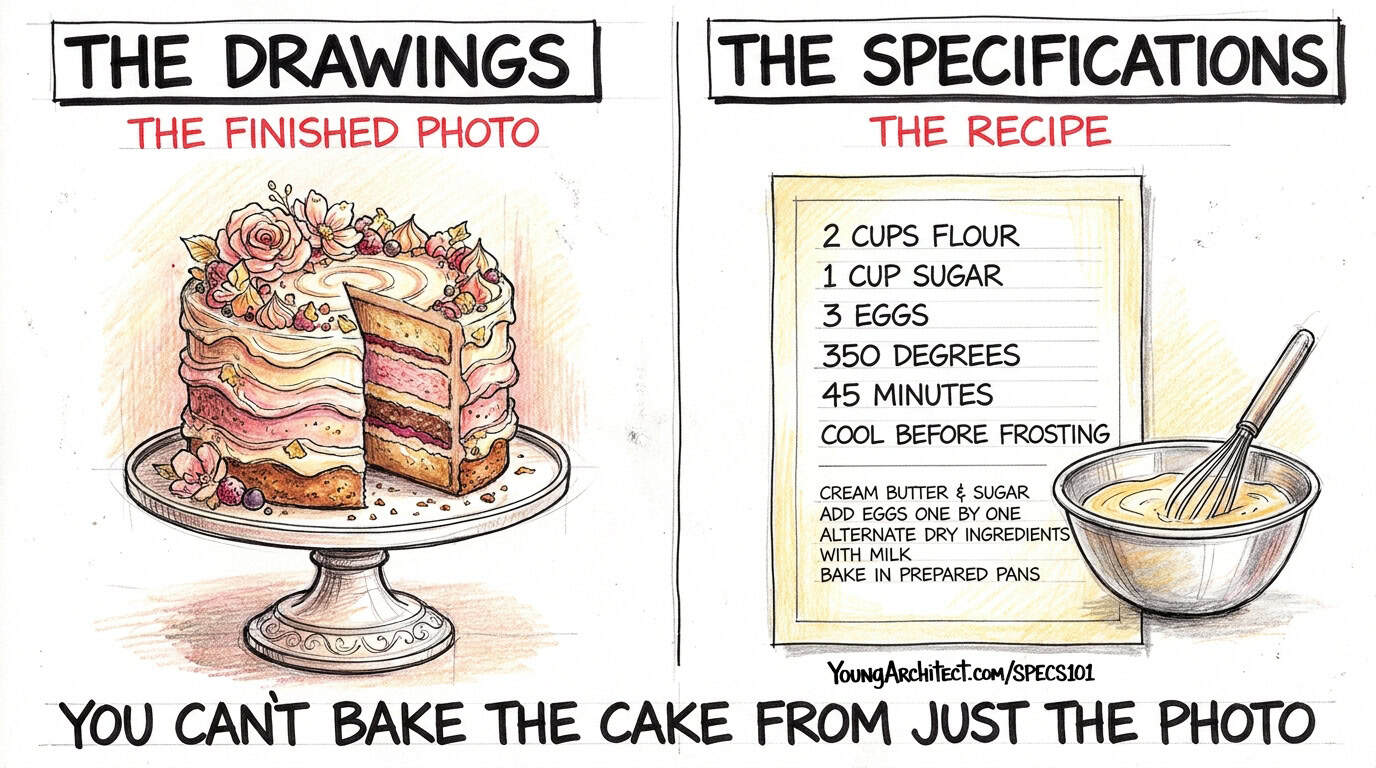
The recipe analogy:
Drawings are like the photo of the finished cake. You can see how it should look: the layers, the frosting, the decorations. But you can’t bake it from the photo alone.
Construction specifications are the recipe: exact ingredients, quantities, oven temperature, and step-by-step preparation method.
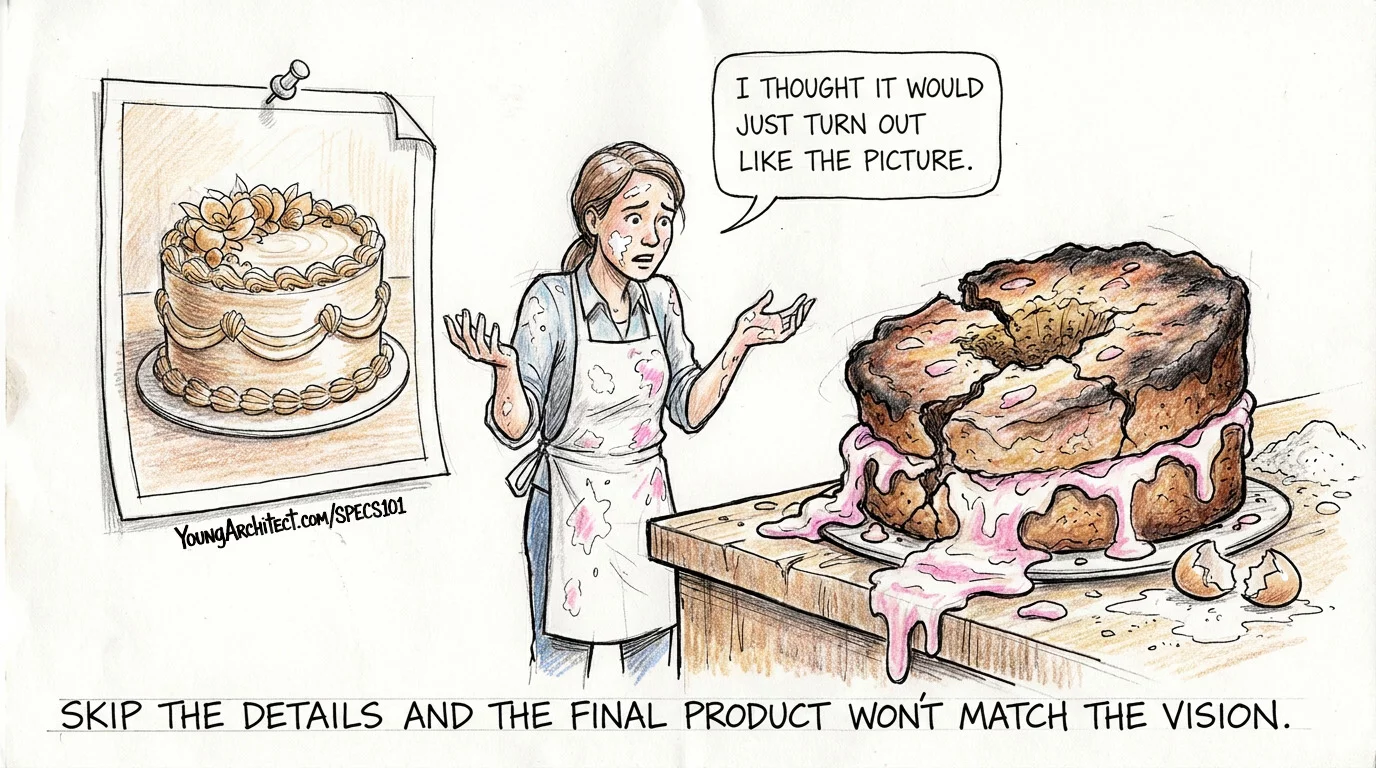
Skip the recipe and try to recreate the cake from the photo? That’s exactly what happens on a construction project without clear specs. The contractor sees the drawings, makes assumptions about materials and methods, and the final product doesn’t match the architect’s intent.
The car analogy:
Drawings show you the car’s design, color, and shape. You can see it in the showroom and appreciate how it looks.
Construction specifications define the engine type, horsepower, interior materials, safety ratings, and fuel efficiency: the performance characteristics and quality standards behind the surface.
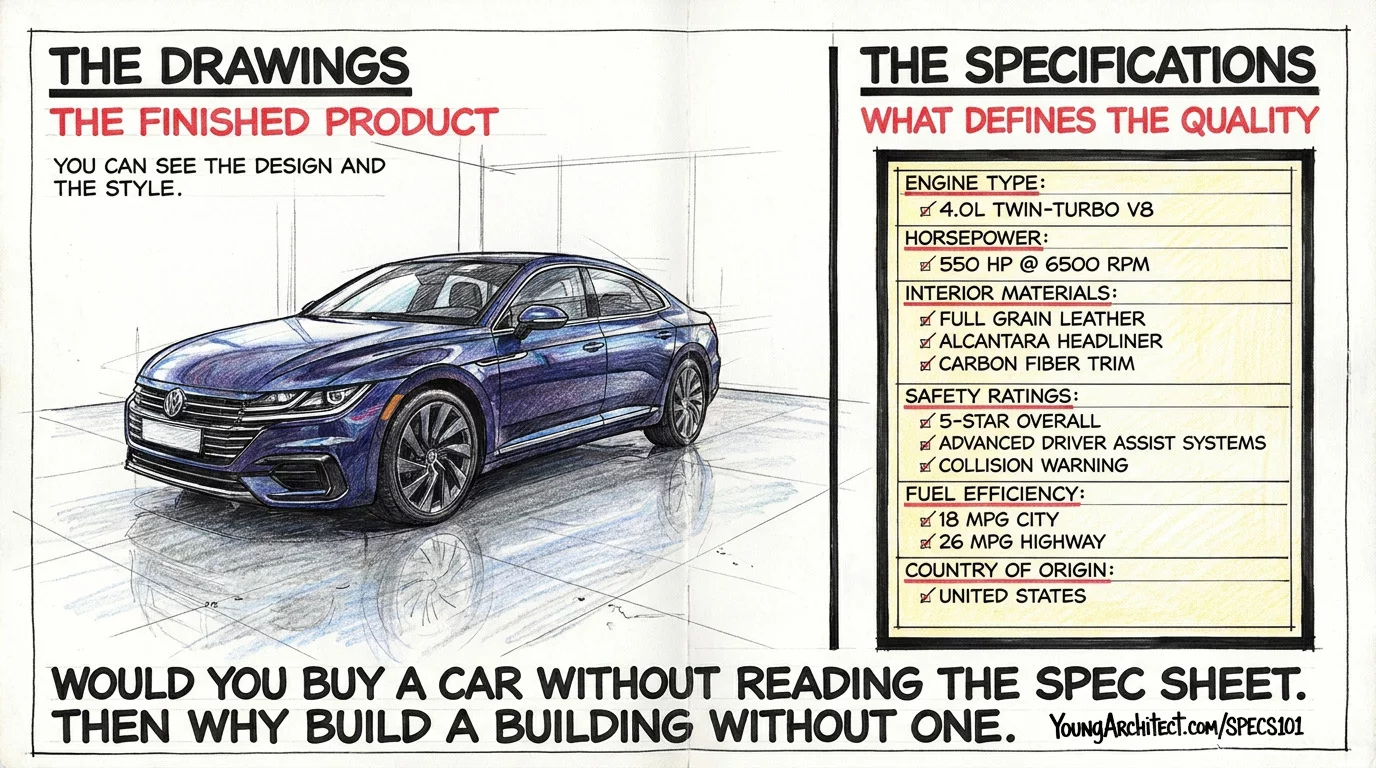
You wouldn’t buy a car without reading the spec sheet. So why would anyone build a building without one?
Together, drawings and construction specifications form the complete set of instructions needed to properly execute a project. Neither one alone is sufficient.
Understanding the Project Manual
The project manual is the comprehensive written documentation package for a construction project. It’s the definitive guide for everyone involved, and it’s bigger than just the specs.
The complete project manual includes:
- Bidding Requirements: instructions to bidders, bid forms, and bidding process information
- Contracting Requirements: contract forms, general conditions, supplementary conditions
- Division 01 General Requirements: the administrative and procedural rules that apply to the entire project
- Technical Specifications (Divisions 02–49): the detailed product and execution requirements organized by CSI MasterFormat divisions
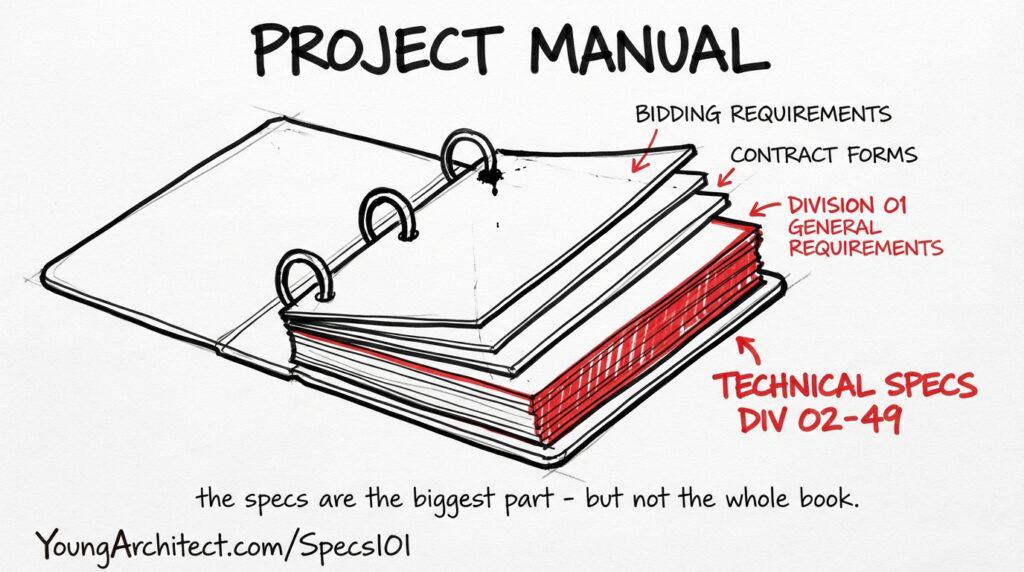
Think of the project manual as the complete “book” for the project. Specifications make up the largest portion, which is why architects often say “the specs” when they technically mean the entire project manual. They’re not the same thing.
During bidding, contractors rely heavily on the project manual to understand the full scope of work and prepare accurate cost estimates. That’s a critical part of the construction bidding process.
This distinction between specs and the full project manual matters for both professional practice and exam preparation. Don’t let the terms get blurred.
How Construction Specifications Are Organized
The Construction Specifications Institute (CSI®) developed the standardized formats the entire construction industry uses to organize specs. Without this system, every firm would organize their project manuals differently, and nobody would be able to find anything.
CSI MasterFormat
CSI MasterFormat is the industry standard for organizing specification sections and other written information for commercial and institutional building projects.
It divides construction specifications into 50 divisions organized by work results or construction practices. Some of the most commonly referenced divisions include:
- Division 03: Concrete
- Division 07: Thermal and Moisture Protection
- Division 09: Finishes
- Division 23: Heating, Ventilating, and Air Conditioning
Within each division, specs break down further into individual sections that address specific products, materials, or systems. For the full breakdown of all 50 MasterFormat divisions and how the numbering system works, check out our complete CSI MasterFormat guide.
The Three-Part Specification Format
Every construction specification section follows CSI’s standardized three-part format. Once you understand this structure, you can open any spec section on any project and immediately know where to look for what you need.
General sets the rules. Products define it. Execution installs it.
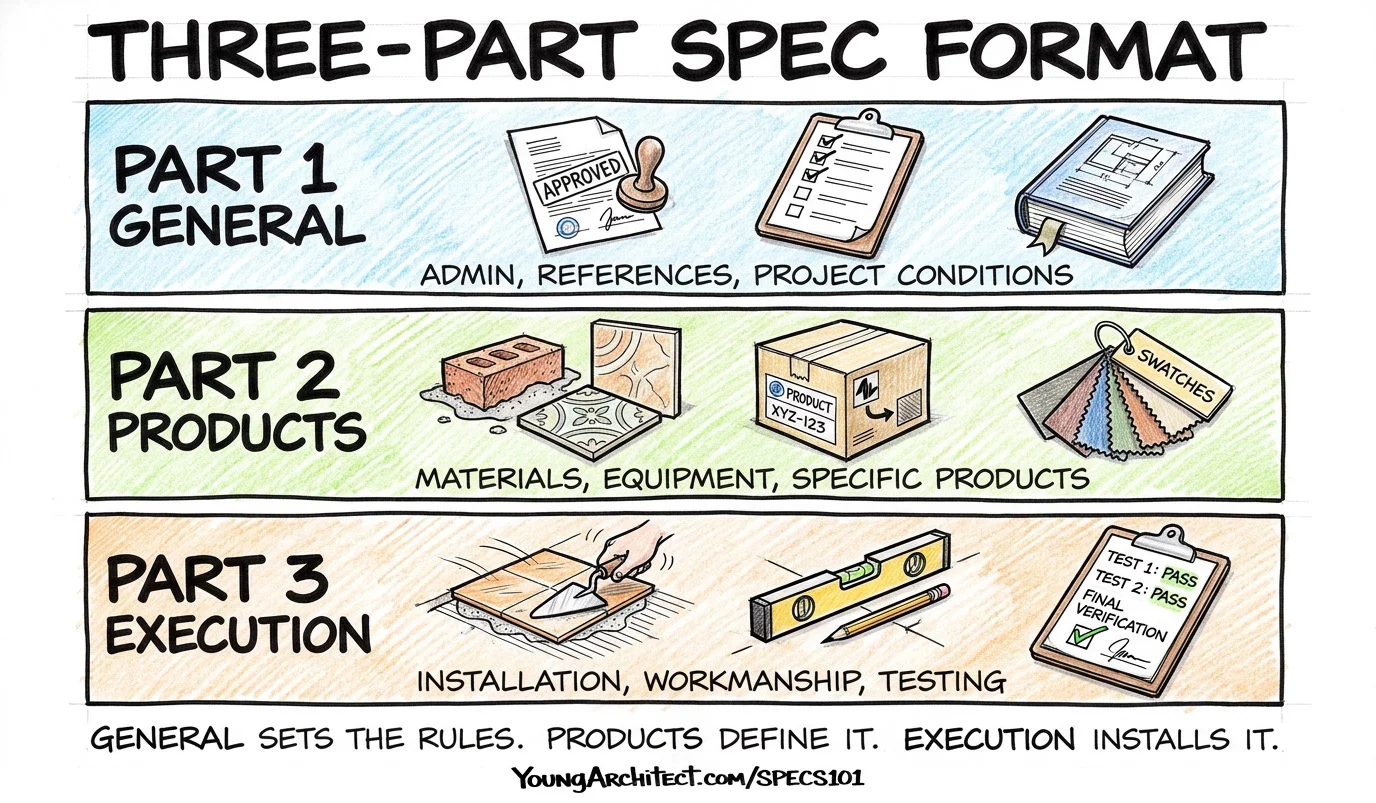
Part 1: General
This is the administrative section. If you need to know who is responsible for something, or when something needs to happen, it’s in Part 1.
- Submittal requirements
- Quality assurance provisions
- References to industry standards (like ASTM)
- Warranty information
- Project conditions
Part 2: Products
This is where the physical stuff lives. If you need to know what material is required or who makes it, it’s in Part 2.
- Acceptable manufacturers and approved substitutions
- Performance criteria and physical properties
- Components and accessories
- Fabrication requirements
Worth noting: the product data listed in Part 2 is exactly what the contractor must prove they’re providing during the submittal review process. Part 2 and the submittal process are directly connected.
Part 3: Execution
This is the how. If the contractor needs to know how to actually install something, it’s in Part 3.
- Installation methods and surface preparation
- Field quality control
- Testing and verification
- Protection and cleaning
In our CDT® 101 course, this three-part structure is often the moment specs finally “click” for design professionals. Once the pattern is clear, navigating any spec section becomes second nature.
Types of Construction Specifications
There are several different approaches when drafting construction specifications, each with specific advantages depending on project requirements. These include prescriptive specifications, performance specifications, proprietary specifications, and reference standard specifications.
Each type puts different levels of responsibility on the contractor and the architect. For a full breakdown of when to use each one, check out our guide on construction specification types.
The Missing Handrail: When Specifications Save the Project
Here’s a story that shows exactly why construction specifications matter in practice.
During a project’s final inspection, the architect walked the site and noticed something missing. An elevated walkway next to the parking lot had no handrail.
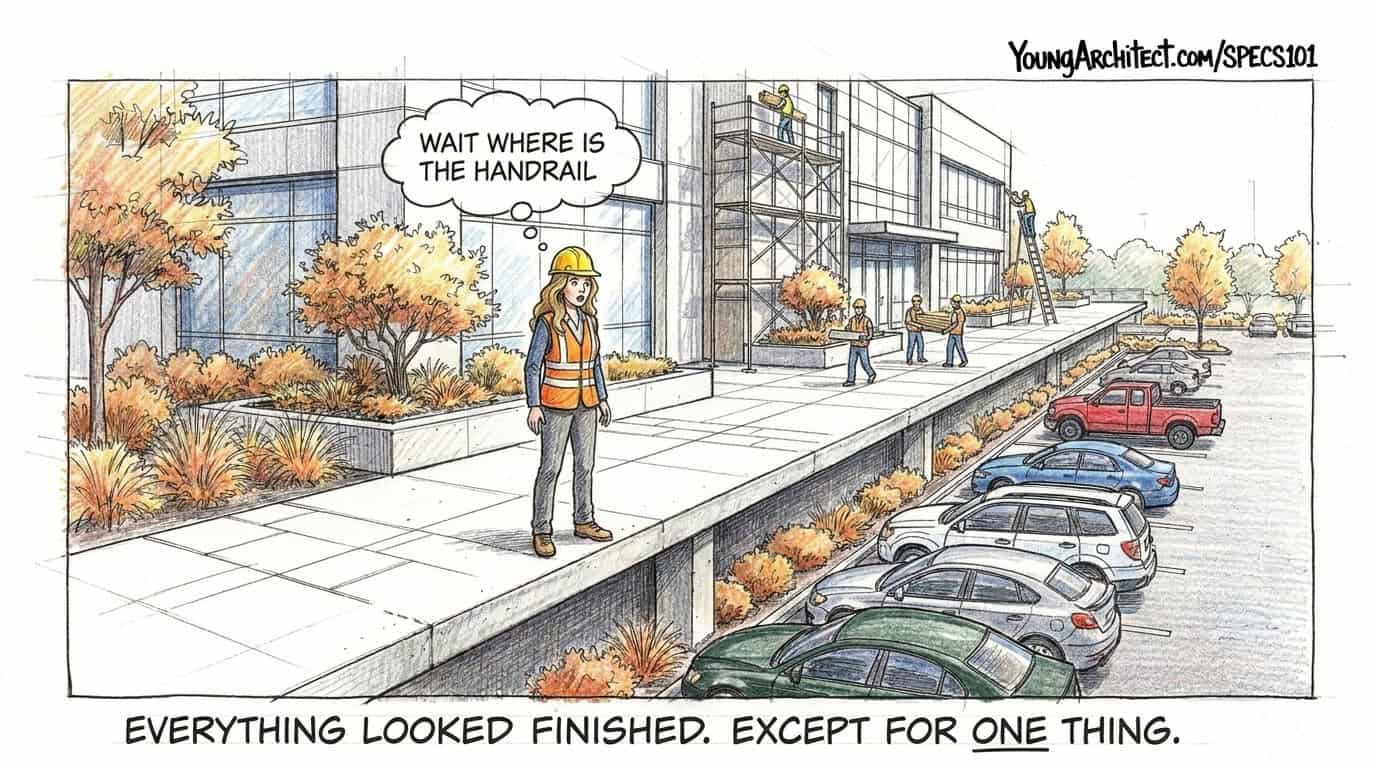
The architect brought it up with the contractor. The contractor’s response? “Show me where it’s in the drawings.”
So the architect went back to the drawings. She flipped through the site plan, the elevations, the details. The handrail wasn’t clearly shown anywhere.
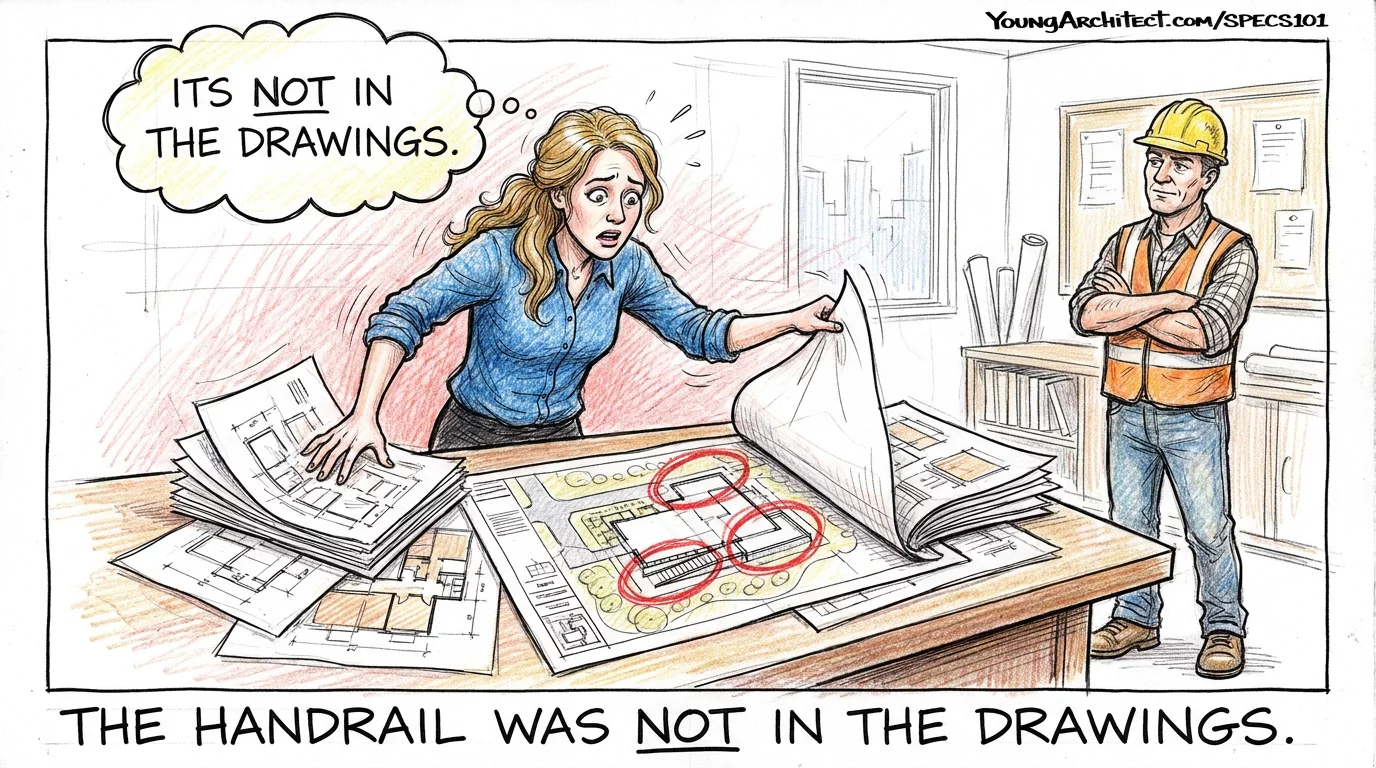
Then she opened the specs.
Right there in Division 05: Metals, the handrail requirement was documented in black and white. Material, standards, installation method: all of it clearly defined in the written word.
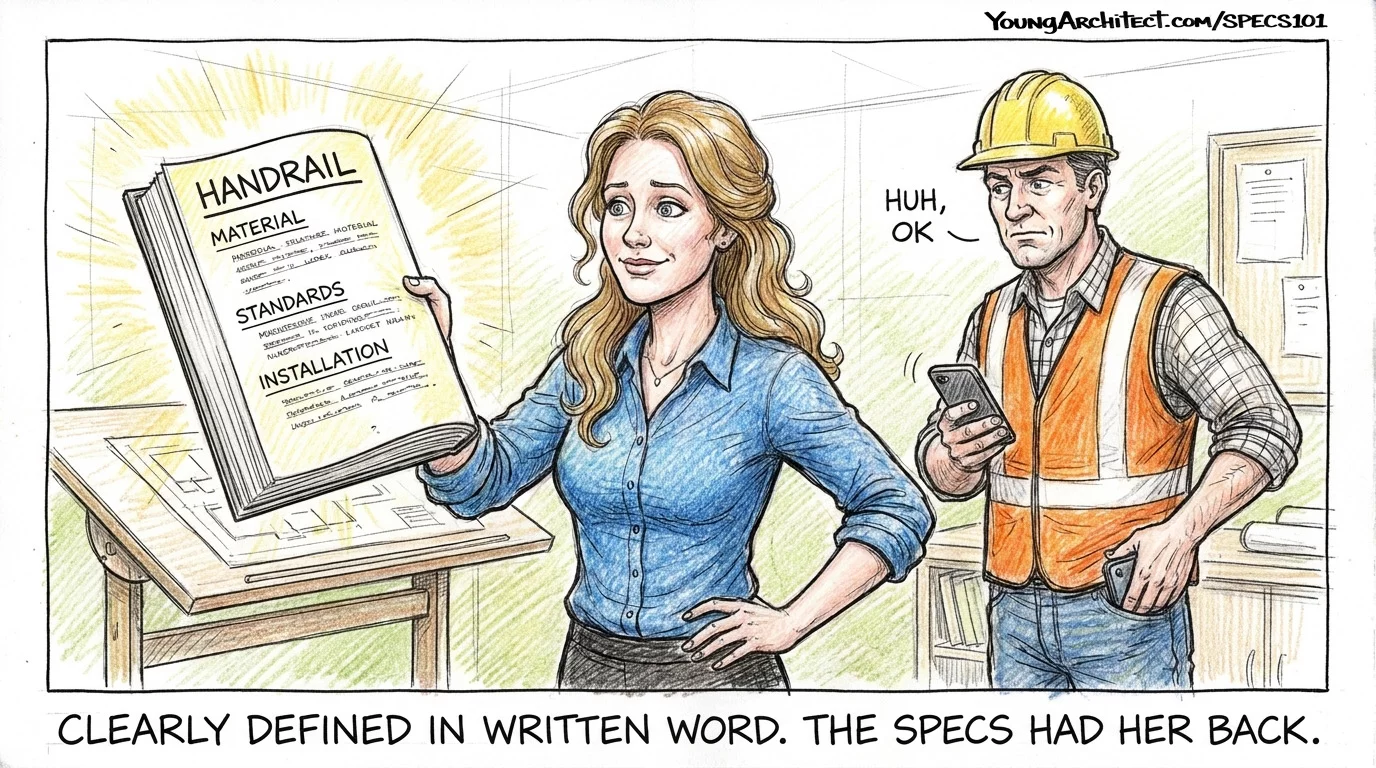
Because the requirement was in the construction specifications, the contractor had to install the missing handrail without a change order, saving the client from unexpected additional costs and ensuring the project was completed as intended.
Under AIA A201, the contract documents are complementary. That means what is required by one document is as binding as if required by all of them. The handrail was in the specs, and that was enough.
That’s specs doing exactly what they’re designed to do. Elements missed in the drawings can still be caught and enforced through comprehensive construction specifications.
Why Construction Specifications Matter
Construction specifications aren’t just administrative overhead. They serve critical functions that directly impact whether a project succeeds or falls apart.
Clarity and Reduced Ambiguity
Clear construction specifications ensure that everyone on the project: architects, contractors, subcontractors, suppliers, and clients, understands exactly what’s required.
Ambiguity is expensive. It leads to errors, rework, and delays. Specs close the gaps that drawings leave open.
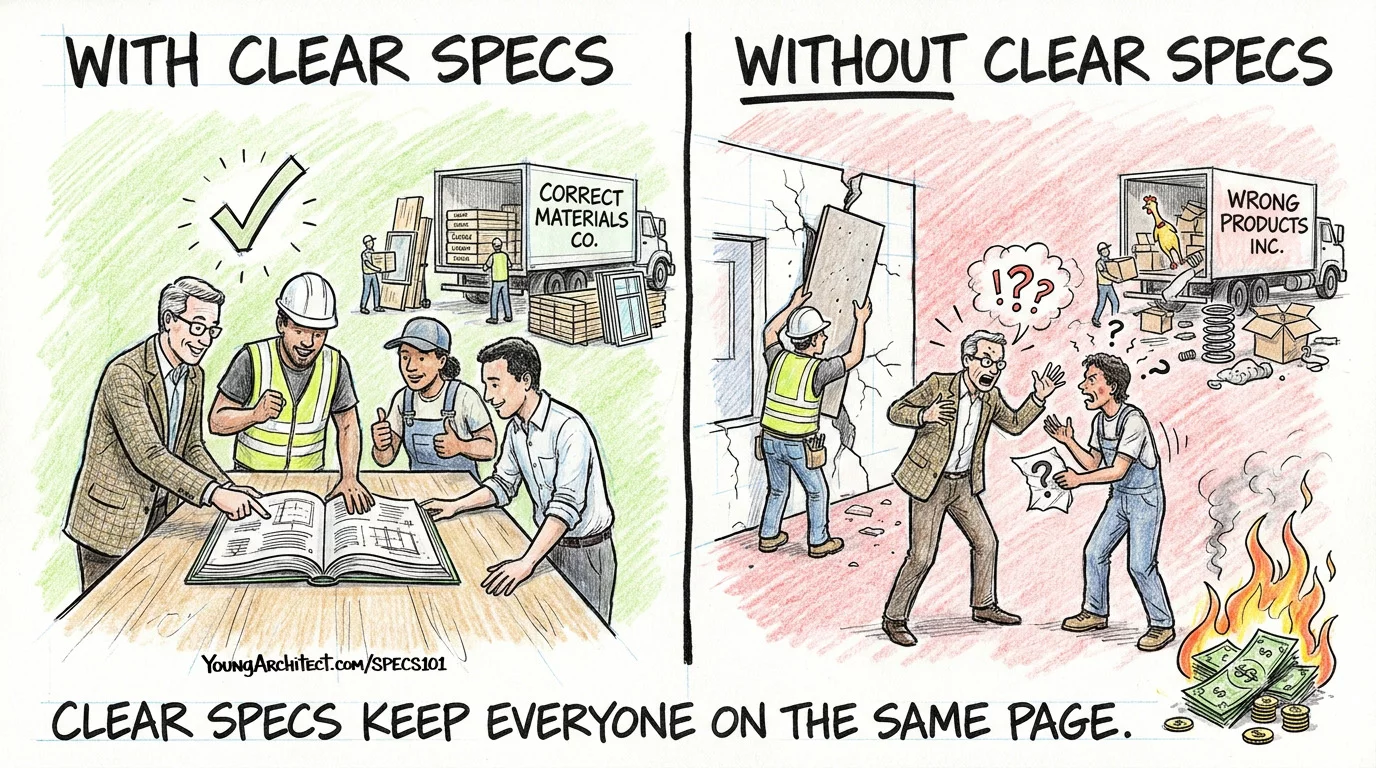
When everyone is reading from the same detailed instructions, the right materials show up, the installation happens correctly, and you don’t burn money fixing preventable problems. There are plenty of myths about specifications that lead people to underestimate how much clarity good specs provide.
Legal Protection
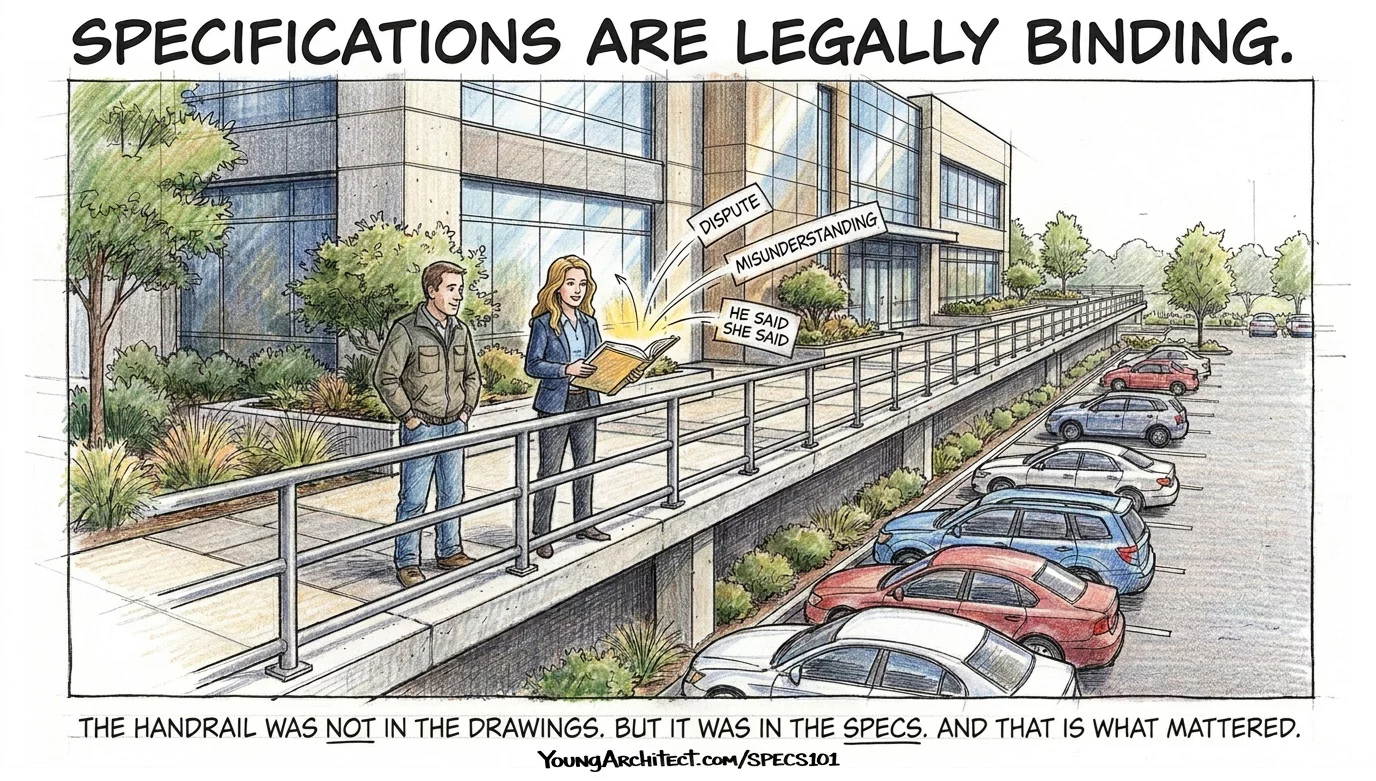
Construction specifications are legally binding contract documents. They establish performance requirements and provide the reference point for resolving disputes.
When properly written, specs protect all parties by clearly defining responsibilities and expectations before anyone breaks ground.
Remember the handrail story? The specs were the legal basis for requiring the contractor to install it at no extra cost. Without that written requirement, the architect would have been stuck arguing from memory, and the owner would have been writing a check.
Quality Control
Specifications set the benchmarks for materials and workmanship that ensure the finished building matches both design intent and client expectations.
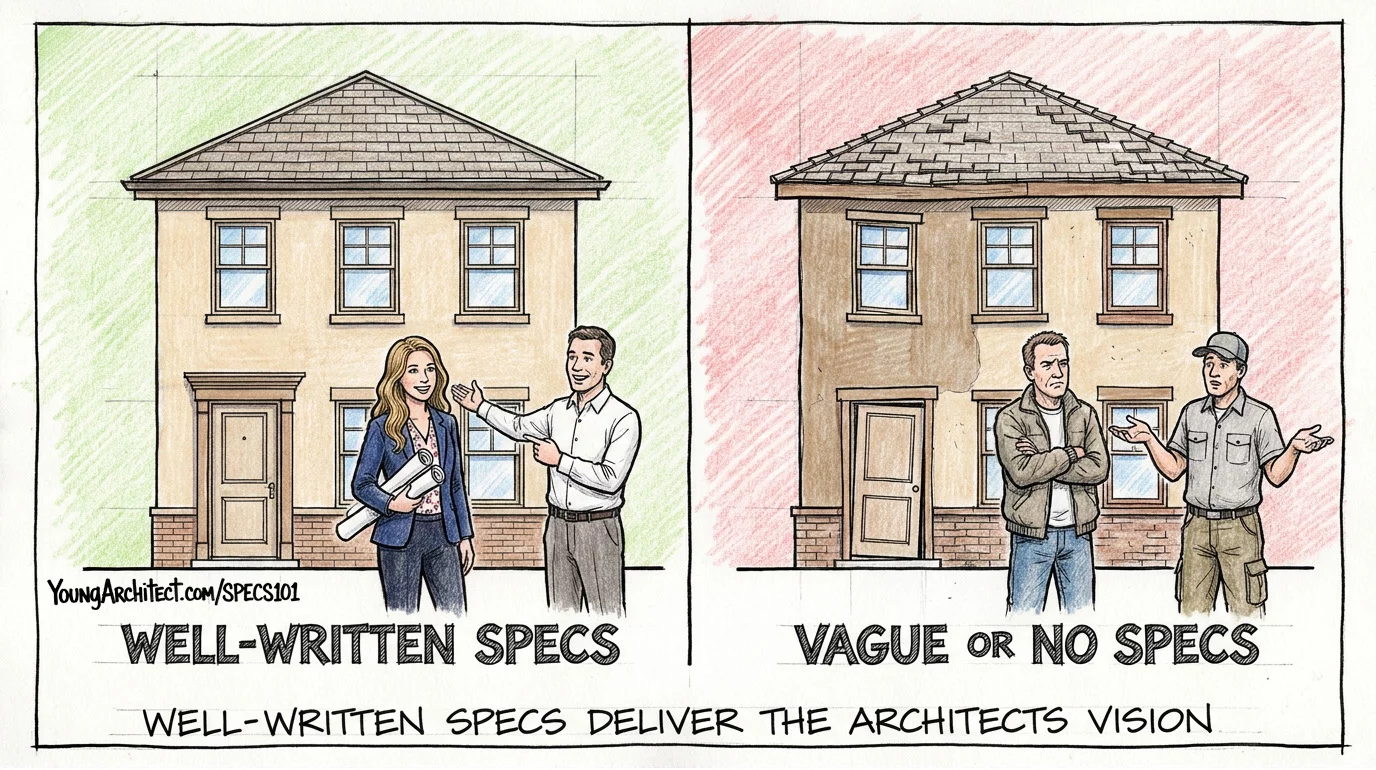
Well-written specs deliver the architect’s vision. Vague specs, or no specs at all, result in mismatched materials, inconsistent finishes, and a building that doesn’t look or perform the way it was designed to.
Understanding the difference between quality assurance and quality control is essential for implementing specs effectively during construction.
Accurate Bidding and Pricing
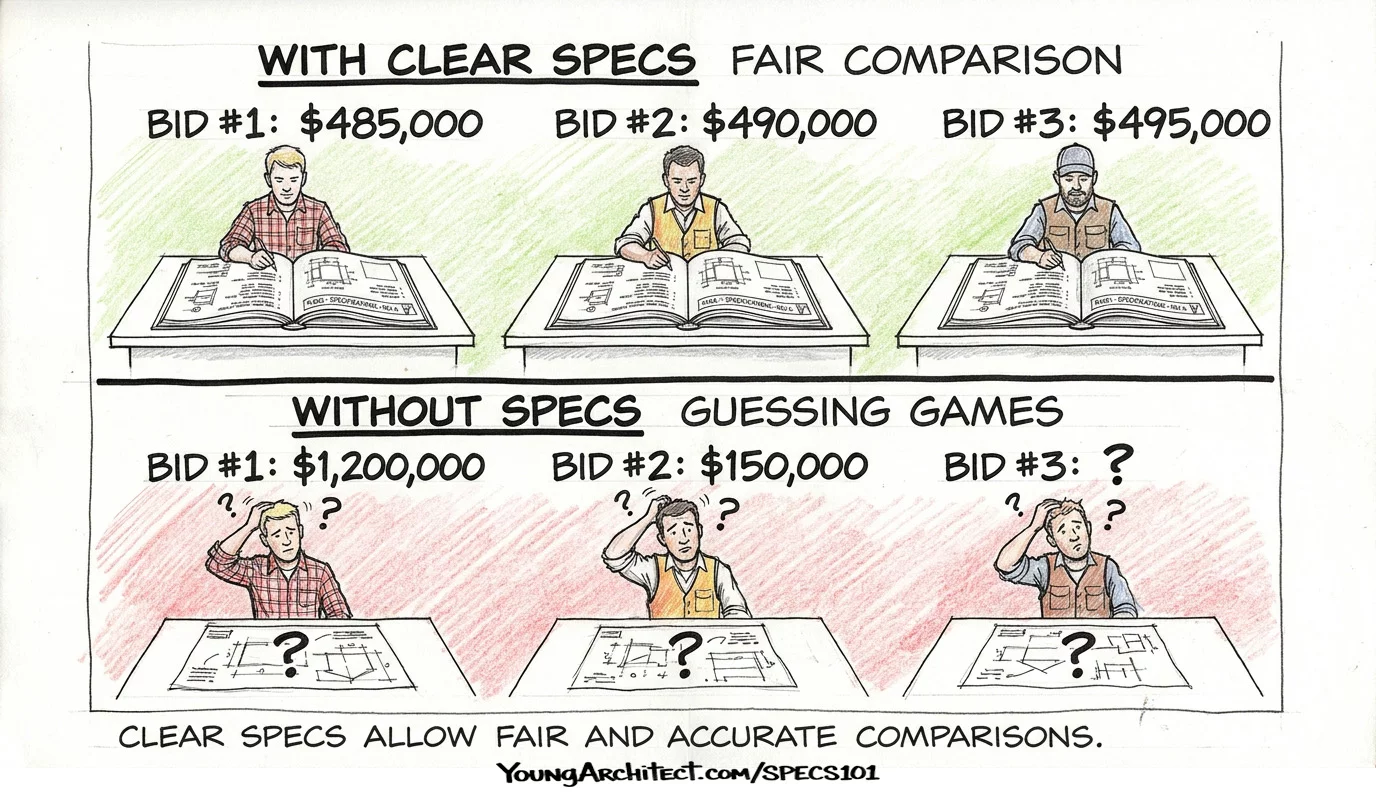
Detailed construction specifications allow contractors to accurately price and bid a project. When specs are vague, contractors pad their numbers to cover uncertainty, which means the owner pays for ambiguity.
Clear specs enable fair, apples-to-apples comparisons between bids and prevent budget surprises later.
With clear specs, three contractors reading the same documents will submit bids within a reasonable range of each other. Without specs? One bids $150,000, another bids $1.2 million, and the third doesn’t even know where to start.
Long-Term Building Performance
Well-written construction specifications directly impact how a building performs over its entire lifecycle.
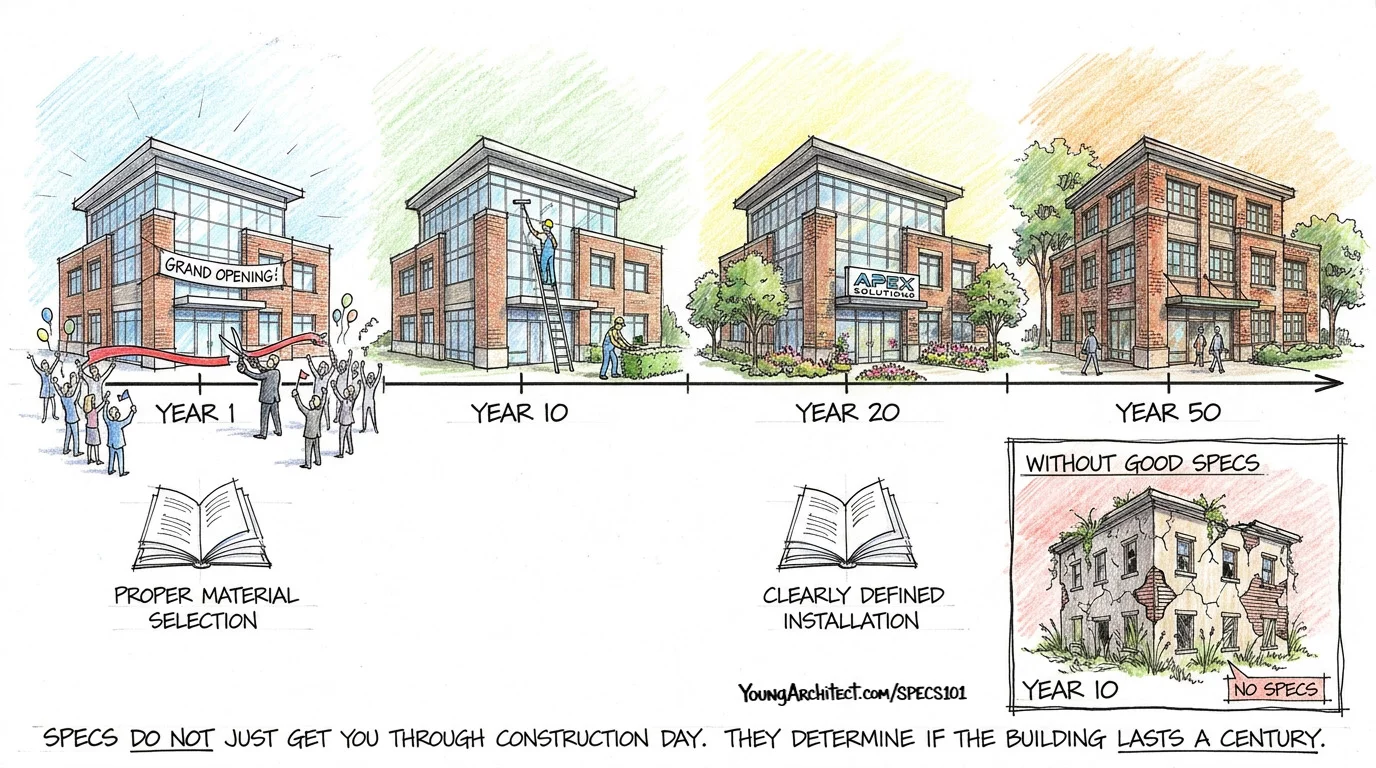
Proper material selection and clearly defined installation processes are what ensure the building functions as intended: not just on day one, but for decades. Specs don’t just get you through construction. They determine if the building lasts a century.
How to Read Construction Specifications
Knowing what specs are is one thing. Knowing how to actually use them on a project is what separates competent professionals from everyone else.
- Start with Division 01 before reading any technical section. Division 01 sets the rules for the entire project: submittal procedures, quality requirements, temporary facilities, closeout requirements. If you skip it, you’ll miss the framework that governs everything else.
- Use the three-part structure to navigate. Need to know what product is required? Go to Part 2. Need to know how to install it? Part 3. Need to know the submittal requirement? Part 1. It’s always in the same place.
- Cross-reference drawings and specifications constantly. Neither one alone tells the full story. When they appear to conflict, most AIA contracts treat them as complementary and require the architect’s interpretation.
- Pay attention to “or equal” language. When a spec lists a product and adds “or equal,” that’s your signal that substitutions are allowed, but the contractor has to prove equivalency. When that phrase is absent, the specified product is required.
A Closer Look: The Paint Specification Example
Let’s look at how all of this comes together with a real example. A typical specification section for interior paint in CSI format:
Section 09 91 23: Interior Painting
PART 1: GENERAL
1.1 SUMMARY
A. Section includes surface preparation and the application of paint systems on interior substrates.
1.2 SUBMITTALS
A. Product Data: For each type of product.
B. Samples: For each type of paint system and in each color and gloss of topcoat.
PART 2: PRODUCTS
2.1 MANUFACTURERS
A. Basis-of-Design Product: Subject to compliance with requirements, provide Sherwin-Williams Company; ProMar 200 Zero VOC Interior Latex Paint or comparable product by one of the following:
1. Benjamin Moore & Co.
2. PPG Architectural Finishes, Inc.
2.2 PAINT, GENERAL
A. Material Compatibility: Provide materials that are compatible with one another and with substrates.
B. VOC Content: Products shall comply with VOC limits of authorities having jurisdiction.
PART 3: EXECUTION
3.1 EXAMINATION
A. Examine substrates and conditions for compliance with requirements for maximum moisture content and other conditions affecting performance of the Work.
3.2 PREPARATION
A. Remove hardware, covers, plates, and similar items already in place that are removable and are not to be painted.
B. Clean substrates of substances that could impair bond of paints.
3.3 APPLICATION
A. Apply paints according to manufacturer’s written instructions.
B. Apply two coats of paint to all surfaces.
This example shows how a single spec section answers questions the drawings never could: which manufacturer, what VOC requirements, how many coats, what preparation is required.
Notice the “or equal” language in Part 2. Sherwin-Williams is the basis-of-design product, but Benjamin Moore and PPG are listed as approved alternatives. The contractor can propose any of these three without going through a formal substitution request.
Creating effective specifications also means avoiding the common specification writing errors that create disputes and liability exposure.
We break down spec samples like this one in our ARE 101 courses to help candidates build fluency with real contract documents.
Connecting Specifications to Professional Practice
Understanding construction specifications isn’t just academic knowledge. It’s a core professional competency.
Specifications are a major topic across multiple professional credentialing paths. NCARB’s published objectives for the Project Development and Documentation (PDD) exam reference project manual and specification knowledge directly.
Specification knowledge also forms the foundation of CSI certifications including the CDT and CCCA. Everything covered in this post, from MasterFormat organization to the three-part format to spec types, is part of the CDT body of knowledge.
Common professional scenarios where spec knowledge matters:
- Determining whether information belongs in drawings or specifications
- Understanding how specs impact construction administration
- Recognizing the legal implications of specifications
- Identifying proper specification formatting and organization
If you’re working toward the PDD exam, our PDD 101 course covers specifications in depth alongside construction documents and MEP coordination. For construction administration topics, our CE 101 course connects spec knowledge to field practice.
If this post made specs click for you, the next step is earning a credential that proves it.
The CDT (Construction Documents Technologist) certification from CSI is the foundational credential for anyone who works with construction documents. Whether you’re an architect, contractor, project manager, or product rep, the CDT validates your knowledge of project delivery, specifications, MasterFormat, and the contract documents that hold every project together.
Everything covered in this post: the three-part format, the project manual structure, how specs and drawings work together, it’s all part of the CDT body of knowledge. The CDT takes that knowledge and puts it into a structured, testable framework.
Want to learn more? We have a free recording that covers everything you need to know about the CDT certification, including exam format, study timeline, and how it connects to your career. Check it out at youngarchitect.com/cdtwebinar.
Ready to start studying? Our CDT 101 course features 13+ hours of expert-led video, 300+ practice questions, a full-length mock exam, and 320 domain-specific flashcards. It’s a one-time purchase of $199 with access through the end of the testing cycle.
If you’re also working toward your architecture license and want structured guidance across all six ARE divisions, ARE Boot Camp is the gold standard in ARE prep since 2015.
Frequently Asked Questions
What are specifications in construction?
Construction specifications are the written documents in a construction contract that describe materials, quality standards, and installation methods for a building project. While drawings show what goes where, specifications explain how things get built and what products to use. They are legally binding contract documents that carry the same weight as drawings when disputes arise.
What is a project manual in architecture?
A project manual is the complete written documentation package for a construction project. It includes bidding requirements, contracting requirements, Division 01 General Requirements, and the technical specifications organized by CSI MasterFormat divisions. The specs make up the largest portion, but the project manual covers more than just specs.
What is the three-part spec format?
The three-part spec format is the CSI standard for organizing every specification section. Part 1 (General) covers administrative requirements and submittals. Part 2 (Products) defines the specific materials and manufacturers. Part 3 (Execution) describes how the product should be installed, tested, and verified.
Are construction specifications legally binding?
Yes. Construction specifications are legally binding contract documents that carry the same weight as the drawings. Under AIA A201, the contract documents are complementary, meaning what is required by one is as binding as if required by all. When disputes arise during construction, the specifications are often the first reference point for clarifying responsibilities.
What is the difference between drawings and specifications?
Drawings show dimensions, locations, and visual relationships: the what and where. Specifications describe materials, products, and installation methods: the how and with what. Together they form the complete set of contract documents. Neither one alone is sufficient to build a project.