
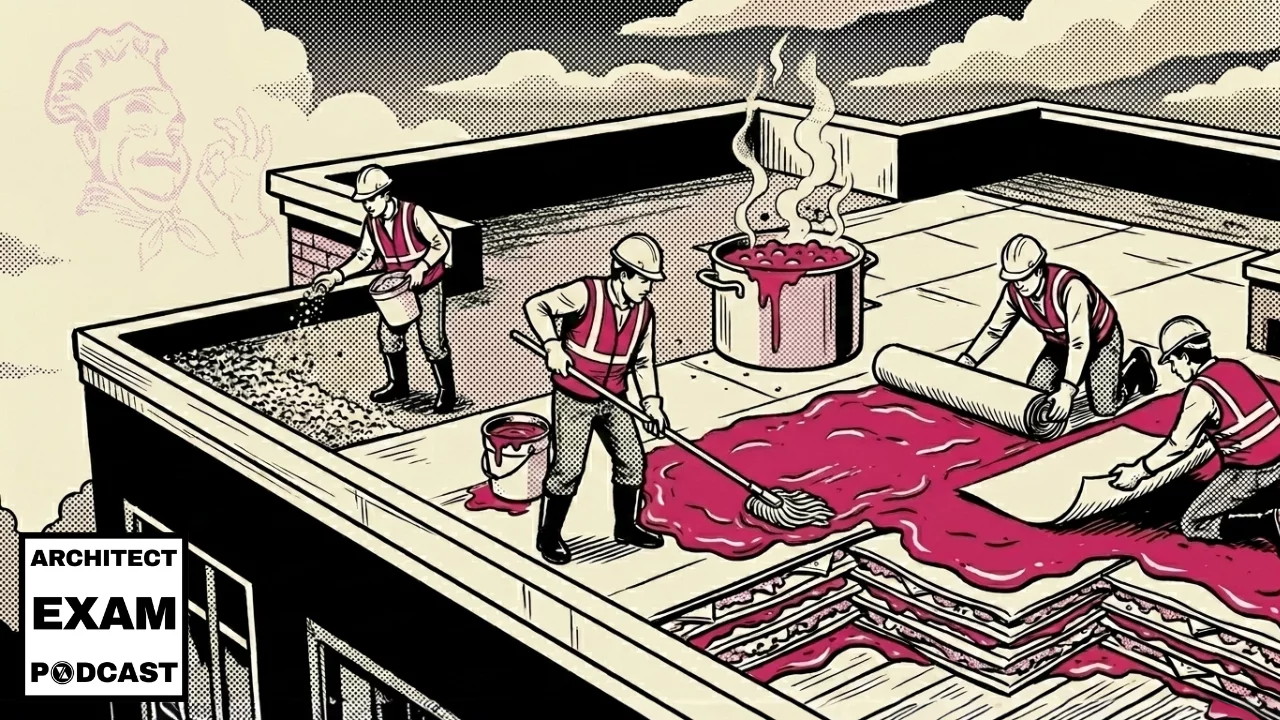

On a pitched roof, gravity does all the work. Flatten that roof out and the water has nowhere to go. The only thing standing between that pooling water and the inside of the building is one thin layer called the roof membrane. This post breaks down the five major low-slope roofing membrane types, from built-up roofing to EPDM to TPO, how each one works, where it belongs, and how to choose the right one for any building.
This podcast is also available on YouTube, Spotify, and Apple Podcasts
Test yourself! This episode has a free 10-question roof membrane types quiz at the bottom of this page.
What Is a Low-Slope Roof Membrane
A low-slope roof is any roof with a pitch under 3:12. That means for every 12 inches you move horizontally, the roof rises less than 3 inches.
Visually, it reads as flat, even though it is not.
There is no such thing as a truly flat roof on a commercial building. Even the ones that look dead level have a slight pitch built in, usually about a quarter inch of drop per foot, just enough to nudge the water toward the drains. That quarter inch per foot is the IBC minimum slope required for new construction drainage, not just a rule of thumb.
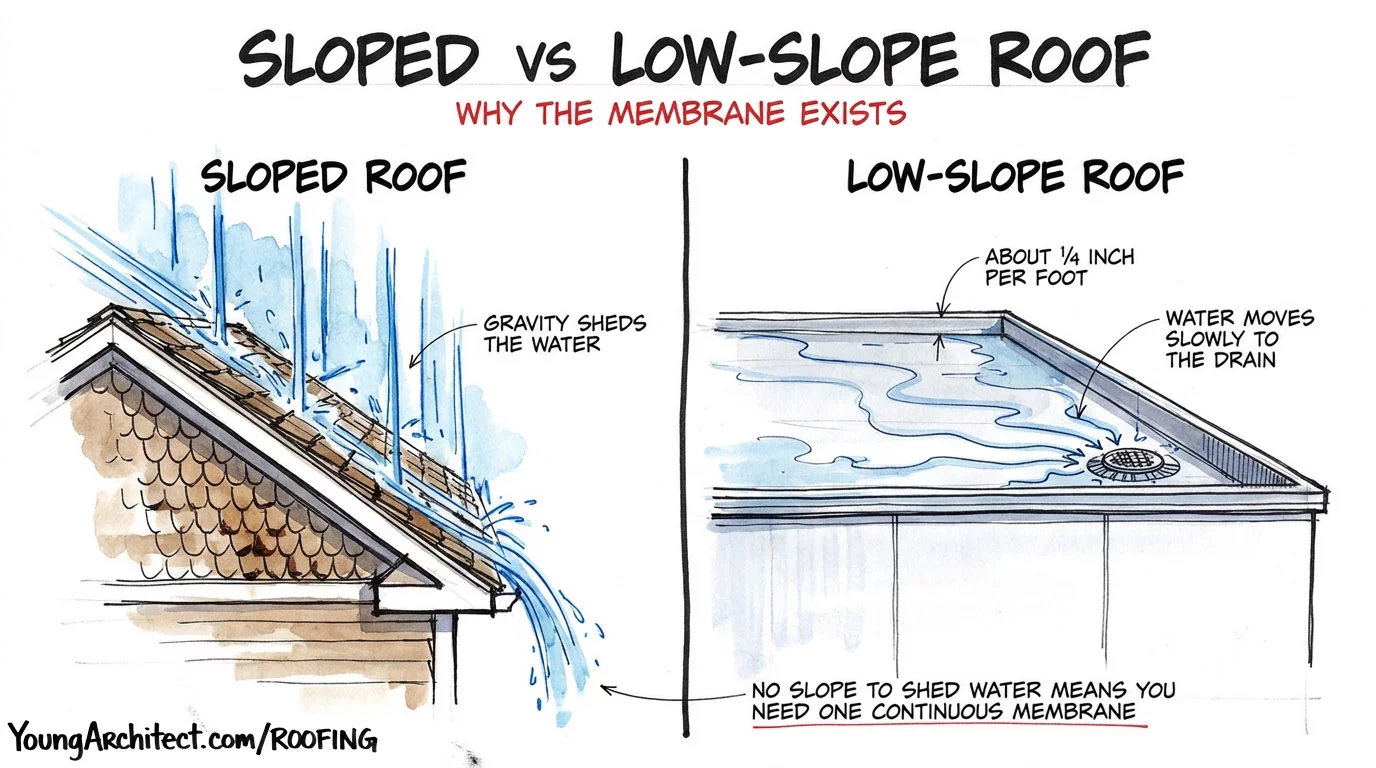
So compared to a steep roof where rain sheds in seconds, a low-slope roof lets the water linger. It still drains. It just does it slowly.
And that lingering water is exactly why shingles do not work up here.
Shingles need gravity. They overlap like fish scales and rely on water running down the slope fast enough to shed off each layer before it can work its way underneath. Take the slope away and the whole system falls apart. Water pools on top of the laps and finds its way in.
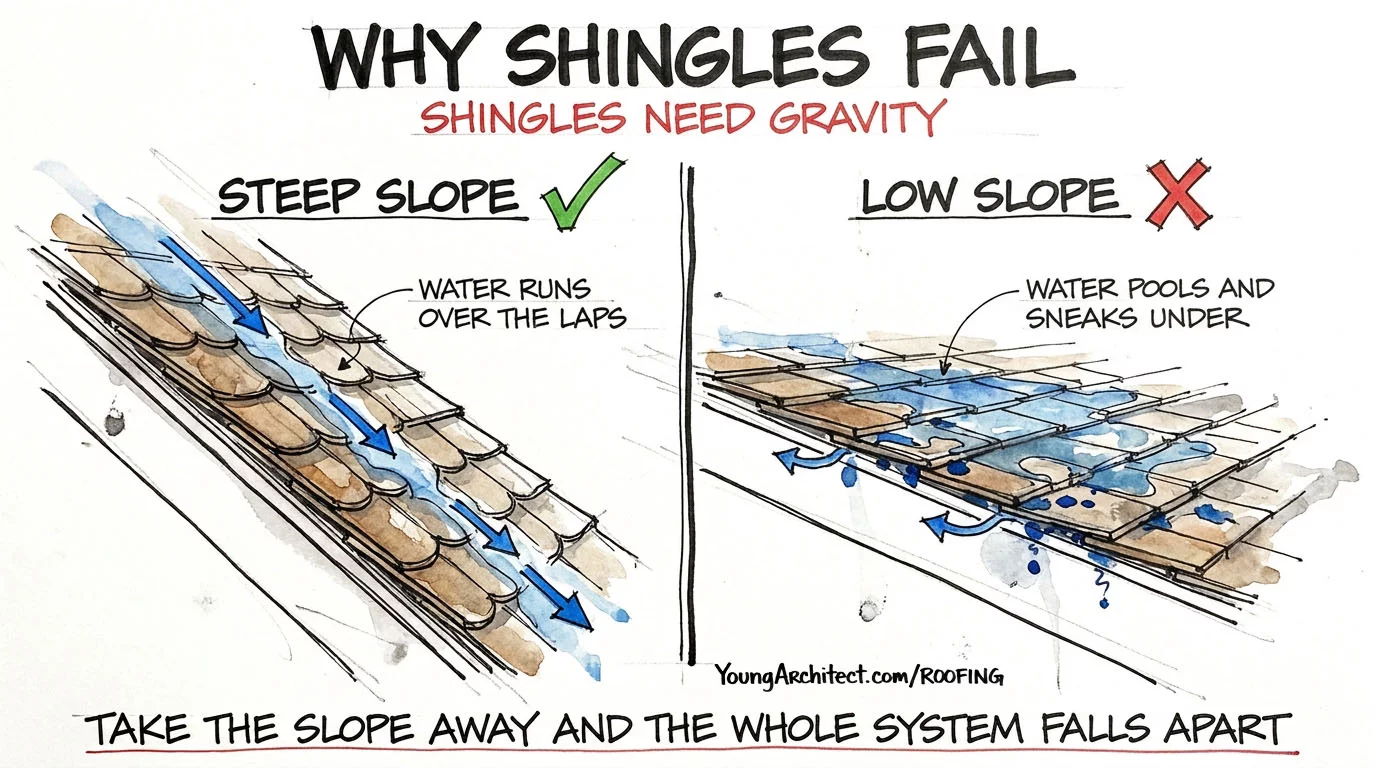
Instead of overlapping pieces, a low-slope roof needs one continuous, fully waterproof layer with seams you can trust.
That layer is the roof membrane, and it is the only thing standing between the weather and the inside of the building.
This is one piece of the larger building envelope puzzle. The roof membrane handles bulk water from above, while the walls manage water, air, and vapor from the sides. If you want the full picture of how a building envelope controls moisture, that post breaks it all down.
Built-Up vs. Single-Ply Roofing
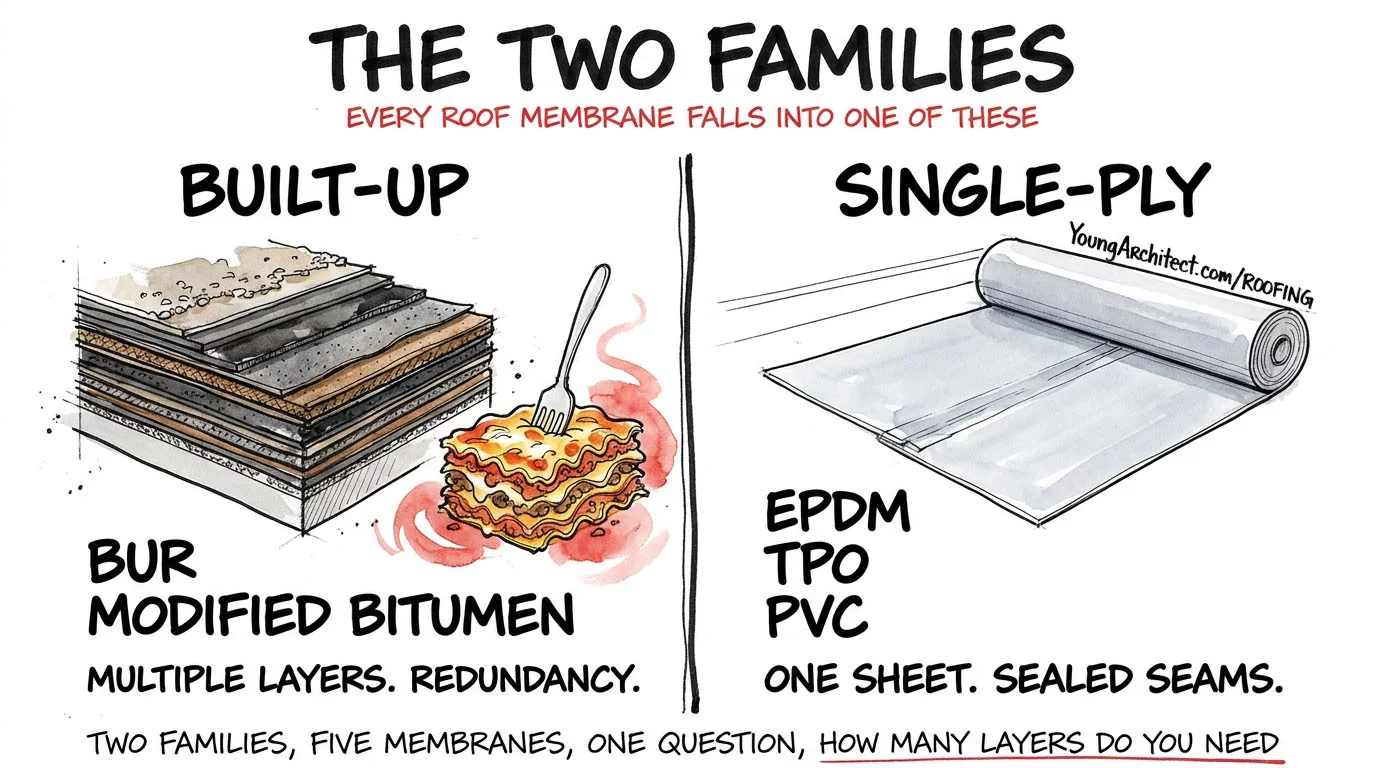
There are five roof membrane types you need to know, and the fastest way to keep them straight is to realize they fall into just two families.
Once you have the families down, the individual products stop feeling like random letters and start fitting into a system.
The first family is built-up systems. These are made of multiple layers, built right on the roof, stacked one on top of the other. The classic image is the old tar-and-gravel roof. The whole strategy is redundancy. If one layer gets compromised, more layers underneath are still doing their job.
Think of it like a lasagna. Sheet, goo, sheet, goo, all the way up.
The second family is single-ply roofing. Instead of building up layers, you roll out one single sheet of membrane and seal it at the seams. Fewer layers, faster to install, lighter on the building.
Understanding how each of these membrane families gets organized in project documents connects directly to how specifications are written for a roof assembly.
Now here is one idea I want to plant right now, because it pays off in a big way later.
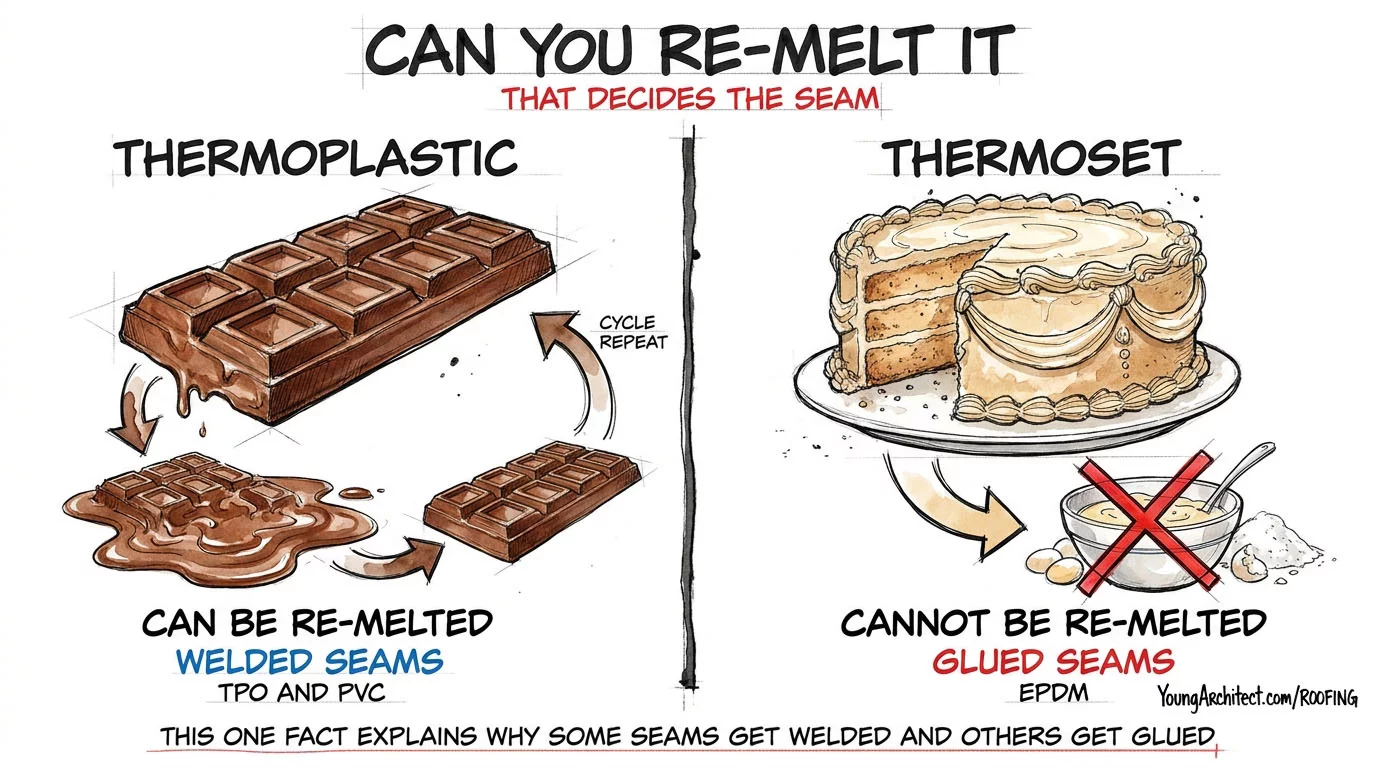
Within that single-ply roofing family, some membranes can be re-melted with heat, and some cannot. That one fact, whether or not you can re-melt the material, explains why some seams get welded and others get glued.
Think of it like the difference between chocolate and a baked cake.
Chocolate you can melt, let it harden, and melt all over again. That is a thermoplastic. TPO and PVC work this way, and their seams are heat-welded.
A baked cake is done the moment it comes out of the oven. You cannot un-bake it back into batter. That is a thermoset. EPDM works this way, and its seams are glued.
Hold onto that. It is going to make every seam discussion from here on make sense.
Built-Up Roofing (BUR)
The family elder. Built-up roofing, or BUR. The lasagna roof.
The construction is exactly what the name says. You alternate layers of bitumen (asphalt or coal tar) with reinforcing felts and build the whole thing up in place. Usually three to five layers, or what the trade calls plies. Then you cap it off with a layer of gravel, which protects everything underneath from the sun and weighs the system down against the wind.
It is the only roof where the finishing touch is throwing rocks at it.
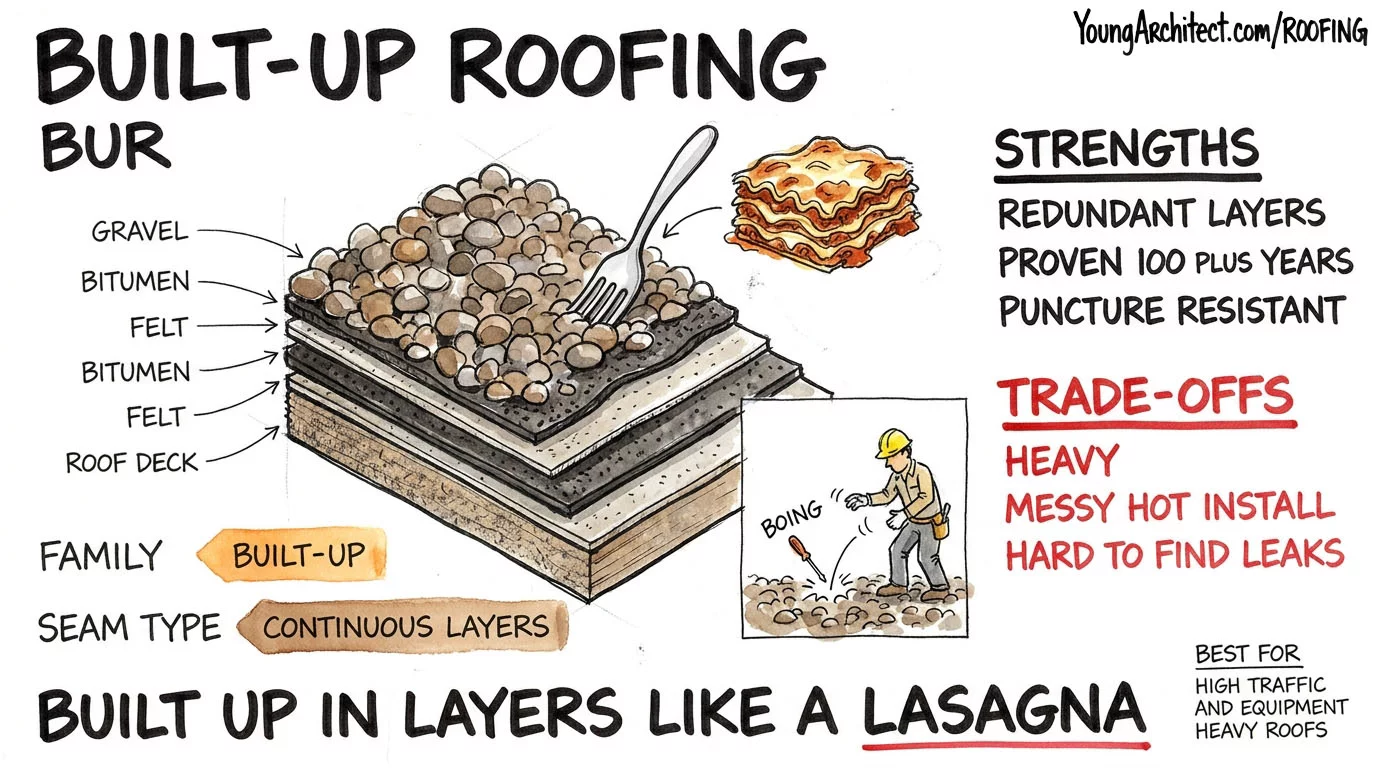
The biggest strength of the lasagna roof is redundancy. With four or five layers stacked up, water has to defeat every single one of them to get inside. That is a tall order.
There is a second strength that is easy to overlook until you have watched it matter. Puncture resistance.
Picture a maintenance tech up on the roof servicing a rooftop unit, and they drop a screwdriver. On a thin single sheet, that tool can punch a clean hole straight through your only waterproof layer. On a four-ply lasagna roof capped with gravel, that same tool just bounces off the rock.
When a roof is going to carry a lot of equipment and regular foot traffic, that toughness is a real reason to reach for a built-up roof.
The trade-offs:
- It is heavy, so the structure has to be designed to carry it
- The installation is messy and smelly, because you are working with hot asphalt on a roof
- It is labor intensive compared to rolling out a single sheet
The Leak Detective Problem
And here is the sneaky one.
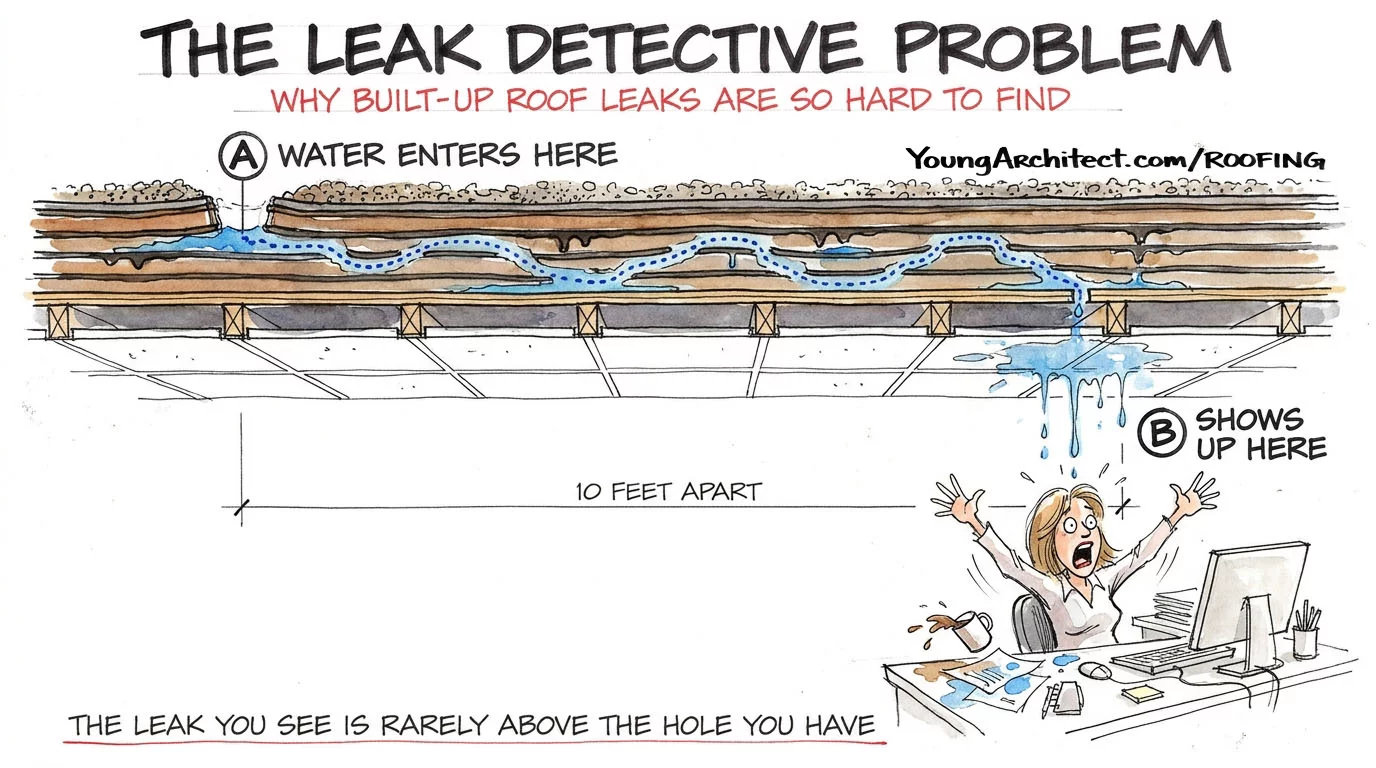
When a built-up roof finally does leak, the water can travel sideways between the plies before it shows up inside. The wet spot on your ceiling might be nowhere near the actual hole in the membrane.
The leak you see is rarely above the hole you have.
Finding the leak becomes a detective job. Except nobody gives you a magnifying glass and the crime scene is four stories up in August.
Memory hook: BUR is built up in layers, like a lasagna. Heavy, redundant, proven, and tough as nails underfoot.
If you are studying building envelope systems for the ARE, this is the kind of content we break down across our courses. The ARE Boot Camp gives you a structured study plan and weekly coaching, and the ARE 101 Membership gives you self-paced access to every course we offer for one monthly price.
Modified Bitumen Roofing
Now the lasagna roof’s younger, more flexible sibling. Modified bitumen roofing. The lasagna rollup.
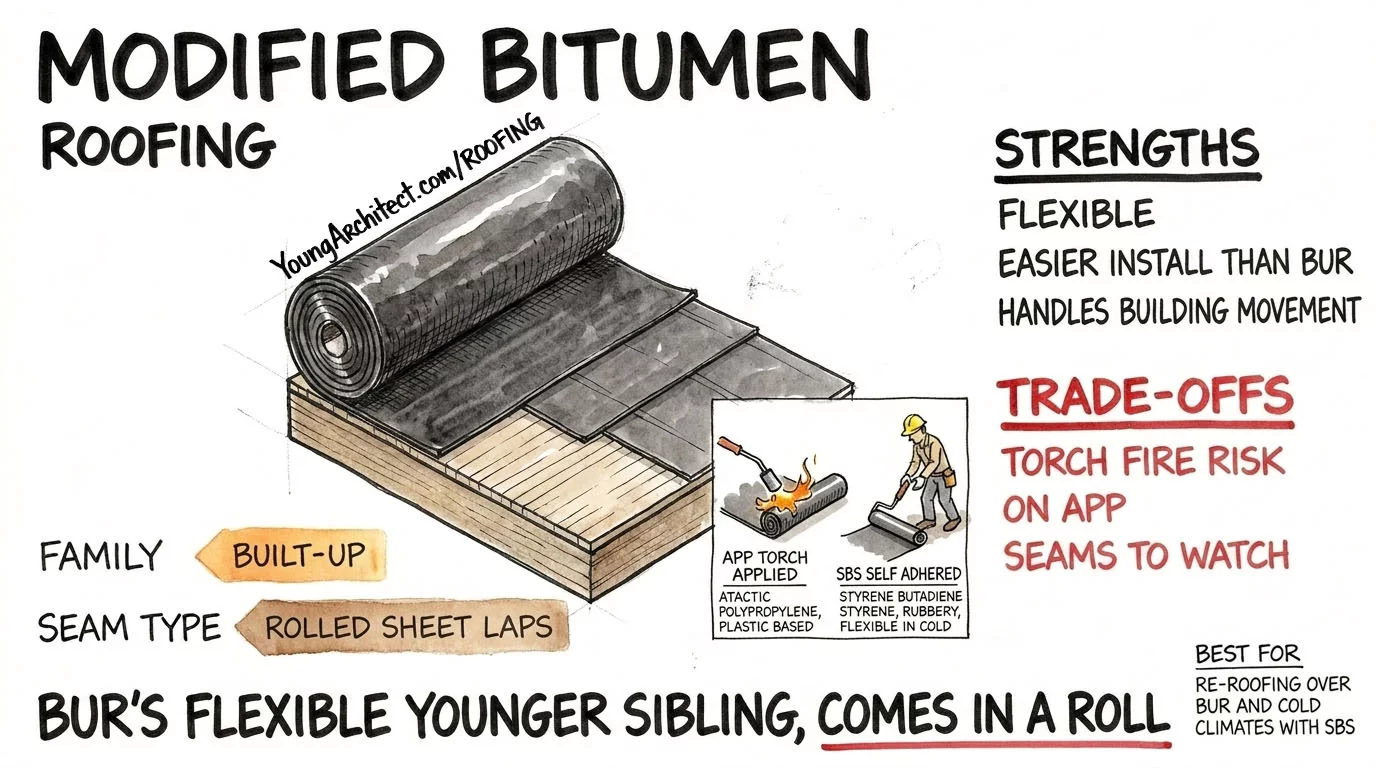
Same family as BUR, but instead of mopping hot asphalt and laying felts layer by layer, modified bitumen comes in rolls. You roll it out across the roof, usually just two or three layers instead of five.
The asphalt itself has been modified with polymers, which is where the name comes from, and those polymers make it far more flexible and better at handling a building that expands and contracts.
There are two main types.
APP (atactic polypropylene) is the plastic-based version. It gets torch-applied, meaning the installer uses an open flame to melt the back of the roll as they lay it.
SBS (styrene-butadiene-styrene) is the rubbery version. It stays flexible in cold weather and can be torched, cold-adhered, or applied with a peel-and-stick back.
The strengths:
- More flexible than old-school BUR
- Easier and cleaner to install
- Handles building movement well
The trade-offs:
That torch application on APP is an open flame on a roof. On purpose. The fire risk during installation has to be managed carefully. Many urban jurisdictions and strict corporate safety policies restrict or outright ban open-torch application, which is a big reason cold-applied and self-adhered SBS roofing options have become so popular.
And because it comes in rolls, you have seams between the rolls, and seams are always the spot you watch most closely.
Memory hook: Modified bitumen is the lasagna rollup. Same family as BUR, thinner, comes in a roll, easier to live with.
EPDM Roofing
We are leaving the lasagna family now and crossing into single-ply roofing.
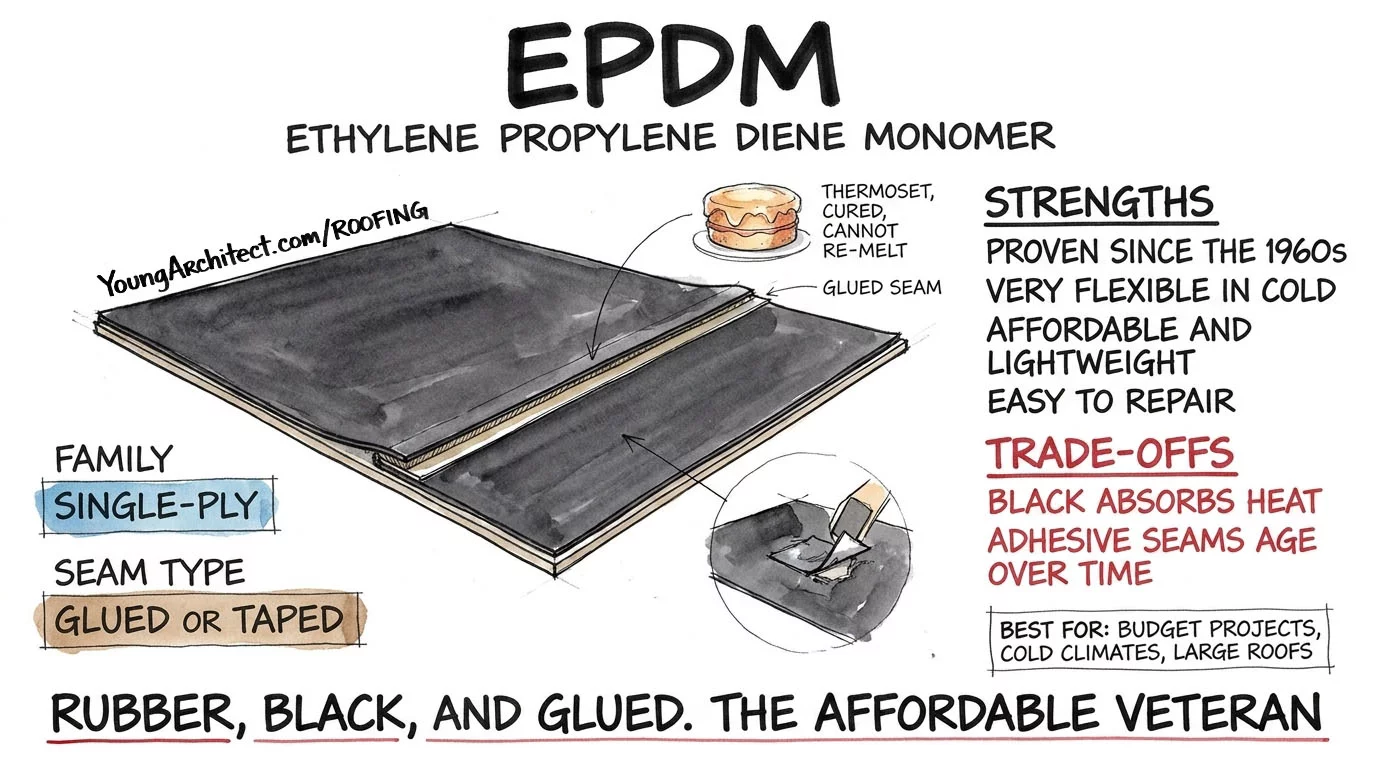
First up, the veteran. EPDM roofing, which stands for ethylene propylene diene monomer. All you really need to hold onto is two words: synthetic rubber. That is what EPDM is. The rubber roof.
It has been around since the 1960s, so it has decades of real-world track record behind it. The classic version is black.
Nothing flashy about this one. It has just quietly worked for a very long time.
And here is where the chocolate-and-cake idea pays off.
EPDM is a thermoset. It is the baked cake. Once it is manufactured and cured, the chemistry is locked in for good. You cannot re-melt it.
So when you need to join two sheets of EPDM together, you cannot weld them with heat. You have to glue them or tape them instead.
The strengths:
- Proven since the 1960s with decades of track record
- Very flexible in cold weather, where some other membranes stiffen up
- Affordable and lightweight
- Easy to patch when damaged
The trade-offs:
That classic black color absorbs heat, which can drive up cooling costs and age the membrane faster. That is exactly why white-coated versions exist.
And those glued seams, while reliable, rely on an adhesive that can weaken over time. The seams are the part you watch as the EPDM roof gets older.
Memory hook: EPDM is rubber, black, and glued. The affordable veteran.
TPO Roofing
The one you will run into more than any other on new construction today. TPO roofing.
Officially, thermoplastic polyolefin. Unofficially, The Popular One. Because that is exactly what it is.
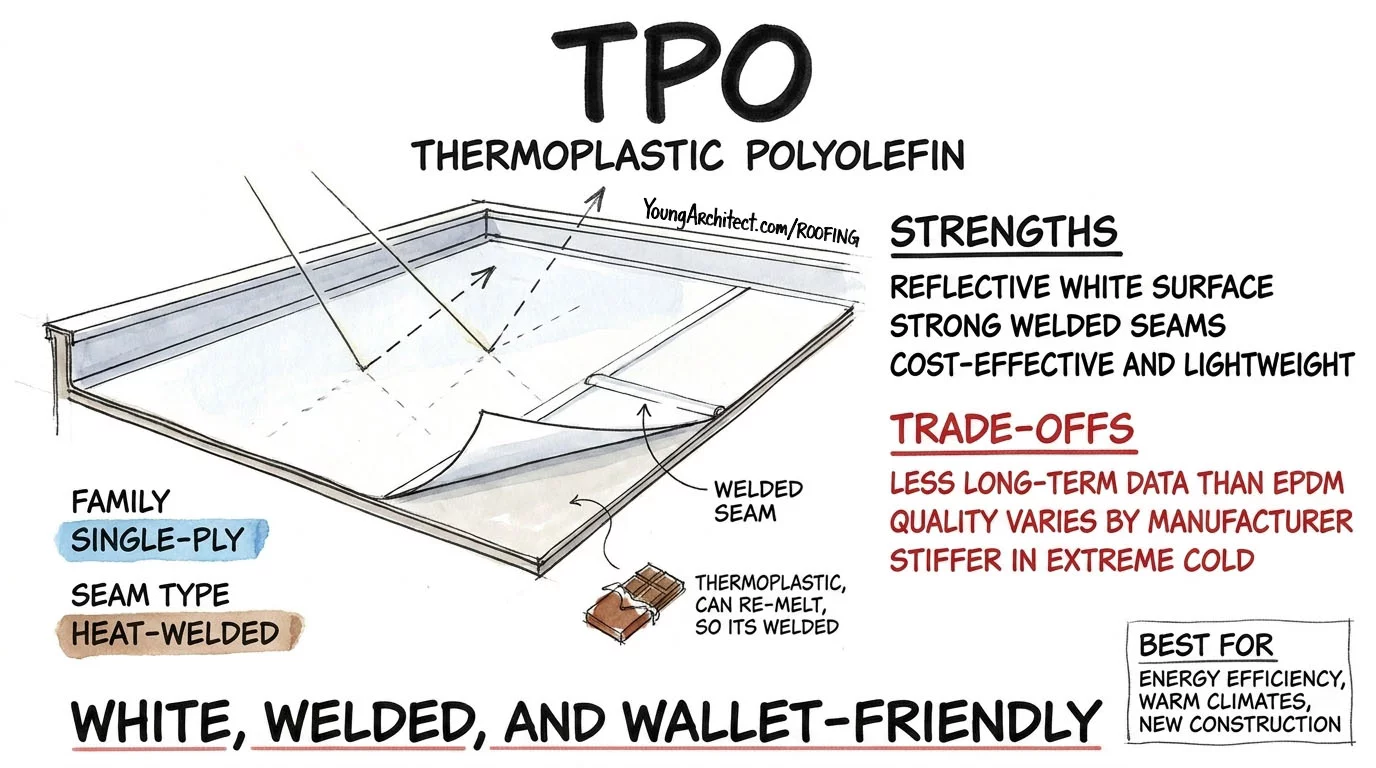
TPO shows up white and reflective, and even though it has only been around since the 1990s, it caught on so fast that it is now the most common single-ply roofing membrane in the country.
And now the chocolate side of the analogy gets its moment.
TPO is a thermoplastic. It can be re-melted. So when you join two sheets of TPO together, you do not reach for glue. You run a hot-air welder along the seam and literally melt the two sheets into one.
Done right, that welded seam is actually stronger than the membrane itself. That is a real step up from a glued seam that can age and let go.
Glued vs. Welded Seams
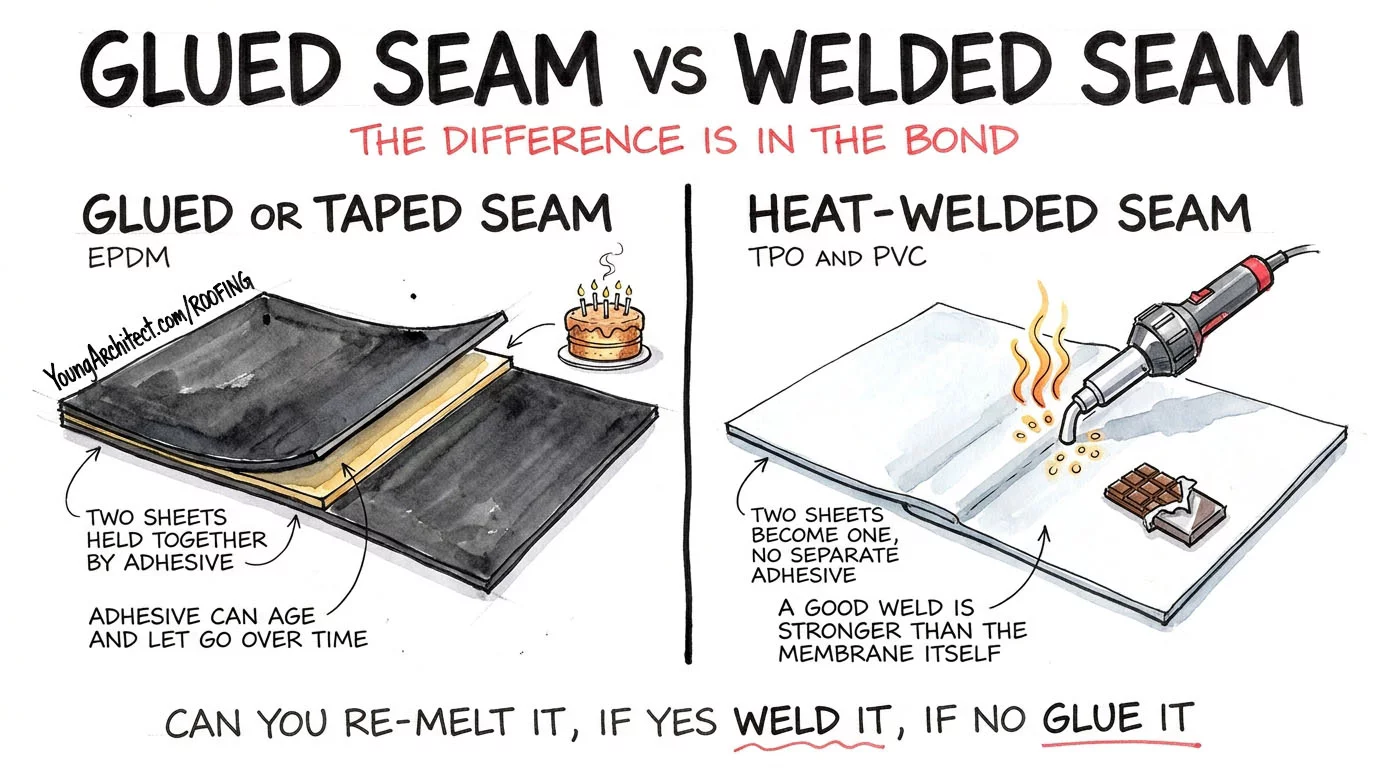
This is the practical payoff of the thermoplastic vs. thermoset distinction.
A glued seam (EPDM) holds two separate sheets together with adhesive. Two sheets, held together.
A welded seam (TPO, PVC) fuses the two sheets into one with heat. No adhesive. No separate bond to fail. Two sheets become one.
A good weld is stronger than the membrane itself.
So why has The Popular One taken over? Mostly that reflective white surface.
It bounces heat away instead of soaking it up, which cuts cooling costs and helps a building meet today’s energy codes. That reflective performance is what the industry calls a cool roof, and it is a big part of why TPO dominates in warm climates.
The strengths:
- Reflective white surface cuts cooling costs and helps meet energy codes
- Strong welded seams that are stronger than the membrane itself
- Cost-effective and lightweight
- Fast install
The trade-offs:
The thing to watch with TPO is consistency. It has not been around as long as EPDM, and the quality varies a lot between manufacturers. A cheap TPO can give up early in a way a good one never would. And like most plastics, it stiffens up in serious cold.
The relationship between the roof membrane and the rest of the building envelope matters here too. The types of insulation sitting directly below that membrane play a major role in overall thermal performance.
Memory hook: TPO is white, welded, and wallet-friendly. The Popular One.
PVC Roofing
Here is where a lot of people get tripped up, so stay with me.
PVC roofing. Officially, polyvinyl chloride. Think of it as Pretty Versatile, Costs More. Because that sums it up perfectly.
It is the same family of plastic as those white plumbing pipes under your sink. And up on a roof, at a glance, PVC looks almost exactly like TPO.
It is also a thermoplastic. Also white. Also heat-welded.
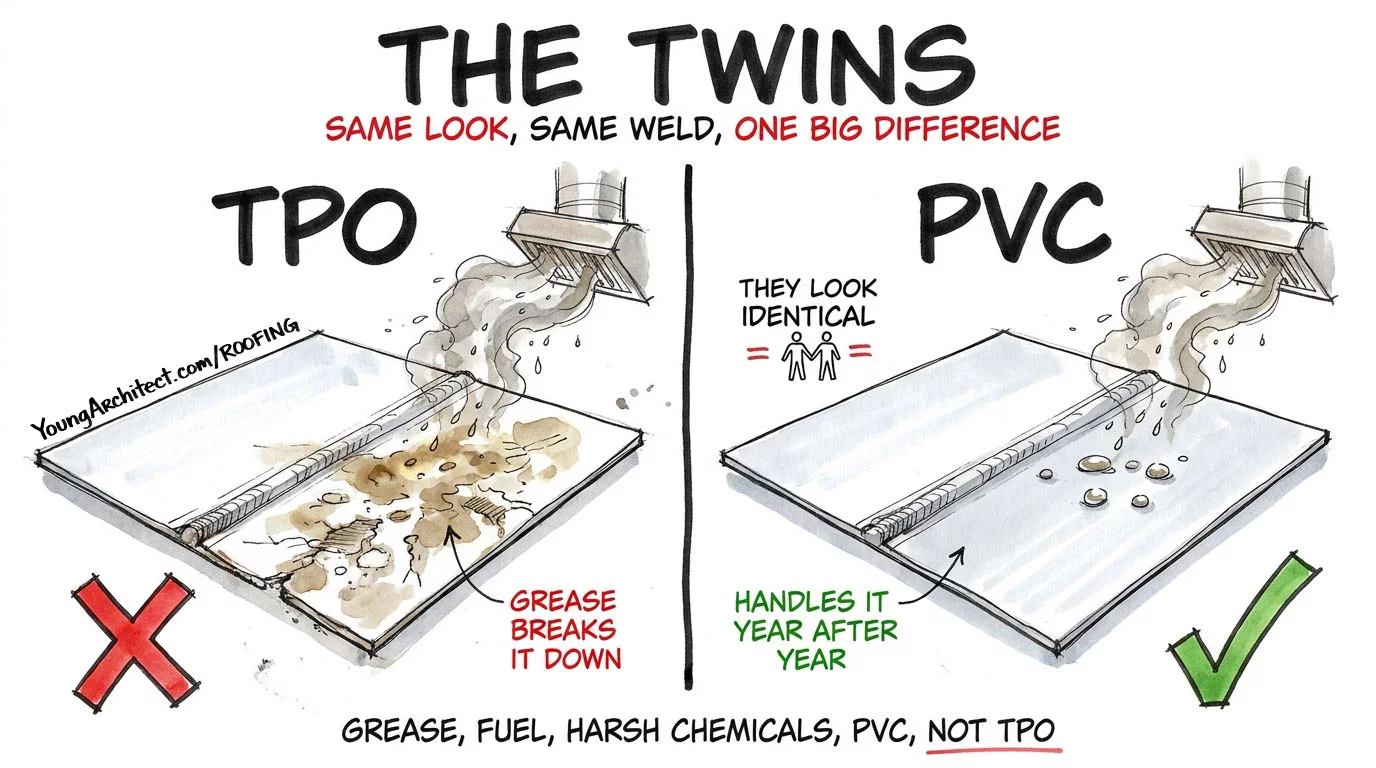
Put a junior designer up on two finished roofs, one TPO and one PVC, and they probably could not tell you which is which. They are the identical twins of the roofing world. Same outfit, same haircut, completely different personalities.
TPO vs. PVC: The Twins
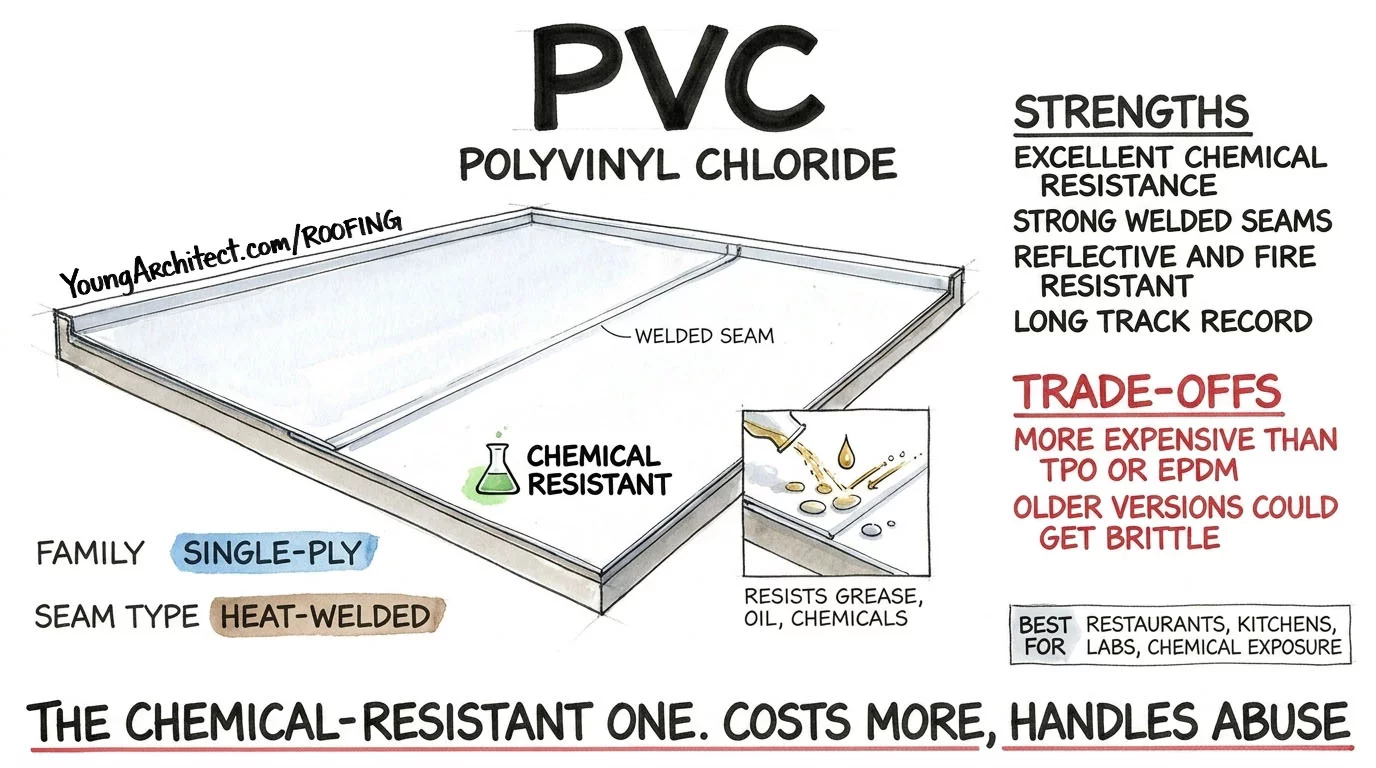
There is one thing PVC does that sets it completely apart. Chemical resistance.
PVC shrugs off the stuff that destroys other membranes. Grease, oils, animal fats, harsh chemicals. None of it bothers PVC.
Picture a roof sitting right downwind of a restaurant’s kitchen grease exhaust. Put a standard TPO membrane under that greasy plume and the oils will break it down surprisingly fast. Put PVC there and it just handles it, year after year.
If a roof is anywhere near chemical exposure, PVC roofing is the answer. TPO is not.
The strengths:
- Excellent chemical resistance to grease, oils, and harsh chemicals
- Strong welded seams
- Reflective white surface with good fire resistance
- Decades of track record
The trade-offs:
The catch is mostly the price tag. PVC costs more than TPO or EPDM. Pretty Versatile, Costs More.
Older formulations could also turn brittle over the years as the plasticizers that kept them flexible slowly worked their way out, though modern PVC has largely addressed that.
Memory hook: PVC is Pretty Versatile, Costs More. The chemical-resistant one.
How to Choose a Roof Membrane
Now you have met all five. The real skill is not naming them. It is knowing which one belongs on a given building.
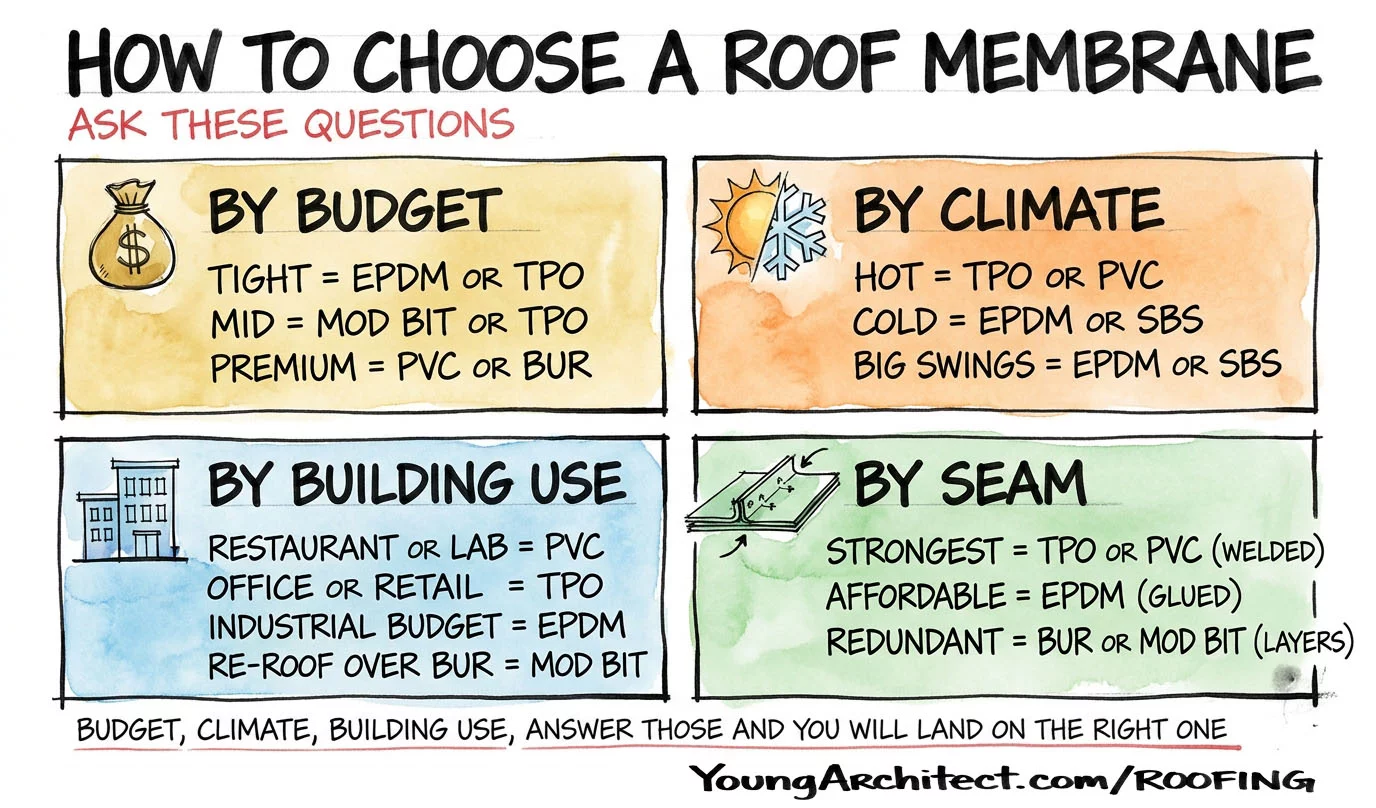
And you can get to the right answer by asking a few simple questions.
Start with budget.
If money is tight, you are looking at EPDM or TPO, the two most affordable options. In the middle, modified bitumen or TPO make sense. And when there is room in the budget for premium performance, that is where PVC or a heavy-duty BUR with a long warranty earns its keep. Understanding how construction costs evolve across project phases helps put these decisions in context.
Next, think about climate.
In a hot, sunny climate where cooling costs dominate, you want a reflective white surface with strong solar reflectance ratings, so TPO or PVC. In a cold climate, you want something that stays flexible when the temperature drops, which points to EPDM or SBS modified bitumen. And if the building sees wild temperature swings, again EPDM or SBS, because flexibility is what survives all that expansion and contraction.
Then ask what the building is actually used for.
A restaurant, a commercial kitchen, a lab, anything with grease or chemical exposure? PVC, every time. A standard office or retail building? TPO is the workhorse. An industrial building on a tight budget? EPDM. And if you are re-roofing over an existing built-up roof, modified bitumen is a natural fit.
And finally, the seams.
If you want the strongest seam, you want a welded one, and that means TPO or PVC. If you are working with EPDM, you have glued or taped seams, because you cannot melt a cured rubber. And if you want the security of multiple redundant layers, that is the lasagna family, BUR and modified bitumen.
If you are tracking NCARB objectives while you study, this decision-making process maps directly to what PPD and PDD objectives are pointing toward. PPD Objective 3.4 covers selecting building envelope systems based on environmental and budgetary conditions. PDD Objective 1.1 covers resolving and detailing those systems with an understanding of the individual materials.
The work you just did in your head is the work those objectives are pointing at.
How a Roof Membrane Stays Put
Picking the right membrane is only half the decision. You also have to decide how it actually stays on the roof.
There are three main attachment methods, and each one changes the structural load and how the roof handles wind.
Fully adhered means gluing the membrane down across the entire roof deck. Nothing lifts, so it is the best option in high-wind areas. It costs more, but when wind performance matters, this is the answer.
Mechanically fastened means screwing the membrane down with plates along the seams. It is fast and affordable, which is why it is the most common method. The key detail is that fastener spacing gets tighter as you move from the field of the roof into the perimeter and corner zones, where wind uplift is strongest.
Ballasted means laying the membrane loose and holding it down with weight, like river rock or concrete pavers. It is cheap, but it is also heavy, and you cannot use it everywhere. The IBC severely restricts ballasted systems in high-wind and hurricane-prone regions because lifted stones become high-velocity projectiles that can shatter windows and damage neighboring structures. If a building is coastal or in a high-wind zone, ballast is almost always off the table.
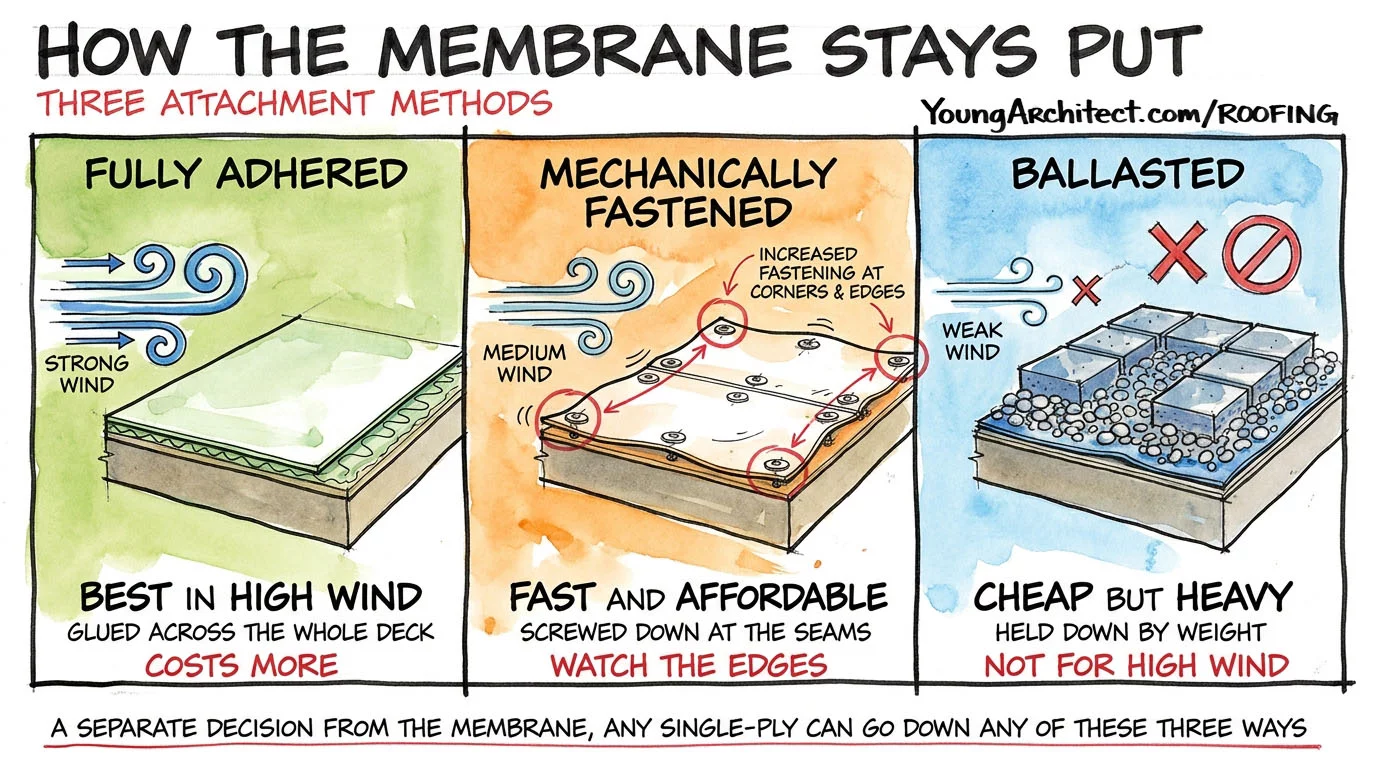
One important point: this is a separate decision from the membrane itself. Any single-ply membrane can go down any of these three ways. The membrane is the “what.” The attachment method is the “how.”
Roof Membrane Recap
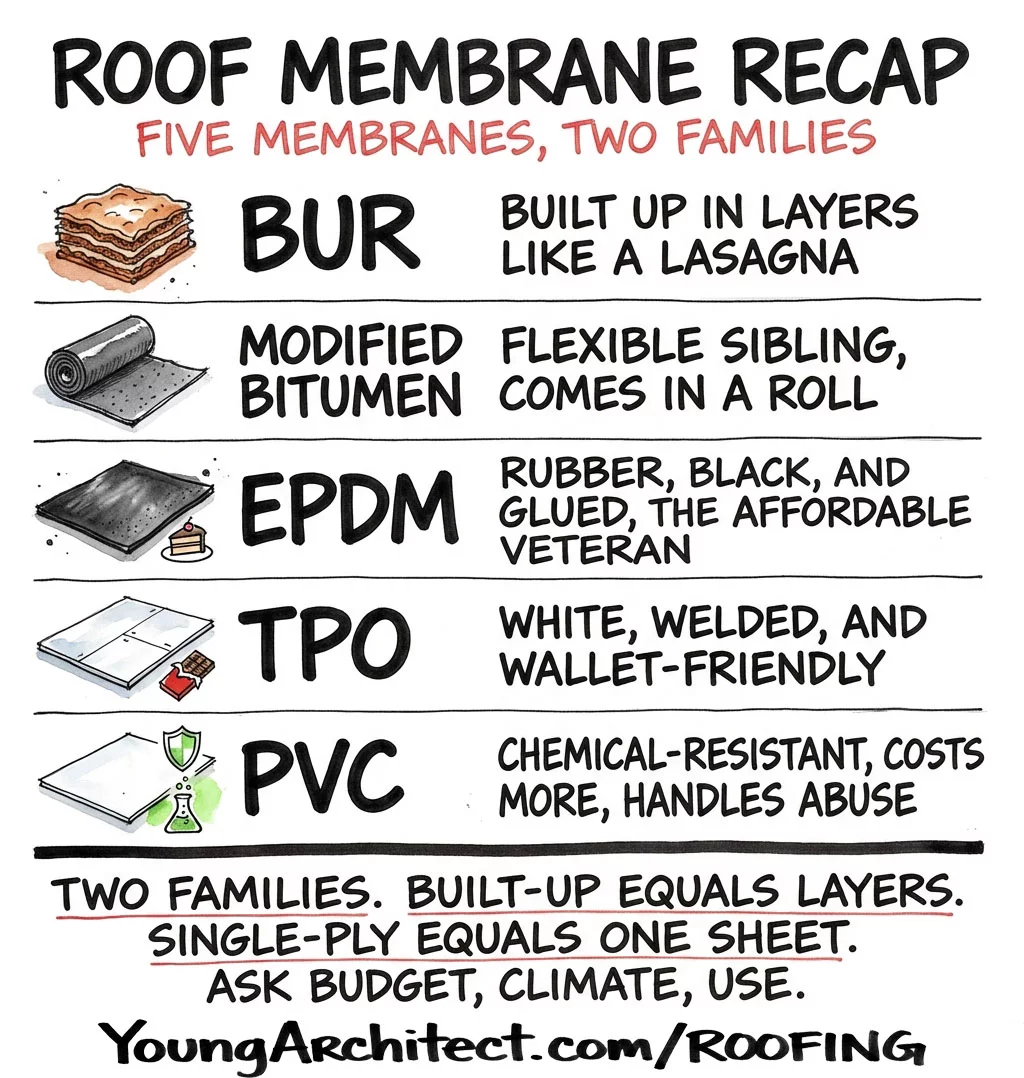
Five roof membrane types. Two families defined by their seams. And three final questions that get you to the right answer.
- BUR / The Lasagna Roof. Built up in layers. Heavy, redundant, tough underfoot, proven for over a century. The only roof you finish by throwing rocks at it.
- Modified Bitumen / The Lasagna Rollup. Same family, thinner, comes in a roll. Easier to install. Watch the torch and the seams.
- EPDM / The Affordable Veteran. Rubber, black, glued. Stays flexible in the cold. The rubber roof that has quietly worked since the 1960s.
- TPO / The Popular One. White, welded, wallet-friendly. The reflective newcomer that showed up and took over.
- PVC / Pretty Versatile, Costs More. White and welded like its twin, but the chemical-resistant one. Handles grease, handles abuse.
Underneath all five, remember the two families and the one big idea.
The lasagna family means layers and redundancy. Single-ply means one sheet and good seams. And whether a seam gets welded or glued comes down to whether you can re-melt the material. Chocolate or baked cake.
When you are staring at a real project, just ask three questions:
What is the budget? What is the climate? What is the building used for?
Answer those, and you will land on the right roof membrane just about every time.
If this is the kind of content that is clicking for you, come study with us.
The ARE Boot Camp is a coaching program that gives you a structured study plan, weekly accountability, and a community of candidates working through the exams alongside you. It is more than study materials. It is the structure that keeps you actually studying.
If you prefer to go self-paced, the ARE 101 Membership gives you access to every course we offer for one low monthly price, cancel anytime. For this topic specifically, PPD 101 covers choosing envelope systems based on project conditions, PDD 101 covers detailing and specifying materials, and Building Systems 101 covers the energy and sustainability side of the conversation.
Now go pass this exam.
Frequently Asked Questions
What is a roof membrane?
A roof membrane is a continuous waterproof layer installed on low-slope and commercial roofs to prevent water from entering the building. Unlike shingles on steep roofs that rely on gravity and overlapping layers, a membrane provides a single sealed surface with watertight seams designed to handle water sitting on it for extended periods. The five major types are BUR, modified bitumen, EPDM, TPO, and PVC.
What is TPO roofing?
TPO (thermoplastic polyolefin) is a white, reflective single-ply roofing membrane with heat-welded seams. It is the most widely installed low-slope roof membrane on new construction in the United States. TPO is a thermoplastic, meaning it can be re-melted, which allows installers to fuse two sheets into one using a hot-air welder. That welded seam is stronger than the membrane itself.
What is the difference between TPO and EPDM?
TPO is a white thermoplastic membrane with heat-welded seams, while EPDM is a black thermoset rubber membrane with glued or taped seams. TPO reflects heat and helps reduce cooling costs. EPDM absorbs heat but stays more flexible in extreme cold. TPO seams are generally stronger because the sheets fuse into one, while EPDM seams depend on adhesive that can weaken over time. Both are affordable single-ply options with different strengths by climate.
What is the difference between TPO and PVC?
TPO and PVC look nearly identical. Both are white, reflective, single-ply thermoplastic membranes with heat-welded seams. The critical difference is chemical resistance. PVC handles grease, oils, animal fats, and harsh chemicals that would break down TPO over time. If a roof sits near a kitchen exhaust or any chemical exposure, PVC is the right choice. PVC costs more, which is why TPO dominates on standard commercial projects without chemical concerns.
What is the most common low-slope roof membrane?
TPO is the most common low-slope roof membrane on new construction in the United States. Its reflective white surface, strong heat-welded seams, and competitive pricing made it the dominant choice for commercial roofing. EPDM remains widely installed on existing buildings and budget projects, and BUR still shows up on heavy-duty roofs that need maximum puncture resistance and foot traffic durability.
Roof Membrane Types Quiz Time: