
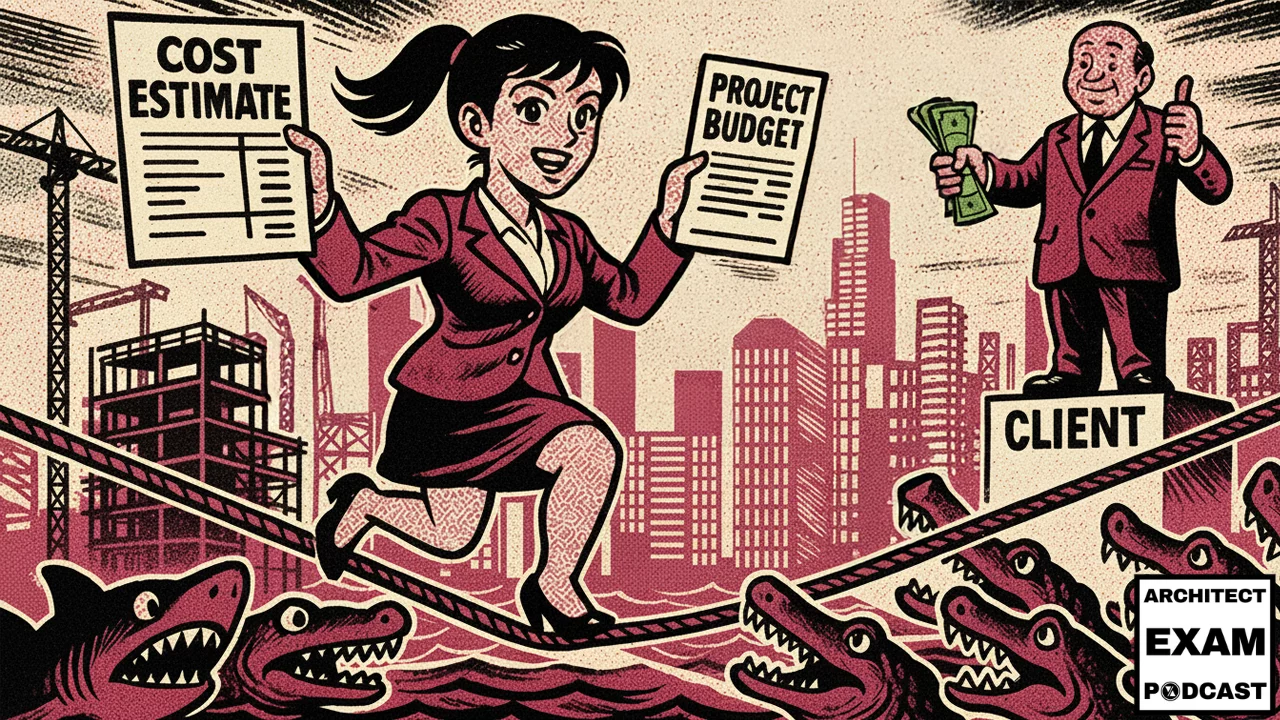

Construction cost estimates are essential tools that help architects provide accurate budget guidance and make smart design decisions throughout every project phase. These estimates evolve from broad conceptual estimates with 25-50% accuracy to precise construction document estimates within 5-10% of actual costs. Understanding how to estimate construction costs separates successful architects from those who struggle with budget overruns and client disputes.
This podcast is also available on YouTube, Spotify, and Apple Podcasts
Picture this: You’re six months into designing a beautiful new community center. The client is thrilled with the design, the planning commission loves it, and you’re feeling pretty good about the whole project.
Then you get the construction bids back, and they’re 40% higher than your latest construction cost estimate.
The client looks at you and says:
“How did we go from $2 million to $2.8 million? I thought architects were supposed to track this stuff!”
Sound familiar? If you work in architecture, this scenario probably keeps you up at night. We’ve all been there or at least heard horror stories like this from colleagues.
Here’s the thing: construction cost estimating isn’t some mysterious black art that only contractors understand.
As architects, we have both the responsibility and the tools to provide reliable cost guidance throughout the entire design process.
If you’re studying for the ARE, this topic is absolutely critical. You’ll see construction cost estimates show up everywhere:
- In Project Management when you’re tracking budgets and evaluating compliance with construction budgets
- In Programming & Analysis during feasibility studies and preliminary project budgets
- In Project Planning & Design when you’re selecting systems and performing cost evaluations
- In Project Development & Documentation when you’re specifying materials and analyzing cost estimates
- In Construction & Evaluation when you’re analyzing cost adjustments and value engineering opportunities
When you understand construction cost estimates properly, you realize they’re not about predicting the future perfectly. They’re about creating frameworks for smart decision-making and setting realistic expectations with your clients, helping you avoid costly change orders during construction.
Let’s break down everything you need to know to make construction cost estimates one of your strongest professional tools.
Why Construction Cost Estimates Matter for Architects
What Is a Construction Cost Estimate?
A construction cost estimate is a detailed projection of the total costs to complete a building project. It accounts for materials, labor, equipment, contractor overhead, and contingencies.
Architects develop these estimates at each project phase, starting with broad conceptual estimating numbers during programming and refining them into precise figures by construction documents. The goal is to help owners make informed decisions and keep the project aligned with the construction budget estimate from the start.
Construction cost estimates aren’t just about money though. They’re actually powerful design tools that help you make better decisions throughout your project.
Your Professional Responsibility
First, it’s literally our professional responsibility. Most architect agreements require us to provide construction cost estimates at various project phases.
We have what’s called a fiduciary duty to our clients. That means we’re legally obligated to look out for their financial interests, not just create pretty drawings. Under AIA B101, the architect is responsible for managing the design to meet the owner’s budget, and the owner has the right to rely on the architect’s conceptual cost estimating.
For a deeper look at how this plays out contractually, see AIA’s guidance on designing to budget.
Every Design Decision Has Financial Impact
Here’s what’s really interesting: every design choice you make affects your client’s budget.
When you choose between:
- Brick vs EIFS
- Standard windows vs high-performance glazing
- Hydraulic vs traction elevators
- A simple roof vs a complex one
You’re making cost decisions. Construction cost estimates give you the data to have those conversations intelligently.
Without cost data, design discussions become purely aesthetic debates. With cost information, you can have real conversations about value.
I learned this lesson early in my career working on a school project. We had two roof options: a simple gable roof and a more architecturally interesting shed roof design. Without cost data, it was just an aesthetic debate.
But when we ran the numbers and found the shed roof would add $85,000 to the project, suddenly we could have a real conversation about whether that architectural feature was worth the cost to the school district.
Setting Realistic Expectations and Risk Management
Construction cost estimates also set realistic expectations with clients from day one. When a client comes to you with a $500,000 budget and a 5,000 square foot program, you can immediately flag that there’s a disconnect.
It’s much better to have that conversation during schematic design than to discover the problem when construction bids come in.
From a risk management perspective, good cost tracking protects both you and your client. It shows you’re exercising professional judgment and due diligence while maintaining your standard of care. If a project does end up in a construction claims and disputes situation, documented cost estimates show you were doing your job.
Architects who understand construction cost estimates become trusted advisors to their clients. You’re not just form-givers. You’re problem-solvers who help clients balance their dreams with their budgets.
How Construction Cost Estimates Evolve Through Project Phases
Different project phases require different types of estimates with different accuracy levels. Think of it like focusing a camera: early estimates give you the general picture, while later estimates bring everything into sharp focus.
The Construction Estimating Process
The construction estimating process follows a predictable arc. You gather project information, identify and quantify the scope, apply unit costs, factor in site conditions and contingencies, then validate against benchmarks or comparable projects.
As the design progresses, each step becomes more detailed and more accurate. Early on, you might be working with construction cost per square foot numbers from similar projects. By the time you reach construction documents, you’re pricing individual assemblies and materials from a complete set of drawings and construction specifications.
Conceptual Estimates (Pre-design and Programming)
These are your order of magnitude estimates, the earliest and roughest form of conceptual estimating. They’re typically accurate to within plus or minus 25 to 50 percent.
You’re usually working with historical data or construction cost per square foot numbers. If you know that similar office buildings in your area cost around $200 per square foot, and your client needs 15,000 square feet, you can estimate roughly $3 million. But you’d present this as a range, maybe $2.2 to $3.8 million, to account for unknowns.
The key here is setting the right expectations. Your client needs to understand that this is a feasibility number, not a construction budget.
Schematic Design Estimates
During schematic design, your construction estimates get more refined, typically plus or minus 15 to 25 percent accuracy.
Now you’re making real design decisions about building height, basic materials, and major systems. Your construction estimate might be based on building systems or functional areas rather than simple square footage calculations.
Design Development Estimates
Design development is your critical checkpoint. Construction estimates should be accurate to within plus or minus 10 to 15 percent. This is your last chance to make major changes without significant cost implications.
At this stage, you’re estimating by assemblies or systems. Instead of just construction cost per square foot, you’re looking at:
- Wall assemblies
- Roofing systems
- Mechanical packages
Construction Document Estimates
By construction documents, your construction cost estimates should be within plus or minus 5 to 10 percent of actual contractor estimates. These are detailed quantity takeoff and labor-plus-materials estimates based on your completed drawings and specifications.
The estimate becomes part of the quality assurance process for your project, and the pricing feeds directly into construction submittals and payment applications once the project moves to construction.
At this level of detail, your estimate should align with how the work is organized in the CSI MasterFormat divisions and account for administrative items covered in Division 01 General Requirements.
Bid Estimates and Guaranteed Maximum Prices
Finally, you get contractor estimates or guaranteed maximum price proposals from contractors. These are the most accurate because they’re based on actual market conditions from the competitive bidding process and include the contractor’s overhead and profit.
Here’s the key insight: as design progresses, accuracy improves but flexibility decreases. Early on, you can make big changes easily. By construction documents, every change has significant cost and schedule implications.
Construction Cost Estimate Accuracy by Phase
Here’s a quick reference for how construction cost estimate accuracy tightens as the project moves forward:
- Conceptual/Programming (Order of Magnitude Estimate): plus or minus 25-50%
- Schematic Design: plus or minus 15-25%
- Design Development: plus or minus 10-15%
- Construction Documents: plus or minus 5-10%
- Contractor Bids / GMP: Most accurate, based on actual market conditions and contractor pricing
The more design information available, the tighter the accuracy range becomes. That’s why keeping your estimates updated at every phase is so important for effective construction cost control.
Construction Cost Breakdown and Cost Control Strategies
Understanding the building blocks of construction cost estimates helps you communicate effectively with contractors and clients while implementing smart cost control throughout your project.
Unit Costs and Quantity Takeoffs
Unit costs are your dollars per square foot, dollars per linear foot, or dollars per each. They come from databases like RSMeans or local historical data, and they need to account for regional variations.
Installing a square foot of ceramic tile might cost $8 in rural Alabama but $15 in downtown San Francisco. Understanding these regional differences is crucial for accurate construction cost estimating.
Quantity takeoffs are where you’re literally counting and measuring everything from your drawings. How many square feet of flooring? How many linear feet of walls? Small errors in a quantity takeoff compound quickly, which is why this step is the backbone of any reliable construction estimate.
Labor and Material Cost Breakdown
Understanding the split between labor and material costs helps identify where your money is going. A typical construction cost breakdown might be:
- 40% materials
- 40% labor
- 20% contractor overhead and profit
Understanding this breakdown helps with value engineering construction decisions. You know whether to focus on material substitutions or labor-saving installation methods.
Construction Allowances and Alternates: Managing Flexibility
Construction allowances are budget placeholders for items that aren’t fully defined yet. Maybe you know you need kitchen appliances but haven’t selected specific models. You might include a $15,000 appliance allowance.
The key thing clients need to understand is that construction allowances aren’t unlimited budgets. If they exceed the allowance, they pay the difference.
How procurement methods are structured also affects your estimate. For example, items designated as OFCI (owner furnished, contractor installed) get estimated differently than standard contractor-furnished items because the material cost sits on the owner’s side of the budget.
Alternates give you flexibility at bid time. These are optional scope items that can be added or deducted based on actual contractor estimate results.
For example:
“Alternate 1: Add covered walkway for $25,000.”
If contractor estimates come in under budget, you can add the walkway. If they’re over budget, you skip it.
Cost Control Strategies That Work
Regular Budget Check-ins
Establish regular budget check-ins throughout the design process. Don’t wait until design development to see if you’re on budget.
Update your construction cost estimate at every major milestone and compare it to your original construction budget estimate. This prevents surprises and keeps clients informed.
Value Engineering Workshops
Value engineering construction workshops are incredibly powerful when done correctly. This isn’t about making everything cheaper. It’s about finding smarter ways to achieve the same functional goals.
I worked on a project where we value-engineered the building envelope and saved $120,000 by switching from a complex curtain wall system to a simpler window-and-spandrel approach. The building looked virtually identical, but the construction was much more straightforward.
Strategic Use of Alternates and Smart Allowance Management
Build flexibility into your bidding process with strategic alternates. Set realistic construction allowances based on the quality level your client expects. Don’t low-ball allowances to make the overall budget look better. That just creates problems later.
Clear Communication with Owners
Present options with associated costs. Instead of asking: “Do you want the upgraded flooring?” try:
“The upgraded flooring adds $18,000 to the project. Is that within your comfort zone for this space?”
Document all changes and their budget impact as you go. This creates a clear decision trail and helps prevent disputes about scope creep.
Common Construction Cost Estimating Mistakes to Avoid
Let me share the mistakes I see over and over again, plus how to avoid them.
Over-Reliance on Historical Data
The biggest mistake is over-reliance on historical data without adjusting for current conditions. Just because your last office building cost $180 per square foot doesn’t mean this one will, especially if construction cost inflation has increased material costs 15% since then.
Critical Oversights
Other common construction cost estimating mistakes include:
- Ignoring regional variations New York City construction costs aren’t the same as Kansas City costs
- Math and unit errors always double-check your calculations and make sure you’re comparing apples to apples
- Forgetting construction soft costs like permits, testing, utility connections, and construction contingencies
- Failing to update estimates after design changes – every time you change the design or update your specifications, update your construction cost estimate
- Underestimating MEP systems and site work – these can represent 40-50% of your project cost
- Using contingencies as design flexibility rather than true risk management
Construction soft costs can represent 15-25% of total project cost, making them too significant to overlook.
Construction Cost Estimating Example: A Real Project Walkthrough
Let me show you how estimate accuracy evolves through a real project. Our conceptual estimating for a 20,000 square foot office building was $4 million, plus or minus 50%, giving us a range of $2 million to $6 million.
That sounds huge, but it eliminated clearly infeasible options and confirmed the project was worth pursuing.
By schematic design, we estimated $4.4 million plus or minus 20%, narrowing the range to $3.5 to $5.3 million.
Design development brought us to $4.7 million plus or minus 10%, or $4.2 to $5.2 million.
Our final construction document estimate was $4.85 million, and actual contractor estimates averaged $4.92 million. Pretty close!
This evolution shows how the construction estimating process becomes more precise as design development progresses and more information becomes available for the quantity takeoff.
Construction Cost Estimates on the ARE Exam
For those studying for the ARE, construction cost estimation knowledge appears across multiple exam divisions.
Project Management (PjM) focuses on your ability to “evaluate compliance with construction budget.” You’ll need to understand how contractor estimates compare to original budgets and what actions to take when costs exceed planned amounts. Our PjM 101 course covers budget evaluation in detail.
Programming & Analysis (PA) requires you to “recommend a preliminary project budget and schedule.” This connects directly to conceptual estimating and order of magnitude estimates during early project phases. Our PA 101 course walks through preliminary budgeting and feasibility.
Project Planning & Design (PPD) has an entire section dedicated to project costs and budgeting, including evaluating design alternatives and performing cost evaluation during the design process. Our PPD 101 course covers system selection and cost evaluation.
Project Development & Documentation (PDD) requires you to “analyze construction cost estimates to confirm alignment with project design.” According to NCARB’s PDD exam objectives, construction cost estimates account for 2-8% of exam items. This is where detailed understanding of quantity takeoff, construction allowances, and alternates becomes essential. Our PDD 101 course digs into cost estimate analysis and documentation.
Construction & Evaluation (CE) focuses on analyzing “aspects of the contract or design to adjust project costs,” essentially construction cost estimating in reverse using value engineering construction opportunities. Our CE 101 course covers value engineering and cost adjustments during construction.
Understanding how to estimate construction costs also connects to the CDT certification knowledge domains around project delivery and procurement, making it valuable beyond just the ARE. It’s also worth noting that the 2026 ARE exam changes are narrowing the cost estimating objectives from creating estimates to reviewing and evaluating estimates prepared by others, which shifts how candidates should study this topic.
Frequently Asked Questions About Construction Cost Estimates
What is a construction cost estimate?
A construction cost estimate is a detailed projection of the total costs to complete a building project. It accounts for materials, labor, equipment, contractor overhead, and contingencies. Architects develop these estimates at each project phase, starting with broad conceptual numbers during programming and refining them into precise figures by construction documents. The goal is to help owners make informed decisions and keep the project aligned with the budget.
What is an order of magnitude estimate?
An order of magnitude estimate is the earliest and roughest type of construction cost estimate, typically accurate to within plus or minus 25 to 50 percent. It’s based on limited information like the building type, gross square footage, and historical cost data from similar projects. Architects use order of magnitude estimates during the programming phase to determine if a project is financially feasible before committing to design work.
What is a quantity takeoff in construction?
A quantity takeoff is the process of measuring and counting every material and component needed to build a project, directly from the construction drawings. This includes square footage of flooring, linear feet of walls, number of doors and windows, and every other measurable item. Quantity takeoffs form the foundation of detailed construction cost estimates because the accuracy of the estimate depends on how precisely the quantities are measured.
What is value engineering in construction?
Value engineering in construction is the process of analyzing building systems and materials to find ways to reduce costs without sacrificing function or quality. It’s not about making things cheaper. It’s about finding smarter solutions that deliver the same performance at a lower cost. For example, switching from a complex curtain wall to a simpler window-and-spandrel system might save significant money while achieving a nearly identical appearance. Value engineering workshops are most effective during design development when changes can still be made without major cost or schedule impacts.
How accurate are construction cost estimates?
Construction cost estimate accuracy improves as the design progresses. During the conceptual phase, estimates are accurate to within plus or minus 25 to 50 percent. By schematic design, accuracy improves to plus or minus 15 to 25 percent. Design development brings estimates within plus or minus 10 to 15 percent. By construction documents, estimates should fall within plus or minus 5 to 10 percent of actual contractor bids. The key factor is how much design information is available at each stage.
Master Construction Cost Estimating for ARE Success
Construction cost estimates aren’t just numbers. They’re critical knowledge that appears across multiple ARE divisions and separates successful architects from those who struggle with budget overruns.
Our ARE 101 Course Membership gives you comprehensive coverage of construction cost estimating concepts across all six exams, plus 1,300+ practice questions designed specifically for ARE success.
Our practice questions don’t just give you the answer. Instead each question is a masterclass teaching the underlying concepts, explaining why incorrect answers are wrong, and connecting everything back to specific NCARB objectives. Most ARE prep companies don’t put this level of detail into their questions.
Looking for more structured guidance and accountability? ARE Bootcamp breaks your entire ARE journey into manageable weekly steps with personal coaching, live sessions, and ongoing support until you pass all six exams. You get the realistic roadmap, community, and expert guidance to master the ARE topics.
Whether you choose comprehensive self-paced learning or structured coaching, you’ll have the tools and practice to walk into your testing center with confidence, knowing you can handle any construction cost estimating question the ARE throws at you.