
Understanding the different types of elevators is crucial for architects planning vertical transportation systems. This comprehensive guide covers hydraulic, traction, and machine room-less elevators with selection criteria, components, and code requirements essential for ARE exam success and professional practice.
This podcast is also available on YouTube, Spotify, and Apple Podcasts
After listening to the podcast or reading this post, test yourself with our 10 question quiz at the bottom of this page – no cheating!
You’re presenting your mid-rise apartment design when the client casually mentions they want to add 5 more stories. Suddenly, your hydraulic elevator choice just became a major problem.
Choosing the wrong elevator type can blow your budget, violate building codes, and create accessibility nightmares. Mastering these systems is crucial for passing your architecture exams.
Your elevator design decisions affect every other system in the building.
Here’s how to get it right from the start…
Understanding Elevator Types: The Foundation of Vertical Transportation
Elevators aren’t just about moving people up and down. They’re about creating accessibility, managing circulation flow, and sometimes even serving as the architectural centerpiece of a building. Ever been in one of those glass elevators in hotels? Sometimes they’re literally the visual star of the space!
Here’s why this matters for your ARE journey: elevator knowledge shows up across multiple exams including PA for programming, PPD for systems integration, and PDD for technical details.
The three main types of elevators:
- Hydraulic elevators – fluid-powered systems best for low-rise applications
- Traction elevators – cable and counterweight systems for taller buildings
- Machine room-less (MRL) elevators – space-saving designs with the elevator motor mounted in the hoistway
Key selection factors include initial cost versus long-term operating costs, speed capabilities, maximum building height, traffic patterns, and energy efficiency goals.
Every building has unique needs, and choosing the wrong elevator system is like wearing flip-flops to climb Mount Everest. Technically possible, but you’re going to regret it!
Elevator Components: What Every Architect Needs to Know
Understanding elevator anatomy helps you plan space requirements and coordinate with other building systems like HVAC and plumbing.
Structural and Moving Components
Key moving parts:
- Elevator cab – passenger compartment with customizable finishes
- Car sling – steel frame supporting the cab
- Guide rails – vertical tracks ensuring proper alignment
- Plunger (hydraulic only) – piston providing lifting force
- Elevator cables and counterweight (traction only) – balance system for efficiency
- Sheaves – grooved wheels that move the elevator cables
- Buffers – emergency shock absorbers at the elevator pit bottom
The elevator counterweight system works like a see-saw. When one side goes down, it helps push the other side up, making the whole system more efficient.
Building Components
These three components take up valuable real estate in your building, and their dimensions get locked in early. Understanding what each one is and how much space it demands will save you from painful redesigns later.
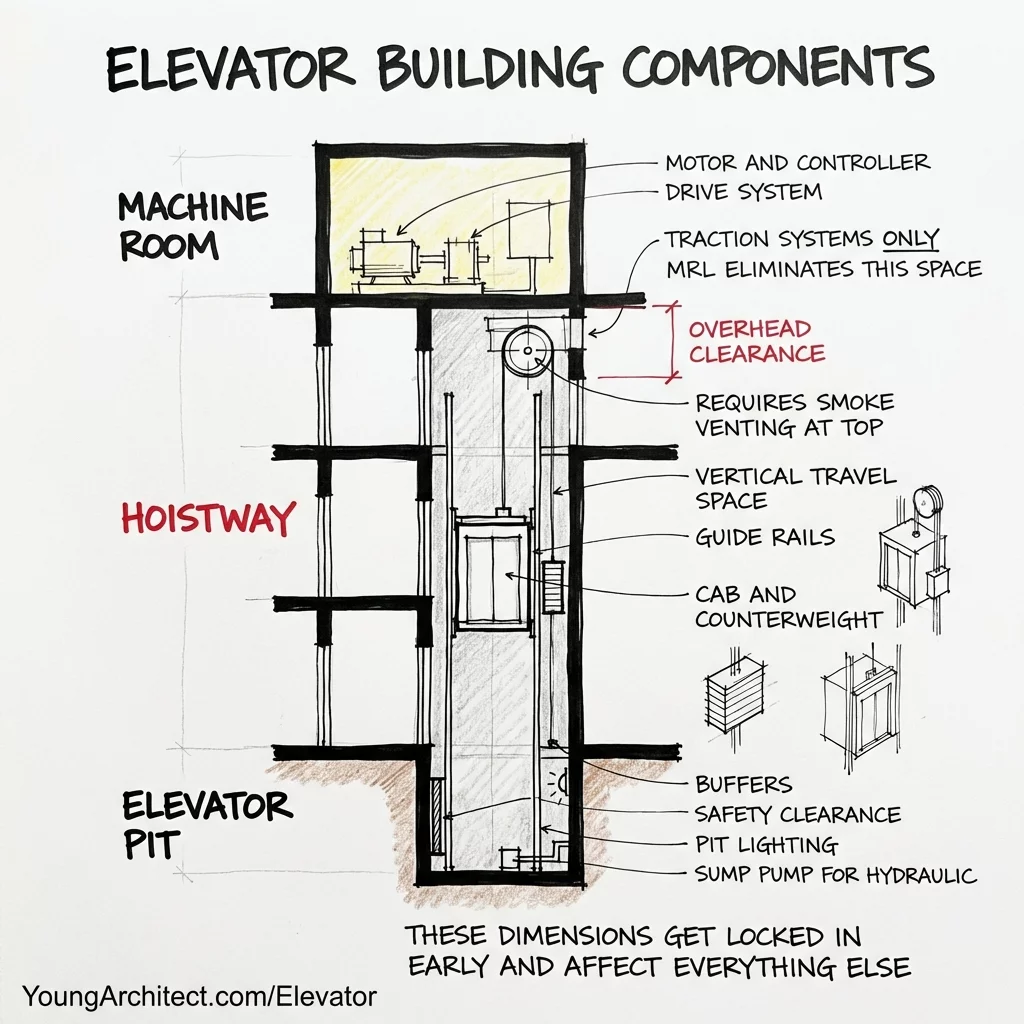
Elevator hoistway. The elevator hoistway (also called the shaft) is the vertical enclosure that the cab travels through. It runs the full height of the building and must be sized to accommodate the cab, guide rails, counterweights, and minimum clearances required by code. Hoistway dimensions get locked in early because they directly affect the structural system and floor plate layout.
Because hoistways act as vertical chimneys during a fire (the stack effect), building codes require hoistway venting at the top of the shaft to let smoke escape. Elevators also require overhead clearance (over-travel space) above the highest landing for safety mechanisms. If you’re designing a building with a strict zoning height limit or a sloped roof, forgetting to account for this overhead clearance can derail your top-floor ceiling heights.
Elevator pit. The elevator pit is the space below the lowest floor level. It provides a buffer zone for the cab to stop safely and houses buffers, pit lighting, and emergency stop switches. Minimum pit depths vary by elevator type and speed.
For hydraulic elevators, pits also require sump pumps equipped with oil-water separators to prevent hydraulic fluid from entering the municipal sewer system during a leak or flood. This is the kind of cross-system coordination between architectural, plumbing, and mechanical disciplines that shows up on PPD and PDD.
Elevator machine room. The elevator machine room is the dedicated space that houses the motor, controller, and drive system. For traction systems it typically sits above the hoistway. For hydraulic systems it’s adjacent to the base of the shaft. MRL systems eliminate this room entirely, which is their biggest space-saving advantage.
Hydraulic Elevator: The Low-Rise Workhorse
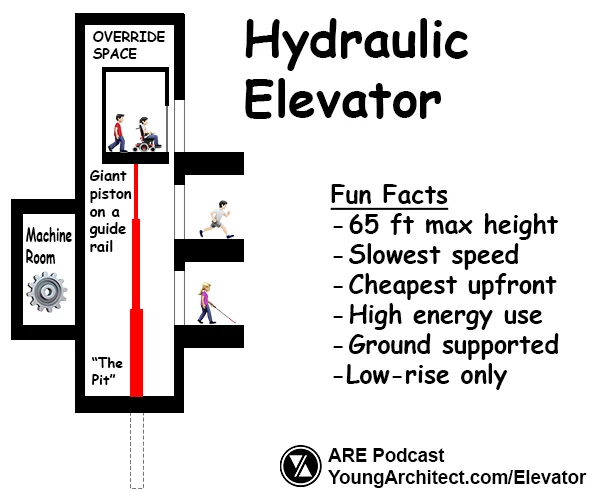
The hydraulic elevator is the workhorse of the elevator world. Reliable and cost-effective for the right applications. Think of it like a pickup truck: powerful, practical, not fancy, but it gets the job done for smaller loads and shorter distances.
Key specifications:
- Height limit: 65 feet (4-5 stories)
- Speed: Up to 200 feet per minute
- Cost: Most economical initial installation
- Energy: Higher operating costs over lifetime
Best applications:
- Low-rise buildings (offices, apartments, retail)
- Freight elevators and service elevators
- Theaters, parking garages, accessibility lifts
Advantages:
- Simple and compact design
- Load carried by ground, not building structure
- Less structural reinforcement needed
- Can be manually lowered during power failures
Disadvantages:
- High energy consumption
- Poor efficiency compared to traction systems
- Potential environmental concerns with fluid leaks
- Noise from pump and piping
Three main variants:
- Plunger-type – traditional design requiring a deep shaft drilled into the ground
- Hole-less – telescoping jack mounted inside the pit for sites where drilling is impossible (high water table, bedrock, contaminated soil)
- Roped hydraulic – hybrid approach combining hydraulic power with cables
If you’re designing a small building with just a few floors, hydraulic is often the way to go. Just remember to account for machine room space and consider long-term operating costs!
Traction Elevator Systems: Mid-Rise to High-Rise Performance
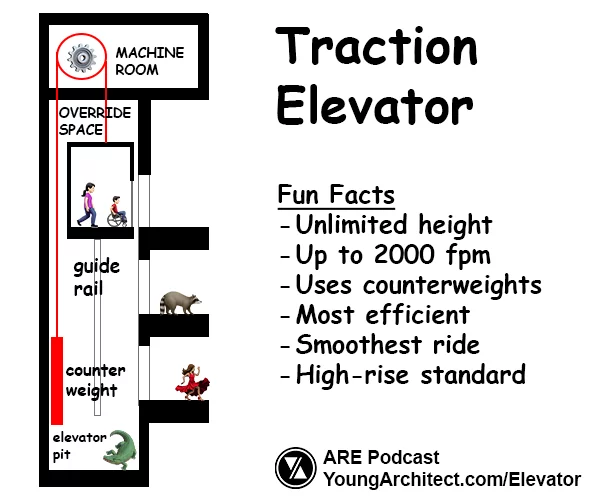
A traction elevator uses steel cables (or belts) wrapped around a motor-driven sheave to move the cab up and down. What makes traction systems efficient is the elevator counterweight.
The elevator counterweight is a weighted assembly that travels on the opposite side of the cable from the cab. It’s sized to balance the weight of the cab plus roughly 40-50% of the cab’s rated load. That means when a fully loaded cab is going up, the counterweight is going down and doing a significant portion of the work for the motor. This balance is what makes traction systems dramatically more energy-efficient than hydraulic systems over the life of the building.
Unlike hydraulic elevators where the load is carried by the ground, traction systems hang from the top. The roof structure or penthouse floor must be designed to carry the dead load of the cab, counterweights, and machinery, plus live loads. That’s a structural coordination conversation that needs to happen early in design.
Traction elevators come in two main varieties: geared and gearless systems.
Geared Traction Elevator: Mid-Rise Performance
A geared traction elevator uses a gear reduction system to balance speed and power. Think of it like a bicycle with multiple gears: mechanical advantage lets a smaller motor move heavier loads.
Specifications:
- Height limit: Up to 300 feet (30 stories)
- Speed: 150-450 feet per minute
- Applications: Mid-rise buildings
Control types:
- Thyristor – medium cost, good performance
- VVVF – high performance, excellent control, higher cost
Gearless Traction Elevator: High-Rise Performance
A gearless traction elevator connects the motor directly to the sheave with no gear reduction. Think of it like a high-speed train: designed for long distances at impressive speeds with smooth rides.
Specifications:
- Height limit: Unlimited
- Speed: Up to 2000 feet per minute
- Applications: High-rise buildings, luxury installations
Gearless traction elevators are the Ferraris of the elevator world. Smooth, fast, and built for the long haul.
Advantages of traction systems:
- Better ride quality (smoother and quieter)
- Higher efficiency due to counterweight balance
- Longer lifespan than hydraulic systems
- Regenerative drives can feed electricity back into the building when descending
Disadvantages:
- Higher initial cost
- Greater structural requirements that vary by IBC construction types and fire ratings
- Building must support elevator system and counterweights from above
If your building is over five stories or you need faster speeds, traction is probably your best bet. Just be prepared for that higher upfront cost!
Machine Room-Less (MRL) Elevator: Space-Saving Innovation
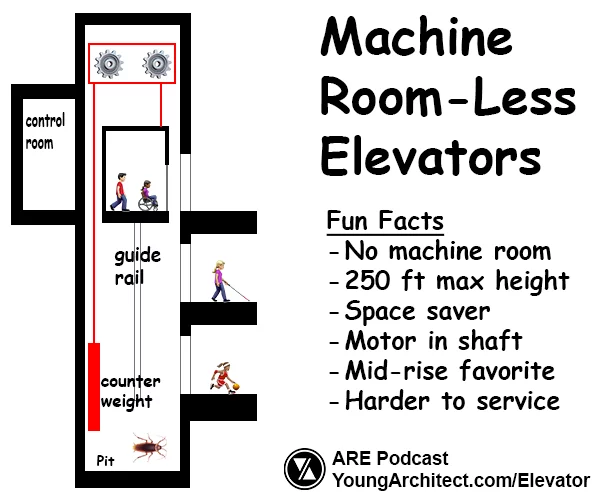
The MRL elevator is the space-saving solution that building owners love. Think of MRLs as compact all-in-one printers: they pack all the functionality into a smaller footprint through clever integration.
How they work: The elevator motor is mounted within the hoistway rather than in a separate elevator machine room. A machine room less elevator uses traction technology but eliminates the dedicated penthouse space entirely.
Specifications:
- Height limit: Up to 250 feet (20-25 stories)
- Speed: Up to 500 feet per minute
- Cost: Medium to high initial costs
Biggest advantage: Space utilization. Eliminates the penthouse machine room, reducing overall building height and freeing up roof space for other uses.
Considerations:
- Maintenance can be more complex due to confined equipment access
- Some jurisdictions have special requirements for control access
- Code requirements vary widely for these newer systems
- While MRLs eliminate the penthouse room, code still requires a dedicated, fire-rated control space (usually a closet near the top landing) for the controller panels. Architects often miss this during design and have to carve space out of a finished corridor later.
If you’re working on a mid-rise project where space efficiency is a priority, MRL systems deserve serious consideration. Just verify local code requirements early in design!
Fire Safety and Emergency Protocols for Elevator Systems
This is where things get serious. We’re talking life safety here.
ADA Requirements:
The ADA establishes minimum elevator cab dimensions based on door type and configuration. Rather than a single fixed size, Table 407.4.1 in the accessibility standards provides different minimum dimensions depending on whether the elevator has center-opening or side-opening doors. You can find the full technical specifications in the U.S. Access Board’s elevator accessibility requirements.
Additional ADA requirements include:
- Control panels mounted between 15 and 48 inches above the floor
- Raised characters and Braille on all control buttons
- Audible signals and visual floor indicators required
- Door clear widths of at least 36 inches
For the ARE, understand the concept of how door configuration drives cab dimension requirements and know where to find the table. NCARB tests your ability to navigate the standard, not memorize exact inches.
Five-Step Fire Emergency Protocol:
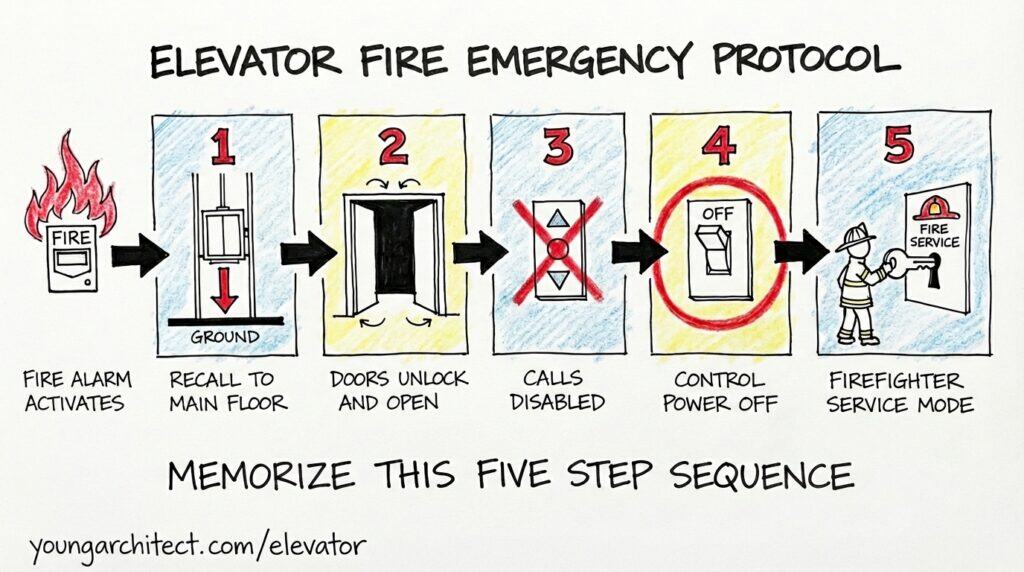
When a fire alarm activates, elevators execute this mandatory sequence:
- Recall to designated floor (usually main exit level)
- Unlock and open doors upon arrival
- Disable call registration (elevator can’t be summoned)
- Deactivate control power (prevents normal operation)
- Enable firefighter’s service mode (emergency personnel control)
The number of elevators required, whether they need to be sized for an ambulance stretcher, and standby power requirements are all heavily influenced by building occupancy classifications and use groups. A hospital has drastically different elevator requirements than an office building.
Key Code References:
- ASME A17.1/CSA B44 – Safety Code for Elevators and Escalators
- IBC Chapter 30 – Elevators and Conveying Systems
- NFPA 72 – Fire alarm interface requirements
This code knowledge impacts early design decisions and shows up on the PA exam! Master code navigation with our Building Codes 101 course. Consider space allocation, structural support, and emergency access and egress planning from the beginning.
Getting these elements right from the start saves massive headaches later and potentially saves lives in emergencies.
Common Elevator Design Mistakes and How to Avoid Them
Don’t be that architect who treats elevators as an afterthought! Here are the biggest mistakes that can derail your project:
Space Planning Errors:
- Underestimating shaft size, pit depth, and overhead clearance affects gross and net building area calculations
- Inadequate structural support planning
- Forgetting about machine room space requirements
- Insufficient lobby space for peak traffic times
System Selection Mistakes:
- Choosing hydraulic for buildings over 5 stories
- Mixing up speed capabilities between elevator types
- Overlooking emergency power requirements for fire service
- Not considering long-term energy costs
Coordination Challenges:
- Structural conflicts: some systems need top support, others bottom support
- Mechanical space battles: ductwork vs elevator shafts
- Electrical load miscalculations: elevators are power-hungry
- Poor planning for future modernization needs
ARE Exam Traps:
- Confusing MRL capabilities with traditional systems
- Forgetting fire safety protocol requirements
- Misunderstanding building height limitations for each type
Simple rule for the ARE: Hydraulic for low, traction for high, and always consider traffic flow!
Avoiding these issues requires good project management from the very beginning. Plan early, coordinate often through quality assurance and control processes, and don’t treat elevators as an afterthought!
Elevator Selection Guide: Choosing the Right Type for Your Project
Think of elevator selection like choosing the right vehicle for a road trip. You wouldn’t take a sports car camping or a moving truck to pick up groceries.
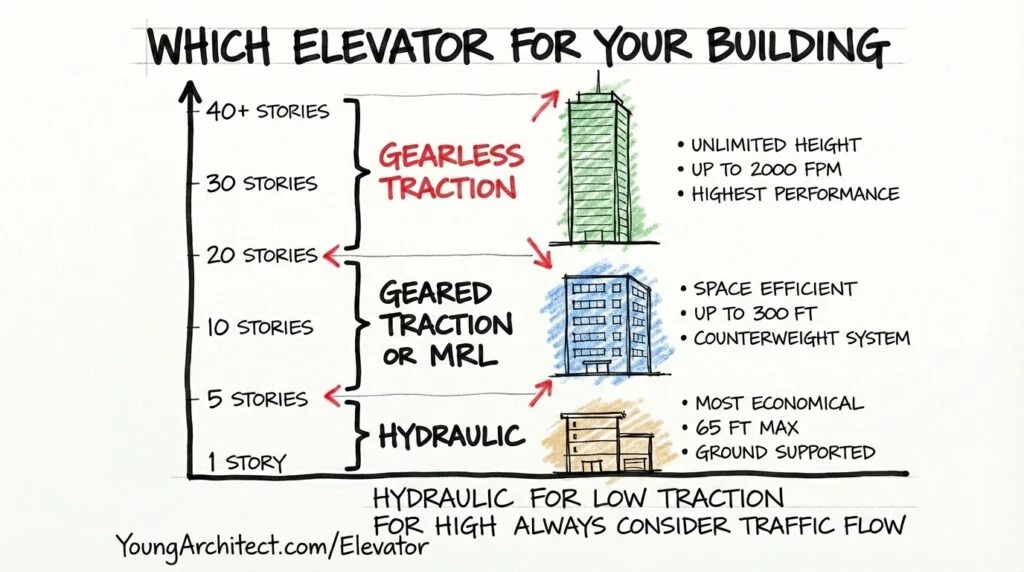
Building Height Decision Matrix:
- 1-4 stories: Hydraulic is usually most economical
- 5-20 stories: Consider geared traction or MRL systems
- 20+ stories: Gearless traction systems required
Other Key Factors:
Traffic Analysis: How many people need to move and when? Busy office buildings have different needs than low-traffic warehouses. Peak usage during morning and evening rushes dramatically affects system requirements.
Budget Planning: Consider both initial and lifecycle costs in your construction budget planning for hard and soft costs. Hydraulic might be cheaper upfront, but energy costs add up over decades.
Energy Efficiency: Traction systems with regenerative drives can feed power back into the building when descending.
Structural Coordination: Your elevator choice affects foundation design and structural system decisions from day one. Hydraulic systems load the ground; traction systems load the roof structure. That conversation needs to happen early.
Future Planning: Elevators need updates every 20-25 years. Planning for modernization from the beginning saves major headaches during project closeout and evaluation phases.
The key is matching your elevator choice to your building’s specific needs, not just going with what’s cheapest or what the contractor suggests.
Frequently Asked Questions About Elevator Types
What are the three main types of elevators?
The three main types are hydraulic elevators, traction elevators, and machine room-less (MRL) elevators. Hydraulic systems use fluid pressure and a piston to lift the cab, making them ideal for low-rise buildings up to about 65 feet. Traction elevators use cables and an elevator counterweight for mid to high-rise buildings with no height limit on gearless systems. MRL elevators use traction technology but mount the motor inside the hoistway, eliminating the need for a separate machine room.
What is a hydraulic elevator and when is it used?
A hydraulic elevator uses a fluid-powered piston (called a plunger) to raise and lower the cab. It’s the most economical option for low-rise buildings of 4 to 5 stories and is commonly used in small office buildings, retail spaces, accessibility lifts, and freight applications. The trade-off is higher energy consumption compared to traction systems over the building’s lifetime.
What is an elevator hoistway?
An elevator hoistway (also called the shaft) is the vertical enclosure that the elevator cab travels through. It runs the full height of the building and must be sized to accommodate the cab, guide rails, counterweights, and code-required clearances. Hoistway dimensions are determined early in design because they affect the structural system and floor plate layout.
What is a machine room less elevator?
A machine room less elevator (MRL) places the motor and drive system inside the hoistway rather than in a separate penthouse machine room. This frees up roof space and reduces overall building height. MRL systems are a popular choice for mid-rise buildings up to about 250 feet where space efficiency matters. The trade-off is that maintenance access is more constrained, and code still requires a fire-rated control closet near the top landing.
What are the ADA requirements for elevators?
The ADA requires elevators in multi-story buildings (with limited exceptions) and establishes minimum cab dimensions based on door type and configuration per Table 407.4.1. Additional requirements include controls mounted between 15 and 48 inches above the floor, raised characters and Braille on all control buttons, door clear widths of at least 36 inches, and audible and visual floor indicators. The 2010 ADA Standards for Accessible Design provide the full technical specifications.
Types of Elevators on the ARE Exam: What You Need to Know
Understanding elevators is crucial for passing multiple ARE divisions. Here’s how elevator knowledge shows up:
Programming & Analysis (PA):
- Early planning implications and cost considerations covered in our PA 101 course
- Space programming and budget allocations
- Accessibility compliance requirements
- Initial programming decisions affect entire elevator design
Project Planning & Design (PPD):
- System selection criteria and capabilities covered comprehensively in our PPD 101 course
- Integration with building mechanical systems including HVAC and plumbing coordination
- Understanding which system works for different building types and heights
Project Development & Documentation (PDD):
- Technical requirements and code compliance
- Coordination with structural systems
- Fire safety requirements and specifications
Key Study Tips:
- Create flashcards with elevator types, height limits, and speed capabilities as part of your realistic ARE study schedule and timeline
- Practice identifying appropriate systems for different building scenarios using multiple learning approaches and study methods
- Memorize the five-step fire safety protocol
- Understand ADA requirements for elevator accessibility
Common Exam Traps:
- Confusing MRL capabilities with traditional machine room systems
- Forgetting emergency power requirements for fire service
- Mixing up speed capabilities between different elevator types
- Not understanding the relationship between building height and elevator type
Memory Device: Hydraulic for low, traction for high. That rule alone eliminates wrong answers quickly!
Ready to master this content? Our ARE 101 courses include elevator system coverage with practice questions designed around NCARB’s exam objectives.
Conclusion: Mastering Elevator Systems for Success
Alright, we’ve covered a lot of ground. Or should I say, a lot of vertical distance!
Here’s what you need to remember about the different types of elevators:
Hydraulic elevators are your economical workhorses for low-rise buildings up to 65 feet. They’re simple, compact, but have higher energy costs over time.
Traction elevators come in geared and gearless varieties. Geared systems work well for mid-rise buildings up to 300 feet, while gearless systems can handle unlimited height with superior performance.
Machine room-less (MRL) elevators save space by integrating machinery into the hoistway, perfect for mid-rise buildings where space efficiency matters.
Remember the fire safety protocols. That five-step emergency sequence could easily show up on your ARE exam. And don’t forget about ADA requirements and proper space planning.
Your elevator choices impact everything from the building structure to the user experience. Getting it right from the start saves headaches later. Whether you’re studying for the ARE or designing your next building, understanding these systems is crucial for success.
Ready to master building systems and pass your ARE exams? Check out our ARE Boot Camp for comprehensive exam preparation with personalized guidance, or explore our ARE 101 courses for in-depth coverage of elevator systems and other critical building technologies.
Next time you’re riding in an elevator, take a moment to think about all the engineering and planning that went into making that smooth vertical journey possible. Pretty amazing when you think about it!
Elevator Quiz Time:
Prove You Were Paying Attention
Comprehension Quiz: Types of Elevators
Ready to test what you learned? This 10-question quiz covers the key concepts from the podcast episode and blog post above.
• All answers revealed at completion
• Perfect for ARE exam prep
• Option to get the quiz questions, answers and explanations emailed for further study
We're processing your score right now...
After you see your score, you can request the full quiz questions, answers and explanations.