

Construction contingency is a reserve of money or time set aside to cover unexpected costs and unknown risks on a construction project. Learn what contingency means in construction, how to calculate the right percentage by project phase, the different types every project team member needs, and how smart contingency planning protects your projects from budget disasters.
This podcast is also available on YouTube, Spotify, and Apple Podcasts
What Is Contingency in Construction?
At its core, a construction contingency is a financial reserve set aside to cover unexpected costs or unknown risks. If something goes wrong on your project, you have funds to deal with it because the contingency budget was already included in the original project budget.
But here’s what a lot of people miss. Contingencies don’t always have to be about money.
They can also apply to time and schedule.
Let’s say your client needs to move into their new building in 12 months. That doesn’t mean the contractor gets the full 12 months to finish the work.
You build in a schedule contingency, maybe telling the contractors they have eight or nine months for construction. That leaves wiggle room for construction delays, approvals, or last-minute issues.
The idea is the same whether you’re talking about dollars or days. You’re creating a buffer between what you expect to happen and what actually happens.
A Simple Analogy
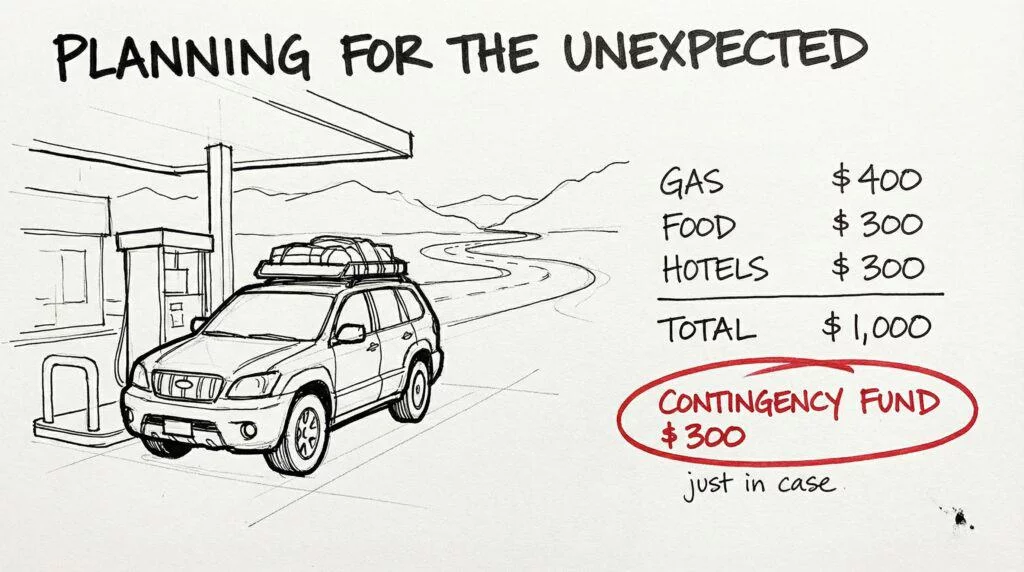
Say you’re planning a long road trip. You figure out gas, food, and lodging will run about $1,000. Do you bring exactly $1,000?
No way Dude.
You set aside a few extra hundred dollars in case gas prices go up, or you decide to spend an extra night somewhere, or something unexpected happens.
That extra cash? That’s your contingency fund. You don’t plan on spending it. But if something goes sideways, you’ll be really glad it’s there.
That’s exactly how a construction contingency works. You’re not planning to use it. You’re planning to have it available when the unexpected hits. And on a construction project, the unexpected always hits.
Construction Contingency vs Allowance: What’s the Difference?
This is one of the most commonly confused concepts in construction budgeting, and it shows up regularly on the Architect Registration Exam.
Here’s the simple breakdown:
An allowance is money set aside for a known item with an unknown cost. You know the client needs light fixtures, but they haven’t picked them out yet. So you include a $5,000 allowance in the budget to cover that selection.
A contingency is money set aside for unknown items or unknown risks. You don’t know what will go wrong. You just know that something will.
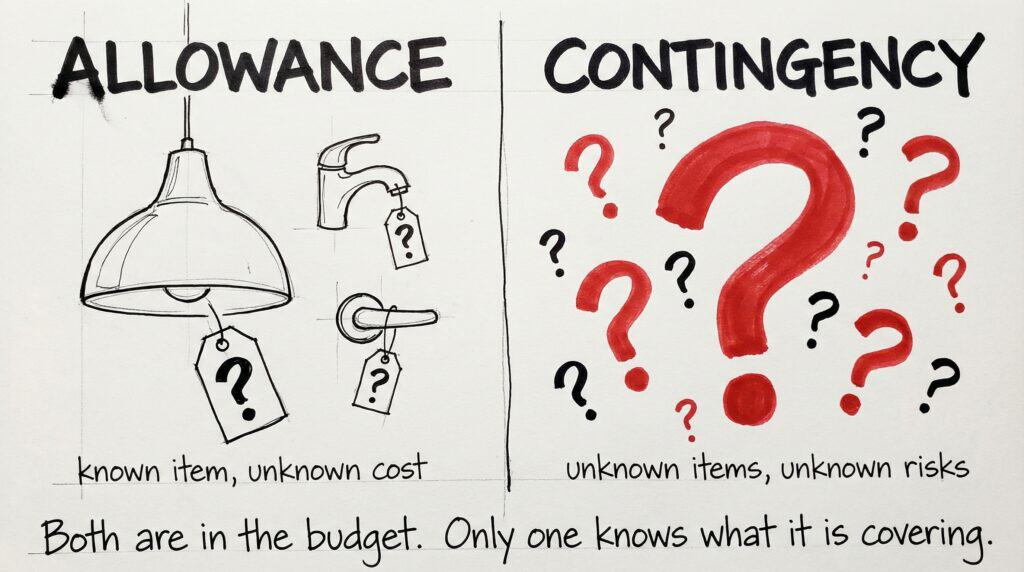
An allowance covers the things you can see coming but haven’t priced yet.
A contingency covers the things you can’t see coming at all.
Both are critical tools in a well-managed construction budget. Understanding the difference between them is essential for the Practice Management exam. For more on how AIA contracts address this distinction, check out AIA’s guidance on managing contingency allowances.
Contingency vs Management Reserve: What’s the Difference?
Here’s another comparison that trips people up on the ARE.
A contingency covers identified risks. These are problems you can anticipate even if you don’t know exactly when or how they’ll show up. Underground utilities, weather delays, material price swings. You know these things could happen, so you plan for them.
A management reserve covers unidentified risks. These are the things you didn’t even think to plan for. The surprises that weren’t on anyone’s radar.
In practice, the owner’s contingency often functions as both on smaller projects. On larger public projects, they may be separate budget line items. Accessing a management reserve typically requires formal approval, like a board or council vote, because it represents money that wasn’t part of the original approved budget.
One thing worth knowing for the exam: the term “management reserve” comes from PMI/PMBOK project management frameworks, not AIA contract documents. Don’t panic if you don’t see it printed in the A201. The concept is universal even if the exact label isn’t.
Understanding this distinction is one of those project contingency concepts that separates candidates who just memorized definitions from candidates who actually understand how budgets work in the real world.
Types of Construction Contingency
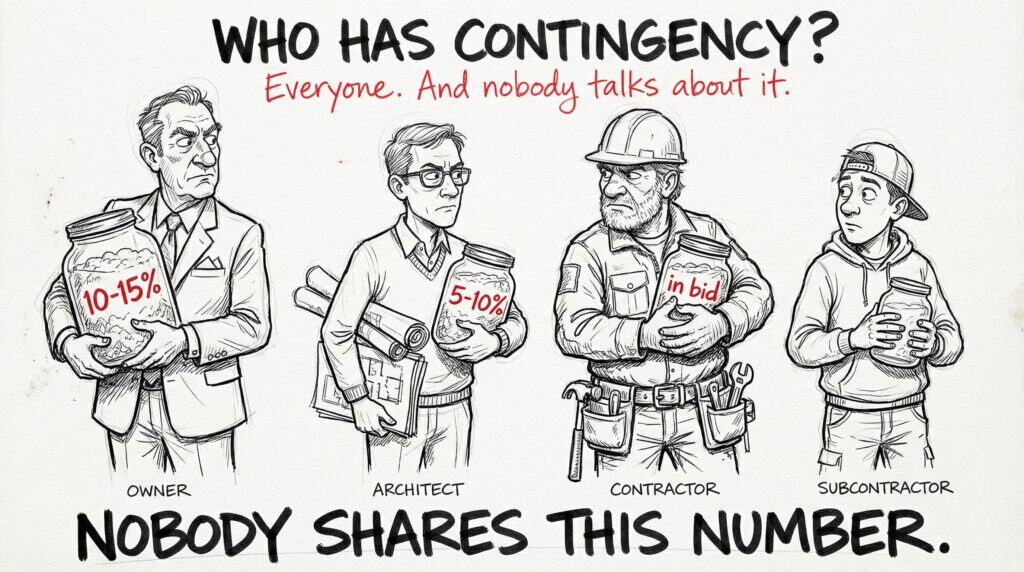
Here’s something that surprises a lot of people studying for the architect exam. It’s not just one big pot of contingency money sitting on a project.
Every member of the project team should have their own contingency to protect against their specific risks.
Owner’s Contingency
The owner’s contingency is the reserve the building owner sets aside for their own risks. This typically covers:
- Scope and design changes
- Unforeseen site conditions
- General budget overruns
Typical ranges: 10-15% for new construction, and 15-25% for renovation projects where unforeseen conditions are more likely.
On public projects, the owner’s contingency is often a formal budget line item that requires board or council approval to access. It can’t just quietly disappear mid-project.
Many owners keep their contingency amount private. They don’t want the contractor or architect to know exactly how much extra money is available, because that knowledge can influence spending behavior. Having a contingency isn’t a sign of poor planning. It’s a sign of realistic planning.
Design Contingency
The design contingency is a portion of the architect’s fee set aside for unexpected redesign work, consultant coordination issues, or errors and omissions in the construction documents.
Design contingency typically runs 5-10% of the architect’s fee. It covers more than just redesign. It also absorbs:
- Additional code review rounds
- Responding to agency comments during permitting
- Coordination issues between structural and MEP consultants that require drawing revisions
Understanding the standard of care is directly connected here. Errors and omissions that exceed what a reasonably competent architect would produce can create liability that even design contingency can’t fully absorb.
Contractor Contingency
The contractor contingency is usually built right into the bid. Contractors use it to cover:
- Cost fluctuations and material delays
- Minor change orders
- Anything missed during the estimating process
Experienced contractors know that no set of construction documents is perfect. Their contingency accounts for the gap between what the drawings show and what actually happens in the field. That includes gaps discovered during the construction submittals process, when fabrication drawings often reveal coordination issues that weren’t visible in the contract documents.
For a deeper look at how contractors approach this, the contractor contingency considerations from ConsensusDocs is worth a read.
Subcontractor Contingency
Subcontractors also carry their own contingencies, typically to account for:
- Labor shortages
- Material price swings
- Coordination issues with other trades on the project
Schedule Contingency
We touched on this in the intro, but it deserves its own section. Contingency isn’t only about money.
Schedule contingency is a time buffer built into the project timeline to absorb delays. Here’s how it works in practice:
If a school needs to open in September, you tell the contractor the building needs to be ready by July. That two-month gap is schedule contingency. It absorbs weather delays, inspection backlogs, late equipment deliveries, and other disruptions without blowing the real deadline.
In formal project scheduling, this connects to float, which is the amount of time an activity can slip before it affects the critical path. Schedule contingency is what protects the critical path from shifting when delays start stacking up. When schedule contingency runs out, you’re officially in the danger zone.
This is also where liquidated damages become relevant. If the contractor blows past the contract completion date, pre-agreed daily penalties kick in.
Hard Cost Contingency vs Soft Cost Contingency
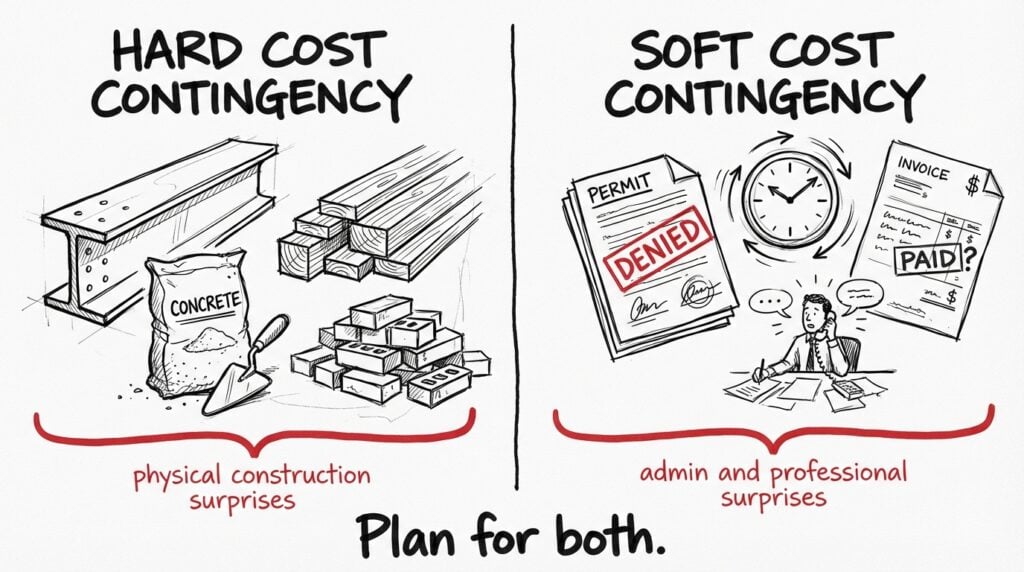
You’ll also hear contingency in construction described in terms of hard costs and soft costs.
A hard cost contingency covers unexpected expenses related to physical construction work. Think material price increases, unforeseen site conditions, or structural surprises.
A soft cost contingency covers unexpected expenses on the administrative and professional services side. Think permitting delays, additional consultant fees, or extended project timelines that increase overhead.
Both are important. Both need to be planned for. Understanding this distinction is a key concept for PcM 101 exam prep, where cost management and risk planning are heavily tested.
The Unspoken Reality
Here’s something they don’t really teach you in school. Most of the time, the contingencies that all these different parties carry aren’t openly discussed or shared with each other.
Everyone on the project team is quietly protecting themselves.
And once the project wraps up? Unused contingency funds either go back into the pot or they become additional profit. That’s just how it works.
Construction Contingency Examples: Real-World Scenarios
Theory is great, but let’s talk about what contingency in construction actually looks like when it gets used.
Scenario 1: The Asbestos Discovery. A contractor opens up walls during a school renovation and finds asbestos-containing materials behind the drywall. Nobody saw it coming. The abatement work adds $80,000 to the project cost and two weeks to the schedule. The owner’s contingency absorbs the cost. Without it, the project would have gone over budget before the new walls even went up.
Scenario 2: The Rain Delay. A concrete pour gets delayed three times by back-to-back rain events. The contractor’s general conditions costs keep running. Superintendent time, equipment rental, temporary facilities. The contractor’s contingency covers the extended overhead while the project waits for a weather window. This is exactly what that reserve was built for.
Scenario 3: The Coordination Miss. A mechanical engineer designs ductwork that runs straight through the structural steel framing. Nobody caught it during document coordination. The contractor raises it through an RFI, the duct layout needs to be redesigned, and the structural drawings need revision. The design contingency absorbs the extra hours without blowing up the architect’s fee structure.
Scenario 4: The Scope Creep Spiral. A retail client keeps making small changes during construction. Relocated partitions here, upgraded finishes there, a last-minute storefront addition. Each change is small, but collectively they add up to $120,000 in project contingency draw-down. The owner’s contingency was sized for exactly this kind of gradual scope expansion.
These aren’t edge cases. They’re Tuesday on a real project.
Construction Contingency Percentage: How Much Should You Set Aside?
This is probably the most common question I get about contingency. And the honest answer is: it depends.
But before you throw something at your screen, let me give you some real guidance.
The Golden Rule
The less confidence and information you have, the higher your construction contingency percentage should be.
At the start of a project, almost everything is unknown. The design isn’t done. Material costs aren’t finalized. Site conditions haven’t been fully assessed. The contingency percentage needs to be much larger because the risks are much higher.
As the project moves forward, details get locked in. Materials are selected. The construction team is on board. The methodology is finalized. Risks start to decrease, and the contingency reserves can be reduced along with them.
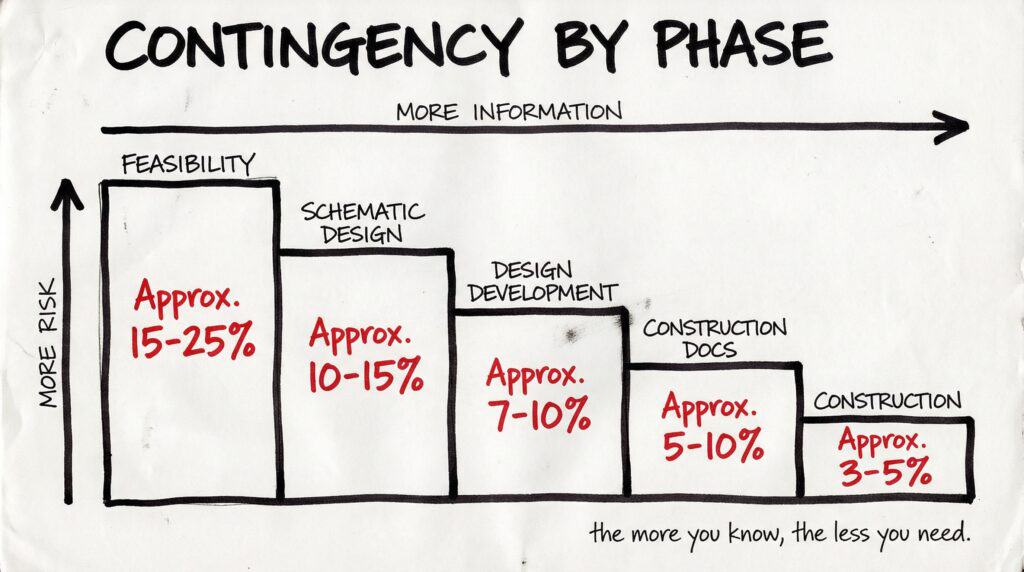
Typical Contingency Percentages by Project Phase
- Early Conceptual/Feasibility Phase: 15-25% (sometimes higher for complex projects)
- Schematic Design: 10-15%
- Design Development: 7-10%
- Construction Documents: 5-10%
- During Construction: 3-5%
These aren’t hard rules. A straightforward new commercial building might be on the lower end. A historic renovation with unknown site conditions might need percentages well above these ranges.
Contingency decreases as project information increases. The more you know, the less you need to protect against. This is directly connected to how construction cost estimates evolve and become more accurate at each phase of design.
The 20-Minute Cost Estimate Story
When I worked for the government, politicians would occasionally call and say, “What would it cost to build a new fire station? I need an answer in 20 minutes for my budget meeting.”
Then they’d quickly hang up.
Here’s how you do a 20-minute cost estimate:
Pull financial data from the last similar project. Add up construction costs, soft costs, land acquisition, permits, and fees. Then double, triple, or even quadruple it based on the massive amount of unknowns. If it still feels low? Add another 20-40%.
That number was basically all contingency with a little bit of data mixed in. And that was perfectly fine for what it needed to be at that stage.
It is always better to have extra funds set aside than to scramble for more when problems start showing up.
How to Determine the Right Construction Contingency
The most effective approach is a systematic one tied directly to risk management. This shows up frequently on the Project Management (PjM) exam, and more importantly, it’s a skill that will serve you throughout your entire career.
Step 1: Identify the Construction Risks
Start with a brainstorm. Before any work has been done, think through every potential problem. What could go wrong with the construction budget? What about the project timeline? Are there potential unforeseen conditions on the site?
Could there be permitting or regulatory delays? What about design changes or scope modifications? The more honest you are about potential risks, the better prepared you’ll be.
Step 2: Plan Solutions Before They Become Problems
While you’re identifying risks, also think about solutions. How do you address these risks before they turn into expensive problems?
Maybe it’s a budget adjustment. Maybe it’s an early conversation with stakeholders about realistic expectations. Maybe it’s building a schedule buffer into the construction timeline. Or maybe it’s setting aside a specific reserve for hazardous materials that might turn up when the contractor opens existing walls.
On projects where schedule risk is high, think early about delay-related costs like liquidated damages. If the contract includes them, the project contingency needs to account for the possibility of paying them.
Every risk you plan for is a crisis you potentially avoid. For a broader framework on how contractors approach this, the Associated General Contractors’ risk management resources are a solid reference.
Step 3: Track and Update Continuously
As the project progresses, continuously track and update your understanding of the risks. New information comes in on every project. Revisit your risk list regularly and adjust the contingency budget accordingly.
If the project still has a lot of uncertainties, keep the contingency fund high. If risks are getting under control, start scaling it back.
This approach directly connects to how construction claims and disputes develop. Projects that identify and plan for risks early are far less likely to end up in costly disputes later. It also ties into why architect insurance exists. Even the best risk planning can’t eliminate every unforeseen condition.
Who Uses Construction Contingency?
The short answer? Everyone.
Every person and entity involved in a construction project should have some form of project contingency to protect themselves from their specific risks.
Owners need contingency for scope changes and budget overruns. Architects need it for redesign work and coordination issues. Contractors need it for material delays and cost fluctuations. Consultants need it for unexpected additional work. Subcontractors need it for labor and material surprises.
The dynamic is different depending on whether you’re working on a public project or a private project. Public projects often have more rigid contingency requirements and transparent budgeting. Private clients might have more flexibility but less formal documentation.
On public projects, construction bonds are another layer of financial protection that works alongside the owner’s contingency to manage risk exposure.
Understanding how all these different contingencies interact on a real project is one of those things that separates someone who just passes tests from someone who actually understands how the industry works. That’s a huge focus of the ARE Boot Camp coaching program, where we connect exam concepts to real-world practice.
Construction Contingency and the ARE Exam
If you’re studying for the architect licensing exams, contingency planning shows up across multiple divisions:
Practice Management (PcM) tests your understanding of financial planning, risk management, and how contingencies protect the firm’s profitability.
Project Management (PjM) covers how contingencies are managed throughout the project lifecycle, from early budgeting through construction administration.
Construction & Evaluation (CE) deals with how contingencies get used during the preconstruction phase and throughout construction when change orders start eating into project budgets.
Programming & Analysis (PA) touches on contingency in the context of early project feasibility and cost planning.
The exam won’t just ask you to define contingency. It will ask you to apply it. You might get a scenario where a project is over budget and need to decide what to recommend. Or you might need to evaluate whether a contingency percentage is appropriate for a specific project phase.
The best way to prepare is to understand the underlying principles, not just memorize numbers. If you understand that contingency decreases as information increases, you can answer almost any question they throw at you.
Check out PcM 101 and PjM 101 for deep dives into project management and risk strategies. Or browse all our courses at the ARE 101 Course Membership. For a comprehensive study approach that connects all six exams together, the ARE Boot Camp provides the roadmap and accountability to get you across the finish line.
FAQ: Construction Contingency Questions Answered
What is contingency in construction?
A construction contingency is a reserve of money or time set aside in a project budget to cover unexpected costs or unknown risks. It acts as a financial buffer that keeps projects moving when surprises happen, which they always do.
What is a typical construction contingency percentage?
It depends on the project phase. Early in a project, contingencies typically range from 15-25% of the estimated cost. By the time construction documents are complete, contingencies usually drop to 5-10%. During active construction, 3-5% is common. The more information you have, the lower the percentage needs to be.
What is the difference between a contingency and an allowance?
An allowance is money set aside for a known item with an unknown cost, like light fixtures that haven’t been selected yet. A contingency is money set aside for completely unknown items or risks that haven’t been identified yet.
What is an owner’s contingency?
The owner’s contingency is the financial reserve that a building owner maintains to cover unexpected project costs like scope changes, unforeseen site conditions, and budget overruns. Many owners keep this amount confidential to maintain leverage over project spending.
What is a design contingency?
A design contingency is a reserve within the architect’s fee structure that covers unexpected redesign work, consultant coordination problems, or errors and omissions in the construction documents.
What is the difference between a hard cost contingency and a soft cost contingency?
A hard cost contingency covers unexpected expenses related to physical construction, such as material price increases or unforeseen structural issues. A soft cost contingency covers unexpected administrative expenses like permitting delays, additional consultant fees, or extended project overhead.
How much contingency should a project have?
There’s no one-size-fits-all answer. The right amount depends on how much is known versus unknown about the project. A simple new construction project with complete documents might need 5%. A complex renovation with lots of unknowns might need 20% or more. Assess your risks and set your contingency accordingly.
What happens to unused contingency funds?
It depends on the contract structure and who holds the contingency. For owners, unused funds typically stay in the project budget and may be returned or reallocated. For contractors, unused contingency usually becomes additional profit.
Is 10% contingency enough?
It depends on where you are in the project. A 10% contingency is often appropriate during design development or construction documents. But it would be dangerously low during early feasibility, when unknowns are at their peak. And it might be unnecessarily high during active construction when most risks have been resolved.
Do contractors include contingency in their bids?
Yes. Experienced contractors almost always build some contingency into their bids to cover cost fluctuations, material delays, and items that may have been missed during estimating. This is separate from the owner’s contingency and is part of the contractor’s risk management strategy.
What is the difference between a contingency and a management reserve?
A contingency covers identified risks, meaning problems you can anticipate even if you can’t predict exactly when they’ll occur. A management reserve covers unidentified risks, meaning surprises that weren’t on anyone’s radar. In construction, the owner’s contingency often serves both purposes, but on larger projects they may be separate budget line items requiring different approval processes to access.
What is a contingency allowance?
A contingency allowance is a budget line item that combines elements of both contingency and allowance. It sets aside funds for work that is anticipated but not yet fully defined, such as unforeseen conditions discovered during renovation. The term appears frequently in AIA contracts and public project budgets.
Ready to Master Construction Project Management?
Construction contingency planning is one of those skills that architecture school doesn’t really teach you. You typically learn it through trial, error, and a few stressful projects that didn’t go according to plan.
But you don’t have to learn it the hard way.
If you’re preparing for the ARE, check out PcM 101 and PjM 101 for comprehensive strategies on risk management, cost control, and project delivery. For construction documentation expertise, explore CDT 101. Or browse all our ARE study materials to find the right course for where you are in your licensing journey.
Have questions? Reach out anytime at youngarchitect.com/chat.