
Choosing the right ARE 5.0 test order can save you hundreds of hours and thousands of dollars in retakes. The sequence you choose isn’t just about convenience – it’s about building the foundation knowledge that appears across all six NCARB’s ARE 5.0 divisions and setting yourself up for success throughout your entire licensing journey.
This podcast is also available on YouTube, Spotify, and Apple Podcasts
How Hard Can The ARE Really Be?!?
The reality is that you’re looking at 700 to 1,500 hours of studying, taking tests, retaking tests, and doing the work to pass all six ARE 5.0 divisions. Creating a realistic study schedule becomes critical when you’re managing this level of commitment alongside work and life responsibilities.
That’s why thousands of candidates choose structured coaching programs that break this massive project into manageable weekly steps rather than trying to figure it out alone.
This isn’t something you knock out in a few weekends. This is a massive project we’re talking about here.
I’m about to save you from the most expensive game of trial and error you’ll ever play, so let me be direct.
The Complete ARE 5.0 Test Order Strategy
This ARE 5.0 test order strategy works for about 95% of people taking NCARB’s ARE 5.0 exams. I’ve refined this approach through years of helping candidates navigate the licensing process and seeing what actually works in practice.
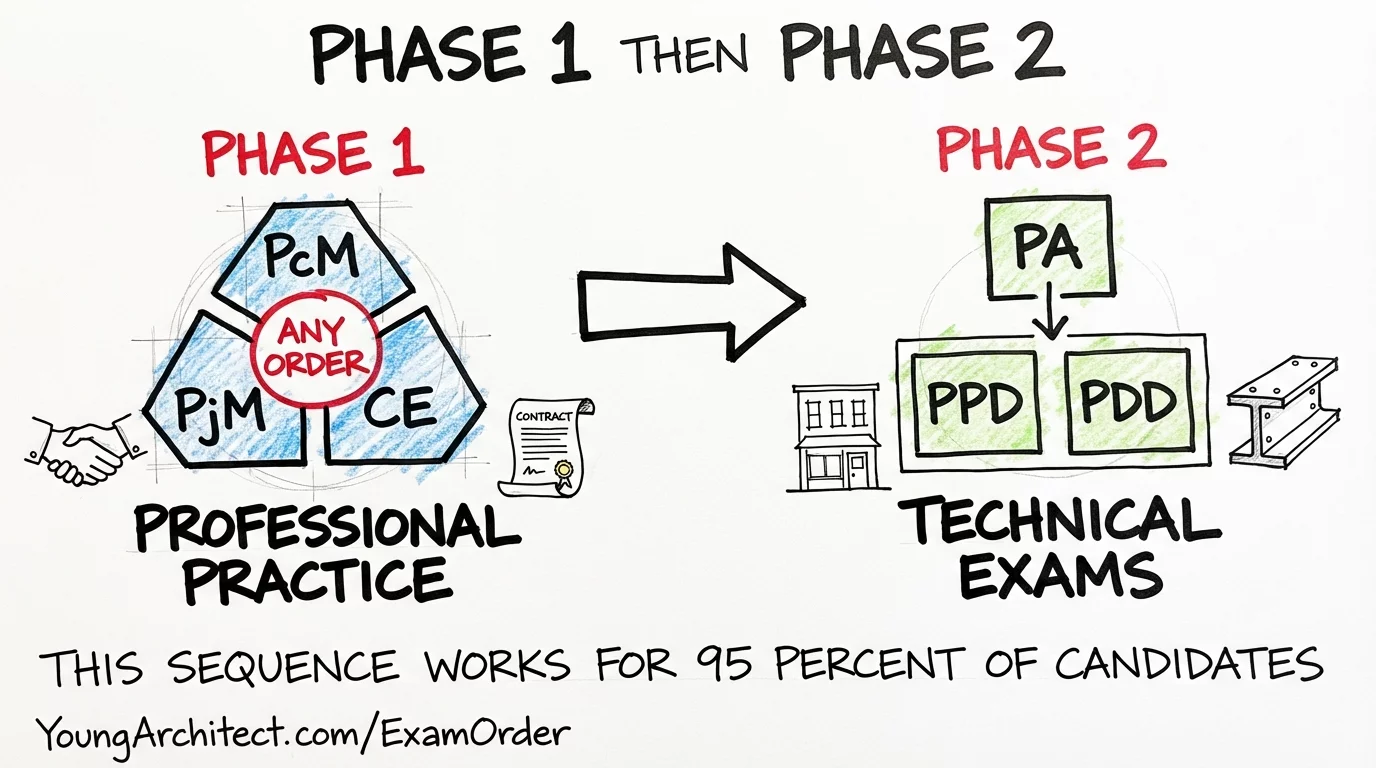
Phase 1: Professional Practice Exams (Complete First)
- Practice Management (PcM)
- Project Management (PjM)
- Construction Evaluation (CE)
The order of these three doesn’t matter.
Phase 2: Technical Exams
Immediately after completing the professional practice exams, take Programming and Analysis (PA) as the first technical exam. Study hard, take it once, and then move onto:
- Project Planning and Design (PPD)
- Project Development and Documentation (PDD)
After passing PPD/PDD, retake PA again if you didn’t pass it the first time.
This sequence is the most effective ARE 5.0 test order because it builds knowledge systematically rather than scattering your focus across unrelated topics. Next, let me explain why this approach works so well.
Understanding the Two Categories of ARE Exams
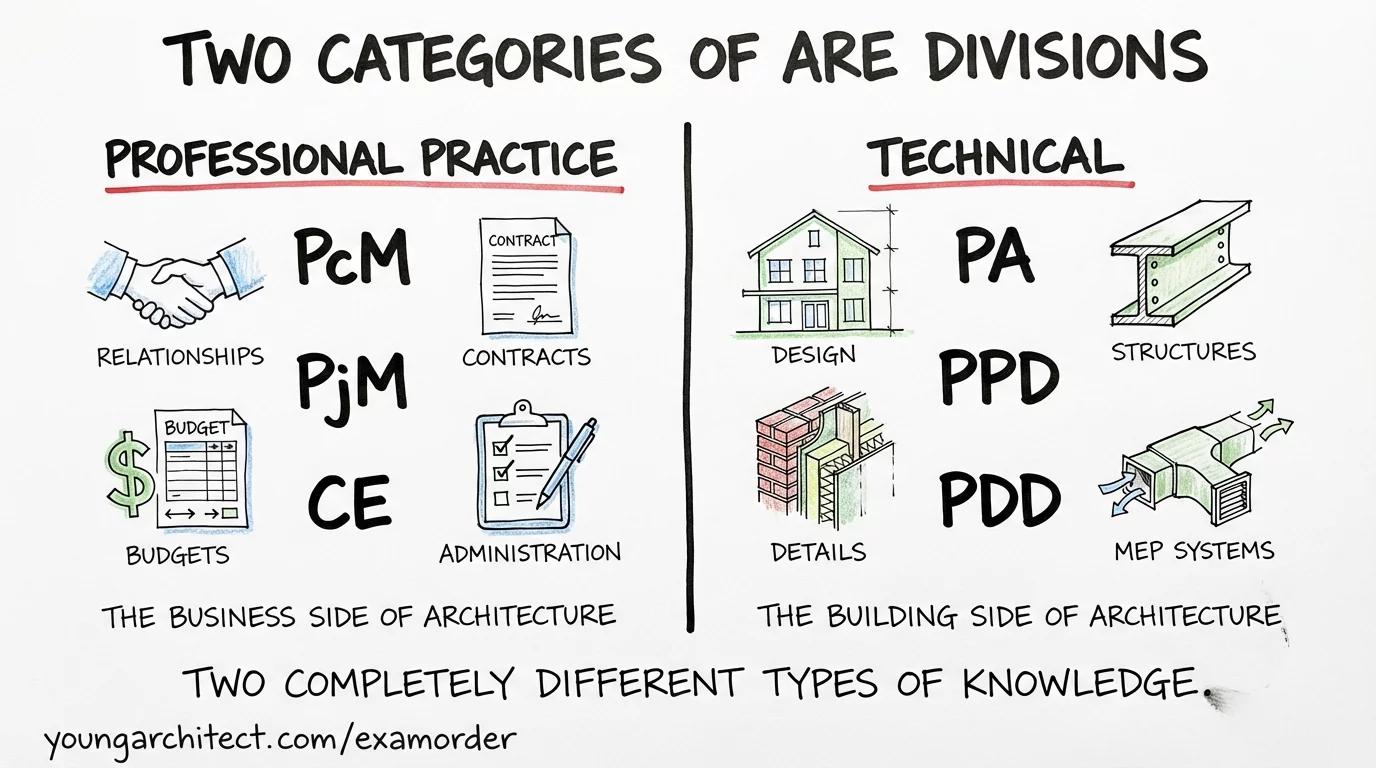
The ARE 5.0 consists of six divisions split into two categories that require completely different types of knowledge and study approaches. Rather than thinking of the ARE as six separate tests, think of them as falling into these two distinct groups.
Professional Practice Exams (PcM, PjM, CE)
These three ARE divisions cover the administrative side of architecture. We’re talking about starting and running your firm, managing professional liability, managing financial data, keeping projects on track with schedules and budgets, handling clients and contractors, managing change orders, reviewing construction submittals, and construction administration.
Think of these as the soft skills of design and construction projects. You can’t physically touch these things, but understanding these topics will decide if your projects sink or swim.
For a deeper look at what separates these three exams and where they overlap, check out how PcM, PjM, and CE connect.
Technical Exams (PA, PPD, PDD)
On the flip side, these exams cover everything that goes into the actual building. This is the tangible stuff:
- Designing and site analysis
- Structures and accessibility
- Codes, materials, methods, and assemblies
- Detailing and construction documents
- Mechanical, electrical, and plumbing systems
- Specifications
Wood versus concrete versus steel buildings. Basically all the architecture and building design elements.
If you want to understand how these three technical divisions relate to each other before you start studying, read understanding how PA, PPD, and PDD connect.
Completing PcM, PjM and CE First Just Makes Sense
The PcM, PjM, and CE divisions are perfect for beginners starting their journey with NCARB’s ARE 5.0. Here’s why this foundation-first approach makes all the difference:
They Build Essential Foundation Knowledge
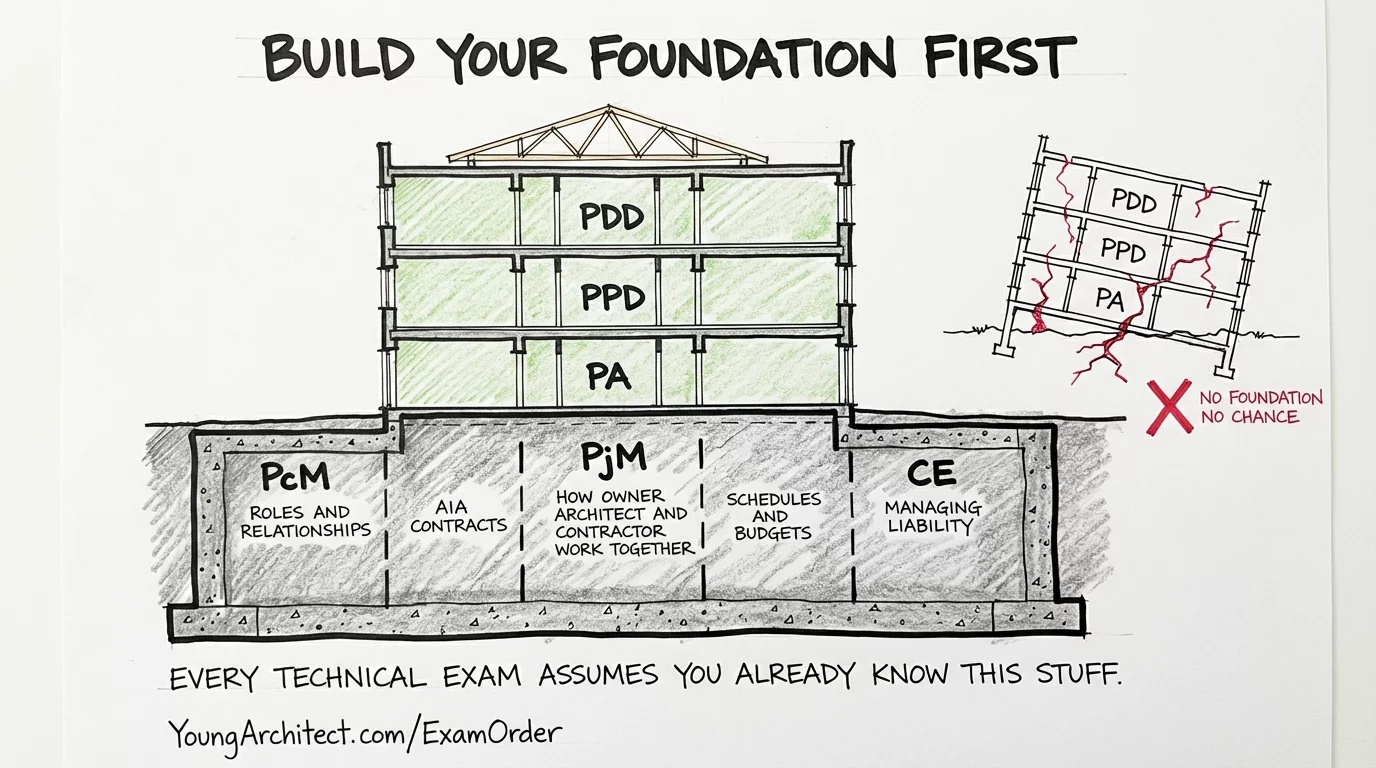
Every single ARE exam tests your knowledge on the basics of how an owner, architect, and contractor work together. If you don’t understand the roles, relationships, and responsibilities between these three parties inside and out, you’ll be dead before you even think about what mechanical system to use.
They’re Smaller and More Manageable
The pro practice ARE 5.0 tests have a smaller scope and are generally better options for people at the beginning of the ARE process. Most people need only a few key references and study materials to pass them.
Foundation Knowledge Shows Up Everywhere
During the technical ARE divisions, questions will assume you have basic contract knowledge and understanding of owner-architect-contractor relationships. Lacking this foundational knowledge could become a fatal error on any technical exam.
Strike While the Iron is Hot
Since you’ll study AIA contracts and A201 for the pro practice exams, it makes sense to complete all three while that knowledge is fresh in your mind.
Our AIA Contracts 101 course breaks down B101, A201, and all the essential contract forms you’ll need for these three exams.
The Technical PA, PPD, PDD Strategy
When you move into the technical architecture licensing exams, you’re starting over from scratch. The technical content has almost nothing in common with what you just studied for PcM, PjM, and CE.
Programming and Analysis Strategy
PA covers the predesign and early design stages: budget, site, building codes, occupancy classifications, accessibility, and programming. Getting solid on codes and programming fundamentals through PA 101 sets you up for success with the advanced concepts in PPD and PDD.
PA’s content overlaps about 25% with PPD content, so what you learn from properly studying PA sets you up for the advanced concepts in the monster ARE 5.0 exam sections.
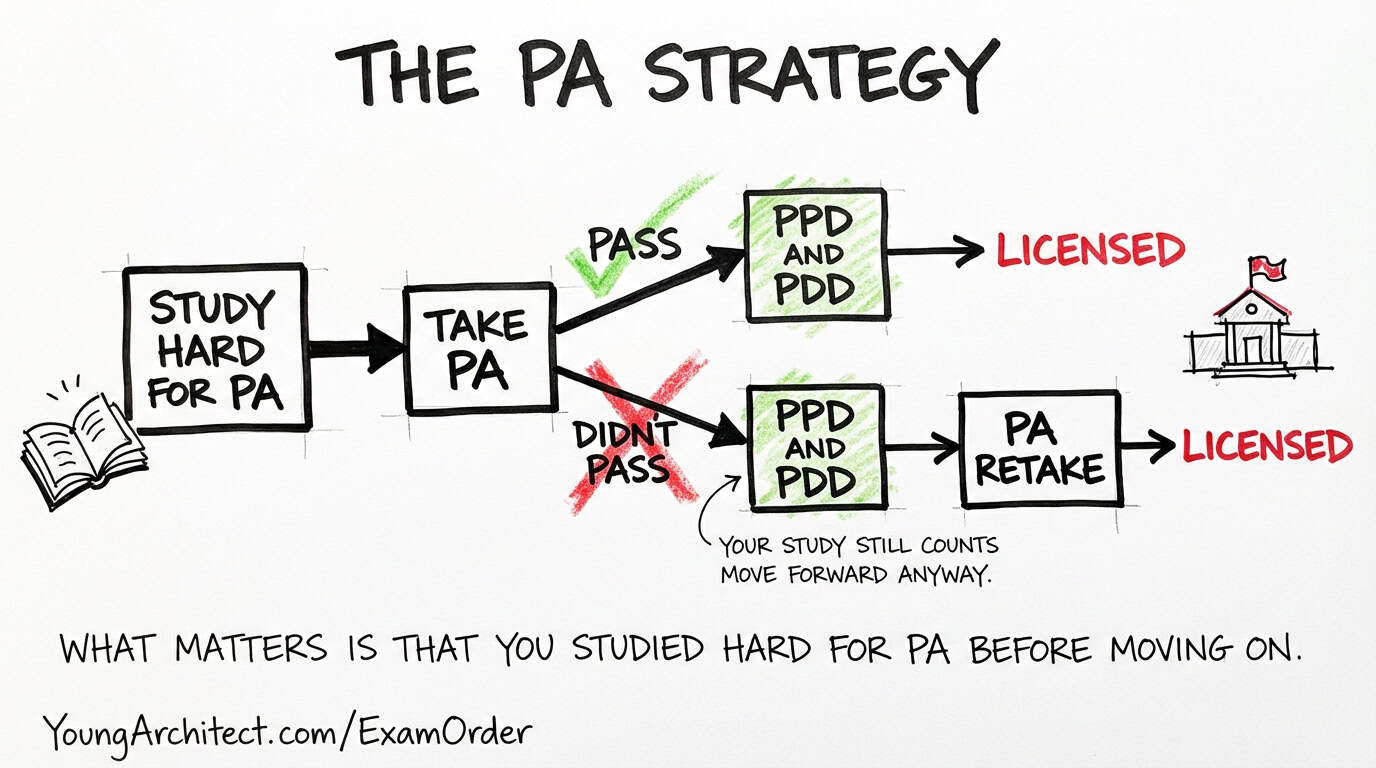
Study hard for PA. If you don’t pass, save it for last.
What’s more important than passing is that you study thoroughly for it. If you don’t study hard for PA, you’re going to struggle with PPD and PDD because they build off PA’s knowledge base.
PPD and PDD: The Monster Exams
Project Planning and Design and Project Development and Documentation are massive tests with almost 100% overlap between them. These cover everything from structural systems to mechanical design, from building codes to construction details.
Because the overlap is so significant, treat PPD and PDD as a two-part exam rather than two isolated tests. If your schedule allows it, try to take them 2 to 4 weeks apart. Studying for one inherently prepares you for the other, and you don’t want that knowledge fading between attempts.
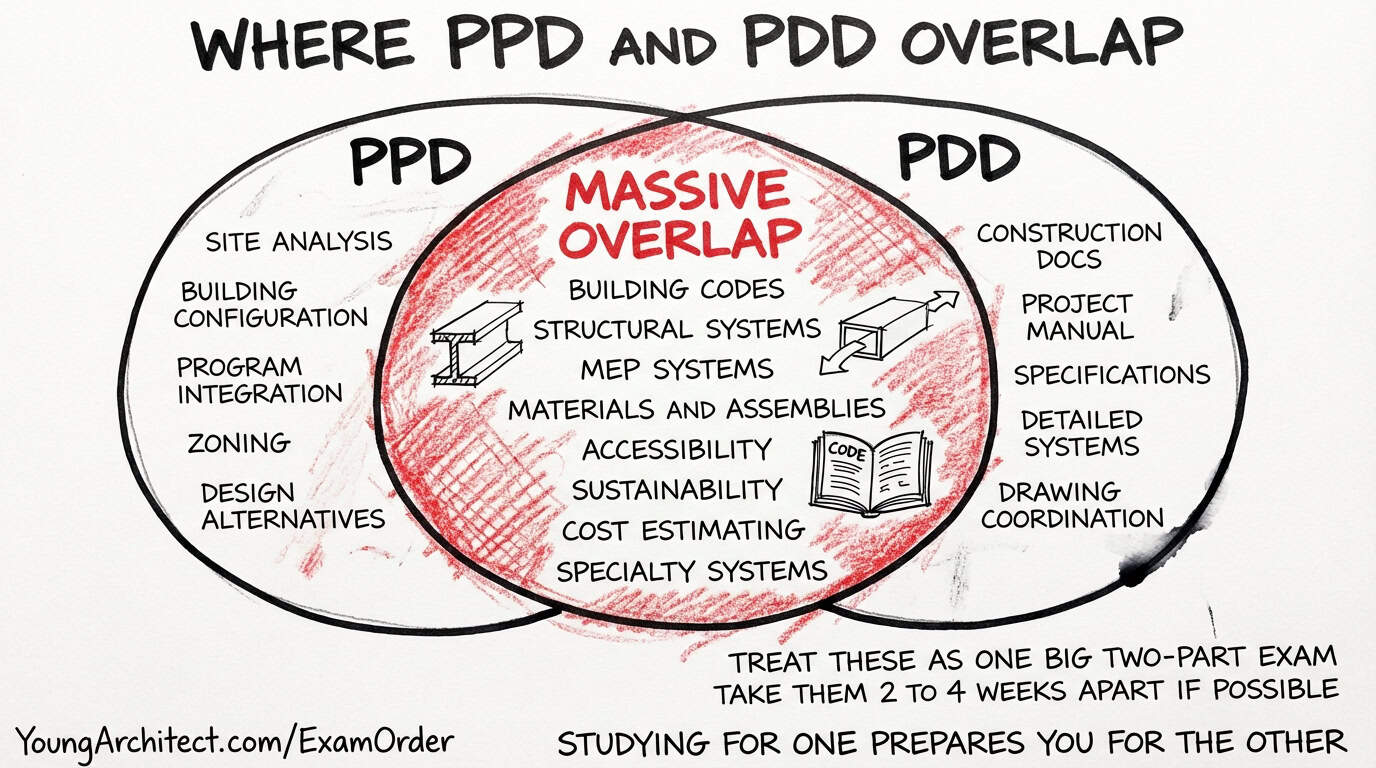
Make sure you’re studying with current NCARB objectives for these divisions. NCARB has made 2026 ARE exam changes that affect several objectives across multiple divisions, and you don’t want to be studying outdated material.
What ARE Study Materials Do You Actually Need?
Now that you know the order, the next question is what to actually use to study.
There’s no shortage of ARE 5.0 study guides and ARE exam prep materials out there. But most candidates don’t need more stuff. They need the right material in the right order with accountability to keep them moving forward.
ARE Boot Camp gives you the sequence, the schedule, and a community built around exactly this exam order. It’s a 10-week intensive coaching program with weekly live meetings and ongoing support until you pass all six divisions.
If you prefer self-paced study, the ARE 101 Membership includes courses organized by division so you’re studying the right content at the right time in your sequence. Every course is built around NCARB objectives, not just random information dumps.
Common ARE 5.0 Test Order Mistakes to Avoid
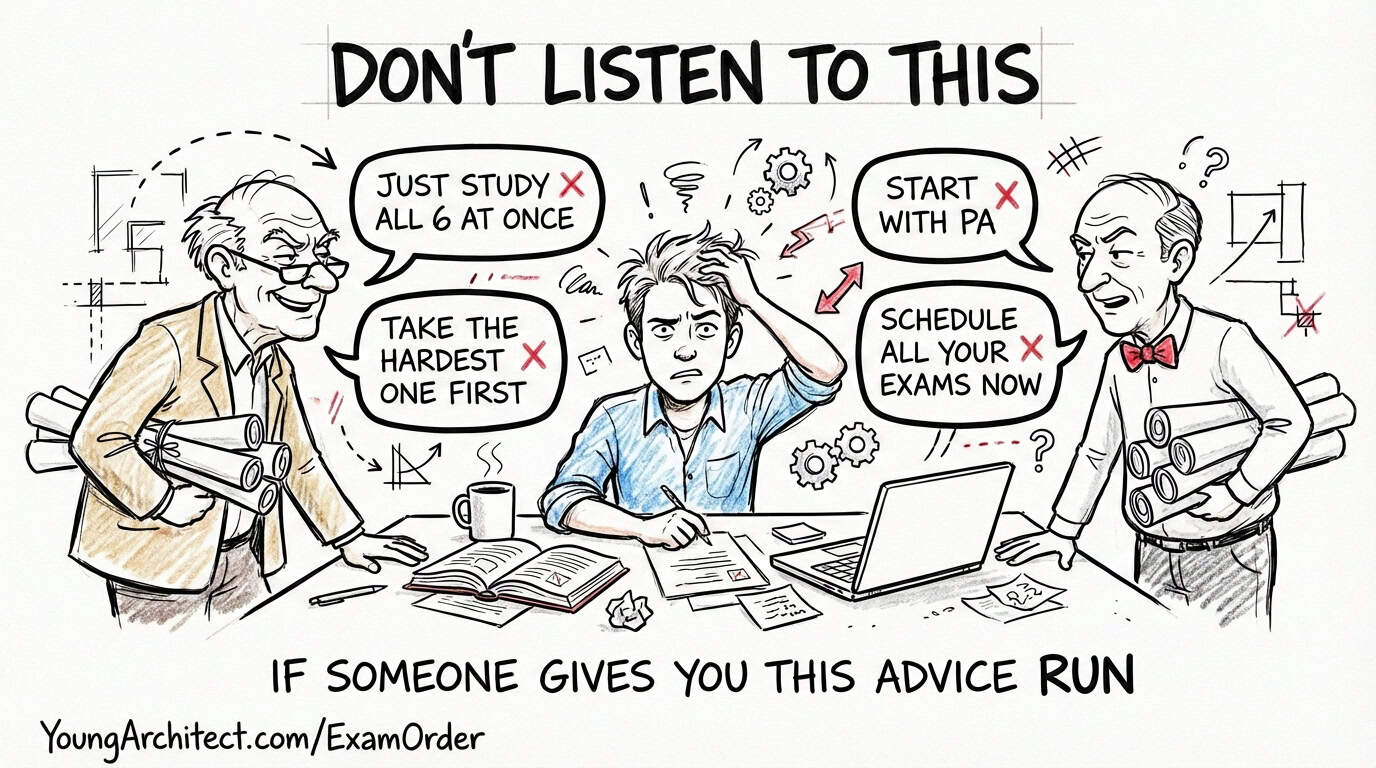
Let me address some terrible advice that’s consistently given to people starting their ARE journey:
“Study for All 6 ARE Exams at Once”
This is probably the worst advice I hear. The human brain can’t handle the amount of detail required to successfully pass six exams at the same time. It’s like trying to cook six different meals at once. You’re gonna burn something, but with the ARE it’s probably gonna be your brain.
People end up failing six exams at the very beginning, which is a terrible way to start this journey.
“Take the Hardest ARE Exam First” or “Take the Easiest Test First”
Neither approach makes strategic sense. What matters is taking the professional practice exams first to build your foundation, then following the logical progression through the technical material.
“Take PA as Your First Exam”
PA might look friendly in the NCARB guidelines, but it’s actually one of the hardest tests to study for. Many people take PA as their last exam and say it was their hardest ARE exam to pass.
“Schedule All Your ARE Exams Upfront”
There’s no benefit to arbitrarily choosing test dates months in advance. It’s like buying concert tickets 6 months away for a band that’s probably gonna break up. All this does is create stress. Your personal life will dictate your ARE schedule more than anything else.
ARE Test Order Frequently Asked Questions
Doesn’t it make more sense to take the Technical Exams first?
I hear this all the time: “I’ve got lots of experience with construction documents, so PDD should be easiest for me first.”
Unfortunately, it doesn’t work that way. The roles, relationships, and responsibilities between owner, architect, and contractor come up on every single ARE exam. Every exam requires good understanding of how AIA contracts work. These topics are huge parts of the pro practice exams.
The technical ARE 5.0 exams test substantially more topics and are much more complicated to study for. Completing the pro practice exams first is a fantastic warm-up for the more complicated technical exams.
Does architecture experience make a difference in the ARE?
Yes, experience helps, but I wouldn’t say it always gives people a big advantage. Often the way things are done in daily practice isn’t necessarily the right answer on the ARE exam.
After coaching thousands of people, I’ve learned that the ability to focus, concentrate, and not get distracted has always been more valuable than having many years of experience.
Should I take Programming and Analysis (PA) as my first exam?
Not recommended. PA is probably the worst ARE exam to take first because it’s complicated, wordy, and technical. When people read the ARE guidelines, PA’s scope comes across as friendlier than other exams, but that’s misleading.
Complete the pro practice exams first. By that point you’ll have learned a lot about how to study and take the ARE 5.0.
Would it make sense to study for all the exams and take them all at the same time?
I do not recommend this approach. I’ve repeatedly seen this strategy fail for almost everyone who tries it when they ask “how many ARE exams are there” and think they can tackle all six simultaneously.
It’s information overload. Imagine trying to learn piano, guitar, drums, harmonica, and violin all at the same time. It’s more effective to become competent in one instrument before learning the next.
This is exactly why our ARE Boot Camp follows a proven sequence that prevents information overload while building systematic knowledge.
If your goal is to save time, you’ll move more quickly by doing a thorough job studying for each exam one at a time.
How long should I study for each ARE 5.0 exam?
Study for as long as it takes for you to feel confident. Often, whatever’s going on in your personal life will dictate how fast you complete the ARE 5.0.
Let your ability to learn and synthesize the information dictate how long you study. The Architect Registration Examination tests your ability to interpret information and make decisions, not just memorize facts. Remember that effective study methods involve multiple approaches, not just one preferred learning style.
What is the best ARE 5.0 study guide?
The best ARE 5.0 study guide is one built around NCARB’s official exam objectives, not just a textbook full of information. Whatever you use should be organized by division so you’re studying the right content at the right time in your sequence.
Young Architect’s ARE 101 Membership includes courses for each division, organized to match the exam order recommended here. ARE Boot Camp adds live coaching and a structured weekly schedule on top of that.
How many ARE divisions are there?
The ARE 5.0 has six divisions total:
- Practice Management (PcM)
- Project Management (PjM)
- Construction and Evaluation (CE)
- Programming and Analysis (PA)
- Project Planning and Design (PPD)
- Project Development and Documentation (PDD)
Three cover professional practice, and three cover technical design. The best approach is to complete the practice divisions before tackling the technical ones.
The ARE Exam Order That Works
This isn’t about gaming tests or hoping you get lucky. Completing the architecture licensing exams is the most important project you’ll ever work on in your entire career because the return on investment will be bigger than any project, client, or firm you’ll ever work for.
I strongly recommend completing the professional practice exams first (PcM, PjM, and CE) before moving to the technical exams (PA, PPD, PDD). This ARE 5.0 test order is the most common approach and has repeatedly proven successful.
Having good strategy will save you a lot of wasted effort in the long run. This approach has worked for thousands of people I’ve coached over the years.
Master the ARE with Structured Study Materials
The ARE 5.0 test order strategy only works if you have quality study materials that break down every NCARB objective. Our ARE 101 Course Membership provides comprehensive courses for each exam division.
Rather than forcing you to piece together individual courses, we provide everything you need in one complete package because we believe in giving you all the tools necessary to succeed. Every course systematically breaks down NCARB objectives so you truly understand the concepts you’ll be tested on rather than just memorizing facts.
Ready for Interactive Coaching and Community Support?
If you prefer structured guidance over self-study, our ARE Boot Camp transforms the overwhelming ARE journey into manageable weekly steps. This 10-week intensive coaching program provides the structure, accountability, and community support that candidates consistently say makes the difference between struggling alone and achieving licensure success.
You’ll get weekly live meetings, expert guidance, and ongoing support until you pass all six exams. Learn more about how our students are maximizing their Boot Camp experience once they join the program.
“The bootcamp gives you a schedule, a study group, focused content, and has found a way to help me understand the exam concepts… It’s not just a prep program. It’s a support system.” – Christopher Cortez