
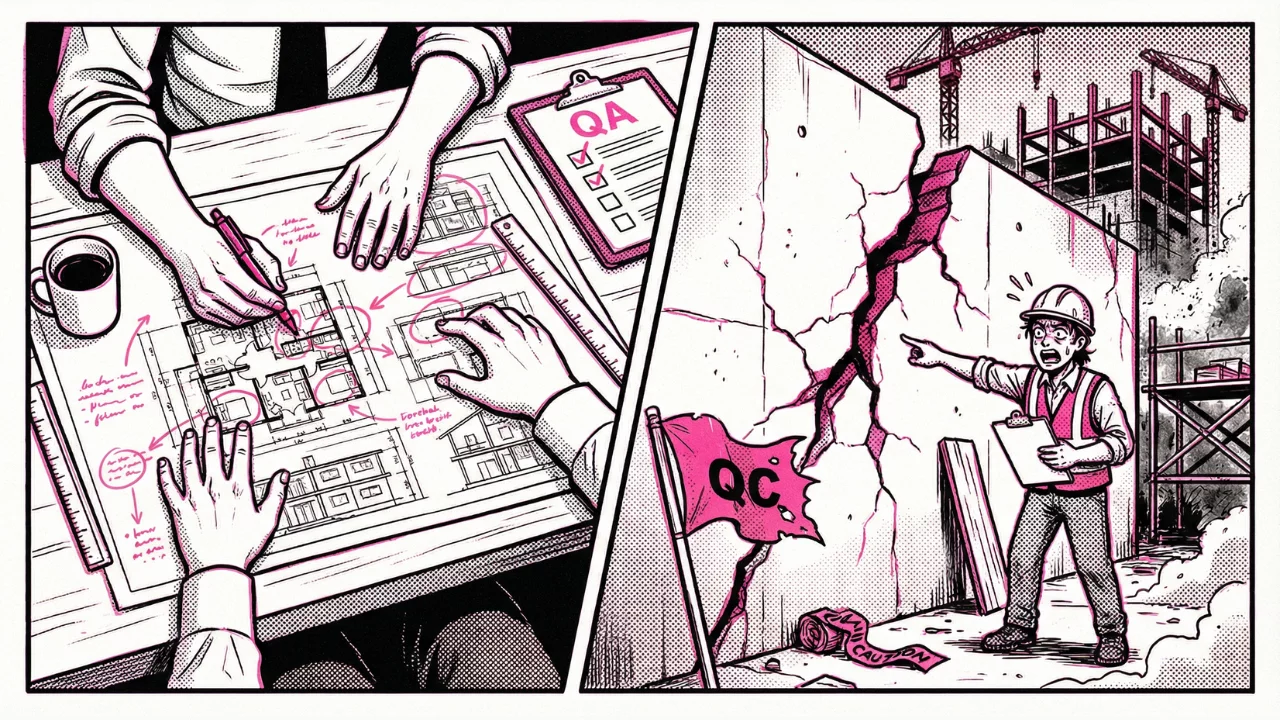
QA vs QC is one of the most commonly confused topics in architecture and construction. Quality assurance (QA) prevents problems before they happen. Quality control (QC) finds and fixes them after the fact. This guide breaks down the full QA/QC meaning, walks through how these quality control procedures work across design and construction phases, and gives you real examples so you can apply them in practice and on the ARE.
This podcast is also available on YouTube, Spotify, and Apple Podcasts
What Is QA vs QC? The Fundamental Difference
So what does QA/QC mean? Quality Assurance (QA) and Quality Control (QC) get thrown around like they’re the same thing. They’re not. Mixing them up is a mistake that leads to real project problems, and it’s a distinction the ARE loves to test.
Quality Assurance (QA) is all about prevention. It’s the planned, systematic process you put in place before work begins to make sure a project will meet quality requirements. QA means building the system, setting the standards, training the team, and creating protocols so problems don’t happen in the first place.
Quality Control (QC) is about detection and correction. QC focuses on inspecting and testing specific results to determine if they actually comply with the standards that QA established. Quality control procedures include inspection and testing of products, materials, and building components to verify the work meets the established standards and design intent.
Here’s an easy way to remember: A comes before C in the alphabet. Quality Assurance (prevention) happens before Quality Control (correction). One sets the standards. The other verifies they’re being met.
Together, these two processes form a complete quality management system. QA builds the framework. QC operates within it. And the results from QC feed back into improving QA procedures, creating what’s called a closed loop system.
Expectations for this process can also shift depending on whether the client is public or private, with public projects typically having more formalized QA/QC requirements and documentation.
Quality Assurance vs Quality Control Examples from Everyday Life
Let’s make these concepts more relatable before diving into architecture-specific applications. These quality assurance vs quality control examples from everyday life help clarify the difference.
Consider cooking a meal:
- QA is following a recipe and measuring ingredients before you start cooking
- QC is tasting the food as you cook and adjusting the seasoning as needed
Planning a road trip:
- QA is mapping your route and checking your car beforehand
- QC is monitoring your gas levels and adjusting your route when you hit traffic
Staying healthy:
- QA is exercising regularly and following a balanced diet
- QC is monitoring symptoms and treating specific issues that come up
Gardening:
- QA is preparing soil and selecting appropriate plants
- QC is checking for pests and adjusting care based on how the plants respond
Notice the pattern? QA always comes first and creates the plan. QC always follows and checks the results. That cycle is exactly how it works in architectural practice too.
QA/QC During the Design Phase
Most people only think about quality in terms of construction, but effective quality management starts much earlier. The design phase is where your QA/QC process should begin, because catching issues on paper is a whole lot cheaper than catching them on the job site.
Quality Assurance in Design
- Establishing design standards and BIM management plans before work begins
- Implementing consistent documentation protocols across the team
- Coordinating regularly with consultants through structured meetings
- Conducting early code analysis including occupancy classification and accessibility compliance checks
- Performing constructability reviews to identify potential field issues early
- Regularly verifying design against program requirements to prevent scope drift
Quality Control in Design
- Conducting structured reviews at each phase milestone (Schematic Design, Design Development, Construction Documents)
- Performing peer reviews or “fresh-eye” reviews from team members outside the project
- Verifying technical accuracy of dimensions, cross-references, and notes
- Implementing value engineering to confirm budget compliance
- Documenting milestone approvals and sign-offs
The key difference here is that QA in design establishes the ongoing standards and processes that guide design work, while QC in design involves formal evaluations at specific checkpoints.
A real-world example: A firm I worked with implemented a robust QA program requiring three-person review teams for all projects over a certain size. Each team included someone from outside the project for a fresh perspective. It initially seemed time-consuming, but it reduced errors by over 40% and actually accelerated project delivery by cutting down rework later.
By having a preset plan followed by structured reviews and checks, time was well spent up front rather than scrambling to fix issues later. That’s the power of a good QA/QC process in action.
QA/QC in Construction Documentation
As design transitions to construction documents, quality procedures become even more critical. This is where your documents must clearly communicate design intent and technical requirements to the people actually building the project.
Quality Assurance in Documentation
- Establishing document standards for drawings, sheet organization, and notation systems
- Coordinating technical specifications with drawings to prevent conflicts
- Organizing specifications using the CSI MasterFormat system for consistency
- Setting up quality requirements within Division 01 General Requirements
- Conducting regular interdisciplinary coordination meetings
- Understanding different construction specification types and which are appropriate for each situation
- Learning to avoid common specification writing errors that create quality problems down the line
Quality Control in Documentation
- Verifying technical accuracy across plans, sections, elevations, and details
- Ensuring complete scope coverage with no missing information
- Checking interdisciplinary coordination between structural, architectural, and MEP documents
- Confirming specification and drawing coordination so they tell the same story
- Conducting a comprehensive final document review before issuance
The consequences of documentation QA/QC failures can be severe. On one high-profile project, insufficient coordination between structural and architectural drawings resulted in a concrete beam that interfered with a main corridor’s clearance requirements. The error was caught during construction, resulting in costly redesign, schedule delays, and damaged client relationships.
All of it was preventable with proper documentation quality control procedures.
QA/QC During Construction Administration
Once construction begins, QA/QC transitions from documents to the physical building. This is where quality assurance and quality control in construction become most visible, and where failures become most expensive.
Quality Assurance in Construction
- Conducting pre-construction meetings to review quality expectations with all parties
- Establishing submittal review procedures for verifying proposed materials and systems
- Creating systems for RFI management and documentation
- Developing site visit protocols and observation schedules
- Implementing non-conformance documentation processes
- Setting up procedures for managing construction change orders when quality issues require modifications
Quality Control in Construction
- Planning testing and inspection schedules aligned with the construction sequence
- Verifying materials match approved submittals
- Inspecting first installations of critical systems before full-scale work proceeds
- Continuously verifying conformance to contract requirements
- Managing project closeout quality verification including punch lists and systems testing
The relationship between quality assurance and quality control procedures in construction is constant. QA sets up the system. QC verifies the results. And when QC finds a problem, it feeds back into the QA process to prevent it from happening again.
Who Is Responsible for QA/QC? Roles and Responsibilities
Understanding who’s responsible for what is crucial for effective quality management, and it’s a topic the ARE tests regularly.
The Architect/Engineer:
- Establishes quality standards in the contract documents
- Implements design phase quality assurance and quality control
- Reviews submittals for conformance with the design intent
- Conducts field observations during construction
- Has authority to reject non-conforming work
- Must maintain appropriate professional liability protection to cover quality management responsibilities
Important limitations: architects don’t dictate construction means and methods, and aren’t continuously on site conducting inspections. The architect observes. The contractor inspects. That distinction matters on the exam.
The Owner:
- Establishes project quality goals and requirements
- Defines quality expectations in the program
- Engages special inspectors and testing agencies
- May hire owner’s consultants including a commissioning authority
- Makes decisions on non-conforming work
- Accepts the completed work at substantial completion
The Contractor:
- Responsible for construction means and methods
- Supervises and coordinates all work on site
- Plans and coordinates testing and inspection schedules with the construction sequence
- Manages subcontractor quality
- Handles product storage and protection
- Conducts pre-installation meetings
- Verifies installation quality through self-checks
- Corrects non-conforming work
- Resolves punch list items during closeout
- For larger projects, contractors may need to secure construction bonds that provide financial protection if quality standards aren’t met
Each party has a defined role in the QA/QC process, and understanding where those responsibilities start and stop is essential for both practice and the exam.
Real-World Example: Curtain Wall QA/QC Process
Let’s follow a curtain wall system through the entire QA/QC process to see how quality management works across every project phase.
During Design:
- QA: Establish curtain wall performance requirements based on climate zone, building use, and construction type
- QC: Review integration of the curtain wall with structural elements and energy performance targets
In Documentation:
- QA: Develop detailed curtain wall specifications coordinated with drawings
- QC: Verify details are complete, coordinated, and technically sound
During Procurement:
- QA: Establish the submittal review process and acceptance criteria
- QC: Verify proposed system meets requirements through mock-up reviews and testing
In Construction:
- QA: Conduct pre-installation meetings with the installer
- QC: Scrutinize first panel installation, conduct water testing, verify final installation quality
A breakdown at any stage affects every phase that follows. One project I observed had incomplete performance specifications that weren’t caught during the documentation QC review. This resulted in endless submittal revisions, construction delays, and eventually water infiltration issues that required costly remediation.
If the QA process had been stronger up front, and if QC had caught the specification gaps during document review, the entire chain of problems would have been avoided.
QA/QC on the Architect Registration Exam
Quality assurance and quality control concepts appear across multiple ARE divisions, and they’re tested both directly and indirectly:
- Practice Management (PcM): Objective 4.2 covers quality management directly. Our PcM 101 course breaks this down with practice questions and real scenarios.
- Project Management (PjM): Section 5 addresses quality management in project execution. Our PjM 101 course covers the project-level QA/QC responsibilities in detail.
- Construction & Evaluation (CE): Quality verification during construction is a major focus. Our CE 101 course covers construction quality control procedures thoroughly.
- Project Development & Documentation (PDD): Document quality control and coordination are central topics covered in our PDD 101 course.
The CDT exam also covers these concepts extensively, particularly around construction documentation quality and specification coordination. If you’re pursuing CSI certification, our CDT 101 course connects QA/QC directly to project delivery.
Common exam scenarios include questions about who’s responsible for specific QA/QC tasks, when certain quality processes should occur, and the appropriate response to quality issues discovered during construction.
Not sure which exam to tackle first? Our guide on the best ARE 5.0 test order walks you through a proven sequence that builds your knowledge strategically.
The QA/QC Approach to Passing the ARE
Here’s something worth thinking about: the ARE itself is a perfect application of QA/QC principles.
Many candidates approach the exam through trial and error. They study without a plan, take the test, fail, adjust, and try again. That’s essentially a reactive, quality control only approach, and it gets expensive and frustrating fast.
Our 10-week intensive ARE Boot Camp applies quality assurance principles to your exam preparation. We help you establish good study habits from the beginning, create a realistic study schedule, and build a proactive learning approach aligned directly with NCARB’s objectives.
Using multiple learning methods rather than relying on a single study approach is itself a quality assurance strategy. You’re building a better system, not just hoping things work out.
The structured curriculum, personalized coaching, and community accountability are QA in action. And the practice questions, mock exams, and progress tracking? That’s your QC, verifying you’re actually learning what you need to know.
Key Takeaways
- QA and QC are distinct but complementary processes. Quality assurance prevents issues through systems. Quality control detects and corrects issues through verification.
- The difference between QA and QC comes down to timing. QA is proactive and preventive. QC is reactive and corrective.
- QA/QC isn’t just a construction thing. Quality management spans the entire project lifecycle from initial design through closeout.
- Each party in the building process has specific QA/QC responsibilities. Understanding those boundaries is critical for both practice and the exam.
- Documentation and communication are what hold the entire quality management process together.
- The same QA/QC principles that build better buildings can build a better approach to passing the ARE.
Quality isn’t accidental. It’s the result of deliberate systems and consistent verification. Understanding QA vs QC and how to implement effective quality assurance and quality control procedures will help you pass your exams and make you a more effective architect throughout your career.
If you’re preparing for the ARE or CDT exams and want structured resources on quality management and dozens of other critical topics, our ARE 101 course membership gives you access to all exam prep courses, practice questions, and study materials in one place.
Frequently Asked Questions About QA vs QC
What does QA/QC mean?
QA/QC stands for Quality Assurance and Quality Control. Together they form a complete quality management system. Quality assurance is the proactive side, establishing standards, processes, and procedures before work begins. Quality control is the reactive side, inspecting and testing to verify those standards are actually being met. In construction and architecture, QA/QC covers everything from design phase reviews to field testing during construction.
What is the difference between QA and QC?
The simplest way to think about it: QA prevents problems, QC finds them. Quality assurance focuses on building the right systems and processes so work is done correctly the first time. Quality control focuses on checking the finished work to confirm it meets requirements. QA happens before and during the work. QC happens during and after. Both are necessary because no system is perfect, and no inspection catches everything.
What does QA/QC mean in construction?
In construction, QA/QC refers to the combined quality management processes that ensure a building is constructed according to the contract documents. Construction QA includes activities like pre-construction meetings, submittal review procedures, site visit protocols, and non-conformance documentation systems. Construction QC includes material testing, inspection schedules, first installation reviews, and punch list verification. The architect, owner, and contractor all have specific QA/QC responsibilities defined in the contract.
What is quality assurance in architecture?
Quality assurance in architecture means establishing the systems, standards, and processes that guide design and documentation work. This includes things like BIM management plans, documentation protocols, coordination procedures with consultants, code analysis checklists, and structured review processes at each design phase. The goal of QA is to prevent errors from entering the documents rather than trying to catch them all at the end.
What is quality control in construction?
Quality control in construction is the inspection and testing process that verifies built work meets the standards established in the contract documents. QC activities include testing materials like concrete and steel, inspecting installations against approved submittals, conducting water testing on building envelope systems, and performing final punch list walkthroughs. The contractor is primarily responsible for construction quality control, while the architect observes and the owner may engage special inspectors and testing agencies.
What is a QA/QC process?
A QA/QC process is the structured cycle of planning, implementing, checking, and improving quality on a project. It starts with QA: establishing quality standards, creating procedures, and training the team. Then QC kicks in: inspecting work, testing results, and documenting findings. When QC identifies an issue, that information feeds back into the QA system to prevent the same problem from recurring. This closed loop system operates continuously throughout every phase of an architectural project, from programming through construction closeout.
What are common QA/QC procedures in construction?
Common quality assurance procedures include pre-construction conferences, submittal schedules, shop drawing review processes, RFI tracking systems, and site observation protocols. Common quality control procedures include concrete slump testing, steel welding inspections, building envelope water testing, fire-stopping inspections, and commissioning of mechanical and electrical systems. These procedures are typically outlined in Division 01 General Requirements of the project specifications.
Who is responsible for quality control on a construction project?
The contractor is primarily responsible for quality control during construction. This includes supervising work, coordinating testing and inspections, managing subcontractor quality, and correcting non-conforming work. However, quality management is a shared effort. The architect establishes quality standards in the contract documents and reviews submittals. The owner sets project quality goals and may hire special inspectors. Each party has distinct responsibilities, and understanding those boundaries is a common topic on the Architect Registration Examination.