

Construction bonds provide essential financial protection for owners and ensure contractors fulfill their obligations on building projects. This guide explains the different types of construction bonds, how surety bonds work in practice, who pays for them, what they cost, and when they’re required. Whether you’re working on real-world projects or building your professional knowledge, understanding construction bonds will make you a better architect.
This podcast is also available on YouTube, Spotify, and Apple Podcasts
What Are Construction Bonds?
Imagine you’re six months into a high-profile public project when your general contractor suddenly vanishes. No warning, just gone. Along with your project schedule and your client’s confidence.
This nightmare scenario happens more often than most architects realize. But there’s a financial safety net designed specifically for situations like this.
Construction bonds are financial guarantees that ensure obligations are met on a project. They protect project owners and other stakeholders when contractors fail to fulfill their contractual responsibilities.
Think of a construction bond as a promise backed by money.
A third-party company guarantees that the contractor will do what they said they’d do. And if they don’t? That third party steps in to make things right. That third-party company is called a surety, and the bond itself is a surety bond. Every construction bond is a type of surety bond, built on the same three-party structure we’ll break down shortly.
When contingency planning isn’t enough to save a project, bonds provide that critical layer of protection that can mean the difference between project success and total disaster.
Understanding bonds isn’t just important for real-world practice. It’s essential knowledge for anyone pursuing their architecture license. Yet many professionals confuse bonds with insurance or misunderstand their fundamental purpose.
Let’s fix that.
Before we get into the different types, it helps to understand what makes a construction bond different from the other financial protections you’ll encounter on projects.
Construction Bonds vs Insurance: What’s the Difference?
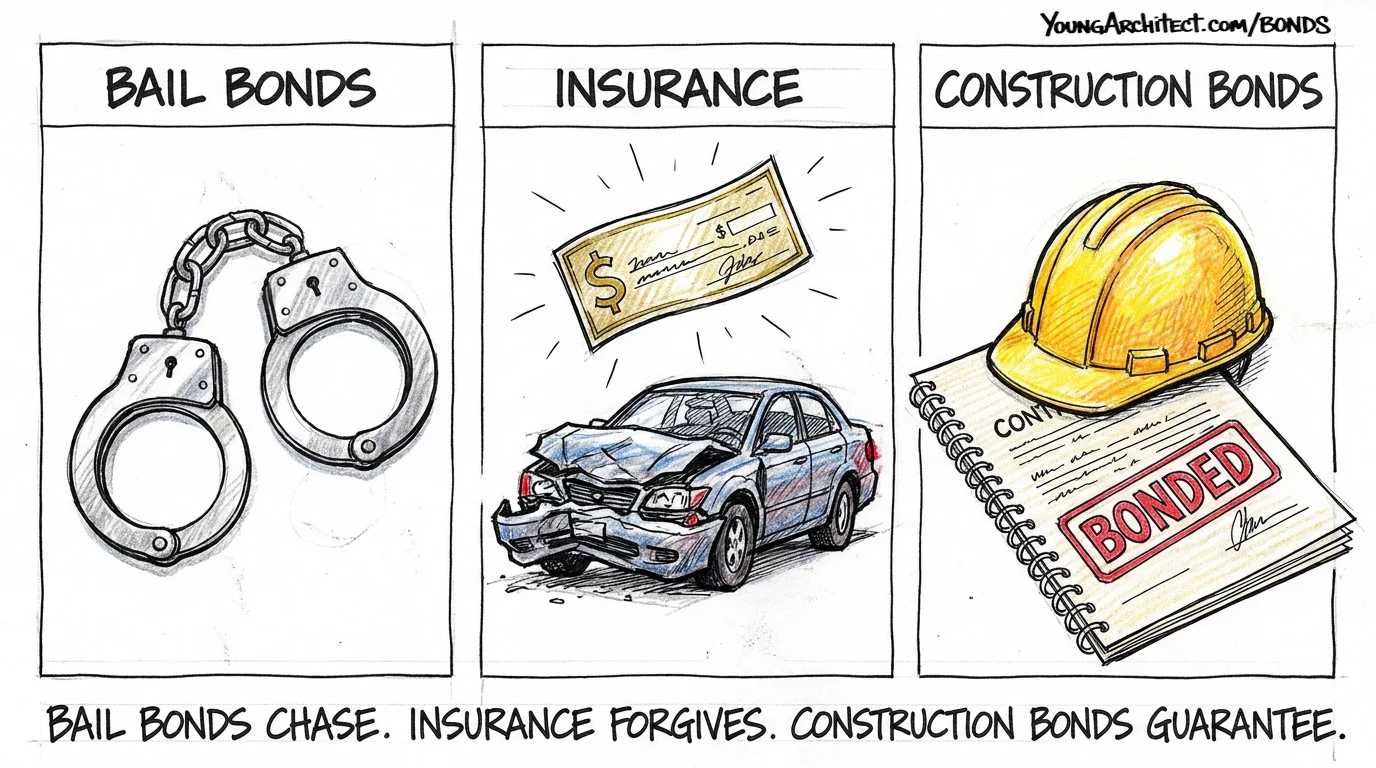
This is one of the most common areas of confusion in the construction industry. Bonds and insurance are not the same thing.
Insurance spreads risk among many policyholders and doesn’t require repayment after a claim. If you crash your car, your insurance company pays for damages. You don’t pay them back directly, though your rates might go up.
A surety bond works more like a co-signed loan. When a contractor fails to meet their obligations, the bond company (called the surety) steps in to cover the cost. But here’s the key difference:
The surety will recover every penny from the contractor afterward.
If insurance is like having a safety net, a bond is like having a parachute with someone holding a gun to the skydiver’s head saying “This better open!”
The easiest way to visualize the difference is to think about car insurance versus a co-signed loan.

With car insurance, you crash, they pay, life goes on. With a co-signed loan, if you skip town, the co-signer is stuck with the bill. And the lender is coming after both of you.
Here’s the simplest way to remember it:
- Insurance protects against unforeseen risks
- Bonds guarantee performance
This distinction matters in practice because it changes who carries the financial risk. With insurance, the risk transfers to the insurance company. With a bond, the contractor always remains on the hook. The surety is just guaranteeing they’ll follow through.
When you’re working on projects that involve both bonds and insurance requirements, understanding this difference helps you advise clients and evaluate contractor qualifications with confidence.
Speaking of that co-signed loan comparison, there’s actually a perfect analogy that makes the bond concept click for most people. It involves bail bonds.
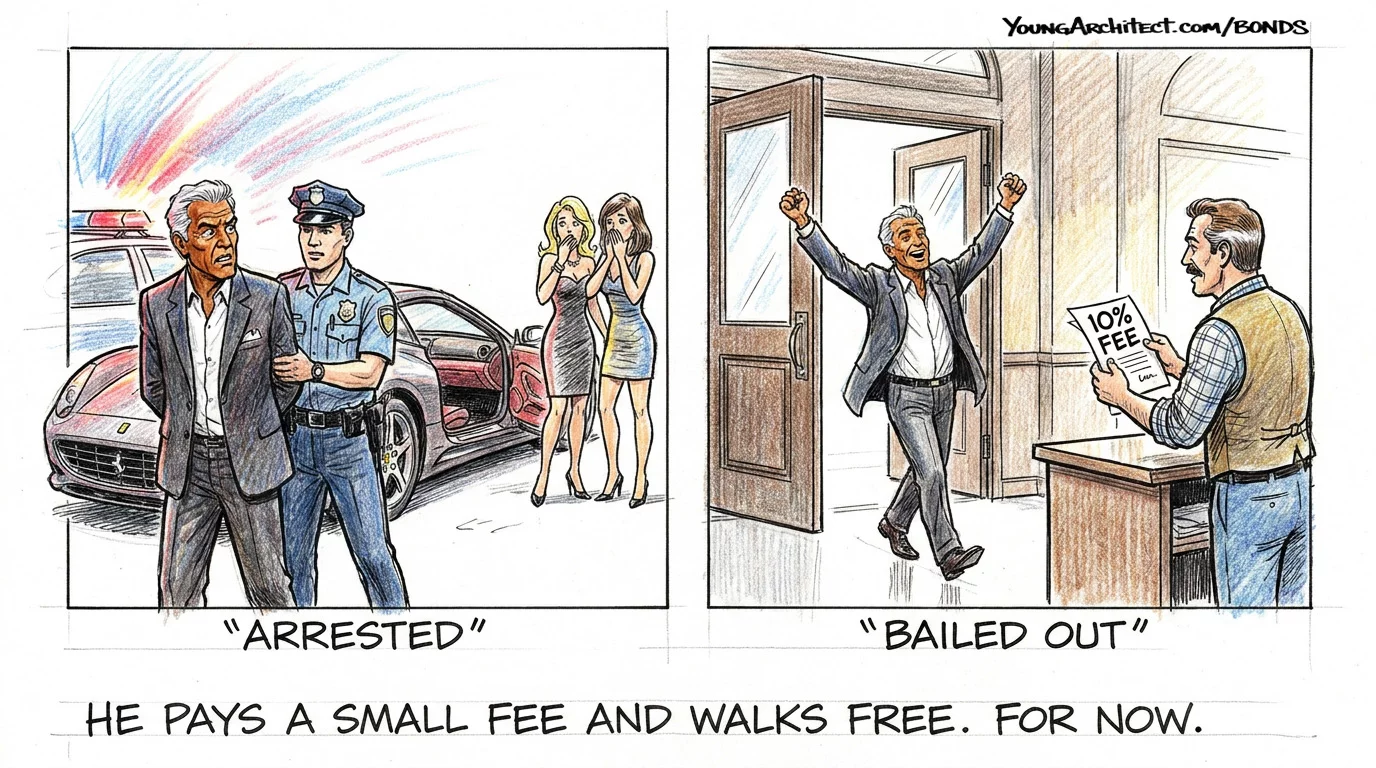
A celebrity gets a DUI and gets arrested. Bail is set at $100,000. He doesn’t want to sit in jail, so he calls a bail bond company. The bail bond company charges him a 10% fee ($10,000), puts up the full $100,000 with the court, and the celebrity walks free.
Now here’s where the bond part kicks in.
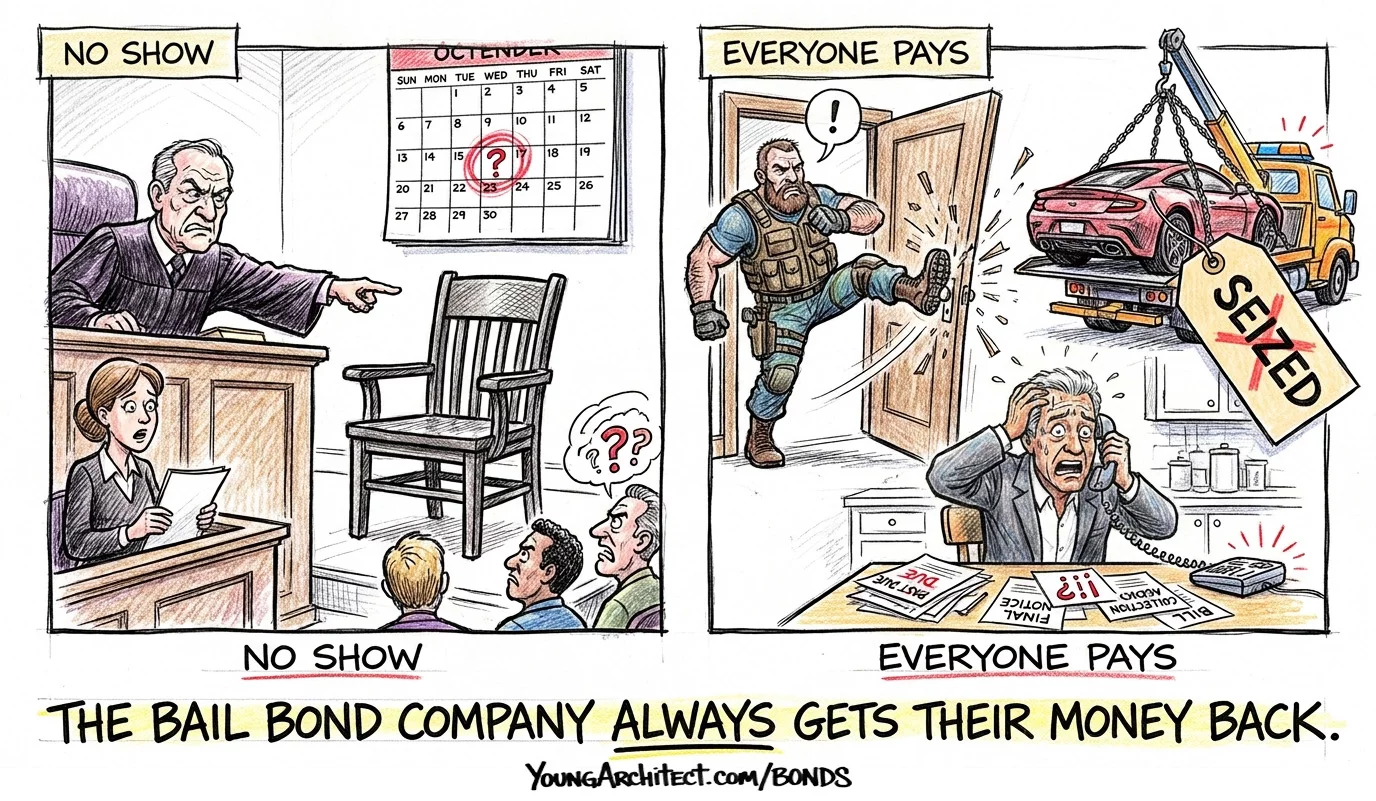
If the celebrity shows up to court? Everyone’s fine. The bail bond company gets their $100,000 back from the court, and they keep the $10,000 fee as profit.
But if he skips his court date? The bail bond company loses $100,000. And they are coming after him. Bounty hunters, asset seizure, lawsuits. The bail bond company always gets their money back.
That’s exactly how a surety bond works in construction. The surety puts up a financial guarantee. The contractor pays a small premium. If the contractor performs, everyone’s happy. If they don’t, the surety covers the loss and then chases the contractor to recover every dollar.
Unlike with bail bonds, no one’s sending Dog the Bounty Hunter after your contractor if they default. Though sometimes you might wish they would.
The Three-Party Relationship in Construction Bonds
Every construction bond involves three parties. Understanding who’s who is essential.
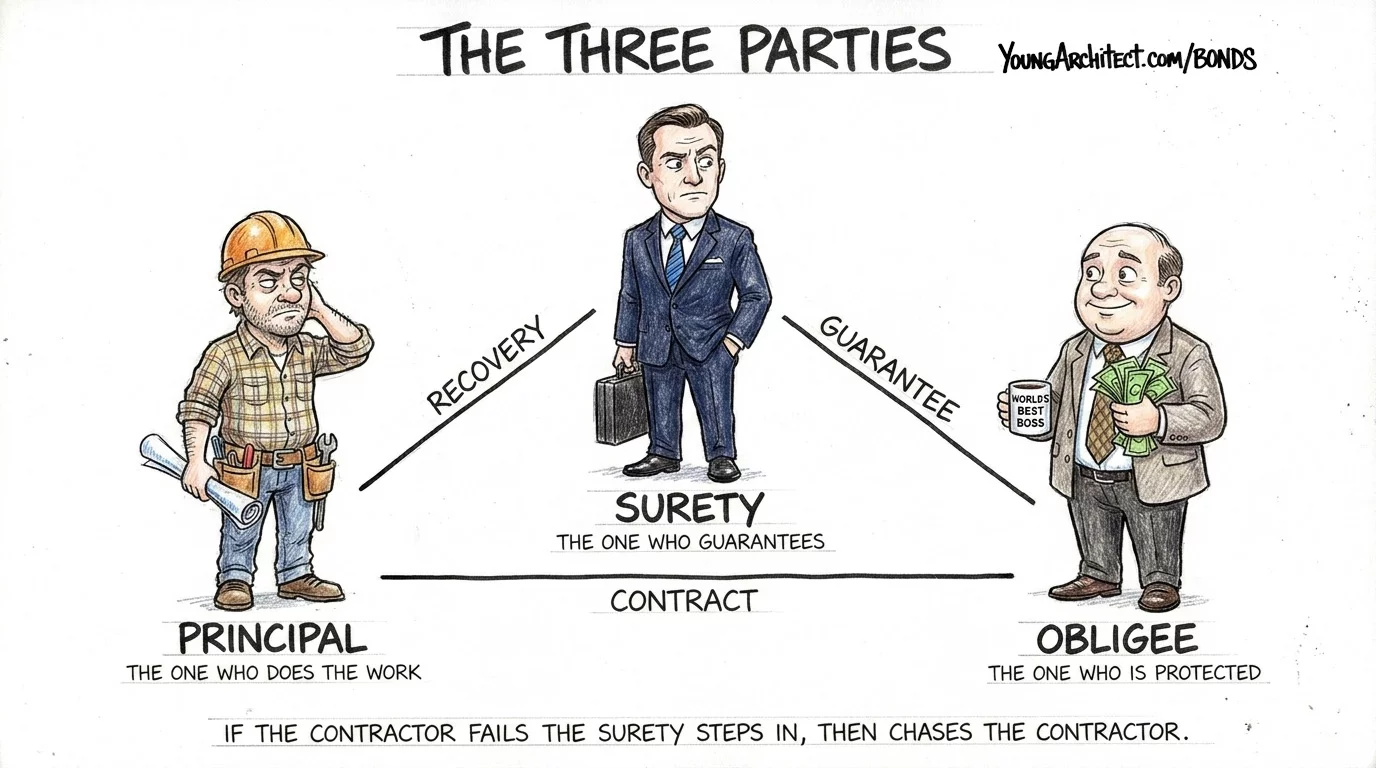
The Principal is the contractor who purchases the bond. They’re the ones making the promise to perform.
The Surety is the bonding company that guarantees the principal’s obligations. They’re the financial muscle behind the promise.
The Obligee is the project owner who is protected by the bond. They’re the ones who benefit if something goes wrong.
Surety companies are like that friend who will loan you money but then texts you every day asking “So… when do I get paid back?” Except with legal authority and much better collection methods.
A surety company evaluates the contractor’s ability to perform before issuing any bond. Think of the surety as an underwriter. They’re assessing risk and deciding whether this contractor is a safe bet.
The surety’s evaluation typically looks at:
- Financial statements and credit history
- Work experience and track record
- Current workload and capacity
- Equipment and resources available
- Management team qualifications
This vetting process is actually one of the hidden benefits of requiring bonds on a project. If a contractor can get bonded, it means a surety company has already done the due diligence and determined they’re financially stable and capable. It’s like a pre-qualification stamp of approval.
This three-party relationship ensures that even if the contractor fails, the project can still move forward with minimal disruption. The surety has a financial incentive to make sure the contractor performs, because if they don’t, the surety is paying out of pocket and then chasing the contractor to recover costs.
Types of Construction Bonds
Not all contract bonds serve the same purpose. There are several types of construction bonds you need to understand, each protecting different aspects of a construction project.
Bid Bonds
A bid bond ensures that a contractor will sign a contract if they win the bid. It protects the owner from contractors who submit low bids just to win and then try to back out.
The bid bond is the construction equivalent of those parent-child leashes you see at Disney World. Freedom to move around, but only so far before someone yanks you back.

Here’s a real-world example. A contractor submits the lowest bid at $500,000 but then realizes they made a calculation error and wants to walk away. The next lowest bid is $600,000. The bid bond would compensate the owner for the difference between those two bids, up to the face value of the bond.
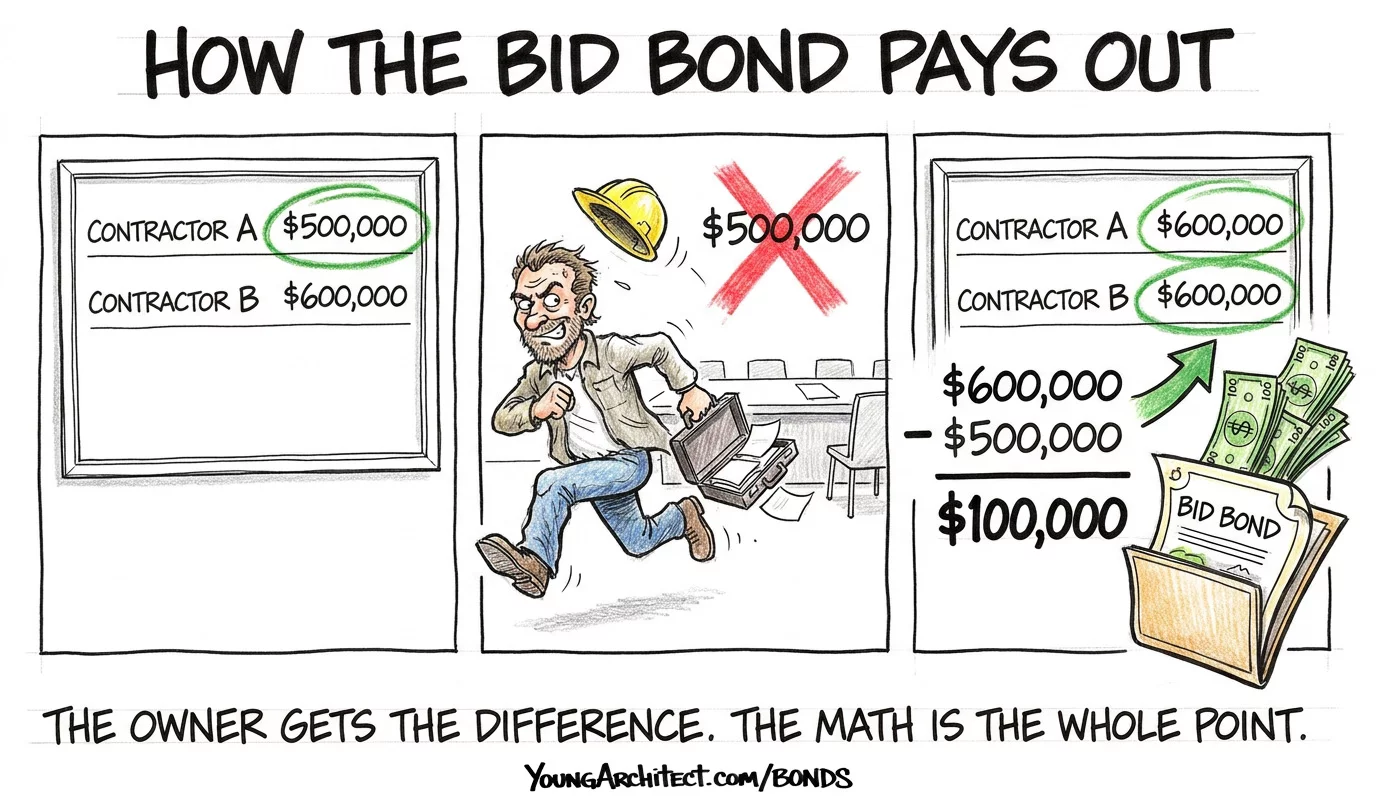
Bid bonds are typically set at 5-10% of the bid amount. In practice, the bid bond has a cap (called the penal sum), so the surety’s payout maxes out at the face value of the bond. If the difference between bids exceeds that cap, the owner may have to absorb the rest. But the bond still creates real financial consequences for walking away.
Bid bonds are a critical part of preconstruction activities and are usually one of the first bond types you’ll encounter on a project.
On public projects, bid bonds are almost always required as part of the construction bidding process. No bid bond? Your bid doesn’t even get opened.
Performance Bonds
A performance bond guarantees that the contractor will complete the work according to the contract terms. This is the big one. The bond that keeps project owners up at night when they realize they need it.
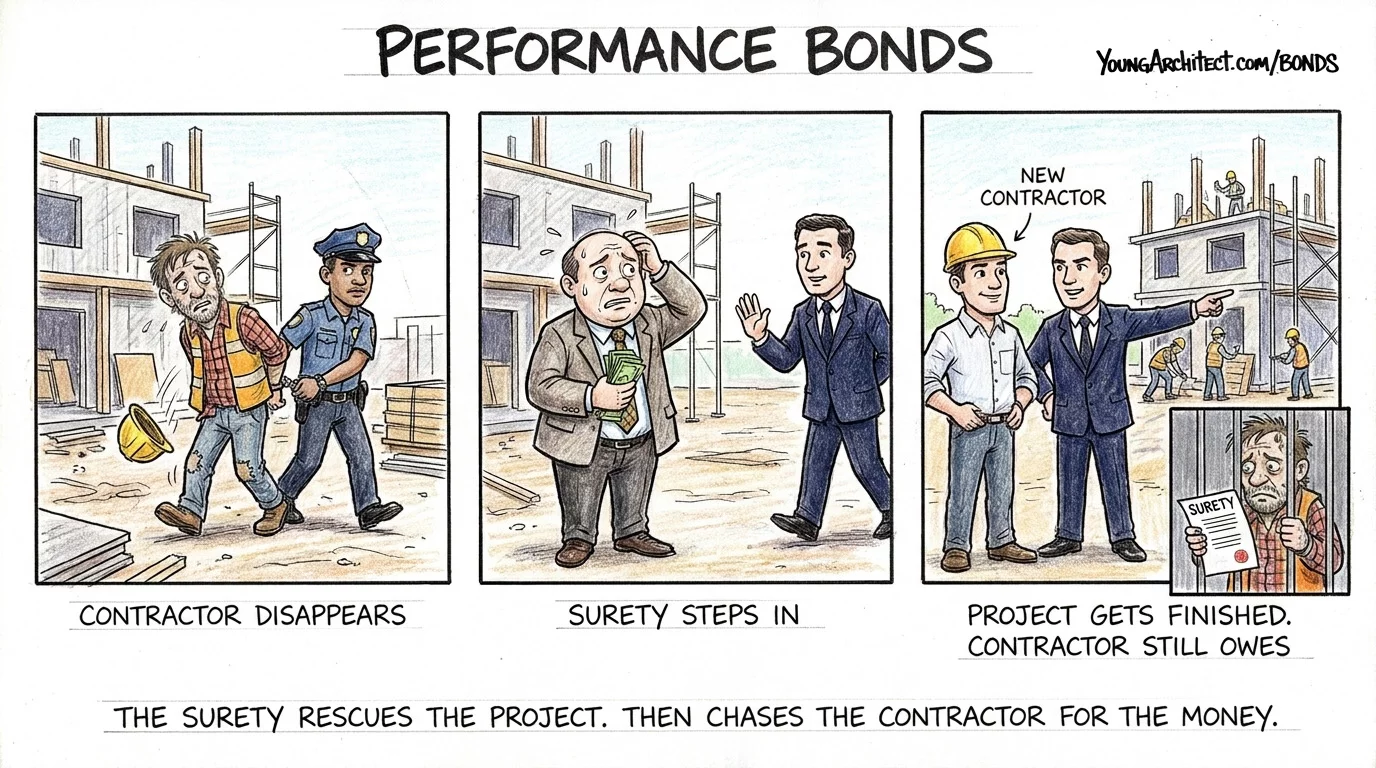
If a contractor goes bankrupt mid-project, the performance bond allows the owner to get the project finished. The surety company steps in and either hires a replacement contractor or finances the completion of the work.
Performance bonds are typically set at 100% of the contract value. That means for a $5 million project, the surety is guaranteeing the full $5 million.
The surety doesn’t just write a check, though. They usually have three options when a contractor defaults:
- Finance the original contractor to help them finish the job
- Hire a new contractor to complete the remaining work
- Pay the owner directly for the cost to complete (least common)
Understanding how performance bonds work is essential knowledge for architects who manage projects through construction administration, especially on public work where contractor default has serious consequences.
Payment Bonds
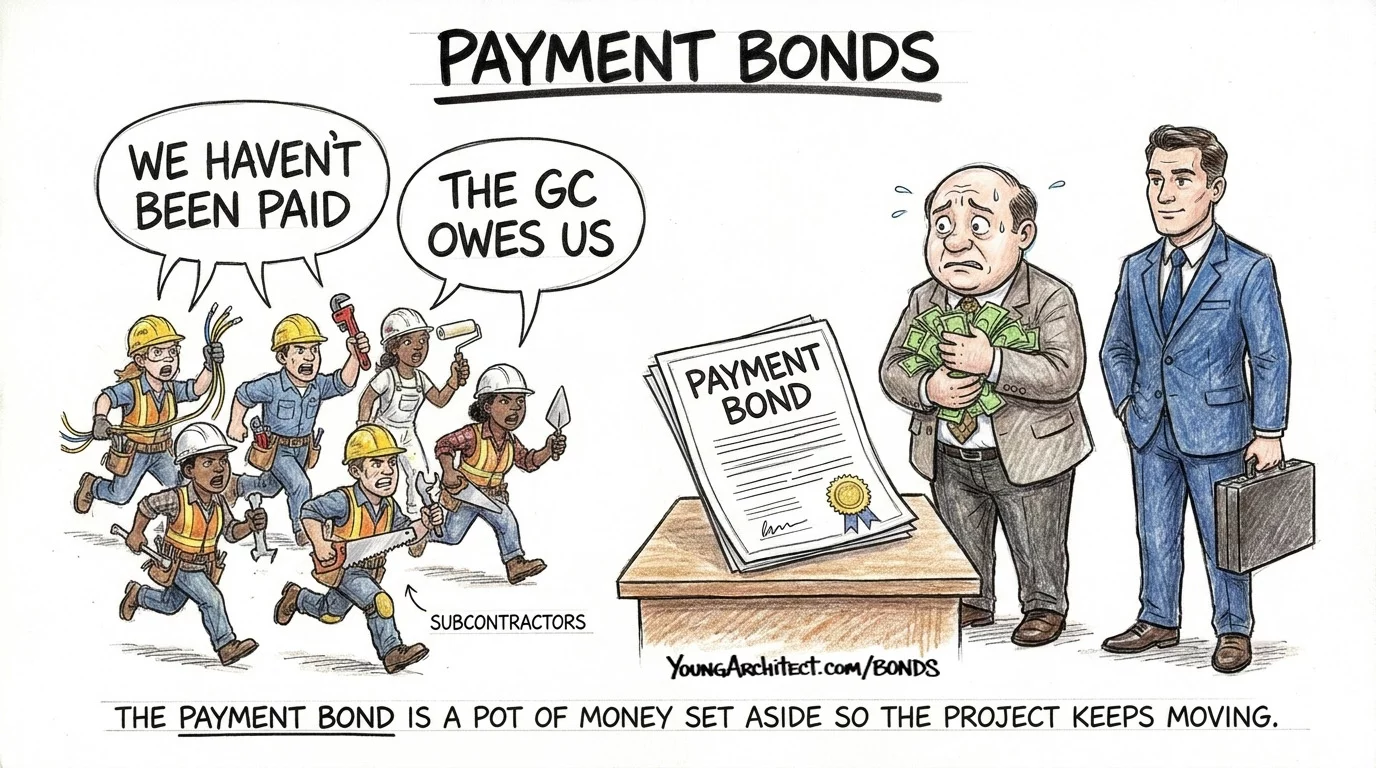
A payment bond ensures that subcontractors and suppliers get paid for their work and materials. This one protects the entire supply chain beneath the general contractor.
Here’s why this matters on public projects specifically. On private projects, if a sub doesn’t get paid, they can file a mechanics lien against the property. That’s a powerful legal tool.
But on public projects? You can’t put a lien on government property. That’s where the payment bond comes in. It gives subs and suppliers a way to recover their money without lien rights.
If a general contractor refuses to pay a subcontractor, the sub can file a claim against the payment bond to receive their money. This keeps the project moving and protects the people actually doing the work.
Payment bonds are often required alongside performance bonds, especially on public projects. They’re typically set at 100% of the contract value.
Maintenance and Warranty Bonds
A maintenance bond (also called a warranty bond) covers defects discovered after the project is completed. It guarantees that the contractor will come back and fix problems that arise during the warranty period.
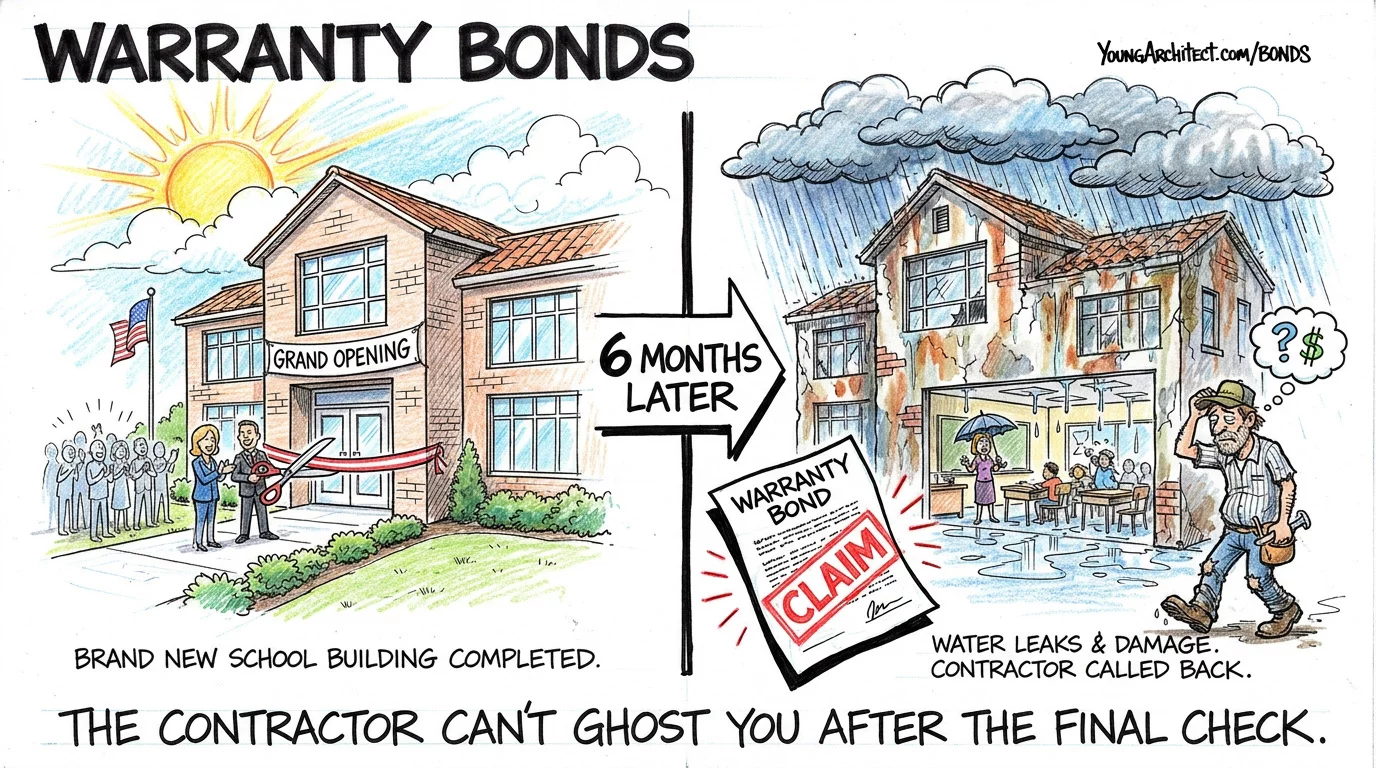
Real-world example: Six months after a school is completed, the roof starts leaking. The owner can file a claim against the warranty bond, and the contractor must return to fix the issues at no additional cost.
These bonds are especially important during project closeout when transitioning from construction to occupancy. They typically cover a period of one to two years after substantial completion.
Subdivision Bonds
Subdivision bonds guarantee that developers will complete public infrastructure like roads, sidewalks, and utilities in a new development.
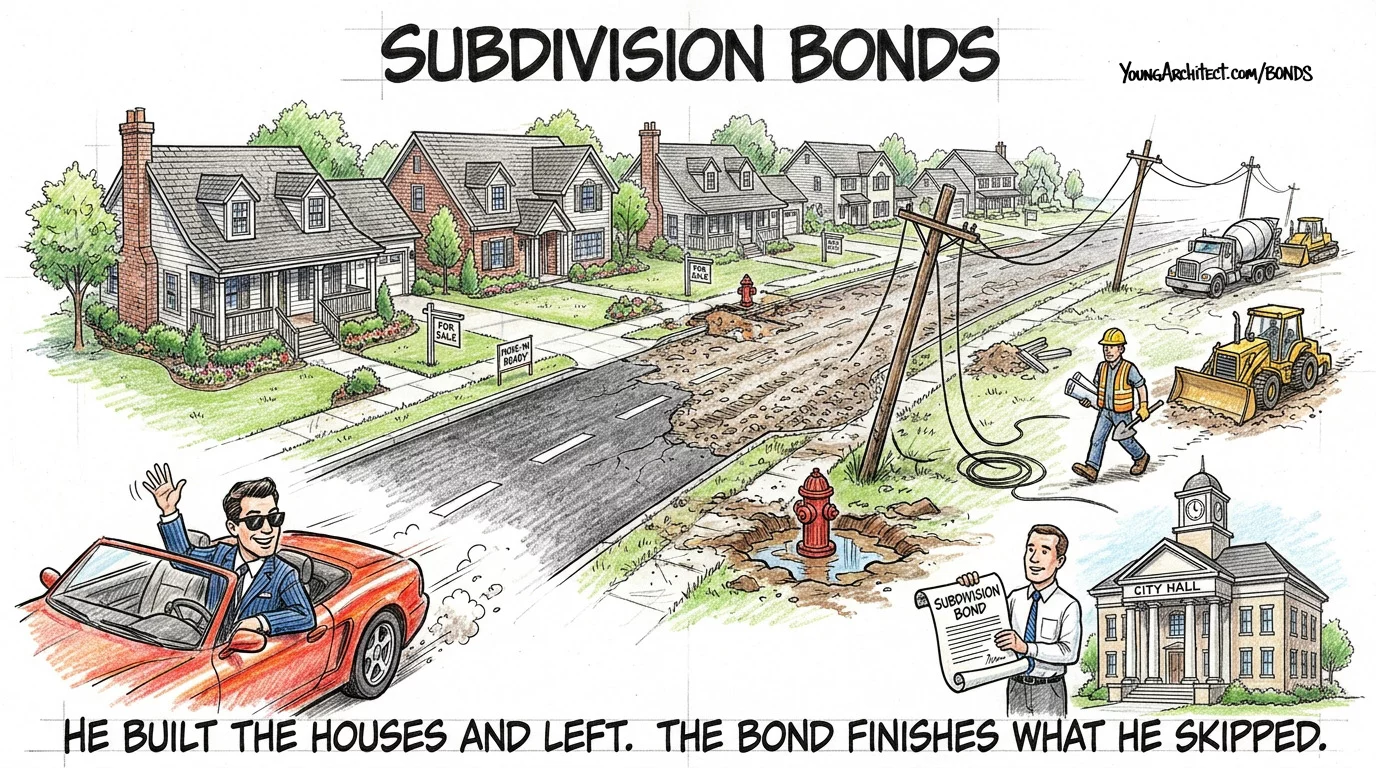
A developer builds a new neighborhood but hasn’t finished the promised public sidewalks.
The city can use the subdivision bond to hire another contractor to complete that work. This protects municipalities and future residents from developers who take the money and disappear.
License and Permit Bonds
License and permit bonds ensure that contractors comply with local regulations and building codes. They’re often required before a contractor can obtain a business license in a particular jurisdiction.
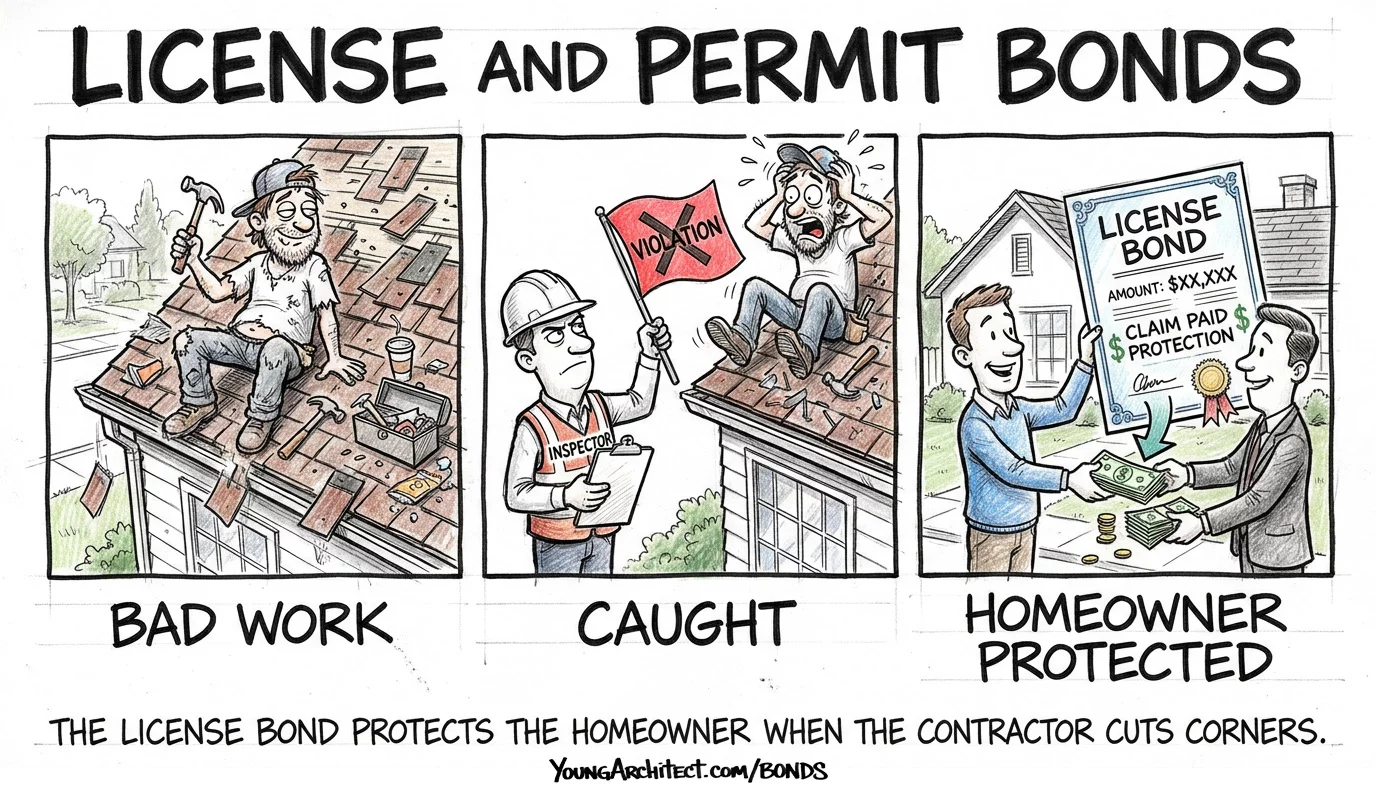
If a roofing company gets a license bond and then violates building codes, the bond will compensate affected homeowners.
These bonds help municipalities enforce standards and protect the public.
How Do Construction Bonds Work?
When a contractor purchases a bond, they’re not buying protection for themselves. They’re providing a guarantee to the project owner. This is the most misunderstood part of how bonds work.
Here’s the step-by-step process:
Step 1: Application. The contractor applies for a bond through a surety company. This involves submitting financial statements, work history, and project details.
Step 2: Underwriting. The surety evaluates the contractor’s financial stability, experience, and capacity. This is where the surety decides if the contractor is a reasonable risk.
Step 3: Premium payment. If approved, the contractor pays a premium, typically 1-3% of the bond amount for established contractors.
Step 4: Bond issuance. The surety issues the bond to the project owner. Now the guarantee is in place.
Step 5: Default (if it happens). If the contractor fails to meet their obligations, the owner files a claim against the bond.
Step 6: Surety steps in. The surety investigates the claim and, if valid, fulfills the obligation, either by finishing the work or paying for its completion.
Step 7: Recovery. The surety pursues the contractor to recover every dollar they paid out. This is called indemnification, and it’s what separates bonds from insurance.
This process is part of the broader quality assurance and quality control framework that helps ensure projects meet required standards.
When Are Construction Bonds Required?
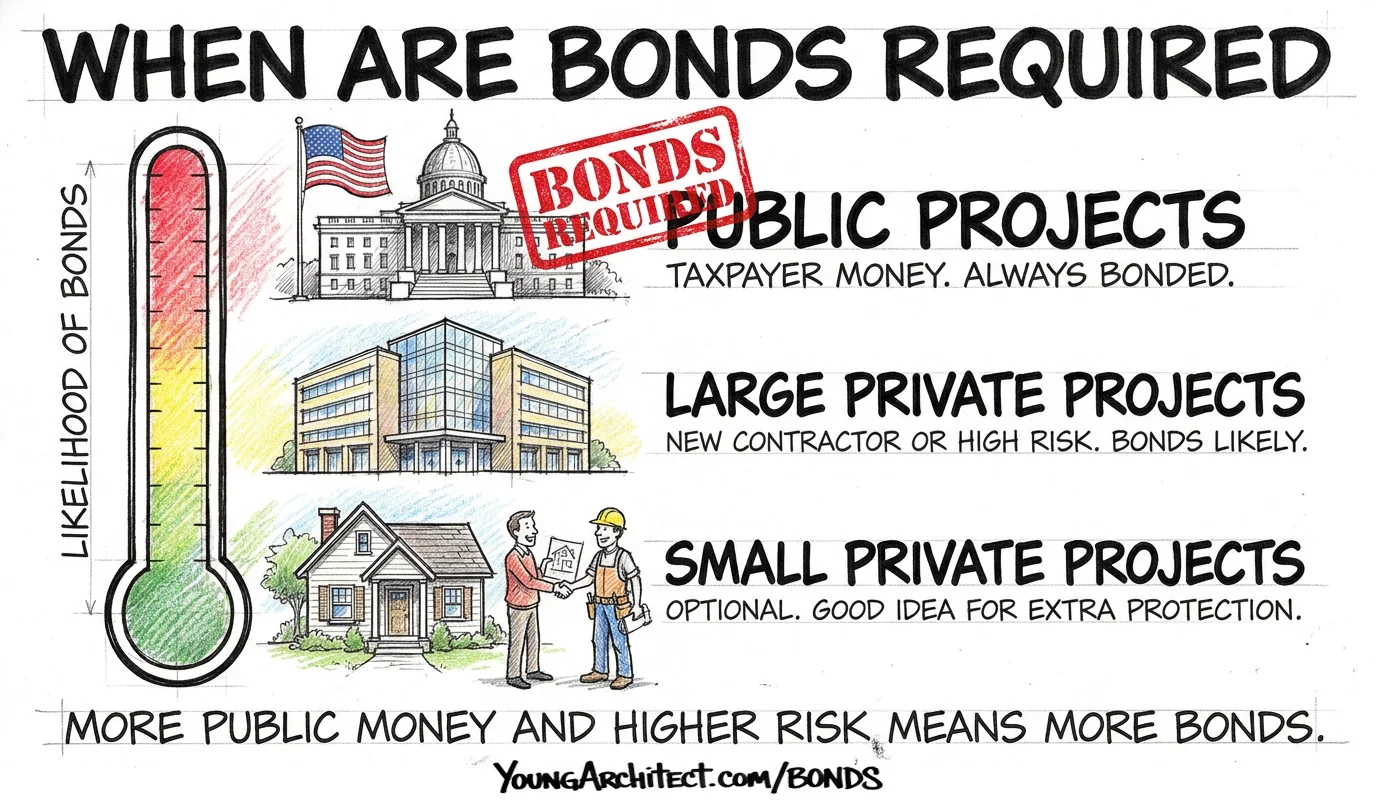
Not every project requires bonds, but they’re far more common than many professionals realize. The answer depends almost entirely on whether the project is publicly or privately funded.
Public Projects and the Miller Act
Government construction projects almost always require bonds because taxpayer money is at stake. At the federal level, the Miller Act mandates performance and payment bonds for any federal contract exceeding $150,000. This has been the law since 1935, and it’s one of the most important pieces of procurement legislation in the construction industry.
Most states have their own versions called “Little Miller Acts” that impose similar requirements on state and local government projects. The thresholds and specific requirements vary by state, but the principle is the same: protect public money.
This creates a significant difference in how public versus private clients approach risk management. Understanding these requirements is essential for any architect working on government projects.
Private Projects
Private projects don’t always require bonds by law, but many private owners request them anyway. This is especially common when:
- The project involves significant financial investment
- The owner is working with a new or unproven contractor
- The project is complex or high-risk
- A lender or financial institution requires bonds as a condition of financing
- The project is large-scale (typically over $1 million)
The more money at risk, the more likely bonds will be required, regardless of whether it’s a public or private project.
How Much Do Construction Bonds Cost?
Bond premiums typically range from 1-3% of the bond amount for established contractors with a solid track record and good credit.
For a $1 million project, that means the bond premium would be somewhere between $10,000 and $30,000. That cost is almost always built into the contractor’s bid price, which means the owner is indirectly paying for it through the contract amount.
Bond premiums of 1-3% might not sound like much, but neither does “just a small leak in the roof.” And we all know how that turns out.
Several factors determine what a contractor actually pays:
- Financial strength and credit history have the biggest impact on rates
- Experience and track record on similar projects
- Size and duration of the project
- Type of bond required (bid bonds are cheaper than performance bonds)
- Existing relationship with the surety company
For less established contractors or those with weaker financials, rates can climb to 3-5% or even higher. Some contractors with poor financial history may not be able to get bonded at all, which brings us to the next section.
Construction Bonding Requirements: How Contractors Get Bonded
Getting bonded isn’t automatic. Surety companies are putting their own money on the line, so they’re selective about who they’ll guarantee.
The bonding industry evaluates contractors using what’s known as the “Three C’s”:
Character looks at the contractor’s reputation, integrity, and track record. Have they completed projects on time? Do they have a history of claims and disputes? Are they known for honoring their commitments?
Capacity evaluates whether the contractor has the skills, equipment, personnel, and management ability to complete the project. A contractor who’s done ten $500,000 projects isn’t automatically qualified for a $10 million project.
Capital examines the contractor’s financial health. The surety reviews financial statements, cash flow, credit history, and working capital. This is usually the biggest factor in the decision.
New contractors often struggle to get bonded because they lack the track record and financial history surety companies want to see. Here’s how newer contractors can build their bonding capacity:
- Start with smaller bonds and build a successful track record
- Maintain clean financial statements and strong working capital
- Develop a relationship with a bonding agent who understands your business
- Keep your personal credit in good shape (sureties often look at personal finances too)
- Complete projects on time and on budget to build credibility
Building bonding capacity is a gradual process. But for contractors who want to work on larger projects, especially public projects, getting bonded is a non-negotiable requirement.
Common Bond Confusions
Let’s clear up some of the most persistent myths about how construction bonds work. These come up constantly in practice, and getting them wrong can lead to serious misunderstandings on a project.
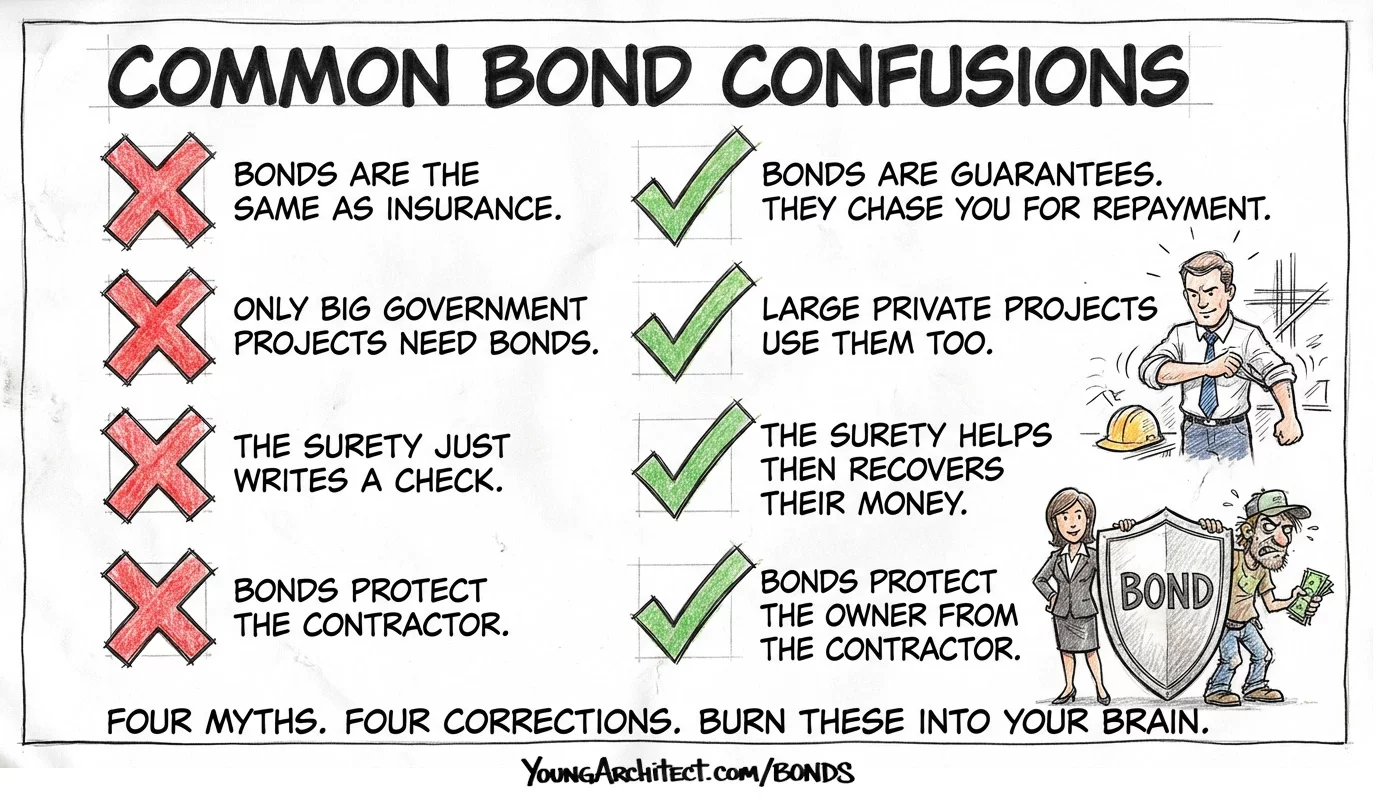
“Bonds protect the contractor.” Nope. Bonds protect the owner, subcontractors, and the project. Contractors purchase bonds because they’re required to, not because bonds benefit them directly. In fact, if a bond is called, it’s one of the worst things that can happen to a contractor’s career and finances.
“If a contractor defaults, the surety just writes a check.” It’s not that simple. The surety investigates the claim, evaluates options, and may try to help the original contractor finish the job before bringing in someone new. And whatever the surety pays, they’re coming after the contractor to recover it.
“Bonds only apply to big government projects.” While public projects almost always require bonds, many large private projects require them too. Any time significant money is at risk, bonds can be part of the equation.
“A letter of bondability is the same as having a bond.” This is a dangerous assumption. A letter of bondability just means a surety company said the contractor could potentially get a bond. It’s not an actual bond. Always verify that an actual bond has been issued.
Real-World Application: How Bonds Save Projects
Here’s a scenario from a real project that shows exactly why bonds matter.
On a private commercial building project, the general contractor and excavator were in a heated dispute over $200,000 worth of site work. The excavator filed a mechanics lien against the property, which threatened to cloud the title and halt the owner’s financing.
To clear the lien and keep the project moving, the general contractor obtained a lien discharge bond (sometimes called a bond to release lien). This surety product transferred the lien claim from the property to the bond, freeing the title. The legal dispute could continue separately while the project progressed uninterrupted.
This solution protected the owner from title complications, kept the schedule intact, and provided a pathway to resolve the payment dispute without shutting down the job site. It’s also a great example of how surety bonds extend beyond the standard bid, performance, and payment categories. Lien discharge bonds are a specialized tool, but they solve a very real problem that comes up on private projects where lien rights are in play.
This is exactly the kind of problem-solving that separates good construction professionals from great ones. Understanding your options, including how bonds can be deployed strategically, gives you tools that most people in this industry don’t even know exist.
Why Bonds Matter Beyond the Project
Bond knowledge connects to multiple areas of professional practice. Understanding how bonds work strengthens your ability to manage projects, advise clients, and navigate construction contracts.
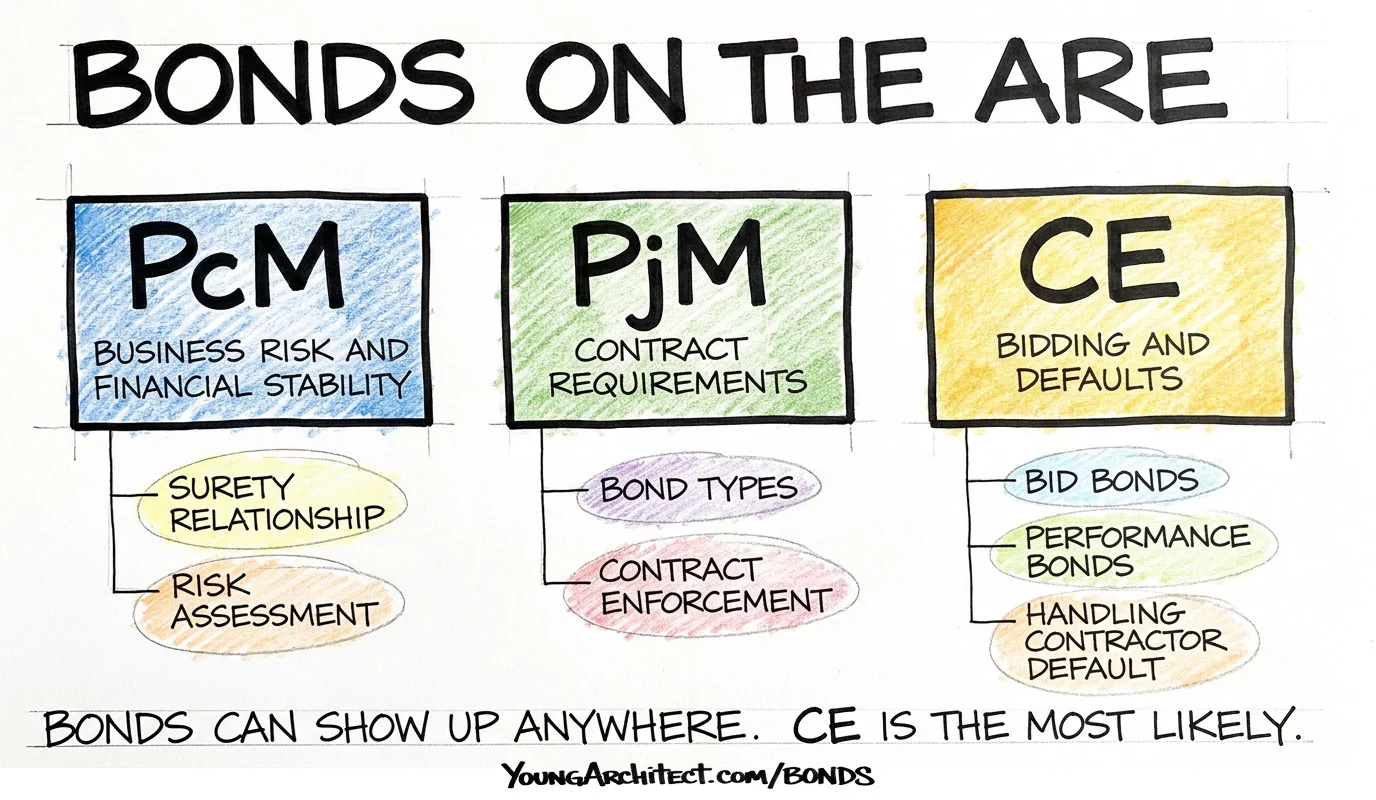
Understanding risk and financial stability is part of how architects evaluate project feasibility and advise clients on procurement strategy. Knowing which bonds protect which parties, and why they’re required, is foundational knowledge for anyone managing projects. This connects to the kind of thinking covered in PcM 101.
Contract requirements and project delivery directly involve bonds. When you’re reviewing contract documents or helping a client choose between project delivery methods, understanding bond requirements shapes the conversation. This is the kind of knowledge that PjM 101 builds on.
Construction administration and contractor default is where bond knowledge becomes most practical. Knowing what happens when a bonded contractor walks off the job, how payment bonds protect subs, and how the surety process works gives you real tools for managing projects through difficult situations. CE 101 covers this in depth with practice questions that test these concepts.
The key principles that matter in practice:
- Public projects require bonds. When you identify a project as publicly funded, the entire chain of procurement, bonding, and documentation requirements follows.
- Bonds protect the owner and the project, not the contractor.
- When a contractor defaults, the surety company steps in to help complete the work, then recovers costs from the contractor.
- Bonds and insurance serve fundamentally different purposes.
All of these courses are available through the ARE 101 Membership, and if you want structured coaching with accountability, ARE Boot Camp provides weekly guidance and community support throughout your entire licensing journey.
It’s also worth noting that bonds are part of the project delivery body of knowledge covered in the CDT® certification. If you’re building your understanding of how projects get delivered from procurement through closeout, CDT 101 provides a solid foundation that complements your ARE preparation.
Frequently Asked Questions About Construction Bonds
How much do construction bonds typically cost?
Bond premiums typically range from 1-3% of the bond amount for established contractors with good credit and a strong track record. New contractors or those with poor financial history may pay 3-5% or more. The cost depends on the contractor’s financials, the project size, and the type of bond required.
What is a performance bond in construction?
A performance bond guarantees that a contractor will complete a project according to the contract terms. If the contractor defaults, the surety company steps in to finish the work, either by helping the original contractor, hiring a replacement, or paying the owner directly. Performance bonds are typically set at 100% of the contract value.
What is a payment bond in construction?
A payment bond ensures that subcontractors and material suppliers get paid for their work on a project. This is especially critical on public projects where subs can’t file mechanics liens against government property. If the general contractor refuses to pay, subs can file a claim against the payment bond.
Who pays for a construction bond?
The contractor pays the bond premium, but the cost is almost always included in their bid price. So the project owner is indirectly paying for it through the total contract amount. Bond premiums are considered a cost of doing business for contractors.
Are construction bonds required on all projects?
No. Bonds are almost always required on public projects due to the Miller Act (federal) and Little Miller Acts (state/local). Private projects may or may not require bonds depending on the owner’s preference, project size, and risk level. Lenders sometimes require bonds as a condition of financing.
What is the difference between a bond and insurance in construction?
Insurance protects against unforeseen risks and doesn’t require repayment after a claim. A surety bond guarantees performance and the surety will recover costs from the contractor. Think of insurance as a safety net and a bond as a co-signed loan. The contractor always remains financially responsible when a bond is called.
How does a contractor get bonded?
Contractors apply through a surety company, which evaluates their character, capacity, and capital. The surety reviews financial statements, credit history, work experience, and management capabilities. Contractors with strong financials and a solid track record get better rates and higher bonding limits.
What happens if a bonded contractor defaults?
The surety company investigates the claim and then typically takes one of three actions: help the original contractor finish, hire a replacement contractor, or pay the owner for the cost to complete the work. After resolving the situation, the surety pursues the contractor to recover all costs.
Are bonds available to small or new contractors?
Yes, but it can be more challenging and expensive. New contractors typically need to start with smaller bonds, maintain clean financial records, and build a track record of successful project completions. Working with an experienced bonding agent can help newer contractors navigate the process and gradually increase their bonding capacity.
How do I verify a contractor is properly bonded?
Ask for a copy of the bond certificate and contact the surety company directly to verify it’s active. Never accept a “letter of bondability” as proof of an actual bond. A letter of bondability is just a statement that the contractor could potentially get a bond. It’s not a guarantee.