
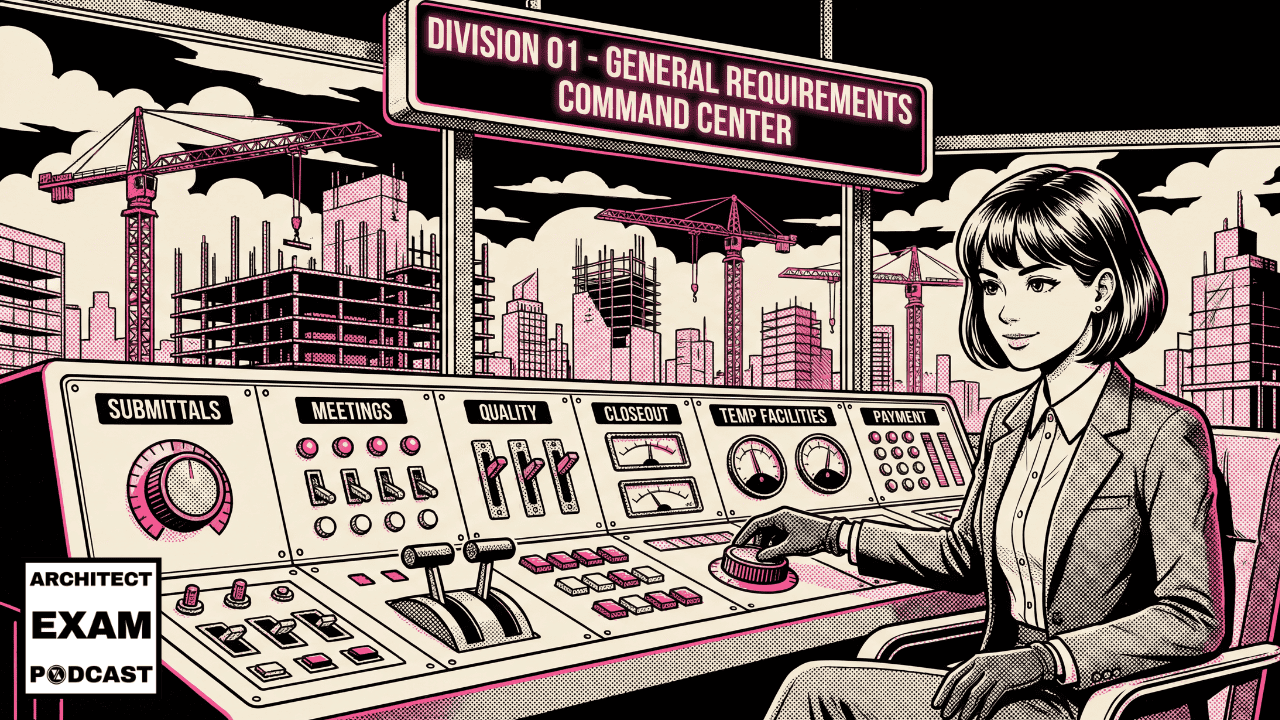
When you open a set of specifications, you probably flip straight to the division you care about. Concrete? Division 03. Steel? Division 05. Finishes? Division 09. But general requirements, the very first division in the project manual, is the one almost everyone skips. And that’s a problem, because Division 01 is the rulebook that governs how everything else on the project actually works.
This podcast is also available on YouTube, Spotify, and Apple Podcasts
What Are General Requirements?
General requirements is another name for Division 01 of the project manual. Same thing, two names. You’ll hear people say “Division 01” and “general requirements” interchangeably in practice, and throughout this post we’ll do the same.
But before we get into what’s inside Division 01, let’s zoom out and look at where it sits in the big picture.
A project manual is organized into three main chunks:
- Division 00 is your Procurement and Contracting Requirements. That’s bidding documents, contract forms, and contract conditions. Everything that establishes the deal between the owner and the contractor.
- Division 01 is General Requirements. That’s what we’re here to talk about.
- Divisions 02 through 49 are the Technical Specifications. That’s the actual building stuff: concrete, masonry, steel, finishes, mechanical, electrical, all of it.
So general requirements in construction sit right between the contract setup and the technical specs. Division 1 specifications govern every trade on the project, making Division 01 the bridge between the two. Here’s a way to think about it…
Imagine you’re sitting down to play a board game.
Divisions 02 through 49 are the pieces and cards on the table.
Division 00 is the stuff that determines who’s playing and what’s at stake.
But Division 01? That’s the rulebook. Without it, you’ve got a bunch of people at the table with pieces everywhere and no idea how the game actually works.
One important distinction worth noting here:
Division 00 is not part of the specifications. It’s procurement and legal.
Division 01, even though it feels administrative, is part of the specifications.
That’s a subtle but important difference, especially when exam questions ask you about what counts as a technical specification versus a contracting requirement.
Whether you’re studying for the Architect Registration Examination or any CSI certification, understanding where general requirements fit in the project manual is foundational knowledge you’ll use over and over again.
General Conditions vs General Requirements
This is the single most common point of confusion in specifications, and it trips up almost everyone.
People mix up general conditions and general requirements all the time. In the office, on job sites, in study groups. Our own Podcast host Emily caught herself saying “general conditions” on camera when she meant “general requirements.” It’s that easy to mix up.
But they are not the same thing, and understanding the difference is critical, especially on the exam.
Before we explain the difference, here’s the most important thing to know. If you take nothing else away from this post, take this:
Both general conditions and general requirements are Contract Documents.
They both live inside the same project. This is not a situation where one is “the contract” and the other isn’t. They are both legally binding parts of the contract.
The difference is not about which one matters more. The difference is about what they do.
General conditions in construction define the legal rights and responsibilities of all parties. They are the Constitution of the project.
Think of AIA A201 Conditions of the Contract. This is the document that defines relationships and rights.
- Who is in charge?
- Who pays for insurance?
- How do you terminate the contract?
- What happens when there’s a claim or a dispute?
- What is the architect’s role?
This is heavy legal stuff, typically written by lawyers. You don’t casually edit your general conditions.
For a deeper look at what’s inside A201 and how it coordinates responsibilities across parties, AIA’s overview of A201 General Conditions is a helpful resource.
Construction general requirements are the Operating Manual of the project.
This is Division 01 General Requirements. Think of it as the document that defines procedures.
- How do you file the paperwork?
- Where do the dumpsters go?
- What format do the submittals need to be in?
- How do project meetings run?
- What happens at closeout?
It is written by architects and specifiers, and it’s project-specific. It changes from job to job based on what that particular project needs.
The Constitution tells you your rights.
The Operating Manual tells you the rules.
Here’s a memory trick that helps keep these straight:
The C in Conditions stands for Contract rights. The R in Requirements stands for Rules of the job site.
For the exam, this distinction will come up. If a question asks about contract obligations and rights, that’s general conditions territory. If a question asks about project procedures and administration, that’s Division 01.
And remember: both are Contract Documents. Don’t fall into the trap of thinking only one of them is part of the contract.
Test yourself: The contractor hits hidden rock during excavation and needs more money.
Which document tells them how to request additional compensation? That’s Division 01, Price and Payment Procedures.
Which document gives them the right to request it? That’s General Conditions, under concealed conditions. See the difference?
Division 01 Is Your Project’s Global Settings
Here’s the concept that makes all of this click.
Think of Division 01 as the global settings for the entire project.
You know how on your phone, you can go into Settings and change something like your notification preferences, and it applies to every single app on your phone? That’s what Division 01 does for a construction project.
Every technical specification in Divisions 02 through 49 has a “Part 1 – General” section. And most of the time, that Part 1 points right back to Division 01 for the rules.
So when you’re reading the concrete spec, Section 03 30 00, and it says “submit shop drawings per Section 01 33 00,” that’s Division 01 running the show behind the scenes.
And here’s what makes it so powerful. If you change a rule in Division 01, like changing the submittal review period from 10 days to 14 days, that change applies to every single trade on the project. Concrete, steel, finishes, mechanical, electrical, all of them.
One change, global impact.
Division 01 is the only specification division that governs all the others. Every trade, every subcontractor, every material supplier has to follow it. That’s why it matters so much.
What’s Inside Division 01?
Now let’s walk through the major sections inside general requirements. These are the building blocks of your project’s operating manual. The section numbers below follow the CSI MasterFormat organization system.
01 10 00 – Summary
This is where you find the project description, any work restrictions, and things like owner-furnished items.
If the project is being built in phases, that’s in here. If the owner is buying certain equipment and having the contractor install it, that’s in here too.
And if the owner needs to occupy part of the building before the project is finished, like keeping a pharmacy open during a hospital renovation, those partial occupancy requirements live here as well.
Exam tip: Partial occupancy questions may show up. If a question asks where you’d find restrictions on the owner moving in before the project is done, this is your answer.
01 20 00 – Price and Payment Procedures
This is where alternates, allowances, and unit prices are documented. It’s also where the Schedule of Values (SOV) requirements live, including what format the payment application needs to follow (such as AIA G702).
Here’s an important distinction. Division 01 does not tell you how much the contractor gets paid or when the check is cut. That’s in the Agreement, which is Division 00.
What Division 01 tells you is what the payment application needs to look like. What form to use, what supporting documents to include, what the process is. It’s the administrative side of getting paid, not the monetary side.
Exam tip: Unit prices are often used when you have unknown quantities on a project, like when you don’t know how much rock you’re going to hit during excavation. The cost per unit (say, $50 per cubic yard) gets established in the Bid, which is Division 00. But the method of measurement, how you actually prove you dug 10 cubic yards and not 8, that’s defined here in Division 01.
01 30 00 – Administrative Requirements
This is the engine that keeps the project running day to day.
How often do project meetings happen? What’s the construction submittal process? What progress reports does the contractor owe the team?
How are RFIs (Requests for Information) handled, including submission procedures, response timelines, and what qualifies as a legitimate RFI?
If you’ve ever been on a project where nobody knew when meetings were or what format submittals were supposed to be in, it’s because someone didn’t read this section.
01 40 00 – Quality Requirements
Testing, inspection, mock-ups, and reference standards.
Who’s paying for the testing? What industry standards apply? When do we need to build a mock-up before the full installation?
This connects directly to the broader concepts of quality assurance and quality control that show up throughout the project lifecycle.
Exam tip: Generally, the owner pays for the initial testing, because they want to verify they’re getting what they paid for. But if that test fails, the contractor pays for the re-testing. Owner pays first, contractor pays for the fix. That distinction lives right here in Division 01.
01 50 00 – Temporary Facilities and Controls
This is where general requirements get really project-specific.
Temporary power, temporary water, fencing, weather protection, site security.
If the project is in an area with extreme weather, hurricane preparedness plans go here. If an HOA restricts construction hours, no work before 8 AM, no work on Sundays, those rules get documented here too.
This is where the real-world conditions of your specific project get written down.
01 60 00 – Product Requirements
This covers substitution procedures and product options.
How does a contractor request a substitution? What does “or equal” actually mean?
Here’s a classic exam trap to watch for.
There’s a big difference between a substitution request during bidding and one during construction.
If a contractor wants to swap a product before the contract is signed, during the bidding phase, the rules for that are in the Instructions to Bidders, which is Division 00.
But if they need to swap a product during construction because of a supply chain issue or availability problem, that process is governed by Division 01.
Know the difference between a bidder inquiry and a substitution request. That’s the kind of thing that shows up on an exam.
01 70 00 – Execution and Closeout Requirements
This is the finish line. Cutting and patching, cleaning, closeout submittals, warranties.
What does the contractor owe the owner at the end of the project? How does the construction closeout process officially wrap up?
One detail that often gets overlooked: attic stock and spare parts. Division 01 defines whether the owner gets extra carpet tiles, paint cans, or replacement materials at the end of the job. It sounds minor, but when it’s not specified, it creates real fights during project closeout.
01 91 00 – Commissioning
This isn’t just checking if the AC turns on. Commissioning in construction is the process of verifying that the building actually performs the way the owner intended.
If you see an exam question about the Owner’s Project Requirements (OPR), that connects right back here to Division 01.
For a detailed breakdown of the full commissioning process from planning through occupancy, the Whole Building Design Guide’s commissioning overview is an excellent reference.
This is a hot topic on ARE 5.0 and CSI Certifications right now, so keep it on your radar.
And while we’re in this territory, it’s worth noting that sustainability and green building requirements, things like LEED and WELL compliance, also live in Division 01 (Section 01 81 00). This reinforces the idea that Division 01 is where project-wide performance standards are enforced, not just administrative procedures.
Why General Requirements Matter for the Exam
Don’t make the mistake of thinking Division 01 is just a PDD topic.
General requirements knowledge shows up across multiple exams. You might get a question about submittal procedures. That’s Division 01. You might be asked about closeout requirements. That’s Division 01. Each of the CSI Certifications will make sure you understand the difference between general conditions and general requirements.
When things go wrong on a project, when submittals fall through the cracks, when quality is inconsistent, when closeout drags on for months, it’s almost always because someone didn’t follow Division 01. Or because Division 01 wasn’t written well in the first place.
Understanding where information lives and why it lives there is what separates people who memorize facts from people who actually get it. And if you’re preparing for any of the architecture licensing exams, that deeper understanding is what’s going to help you choose the right answer under pressure.
The International Code Council’s IBC resources are also a good reference for understanding how codes and specifications work together in practice.
If you want structured help working through the ARE, the ARE Boot Camp coaching program gives you a clear roadmap, weekly accountability, and support until you’re fully licensed.
And for self-paced study, our ARE 101 course membership covers all six divisions with practice questions and case studies.
If you’re pursuing CSI certifications, CDT 101 and CCCA 101 breaks down specifications and project delivery in a way that’s designed to help you pass.
Frequently Asked Questions
What are general requirements in construction?
General requirements, also known as Division 01, are the administrative and procedural specifications that govern how a construction project operates. They cover everything from submittal procedures and payment application formats to quality standards and closeout requirements. Unlike the technical specifications in Divisions 02 through 49 that describe what gets built, general requirements describe how things get built.
What is Division 1 in construction?
Division 1 (often written as Division 01 in modern MasterFormat) is the first division of the specifications section in a project manual. It contains the general requirements that apply to every trade and every other specification division on the project. Think of it as the global settings for the entire project. Every subcontractor, supplier, and trade is required to follow Division 01.
What is the difference between general conditions and general requirements?
General conditions (like AIA A201) define the legal rights and relationships on a project, such as who is responsible for insurance, how disputes are resolved, and what the architect’s authority is. General requirements (Division 01) define the procedures and rules for how the project runs day to day, such as submittal formats, meeting schedules, and closeout requirements. Both are Contract Documents, but general conditions are the Constitution while general requirements are the operating manual.
What are general conditions in construction?
General conditions are the legal framework of a construction contract, typically based on a standard document like AIA A201. They establish the rights, responsibilities, and relationships between the owner, contractor, and architect. They cover things like payment terms, insurance obligations, dispute resolution, and contract termination. General conditions are written by lawyers and rarely change from project to project, unlike general requirements which are project-specific.
What is included in general conditions?
General conditions typically include the definitions of key contract terms, the roles and responsibilities of each party, payment procedures and timing, insurance and bonding requirements, procedures for changes and claims, dispute resolution methods, and conditions for contract termination. The most widely used general conditions document in the U.S. is AIA A201, which serves as the legal backbone of most construction contracts.
What is commissioning in construction?
Commissioning is the process of verifying that a building’s systems actually perform the way the owner intended. It goes beyond simply checking if equipment turns on. Commissioning traces performance back to the Owner’s Project Requirements (OPR) and ensures the building delivers on those goals. Commissioning requirements are typically documented in Division 01, Section 01 91 00, and it’s a growing topic on the ARE (particularly PPD and PDD) and the CDT exam.
What is the construction closeout process?
The construction closeout process is the final phase of a project where the contractor completes remaining work, delivers required documentation, and hands the building over to the owner. Division 01, Section 01 70 00 defines what the contractor owes at the end, including closeout submittals, warranties, operation and maintenance manuals, record drawings, and attic stock. A well-written closeout section in general requirements prevents the project from dragging on for months after substantial completion.
Who writes the general requirements?
General requirements are typically written by the architect or specifier because they are project-specific procedural rules that change from job to job. This is different from general conditions, which are legal documents often prepared by lawyers or adopted from standard AIA forms like A201. Understanding who is responsible for writing each document is an important distinction for PjM and CE exam questions.
Is Division 01 part of the contract?
Yes. Division 01 is part of the specifications, which are Contract Documents. Both general conditions and general requirements are legally binding parts of the contract. A common exam trap is thinking that only the general conditions are “the contract” while Division 01 is just administrative. That’s not the case.
Quick Recap
Division 01 is general requirements. It’s the rulebook for the project, not the contract rights. That’s general conditions. But they’re both Contract Documents.
Division 01 is the global settings that govern every other division. Change something here and it ripples through every trade on the project.
If you’re skipping general requirements when you study or ignoring it in practice, you’re missing one of the biggest pieces of the puzzle.
Want to keep learning about specifications and how they show up on the exam? Check out our posts on MasterFormat, construction specification types, and drawings vs specifications.