
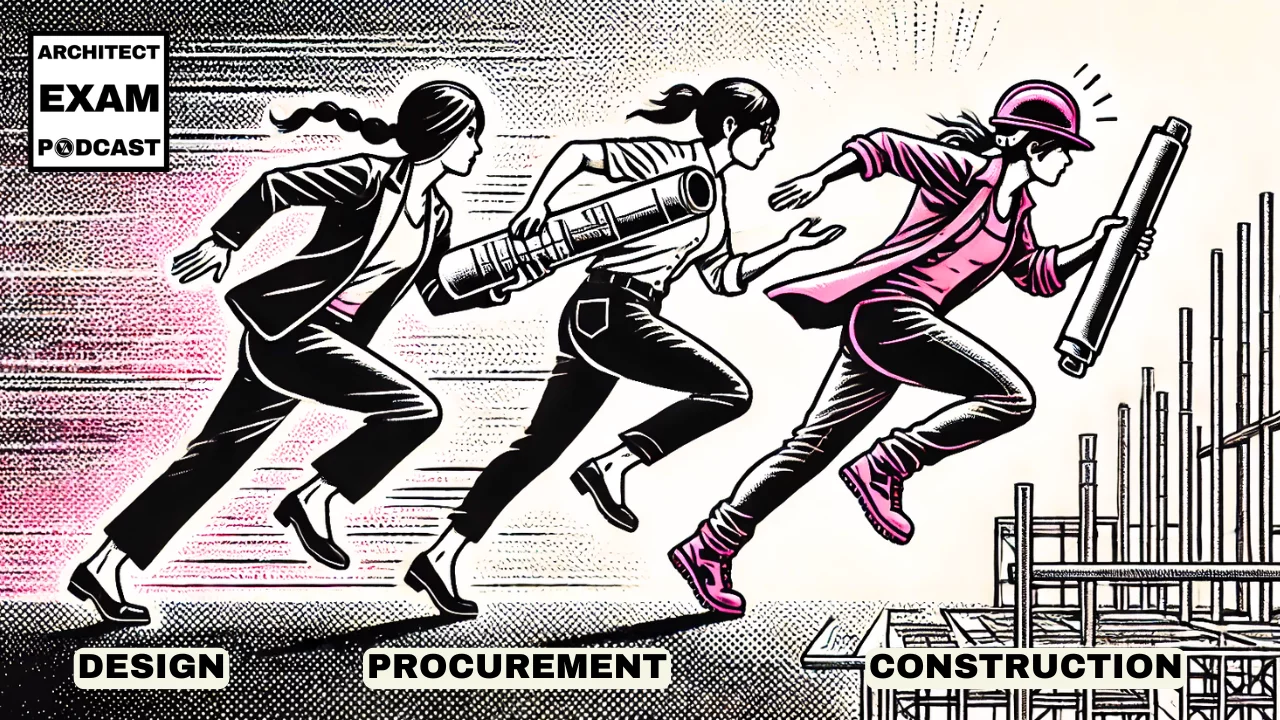

The construction bidding process on public projects follows a strict, regulated path from completed drawings to breaking ground. This guide walks through all eight stages of the construction bid process, covering bid preparation, sealed bidding, bid tabulation, evaluation, and award, so you understand exactly how public procurement works and why it matters for the ARE and your career.
This podcast is also available on YouTube, Spotify, and Apple Podcasts
The Black Box Between Design and Construction
Have you ever wondered what happens after architectural drawings are completed, but before construction actually begins? For many architects and design professionals, especially those who have worked primarily on private or residential projects, the public bidding process remains a mysterious “black box.”
I’ve had the unique opportunity to see this process from both sides. First as an architect working on public projects, and later as a government project manager responsible for hiring architects, contractors, and engineers. This dual perspective helped me understand the full procurement journey and the reasoning behind its many rules and requirements.
In a previous article about public vs. private architecture clients, we discussed how your client type dramatically changes project dynamics. The bidding process in construction is perhaps where these differences are most apparent.
This knowledge matters for three key groups:
- ARE candidates preparing for exams (particularly the Construction & Evaluation division)
- AEC professionals new to public projects
- Experienced professionals transitioning from private/residential work
The culture shock can be intense when moving from private to public work. What once was accomplished with a phone call and a handshake now involves formal advertisements, strict deadlines, public bid openings, and enough paperwork to wallpaper your entire office. Twice. Let’s demystify how the bidding process works together.
Design-Bid-Build Timeline
Let’s start with what everyone wants to know: how long will this take?
While every project is different, the typical public project using the design bid build process takes approximately 2-3 months from completed drawings to breaking ground. Larger projects can take considerably longer.
Here’s the general timeline breakdown for the construction procurement process:
- Bid document preparation: 2-4 weeks
- Advertising and bidding period: 3-6 weeks
- Evaluation and award: 1-2 weeks
- Contract signing and pre-construction: 1-3 weeks
Throughout this process, several key players work together:
- The owner’s procurement department acts as the legal gatekeepers of the process
- Owner’s project managers oversee the technical aspects
- Design professionals provide clarifications during bidding
- Contractors and subcontractors prepare and submit their bids
- Oversight bodies like city councils provide final approvals
Most people don’t fully understand the critical role of the procurement department. These specialists in contracting law ensure the government procurement process follows all legal requirements.
Think of them as the construction world’s equivalent of baseball umpires. They don’t play the game, but they make sure everyone follows the rules. And nobody’s particularly happy to see them until they need a call in their favor.
They maintain fairness, prevent favoritism, and make sure taxpayer money is spent properly. They handle advertisements, receive bids, and enforce all bidding rules.
This entire process is governed by laws and regulations like the Federal Acquisition Regulation for federal projects or state-specific procurement codes designed to ensure:
- Fairness – giving all qualified contractors an equal chance
- Transparency – making the process open to public scrutiny
- Accountability – ensuring proper use of public funds
- Competition – obtaining the best value for taxpayer dollars
Now let’s explore each stage of this construction bid process in detail.
8 Stages of the Construction Bidding Process for Public Projects
1. Bid Preparation
Once architectural drawings are complete, they need to be transformed into comprehensive bidding documents. This transformation involves several critical steps:
- The procurement department adds legal front-end documents and bonding requirements
- The design team finalizes technical specifications which are essential for proper bidding
- Understanding the differences between construction specification types is critical for preparing comprehensive bidding documents in construction
- The specifications must align with Division 01 General Requirements, which establish the administrative rules that govern every trade during construction
- The project may be divided into a base bid with alternates to provide budget flexibility
This preparation phase is crucial because poorly detailed documents create opportunities for contractors to find ambiguities. Understanding the relationship between drawings and specifications is essential for creating clear, comprehensive documents that help prevent low initial bids followed by expensive change orders during construction.
A well-organized construction bid package typically includes the invitation to bid, technical specifications, drawing sets, addenda forms, and a detailed bid schedule that outlines key milestones.
2. Bid Advertisement and Invitation to Bid
With bid documents prepared, the project must be advertised to potential bidders. Different levels of government use different methods to announce government construction projects for bid:
- Federal projects are posted on SAM.gov
- State projects use state procurement websites, often governed by standards from organizations like the National Association of State Procurement Officials
- Local projects appear in official newspapers, city websites, and plan rooms
The formal advertisement for a design-bid-build project is called an Invitation to Bid (ITB). This is different from a Request for Proposals (RFP), which is used for qualifications-based selection.
An ITB in construction is straightforward: the owner publishes the project, and contractors compete on price. The lowest responsive, responsible bidder wins. There’s no scoring of qualifications, no interviews, no design creativity points. Just price.
These advertisements must include specific information like project descriptions, submission deadlines, document access instructions, bond requirements, and pre-bid meeting details. This stage is what starts the bidding process officially.
Time periods for advertisements are strictly regulated by law. Federal projects typically require at least 30 days of public bidding, while states often mandate 3-4 weeks minimum to ensure fairness.
3. Pre-Bid Conference and Bidding Period
During the bidding period, a pre-bid conference (also called a pre-bid meeting) is typically held. This crucial gathering brings together contractors, the owner, architect, subcontractors, and suppliers. It allows contractors to see the site, meet the team, and ask questions before finalizing their bids.
Some projects make the pre-bid conference mandatory, meaning a contractor who doesn’t attend can’t submit a bid. Others keep it optional but strongly recommended. Either way, a site visit is usually part of the meeting so contractors can evaluate existing conditions firsthand.
As questions arise during the bidding period, a formal process must be followed:
- Questions are submitted to the procurement official, not directly to the architect
- The architect cannot share information unless it goes through procurement
- When clarifications are needed, formal addenda are issued to modify the bid documents
Most jurisdictions prohibit issuing addenda within 72 hours of bid opening without extending the deadline. This gives bidders adequate time to finalize their prices and prevents last-minute changes that could disadvantage some bidders.
Many contractors wait until all addenda have been issued before seriously preparing their construction bids to avoid rework. During this time, general contractors also collect subcontractor bids for various trade packages.
4. Sealed Bidding and Bid Submission
Sealed bidding is the formal procurement method used on most public construction projects. Contractors submit their bids in sealed envelopes that are opened publicly at a specified date and time. The sealed format prevents any bidder from knowing competitors’ prices before submission, which is what makes the competitive bidding process fair.
When bid day arrives, the rules are strict and unforgiving:
- Bids must be sealed and include bid security (usually 5-10% of the bid amount)
- Submissions must arrive before the deadline – even one minute late can disqualify a bid
- There are no exceptions or grace periods. In the public bidding world, “fashionably late” isn’t a concept. It’s more like “permanently disqualified.”
Bid security is the financial guarantee that a contractor will honor their bid if selected. It typically takes the form of a bid bond, cashier’s check, or certified check. If the winning contractor refuses to sign the contract, the owner keeps the bid security to cover the financial difference between that contractor’s bid and the next lowest bidder’s price. That spread can be significant, which is why bid security exists in the first place. This is where understanding construction bonds becomes essential, since bid bonds, performance bonds, and payment bonds each serve different purposes during procurement and construction.
The bid opening is a public event where procurement officials open each sealed submission, reading aloud the bidder’s name and total price. Anyone can attend: contractors, subcontractors, the public, even competing firms.
Officials record all bids in a bid tabulation, noting the apparent low bidder while emphasizing that this determination is preliminary until all requirements are verified.
The atmosphere at bid openings can be tense as general contractors discover their ranking among competitors and subcontractors learn which general contractor might be awarded the project. You can practically hear contractors’ hearts pounding when the numbers are read aloud.
5. Bid Tabulation and Evaluation
After the opening, evaluation begins with two key assessments:
First, the responsiveness check confirms:
- Each bid included all required documents
- All addenda were acknowledged
- All proper signatures are present
Next, the responsibility determination for the apparent low bidder verifies:
- They have the proper license
- They have the financial capacity for the project
- Their performance history is satisfactory
This is the core of the competitive bidding process: the lowest responsive bid from a responsible bidder wins. We’ll break down what those terms actually mean in a dedicated section below.
Officials also check all calculations and determine which alternates to accept based on the budget.
Competitors typically have about 5 business days to protest if they believe proper processes weren’t followed. If a protest leads to a formal claim or dispute, it can extend the evaluation period significantly. The entire evaluation takes 1-2 weeks, longer if protests arise, and culminates in posting an “Intent to Award” document.
During this phase, if you decide to withdraw your bid, you may lose your bid bond, which is why contractors must be certain of their pricing before submission.
6. Contract Formation
Now it’s time to form the contract. Interestingly, public projects often don’t use standard AIA contracts. Instead:
- Federal projects use FAR-based contracts
- State and local infrastructure projects may use EJCDC engineering documents or government-specific forms
For a deeper understanding of how standard contract documents work, including AIA agreements and general conditions, our AIA Contracts 101 course breaks down B101, A201, C401, and more.
And even when public entities do use standard forms like A201, they almost always attach supplementary conditions to modify the terms and align them with local procurement laws. These contracts include required clauses for public funds, different dispute resolution mechanisms, and specific change management procedures.
Security requirements are substantial:
- Performance bonds (100% of contract value) ensure completion
- Payment bonds protect subcontractors and suppliers
- Insurance requirements are often higher than for private projects
Many public projects require formal approval from a board or council that might meet only monthly, potentially adding weeks to the timeline.
7. From Award to Breaking Ground
After the award, the contractor typically has 10 days to return signed documents with bonds and insurance certificates. The contractor also provides the Schedule of Values after contract signing.
Then comes the pre-construction meeting, which:
- Introduces the contractor to the project team, including any owner’s consultants involved in the work
- Establishes communication protocols
- Reviews schedule and milestones
- Discusses site logistics, safety plans, and administrative procedures
- Clarifies procurement responsibilities, including any OFCI (owner furnished, contractor installed) items that require special coordination
- Outlines expectations for project closeout, including who creates the punch list and other completion documentation
The contractor must also pull building permits using the approved plans, even though planning approvals were secured earlier in the process. At this point, the procurement phase in construction is complete, and the execution phase begins.
8. Notice to Proceed (NTP)
The final step before construction is the Notice to Proceed, commonly called the construction NTP. This formal document states when construction can begin and is crucially important because it starts the contractual clock for completion.
The NTP meaning in construction is simple: it’s the owner’s official green light. Liquidated damages are calculated from this date, so the clock starts ticking the moment the NTP is issued.
The NTP is issued after all prerequisites are met, typically within days of the pre-construction meeting. Once received, contractors begin mobilizing equipment and setting up site facilities.
Some projects include a ceremonial groundbreaking with officials, which may or may not align with the actual construction start. We’ll cover the Notice to Proceed in more detail in a future dedicated post.
Addenda in Construction: Addendum vs Addenda
We mentioned addenda above in the bidding period, but let’s define the terms clearly since they come up constantly in procurement.
An addendum is a single formal written modification to the bid documents issued before bid opening. Addenda is simply the plural: multiple changes.
So if the architect issues one correction to the drawings, that’s an addendum. If three corrections go out during the bidding period, those are three addenda.
Don’t confuse addenda with change orders. The timing is what separates them:
Addenda happen before bid opening. They modify the bid documents while contractors are still preparing their prices.
Change orders happen after contract award. They modify the contract during construction.
Common triggers for a construction addendum include: RFI responses during the bidding period, errors or omissions found in the documents, design changes requested by the owner, and comments from the code official.
Here’s the critical part: all addenda must be acknowledged on the bid form. If a contractor submits a bid without acknowledging every addendum, that bid may be rejected as non-responsive. It doesn’t matter how low the price is.
Responsive Bid vs Responsible Bidder
These two terms sound similar, but they test completely different things. Understanding both is essential for anyone working with the construction bidding process.
Responsive bid: A bid that meets all the procedural requirements of the solicitation. All documents included, all addenda acknowledged, all signatures present, bid bond attached, submitted on time.
Responsible bidder: A bidder who has the actual capability to perform the work. Proper contractor’s license, adequate financial capacity, satisfactory performance history on past projects, and sufficient equipment and personnel.
A bid can be perfectly responsive but come from an irresponsible bidder, and vice versa. Both tests must pass for a bid to be considered for award.
Think of it this way: responsive asks “did you fill out the paperwork correctly?” while responsible asks “can you actually build this thing?”
The apparent low bidder must pass both checks. If they fail either one, the evaluation moves to the next lowest bidder and starts over.
What is Bid Tabulation?
A bid tabulation, often shortened to bid tab, is the document that records all submitted bids side by side after a public bid opening.
A typical bid tabulation form includes:
- Each bidder’s name
- Base bid amount
- Alternate prices (if applicable)
- Bid bond status
- Addenda acknowledgment
- Any mathematical errors found during review
The bid tab is what identifies the apparent low bidder and serves as the starting point for the full evaluation process.
Here’s what makes bid tabs unique in public work: they’re public records. Anyone can request a copy after the bid opening, including competing contractors, subcontractors, and the media. This level of transparency is one of the fundamental differences between public and private procurement.
Bid tabulations also become the basis for any bid protests. If a competitor believes the apparent low bidder should have been disqualified, the bid tab is the first document they’ll review.
Understanding the Different World of Public Procurement
For professionals coming from private sector work, the public bidding process can feel unnecessarily complex and rigid. However, these rules exist for good reasons:
- Accountability for public funds requires transparent processes
- Fair competition ensures all qualified contractors have equal opportunity
- Documented decision-making protects all parties from accusations of favoritism
The priorities in government procurement also differ from private work:
- Process compliance often takes precedence over schedule expediency
- Documentation requirements are more extensive
- Relationship-building follows different rules with limitations on gifts and interactions
The competitive bidding process is designed specifically to prevent favoritism and ensure taxpayers get the best value for their money on government contract jobs.
Common Challenges in the Procurement Process
Several common issues can delay the process:
- Bid protests can extend the evaluation period substantially
- Funding issues might require additional approvals mid-process, sometimes affecting project contingency planning
- Permitting complications may require design adjustments, especially when occupancy classifications require special reviews or variances
- Weather or seasonal constraints can affect start dates
- Projects with certain construction types may attract specialized contractors, potentially limiting the bidding pool
Cultural challenges for teams used to private sector work include:
- Adapting to strict rules and protocols
- Understanding the different priorities in government procurement
- Learning the specialized terminology of public bidding
When delays occur, owners might issue a limited Notice to Proceed for certain activities like material procurement while resolving other issues.
Best Practices for Navigating Public Bidding
To successfully navigate the construction bidding process:
- Create clear, comprehensive bid documents that reduce questions and ambiguities
- These documents must clearly outline the quality assurance vs quality control expectations that will be enforced during construction
- Develop realistic schedules that account for the entire procurement timeline
- Understand the procurement official’s perspective and priorities
- Follow communication protocols that respect procurement rules
- Prepare clients for the extended timeline and formal process
- Utilize digital bidding platforms that have streamlined document distribution
For professionals transitioning from private/residential work, expect a learning curve but recognize that mastering these processes opens doors to larger projects, including government contract opportunities.
Construction sites like PlanHub and BidClerk can help contractors bid on construction jobs by connecting them with open projects and facilitating the request for bids process.
The CDT Advantage: The Foundation for Understanding Construction Procurement
The Construction Documents Technologist (CDT®) certification from the Construction Specifications Institute (CSI®) is one of the best ways to build a solid understanding of the construction bidding process and procurement as a whole.
CDT® knowledge benefits all construction professionals, whether you’re an architect, engineer, construction manager, interior designer, or specialty consultant. The certification covers the full project delivery lifecycle, and procurement is a major piece of that puzzle.
Understanding this process helps you create better documents, provide more accurate timelines to clients, and avoid costly mistakes during the bidding phase. It’s the kind of knowledge that makes you better at your job every day, not just on exam day.
What’s particularly valuable for architects is how CDT® and ARE preparation reinforce each other. The knowledge areas overlap significantly, especially around project delivery, construction documents, and construction administration. Many ARE Boot Camp members have pursued both paths simultaneously, and the efficiency gains are real.
Our CDT® 101 course covers all eight CDT® knowledge domains, including procurement. And if you want to go deeper into construction administration specifically, our CCCA® 101 course picks up where CDT® leaves off with a deep dive into submittals, change orders, closeout, and QA/QC.
How This Knowledge Applies to the ARE
For those pursuing architectural licensure, understanding the construction bidding process is directly relevant to several exam divisions:
- Construction & Evaluation (CE) exam:
- Section 1 tests procurement knowledge directly as covered in our Preconstruction Activities guide
- Questions address bidding documents and processes
- Understanding contractor selection methods is critical
- Project Management (PjM) exam:
- Project delivery methods impact procurement approaches
- Budget management connects to bid alternates
- Value engineering often occurs during bid evaluation
- Practice Management (PcM) exam:
- Legal and contractual knowledge requirements include procurement
- Risk management relates to bidding practices
Our CE 101 course helps candidates master these specific topics. For PjM-specific preparation, PjM 101 covers project delivery methods and budget management in depth, and PcM 101 tackles the legal and risk management side.
If you’re studying for multiple divisions, the ARE 101 Membership gives you access to all of these courses in one place.
Far from being a distraction from ARE prep, understanding procurement is essential knowledge that will serve you throughout your career.
Conclusion
The journey from completed drawings to breaking ground involves multiple carefully regulated steps ensuring transparency and fairness. While much of this happens after our drawings are complete, architects often stay involved answering questions, preparing addenda, and participating in pre-construction meetings.
Understanding this process helps you:
- Prepare better, more comprehensive documents
- Set realistic client expectations about timelines
- Pass relevant sections of the ARE
- Expand your professional opportunities beyond residential work
Whether you’re preparing for the ARE, bidding for construction projects as a contractor, or simply trying to understand how the construction bidding process works, investing in understanding procurement will pay dividends throughout your career.
For ARE candidates looking to master construction bidding concepts and other exam topics, ARE Boot Camp provides the structured coaching, accountability, and community support you need to get licensed.
Frequently Asked Questions
What starts the construction bidding process?
The construction bidding process starts when the design team finishes the construction documents and the owner’s procurement department packages them into formal bid documents. This means adding the legal front-end documents, bonding requirements, and bid forms to the technical drawings and specifications. Once the bid package is assembled, the project gets publicly advertised and the clock starts ticking for contractors to submit their bids.
What is a bid tabulation in construction?
A bid tabulation (or bid tab) is the document that records all submitted bids side by side after a public bid opening. It lists each bidder’s name, base bid amount, alternate prices, and whether all required documents were included. Bid tabs are public records that anyone can request after the opening, and they serve as the basis for identifying the apparent low bidder and kicking off the formal evaluation process.
What is the difference between a responsive bid and a responsible bidder?
A responsive bid is one that checks all the procedural boxes: proper signatures, bid security attached, all addenda acknowledged, submitted on time. A responsible bidder is one who can actually do the work, demonstrated through proper licensing, financial capacity, and a solid track record on past projects. You need both. A perfectly filled-out bid form from a contractor who can’t actually build the project won’t get the award, and neither will a great contractor who forgot to acknowledge an addendum.
What is the difference between an addendum and addenda in construction?
An addendum is a single formal written change to the bid documents issued before bid opening. Addenda is the plural, meaning multiple changes. Addenda get issued when questions come up during bidding, errors are found in the documents, or design changes are needed. Every single addendum must be acknowledged on the bid form, or the bid risks being tossed out as non-responsive, regardless of how competitive the price is.
What is sealed bidding in construction?
Sealed bidding is the procurement method where contractors submit their bids in sealed envelopes that get opened publicly at a set date and time. It’s the standard competitive bidding process for design-bid-build public projects. The sealed format keeps everyone honest because no bidder can see a competitor’s price before submitting their own. It’s all about fair competition and transparency with public funds.