

Public works projects and private projects follow completely different rules for procurement, contracts, and decision-making. Whether you’re working with government agencies or private architecture clients, understanding these differences changes how you practice. This guide breaks down the 12 key differences between public and private construction, covering contracts, procurement, delivery methods, and decision-making.
This podcast is also available on YouTube, Spotify, and Apple Podcasts
I spent the first chunk of my architecture career on the far private end of the spectrum. High-end residential. Working for an architect who really only worked with a handful of custom home builders.
Then I made a switch that completely changed how I understood this profession.
I went to work on public works projects, low-bid government work, and eventually I ended up working for the City of Portland, Oregon, as a facilities capital improvement project manager. I was the one hiring the architects. I was the one hiring the contractors and the engineers.
I was on the other side of the table.
And one time, when a change order on one of my projects hit a certain threshold, I had to present it at a city council meeting in front of hundreds of people, broadcasted on live television with reporters in the room. We’ll get to how that went later.
The learning curve was steep. I wished someone had warned me about these differences before I walked into that first public project meeting.
Whether you’re preparing for the ARE or just starting your career, understanding the differences between public works projects and private projects is critical knowledge.
This isn’t just academic stuff for exams. These differences affect every aspect of how you practice.
From the government contracts you sign to how quickly decisions get made, everything changes based on your client type. Let’s break down the 12 key differences that separate public sector construction from private projects.
What Are Public Works Projects vs Private Projects
Before we get into all the ways public and private projects are different, let’s make sure we’re on the same page about what actually makes a project public or private.
It really comes down to two questions.
Where’s the money coming from? And who makes the decisions?
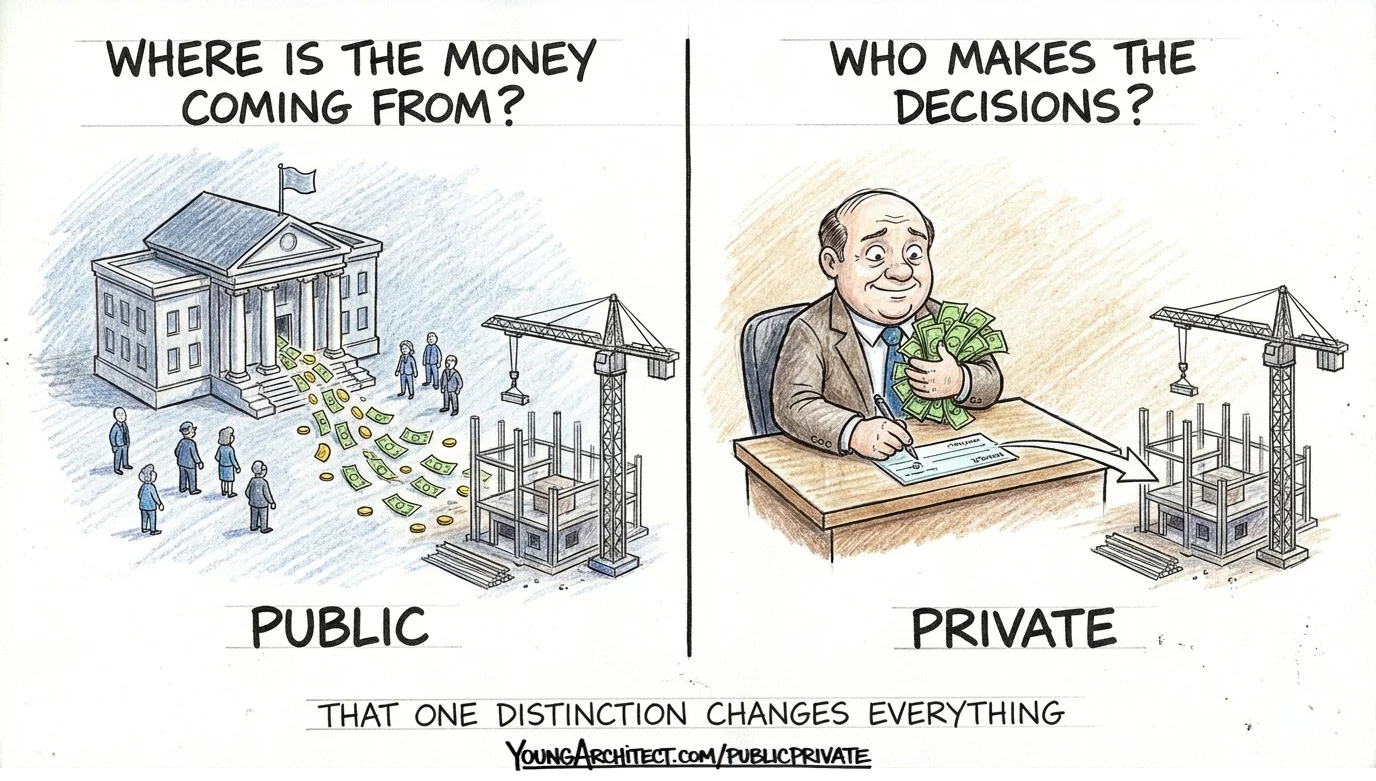
A public works project is funded by taxpayer money. The client is a government entity at the federal, state, county, or municipal level.
The American Public Works Association defines public works broadly as the physical infrastructure and services that support a community’s quality of life. In practice, that means any building, road, bridge, or utility system built with public dollars and managed by a government agency.
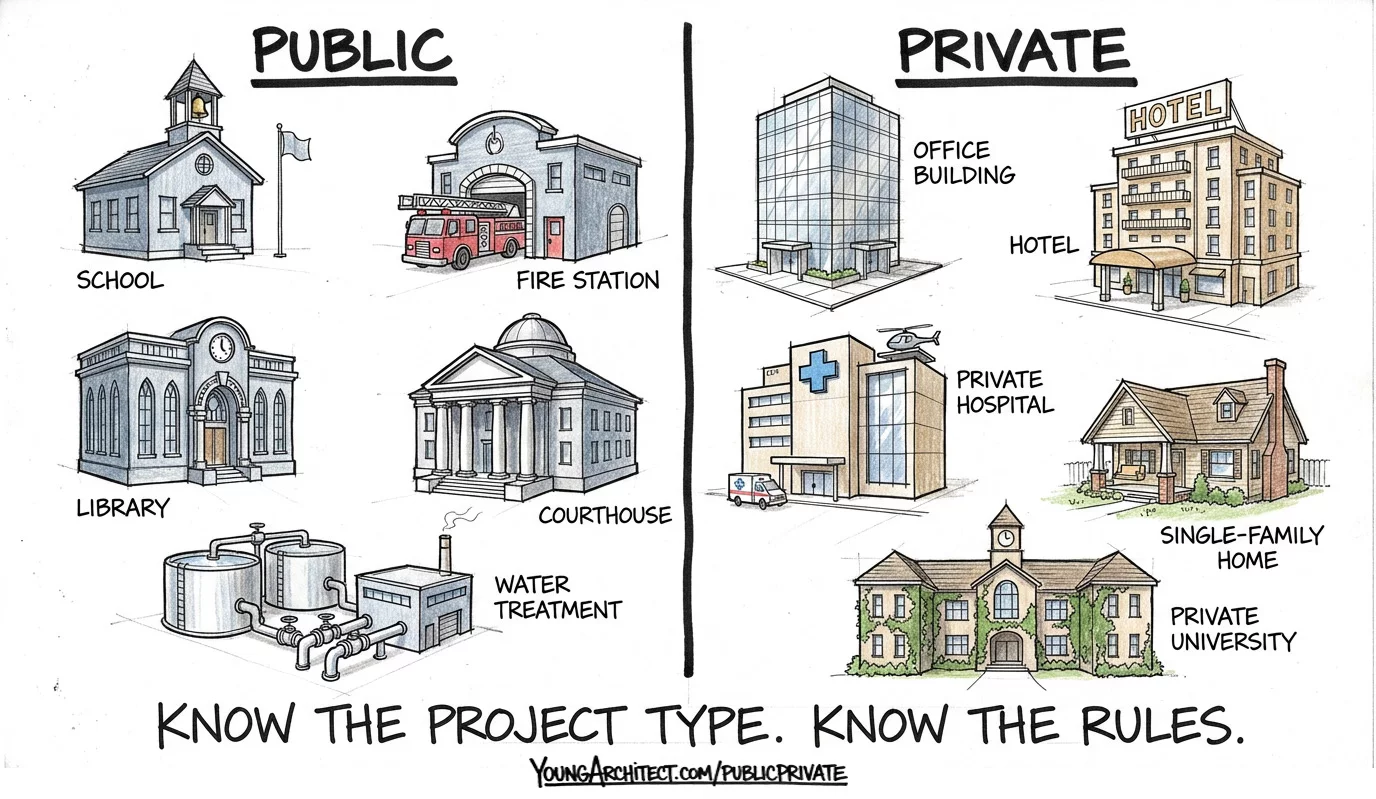
Public works examples include:
- Federal, state, county, or municipal government buildings
- Schools and fire stations
- Libraries and courthouses
- Roads, bridges, and highways
- Water and wastewater treatment plants
- Parks and public recreation facilities
- Infrastructure projects like utilities and stormwater systems
A private project is funded by individuals, corporations, or private institutions. The money is coming from the owner or their investors, and that gives them a lot more flexibility in how they spend it and how they make decisions.
Private project examples include:
- Single-family homes and residential projects
- Corporate headquarters and office buildings
- Hotels and shopping centers
- Private hospitals and private universities
It sounds simple on the surface, but here’s what I want you to understand.
That one distinction, public or private, ripples through every single part of the project.
It changes the contracts, the procurement, the delivery method, how decisions get made, how detailed the documents need to be, how change orders work, and even how fast you get paid.
Lots of strings attached to public money. Like, enough strings to make a marionette jealous.
When you’re spending taxpayer dollars, there are laws governing how that money gets spent. These laws create most of the differences we’re about to discuss. The goal is transparency, fairness, and accountability in how public funds are used.
Now, let’s get into those 12 differences.
Government Contracts vs Private Contracts
Here’s the first major difference, and it’s a big one.
Private Projects: Maximum Flexibility
Private projects offer incredible contract flexibility:
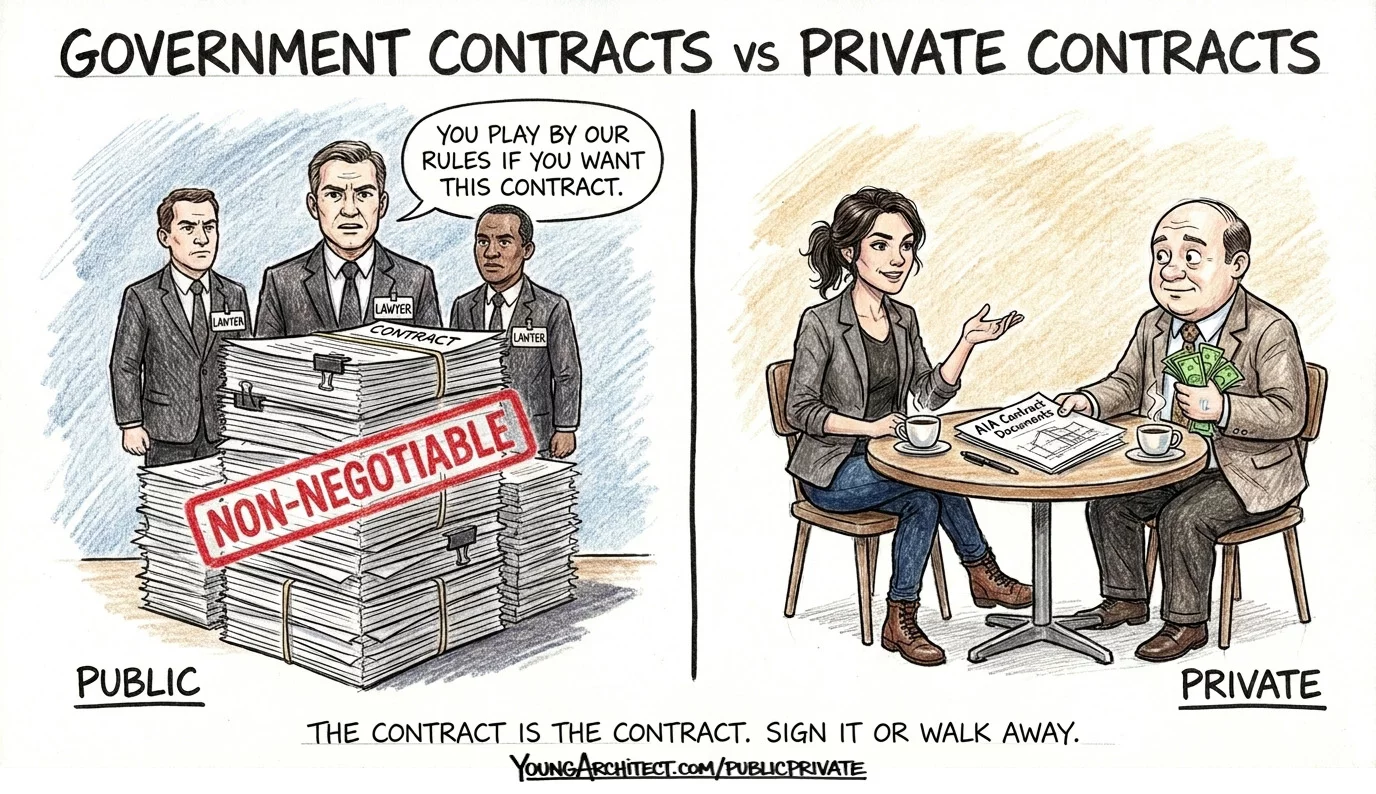
- Might use AIA contracts or modify them
- Create custom agreements tailored to the project
- Negotiate terms that work for both parties
- Adjust liability clauses as needed
- Structure the agreement however you both agree
Want to change your scope of work mid-project? If your private client agrees, you can do it.
Want to add or remove services? Write up an amendment and you’re good to go.
Public Works: Take It or Leave It
Government construction projects are a completely different story.
Government entities typically use standardized public contracts that you can’t negotiate. These contracts are created by the government’s legal department and approved by their legislative body.
You either accept the terms as written or you don’t get the project.
When I was working for the City of Portland, the city had their own army of lawyers writing contracts. They didn’t use standard AIA contracts. They had their own government contract templates with strict payment terms, performance requirements, and legal protections.
I tried to change a clause once. The answer was a very firm “no.” The contract had been approved by the city council, and changing even one word would require going back to council for approval.
I learned that lesson exactly once.
What Makes Public Contracts Different
These standardized government contracts often include provisions you’d never see in private work:
- Requirements to attend public meetings
- Compliance with open records laws
- Specific procurement processes for your consultants
- Detailed reporting requirements
- Fixed payment terms and schedules
Dispute resolution on public contracts is also very formalized. You’re talking about claims processes, arbitration, sometimes full litigation. There’s a paper trail for everything.
On private projects, disputes are usually resolved through informal negotiations or mediation. Nobody’s marching into a courtroom over a residential renovation if they can avoid it.
Before you sign any contract, understanding business entity types for architects helps you protect your practice no matter which side of the public-private line you’re working on. If you want to go deeper on the contract forms themselves, the AIA Contracts 101 course breaks down B101, A201, C401, and the other major agreements you’ll encounter across both public and private work.
RFQ vs RFP: How Architects and Contractors Get Selected
Now let’s talk about procurement.
This is probably the most significant distinction between public and private work.
On public work, procurement is governed by strict laws. The whole point is fairness, transparency, and competitive bidding. Public agencies can’t just call up an architect they like and hire them. There’s a process.
How Design Professionals Get Selected on Public Work
The process typically uses two tools, and understanding the difference between an RFQ vs RFP is key to navigating it.
An RFQ (Request for Qualifications) focuses on who you are and what you’ve done. It asks firms to submit their credentials, relevant project experience, team qualifications, and references.
Public agencies use the RFQ process to build a shortlist of qualified firms before moving to interviews or more detailed proposals. Think of it as the “prove you can do this” step.
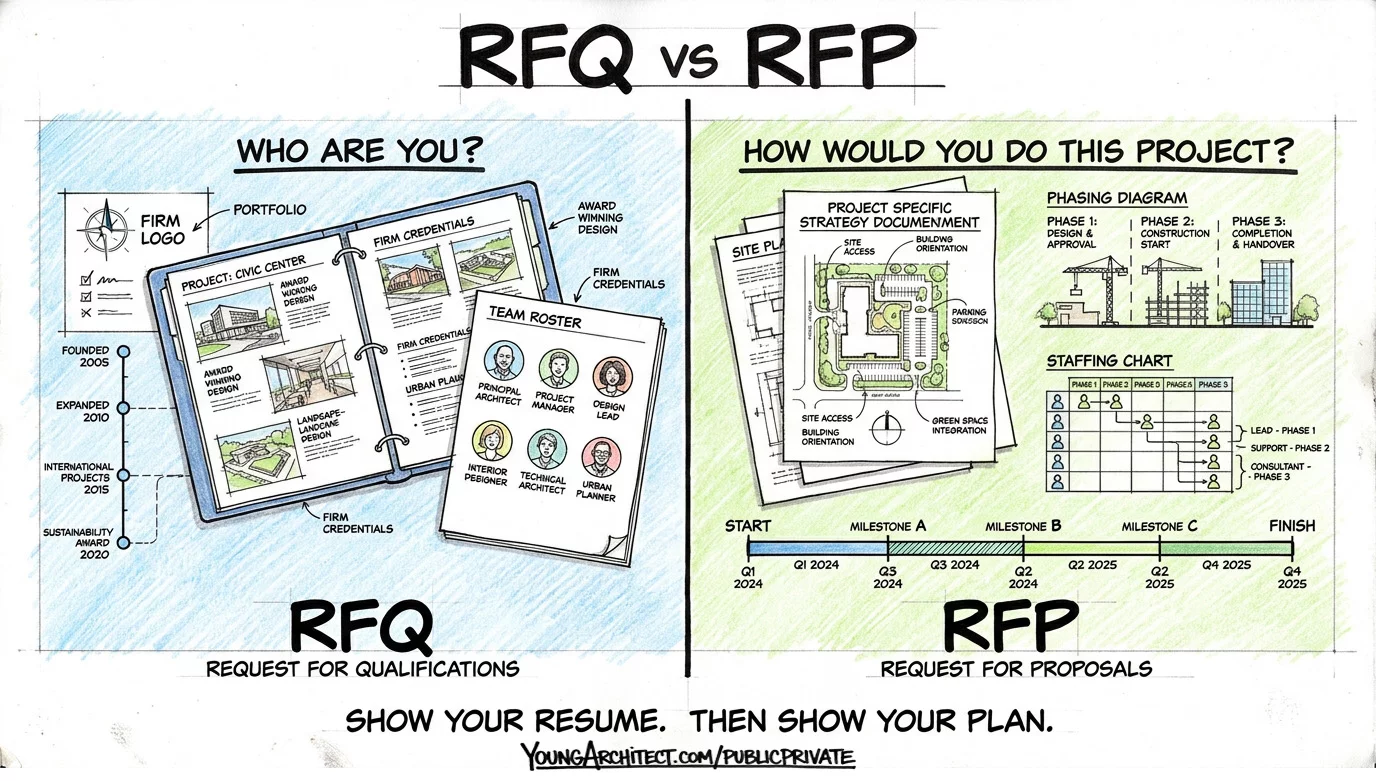
An RFP (Request for Proposals) goes deeper. It asks firms to explain how they would approach the specific project, who would be on the team, and what their proposed schedule looks like. The RFP evaluates your thinking and strategy, not just your resume.
Some public agencies use a two-step process: RFQ first to shortlist, then RFP from the shortlisted firms. Others combine elements of both into a single submission.
This qualifications-based selection process is rooted in the Brooks Act, a 1972 federal law that requires architect and engineer selection on federal projects to be based on qualifications rather than price. Most states have adopted similar versions of this law for their own public projects.
Here’s the important part: unlike contractor selection, price typically isn’t the primary factor for selecting architects on public work. The law recognizes that design quality matters, so qualifications come first. Only after a firm is selected do you negotiate fees.
The full RFQ process for a public project usually follows these steps:
- Government publishes project needs publicly
- Firms submit qualifications packages
- Selection committee reviews submissions and shortlists candidates
- Shortlisted firms give presentations or interviews
- Committee ranks firms based on qualifications
- They negotiate with the top-ranked firm
If the agency can’t agree on a fee with the top-ranked firm, they move to the next firm on the list.
This procurement process takes time. Where a private client might hire you after one meeting, the public procurement process can take months from advertisement to contract signing. Understanding the complete construction bidding process helps you set realistic timelines and client expectations.
How Contractors Get Selected on Public Work
Construction on public projects is a completely different story.
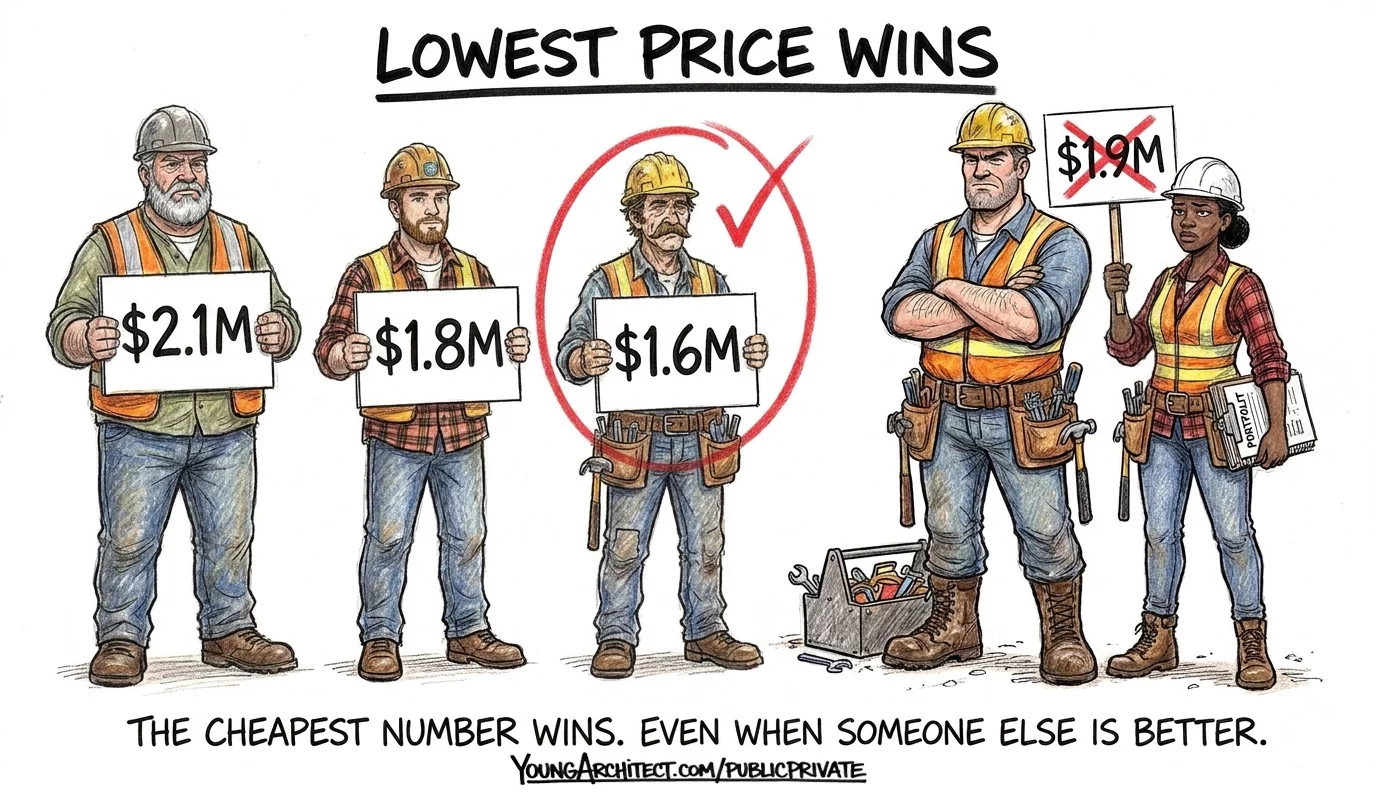
For most public work, the law requires competitive bidding with sealed bids and low-bid selection:
- Project gets advertised publicly
- Contractors submit sealed bids
- Contract goes to the lowest qualified bidder
- Not the best qualified, not the most experienced
- The lowest price, as long as they meet minimum qualifications
The contractor with the best reputation and track record might lose the job to someone who bid $5,000 less. The owner has no choice if that low bidder is qualified.
Private Sector Selection
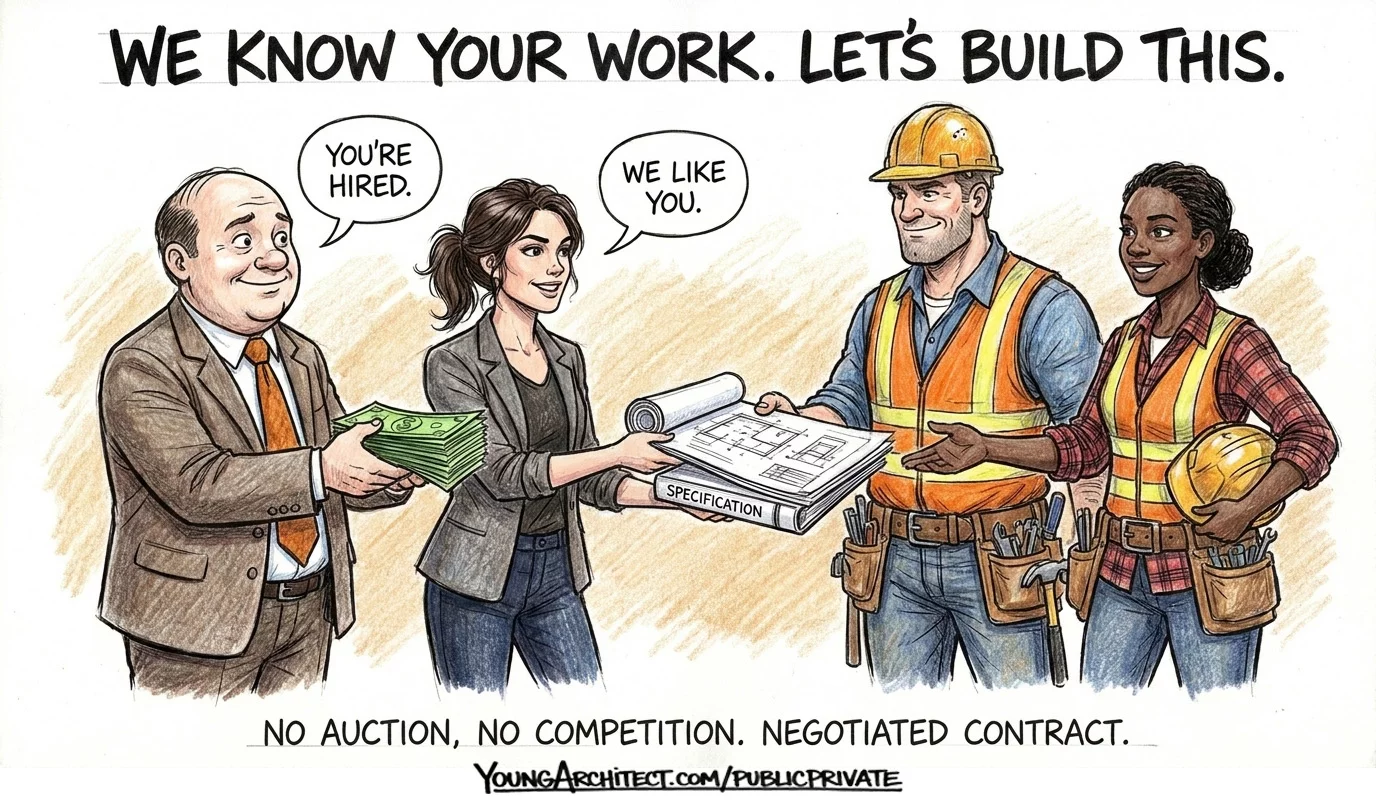
On private projects, the owner can hire whoever they want, architect or contractor:
- Interview three firms and pick the one they like best
- Hire based on a friend’s recommendation
- Choose based on past working relationship
- Select based on reputation, speed, or quality over cost
The selection process is entirely up to them. No required process, no legal restrictions.
The PcM 101 course covers these procurement and contract concepts in depth.
Design Bid Build and Public Project Delivery Methods
Project delivery methods define how a project’s design, bidding, and construction are structured. They outline the contractual relationship between the owner, the architect, and the contractor.
Private Sector Flexibility
Private clients can use any delivery method they want:
- Complete freedom to choose what works best
- Select based on project needs, budget, and timeline
- No legal restrictions on delivery methods
- Can innovate and try new approaches
A private client can say “I want my architect and my contractor working together from day one” and just do it.
Public Sector Restrictions
Public works projects are heavily restricted in what project delivery methods they can use. Many states require design bid build by law for most municipal construction.
Why Design Bid Build Dominates Public Work
The design bid build approach clearly separates design from construction, making competitive bidding cleaner and more transparent:
- The project is designed first. The full set of construction documents gets completed.
- Those documents go out to bid. Multiple contractors compete by submitting prices based on the exact same scope of work.
- The lowest qualified bidder gets the contract and builds it.
Design. Bid. Build. Three distinct phases, and they happen in that order.
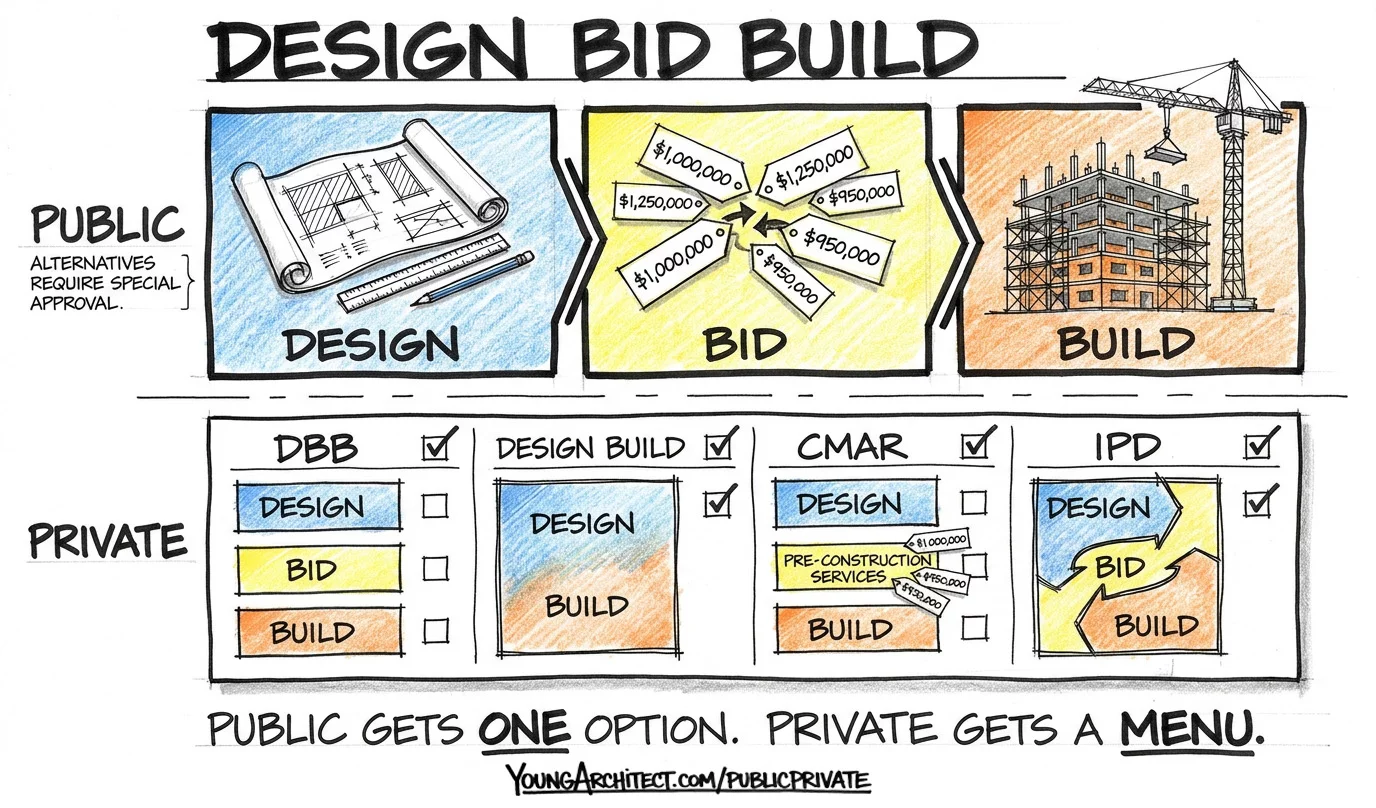
Most states actually require design bid build by law for public projects, because it’s the delivery method that ensures the most transparency and fairest competition. Everyone is bidding on the same thing with the same information.
Alternative Delivery Methods
Some progressive jurisdictions have passed legislation allowing Design-Build or Construction Manager at Risk for certain project types, but these methods often require special approval and justification.
You might need to prove to a legislative body why your project needs an alternative delivery method.
I worked on one public project where we wanted to use Construction Manager at Risk because of the complex phasing requirements. Getting approval required presentations to the city council explaining why this delivery method was necessary.
For a private client, we would have just done it.
Integrated Project Delivery: Almost Impossible
Integrated Project Delivery is almost impossible to use on public works. The collaborative, shared-risk nature of IPD conflicts with public procurement requirements that mandate strict separation between design and competitive bidding.
As an architect working on government projects, you’re almost always working within the design bid build framework, with all its limitations and inefficiencies.
Public gets one option. Private gets a menu.
For a deeper dive into all the major delivery methods, check out our guide to project delivery methods.
Government Project Management and Decision-Making
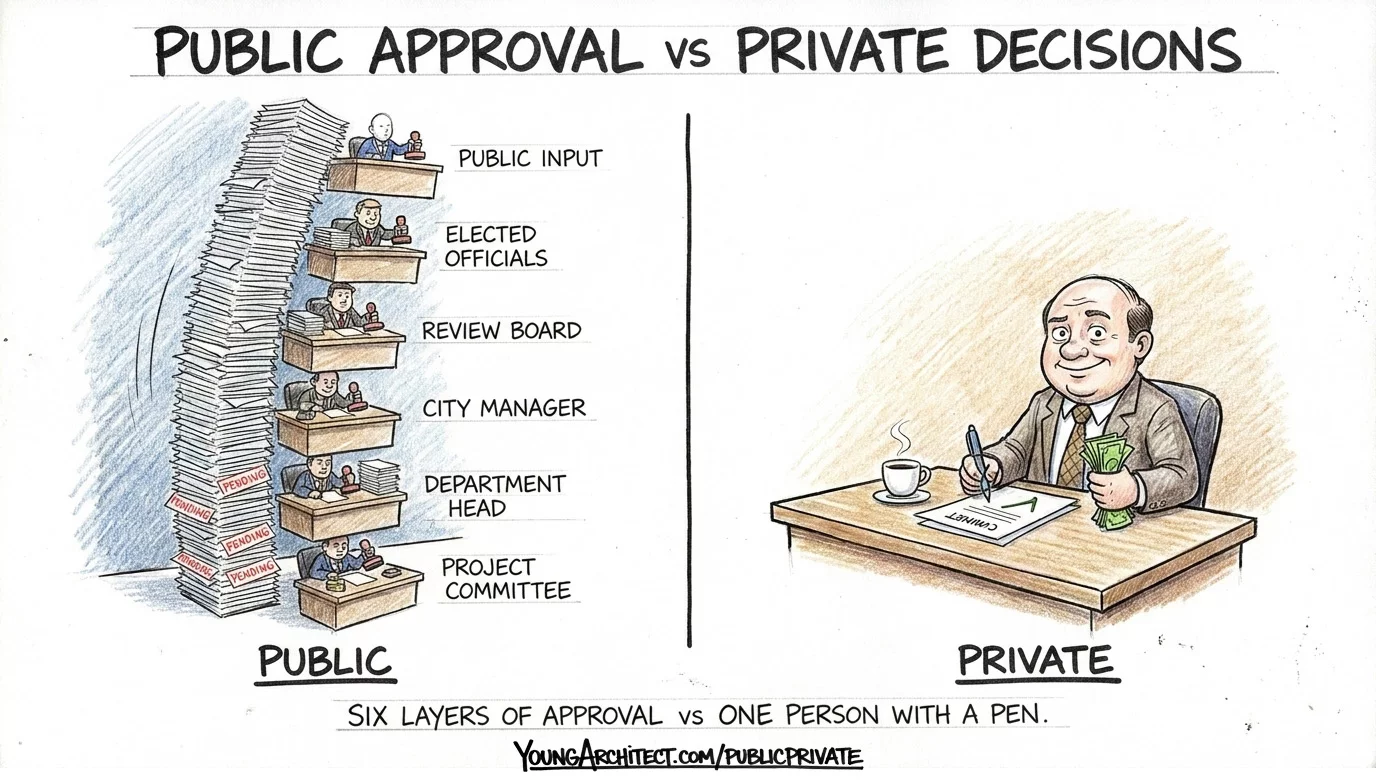
Here’s a difference that affects your daily life on a project more than you might expect.
Private Projects: Clear Decision Makers
Private projects usually have a single decision-maker or a small group:
- One person or department with authority to approve decisions
- Makes the design process relatively efficient
- You present options, they make a choice, you move forward
Even in a large corporation, there’s typically one person with the authority to say yes or no.
Public Works: Committees Everywhere
Government project management involves committees. Lots of committees.
You might need sign-off from:
- A project committee (gives input)
- A department head (operational approval)
- A city manager (administrative approval)
- An agency review board (compliance)
- Elected officials (final authority)
- The general public (input through hearings)
Each of these groups has different priorities and concerns:
- What the facilities committee loves, the budget committee might hate
- What satisfies the planning commission might not fly with the elected officials
The Reality of Committee-Based Decisions
I’ve watched projects sit idle for months waiting for a committee to meet and vote on whether to proceed. That’s not an exaggeration. Months.
And here’s the part that really gets you.
Decisions can be politically influenced. A change in leadership, a shift in budget priorities, an election, and suddenly your project gets delayed, scaled back, or canceled entirely. Not because anything was wrong with the project, but because the political landscape changed.
On a private project, the client would have said “looks good, let’s build it” and we’d have been done.
A private client can walk into a meeting, hear the options, and make a call on the spot. That kind of speed just doesn’t exist on most public projects.
This committee-based decision making isn’t necessarily bad. It brings diverse perspectives and ensures thorough review. But it’s slower, and it requires different skills from you as the architect. You need to be a diplomat, building consensus among people who may have conflicting goals.
Construction Documents for Public Bidding
Remember how public projects typically use design bid build and award the work to the lowest bidder?
That has a direct impact on how detailed the construction documents need to be.
Public Works: Extreme Detail Required
Public works projects require extremely detailed and complete construction documents.
Contractors are competitively bidding on public work. They need to know exactly what they’re bidding on. If your construction documents are vague or incomplete:
- Contractors will either bid high to cover unknowns
- Or they’ll bid low and then request change orders for everything that wasn’t clearly documented
The Low-Bid System Is Adversarial by Design
And here’s why that matters so much.
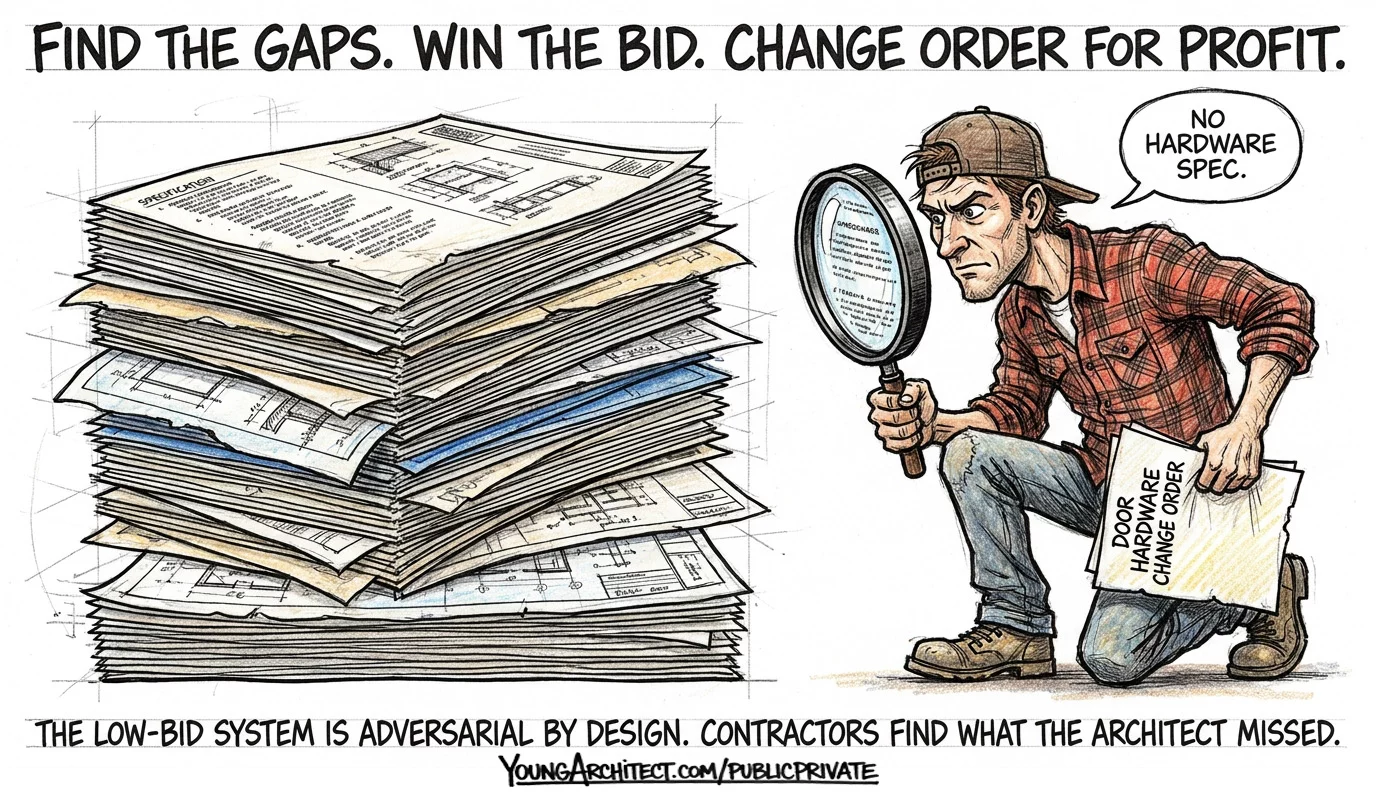
The low-bid system is adversarial by design, and the tension starts before anyone even submits a price.
Because the system forces a race to the bottom on numbers, contractors aren’t looking at your drawings thinking about partnership. They’re looking to protect their margins.
They need to find the ambiguities, the missing details, the vague specifications, just to get their bid low enough to win the job. Then day one of construction, those exact same gaps become change orders. And they win back their profit.
On government work, that’s not bad behavior. That’s just how the system works.
Contractors on low-bid public work are incredibly skilled at finding gaps in the architect’s documents. I say this with respect, because it’s true. If something is missing or vague or open to interpretation, a savvy contractor will leave it out of their bid on purpose. That’s how they get their number low enough to win.
Then once construction starts and they’ve got the contract, they’ll bring those missing items back as a change order, usually at a much higher price than if it had been included in the original bid.
I lived this. When I was the facilities project manager for the city, I saw it happen over and over.
Public construction documents need to be thorough enough that any qualified contractor can bid the work accurately.
This means:
- More detail
- More specifications
- More coordination between drawings and specs
- Understanding the construction submittal process that follows
- It’s more work upfront, but it reduces conflicts later during construction administration
Private Projects: More Flexibility
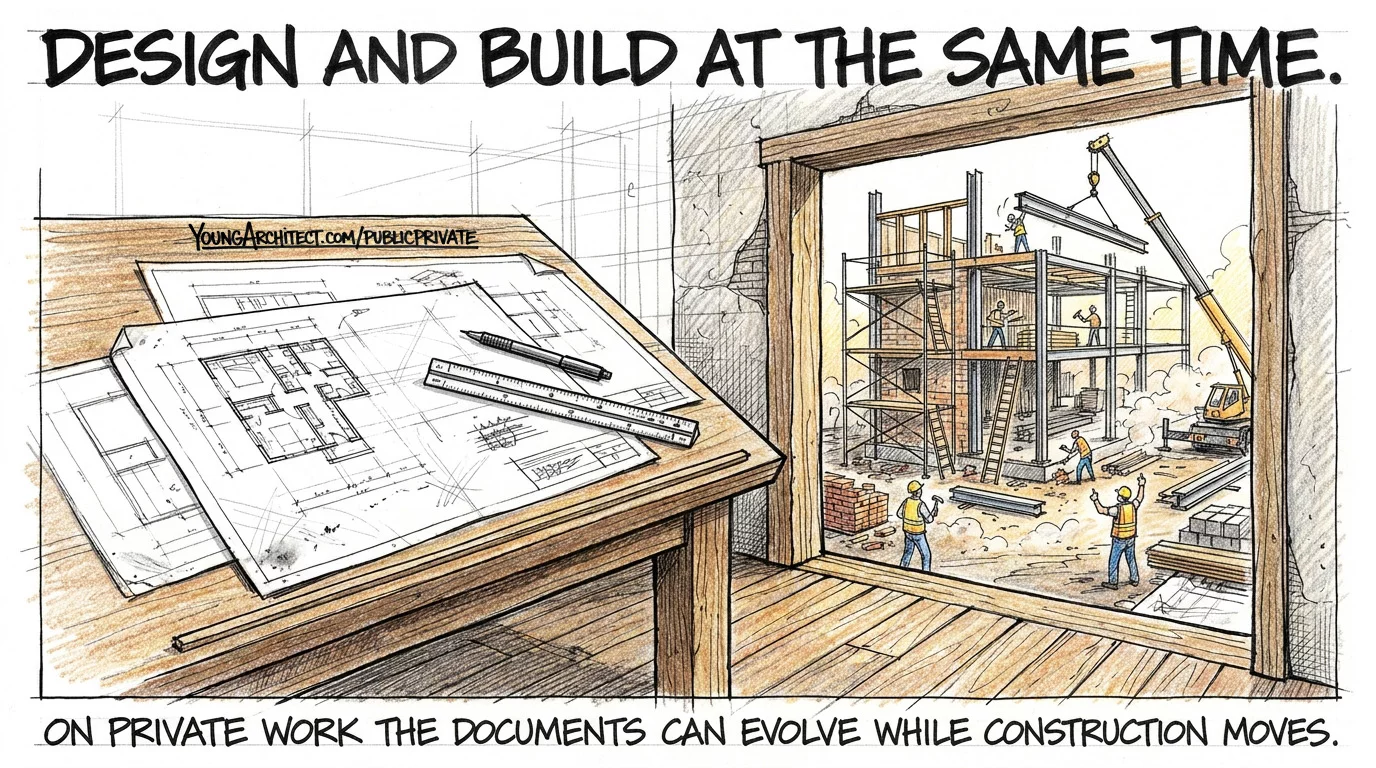
On private projects, it’s a completely different dynamic.
Private projects allow more flexibility in construction document detail:
- If there’s a strong relationship between owner, architect, and contractor, you might issue less detailed documents
- Knowing that coordination can happen during construction
- Can rely on contractor expertise for some details
- Design-build allows design and construction at the same time
- Fast-track scheduling with documents developing in parallel
Private clients generally have a higher tolerance for risk, which means adjustments can happen during construction rather than everything needing to be locked down in advance.
Proprietary Specs: Another Difference
There’s another documentation difference worth knowing. On private projects, you can write closed proprietary specifications naming the exact manufacturer you want. On public projects, that’s usually prohibited because it undermines competitive bidding. Instead, you’re required to provide an “or equal” clause or list multiple acceptable manufacturers so contractors can price alternatives.
Sustainability Mandates on Public Work
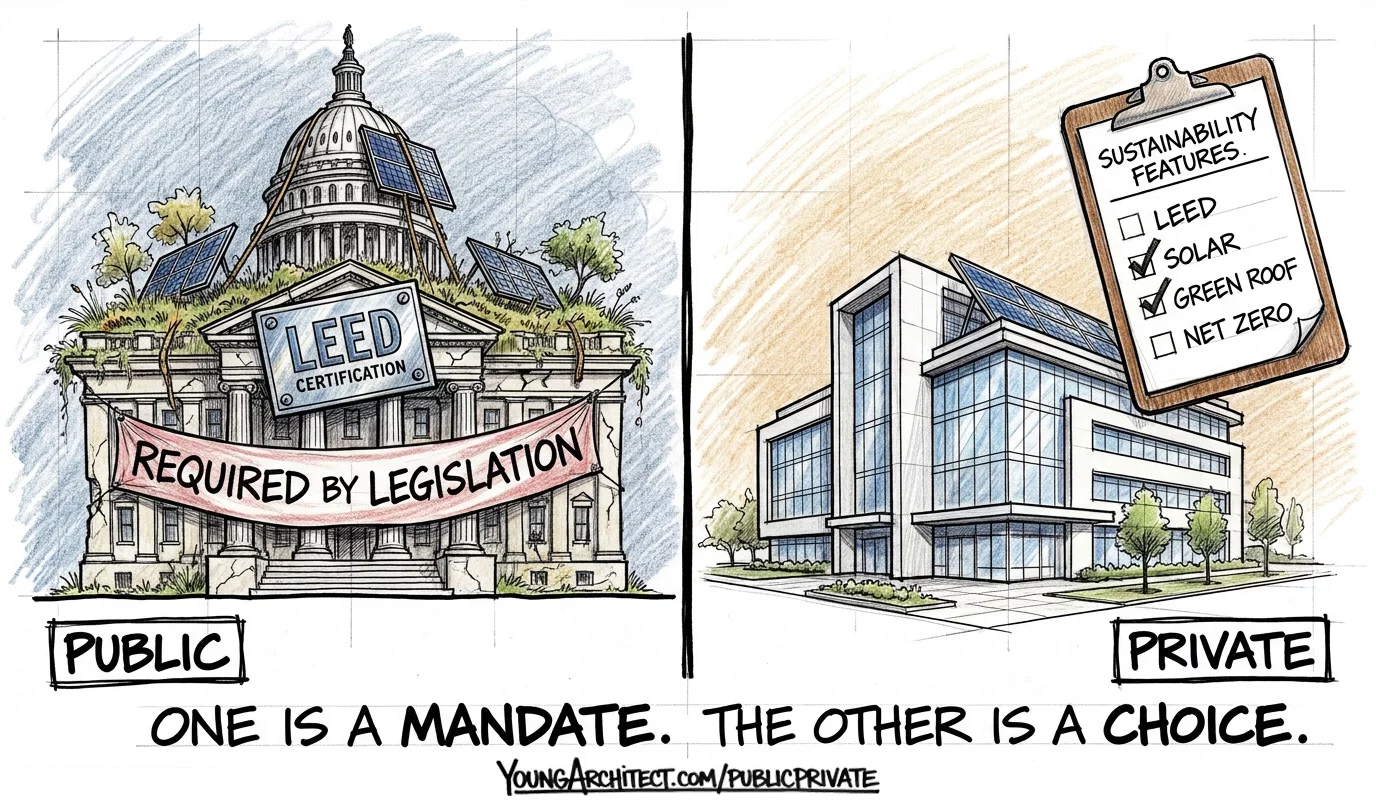
Both public and private projects must meet building codes, obviously. But public works often go beyond minimum requirements.
Private Client Choices
Private clients can choose how green to build:
- Pursue LEED certification if they want
- Specify high-performance systems if it fits their budget
- Or just meet basic energy code requirements
The choice is theirs. Nobody is forcing a private developer to put a green roof on their hotel.
Public Works Mandates
Government construction projects increasingly have mandated sustainability requirements. Many states and municipalities have laws requiring public buildings to achieve certain LEED requirements or meet specific energy performance standards.
When I was working for the government, there was legislation that got passed saying all new buildings would be LEED certified with a green roof and solar panels. And if your project didn’t have the budget for that, or if it was a renovation of an existing building where those requirements just didn’t apply, you still had to jump through hoops to get an exemption.
It wasn’t optional. It was blanket legislation that had to be addressed on every single project.
This means that when you’re designing public projects, you need to factor in sustainability requirements from the start. These requirements affect:
- Material selection
- Mechanical system design
- Site planning
- Documentation requirements for certification
The challenge is that green building adds cost, and public budgets are often tight.
You’re trying to meet high sustainability standards while also keeping within strict budget constraints.
Permitting on Public and Private Work
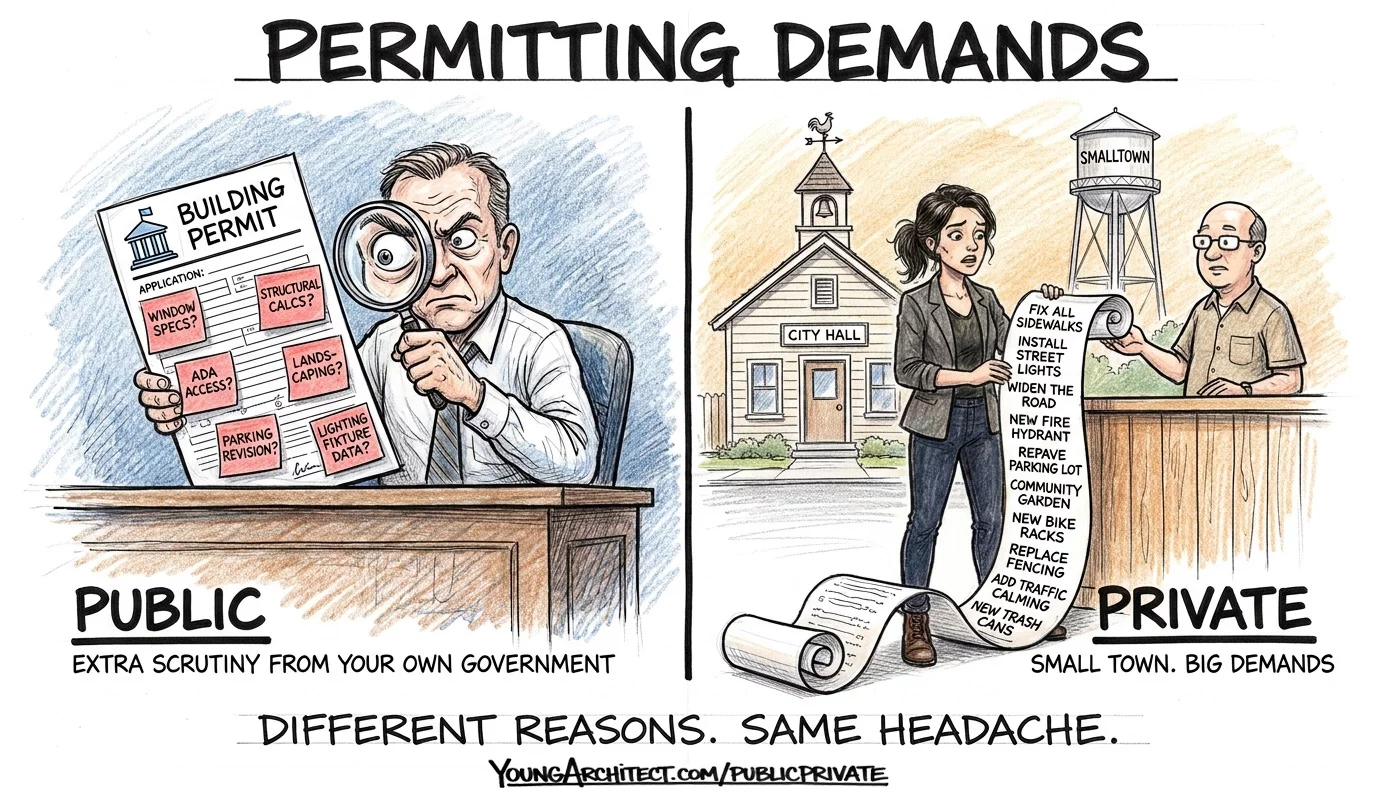
Here’s something that might surprise you.
Even though the permitting agency is often part of the same government as the project owner, permitting on government projects was often more difficult and stringent in my experience.
When my project went in for a building permit and the permitting agency saw it was a city project, they moved slower. They were more nitpicky, asked more questions, and held us to a higher standard. I learned to budget more time for permitting in my schedule on every public project.
And private clients can run into their own permitting headaches too, especially if they have deep pockets. I’ve heard stories about big hospitals wanting to build a small clinic in a small town, and the local jurisdiction sees an opportunity. They start asking for road improvements, infrastructure upgrades, all kinds of things that have nothing to do with the clinic, because they know the hospital can afford it.
Permitting can be a real challenge if you work for the government or if the jurisdiction thinks you’ve got money to spend.
That’s just been my experience.
Public Works Funding and Getting Paid
How projects get funded creates significant differences in how they’re managed.
The Feasibility Study Island
Here’s how funding actually works on a lot of public projects.
A government agency will often hire an architect just to do a feasibility study, a master plan, or a programming report. They use that document as evidence to get a budget approved or secure funding for the real project.
And here’s the part that gets people.
Once the funding comes through, that initial contract is over. The actual design and construction work goes back out to a brand new, competitive RFP. The firm that did all the heavy lifting on the feasibility study might not even win the final project.
Or worse, the funding fails and that project just dies on a shelf.
In public work, you learn very quickly that pre-design is its own separate island.
Public Funding Complexities
Public works projects are funded through complex mechanisms:
- Tax revenue
- Bond measures
- Grant funding
- Or combinations of these
Bond funding is particularly interesting. The public votes to approve bonds for specific purposes. That fire station might be funded by a bond measure that voters approved for “public safety facilities.” The budget is fixed by the bond amount, and spending that money on anything other than what voters approved would be illegal.
Grant funding comes with even more restrictions:
- Federal or state grants often have specific requirements
- About how money can be spent
- What you can buy
- When the project must be completed
You can’t just ask for more money mid-project.
Going back to voters for additional funding is politically difficult and time-consuming. Proper planning for construction contingency becomes even more critical on public projects where budget flexibility doesn’t exist.
I worked on a public project where the budget was set by a voter-approved bond. When construction bids came in higher than expected, we couldn’t just increase the budget.
We had to reduce the scope to fit within the approved funding. It was painful, but it was the law.
Prevailing Wage and Labor Costs
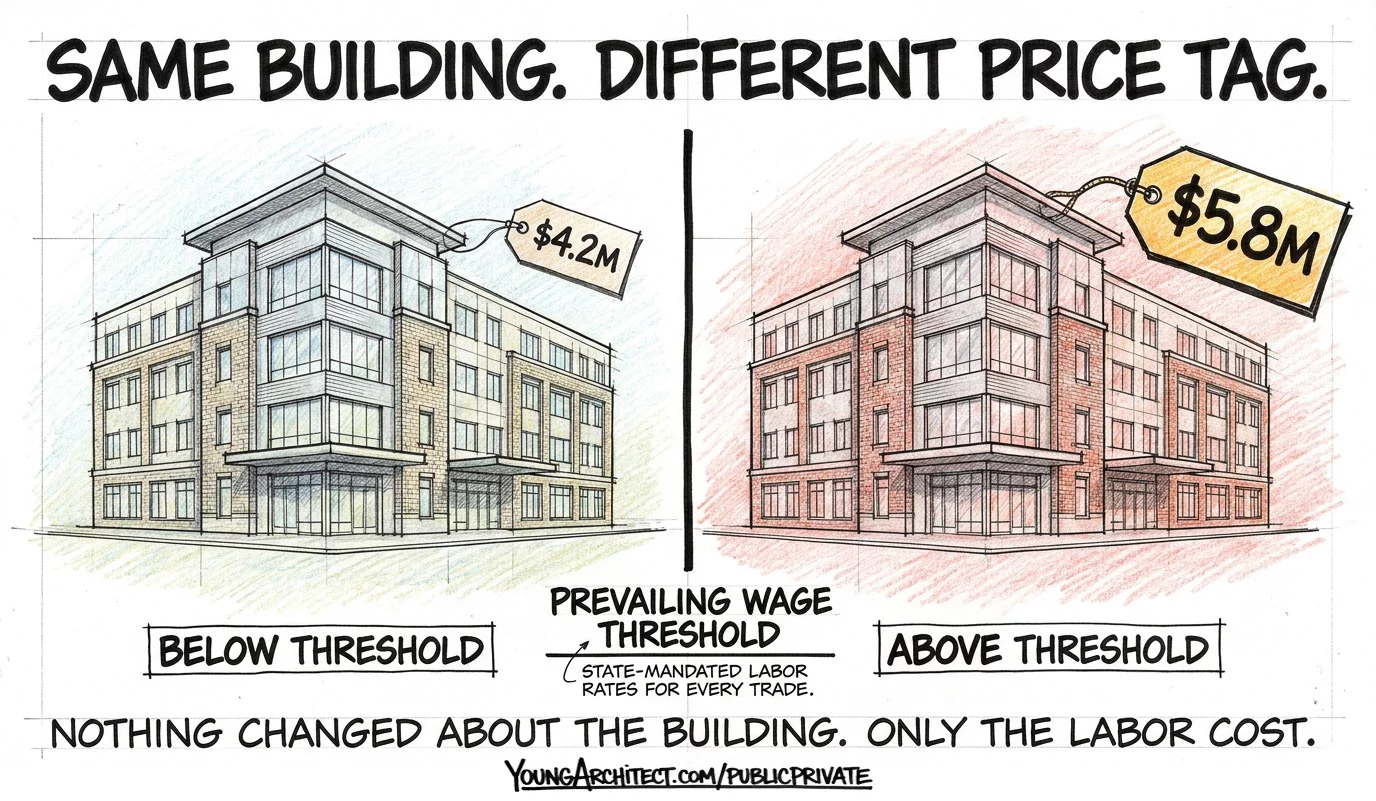
There’s one more cost factor on public work that catches a lot of people off guard.
On public projects, if the construction contract crosses a certain dollar threshold, prevailing wage laws kick in. That means every single worker on that construction project has their pay determined by whatever the state’s prevailing wage is for that specific trade.
This can significantly increase the cost of construction. It’s not optional. Once you cross the threshold, it applies to the entire project.
Federal projects and many state-funded projects must comply with Davis-Bacon prevailing wage requirements, which set minimum pay rates for construction workers based on local wage surveys.
Getting Paid by the Government
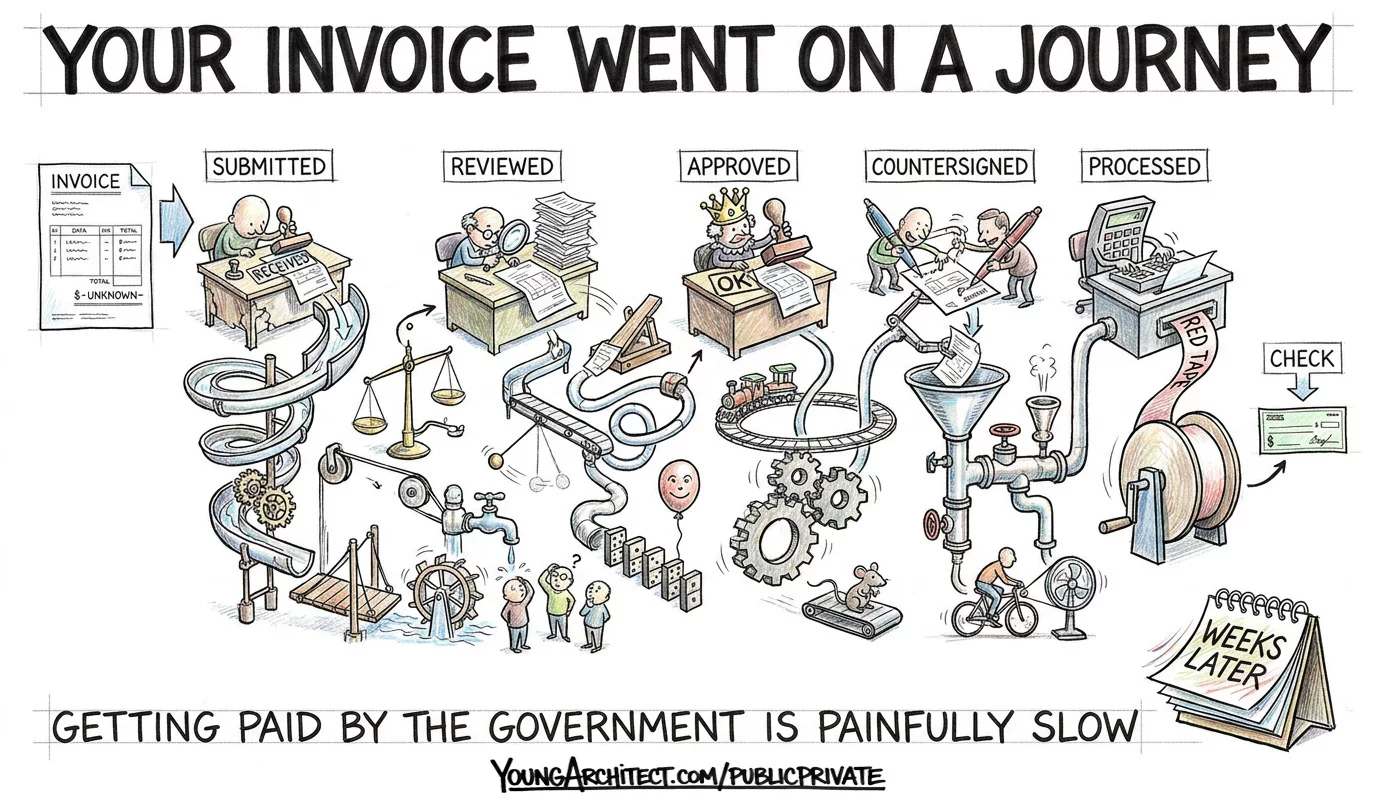
And here’s the part that every architect and contractor working on public projects knows too well.
Getting paid by a government entity is painfully slow.
So many people need to sign off on every invoice. The movement of money is just slower. There’s nothing you can do to speed it up. It’s the process. You learn to be very patient or very persistent. Ideally both.
The upside? Government agencies almost always pay. They won’t go bankrupt and leave you unpaid. The checks are reliable, just slow.
You also typically need to submit more documentation with invoices on public projects:
- Detailed time records
- Backup for expenses
- Sometimes documentation that you’ve paid your consultants and contractors
- The government wants accountability for how their money is spent
Understanding liquidated damages clauses in public contracts is also critical, because delay penalties on government work are often strictly enforced with no room for negotiation.
Private Project Funding
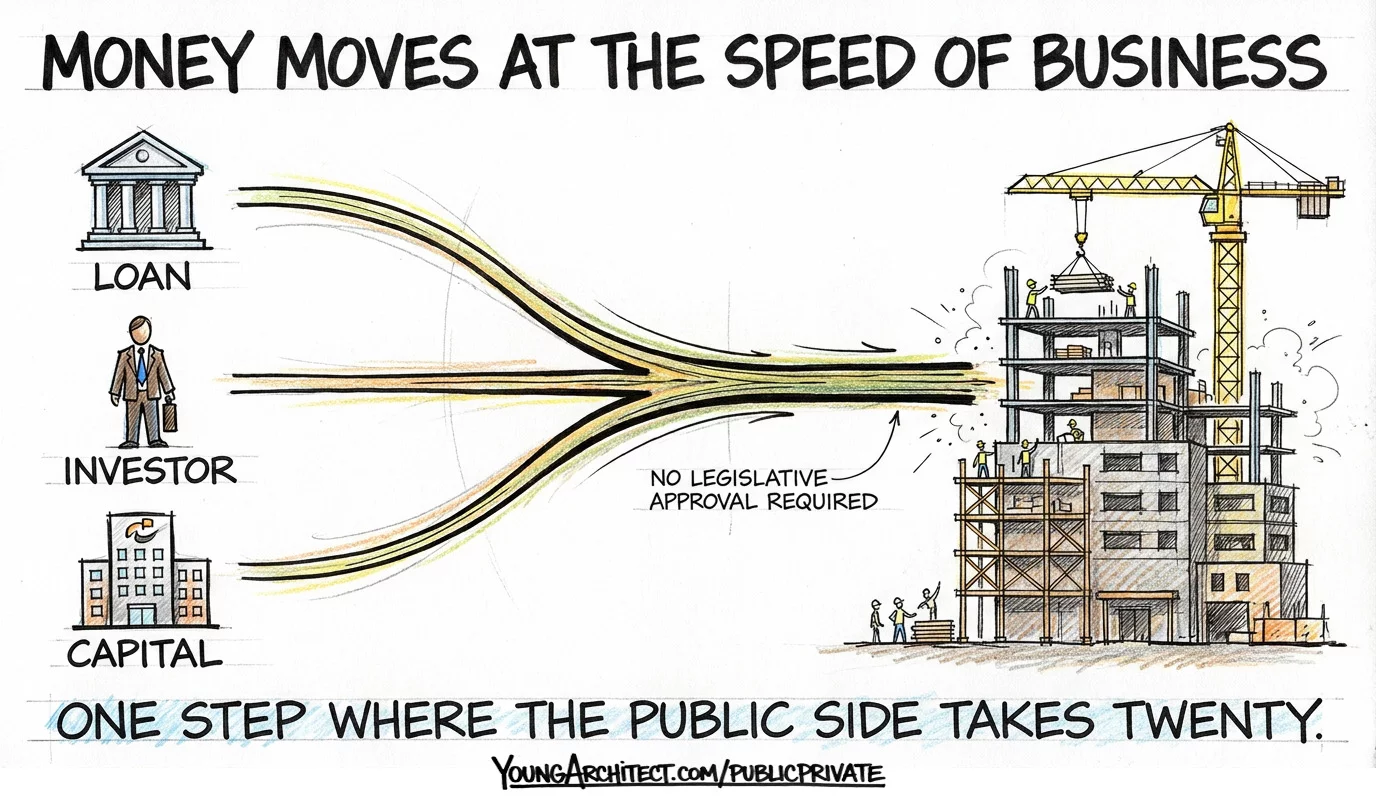
Private projects are funded by the owner’s money:
- Personal wealth, corporate funds, or loans
- The owner controls the budget and can adjust it as needed
- If they want to add scope and spend more, they can
- If they need to cut costs, they decide what to sacrifice
The money moves at the speed of the business, not the speed of government.
The Silver Lining
But here’s the silver lining to all that frustration with public funding.
Part of how I got into government work in the first place was that the architecture firm I worked for had already signed contracts for large government-funded projects right before the 2007-2010 recession. The funding was already committed.
So while the private sector fell off a cliff and most of the architecture profession was getting laid off, those government projects kept my firm alive. The money was there and the projects moved forward.
And when those projects dried up around 2011, the City of Portland reached out and hired me because of all the public project experience I’d built up.
A lot of firms want nothing to do with government work because it’s such a pain. But when the economy turns down and private clients start canceling, suddenly everyone wants government work. And by that point, it might be too late to build the experience and relationships you need to win it.
Change Orders on Public Works Projects
Construction change orders happen on every construction project. How they’re handled on public works is dramatically different from private projects.
Private Project Change Orders
Private projects have relatively simple change order processes:
- Architect documents the change
- Owner approves it
- Contractor gets paid
- Done
The process might involve three people and take a few days.
Public Works Change Order Bureaucracy
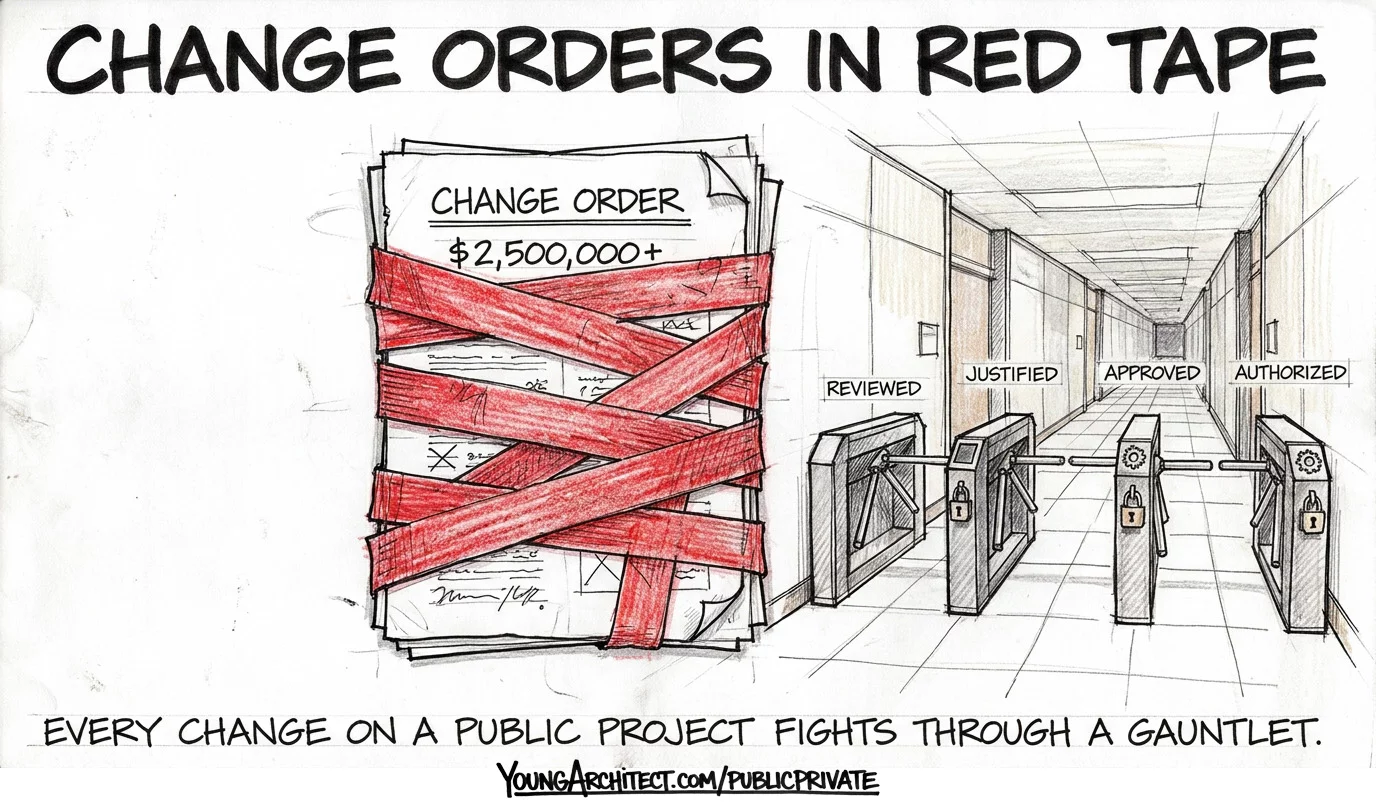
Public works projects have change order processes that can feel like legislative procedures. Because it’s public money, changes need approval at multiple levels:
- Small changes: Facilities director or project manager approval
- Medium changes: City manager or department head approval
- Large changes: City council or board approval at a public meeting
In the city where I worked, the threshold was when change orders amounted to more than 25 percent of the original construction budget. Once you crossed that line, you had to go get approval from city council.
The City Council Story
And remember that television appearance I mentioned at the top?
Here’s that story.
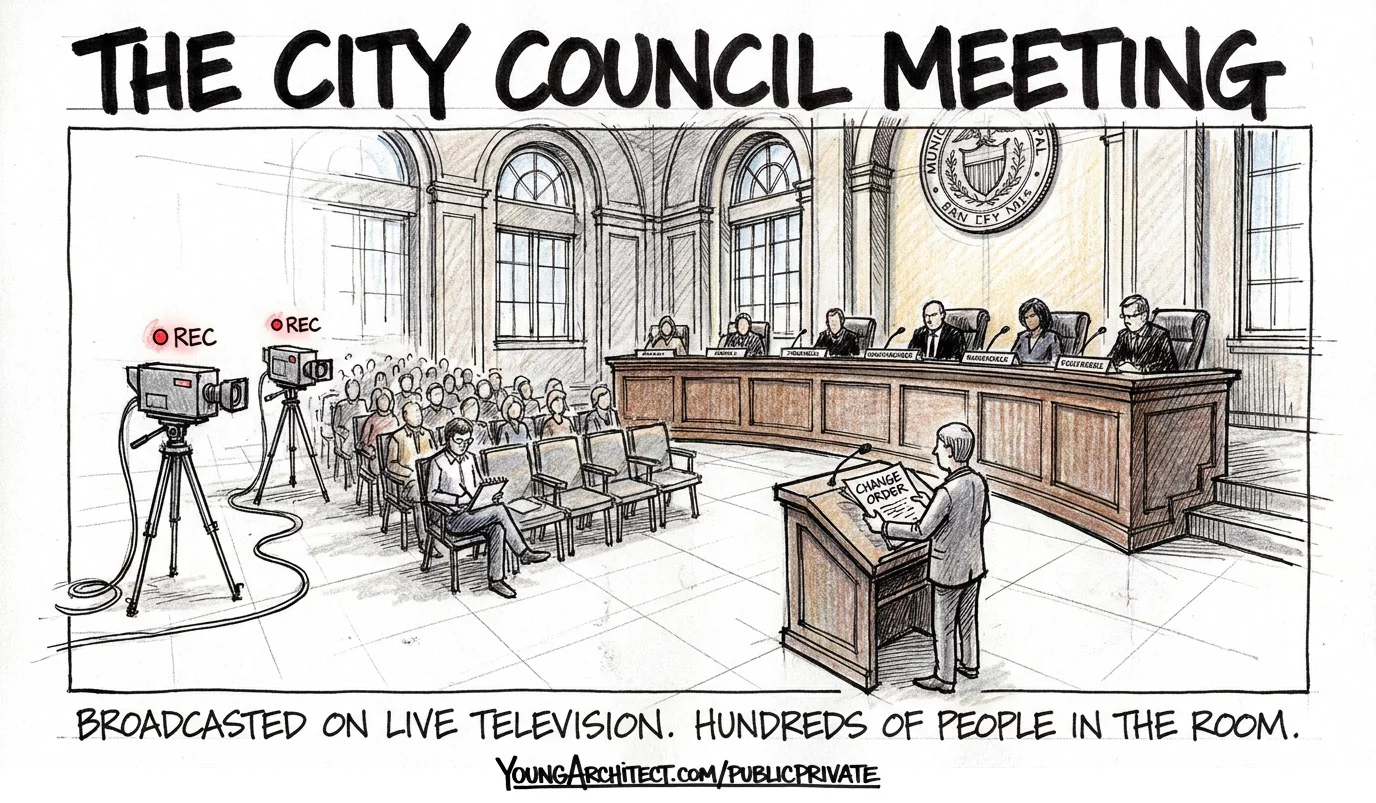
So I’m up there at the podium. Hundreds of people in the room. Live television. Reporters sitting there.
I had to explain what the changes were, why they happened, and what the additional cost was going to be.
And you know what? Nobody asked any questions. It was just business as usual for them.
But I’ll tell you, sitting up there waiting for the mayor to grill me about why a project went over budget during construction on live TV was one of the most terrifying experiences of my career.
The Contractor Dynamic
And here’s the dynamic that made the job so interesting.
The contractors are pushing to increase change orders to win back their profit margins. Meanwhile, I’m trying to protect the change orders to keep myself off TV and out of the mayor’s office asking for more money on my projects.
That was the world I lived in for years. A constant battle back and forth.
Documentation Requirements
This public scrutiny means you need to document the change order process thoroughly:
- Clearly explain why the change is necessary
- Show where the additional funding will come from
- Explain why it wasn’t anticipated in the original design
- Everything is transparent and open to public review
The process is slower, too. A change order that would take a week to approve on a private project might take a month or more on a government project, waiting for the next council meeting and going through the approval process.
Nobody’s going on television to explain why the hotel lobby got redesigned.
When change orders escalate into disagreements, understanding construction claims and disputes helps you protect yourself and the project. These change order procedures are a core part of what the CE 101 course covers in depth.
Public Hearings, Open Records, and Transparency
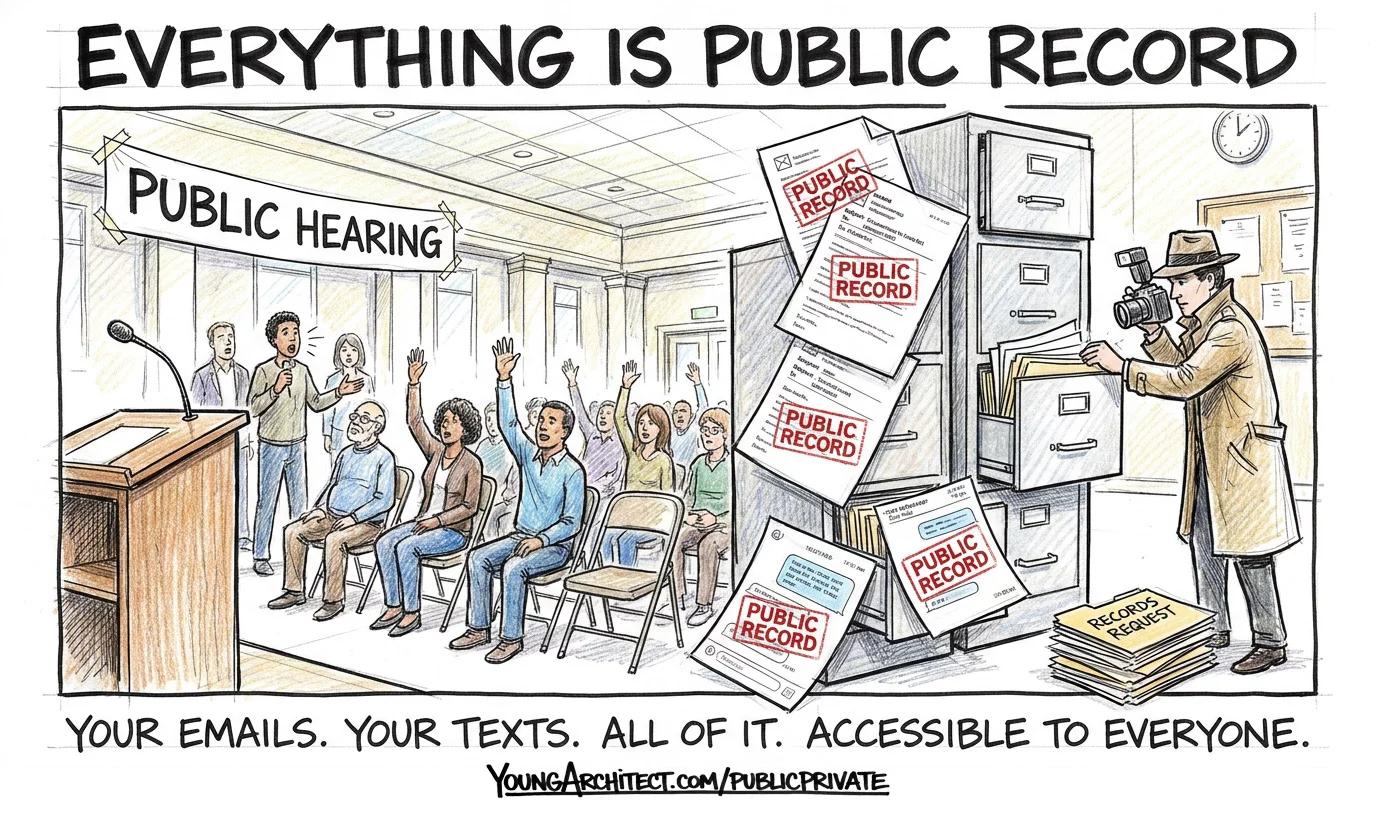
Here’s a difference that might surprise you.
Privacy doesn’t exist in public work the same way it does in private projects.
Private Project Confidentiality
Private projects are confidential:
- Your client’s information is private
- Project budgets are private
- Communications are private
- Documents are private unless they choose to share them
Public Records Requirements
Public works projects are subject to open records laws (also called public records laws or freedom of information laws). These laws vary by state, but generally require that government documents be available to the public upon request.
This means that potentially anyone can request:
- Your emails to the client
- Project budgets
- Meeting notes
- Design documents
A citizen can file a public records request, and the government must provide those documents (with some exceptions for privileged information).
Public projects may also require:
- Public hearings where citizens comment on the design
- Community workshops where neighbors express opinions
- Newspaper coverage and public scrutiny of every decision
This is a huge part of why public projects take so long to get done. It’s not just the bureaucracy inside the government. It’s the public-facing process that happens outside of it too.
Living with Transparency
I had a situation where a citizen filed a records request for all emails related to a public project I was working on.
The city’s legal department had to review everything and release what was legally required. It made me much more careful about what I put in writing.
You can’t write casually in emails on public projects the way you might on private work. Everything might become public.
Understanding standard of care and your professional liability becomes even more important when everything you write might become public record. Protecting yourself with proper architect insurance is equally critical.
This transparency is generally good for democracy and accountability. But it affects how you communicate on every single public project.
Connecting the Dots Across Project Types
So how does all of this connect in practice?
The public versus private distinction shows up across every area of architectural practice, and NCARB’s published objectives reference these concepts throughout their competency framework.
Practice Management covers assessing business risks and understanding different project types. Knowing whether a client is public or private immediately tells you what kind of contracts to expect, what procurement process applies, and what level of regulation you’re working within.
Project Management is about understanding contract requirements and how public versus private changes how you actually manage the project: the approvals, the timelines, the decision-making structure. The PjM 101 course covers project management, stakeholder coordination, and the kind of complex approval structures that show up on public work.
Construction and Evaluation connects to bidding, procurement, construction administration, and change orders, all things we just covered and all things that work differently depending on whether the project is public or private.
Programming and Analysis is where the feasibility island lives. Government agencies hiring architects for feasibility reports, programming, and pre-design work. That whole concept of pre-design being its own separate contract? That’s PA territory.
Project Planning and Design and Project Development and Documentation are where understanding low-bid construction directly informs how documents get put together. Design decisions around accessibility, materials, and detailing are all influenced by knowing how contractors work and what they’re looking for in your drawings.
A set of construction documents for a luxury high-end residence is drastically different from a set for a low-bid public construction project. The level of detail, the specificity, the way things are called out. It’s a different game.
One Detail Triggers Everything
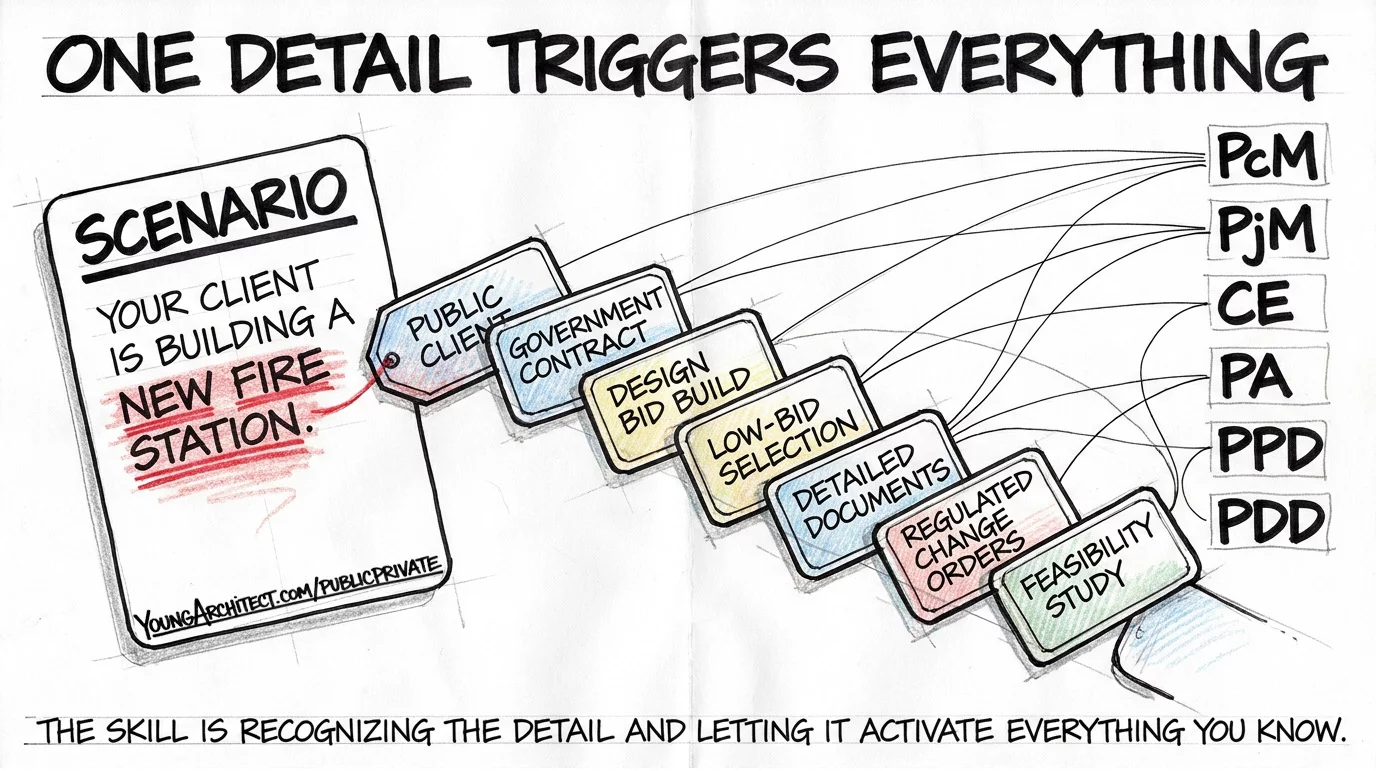
And here’s the thing I really want you to take away from all of this.
Nobody announces “this is a public project, apply everything you know about government procurement.” You have to recognize it from context.
A scenario might tell you that you’re working on a new fire station, or that your client is a public school district. That context should immediately trigger everything we talked about today.
Public client. Government contracts. Design bid build. Low-bid selection. Highly detailed documents. Regulated change orders. Slow approvals.
That whole chain of thinking kicks in from one detail.
And if the scenario says you’re working on a private hospital or an office building for a developer, a different chain kicks in:
- Flexible contracts
- Negotiated procurement
- Multiple delivery method options
- Faster decisions
- Less regulation
That’s the skill. Learning to recognize that one detail and letting it activate everything you know about how that type of project works.
Our comprehensive ARE 101 Course Membership gives you everything you need across all six exam divisions, including in-depth coverage of contracts, procurement, and project management concepts specific to public and private work.
Frequently Asked Questions
What is the difference between public and private construction projects?
Public construction projects are funded by taxpayers and must follow legally mandated procurement processes including competitive bidding and qualifications-based selection. Private projects are funded by private owners who can hire whoever they want, negotiate contracts freely, and make decisions quickly. The biggest differences show up in procurement, contracts, change order approval, and public transparency requirements.
What is an RFP in construction?
An RFP (Request for Proposals) is a formal document that public agencies and some private owners use to solicit detailed proposals from architecture and engineering firms. Unlike competitive bidding for contractors, the RFP process evaluates firms on qualifications, proposed approach, and team experience before discussing fees. RFPs are a key part of the qualifications-based selection process required for most public sector construction design contracts.
What is an RFQ in construction?
An RFQ (Request for Qualifications) is a document that asks firms to submit their credentials, experience, and qualifications for a project. The RFQ focuses on who you are and what you’ve done rather than how you’d approach a specific project. Public agencies use RFQs to create shortlists of qualified firms before moving to interviews or detailed proposals.
What is design bid build in construction?
Design bid build is a project delivery method where the design phase is completed before the construction phase begins. The architect designs the project, the owner puts it out to bid, and the lowest qualified contractor wins the construction contract. Design bid build is the most common delivery method for public works projects because it clearly separates design from construction and supports transparent competitive bidding.
What makes a construction project “public”?
A construction project is considered public when it’s funded by taxpayer money and owned by a government entity at the federal, state, county, or municipal level. Schools, fire stations, libraries, courthouses, roads, bridges, water treatment plants, and government buildings are all examples of public works projects. The public funding triggers legal requirements for competitive bidding, transparency, open records, and specific procurement processes that don’t apply to private construction.
Preparing for the ARE? Join ARE Boot Camp, our intensive coaching program that transforms the overwhelming licensing process into manageable weekly steps. You’ll get live coaching, community support, and expert guidance until you pass all six exams.
Want to study at your own pace? Our comprehensive ARE 101 Course Membership gives you everything you need across all six exam divisions, including in-depth coverage of contracts, procurement, and project management concepts specific to public and private work.
Want to master project delivery? The concepts covered in this guide are fundamental to the Construction Documents Technologist (CDT®) certification. Check out our CDT® 101 course if you want to go deeper on procurement processes, construction documentation, and how projects actually get delivered.