

Understanding liquidated damages is critical for architects, contractors, and ARE candidates preparing for the architect registration examination. This comprehensive guide covers the liquidated damages definition, how a liquidated damages clause works, where they appear in AIA contracts, and how they compare to consequential damages and actual damages. Learn how liquidated damages are triggered by the substantial completion date and how they protect both owners and contractors while avoiding costly litigation.
This podcast is also available on YouTube, Spotify, and Apple Podcasts
You’re Not Being Punished, You’re Being Protected
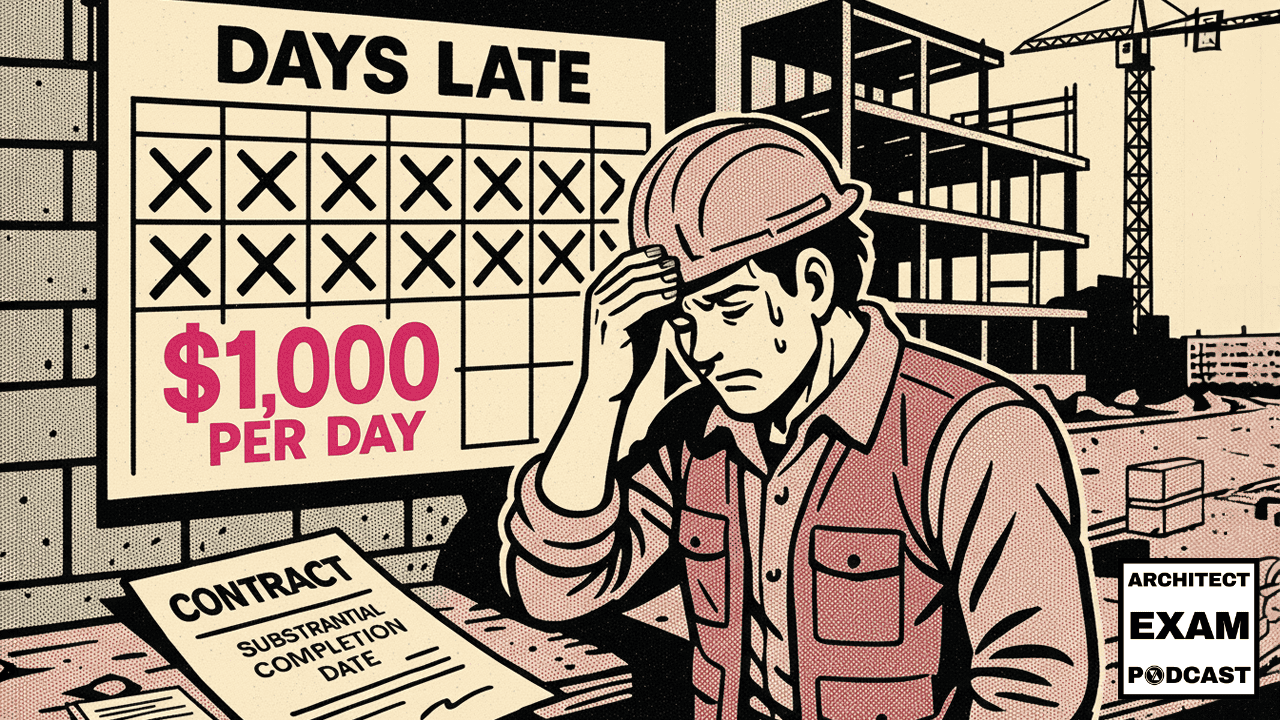
You’re reviewing a construction contract and see “$1,000 per day” listed next to something called “liquidated damages.” Your first thought? That sounds expensive. Your second thought? What exactly am I looking at here?
Here’s what most people get wrong about liquidated damages.
They think it’s a penalty, like getting a speeding ticket for finishing a project late. But that’s not what’s happening at all.
Liquidated damages actually protect everyone involved in the project. They solve a problem that would otherwise cost way more time, money, and stress to figure out after things go wrong.
Let me explain with a quick example.
Imagine you hire a contractor to finish your kitchen renovation before Thanksgiving. You’ve got family flying in from out of town. The contractor promises they’ll be done two weeks early, giving you plenty of time to prep.
Except Thanksgiving morning arrives, and you’ve got exposed drywall, no countertops, and a sink sitting in your garage. Now you’re eating dinner at a restaurant while your mother-in-law gives you that look.
What does that contractor owe you?
You can’t get Thanksgiving back.
You can’t undo the embarrassment. But you definitely deserve something, right? The problem is proving exactly what you lost and what it’s worth in dollars.
That’s the exact problem liquidated damages solve.
Let’s break down what they actually are and the liquidated damages meaning in construction contracts.
What Are Liquidated Damages?
Liquidated damages are a predetermined amount of money that both parties agree to before the work even starts. It’s what the contractor will pay the owner if they’re late finishing the project. That’s the liquidated damages definition in its simplest form.
The key word here is predetermined. You’re not figuring this out after the fact. You’re not fighting in court about it. You’re deciding upfront, when everyone is still friendly and optimistic, what happens if things go wrong.
Think of it like a prenup for construction projects. You’re sitting down before the wedding and saying, “If this doesn’t work out, here’s how we’re going to handle it.” Nobody wants to have that conversation, but it saves everyone a massive headache later.
Here’s what’s important to understand…
Liquidated damages are not a punishment.
They’re not a penalty.
They’re an estimate of what the owner’s actual damages would be if the project is delayed.
This distinction matters because penalties are illegal and unenforceable. But a reasonable estimate of actual damages? That’s completely valid and holds up in court, much like how architects are held to a standard of care in their professional work.
And this benefits both sides. The owner knows they’re going to get compensated for delays. The contractor knows exactly what they’re risking if they fall behind. There’s certainty on both sides, which is huge in construction.
But there is one more critical thing…
You must add the liquidated damages clause to the contract at the time of signing.
You can’t just tack them on later because you’re mad at the contractor.
Both parties make this agreement upfront. It’s not something you use to punish people after the fact.
Liquidated damages also show up outside of construction. In real estate, the earnest money deposit in a purchase contract often serves as liquidated damages in real estate transactions. If the buyer backs out without a valid reason, the seller keeps the earnest money as their pre-agreed compensation. Same concept, different context.
But for the rest of this post, we’re focused on liquidated damages in construction, which is where this concept really gets interesting.
Why Liquidated Damages Exist
In a perfect world, if someone is late on a project, you’d just calculate the actual damages and call it a day. But the real world doesn’t work that way.
Actual damages are really, really hard to calculate.
Let’s say you’re building a hotel, and the contractor is three months late finishing it. How much money did you lose? Well, you lost the revenue from all those empty hotel rooms. But how do you prove that?
What if it was winter and you weren’t expecting to be fully booked anyway? What if there’s a new hotel down the street stealing your customers? Maybe they have a better continental breakfast. Who knows?
Or imagine you’re opening a retail store, and the construction delay means you miss the entire holiday shopping season. That’s a huge deal. But how do you prove what your sales would have been? You’re guessing at hypothetical numbers.
The Hidden Costs No One Can Quantify
And then there’s the stuff that’s even harder to quantify:
- What about your reputation damage?
- What about the financing costs because your loan is sitting there accruing interest while nothing is getting built?
- What about lost business opportunities because you can’t open on time?
All of that is real. But proving it in court? That’s a nightmare. You’re going to spend more money on lawyers than you’d ever recover in contract damages.
And by the time the case is done, three years have passed, you’ve aged ten years from the stress, and you’ve forgotten why you even cared. Which is exactly why construction claims and disputes are better avoided through clear contract terms.
That’s why liquidated damages exist.
They cut through all of that uncertainty and give everyone a clear answer. The owner gets compensated. The contractor knows what’s at stake. And nobody has to hire a team of lawyers to argue about hypothetical lost revenue.
It’s actually kind of brilliant when you think about it.
How Liquidated Damages Work
Here’s the typical setup. When the owner and contractor sign the contract, they agree on a dollar amount per day for delays.
This is usually something like $500 a day, $1,000 a day, or $5,000 a day, depending on the size and type of project.
The clock starts ticking when the contractor misses the substantial completion date (also called the construction completion date). That’s the date when the building is basically done and the owner can start using it, even if there are a few minor things left to finish. Substantial completion is the trigger point for liquidated damages, not final completion.
Let’s walk through a liquidated damages calculation example:
The contract says the project needs to be substantially complete by June 1st, and there’s a liquidated damages clause of $1,000 per day. If the contractor finishes on June 15th, they’re 14 days late. That’s $14,000 in liquidated damages that the owner can deduct from the final payment.
Simple, right? Well, sort of. Here’s the catch. The amount has to be reasonable. It has to be a genuine estimate of what the owner’s actual damages would be.
If it’s way too high and clearly just meant to punish the contractor, a court can throw it out and call it a penalty clause, which is illegal. The liquidated damages clause needs to reflect reality.
So if you’re building a small house and you try to put in a liquidated damages provision of $50,000 a day, that’s not going to fly. A judge is going to see right through that.
But if you’re building a hotel and you can show that each day of delay costs you $5,000 in lost room revenue, that’s reasonable.
The key is that it has to make sense. It has to be a real estimate, not a punishment.
What Is Substantial Completion?
Since substantial completion is the date that triggers liquidated damages, you need to understand exactly what it means.
The substantial completion definition is the point when a construction project is sufficiently complete that the owner can occupy and use the building for its intended purpose, even if minor items remain. Think of it as “move-in ready” even though the contractor still has a few things on the to-do list.
This is different from final completion, which is when every single item is 100% done, all punch list work is finished, and all closeout documents have been submitted. The distinction between substantial completion vs final completion matters because liquidated damages stop accruing at substantial completion, not final completion.
In AIA contracts, the architect issues a Certificate of Substantial Completion (AIA G704) to formally document this milestone. This certificate establishes the date, identifies any remaining punch list items, and shifts certain responsibilities (like insurance and utilities) from the contractor to the owner.
So what is substantial completion in construction from a practical standpoint? It’s the finish line for liquidated damages. If the contract says the project must reach substantial completion by June 1st and the contractor gets there on May 28th, there are zero liquidated damages, even if the punch list takes another three weeks to wrap up.
For a deeper look at the full project closeout and substantial completion process, including what happens between substantial and final completion, check out our breakdown of CE Section 4.
Liquidated Damages vs Penalty: What’s the Difference?
Let’s clear up some confusion. The question of liquidated damages vs penalty comes up constantly, and the answer directly determines whether a liquidated damages clause is enforceable.
They’re not a penalty.
Penalties are illegal and unenforceable. If a court determines that your liquidated damages clause is actually a penalty clause in disguise, they’ll throw it out. The test is whether the amount is a reasonable estimate of actual damages or if it’s clearly meant to punish the contractor.
You can’t add them after delays happen.
You can’t wait until the contractor is running behind schedule and then suddenly decide, “You know what? Let’s add some liquidated damages to this contract.” That’s not how this works. The liquidated damages provision must be in the original contract that both parties signed.
They’re not enforceable if unreasonably high.
Remember that $50,000 per day for a small house renovation? That’s going to get laughed out of court. Courts look at whether the amount bears any relationship to the actual harm the owner would suffer.
Think about it this way. If you claim you’re losing $10,000 a day on a residential garage addition, nobody’s going to believe you. That’s a penalty disguised as liquidated damages, and it won’t hold up. So are liquidated damages enforceable? Yes, but only when the amount is reasonable and agreed to upfront.
How to Calculate Liquidated Damages
So how do you figure out what’s reasonable? You need to think about what the owner would actually lose if the project is delayed.
For a hotel:
- Calculate the daily room revenue you’d lose
- If you have 100 rooms at an average of $150 per night, that’s $15,000 per day in potential revenue
- A liquidated damages clause of $10,000 per day would be reasonable
For a retail store:
- Consider the sales you’d miss, especially if the construction delay causes you to miss a critical season
- If missing the holiday shopping season would cost you $500,000 in sales, you could calculate a daily amount based on that loss
For an office building:
- Think about the rental income the owner would lose, similar to how architect fees are calculated based on the project’s financial value and scope
- Factor in the cost of keeping tenants in temporary space
- Include administrative costs associated with the delay
The liquidated damages calculation needs to be tied to real, foreseeable damages. You can’t just pick a scary number and hope it motivates the contractor.
Here’s an interesting flip side. Some contracts include bonus clauses for early completion. If liquidated damages are the stick, bonuses are the carrot. The same principles apply. The bonus should be reasonable and reflect the actual benefit the owner receives from early completion.
Liquidated Damages in AIA Contracts
Let’s get specific about where this shows up in the AIA contracts you’ll see on the architect exam and in practice.
Finding It in the AIA A101
The main place is in the AIA A101 Owner-Contractor Agreement. In the 2017 version, the dollar amount is inserted in Article 4, Section 4.5. This is the fill-in-the-blank spot where the owner and contractor agree on the liquidated damages amount.
It’ll say something like:
“If the Contractor fails to achieve Substantial Completion by the date specified in Section 3.3, the Contractor shall pay the Owner the sum of [insert amount here] for each day of delay.”
That section connects to Article 3, Section 3.3.3 of the AIA A101, which says that if the contractor misses the substantial completion deadline, liquidated damages will be assessed according to Section 4.5.
So those two sections work together. One sets the substantial completion date, the other sets the consequence for missing it, similar to how change orders establish new dates and costs when project scope changes.
The A201 Connection
Now here’s where it gets interesting. Over in the A201 General Conditions, Section 15.1.7 establishes the waiver of consequential damages. This is a big deal.
Section 15.1.7 says that the owner and contractor are waiving their rights to go after each other for consequential damages. Those are the indirect damages we talked about earlier, like lost revenue, lost reputation, all that hard-to-prove stuff.
But here’s the important part. That same section specifically says that nothing in this waiver prevents the assessment of liquidated damages.
In other words, even though both parties are giving up the right to sue for consequential damages, the liquidated damages provision remains fully intact.
This is critical because it shows you that liquidated damages serve as the owner’s main remedy for construction delays. They’ve given up the right to chase after all those other hard-to-prove breach of contract damages, but they’ve kept liquidated damages as their safety net.
Understanding how these AIA contract documents relate to each other is essential for both exam prep and real-world practice.
When you see a question on the architect exam about delay damages or contract provisions, remember that connection. Liquidated damages and the waiver of consequential damages work together.
What Are Consequential Damages?
Before we compare all three types of damages, let’s make sure you understand each one individually. Starting with the big one.
The consequential damages definition is indirect damages that result from a breach of contract but aren’t directly caused by it. These are the ripple effects. The domino chain of financial losses that flow from one party not holding up their end of the deal.
In construction, consequential damages include things like:
- Lost revenue from not being able to open on time
- Lost business opportunities that passed while the building sat unfinished
- Reputation damage to the owner’s business
- Additional financing costs from carrying a construction loan longer than planned
- Costs of temporary facilities while waiting for the building to be finished
The problem with consequential damages is that they’re extremely difficult to prove and even harder to put a dollar amount on. How do you prove how much revenue a hotel would have earned? How do you quantify reputation damage?
That’s exactly why standard AIA contracts include the waiver of consequential damages in A201 Section 15.1.7. Both the owner and contractor agree to give up the right to pursue these hard-to-prove damages, which keeps disputes from spiraling into years-long litigation.
What Are Actual Damages?
Actual damages are real, documented financial losses that can be proven with receipts, invoices, and records. These are concrete, verifiable costs that a party actually incurred because of a breach.
The burden of proof for actual damages is high. You need documentation for every dollar. You need expert testimony. You need to show a direct connection between the breach and the loss. It’s accurate when you can pull it off, but it’s expensive and time-consuming to prove in court.
Without a liquidated damages clause in the contract, proving actual damages is the owner’s only option when a contractor is late. That’s why most commercial construction contracts include a liquidated damages clause instead. It saves everyone from that fight.
Liquidated Damages vs Consequential Damages vs Actual Damages
Now that you understand each type individually, here’s how they compare side by side:
| Type | Definition | When Used | Proof Required | In AIA Contracts? |
| Liquidated Damages | Pre-agreed amount for delays | Specified in contract upfront | None – already agreed upon | Yes – AIA A101 Article 4.5 |
| Actual Damages | Real financial losses that occurred | When no liquidated damages clause exists | Extensive documentation and proof | Only if liquidated damages not specified |
| Consequential Damages | Indirect damages (lost revenue, reputation, opportunities) | Rarely used in construction | Very difficult to prove | Waived in A201 Section 15.1.7 |
You might also hear the term unliquidated damages. These are simply damages that haven’t been predetermined, which is the opposite of liquidated damages. With unliquidated damages, the amount must be calculated after the breach occurs, either through negotiation or court proceedings. Both actual damages and consequential damages are forms of unliquidated damages because their value isn’t set in advance.
Actual damages require you to prove every dollar you lost. You need receipts, invoices, expert testimony, and hard documentation. It’s accurate but expensive and time-consuming.
Consequential damages are the nightmare scenario. These are indirect damages like lost business opportunities, reputation damage, and financing costs. They’re extremely difficult to prove and almost impossible to quantify. That’s why they’re typically waived in standard AIA contracts.
Liquidated damages offer the practical solution. They’re fair, predictable, and keep everyone out of court.
What Happens Without Liquidated Damages?
If there’s no liquidated damages clause in your contract, the owner’s only option is to prove actual damages in court. And that’s expensive, time-consuming, and uncertain.
The owner has to hire experts, gather documentation, and convince a judge or jury what they would have earned if the project finished on time. Meanwhile, legal fees are piling up, the dispute is dragging on for years, and there’s no guarantee of success.
For the contractor, not having liquidated damages means facing unlimited potential liability. If an owner can prove massive consequential damages, the contractor could be on the hook for way more than a reasonable daily amount.
Nobody wins in that scenario. That’s why liquidated damages have become standard in most commercial construction contracts. They provide certainty and protection for both parties.
What You Need to Remember for the ARE
If you’re studying for the architect registration examination, here are the key points to lock in:
First: AIA A101 Article 4, Section 4.5 specifies liquidated damages. That’s where the dollar amount gets filled in.
Second: They’re triggered when the contractor misses the substantial completion date specified in Article 3, Section 3.3. The substantial completion date is the deadline that matters, not final completion.
Third: A201 Section 15.1.7 protects liquidated damages, even though consequential damages are waived. This makes them the owner’s primary remedy for construction delays.
Fourth: Liquidated damages must be a reasonable estimate of actual damages. If they’re unreasonably high, they’re a penalty and won’t be enforceable.
Fifth: Understand the difference between liquidated damages, actual damages, and consequential damages. Know that liquidated damages serve as the middle ground that saves everyone time and money.
These concepts show up across multiple divisions of the architect exam, especially in Practice Management (PcM), Project Management (PjM), and Construction & Evaluation (CE). Understanding how these contract provisions work together shows you’re ready to handle real-world construction observation and administration.
Frequently Asked Questions
What is the difference between liquidated damages and a penalty?
Liquidated damages are a reasonable pre-agreed estimate of actual losses from a delay, while a penalty is an excessive amount meant to punish. Courts enforce liquidated damages but strike down penalties. The test is whether the amount has a reasonable relationship to the harm the owner would actually suffer. If a court finds the amount is unreasonably high with no connection to real damages, it gets thrown out as an unenforceable penalty clause.
Are liquidated damages enforceable?
Yes, liquidated damages are enforceable as long as the amount is a reasonable estimate of anticipated damages and both parties agreed to the liquidated damages clause before work began. Courts will not enforce a liquidated damages clause if the amount is unreasonably high or clearly designed as a punishment rather than compensation. The clause must be in the original signed contract.
What is the difference between liquidated and unliquidated damages?
Liquidated damages are a specific dollar amount agreed upon before a breach occurs. Unliquidated damages are damages that haven’t been predetermined and must be calculated after the fact, typically through negotiation or court proceedings. In construction, liquidated damages provide certainty for both parties, while unliquidated damages require proving the actual losses incurred.
How do you calculate liquidated damages?
Liquidated damages are calculated by estimating the owner’s daily financial loss from project delays. For a hotel, this might be the lost daily room revenue. For an office building, it could be the daily rental income plus temporary relocation costs. The per-day amount is agreed upon in the contract before construction begins. The total is the daily rate multiplied by the number of days past the substantial completion date.
What is substantial completion in construction?
Substantial completion is the point when a construction project is sufficiently complete that the owner can occupy and use the building for its intended purpose, even if minor punch list items remain. In AIA contracts, the architect issues a Certificate of Substantial Completion (AIA G704) to formally document this milestone. The substantial completion date is what triggers liquidated damages if the contractor is late.
Making Sense of the Numbers
Liquidated damages might sound intimidating, but they actually provide a fair solution to a difficult problem. They give the owner compensation for construction delays without having to fight about it in court. And they give the contractor certainty about what they’re risking if they fall behind.
They show up in AIA A101 Article 4, Section 4.5, and they’re protected in A201 Section 15.1.7, even when consequential damages are waived. The substantial completion date in the contract is what starts the clock.
And here’s the thing to remember. They’re not a penalty. They’re a pre-agreed estimate. That’s what makes them legal and enforceable.
Understanding this concept is going to help you not just on the architect exam, but in real practice too. Because when you’re reviewing contracts or dealing with project delays, you’ll know exactly how liquidated damages work and why they’re there.
If you’re getting ready to take the architect registration examination, I’d like to invite you to check out our ARE 101 membership. Our practice questions are developed to actually teach you the material and build your confidence as you study. Each question comes with a detailed explanation so you’re learning, not just testing yourself.
Understanding contract provisions like liquidated damages isn’t just about passing an exam. It’s about building the professional confidence that comes from knowing you can handle any contract situation that comes your way.