
Architectural specification writing is one of the most important skills in practice, and one of the least taught. Despite being legal contract documents that carry the same weight as your drawings, construction specifications are often treated as an afterthought. There are persistent myths about construction specifications that keep architects from giving them the attention they deserve. The result? Disputes, change orders, field failures, and liability exposure that could have been avoided.
In this guide, I’ll walk through 10 common specification writing errors architects make throughout their careers and how to fix each one. If you’re preparing for the Project Development and Documentation (PDD) exam, these are exactly the kinds of real-world spec issues that show up on test day.
This podcast is also available on YouTube, Spotify, and Apple Podcasts
What Is Architectural Specification Writing?
If you’ve ever heard the phrase “drawings show what and where, specs explain how and with what,” that’s the simplest way to understand specification writing.
Architectural specifications are the written instructions that define materials, products, quality standards, and installation methods for a construction project. They follow a three-part format: General (administrative requirements), Products (what gets used), and Execution (how it gets installed). The Construction Specifications Institute sets the standards for how these documents are organized.
The important thing to understand is that specs are not boilerplate paperwork. They’re legal contract documents. When there’s a problem on a job site, the specs are one of the first things a lawyer looks at. Getting them right matters.
Mistake #1: Poor Coordination Between Drawings and Specifications
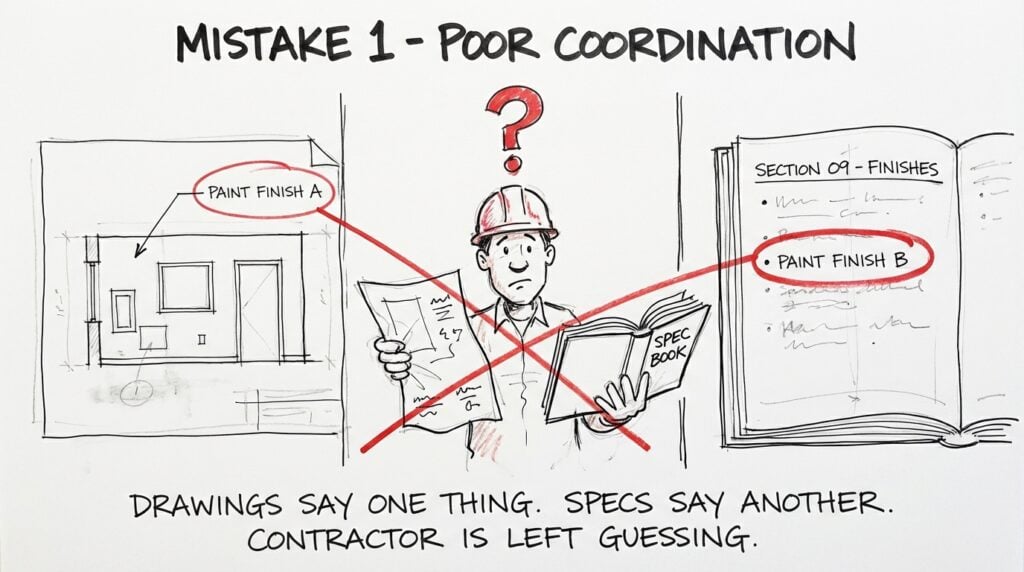
Ever been on a project where the drawings show one thing, but the specs say another? This disconnect creates confusion, RFIs, and sometimes expensive field changes.
Example: On a commercial project, the drawings called for a specific paint finish in offices, but the specs listed a completely different product. The contractor followed the specs, resulting in an unhappy client and costly repainting.
Drawings and specifications have a complementary relationship. One doesn’t automatically override the other. They work together to communicate the complete design intent, and when they contradict each other, the architect is responsible for sorting it out.
How to fix it:
- Implement a cross-referencing process. When you specify a product in Division 09, make sure it matches what’s on your interior elevations and wall types.
- Create a coordination spreadsheet that lists key elements and verifies alignment between drawings and specs before you issue documents.
- Make coordination a team habit, not an afterthought. In ARE Boot Camp, we teach drawing and specification coordination as a fundamental practice skill because it prevents problems before they reach the field.
Mistake #2: Using Vague or Ambiguous Specification Language
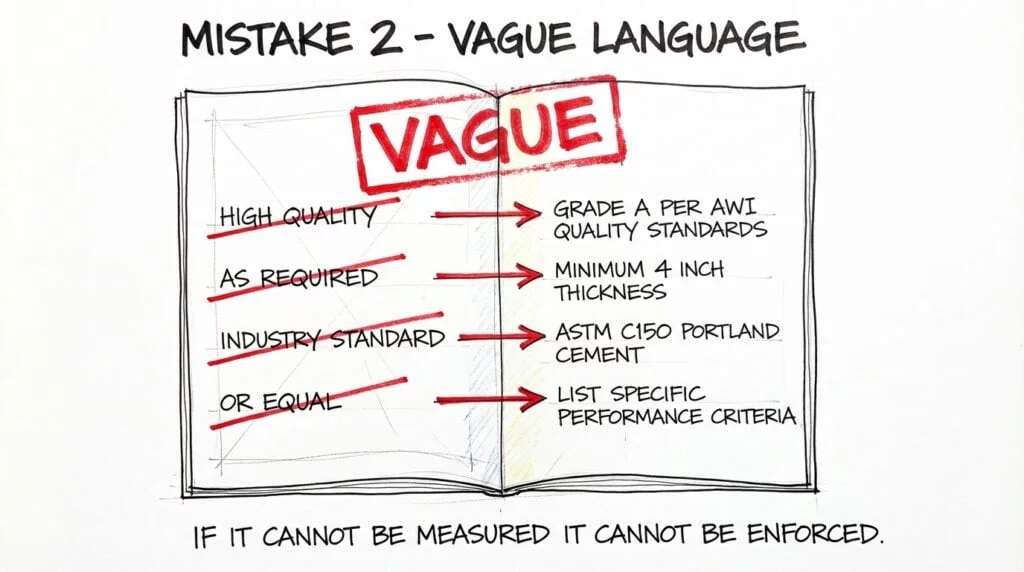
Vague terms like “high-quality,” “as required,” or “industry standard” might feel like they cover your bases. They don’t. They’re open to interpretation, and that’s exactly where disputes start.
Example: A spec that called for cabinets to be “high-quality craftsmanship” led to a dispute when the installed cabinets didn’t meet the architect’s expectations. The contractor argued they met the criteria as written. Without measurable standards in the spec, the architect had no ground to stand on.
CSI’s four Cs of specification writing say that specs must be Clear, Concise, Correct, and Complete. Vague language fails at least two of those every time.
Here are some of the most common offenders and what to use instead:
- “High quality” → “Grade A per AWI Quality Standards“
- “As required” → specific dimension, thickness, or performance metric
- “Industry standard” → cite the specific ASTM standard or ANSI standard by number
- “Or equal” → list the specific performance criteria that any substitution must meet
How to fix it: Replace every subjective term with a specific, measurable criterion. Then have someone unfamiliar with the project read your specs. If they can understand exactly what’s required without asking questions, you’re on the right track.
Mistake #3: Copy-Pasting Manufacturer Specs Without Editing
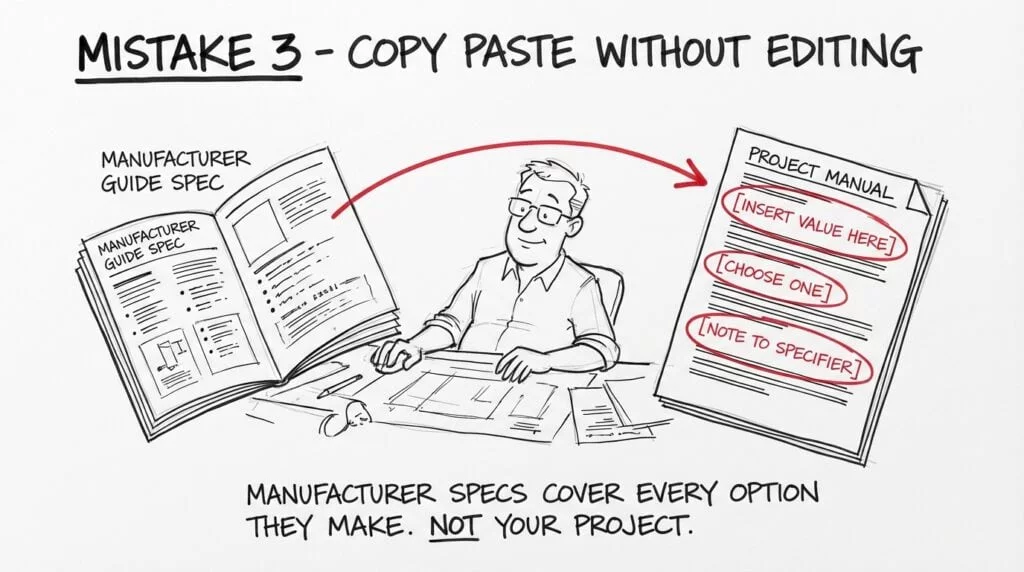
It’s tempting to copy-paste a manufacturer’s guide spec into your project manual. After all, who knows their products better than they do? But manufacturer specs are written to showcase every option they offer, not to match your specific project.
Example: An architect copied a window manufacturer’s complete spec without editing it. The spec included options for hurricane-resistant glazing (not needed for the project location) while missing thermal performance requirements critical for the climate zone.
Different specification types, whether prescriptive, performance, or proprietary, each need careful editing to match your project’s requirements.
Two specific traps to watch for when copying manufacturer specs:
- Bracketed placeholder text. Manufacturer guide specs include brackets like [Insert Dimension Here] or [Choose: 120V or 240V]. Architects who copy-paste without reading every line leave these brackets in the final project manual, forcing the contractor to guess the design intent.
- Hidden “notes to specifier.” Guide specs and MasterSpec templates embed instructional comments meant only for the architect during editing. Printing a final project manual with visible specifier notes is one of the most embarrassing and avoidable errors in practice.
Poor specification documents also create problems downstream during the submittal review process, leading to multiple revisions and project delays.
How to fix it: Always edit manufacturer specs with a critical eye. Delete irrelevant options, clarify which specific products are required, and add any project-specific requirements. Create a highlighting system to mark sections needing customization (yellow for options to select, red for sections to delete). The Construction Documents Technologist (CDT) certification teaches a systematic approach to proper specification editing that every architect should know.
Mistake #4: Ignoring Site-Specific and Regional Conditions
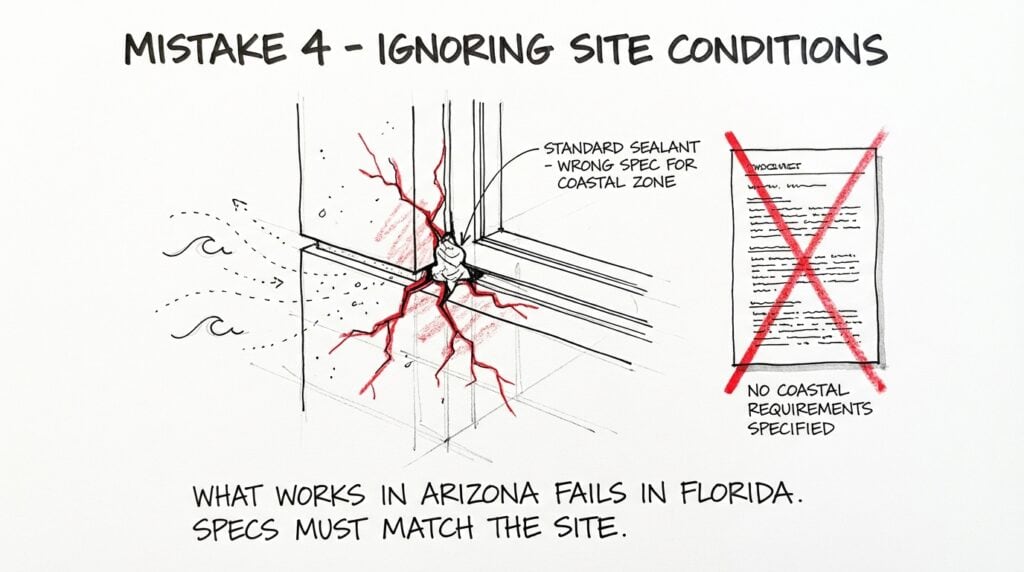
Generic specifications that ignore regional and site-specific conditions are a recipe for failure. What works in Arizona might fail spectacularly in Florida.
Example: A spec calling for a standard exterior sealant led to premature failure on a coastal project where the high salt content in the air degraded the material within months.
Construction type requirements vary by location and condition, making it essential to tailor your specifications to the specific project environment.
Proper planning for site conditions is also a critical part of project contingency planning. Unexpected site conditions are one of the most common triggers for change orders and budget overruns.
How to fix it:
- Research material performance in conditions similar to your project site.
- Create regional specification supplements that address common conditions in your practice area (coastal environments, extreme heat, freeze-thaw cycles).
- Consult with local contractors and manufacturer reps who know from experience what works and what fails in your climate.
Mistake #5: Using Outdated Master Specifications
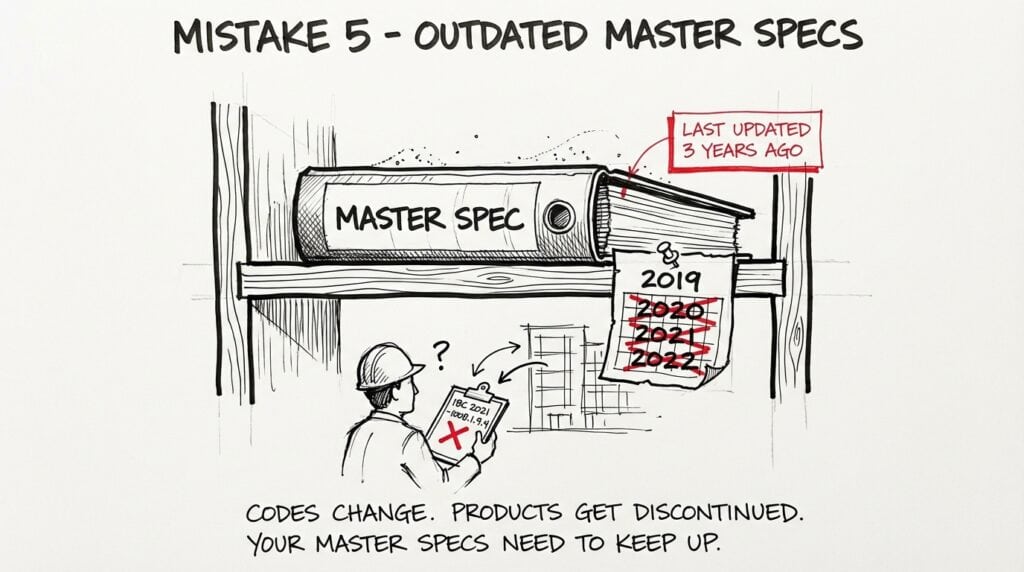
Code changes, product discontinuations, and evolving industry standards make specifications a moving target. Using outdated master specs can lead to non-compliance issues and references to products that no longer exist.
Example: A firm used their standard specs from three years prior, not realizing the International Building Code had changed significantly. The result was non-compliant fire-rated assemblies that required costly field corrections, particularly related to occupancy classifications that had been updated.
Outdated master specs also frequently reference CSI MasterFormat section numbers or organizational structures that have been revised, creating confusion during bidding and construction.
How to fix it:
- Implement a regular update schedule for your master specifications. At minimum, review them annually.
- Date every master specification section and set calendar reminders for reviews.
- Subscribe to code update notifications and industry standards changes from organizations like ICC and ASTM.
- Consider using a commercial master specification system that provides regular updates so you’re not maintaining everything from scratch.
Mistake #6: Poor Coordination with Structural, MEP, and Other Disciplines
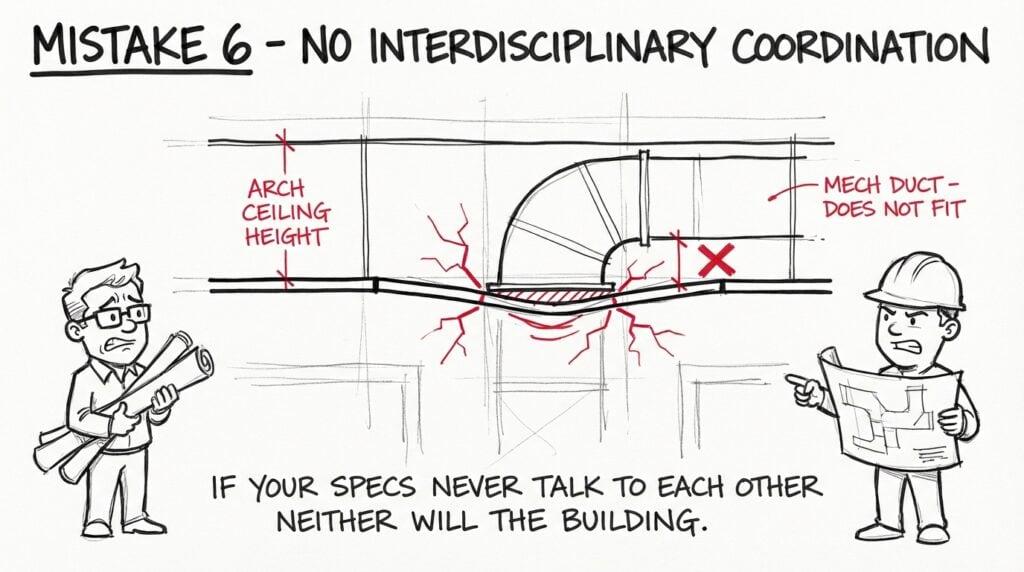
Architectural specifications must work harmoniously with structural, mechanical, electrical, and plumbing specs. When they don’t, interdisciplinary conflicts show up in the field.
Example: The architectural specs called for a specific ceiling height, but the mechanical engineer specified ductwork that couldn’t fit within the plenum space. The result was field coordination issues and schedule delays that could have been caught during document review.
This coordination is especially critical with life safety elements like fire walls, fire barriers, and fire partitions, where proper specification and installation are crucial for code compliance.
How to fix it:
- Hold regular interdisciplinary specification review meetings at key milestones (SD, DD, CD).
- Create a coordination matrix that identifies overlap areas between disciplines.
- Have each discipline review related sections from other disciplines before finalizing documents. An MEP engineer catching a conflict during review is far cheaper than a contractor catching it during construction.
Mistake #7: Weak Execution Sections (Installation Details)
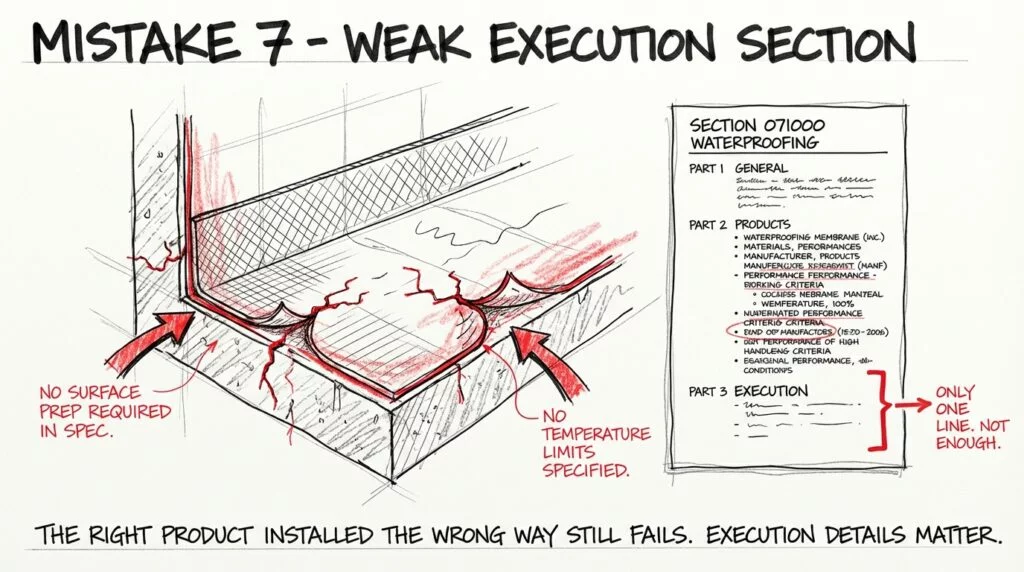
Many architects focus heavily on specifying the right product but neglect the execution requirements. How a product gets installed is often as important as the product itself.
Example: A waterproofing membrane was correctly specified in Part 2, but it failed because the execution section didn’t address substrate preparation, ambient temperature requirements, or cure times. The product was right. The installation wasn’t.
A well-written execution section covers the details that determine whether a product actually performs as intended:
- Surface preparation requirements
- Environmental conditions (acceptable temperature and humidity ranges)
- Installation sequence
- Quality checkpoints during and after installation
- Curing or drying times before subsequent work can proceed
Proprietary specs often have great product data but weak execution guidance. Architects need to write this themselves or pull requirements from reference standards.
Pro tip: For complex installations, a strong execution section can state “install in accordance with manufacturer’s written instructions.” This shifts liability appropriately and keeps the warranty valid without the architect needing to invent the installation sequence. But only use this language after reviewing the manufacturer’s data to confirm their instructions are actually feasible for your project. If the manufacturer requires substrate conditions or temperatures that conflict with your design, you’ve created a bigger problem than the one you solved.
When execution sections are weak, the consequences usually show up as field failures that lead to rework, architect insurance claims, and project delays.
How to fix it: Develop detailed execution sections for critical systems like waterproofing, air barriers, and fire-stopping. Get contractor input on execution requirements during design development. Include step-by-step procedures with environmental conditions, preparation requirements, and quality control checkpoints.
Mistake #8: Unclear Substitution and Alternate Criteria
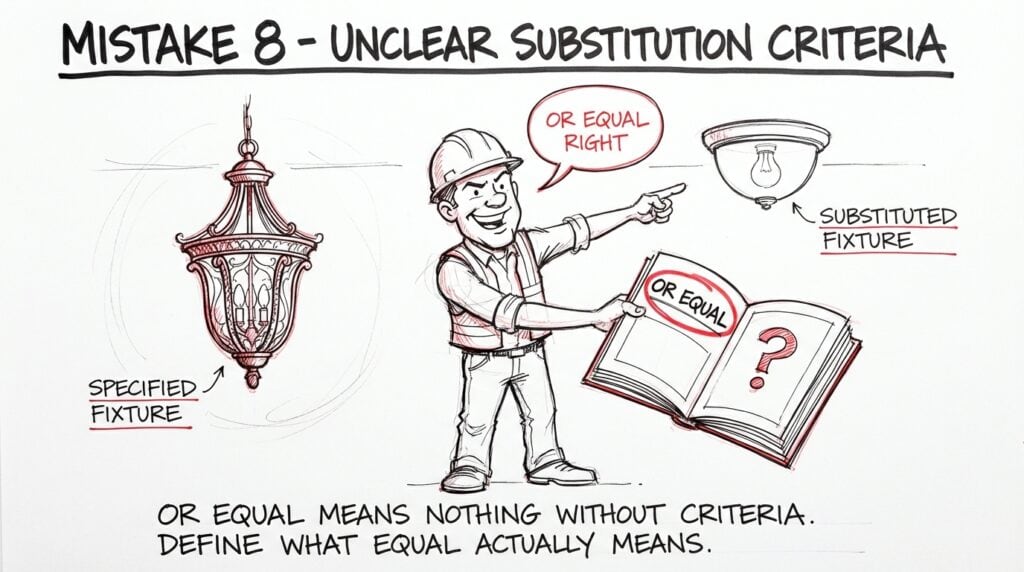
The phrase “or approved equal” without accompanying criteria is an invitation for substitution battles. Contractors will naturally propose less expensive alternatives, but without clear criteria, evaluating “equal” becomes entirely subjective.
Example: A contractor substituted a less expensive lighting fixture, claiming it was “equal” to the specified product. The light quality and dimming capabilities were inferior, resulting in an unsatisfied client and a dispute over whether the substitution met the spec.
How to fix it:
- Establish clear criteria for acceptable substitutions. Don’t just say “or equal.” Define what “equal” means for that specific product.
- List critical performance characteristics that any substitution must meet (light output, CRI, dimming range, finish quality).
- Use standardized substitution request forms that require contractors to provide side-by-side comparisons of the specified product versus their proposed alternative.
- Consider specifying “no substitutions” for critical design elements where the exact product matters to the design intent.
Mistake #9: Communication Breakdowns Between Office and Field
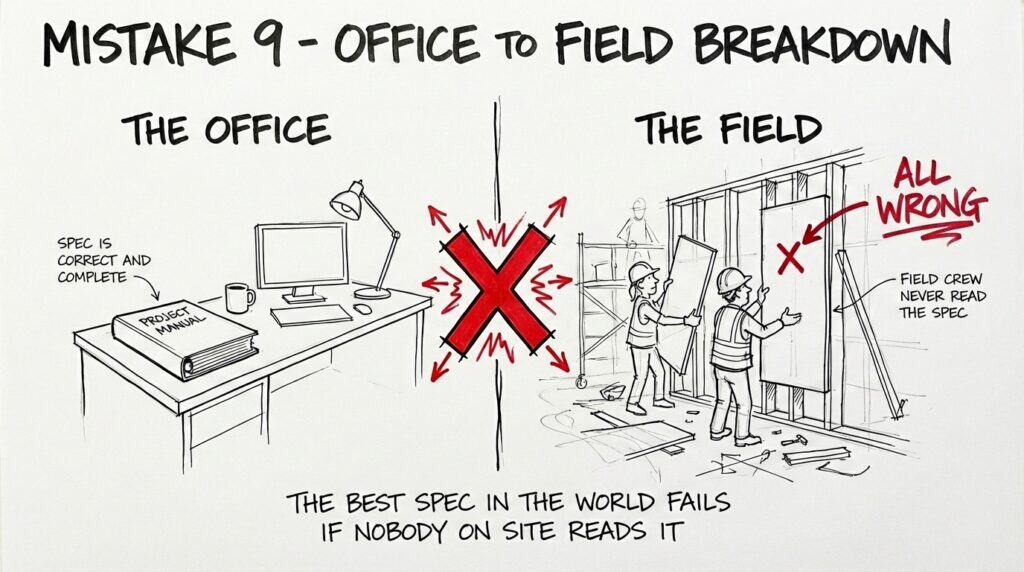
Even the best specifications fail if they’re not understood by the people actually building the project. The gap between the office and the job site can be wide, and problems that start with miscommunication often don’t surface until the construction punch list phase.
Example: A complex rainscreen system was properly specified, but field personnel weren’t familiar with the installation sequence. The result was improper installation that had to be removed and completely redone.
This is where construction observation becomes critical. If the architect isn’t verifying that field crews understand the spec requirements during site visits, problems compound quickly.
How to fix it:
- Highlight critical specification requirements in pre-construction and progress meetings. Don’t assume everyone has read the specs.
- Create one-page “Specification Highlights” for complex systems that summarize key installation points for field personnel.
- Require field mock-ups for complex assemblies with all relevant subcontractors present, so everyone sees and agrees on the correct execution before full installation begins.
Mistake #10: Mis-Specifying Sustainable Materials and Systems
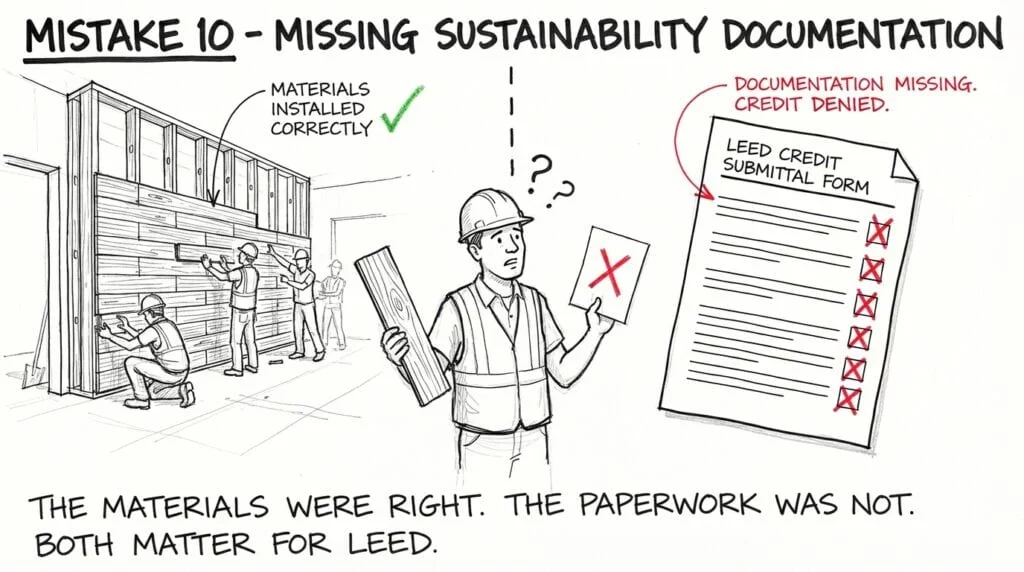
Green building requirements add another layer of complexity to architectural specification writing. Sustainable materials and systems often have special documentation requirements for certification programs that go beyond standard submittals.
Example: A project seeking LEED certification specified recycled-content materials but didn’t include the documentation requirements needed to verify and track those materials for LEED credit submittals. The materials were installed correctly, but the project couldn’t prove it on paper.
How to fix it:
- Involve certification consultants early in the specification process so documentation requirements are built into the specs from the start.
- Create sustainability specification checklists that address both performance requirements and documentation requirements.
- Clearly communicate to contractors exactly what sustainability documentation will be required with their submittals.
Frequently Asked Questions About Specification Writing
What is architectural specification writing?
Architectural specification writing is the process of creating written documents that define the materials, products, and installation methods for a construction project. Specifications work alongside drawings to communicate complete design intent. Drawings show what goes where. Specifications explain how it gets built and to what standard. They are legal contract documents, not administrative summaries.
What are the most common specification writing errors?
The most common errors include poor coordination between drawings and specs, using vague or unmeasurable language, copying manufacturer specs without customizing them for the project, ignoring regional and site-specific conditions, and using outdated master specifications that reference discontinued products or superseded codes.
What is the difference between prescriptive and performance specifications?
A prescriptive specification tells the contractor exactly what product to use and how to install it. A performance specification defines the required outcome and lets the contractor choose how to achieve it. Each approach carries different levels of responsibility. Prescriptive specs give the architect more control but also more liability if the specified product fails.
How do construction specifications relate to drawings?
Specifications and drawings are complementary documents. Under AIA A201, neither takes automatic precedence over the other when there is a conflict. The architect is responsible for interpreting inconsistencies. The best practice is to coordinate both thoroughly during design development so conflicts never make it to the field.
What is a master specification?
A master specification is a pre-written template covering standard materials, systems, and installation methods that a firm customizes for each project. Master specifications save time but must be updated regularly. Outdated master specs are one of the most common sources of code non-compliance and unavailable product references in the industry.
Build Better Architectural Specification Writing Skills
Every error on this list leads to the same place: disputes, change orders, field failures, and liability exposure. The good news is that every one of them is preventable with the right systems and knowledge. Architectural specification writing isn’t about perfection. It’s about building consistent habits that catch problems before they reach the field.
If you want a structured path to mastering spec writing, the CDT certification provides the foundation that architecture school never gave you. For ARE candidates, the PDD 101 course covers specification writing as part of the broader construction documentation process. And if you want to go deeper into how specs get administered during construction, CCCA certification covers the administration side from submittals through closeout.
Whether you’re fixing one of these errors in your own practice or building your spec writing skills from scratch, the investment pays off in smoother projects, fewer problems in the field, and less time spent cleaning up mistakes that never should have happened. Ready to take the next step? ARE Boot Camp can help you build the knowledge and accountability to get there.