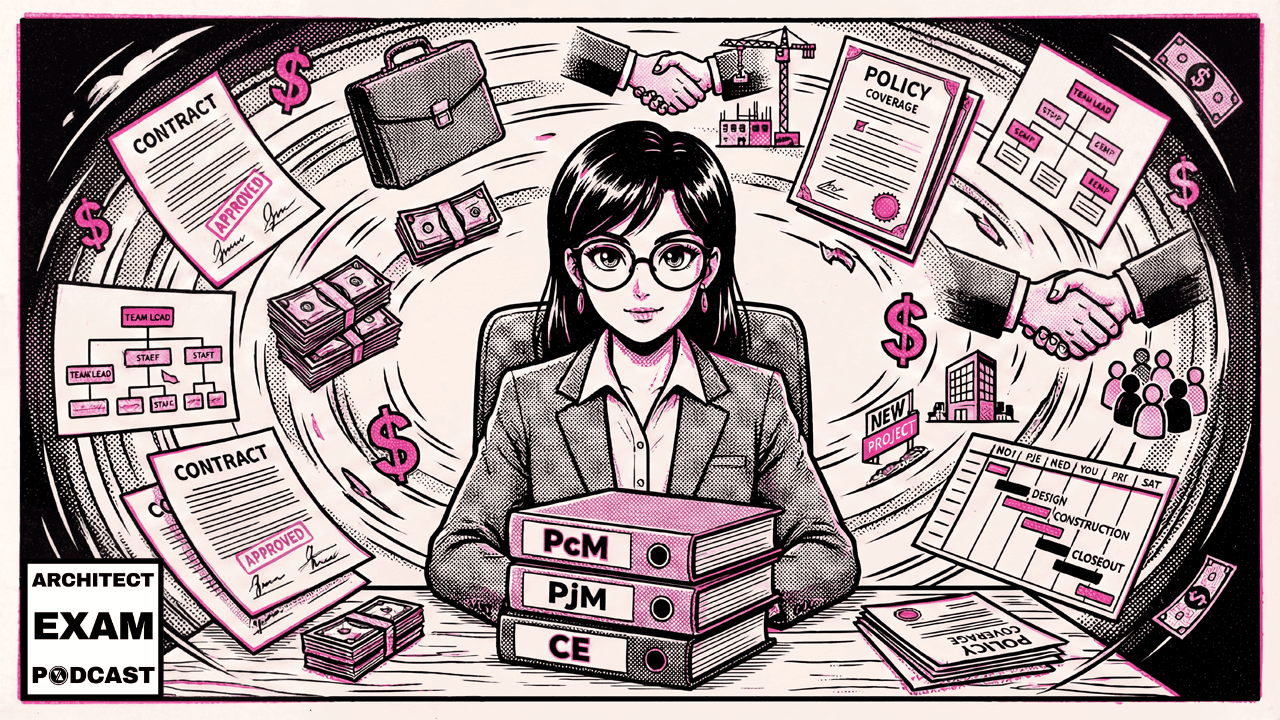
Most ARE candidates jump straight into studying PcM, PjM, and CE without ever stopping to ask, “What is each of these exams actually about?” This guide breaks down the three pro practice exams on the ARE 5.0, explains what makes each one different, and shows you how they connect so you can study smarter and stop wasting time.
This podcast is also available on YouTube, Spotify, and Apple Podcasts
Why You Need to Understand These Exams Before You Study
Here’s what happens all the time. People sign up for ARE prep courses, start watching videos and following along without ever asking what the test is actually about.
And here’s the thing.
NCARB isn’t writing exam questions based on what ARE prep companies are teaching you. They’re writing questions based on their own published exam objectives.
If you’re not studying NCARB’s exam objectives, you’re not actually studying for the architect exam. Everything else is just a game of telephone.
That doesn’t mean you should skip study materials. It means you should make sure whatever you’re using is actually teaching you what NCARB said they’re going to test you on.
And that starts with understanding what PcM, PjM, and CE are really about.
Why Start with the Pro Practice Exams?
If your goal is to get through the ARE quickly and efficiently, completing the pro practice exams first is the way to go.
The content on these three exams is largely about how an owner, an architect, and a contractor work together. That’s the foundation of everything in architecture. If you don’t understand that relationship inside and out, you’re going to struggle on all six exams, not just these three.
On top of that, these exams are smaller and more defined in scope than the technical exams. They’re a great place to build confidence before things get more complex.
If the idea of exam order is new to you, check out our post on the best ARE 5.0 exam order for the full breakdown.
What Ties PcM, PjM, and CE Together
Here’s a simple trick. Take any ARE exam name and flip the words around. It tells you exactly what the test is about.
Practice Management? It’s about managing a practice.
Project Management? It’s about managing a project.
Construction and Evaluation? It’s about evaluating construction.
All three of these exams deal with the administrative side of how architecture works. We’re not talking about designing buildings here. We’re talking about running the business, managing the team, overseeing construction, and handling all the processes and paperwork that come with it.
Here’s the framework to keep in your head:
PcM is about the firm. PjM is about the project. CE is about the construction site.
That distinction is going to make studying a whole lot easier.
PcM: Practice Management
Practice Management zooms all the way out to the firm level. This exam is not about one project. It’s about the whole practice.
The biggest themes are business operations, finances and risk, and how a firm is structured to deliver services.
Think staffing, hiring, professional development, and evaluating your team. Think revenue, expenses, and strategic business decisions. Think ethics, Standard of Care, insurance, and how a firm protects itself legally through the right business entity structure.
A lot of PcM is about what happens before you even have a signed contract. How does the firm find work? How does it negotiate services and fees? How does it decide whether to take on a project in the first place?
PcM wants you to think like a business owner, not a designer.
PjM: Project Management
If PcM zooms out to the whole firm, PjM zooms in to one project.
You’ve got a signed contract. You’ve got a client. Now what? How do you manage this thing from start to finish?
The biggest themes are assembling your team, planning and scheduling the work, and contracts.
Let me be direct about something.
PjM is a major contracts test. A huge part of this exam is understanding the AIA contract documents, especially the B101 between the owner and architect and the A201 general conditions. If you don’t know your AIA contracts, you’re going to have a hard time with PjM.
Beyond contracts, PjM tests your ability to plan and manage the work. Schedules, milestones, scope management, and what happens when things change. Because things always change.
Here’s where people get confused. Both PcM and PjM deal with contracts and risk. But PcM looks at contracts from a “should we take this project” lens. PjM looks at contracts from a “we signed the deal, now how do we execute” lens. Different perspective, same documents.
CE: Construction and Evaluation
CE is about what happens after the documents are done and construction begins. The drawings are out, the contractor is hired, and now a building is actually getting built.
The biggest themes are preconstruction activities, construction observation, and the administrative processes during construction.
Before construction starts, you need to understand the bidding process, how to evaluate contractors, and how different project delivery methods change the architect’s role.
Once construction is underway, you’re visiting the site, reviewing submittals, processing change orders, handling payment applications, and making sure what’s being built matches what was designed.
CE also covers project closeout, including punch lists, substantial completion, final completion, and post-occupancy evaluation.
Think of CE like being the referee between the owner and the contractor. The game is being played, and you’re there to make sure everyone follows the rules. The rulebook? That’s the contract documents.
How PcM, PjM, and CE Flow Together
These three exams follow the natural lifecycle of how architecture actually works.
PcM is about running the firm and winning the work.
PjM is about managing the project through design.
CE is about overseeing construction and evaluating the finished product.
Win the work. Manage the work. Build the work. Evaluate the work.
When you understand that flow, it becomes much easier to mentally organize what belongs where. Topics like contracts, risk, insurance, quality control, and project delivery methods show up on all three exams, but each exam looks at them from a completely different angle.
Study Strategies for the Pro Practice Exams
1. Start with the overlapping topics.
Contracts, risk, insurance, quality, and project delivery methods show up on all three tests. Invest in understanding those topics first and it will pay off across every exam.
2. Master the B101 and A201 first.
There are roughly 70 AIA contract documents, but these two are the backbone. The B101 owner-architect agreement and the A201 general conditions define what these first three tests are all about. If you understand those two inside and out, everything else starts making sense.
3. Get comfortable reading AHPP.
These exams are based on the AIA contracts and the Architect’s Handbook of Professional Practice. You can’t pass a test based on a book if you don’t want to read the book. And reading comprehension matters more than you think. Even reading the actual exam questions requires serious focus and strategy. If reading feels hard now, lean into it. These first three exams are training for when things get much more complex on the technical exams.
Want to Go Deeper? Download the Study Notes.
We created a two-page study guide and an open book homework assignment specifically for this episode. The homework walks you through NCARB’s actual exam objectives for PcM, PjM, and CE, and asks you to compare how key topics show up differently across all three exams.
This is the kind of work that most people skip. And it’s exactly why most people feel confused about what they’re studying for. Don’t be most people.
If you’re looking for ARE study materials built around NCARB’s objectives, check out our ARE 101 membership. We’ve got courses for the PcM, PjM, and CE exams plus a dedicated AIA Contracts 101 course. And because of all the overlap we just talked about, everything is part of one membership so you can study these exams the way they’re meant to be studied, together.
And if you’re looking for more structured coaching and accountability with a clear roadmap, check out the ARE Boot Camp coaching program. It has been the gold standard in ARE prep since 2015.