The visual learner myth has convinced thousands of ARE candidates that watching videos is enough to pass the architect exam. It’s not. This post breaks down the learning pyramid, explains the difference between active vs passive studying, and gives you practical study methods for visual learners that actually work for exam prep.
This podcast is also available on YouTube, Spotify, and Apple Podcasts
Passive vs Active Studying
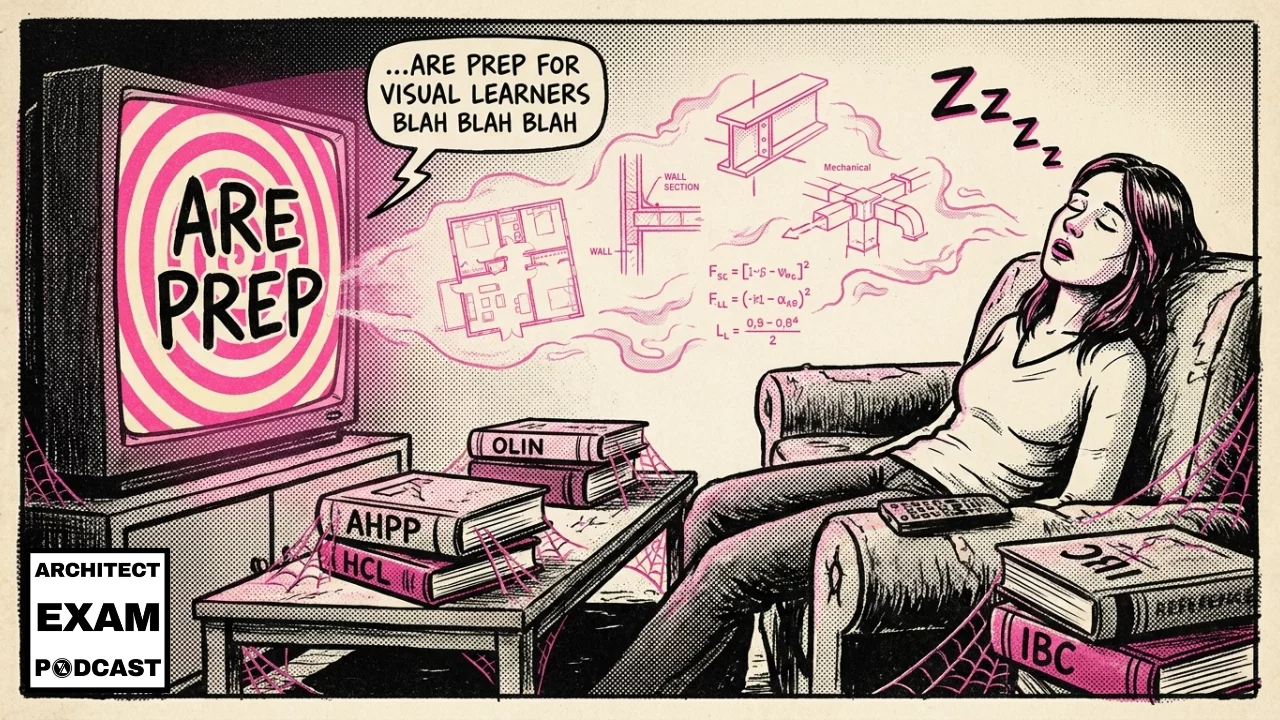
You watched 40 hours of ARE prep videos. You feel ready. You sit down on exam day, read the first question, and your mind goes completely blank.
Sound familiar?
I know that stings. You spent hours watching ARE prep content, flipping through flashcards, and consuming every visual study aid you could find. It all made sense in the moment. You were covering material, checking off topics, feeling productive.
But then you sit for the exam and it’s like someone wiped the hard drive.
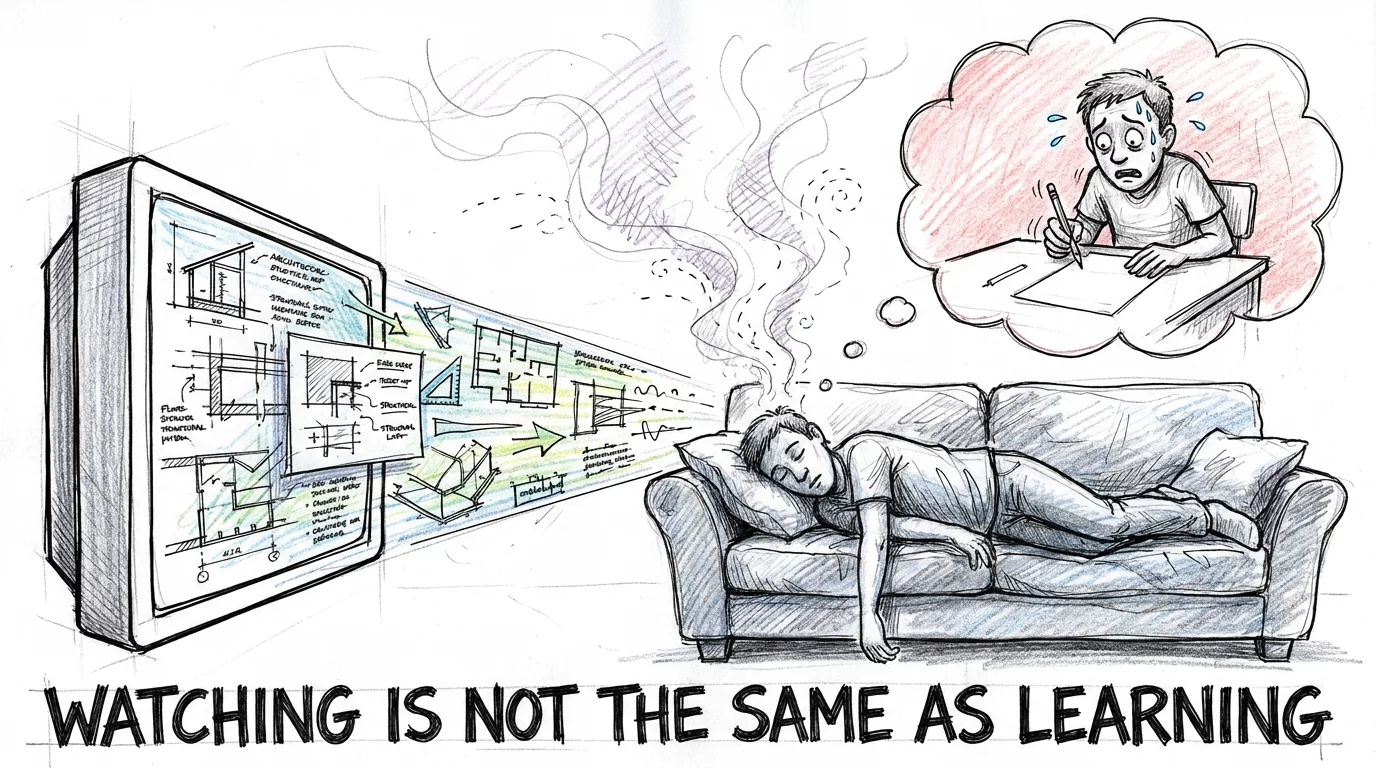
That disconnect happens because watching is passive, and true learning requires active engagement. It’s like thinking you can become a master chef by watching cooking shows all day. At some point, you need to actually get in the kitchen and start cooking.
Just because something clicks when you watch a video doesn’t mean that information will be accessible when you need it most. Under exam pressure, your brain can only retrieve information it actually worked to learn. Passive recognition is not the same as active recall.
The difference between active learning vs passive learning is the difference between watching a cooking show and actually cooking. One makes you feel informed. The other makes you competent.
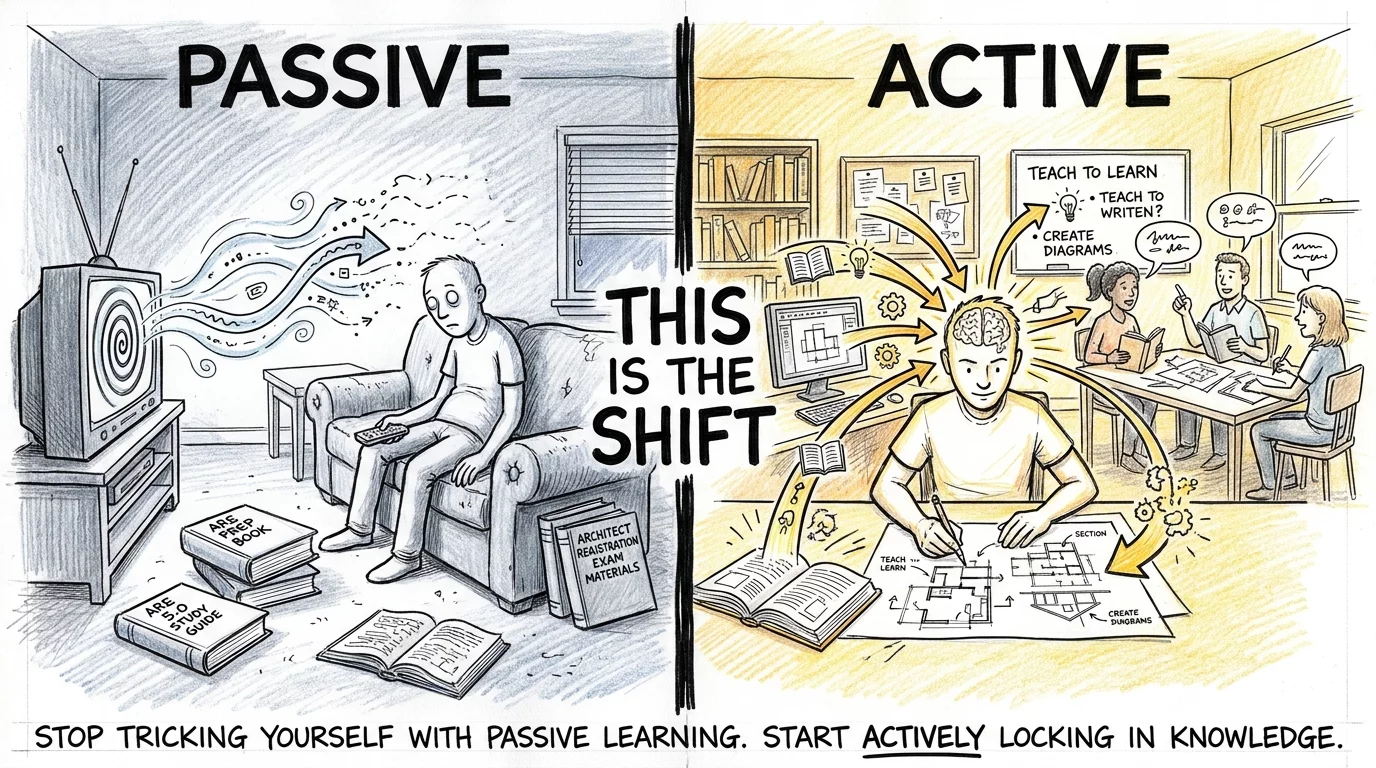
So how do you know if you’re actually learning or just watching? There’s a framework for that.
Learning Pyramid for Exam Prep
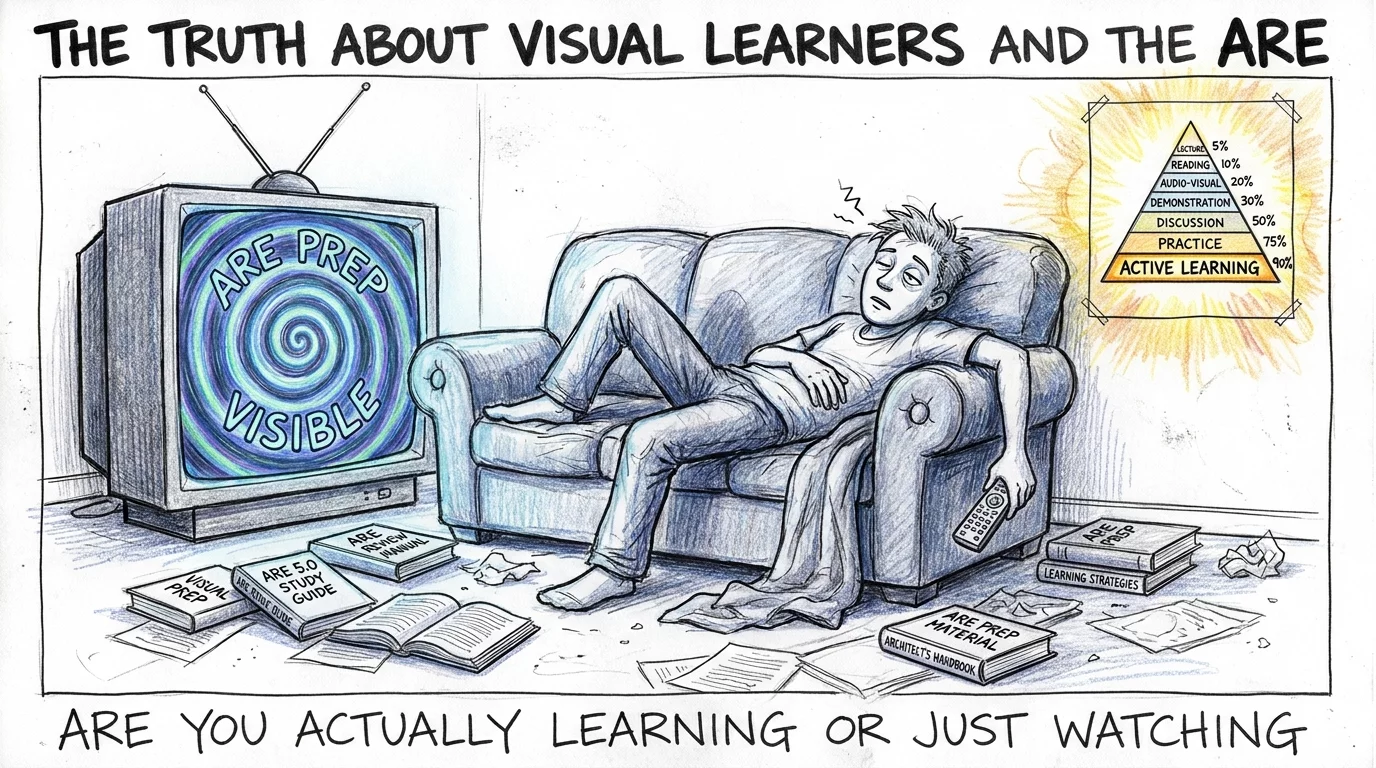
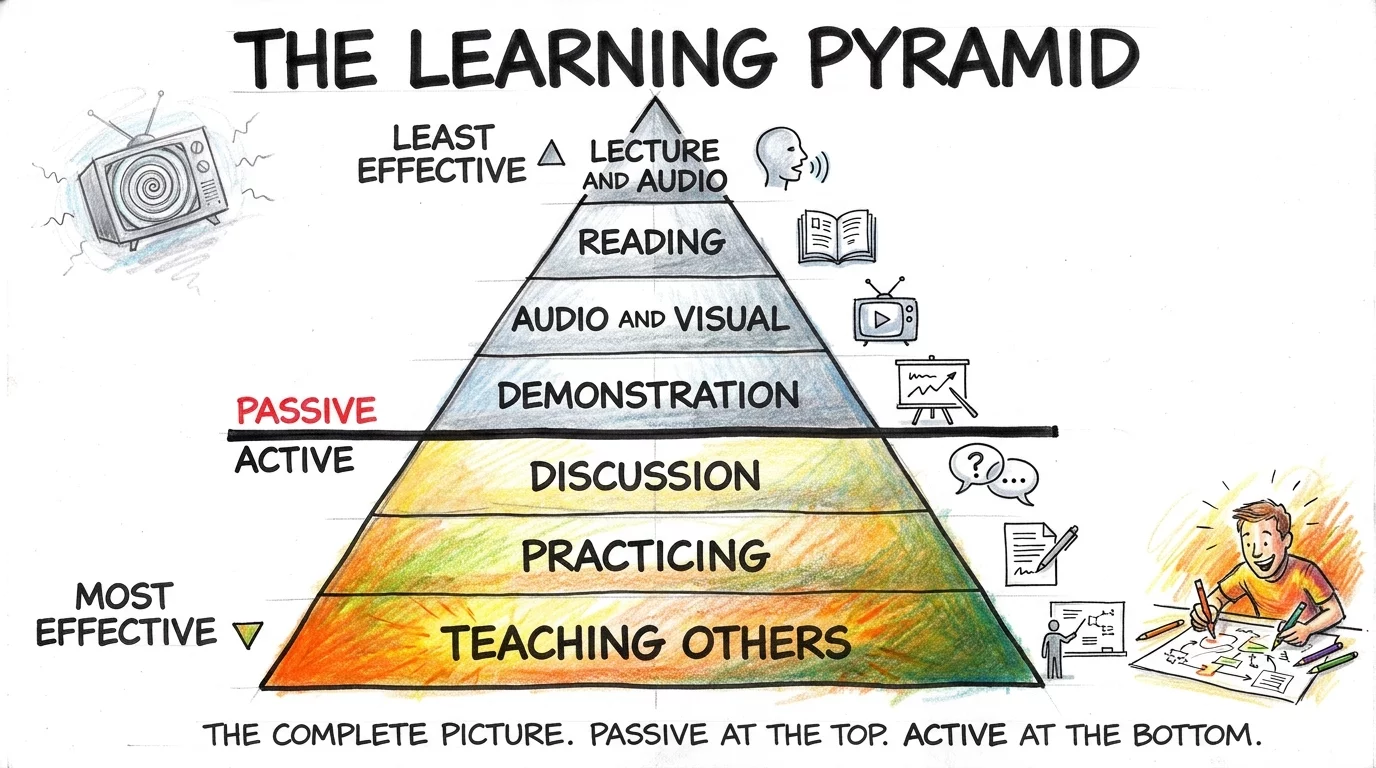
Instead of thinking about learning styles, consider the learning pyramid. It’s a model that ranks study methods from least effective (passive) to most effective (active).
The pyramid breaks into two halves. The top half is passive methods where you’re absorbing information. The bottom half is active methods where you’re doing something with the information.
You’ve probably seen versions of this pyramid that assign specific learning retention rates to each level, like 5% for lectures and 90% for teaching. Those exact percentages are widely cited but not backed by peer-reviewed research. The relative ranking of methods, from passive at the top to active at the bottom, is the valuable insight here. The more actively you engage with material, the better you retain it.
From least effective to most effective.
Passive Study Methods
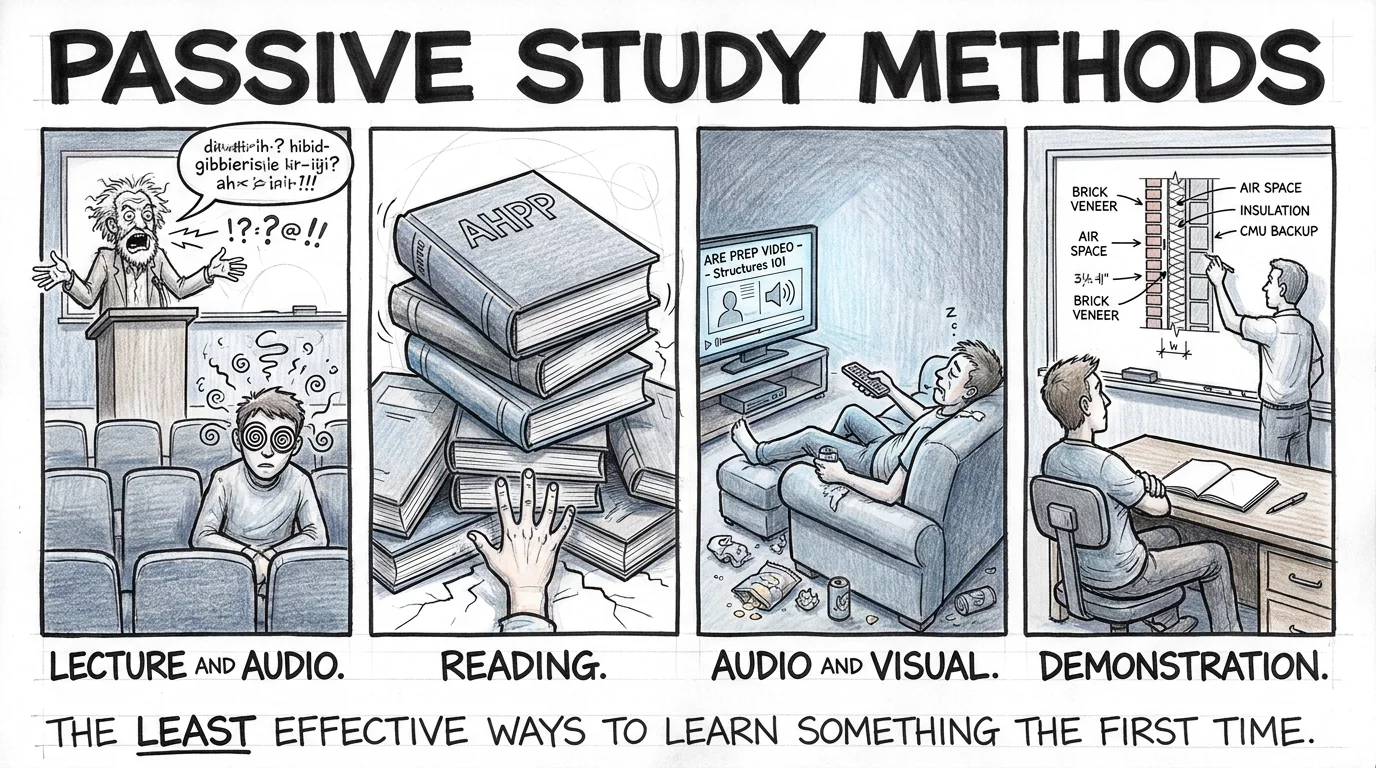
These are the top four layers of the pyramid. They’re not useless, but they’re the least effective ways to learn something the first time. Most ARE candidates spend almost all their study time here.
Lecture and Audio
Sitting in a lecture or listening to a podcast. The information goes in one ear, and unless you’re doing something with it, a lot of it leaves out the other.
That doesn’t mean podcasts are worthless. It means listening should be a starting point, not the whole strategy. Use commute time for podcasts. Listen while you exercise. But don’t count it as your primary study session.
Reading
Reading a textbook cover to cover without stopping to process anything is passive. Your eyes move across the page, but your brain is on autopilot.
The fix isn’t to stop reading. It’s to read actively. Write notes in the margins. Summarize paragraphs in your own words. Ask yourself questions about what you just read. If you need help building those habits, check out our guide to active reading strategies.
Reading is also one of those skills that gets easier the more you do it. Think of it like learning piano. The first few weeks are painful. But the more you practice, the more fluent you become. The same thing happens with reading dense technical material like the AHPP.
Audio and Visual
This is where most “visual learners” live. Watching videos, looking at diagrams, absorbing presentations.
Videos feel productive. You watch someone explain a structural concept, you nod along, it makes sense. But your brain is only engaging the recognition part. “Yes, I recognize this concept” is very different from “I can explain this concept and apply it to a new situation.”
The upgrade is simple. Take notes while watching. Pause the video and try to explain what you just heard out loud. Draw your own version of the diagram instead of just looking at the one on screen.
Demonstration
Watching someone else work through a problem. This is better than a straight lecture because you see the process, not just the answer. But it’s still passive because you’re watching someone else do the thinking.
After watching a demonstration, immediately try a similar problem on your own without looking at the solution. That’s where the learning actually happens.
Active Study Methods
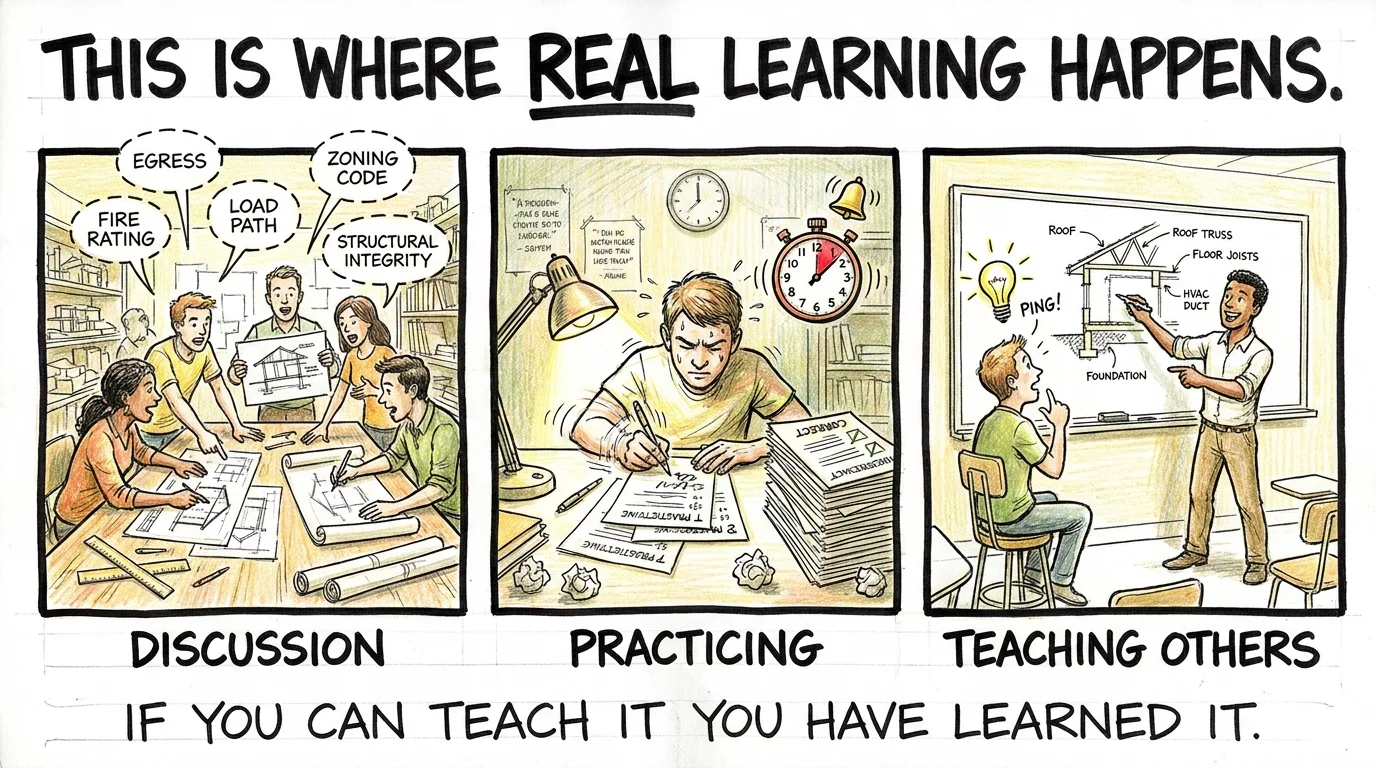
Now we’re in the bottom half of the pyramid. These are the active study techniques that actually move the needle. This is where real learning happens.
Discussion
When you talk about a concept with someone else, your brain has to organize the information, put it into words, and respond to questions and pushback in real time. That’s a completely different cognitive workout than reading or watching.
Join or form a study group. Find a study partner. Jump into online forums where ARE candidates discuss challenging topics. Even explaining a concept out loud to yourself in the car counts. The act of verbalizing forces your brain to process at a deeper level.
Practice by Doing
This is the big one. Tackle practice questions. Create your own scenarios. Set up timed sessions that simulate exam conditions. When you get a question wrong, don’t just read the correct answer. Dig into why you got it wrong and why the right answer is right.
If you want to sharpen how you approach exam questions specifically, take a look at our guide to test taking strategies for the ARE.
Draw diagrams from memory. Sketch wall sections without looking at a reference. Create your own flashcards instead of using someone else’s. The struggle of producing something from memory is exactly what builds strong neural pathways.
Teaching Is the Most Effective Method
The bottom of the pyramid. The most powerful study method you can use.
If you can teach a concept clearly to someone else, you actually know it. If you can’t, you’ve found your knowledge gap. Teaching forces you to organize information logically, anticipate questions, and fill in the holes in your understanding.
You don’t need a classroom for this. Explain a concept to your spouse, your coworker, your dog. Write a simplified explanation as if you were teaching someone who knows nothing about architecture. Mentor a newer candidate on topics you’ve already mastered.
This is why study groups work so well. Everyone takes turns being the teacher. When it’s your turn to explain something, that’s when the real learning locks in.
Cross-Training Your Study Routine
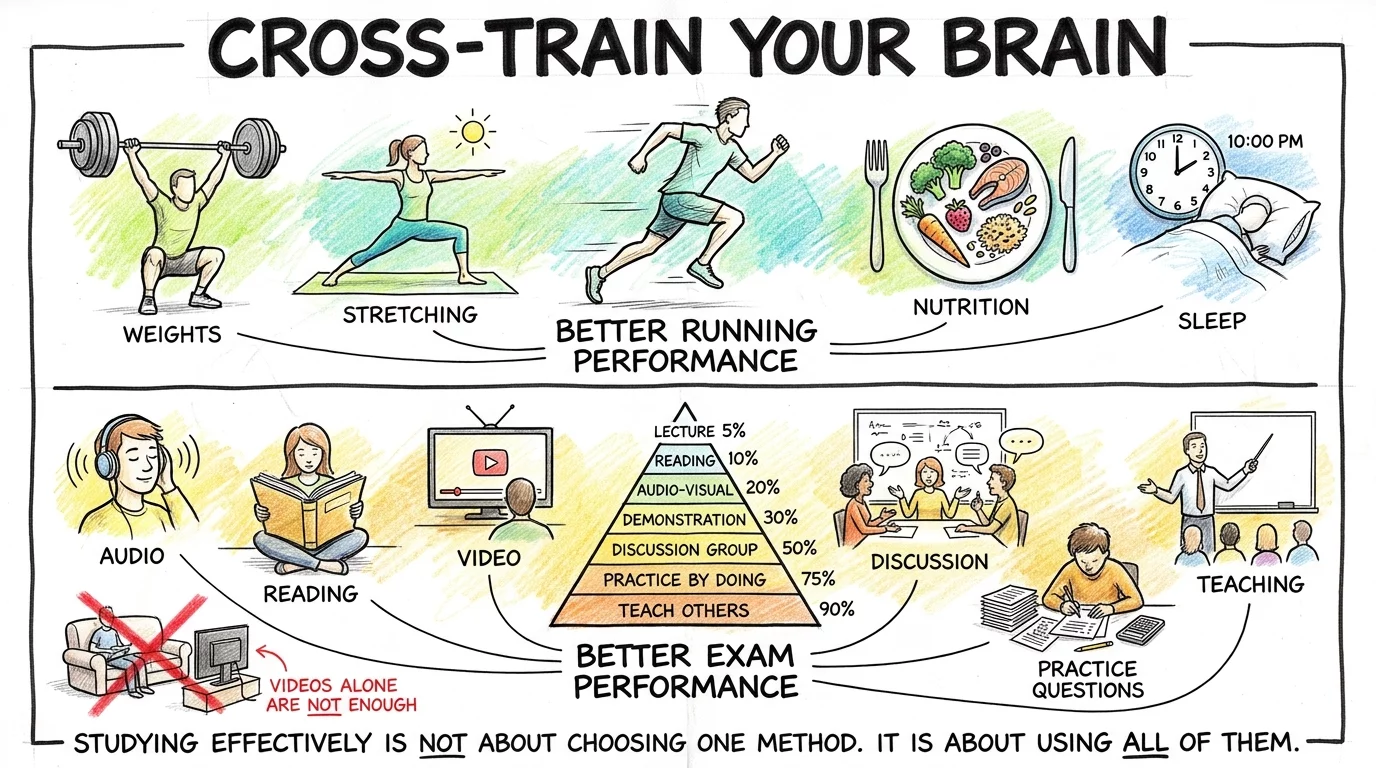
This is where most candidates go wrong. They rely too heavily on one or two methods instead of using the entire pyramid.
Think about training for a half marathon. If all you do is run, you’ll hit plateaus and risk injury. Serious runners cross-train. They add strength work, flexibility, nutrition, and recovery. Each component complements the others, creating a more well-rounded athlete.
Studying for the Architect Registration Exam works the same way.
The most successful candidates don’t just watch videos. They engage with material across every level of the pyramid. They read, then discuss, then practice, then teach. This approach to multimodal learning, using every layer of the pyramid instead of camping out in one spot, is what separates candidates who pass from candidates who keep failing.
If you need help structuring your time to fit all of this in, start with a realistic ARE study schedule and build from there.
A Note on ADD/ADHD
For those with attention challenges (like me), this multi-method approach isn’t just beneficial. It’s essential.
My ADD brain is like a hyperactive puppy. Constantly looking for the next interesting thing. Instead of fighting it, I’ve learned to throw it different study “toys” to keep it engaged.
When focus wanes with one method, switch to another. Use the natural ebbs and flows of your attention to your advantage. Having ADD doesn’t mean you can’t pass the ARE. It means you need to be strategic about how you study.
How ARE Boot Camp Uses Every Layer
At ARE Boot Camp, we built the entire program around the learning pyramid. We don’t just hand you videos and say good luck.
- Structured curriculum that combines reading, video, and audio (passive foundation)
- Weekly live meetings that facilitate real discussion and active learning
- Practice questions and scenarios that require application of knowledge
- Teaching opportunities where candidates explain concepts to each other
- Accountability partnerships that keep you consistently engaged across all methods
This multimodal learning approach is why our candidates consistently report not just passing their exams, but truly understanding the material in a way that benefits their professional practice long after they’re licensed.
Even if you’re not in Boot Camp, you can still implement these principles on your own. The key is to incorporate methods from every level of the pyramid, not just the ones that feel most comfortable.
Visual Learner Myth
Let’s talk about the elephant in the room.
For decades, the idea that people have distinct learning styles, visual, auditory, kinesthetic, has been widely accepted. You’ve probably said it yourself. “I’m a visual learner.” It’s intuitive. It feels true. It provides a nice simple explanation for why some study methods feel easier than others.
Research has consistently shown that most people benefit from multiple learning approaches, not just one. The visual learner myth isn’t that visual learning is bad. Visual resources are incredibly valuable. The myth is that you should only learn visually because that’s “your style.”
What I tell every architect I work with: We’re all visual learners. We’re architects. Of course we respond to diagrams and images and spatial thinking. That’s literally the profession we chose.
But there’s a massive difference between watching someone else draw a wall section and drawing that wall section yourself. Both are “visual.” Only one is active learning.
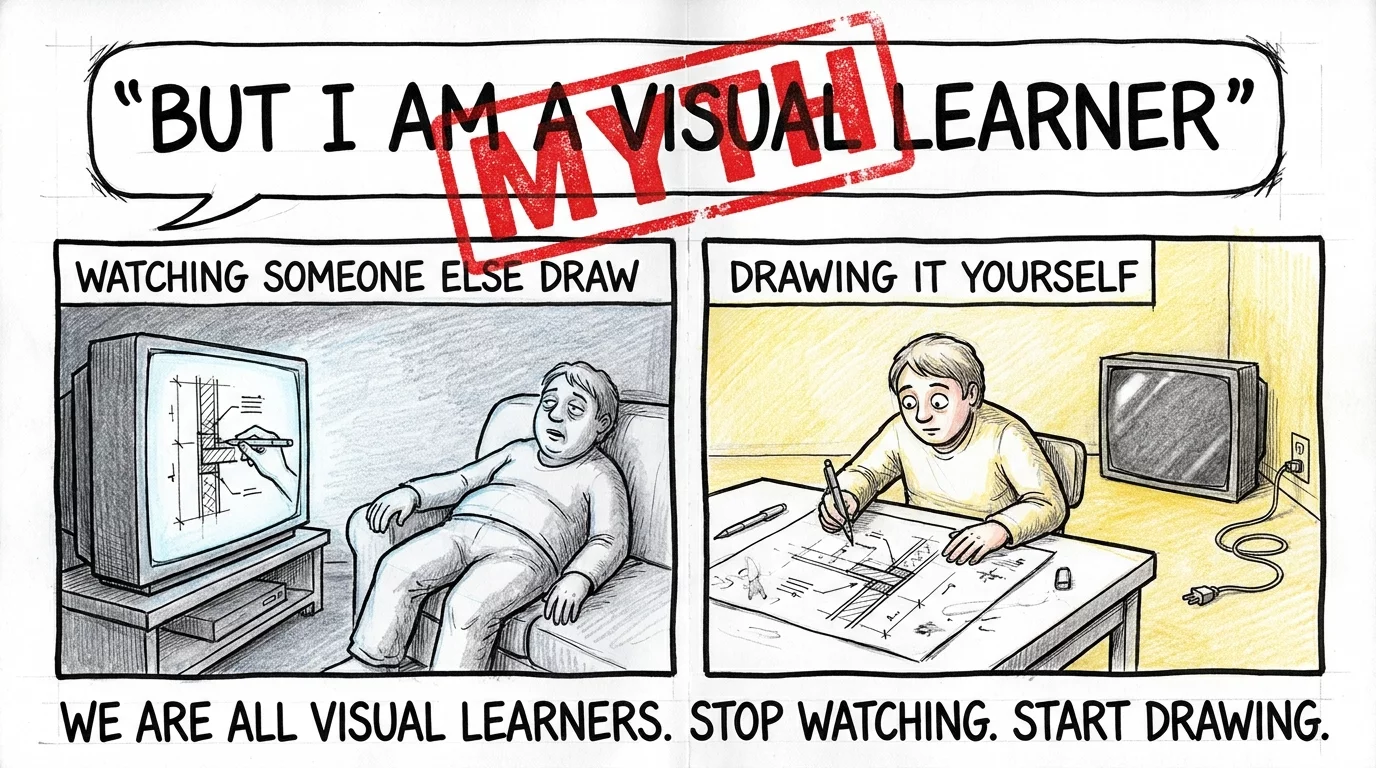
So instead of asking “what kind of learner am I?” start asking “how can I engage with this material in multiple ways?” That shift in perspective can be the difference between failing and passing your next ARE division.
Your Challenge: Make One Shift Today
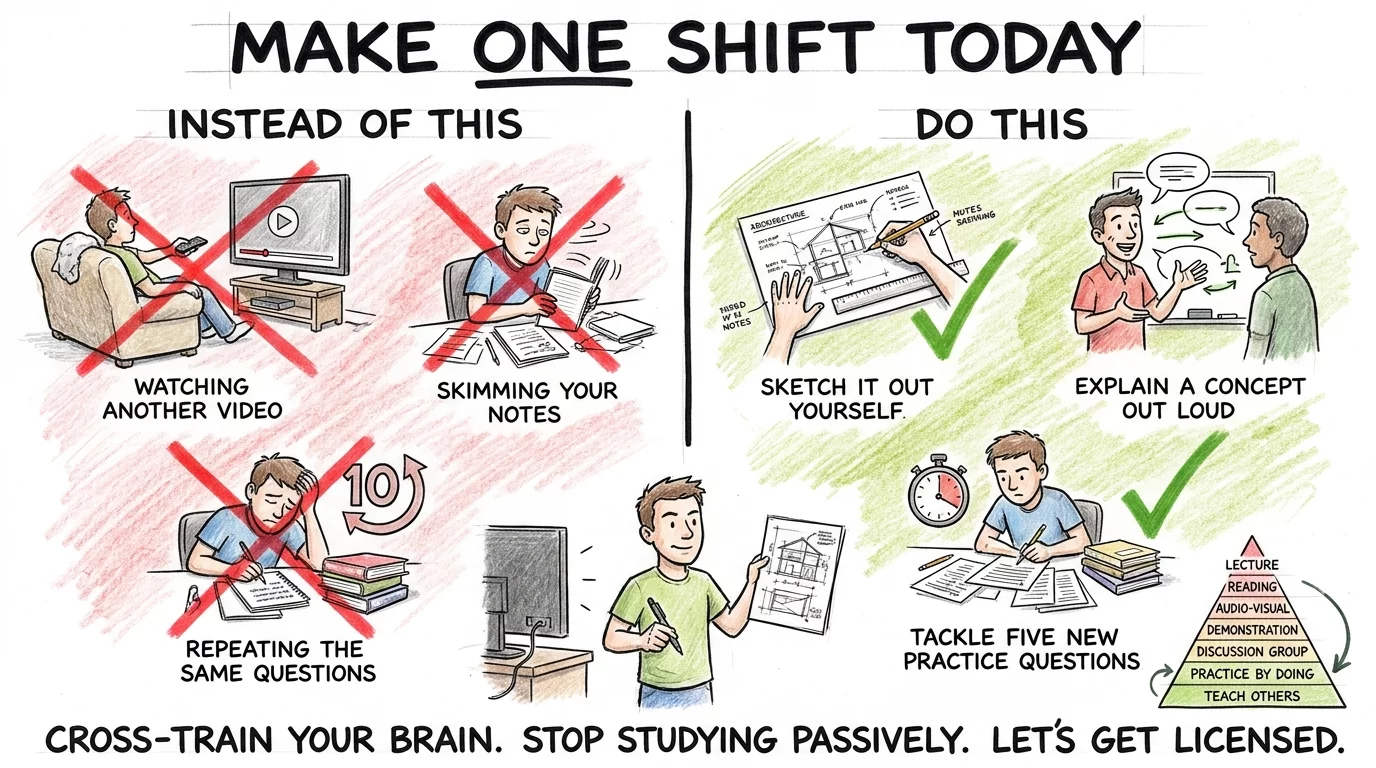
I’m not asking you to overhaul your entire study routine overnight. I’m asking you to make one shift.
If you’ve been primarily watching videos, add one active method this week. Draw a diagram from memory after watching a lesson. Explain a concept out loud to someone. Tackle five new practice questions under timed conditions instead of re-watching a lecture.
Understanding passive vs active studying changed how we built the entire Boot Camp curriculum. It can change how you study too.
Stop watching. Start doing. Cross-train your brain.
If you’re ready to stop guessing and start studying with a real structure, check out ARE Boot Camp. It’s a live coaching program that uses every level of the learning pyramid to get you licensed.
If you prefer to study on your own, the ARE 101 Membership gives you access to all of our courses, practice questions, flashcards, and reading companions for every ARE division.
And if you’re still figuring out which exam to take first, we’ve got you covered there too.
Frequently Asked Questions
Is being a visual learner a real thing?
The idea of fixed learning styles is largely unsupported by research. While you might prefer visual materials, studies show that everyone benefits from using multiple study methods rather than relying on just one. For architects especially, the key is shifting from passively watching visual content to actively creating it yourself.
What is the learning pyramid?
The learning pyramid is a model that ranks study methods from least effective to most effective. Passive methods like lectures, reading, and watching videos sit at the top. Active methods like discussion, practicing, and teaching others sit at the bottom. The more actively you engage with material, the better you retain it.
What is the most effective study method?
Teaching others is consistently ranked as the most effective study method. When you explain a concept to someone else, you’re forced to organize the information, fill in gaps in your understanding, and retrieve knowledge from memory. If you can teach it clearly, you actually know it.
What is multimodal learning?
Multimodal learning means using multiple study methods together instead of relying on just one approach. For ARE exam prep, this looks like combining reading with practice questions, discussion with study partners, and teaching concepts to others. The combination creates stronger, more durable knowledge than any single method alone.
What is the difference between active and passive learning?
Passive learning is absorbing information without interacting with it, like listening to a lecture or watching a video. Active learning requires you to do something with the information, like answering practice questions, discussing concepts, drawing diagrams from memory, or explaining a topic to someone else. Active learning creates much stronger memory pathways.
How do I study for the ARE exam effectively?
Use the learning pyramid as your guide. Don’t rely solely on videos and reading. Build a study routine that includes discussion (study groups), practice (timed questions and drawing from memory), and teaching (explaining concepts out loud). Start with a realistic ARE study schedule and add one active study method at a time until you’re using every level of the pyramid.