
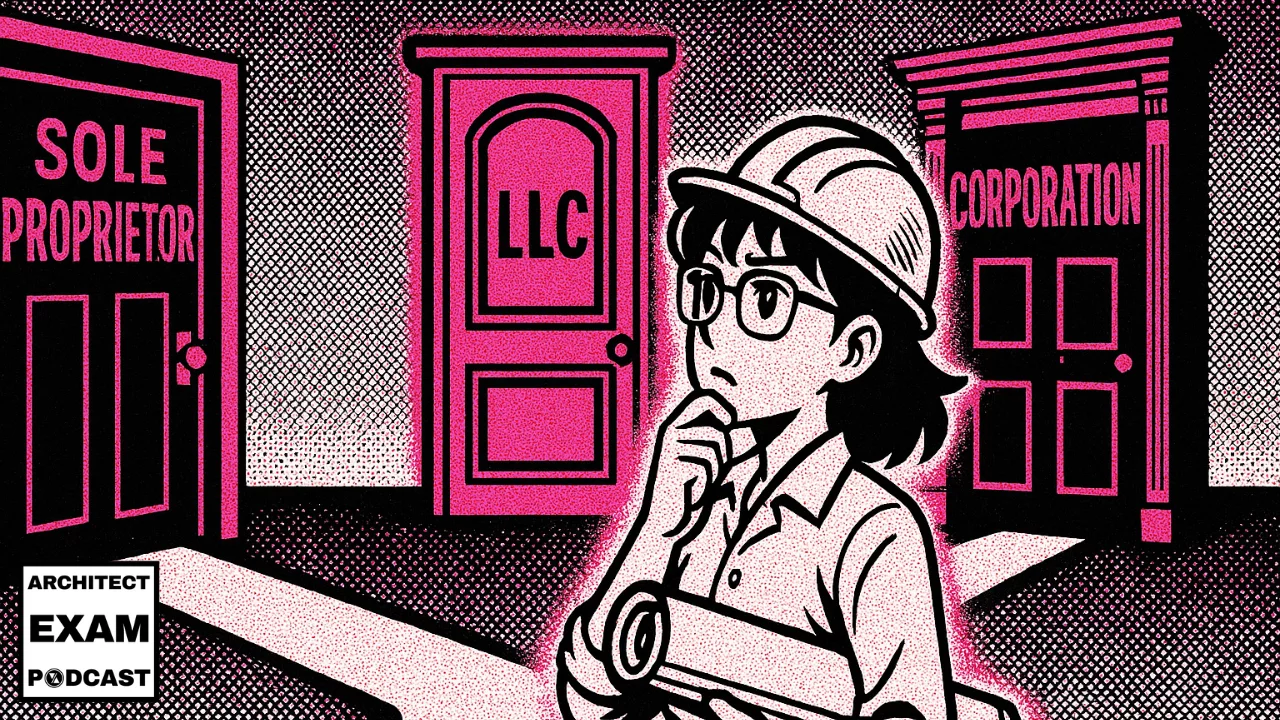

Understanding the different business entity types for architects is about as exciting as watching concrete cure – but it’s absolutely crucial for your architecture career and the ARE exam. Whether you’re choosing between a sole proprietorship, LLC, PLLC, LLP, or corporation, the right business entity protects your personal assets and defines how your architecture firm operates. Think of this guide as the spinach smoothie of architecture knowledge – not what you’re craving, but exactly what you need.
This podcast is also available on YouTube, Spotify, and Apple Podcasts
The Partnership Dilemma: A Cautionary Tale
Let me share what happened to a colleague of mine – an incredible architect who started her own small residential practice. Business was booming when she got an opportunity to partner with another architect on a major commercial project.
Everything went great until they disagreed about the facade design. Words were exchanged, feelings were hurt, and suddenly the partnership dissolved. But here’s the kicker – they never formally established what kind of business entity they were operating under.
They assumed they were just “working together,” but legally, they had created a general partnership by default. My colleague ended up on the hook for commitments her partner had made to consultants – costing her nearly $45,000.
Here’s what made it so painful: general partnership liability works under a principle called joint and several liability. That means each partner can be held personally responsible for 100% of the other partner’s mistakes and commitments – even ones they knew nothing about. One partner signs a contract with a consultant. Both partners are on the hook. That’s how my colleague lost $45,000 over a disagreement about a facade.
This scenario isn’t uncommon. During our last ARE Boot Camp coaching session, we discovered over 80% of candidates had never formally learned about business entity types for architects in school. These topics get pushed aside for more exciting design courses, but understanding which business entity type is right for your practice can literally save your career.
The Business Entity Menu: Options for Architects
Think of business entity types for architects as types of buildings. Each has different features, different levels of protection, and different maintenance requirements. Let’s explore the menu of options available to architects.
It’s ironic that we architects spend years learning to design structures that protect others from the elements, but often forget to build the legal structures that protect ourselves from liability storms. We’ll obsess over a rainscreen detail but overlook the “business entity waterproofing” that keeps our personal assets dry when problems start pouring down.
One thing to flag before we dive in: architecture is a state-regulated profession, and the entity options available to you depend on where you’re licensed. Some states require licensed professionals to form a PLLC or professional corporation instead of a standard LLC. Always verify the rules in your state before forming your firm.
Sole Proprietorship: The Studio Apartment
The sole proprietorship is the “studio apartment” scale of business entity types for architects. It’s just you, doing your thing, with no separation between your business and personal finances.
Imagine your business finances and your personal finances are roommates sharing a studio apartment with no privacy curtain. Whatever mess your business roommate makes, you’re both living in it.
Benefits of Sole Proprietorships:
- Instant formation – No paperwork required to create it
- Complete control – All decisions are yours alone
- Direct profits – All income comes directly to you
- Minimal bureaucracy – Few administrative headaches
The Major Drawback:
- Unlimited personal liability – If a client sues your business, they’re suing you personally
For architects, this means your house, car, savings, and even that vintage Eames chair you splurged on are all fair game in a lawsuit. That’s why many architects start as sole proprietors but don’t stay that way for long. It’s like designing a building with no structural support – fine until something goes wrong, then catastrophic.
For ARE exam preparation, remember this key point: Sole proprietorships are the EASIEST to form but offer ZERO liability protection.
Sole Proprietorship vs LLC: The Key Differences
If you’re weighing a sole proprietorship vs LLC, the decision comes down to three things:
- Liability exposure – A sole proprietorship gives you unlimited liability. An LLC creates a legal wall between your business and your personal assets.
- Tax treatment – Both are taxed the same way by default (pass-through, meaning income flows to your personal return). The LLC just adds protection without adding a tax penalty.
- Formation requirements – A sole proprietorship requires zero paperwork. An LLC requires filing articles of organization with your state and a modest fee – typically a few hundred dollars.
For most architects, the LLC wins easily. The protection is worth the paperwork.
Limited Liability Company (LLC): The Loft Conversion
The Limited Liability Company (LLC) is like the “loft conversion” of business entity types for architects. There’s more protection, more flexibility, but still not overly complex.
An LLC is like installing a really good waterproof membrane between your business and personal life. When problems rain down on your business, your personal assets stay nice and dry.
Why LLCs Are Popular with Architects:
- Limited liability protection – Your personal assets are protected if the business gets sued
- Flexible management structure – Run it yourself or share management with partners
- Tax flexibility – Can be taxed as a sole proprietor, partnership, or even elect S-Corporation taxation
- Fewer formalities than corporations – Less paperwork, fewer corporate requirements
Most tax attorneys recommend LLCs for about 80% of small to mid-size architecture firms. The modest cost and paperwork are well worth the liability protection, especially for design professionals whose work carries inherent risks.
For ARE preparation: Understanding that LLCs are relatively simple to form but provide significant liability protection is an important concept that appears on the Practice Management (PcM) division.
One important note: an LLC protects your personal assets from general business liabilities – things like a vendor dispute or a slip-and-fall in your office. But it does not protect you from your own professional negligence. If your drawings have an error that causes a construction defect, you can still be held personally liable for that mistake regardless of your entity type. Business entities and professional liability insurance are two separate layers of protection – you need both.
Professional Limited Liability Company (PLLC): The LLC for Licensed Professionals
Here’s where it gets specific to architects. A PLLC – or Professional Limited Liability Company – is a special version of the LLC designed specifically for licensed professionals like architects, engineers, doctors, and lawyers.
The PLLC meaning is straightforward: it’s an LLC that requires all members to hold an active professional license in the field the company practices. You can’t have a non-architect own a stake in an architecture PLLC.
Many states require architects to form a PLLC rather than a standard LLC. In those states, a regular LLC simply isn’t an option for a licensed architecture practice. Check your state’s board of architecture for the specific rules.
What a PLLC Does and Doesn’t Protect:
- It protects you from the professional negligence of your partners. If your co-owner makes a design error on their project, your personal assets are shielded from that claim.
- It does NOT protect you from your own professional negligence. This is the most important thing to understand about PLLCs – and honestly, about every business entity type. No corporate structure eliminates personal liability for your own malpractice.
Think of it this way: the PLLC is a firewall between partners. It keeps one architect’s problems from burning down the other’s personal finances. But it doesn’t make you immune to the consequences of your own mistakes. That’s what professional liability insurance is for.
PLLC vs LLC: What Architects Need to Know
The main differences between a PLLC vs LLC for architects:
- Licensing requirement – All PLLC members must hold an active professional license. Standard LLC members don’t need to be licensed in anything.
- State availability – Not every state offers PLLCs. Some states require professional corporations (PCs) instead for licensed professions.
- Malpractice protection scope – A PLLC protects partners from each other’s malpractice. A standard LLC doesn’t make that distinction as clearly.
- State reporting – PLLCs often have additional reporting requirements tied to the licensing board.
For most architects practicing in a state that allows PLLCs, the PLLC is the recommended starting point for a small firm over a standard LLC.
Limited Liability Partnership (LLP): The Townhouse
The Limited Liability Partnership (LLP) is the townhouse of business entities.
An LLP is like a row of townhouses with really good party walls. Each partner has their own unit, and if one catches fire, the others are protected.
Key Features of LLPs for Architects:
- Each partner is protected from the professional negligence of other partners
- Everyone remains personally liable for their own professional mistakes
- Partners share in management and profits
- Like LLCs, they enjoy pass-through taxation
In most states, LLPs are specifically designed for licensed professionals. That’s why you’ll sometimes see “PLLP” – Professional Limited Liability Partnership. The classic LLP scenario is when several architects with different specialties join forces: one handles healthcare, another does residential, a third focuses on sustainable design. They want to share resources but not liability for each other’s work.
LLC vs LLP: Choosing the Right Structure
Both protect your personal assets, but they do it differently. Here’s how to think about LLC vs LLP:
- LLC – Protects all members from the company’s general liabilities. Flexible ownership structure. Anyone can be a member. Works well when partners collaborate on the same projects.
- LLP – Protects each partner from the professional negligence of other partners. Typically restricted to licensed professionals. Works well when each partner runs their own separate client relationships and projects.
Simple decision guide: If your partners will work together on shared projects, consider an LLC. If each partner will manage their own projects independently, an LLP may be the better fit.
Corporations (S-Corp and C-Corp): The High-Rise Office Towers
Corporations are the high-rise office towers of business entities.
A corporation is like a massive mixed-use development project – complex to design and build, expensive to maintain, but extremely durable and capable of housing much larger operations.
There are two main types architects should understand:
C-Corporations:
- Provide complete separation between the business and owners (shareholders)
- Offer the strongest liability protection available
- Have unlimited growth potential through stock issuance
- Require complex governance with boards of directors, officers, etc.
- Come with double taxation – meaning the corporation pays tax on its profits first, and then shareholders pay tax again on any dividends distributed to them. This is the primary differentiator between C-Corps and pass-through entities, and the exam will test you on it.
S-Corporations:
- Maintain all the liability protection of a C-Corp
- Offer pass-through taxation, avoiding the double taxation issue
- Limited to 100 shareholders who must generally be U.S. citizens or residents
- Can only have one class of stock
When studying for the ARE, I kept mixing up all these entity types until a study partner came up with this simple analogy:
“Think about how many times you’re taxed and how many people can come after your personal house if something goes wrong.”
That’s what it really boils down to:
- Sole proprietorships: one taxation, everything at risk
- LLCs and LLPs: one taxation, personal assets protected
- C-Corps: double taxation, strongest protection
- S-Corps: one taxation, strongest protection but more restrictions
Professional Corporation: The Alternative to PLLC
Not every state offers the PLLC option. In states where PLLCs aren’t available, licensed professionals including architects typically form a professional corporation (PC) instead.
A professional corporation works similarly to a standard corporation, but with one key requirement: all shareholders must hold an active professional license in the field the company practices.
Key things to know about professional corporations:
- Personal malpractice liability remains. Just like a PLLC, a PC does not protect individual architects from their own professional negligence. You’re still personally on the hook for your own errors and omissions.
- Tax treatment. PCs are taxed as C-Corporations by default, which means double taxation. However, they can elect S-Corporation tax treatment to avoid that.
- State regulation. Some states require architects to use a PC rather than any form of LLC. Check your state’s architecture licensing board for guidance.
Choosing the Right Business Entity: Scenarios for Architects
Let’s put this knowledge into practice with scenarios you might encounter in your architecture career – and definitely on the exam.
Scenario 1: Solo Practice
You’re starting your own one-person architecture firm focusing on residential projects.
Your options when selecting business entity types for architects:
- A Sole Proprietorship would be easy but risky
- A Single-Member LLC or PLLC requires a bit more paperwork but gives much better protection
- An S-Corporation involves more formalities but offers potential tax benefits if you’re earning significant profit
For most solo architects just starting out, a Single-Member LLC or PLLC makes the most sense. It’s like wearing a helmet while biking – might seem unnecessary until you need it.
Scenario 2: Small Partnership
You and two architect friends want to start a firm together.
Your options:
- A General Partnership forms automatically if you work together without creating a formal entity – which is dangerous, for all the reasons the opening story just explained
- An LLP works well if each of you will manage separate clients and projects
- An LLC or PLLC is good if you’ll all work collaboratively on projects
- An S-Corporation is worth considering once you’re established and profitable
Most small architecture partnerships choose either an LLC, PLLC, or LLP. The decision often comes down to how you plan to divide project responsibilities.
Scenario 3: Growth and Expansion
Your firm is growing rapidly, you’re considering bringing in outside investors, and maybe eventually going public.
Your options:
- A C-Corporation is really the only choice for significant outside investment or going public
- An LLC with multiple membership classes is possible for moderate growth while maintaining control
Very few architecture firms reach this stage, but those that do almost always convert to C-Corporations.
Business Entities and the ARE Exam
According to NCARB’s exam objectives for the Practice Management (PcM) division, candidates should understand several key aspects of business entity types for architects:
- Liability protection – which entities protect your personal assets
- Formation requirements – what’s needed to create each entity
- Management structures – who can make decisions
- Tax implications – pass-through vs double taxation
When preparing for the exam, focus on understanding business scenarios and which entity type is most appropriate for each situation. Our PcM 101 course breaks down these concepts with 17+ hours of video, 230+ practice questions, and full AIA Contracts coverage. And our AIA Contracts 101 course covers how the entity type you choose affects the contract structure you use when working with owners and consultants.
Exam prep tip: Corporations offer the most liability protection but the most formalities and potential double taxation. LLCs offer good protection with more flexibility. Sole proprietorships offer no protection but maximum simplicity.
And remember this important concept: When architects work together informally without any formal business structure, they’ve likely created a general partnership by default – with unlimited personal liability and joint and several liability for every partner’s actions.
Both of these courses are included in the ARE 101 Membership, which gives you access to every course in the library for one low monthly price.
Practical Considerations Beyond the Exam
Here are some practical considerations as you think about your future practice:
- For new graduates: Most new architects work for established firms, so you don’t need to worry about business entities yet. But understanding them helps you make sense of your firm’s structure and decisions.
- For aspiring solo practitioners: An LLC or PLLC is almost always your best starting point. The modest cost and paperwork are well worth the liability protection.
- For groups of architects: Have the business entity conversation EARLY. So many architectural partnerships fracture because they didn’t establish clear expectations and structures from day one. Understanding how construction claims and disputes actually play out makes it very clear why that conversation matters.
- For all architects: Remember that business entities are just one part of your risk management strategy. Your professional liability insurance, your standard of care, and your architect fee structures all work together. No single layer covers everything.
How you structure your AIA C401 architect-consultant agreements is also affected by the entity type you choose. The legal relationship between your firm and your consultants shifts depending on whether you’re operating as an LLC, PLLC, LLP, or corporation.
Reading legal documents about business entities feels remarkably similar to wading through Division 01 specifications – not exactly a page-turner, but ignore them at your peril. Just as missing a critical note in the specs can lead to construction disasters, skimming over business formation details can lead to financial catastrophes. The difference? At least with specs, someone might catch your mistake before it’s built.
Frequently Asked Questions: Business Entity Types for Architects
What is unlimited liability in business?
Unlimited liability means there is no legal separation between a business owner and their business. If the business gets sued or goes into debt, the owner’s personal assets – home, car, savings, personal property – can all be used to pay business obligations.
Sole proprietorships and general partnerships carry unlimited liability. That’s exactly why most architects form an LLC, PLLC, or corporation. The entity creates a legal wall between “you the person” and “you the business.”
What is the difference between a PLLC and an LLC?
A PLLC (Professional Limited Liability Company) is a special type of LLC designed for licensed professionals like architects. The main difference: a PLLC requires all members to hold an active professional license.
A PLLC still protects members from each other’s malpractice, but it does not protect an individual from liability for their own professional negligence. Some states require licensed professionals to form a PLLC instead of a standard LLC.
What is a professional corporation?
A professional corporation (PC) is a corporate structure specifically for licensed professionals like architects and engineers. In states that don’t offer PLLCs, a professional corporation is often the required alternative.
Like a PLLC, shareholders in a professional corporation must hold active professional licenses. PCs are taxed as C-Corporations by default but can elect S-Corporation tax treatment to avoid double taxation.
What happens if architects work together without a formal business entity?
When architects work together without formally establishing a business entity, they create a general partnership by default under most state laws.
General partnership liability operates under joint and several liability – every partner is personally responsible for the actions and commitments of every other partner. One partner can sign contracts or hire consultants, and all partners are on the hook, even without the others’ knowledge or consent. That’s exactly what happened in the $45,000 story at the top of this post.
What is the best business entity for a small architecture firm?
For most small architecture firms, a single-member LLC or PLLC (in states that require it) is the best starting point. It provides personal liability protection, requires minimal paperwork compared to a corporation, and offers tax flexibility through pass-through taxation.
As the firm grows and brings on partners, converting to a multi-member LLC, PLLC, LLP, or S-Corporation may make sense depending on how the firm divides project responsibilities and profits. Before making any decisions, consult with both an attorney and an accountant who specialize in working with design professionals.
How to Choose the Right Business Entity for Your Architecture Firm
Understanding business entity types for architects isn’t just about passing the ARE – it’s about protecting the career you’re working so hard to build.
To recap:
- Sole Proprietorships are simple but offer no protection
- LLCs provide good protection with flexibility, making them popular for small firms
- PLLCs are the LLC equivalent specifically designed for licensed professionals like architects
- LLPs are designed for professional partnerships where each partner manages separate projects
- Professional Corporations are the required alternative in states that don’t offer PLLCs
- Corporations offer the most protection but come with more complexity
Architecture isn’t just an art or a science – it’s also a business. And just like you wouldn’t design a building without understanding structural systems, you shouldn’t practice architecture without understanding business entity types.
The right business entity is like good drainage. Nobody notices when it’s working properly, but everyone suffers when it’s not.
Before launching any architecture practice, consult with both an attorney and accountant who specialize in working with design professionals. State laws vary, and your specific situation might benefit from tailored advice. The SBA’s guide to choosing a business structure and the IRS business structures overview are both solid starting points for understanding the tax and legal basics.
Ready to take your ARE preparation to the next level? Enroll in our ARE Boot Camp today and join thousands of successful architects who’ve mastered these critical business concepts through our proven 10-week program. Don’t let business entity confusion stand between you and your license.