
Understanding the types of specifications in construction is one of those foundational skills that makes every project run smoother. While drawings show what a building looks like, specifications tell contractors how to build it, what materials to use, and to what standard the work must be performed. This guide breaks down every major construction specification type, from prescriptive and performance to open and closed, so you know what each one does and when to use it.
This podcast is also available on YouTube, Spotify, and Apple Podcasts
The Backbone of Construction Documents
Construction specifications are the written instructions that work alongside drawings to fully communicate design intent. Drawings show what and where. Specs tell contractors how and with what. For a closer look at how drawings and specifications work together as contract documents, that post is worth reading alongside this one.
Specification Classification Systems: MasterFormat, UniFormat, and OmniClass
Before we get into the individual specification types, it helps to understand the systems used to organize construction information. There are three major classification systems you need to know.
MasterFormat®
MasterFormat® is the most widely used classification system in North America. Developed by the Construction Specifications Institute (CSI®), it organizes construction information by work results into 50 numbered divisions. It creates a common language across the industry so that everyone from architects to contractors to suppliers knows exactly where to find requirements for their scope of work.
MasterFormat is the standard for organizing detailed construction specifications, used primarily during the construction phase when individual trades need clear, organized instructions. For a full breakdown of all 50 divisions and how they’re organized, check out our MasterFormat guide.
UniFormat®
UniFormat® takes a different approach. Instead of organizing by who does the work, it classifies by building elements and systems: what the building consists of rather than which trade installs it.
UniFormat is most useful in early project stages. It shines for preliminary specifications, conceptual cost estimating, and building systems analysis during schematic and design development phases.
OmniClass®
OmniClass® is the most comprehensive of the three. It incorporates both MasterFormat and UniFormat, plus additional classifications designed to catalog all construction information across the entire building lifecycle.
OmniClass is particularly valuable for BIM projects, facility management, and complex projects that need to track assets and information across multiple phases and perspectives.
Types of Specifications in Construction: Prescriptive, Performance, and Proprietary
This is where most of the real decision-making happens. The type of specification you write determines how much design control you keep, how much flexibility the contractor has, and where liability lands if something goes wrong.
Prescriptive Specifications
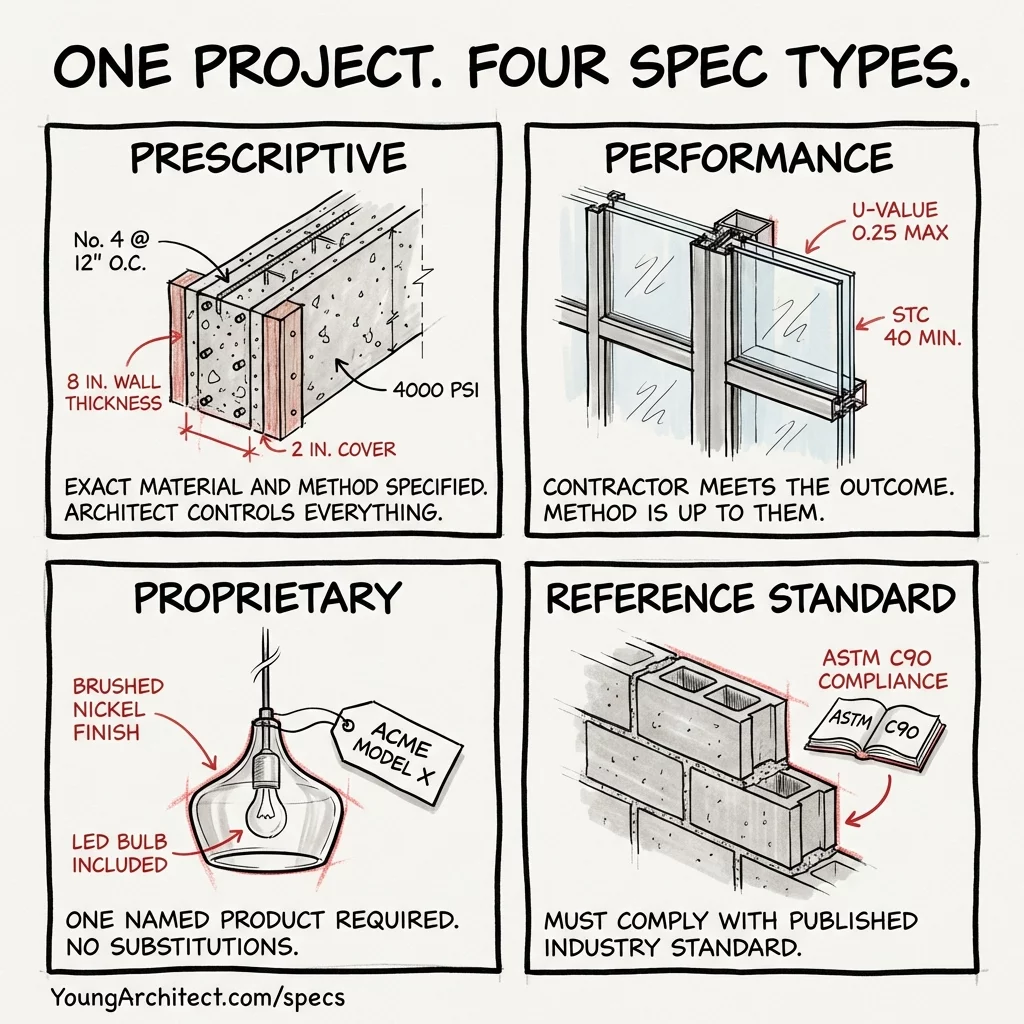
A prescriptive specification tells the contractor exactly what materials to use and exactly how to install them. There’s little room for interpretation or deviation.
You may also see this called a descriptive specification on some exams. CSI® technically categorizes “descriptive” as its own method, separate from reference standards. In practice, the terms are often used interchangeably, but it’s worth knowing both so you’re not thrown off on test day.
When to use it:
- Traditional design-bid-build projects
- When you need tight control over construction methods
- When proven, specific solutions are required
- When contractors may not have specialized design expertise
Example:
A prescriptive concrete specification would require a specific compressive strength (4,000 PSI), a defined mix design, specific reinforcement, a required curing method, and set joint spacing.
The liability angle:
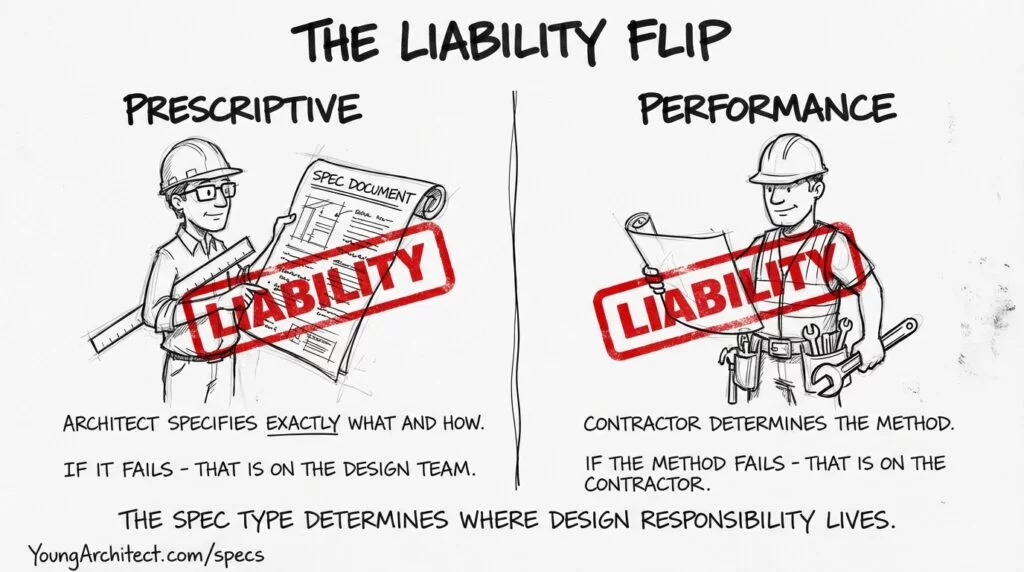
This is a big one for the exam. When you write a prescriptive spec, you take on design responsibility for that element. If the contractor follows your specification exactly and the result still fails, that’s on the design team, not the contractor. This principle connects directly to the Spearin Doctrine, which holds that an owner who provides detailed plans and specs implicitly warrants that following them will produce a satisfactory result.
Performance Specifications
A performance specification defines what the finished product must achieve without dictating how to get there. The contractor determines the method; the spec defines the measurable outcome.
When to use it:
- Design-build projects where contractor expertise adds real value
- Complex systems like curtain walls, MEP, or specialty glazing
- When multiple technical solutions could achieve the same result
- When innovation is encouraged over predictability
Example:
A performance window specification might state: “Windows shall have a maximum U-factor of 0.30 and must resist water penetration at 15 psf.” The contractor chooses the manufacturer and system that meets those requirements.
The liability flip:
When the contractor determines the method, they take on more design responsibility for that element. The Spearin Doctrine warranty shifts. If the contractor’s chosen approach fails to meet the stated performance criteria, that’s their problem, not the design team’s.
The risk for the architect: you have to anticipate every measurable outcome upfront. If you miss one, you may get a result that’s technically compliant with the spec but still doesn’t meet your actual intent.
Proprietary Specifications
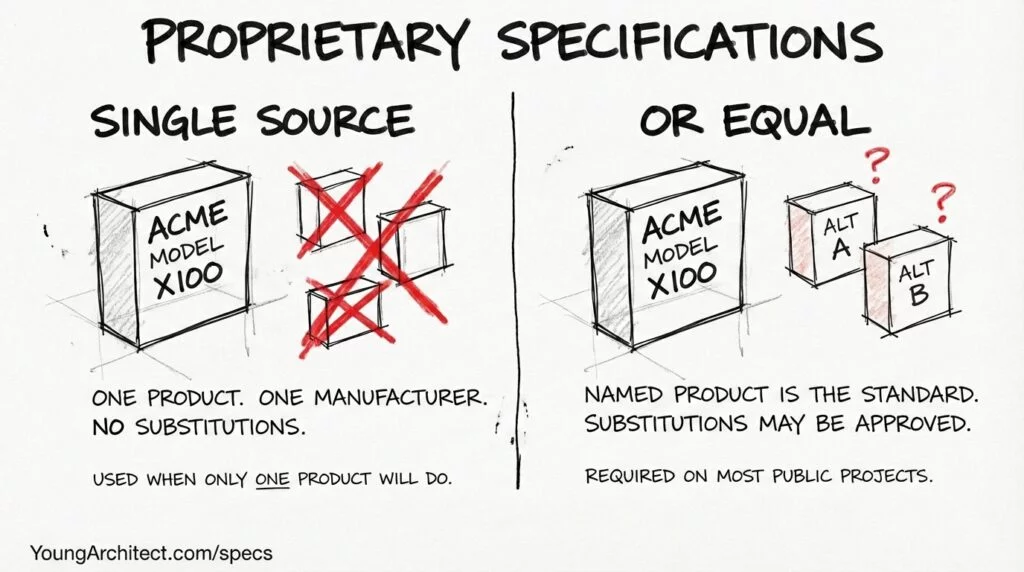
Proprietary specifications call for a specific product from a specific manufacturer. There are actually two versions, and knowing the difference matters.
- Single-source specs name one product with no substitutions. Period.
- Brand-name specs with “or equal” language name a specific product as the standard but allow the contractor to submit substitution requests for approved equivalents.
When to use it:
- Matching existing materials in a renovation
- When an owner has standardized on specific products across their portfolio
- Specialty systems with genuinely limited options
Example:
“Pendant Light: LightingCo Model ABC in Matte Black finish with dimmable LED kit by LEDCorp. No substitutions.”
One important note: on public projects, proprietary specs generally must allow substitution requests to comply with competitive bidding requirements. Single-source specs on public work require clear justification and are used sparingly.
Reference Standard Specifications
Reference standard specifications require a product or process to comply with an established industry standard rather than describing every detail from scratch. Instead of writing out pages of prescriptive requirements, you simply reference an accepted standard.
When to use it:
- When industry-accepted methods or standards already exist for the work
- When specifying commodity materials like concrete, steel, or masonry
- When building codes or manufacturers already require compliance with a specific standard
- On nearly every project, reference standards appear in almost all spec sections to some degree
Example:
“Install single-ply membrane roofing in accordance with the NRCA Roofing Manual and manufacturer’s written instructions.” Or: “Portland Cement shall meet ASTM C150.”
Just be sure to specify which edition of the standard applies. If you don’t, you may get an outdated version that no longer reflects current requirements.
Using a Combination of Specification Types
In practice, almost no project uses just one type. Most real projects use a strategic mix across all four.
Here’s how that typically plays out:
- Prescriptive or descriptive for finishes and critical materials where exact appearance or performance is non-negotiable
- Performance for complex systems like MEP, curtain wall, and specialty glazing where contractor expertise is an asset
- Proprietary for specific products required for aesthetic or operational reasons
- Reference standards woven throughout to avoid rewriting industry-standard requirements that are already well-documented
The architect decides which approach to use for each element based on how much design control is needed versus how much contractor flexibility actually benefits the project.
Open vs. Closed Specifications: How Much Flexibility Does the Contractor Get?
Beyond how a spec is written, there’s another important dimension: how much flexibility does the contractor have in choosing products?
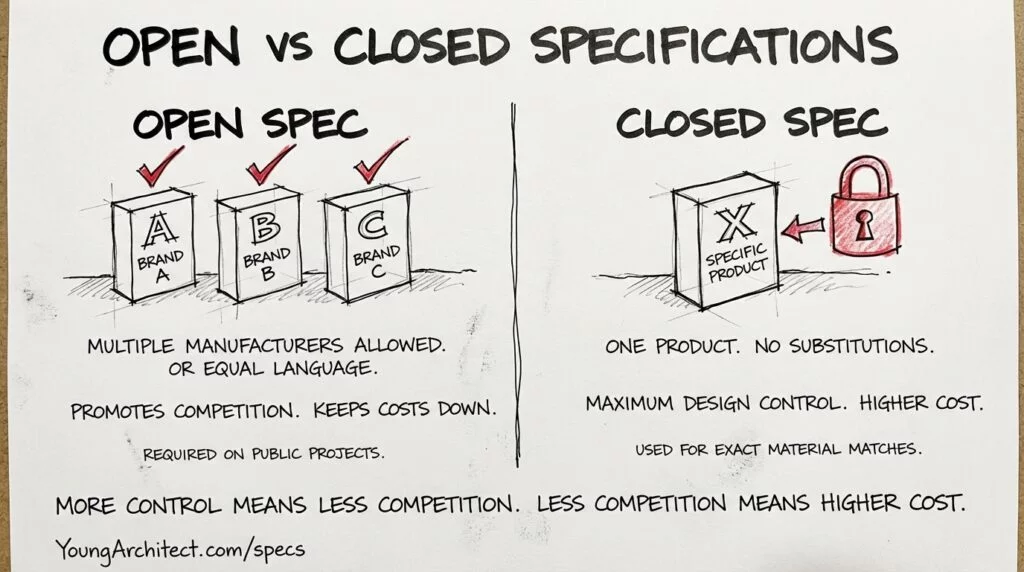
Open Specifications
Open specifications allow multiple products or manufacturers as long as they meet a stated standard. They typically use phrases like “or equal” or list several acceptable manufacturers.
When to use it:
- Public projects where competitive bidding is required
- When multiple products could satisfy the requirements
- When budget is a priority and competition helps drive cost down
- When material availability might be uncertain during construction
Example:
“Concrete Masonry Units meeting ASTM C90, Medium Weight. Acceptable manufacturers include: ACME Blocks, BuildStone Co., or approved equal.”
Open specs promote competitive pricing, give contractors flexibility if a specified product becomes unavailable, and can surface solutions you might not have considered.
Closed Specifications
Closed specifications name a specific product or manufacturer with no substitutions allowed.
When to use it:
- When matching existing materials exactly in a renovation
- For aesthetic requirements where no substitute is acceptable
- When an owner has standardized on certain products across multiple facilities
Example:
“Stone cladding shall be Mountain Creek Quarry, Colonial Cut, Lot #5372 only. No substitutions.”
The tradeoff: higher cost due to lack of competition, and potential project delays if the specified product becomes unavailable.
Short-Form, Long-Form, and Sheet Specifications
The final major distinction is how specifications are formatted and how much detail they contain. Project size and complexity drive this decision.
Long-Form Specifications
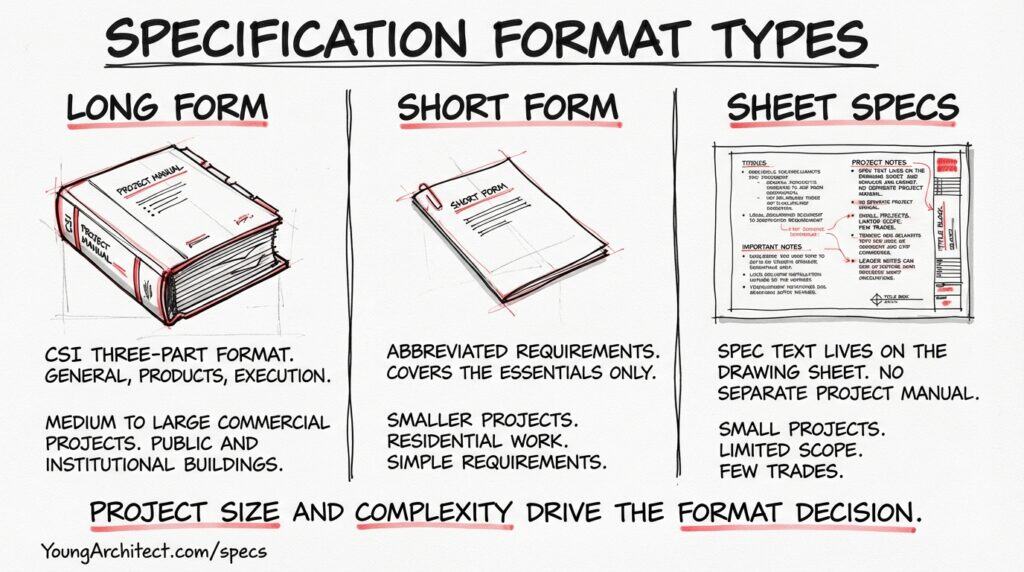
Long-form specifications are comprehensive documents organized by CSI MasterFormat® sections. Each section follows the standard three-part format: General, Products, and Execution.
When to use it:
- Medium to large commercial projects
- Projects with formal bidding processes
- Public or institutional buildings
- Any project where you need strong legal protection and clear delineation of responsibilities
The three-part format breaks down like this:
- General covers scope, references, submittals, and quality assurance requirements
- Products covers materials, equipment, and fabrication requirements
- Execution covers installation, field quality control, and closeout
Division 01 General Requirements sits above all the technical spec sections and governs the administrative procedures that apply to every trade on the project. Think of it as the rulebook that all the other sections have to follow.
Construction submittals, including shop drawings, product data, and samples, are defined and managed through the spec, particularly in the Products and Execution parts of each section.
Short-Form Specifications
Short-form specifications are abbreviated versions that cover the essentials without the full depth of long-form specs.
When to use it:
- Smaller projects and residential work
- Projects with straightforward, limited requirements
- When working with contractors who are unfamiliar with formal spec formats
Example:
For a small library renovation, a short-form spec might simply list the paint type and sheen for walls, the carpet product and installation method, and basic notes on surface prep.
Sheet Specifications
Sheet specifications place specification information directly on the drawing sheets rather than in a separate project manual.
When to use it:
- Small-scale projects with a limited scope of work
- Simple renovations with few trades involved
- When working with familiar contractors on straightforward work
The limitation is obvious: there’s only so much room on a sheet. Sheet specs don’t work for complex projects or anywhere detailed requirements need to be spelled out.
Choosing the Right Specification Type: ARE and CDT® Exam Tips
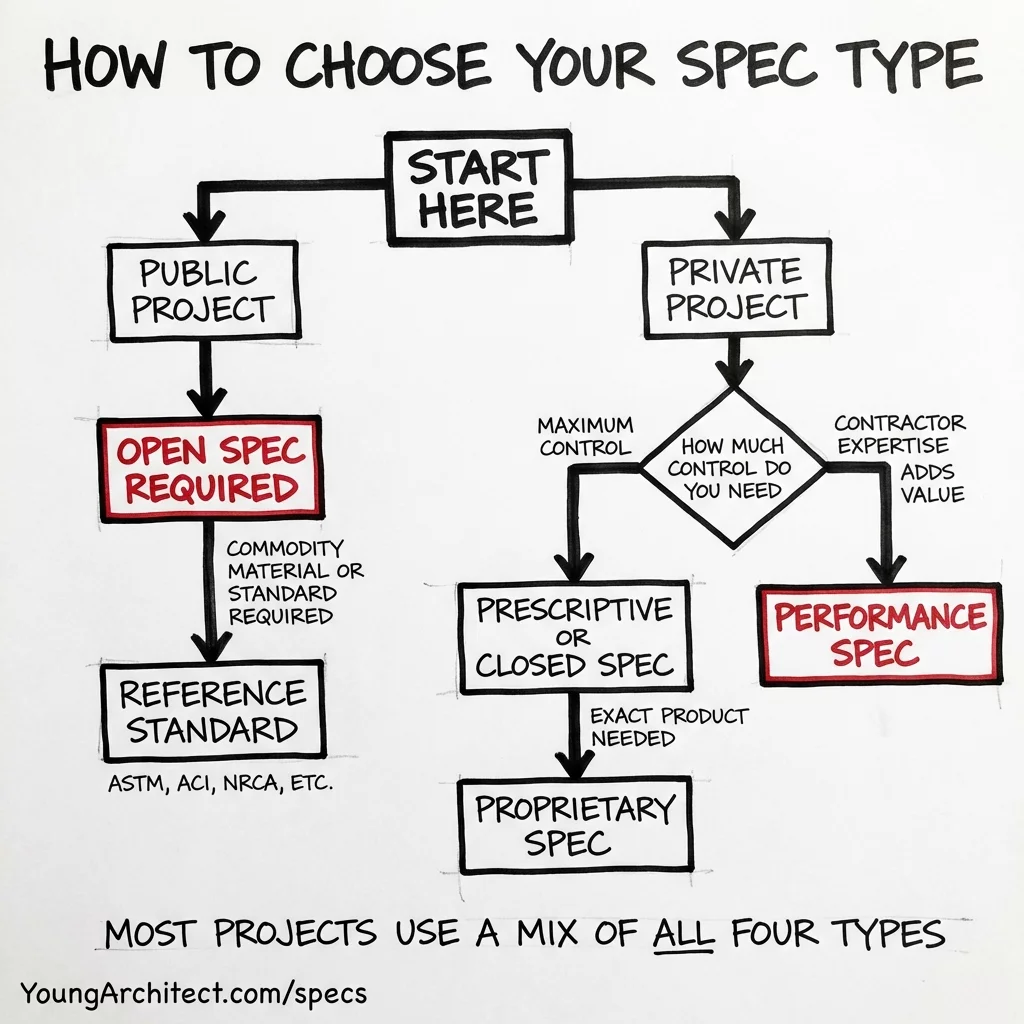
In practice, spec choices depend on a handful of key factors:
- Project size: Larger projects generally require more formal, detailed specifications
- Delivery method: Design-build often uses performance specs; design-bid-build often uses prescriptive
- Public vs. private: Public projects typically require open specs to ensure fair competition
- Budget: Open specs generally drive costs down through competition
- Design control: Prescriptive and closed specs give you maximum control with less contractor flexibility
For the ARE, construction specifications show up across multiple divisions. The Project Development and Documentation (PDD) exam goes deepest on specification writing, document coordination, and CSI MasterFormat®. The CDT® exam covers all of this too, but from a broader project delivery perspective, which is why a lot of ARE candidates find the CDT® an incredibly useful complement to their exam prep.
Study tips for specification questions:
- Know the difference between prescriptive and performance specs, and which one shifts design liability to the contractor
- Understand when open vs. closed specs are required, especially on public projects
- Be solid on the three-part format: General, Products, Execution
- Know how specifications coordinate with drawings and what happens when they conflict
Frequently Asked Questions
What are the main types of construction specifications?
There are four main types. Prescriptive specifications tell the contractor exactly what materials to use and how to install them. Performance specifications define the required outcome and let the contractor determine the method. Proprietary specifications name a specific product or manufacturer. And reference standard specifications require compliance with an established industry standard like ASTM or ACI rather than writing out all requirements from scratch. Most real projects use a combination of all four.
What is the difference between prescriptive and performance specifications?
A prescriptive specification is a how-to document. It tells the contractor what to use and exactly how to do it. A performance specification defines what the finished product must achieve, not how to get there.
The liability distinction is what makes this exam-worthy: prescriptive specs place design responsibility on the architect. If the contractor follows the spec and it fails, that’s on the design team. Performance specs shift some of that responsibility to the contractor when they determine the method.
When should you use a proprietary specification?
Use a proprietary spec when a specific product is genuinely required, such as matching an existing material in a renovation, an owner with standardized products across their portfolio, or a specialty system with truly limited options.
Know the difference between a single-source spec (no substitutions, period) and a brand-name spec with “or equal” language (substitution requests are allowed). On public projects, proprietary specs almost always need to allow substitutions to meet competitive bidding requirements.
What is the difference between open and closed specifications?
An open specification allows multiple manufacturers or products that meet a stated standard, often using “or equal” language or listing several acceptable options. A closed specification names a single product with no substitutions allowed.
Open specs encourage competition and keep costs down. Closed specs give maximum design control but typically increase project cost and can cause delays if the specified product becomes unavailable.
What is MasterFormat® and how does it organize construction specifications?
MasterFormat® is a classification system published by the Construction Specifications Institute (CSI®) that organizes construction specifications into 50 numbered divisions based on work type. It creates a consistent language across the industry so everyone from architects to subcontractors knows exactly where to find the requirements for their scope of work.
For a full breakdown of all 50 divisions and how they’re organized, check out our MasterFormat guide.
Mastering Specification Types: Your Path Forward
Construction specifications might seem like a lot to keep straight at first, but once you understand the logic behind each type, the decisions start to make sense. Prescriptive or performance? Open or closed? Long-form or sheet? Every choice comes down to how much control you need, how much flexibility benefits the project, and where you want liability to sit.
That’s not just exam knowledge. That’s how real projects run.
If you’re working toward your license and want a structured path through the ARE with accountability and coaching built in, ARE Boot Camp is where candidates get a clear roadmap, a community, and the support to get licensed.