
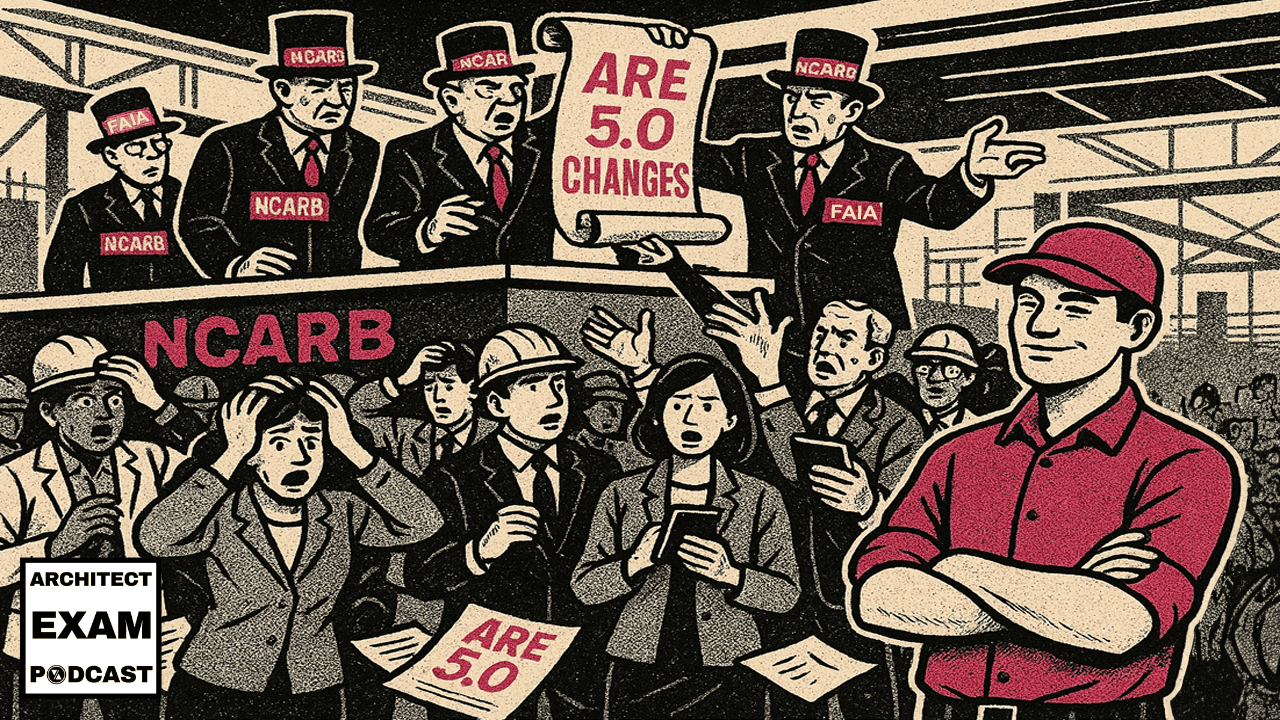
NCARB announced major ARE exam changes for 2026, including updates to 12 exam objectives, streamlined case studies, and new AXP reporting policies. Here’s what’s actually changing and how it affects your architecture licensing journey.
This podcast is also available on YouTube, Spotify, and Apple Podcasts
When NCARB announced they were hosting a webinar on Monday, November 10th at 3pm to discuss the upcoming ARE changes, I got really excited.
I rearranged my entire schedule to be there live when they made these announcements.
I have been waiting 8 years for this announcement.
But when it came time to talk about what’s actually changing on the architect exam, they completely dodged discussing the objective changes.
Instead, they glossed over how they changed 12 objectives across 5 exams and told us to go read a blog post on their website if we were interested.
WTF NCARB. WHY ARE WE ALL HERE?!?
Why wouldn’t NCARB use this opportunity to actually explain to us what’s changing?
They spent the rest of the hour answering softball questions that no one asked, and clarifying information no one was confused about.
So after the webinar ended, I sat down and read their blog post. And then I spent the rest of the day breaking down exactly:
What was actually changing on the architect exam?!?
I compared all the old objectives to the new ones, and figured out what this really means for YOUR exam prep.
That’s exactly what you’re getting in this blog post and podcast.
Here’s the quick summary:
- 12 out of 91 exam objectives are changing (about 13%)
- Case studies are getting streamlined with fewer resources
- AXP gets new reporting policies and competency-based descriptions
- ARE changes take effect April 27, 2026
- AXP changes start November 18, 2025
NCARB keeps saying this won’t change how you study and all your materials will still be relevant.
But I think you should should look at my analysis and decide that for yourself.
Why Is NCARB Making These Changes?
The ARE typically gets updated about every 10 years.
The last major update came in 2016 when we went from ARE 4.0 to 5.0. That was the biggest change the architect exam had ever seen, shifting from subject-based divisions (structures, systems, materials) to timeline-based ARE divisions (PA – programming, PPD – design, PDD – documentation, CE – construction).
The Analysis of Practice Survey
NCARB started working on these changes back in 2022/2023 with their “Analysis of Practice” survey of nearly 20,000 architects. If you took it, you know how frustrating it was.
In October 2024, they finalized everything and released the NCARB Competency Standard for Architects, boiling down 20,000 responses into 16 competency categories for licensure.
Understand that NCARB loves talking about this Competency Standard because it justifies all their decisions. Whether you agree or not, they’re doing what the profession told them through that survey.
The good news?
Its too soon to know if this is good news or not.
But its safe to say, this isn’t a major overhaul. It’s minor adjustments. This will be the most minimal ARE upgrade in 30 years.
The AXP Changes
NCARB’s AXP changes will begin on November 18, 2025
Important: These changes only apply if you still have AXP to complete. If you’re already AXP complete, this doesn’t affect you.
For complete details, visit NCARB’s official AXP changes blog post.
AXP Change 1: Competency-Based Descriptions
The six experience areas stay the same, but instead of 96 specific tasks, NCARB is moving to competency-based descriptions aligned with the Competency Standard.
What this means:
- More flexible and less prescriptive requirements
- Easier for supervisors to understand and review
- Same interface in your NCARB record
- Hover over experience areas to see competencies
Important note: If you’re using the AXP Portfolio method, that still uses the 96 tasks. This change only applies to hourly reporting.
All existing AXP data will be automatically reorganized on November 18th. NCARB used that word we all learned to fear during the pandemic: Transition.
My recommendation: Before November 18th, take screenshots of your AXP hours. This takes 45 seconds. NCARB short changed me 500 hours during a past transition, and the only thing that saved me was having records proving what my hours should have been.
AXP Change 2: New Reporting Policy
Current policy:
- Report within 8 months = 100% credit
- Report within 5 years = 50% credit
- Older than 5 years = nothing
New policy (starting November 18):
- Report within 12 months = 100% credit
- Older than 12 months = 75% credit (no time limit)
What happens automatically:
- 50% credit bumps to 75%
- Reports between 8-12 months old bump to 100%
- System splits reports spanning the 12-month mark (no resubmission needed)
This is good news for most people.
AXP Change 3: More CEU Options
Previously only AIA CEUs counted for AXP credit. Now NCARB is expanding to include courses from NCARB and SARA (Society of American Registered Architects).
The details:
- Earn up to 20 hours per experience area through CEUs
- Must be HSW qualified (Health, Safety, Welfare)
- NCARB’s Professional Conduct series is free and excellent
- Can earn up to 10 hours in Practice Management from that series
My recommendation: Max out the CEU/AXP opportunity. NCARB’s CEU content has always been fantastic. I highly recommend checking it out
The ARE Case Study Changes
NCARB is streamlining case studies and it will begin on April 27, 2026.
What’s changing:
- Fewer resources per case study
- Fewer questions per individual case study
- Total case study items per division stays the same
- More case studies per division, but each one is shorter and focused
Instead of two long case studies with tons of resources, you might get three or four shorter, streamlined ones.
NCARB’s claims:
- Reduced exam loading times
- Less time reviewing case study resources
- More efficient testing experience
- Same user interface and navigation tools
They’re calling this a “quality-of-life improvement.” Instead of wading through extensive resources, you’ll have focused scenarios with less extraneous information.
Timeline:
- New practice exams: February 2026
- Updated ARE Guidelines: January 2026
For complete case study details, visit NCARB’s official ARE changes blog post.
Understanding the ARE Objective Changes
These changes take effect April 27, 2026. If you’re completing all exams before that date, stop reading and get back to studying. For everyone else, this is important.
NCARB didn’t want to discuss objective changes at their webinar.
Halfway through the webinar, they said:
“12 out of 91 objectives are changing, 9 are minor tweaks, 3 are narrowed in scope, go read our blog post”
and moved on.
So I read their blog post and spent hours comparing old objectives to new ones. NCARB keeps saying these changes won’t significantly affect exam prep and your ARE study materials are still good. But you should decide that for yourself.
Why objectives matter:
NCARB’s objectives define how you study for their exams and shape your entire exam preparation strategy. Once you understand how to decode what they’re telling you, studying becomes less of a mystery. One weird thing that surprises me? Many ARE candidates and even prep companies flat out ignore NCARB’s objectives.
If you’re not studying NCARB’s objectives, you’re not studying for the architect exam. Any prep company saying “Don’t worry about objectives, just watch our videos and you’ll pass” is making you play telephone with someone else’s interpretation.
If your goal is to efficiently pass these exams, it’s cheaper, easier, and faster to study what NCARB actually said they’ll test you on. But if I were you? I’d still study the removed content and pay extra attention to what changed.
The 2027 AIA Contracts Question
Before we dive into each exam, there’s one elephant in the room: 2027 AIA Contracts.
The AIA updates contracts every 10 years: 1997, 2007, 2017. And 2027 is 14 months away. I haven’t heard anything about contract updates, but after reviewing all the objective changes, I think NCARB might be future-proofing for upcoming AIA Contract changes that haven’t been announced yet.
That’s just my theory after analyzing the changes.
Alright, let’s break down what changed on each ARE exam.
Practice Management (PcM) Exam Changes
Three objectives are changing in PcM, and there’s a clear pattern: NCARB is narrowing the focus and getting more specific about what they want you to know.
New PcM Objective 3.3: Understand potential project risks and how a practice can mitigate those risks
Previous PcM Objective 3.3: Determine potential risk and/or reward of a project and its impact on the practice
TL;DR: This objective now focuses purely on identifying and mitigating risks. The “reward” and “opportunity” side of evaluating projects is out.
What’s Changing:
The big shift here is moving from a balanced risk/reward analysis to a risk-only focus:
- “Rewards” and “opportunities” are completely removed from this objective
- The focus is now exclusively on risk identification and mitigation strategies
- Less about business development and opportunity assessment, more about defensive strategies and liability protection
What This Means for You:
If you’re studying PcM, this narrows your focus. You’re spending less time thinking about why a practice might want to take on a challenging project (prestige, portfolio building, new market entry) and more time on how to protect the practice from various risks.
How to Adjust Your Studying:
Focus heavily on risk mitigation strategies. Study contract language that protects the architect, insurance types and coverage, project red flags that increase liability, and when to walk away from a project.
Understand different types of project risks: financial risks (scope creep, fee adequacy, client ability to pay), technical risks (unfamiliar building types, complex systems), legal risks (contentious clients, jurisdictional challenges), and reputational risks.
De-emphasize content about evaluating project opportunities, strategic growth, or business development upside.
Check out Episode 021: Architect Insurance – The Designer’s Guide to Risk Management for a deep dive into understanding architect insurance and risk protection.
The Bigger Picture:
This change reflects an increasingly defensive approach to practice management. The profession is becoming more focused on risk mitigation and liability protection, which likely aligns with how contracts are evolving and how insurance companies view architectural practice.
New PcM Objective 4.1: Identify and compare practice and business structures relevant to an architectural practice
Previous PcM Objective 4.1: Analyze the impact of practice methodologies relative to structure and organization of the practice
TL;DR: This simplifies from analyzing how methodologies impact practice organization to just comparing different types of business structures.
What’s Changing:
- The focus shifts from “practice methodologies” to specifically “business structures” (LLC, S-Corp, partnership, sole proprietorship)
- Evidence-based design is no longer explicitly part of this objective
- You’re moving from analyzing impacts to identifying and comparing – a simpler cognitive task
What This Means for You:
This objective becomes more straightforward. Instead of understanding how various practice methodologies affect firm structure, you’re focusing on the basic business entity types architects use.
How to Adjust Your Studying:
Master the different business structure types and know the pros and cons of each: liability protection, tax implications, administrative complexity, ownership flexibility, and capital raising ability.
Understand which structures are most common in architecture and why. Be able to compare structures side-by-side for different scenarios.
De-emphasize studying evidence-based design and other practice methodologies for this specific objective.
Episode 029: Business Entity Types for Architects – Save Your Assets covers this exact topic in detail.
The Bigger Picture:
This change makes the objective more practical and focused on fundamental business decisions every architect needs to understand. It removes theoretical content about methodologies and gets down to how practices are legally structured.
New PcM Objective 4.2: Identify and compare processes, policies, and resources used in the design, coordination, and documentation of different project types
Previous PcM Objective 4.2: Evaluate design, coordination, and documentation methodologies for the practice
TL;DR: Instead of evaluating methodologies broadly, you’re now comparing how different project types require different approaches.
What’s Changing:
- Adds emphasis on “different project types” – residential vs commercial vs healthcare vs institutional
- Moves from “evaluate methodologies” to “identify and compare processes”
- Removes specific mention of IPD, evidence-based design, and phasing
What This Means for You:
You need to understand that a residential project doesn’t follow the same processes as a hospital project, and be able to explain those differences.
How to Adjust Your Studying:
Study how different project types require different approaches in terms of code requirements, consultant needs, documentation requirements, coordination complexity, and review and approval processes.
Understand process differences across residential, commercial, healthcare, institutional, and industrial projects.
Less emphasis on specific methodologies like IPD or evidence-based design for this objective.
I covered a lot of this in Episode 001: Public Works Projects vs Private – 12 Key Differences.
The Bigger Picture:
This change makes the objective more practical. Rather than studying methodologies in the abstract, you’re learning how real-world project types demand different approaches. This better reflects how architects actually work – adapting processes based on project type.
Project Management (PjM) Exam Changes
Five objectives are changing in PjM. Let’s break them down.
New PjM Objective 4.1: Monitor the project throughout its design and documentation for compliance with the construction budget
Previous PjM Objective 4.1: Evaluate compliance with construction budget
TL;DR: Budget monitoring is now explicitly tied to the design and documentation phases, emphasizing continuous tracking as the design develops.
What’s Changing:
- Adds specific timing: “throughout its design and documentation” – making it clear this happens during pre-construction phases
- Emphasizes ongoing monitoring rather than point-in-time evaluation
- Makes it explicit that you’re tracking budget compliance as the design evolves through SD, DD, and CD
What This Means for You:
You need to understand how to continuously monitor budget compliance during design phases, not just check it at milestones.
How to Adjust Your Studying:
Focus on design phase cost tracking: Schematic Design estimates, Design Development cost refinement, Construction Documents detailed cost control, and how estimates become more precise through phases.
Understand continuous monitoring techniques like regular cost checks as design develops, flagging budget concerns early, value engineering throughout design, and tracking scope changes and their cost impacts.
The Bigger Picture:
This clarification reinforces that architects need to be proactive about budget management during design, not reactive after bids come in too high. It’s about preventing budget problems rather than fixing them later.
New PjM Objective 4.3: Implement appropriate policies and procedures to document a project for a specified delivery method
Previous PjM Objective 4.3: Evaluate project documentation to ensure it supports the specified delivery method
TL;DR: You’re now setting up documentation systems rather than just checking if documentation works.
What’s Changing:
- Changes from “evaluate” to “implement” – you’re establishing the system, not reviewing it
- Adds focus on “policies and procedures” – the systematic approach to documentation
- More action-oriented and proactive
What This Means for You:
You need to know how to set up proper documentation protocols for different delivery methods (Design-Bid-Build, Design-Build, CM, IPD, etc.).
How to Adjust Your Studying:
Study documentation requirements by delivery method and understand what policies and procedures are needed: document naming conventions, review and approval workflows, consultant coordination protocols, and change documentation processes.
Focus on creating repeatable processes that work for each delivery type.
The Bigger Picture:
This change emphasizes that project managers need to be proactive about establishing documentation systems. It’s about setting projects up for success from the beginning rather than troubleshooting documentation problems as they arise.
New PjM Objective 5.2: Identify processes, policies, and resources for quality control and risk reduction in the project
Previous PjM Objective 5.2: Identify steps in maintaining project quality control, and reducing risks and liabilities
TL;DR: Simplified from “steps in maintaining” to just identifying the processes, policies, and resources used for QC and risk reduction.
What’s Changing:
- Streamlines from “steps in maintaining” to “processes, policies, and resources”
- Removes explicit mention of “liabilities”
- Less about establishing processes, more about identifying what exists
What This Means for You:
You need to recognize and identify QC systems and risk reduction approaches used in practice.
How to Adjust Your Studying:
Know standard QC processes: peer reviews, drawing checks, code reviews, coordination checks, and consultant review protocols.
Understand policies that support quality control and identify resources for QC like internal review staff, external consultants, software tools for coordination, and code checking services.
Episode 031: Standard of Care covers the legal framework around architect responsibilities and professional standards.
The Bigger Picture:
This objective becomes more about recognizing industry-standard QC practices rather than creating them from scratch. It reflects that most firms have established QC systems, and you need to understand what those typically look like.
New PjM Objective 5.3: Implement quality control processes to ensure project coordination and constructability
Previous PjM Objective 5.3: Perform quality control reviews of project documentation throughout life of project
TL;DR: QC now focuses specifically on two things: coordination (making sure everything fits together) and constructability (making sure it can actually be built).
What’s Changing:
- Shifts from “perform reviews” to “implement processes” – you’re setting up the system, not just doing individual reviews
- Narrows to two specific outcomes: coordination and constructability
- More about the systematic approach to QC rather than individual review tasks
What This Means for You:
You need to understand how to establish QC processes that specifically catch coordination issues and constructability problems.
How to Adjust Your Studying:
Focus on coordination QC: clash detection between disciplines, MEP coordination with structure, architectural elements fitting with systems, and clearances and spatial conflicts.
Study constructability review: sequencing issues, means and methods considerations, material availability, realistic details, and buildability of design intent.
The Bigger Picture:
This change reflects the increasing importance of coordination in complex projects and the need to ensure designs are actually buildable. It’s proactive QC focused on preventing field problems.
New PjM Objective 5.4: Implement quality control processes to maintain integrity of design objectives
Previous PjM Objective 5.4: Evaluate management of the design process to maintain integrity of design objectives
TL;DR: QC now focuses on protecting design intent through systematic processes rather than evaluating how the design process is managed.
What’s Changing:
- Changes from “evaluate management” to “implement processes”
- More action-oriented – you’re setting up systems to protect design intent
- Focuses on the QC mechanisms that ensure design objectives don’t get lost
What This Means for You:
You need to know how to create QC systems that verify the design intent is maintained throughout the project.
How to Adjust Your Studying:
Study QC processes that protect design intent: design intent documentation, checkpoint reviews against original objectives, value engineering reviews, substitution review procedures, and design continuity checks through phases.
Understand how design objectives get compromised through budget cuts, contractor substitutions, owner changes, consultant changes, and code issues forcing revisions.
Episode 013: QA vs QC – One Prevents Problems and The Other Finds Them breaks down the complete quality management process.
The Bigger Picture:
This objective recognizes that maintaining design integrity requires intentional QC systems. Projects naturally drift from original intent through budget pressures, substitutions, and changes – you need processes to catch and prevent that drift.
Programming & Analysis (PA) Exam Changes
PA has one objective changing, but it’s probably the biggest philosophical shift in all the 2026 changes.
New PA Objective 4.5: Review and assess the feasibility of the project budget and schedule to meet the project scope
Previous PA Objective 4.5: Recommend a preliminary project budget and schedule
TL;DR: You’re no longer creating budgets from scratch – you’re reviewing budgets that someone else prepared and determining if they’re realistic for the project scope.
What’s Changing:
- You’re moving from creator to reviewer. Instead of being expected to develop preliminary budgets and schedules, you’re now evaluating ones that have already been prepared (likely by the owner, a cost consultant, or estimator)
- The focus shifts to feasibility assessment. Your job is to look at a budget and schedule and determine: “Is this realistic? Can this project actually be built for this amount of money in this timeframe?”
- Less emphasis on creating preliminary estimates using square footage methods or assembly costs
What This Means for You:
The underlying knowledge is the same – you still need to understand what things cost and how long projects take. You’re just applying that knowledge differently. Instead of being asked “What should this project cost?”, you’re being asked “The owner says this will cost $5 million – is that reasonable given the program and scope?”
How to Adjust Your Studying:
Focus on learning to critique and evaluate budgets rather than create them. Learn to identify red flags: missing line items that should be there, costs that seem too low for the scope, unrealistic timelines, and budget numbers that don’t align with the program requirements.
Understand typical cost ranges for different project types and building systems so you can spot when something is off.
Practice evaluating feasibility. When you see a project scenario, ask yourself: “If the owner gave me this budget, would I believe we could deliver this project?”
Episode 041: Construction Cost Estimates – Getting the Numbers Right covers how estimates work and what makes them accurate.
The Bigger Picture:
This change likely reflects how practice is actually evolving. In real life, architects are increasingly reviewing cost information prepared by professional estimators rather than being the primary source of project cost data. This is probably a liability protection move – both for the profession and potentially aligning with upcoming AIA contract updates that may clarify the architect’s role as reviewer/advisor on costs.
Project Planning & Design (PPD) Exam Changes
PPD has two objectives changing, and they both relate to cost.
New PPD Objective 5.2: Evaluate cost estimates based on the project design
Previous PPD Objective 5.2: Perform cost evaluation
TL;DR: You’re evaluating cost estimates (likely prepared by consultants) rather than creating them yourself.
What’s Changing:
- Focus is on evaluating estimates that have been prepared, not creating them from scratch
- Removes language about “creating preliminary cost estimates”
- The connection to “project design” is now explicit – you’re checking if estimates match the design
What This Means for You:
You still need to understand costs, but you’re applying that knowledge to review estimates rather than generate them.
How to Adjust Your Studying:
Focus on evaluation skills: Is this estimate reasonable for this design? Does the estimate account for all design elements? Are the cost assumptions appropriate? Do the numbers align with the level of design development?
Know how to compare estimates against design decisions: Does the structural system choice match the cost assumption? Are specialty systems properly accounted for? Does the envelope cost reflect the design complexity?
The Bigger Picture:
This parallels the PA change and reinforces the shift toward architects as reviewers of cost information. It reflects how professional estimators are increasingly handling detailed cost development, with architects ensuring those estimates align with design intent.
New PPD Objective 5.3: Evaluate the project design based on cost considerations
Previous PPD Objective 5.3: Evaluate cost considerations during the design process
TL;DR: Subtle shift – you’re now evaluating the design through a cost lens rather than considering costs during design.
What’s Changing:
- Flips the focus from “cost considerations during design” to “design based on cost”
- Removes specific mention of life cycle costs and client priorities
- Still about cost-effectiveness and value engineering
What This Means for You:
The underlying content is largely the same, but the framing emphasizes evaluating design choices through a cost perspective.
How to Adjust Your Studying:
Study how cost impacts design decisions: material selection and cost implications, system selection and budget impact, building configuration and cost efficiency, and site design and development costs.
Understand value engineering principles: reducing costs without sacrificing function, cost-effective alternatives, where to spend and where to save, and design modifications for budget alignment.
The Bigger Picture:
While this change is subtle, it reinforces that architects need to constantly evaluate their design decisions through a cost lens. It’s not about costs being one factor among many – it’s about actively evaluating the design based on cost realities throughout the process.
Project Development & Documentation (PDD) Exam Changes
No changes. PDD is completely untouched.
If you’re studying for PDD right now, none of this applies to you. Keep studying.
Construction & Evaluation (CE) Exam Changes
CE has one objective changing.
New CE Objective 1.1: Understand the architect’s role and responsibilities in advising the client during the bidding process based on project delivery method
Previous CE Objective 1.1: Interpret the architect’s roles and responsibilities during preconstruction based on delivery method
TL;DR: This narrows from all preconstruction activities to specifically the bidding process and your advisory role to the owner.
What’s Changing:
- Narrows from broad “preconstruction” to specifically “bidding process”
- Adds emphasis on “advising the client” – highlighting your role as owner’s advisor
- Still tied to delivery method variations
What This Means for You:
Focus your studying on bidding phase responsibilities rather than trying to cover all preconstruction activities.
How to Adjust Your Studying:
Master bidding phase activities: preparing and issuing bid documents, pre-bid meetings and site visits, responding to bidder questions (RFIs during bidding), bid evaluation and analysis, contractor selection assistance, and reviewing bids for completeness and accuracy.
Understand your advisory role to the owner: helping evaluate contractor qualifications, explaining bid results and variations, recommending contractor selection, advising on bid alternates, and clarifying scope questions.
Know how delivery method changes the bidding process for Design-Bid-Build, Design-Build, CM at Risk, and IPD.
Episode 015: Construction Bidding Process – Navigating Public Projects walks through the entire public bidding process in detail.
The Bigger Picture:
This narrowing makes sense – bidding is a distinct phase with specific architect responsibilities. By focusing on this rather than broad preconstruction activities, the objective becomes more practical and testable.
Final Thoughts on the 2026 ARE Changes
So that’s everything. 12 objectives changed across 5 exams. Most are clarifications or narrowing of focus. Nothing crazy.
If you’re studying right now, don’t panic. NCARB says your ARE study materials are still good. Just pay attention to these shifts.
Here’s how I think these changes will impact your studying:
- If you’re using NCARB’s objectives as a roadmap and making sure you cover all your bases – you’re going to be fine. These changes just give you a little more clarity on where to focus.
- But if you’re blindly following some ARE prep company without ever looking at NCARB’s objectives yourself, then honestly, these changes are the least of your concerns.
The ARE isn’t testing how many hours you sat on the couch watching ARE prep videos.
The ARE is asking you questions about how well you understand NCARB’s objectives.
You’re the one that has to take this test. Not your ARE prep company. Not me. You.
The sooner you make understanding each objective your responsibility, the better off you’ll be.
I find this stuff super interesting, and I don’t know why NCARB didn’t use their webinar as an opportunity to actually talk about these changes in detail. But I had fun doing this analysis and going through all these objectives.
I hope it was helpful to you.
You’ve got this. These changes aren’t a big deal. Just keep studying hard, get the work done, and stay persistent. Do that, and I guarantee you’ll get to the finish line faster than you think.