
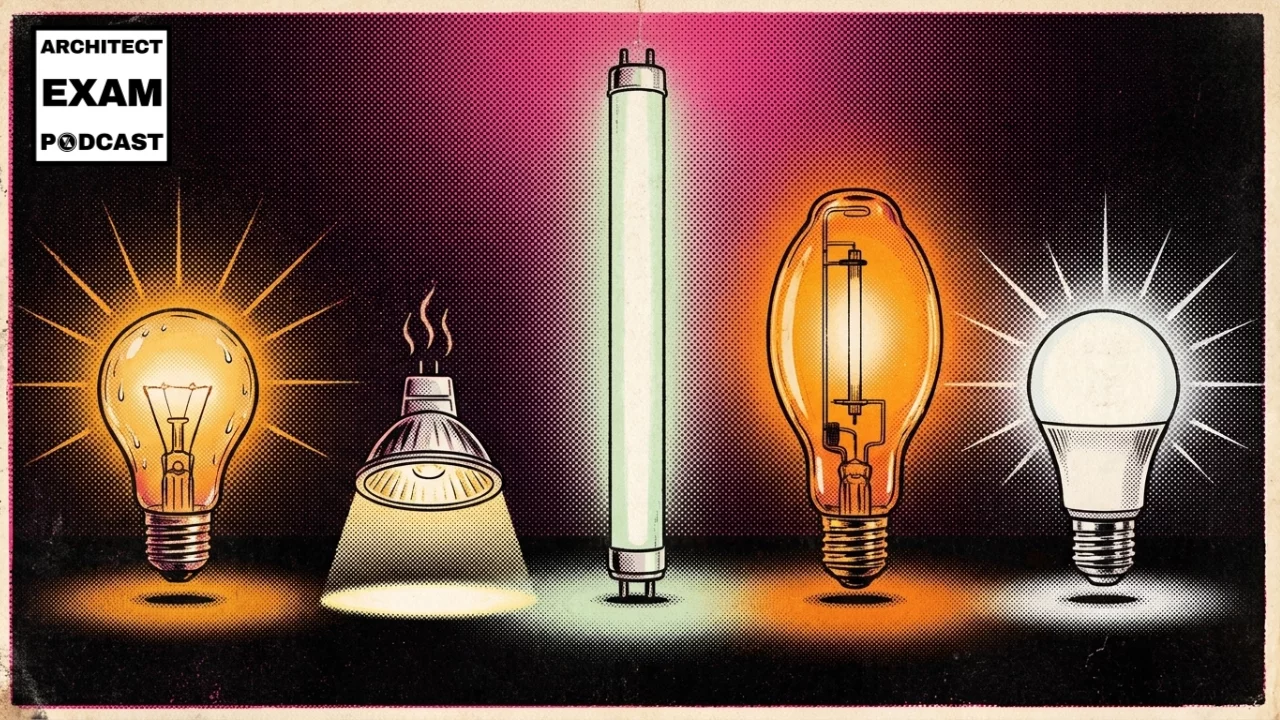

Understanding the different types of light bulbs starts with two numbers: color temperature and CRI. Color temperature, measured in Kelvin, controls whether a light source feels warm or cool. The color rendering index measures how accurately colors appear under that light, on a scale of 0 to 100. This guide compares incandescent, fluorescent, HID, and LED light bulbs, explains how those two numbers shape every space, and shows you how to pick the right light for any application.
This podcast is also available on YouTube, Spotify, and Apple Podcasts.
Test yourself! This episode has a free 10-question types of light bulbs quiz at the bottom of this page.
The Two Numbers That Control Every Space
A high-end clothing store owner spent a fortune on the build-out. Custom millwork, beautiful displays, the kind of finishes that cost more than most people’s cars.
Then they lit the whole thing with cheap fluorescent tubes.
Every sweater on the shelf looked gray. Skin tones in the fitting room mirror looked sickly green. The whole space felt like a hospital waiting room that happened to sell cashmere.
Customers couldn’t pinpoint what was wrong. They just felt off. And they left without buying anything.
The design was perfect. The light ruined it.
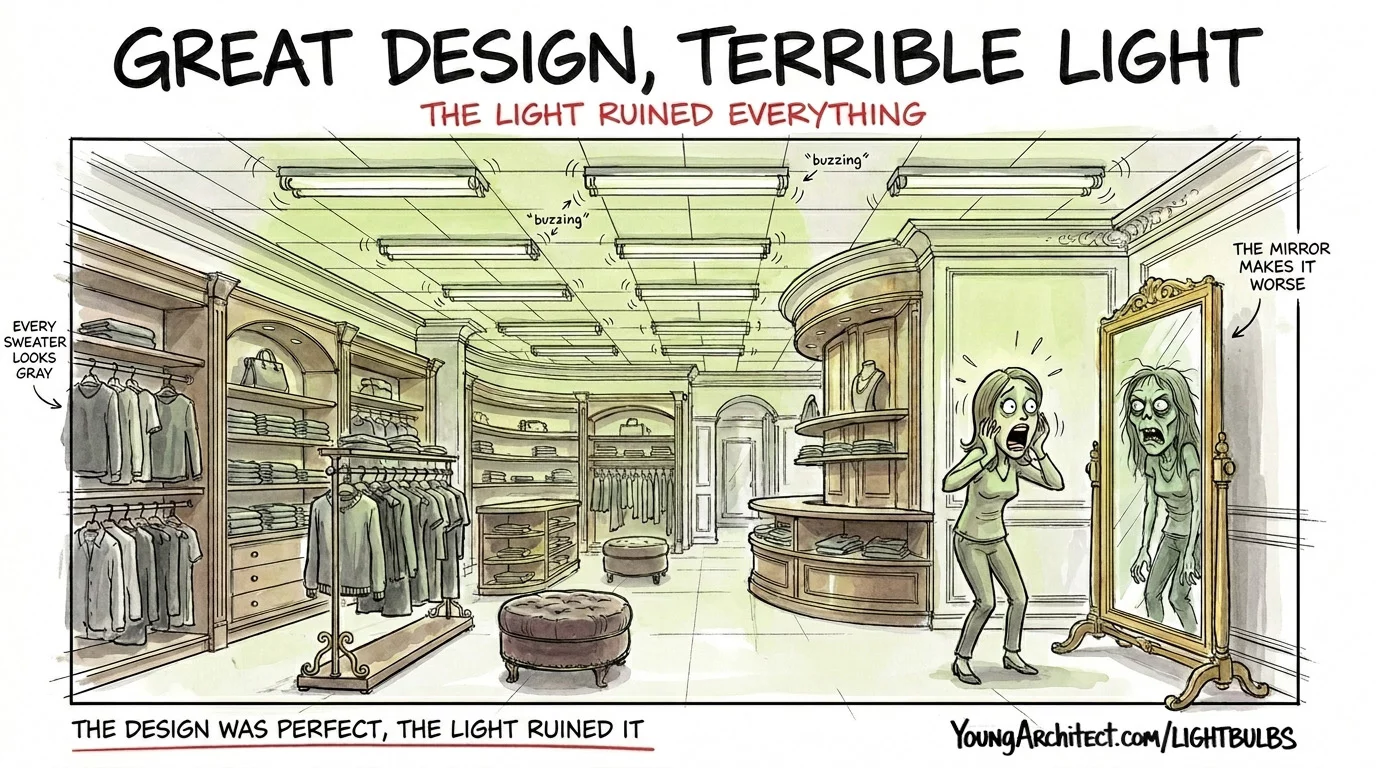
That store didn’t have a brightness problem. It had a color quality problem. And two numbers on the spec sheet would have caught it before a single fixture went up in the ceiling.
Those two numbers are CCT and CRI. They show up on every lighting spec sheet, and together they control how a space looks and how everything inside it appears.
CCT stands for correlated color temperature. It describes whether the light itself feels warm or cool.
CRI is the color rendering index. It describes how accurately colors show up under that light.
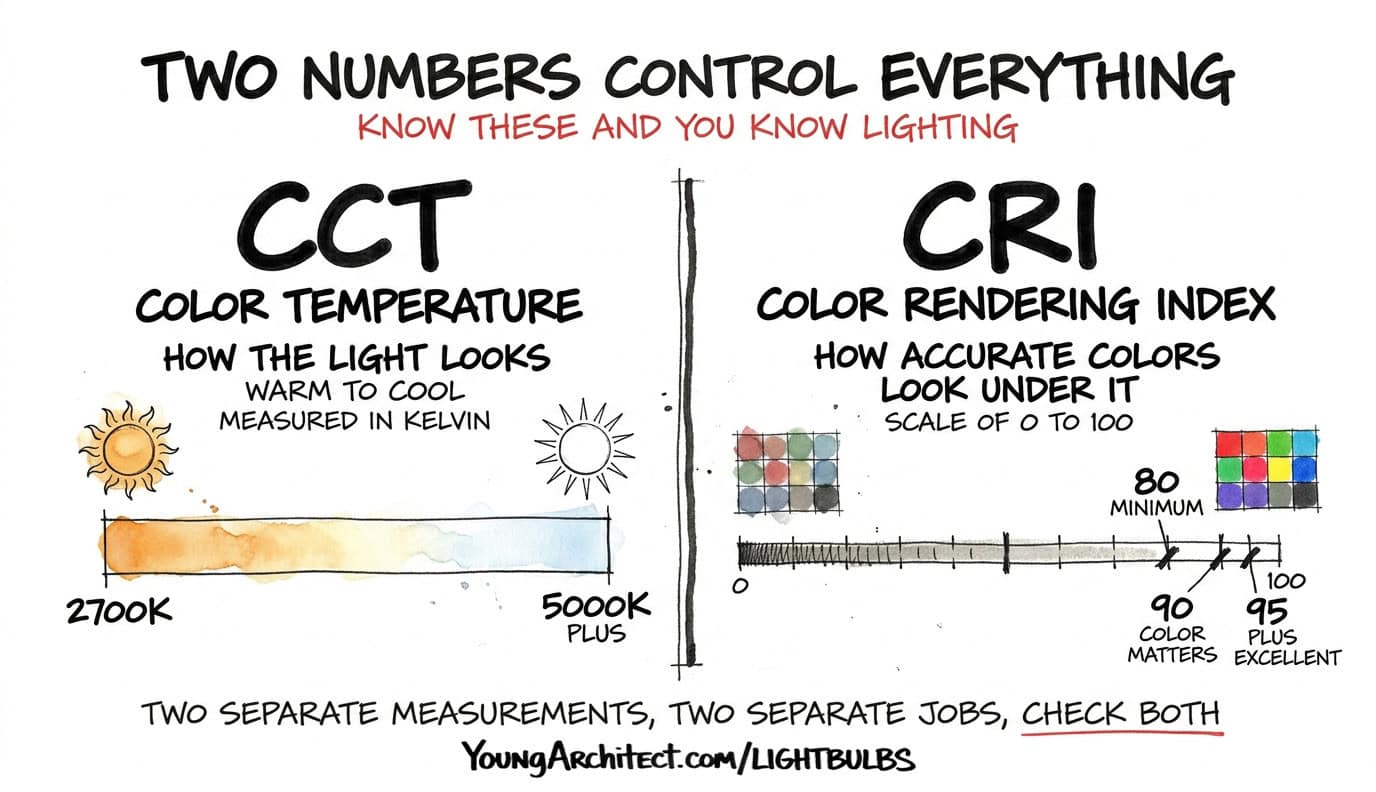
Two separate measurements. Two separate jobs. Confusing them is the single most common lighting mistake in practice.
We’re going to break each number down, then walk through every major type of light bulb from incandescent through LED, so you can look at any fixture and know exactly what it’s doing to a space.
Color Temperature and the Kelvin Scale
Color temperature is measured in Kelvin, and it describes how warm or cool the light appears.
Here’s the part that trips everybody up the first time. It feels backwards.
Lower Kelvin numbers are warmer. More yellow, more amber, more cozy. Higher Kelvin numbers are cooler. More blue, more white, more crisp.
Your brain wants higher numbers to mean “hotter,” which should mean warmer. But the scale is based on the physics of heating a theoretical material until it glows, and the science runs opposite to the feeling.
Don’t get stuck on the why. Just lock in the rule: low K is warm, high K is cool.
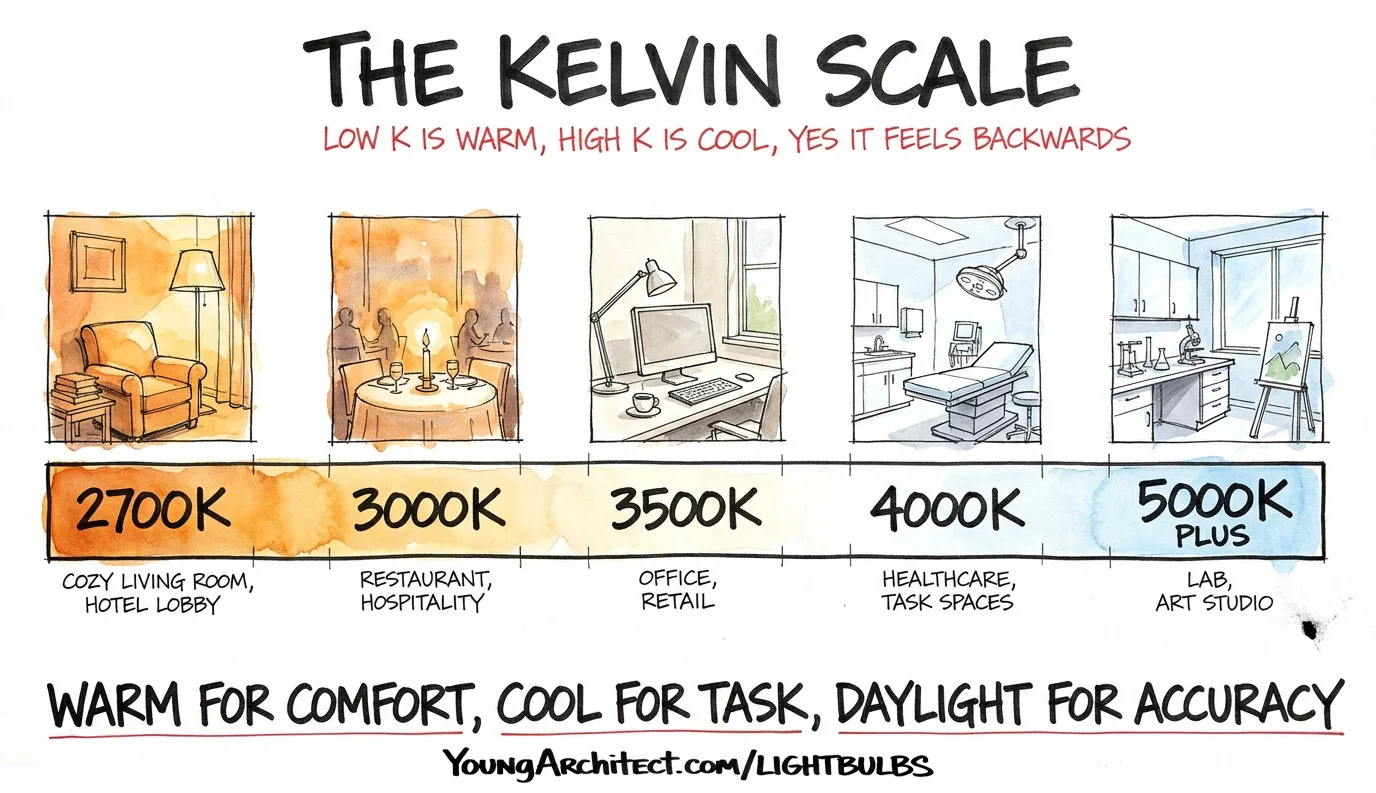
The scale with real-world anchors gives you something concrete to hold onto.
2700K is warm and cozy. This is the classic living room glow, the warm light that old incandescent bulbs gave off. Hotel lobbies, restaurants, anywhere you want people to relax.
3000K is warm white. A touch crisper than 2700K, very common in hospitality and nicer residential spaces. The jump from 2700K to 3000K is subtle. Most people can’t tell the difference without seeing them side by side.
3500K is neutral. Not warm, not cool. You’ll find it in a lot of offices and retail spaces.
4000K is cool white. This is where light starts feeling task-oriented and alert. Healthcare facilities, commercial workspaces, anywhere productivity matters.
There’s real biology behind that shift. Cool light leans toward the blue-white spectrum of midday sun and helps keep us alert, while warm light leans toward the amber of sunset and helps us wind down. That’s part of why color temperature choices follow how people actually use a space.
The jump from 3000K to 4000K is where light shifts from warm residential to cool commercial. It’s the most noticeable transition on the scale.
5000K and above is the daylight range. Crisp, blue-white, almost clinical. Labs, art studios, anywhere people need to judge color accurately. The difference between 4000K and 5000K is less dramatic than the 3000K to 4000K jump, but at 5000K you’re clearly in cool, analytical territory. Comparing 2700K to 5000K side by side would feel like two completely different environments.
Rule of thumb: Warm for comfort. Cool for task. Daylight for accuracy.
One practical warning before we move on. Do not mix color temperatures in the same space. If your ceiling lights are 3000K and your wall sconces are 4000K, the room is going to feel off, and most people won’t be able to tell you why. They’ll just sense that something is wrong.
Keep your color temperature consistent across a single space.
Color Rendering Index (CRI)
Color temperature tells you how the light itself looks. The color rendering index tells you how everything else looks under that light.
CRI measures how accurately colors appear under a given light source compared to a natural reference light. It’s scored on a scale of 0 to 100.
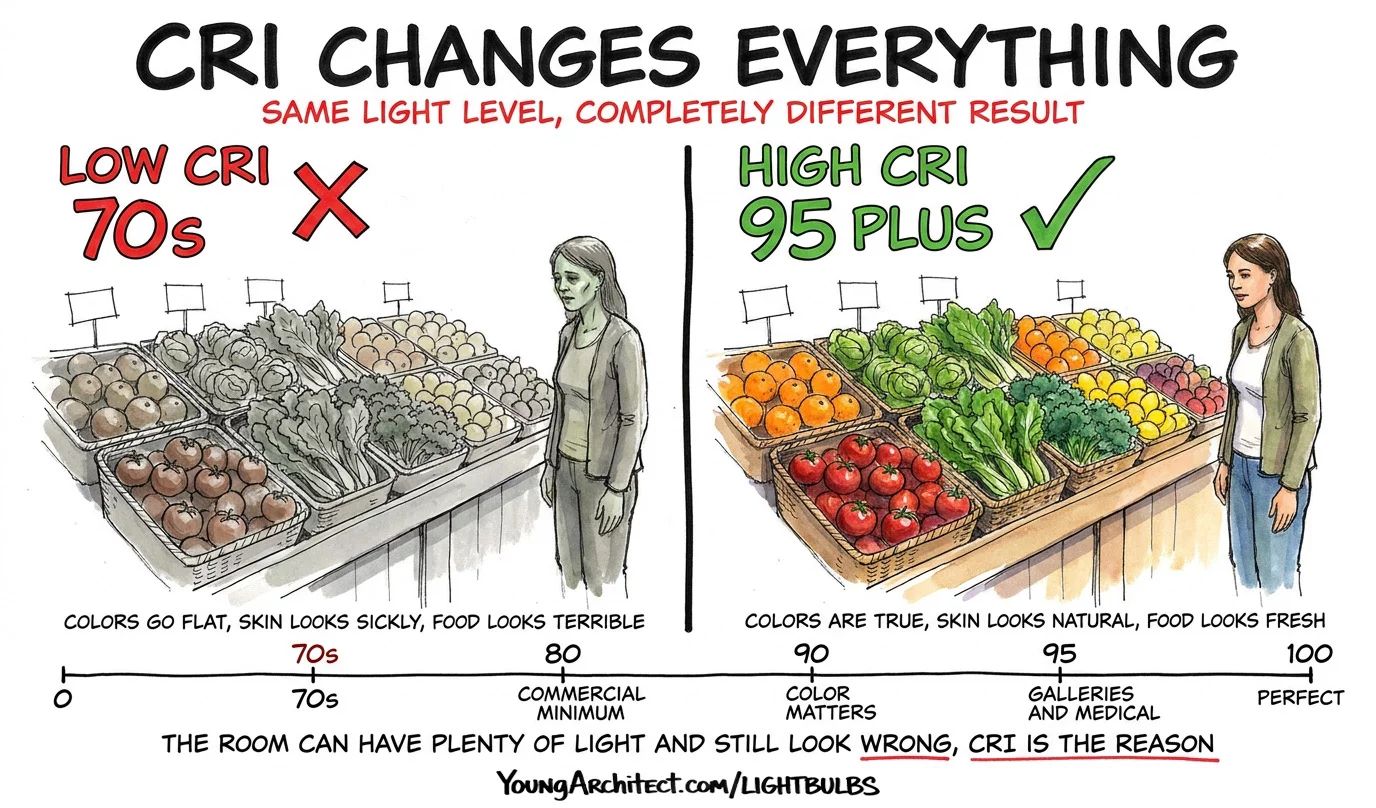
A score of 100 is perfect color accuracy. That’s what you get from natural daylight, and it’s what old incandescent bulbs delivered. That perfect CRI is the real reason incandescent light always felt so good, even though the bulb wasted almost all its energy as heat. The light quality was genuinely excellent.
Here are the CRI benchmarks worth knowing:
- 80 and above is the acceptable minimum for most commercial spaces. A lot of standards and codes land here.
- 90 and above is where you want to be anywhere people are actually evaluating color. Retail, hospitality, healthcare. Skin tones look natural, products look like themselves, food looks appetizing.
- 95 and above is excellent. Art galleries, museums, high-end retail, medical exam rooms. Anywhere getting the color exactly right genuinely matters.
Here’s where low CRI gets sneaky. It quietly wrecks a space without anyone being able to explain what’s wrong.
Colors go flat. They shift. Skin tones turn greenish or gray. Clothing looks dull. Food looks unappetizing.
And here’s the part that really catches people off guard: the room can have plenty of light. The foot candles can be perfectly adequate. And it still looks wrong, because the problem isn’t the amount of light, it’s the quality of the color rendering.
That’s exactly what happened to the clothing store from the top of this post. Plenty of light, terrible CRI. The foot candles were fine. The colors were not.
CRI is the standard you need to know, and it’s still what virtually every spec sheet uses. The industry is slowly developing a newer system called TM-30 that measures color quality more completely, but CRI remains the number that matters in practice.
Why CCT and CRI Are Completely Independent
This is the single most important distinction in lighting, and it’s the one people mix up the most.
Color temperature and CRI are completely independent measurements. Knowing one tells you absolutely nothing about the other.
Think of it this way:
Color temperature is the filter on a photo. CRI is the camera quality.
You can put a beautiful warm filter on a photo, but if it was shot on a garbage camera, it still looks bad. And you can have an incredible camera and choose a cool, crisp filter. The filter and the camera quality are two different things. One controls the mood. The other controls the quality.
So you can absolutely have warm light with terrible CRI. And you can have cool light with excellent CRI. The Kelvin number does not promise you anything about color accuracy.
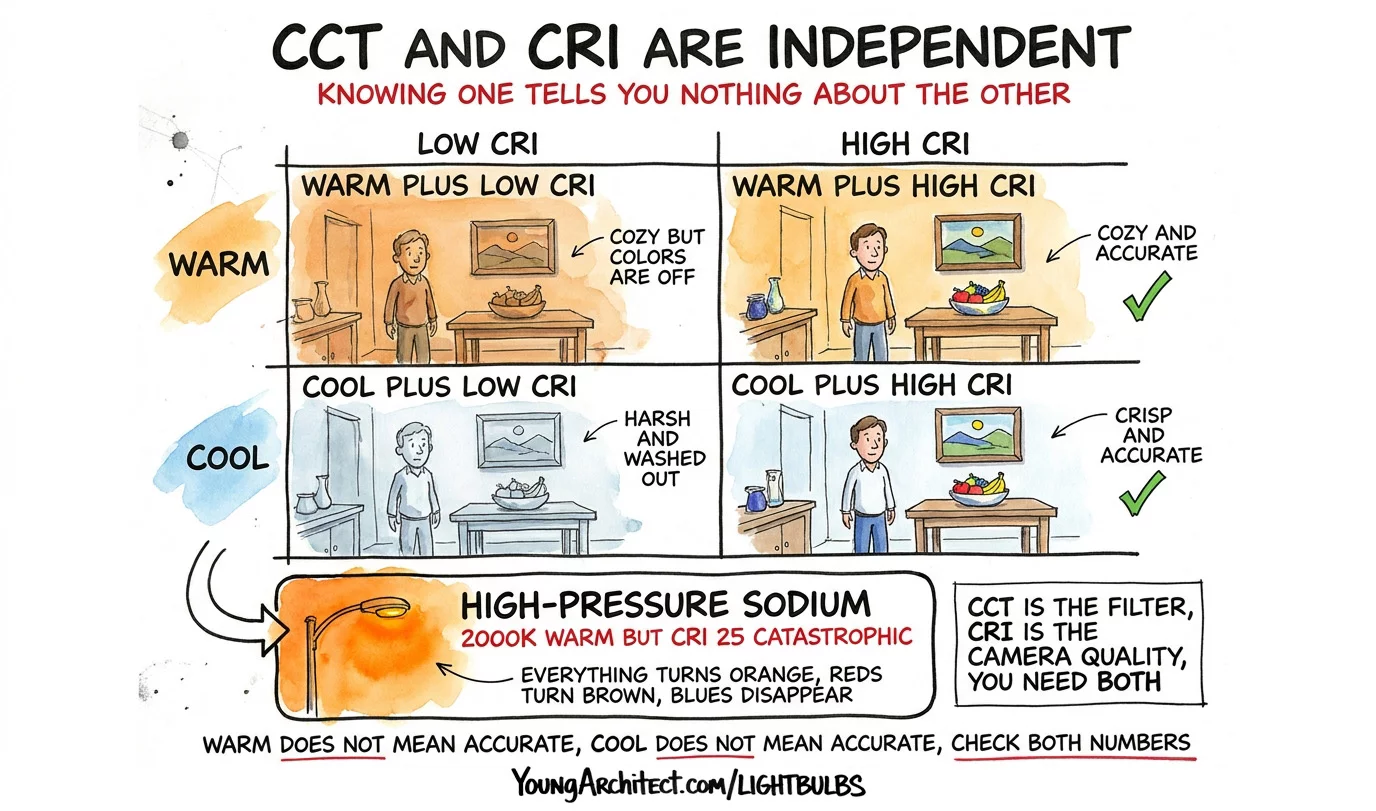
The perfect proof is high-pressure sodium. That’s the orange light you see in parking lots and along highways.
Visually, it looks like a warm amber color, somewhere around 2000K. But its color rendering index is about 25. Catastrophic.
Under high-pressure sodium, everything turns a monochromatic orange-yellow. Skin looks sick. Reds turn brown. Blues basically disappear. It’s a warm-looking light with some of the worst color accuracy of any lamp ever made.
That single lamp is the whole lesson: warm color temperature, garbage color rendering. The two numbers are independent, and you need to check both.
The Energy Information Administration has a good overview of how CRI is measured using incandescent as the reference standard, which is worth reading if you want to understand why the 0-to-100 scale works the way it does.
Meet the Lamp Types
Now that you have the two numbers that describe any light source, let’s meet the light sources themselves.
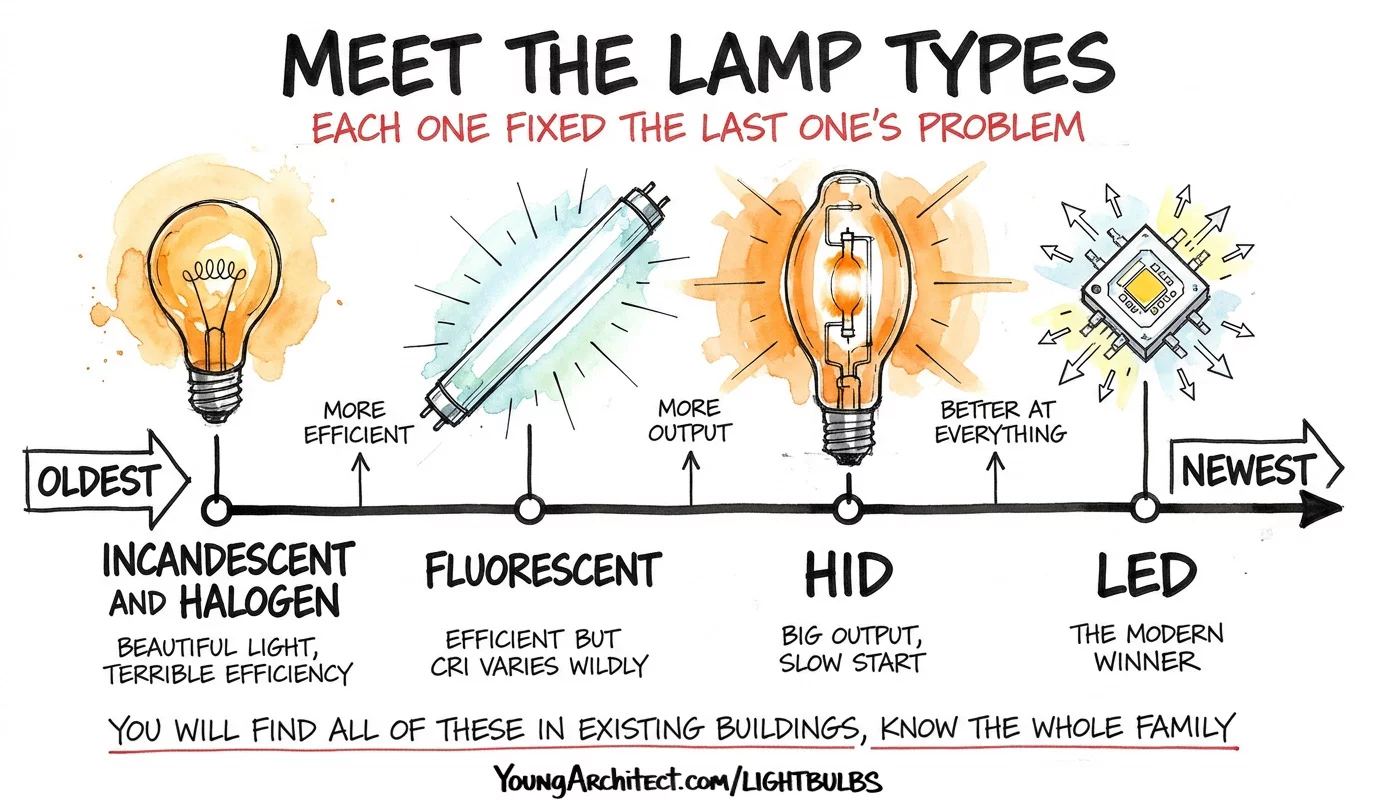
We’re walking through these in chronological order, oldest to newest, because there’s a pattern. Each type of light bulb was invented to fix a problem the last one had. More light, less energy, better color, longer life. That chase has been going on for over a century.
One thing before we get into the lineup: you might be tempted to think the older technologies don’t matter because everything is LED now. But you’re going to walk into existing buildings your entire career. Renovations, retrofits, tenant improvements. You need to recognize what’s already up in the ceiling before you can decide what replaces it.
This is practical knowledge, not a history lesson.
Incandescent and Halogen Lighting
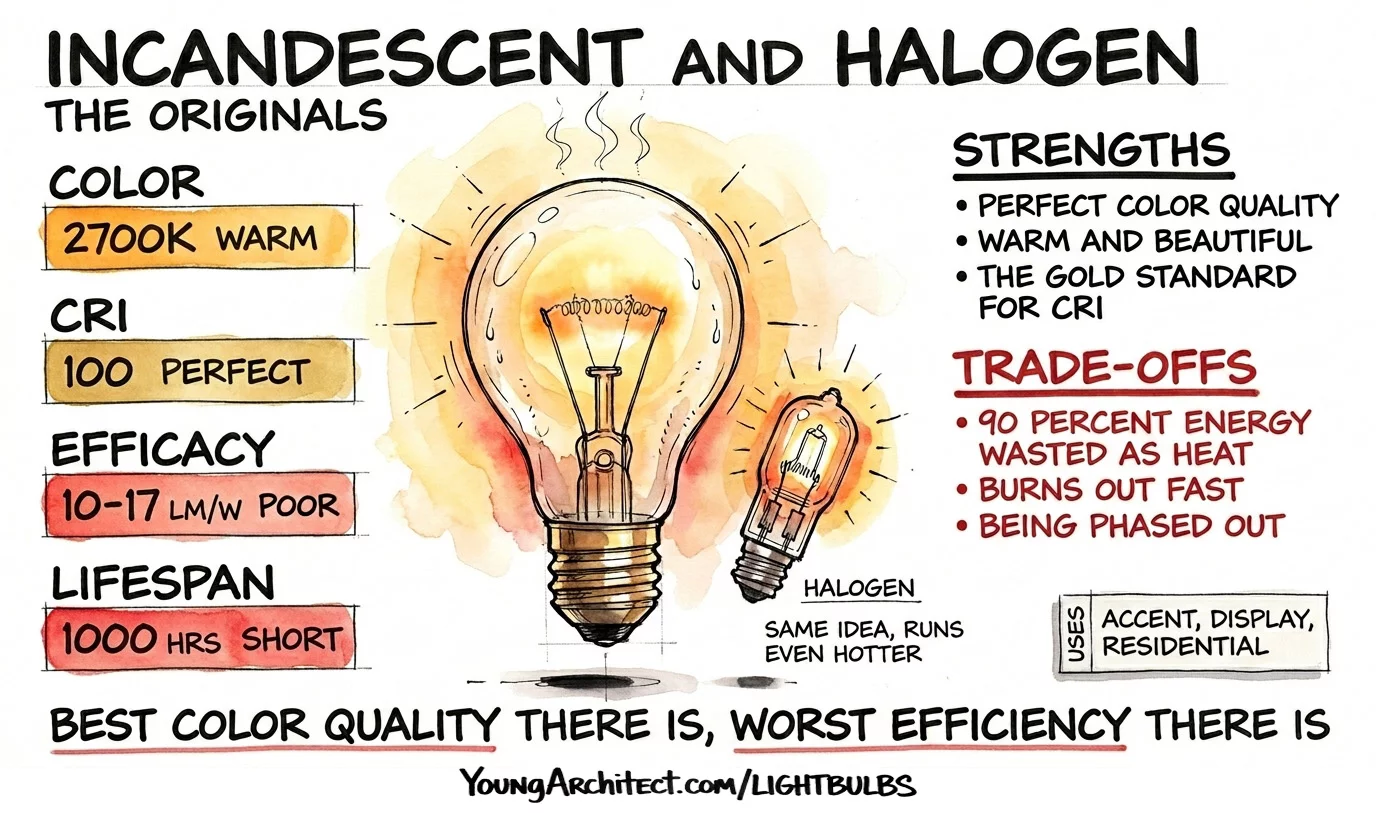
Incandescent is the original. The classic light bulb. The way it works is almost charmingly simple: you run electricity through a thin tungsten filament until it gets so hot it glows. It’s basically a tiny, controlled fire inside a glass bulb.
And the light it makes is gorgeous. Warm 2700K with a perfect 100 CRI. Every other lamp type on this list gets measured against incandescent for color quality. It’s the gold standard.
So what’s the catch?
It’s wildly inefficient. About 90 percent of the energy an incandescent bulb uses turns into heat, not light. It’s basically a tiny space heater that happens to glow a little on the side. And it burns out fast, usually around 1,000 hours.
That combination, beautiful light but terrible efficiency, is why incandescent lighting has been largely phased out of commercial use.
Halogen is incandescent’s slightly upgraded cousin. Same basic idea, a glowing filament, but with halogen gas sealed inside that recycles the tungsten and lets the filament run hotter and last a bit longer. You get the same warm light and the same perfect 100 CRI, with a small bump in efficiency.
The downside is that halogen runs extremely hot. Hot enough to be a burn risk and a fire concern in tight spaces. You’ll still find it in accent lighting, retail displays, and some residential fixtures. Like incandescent, it’s on its way out in favor of LED.
Best color quality there is, worst efficiency there is. Know them. Recognize them in existing buildings. But you won’t be specifying either one on new work.
Fluorescent and CFL Lighting
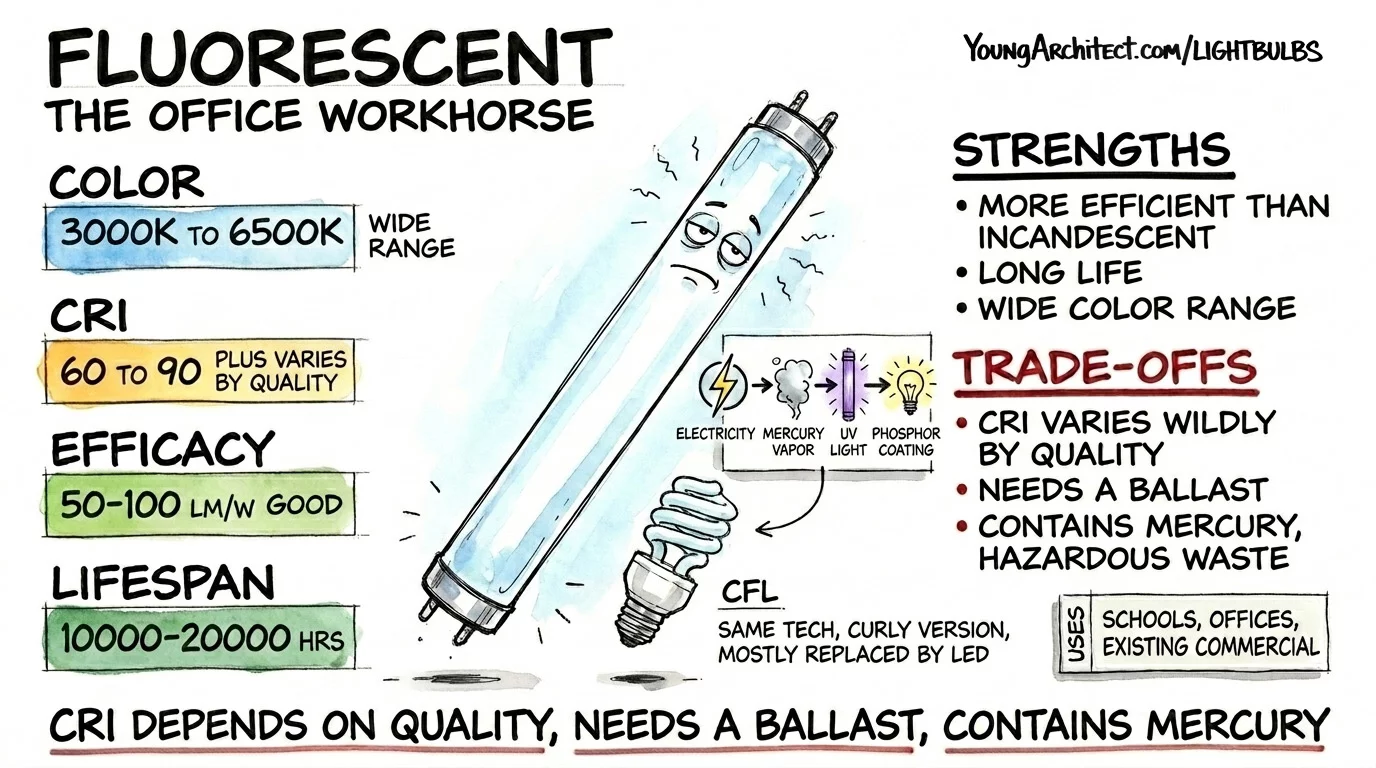
Fluorescent works in a completely different way than incandescent. There’s no glowing filament. Instead, electricity excites mercury vapor sealed inside a tube, which produces ultraviolet light you can’t see. Then a phosphor coating on the inside of the tube converts that invisible UV into the visible light you actually perceive.
It’s a two-step process. The gas makes invisible light, the coating turns it into visible light.
Fluorescent lighting was a big leap forward in efficiency. Way better than incandescent, with a lifespan of 10,000 to 20,000 hours. It comes in a wide range of color temperatures too.
But here’s the catch, and it’s a significant one. CRI varies wildly depending on quality.
Cheap fluorescent tubes have CRI ratings down in the 60s and 70s, and that is the flat, greenish, soul-crushing light everybody associates with bad offices and old schools. Good fluorescent can actually hit the high 80s and look perfectly fine. It all comes down to the phosphor blend, which is a specification decision.
Two more things you need to know about fluorescent:
- It requires a ballast, a component that regulates the electrical current flowing to the tube. Remember that word, ballast, because it’s going to come back when we talk about LED.
- It contains mercury. That makes it hazardous waste at the end of its life, which is a real concern on renovation and demolition projects. You can’t just toss old fluorescent tubes in a dumpster.
A quick note on CFLs, the compact fluorescents. Those are the curly bulbs that screwed into a standard socket. Same technology as the full-size tubes, just folded up into a smaller package. Same pros, same cons. They’ve been mostly replaced by LED at this point.
Fluorescent lighting is still everywhere in existing buildings. Schools, offices, older commercial spaces. It’s fading out, but you’ll be dealing with it on renovation projects for years to come.
HID Lighting
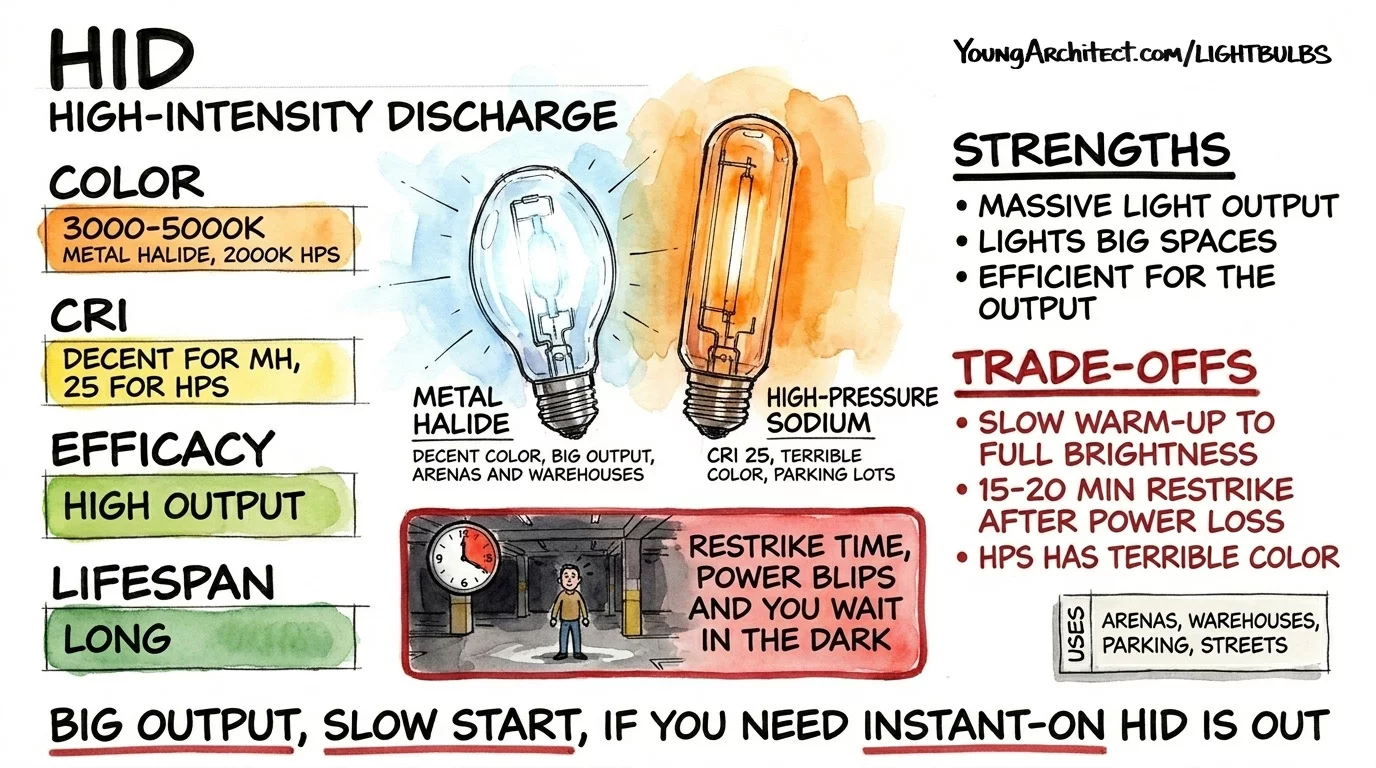
HID stands for high-intensity discharge. It’s not one product, it’s a family. And the thing every member has in common is serious light output. These are the lamps you use when you need to light something big.
Two members of the HID family are worth knowing.
Metal halide has pretty good color quality, somewhere in the 3000K to 5000K range, with a decent CRI. You’ll find it lighting large spaces: sports arenas, warehouses, big-box retail, industrial facilities. A lot of light from a relatively compact source.
High-pressure sodium is the other one, and you already met it. That’s the orange parking-lot light with the catastrophic CRI of about 25. Extremely efficient, long-lasting, but the color rendering is so poor you’d only use it where color genuinely doesn’t matter. Streets, parking lots, security lighting.
Now here’s the critical thing about the entire HID family.
Warm-up and restrike time.
When you switch an HID lamp on, it does not come on instantly. It takes several minutes to warm up to full brightness. And if the power even flickers off for a second, the lamp has to fully cool down before it can restrike.
That cool-down and restrike can take 15 to 20 minutes.
Think about what that means in practice. A parking garage runs on HID. The power blips for half a second. Now you have a pitch-black parking garage for the next 15 minutes while the lamps cool off and restrike. That’s not just inconvenient. That’s a genuine safety problem.
The rule is simple: if a space needs light the instant you flip the switch, HID doesn’t fit. That single limitation knocks it out of a lot of applications.
LED Lighting
LED stands for light-emitting diode, and it changed everything about how we light buildings.
No filament. No gas. No phosphor tube.
LED works in a completely different way than anything else on this list. It’s a solid-state semiconductor chip, and when you run current through it, it emits light directly. Solid, durable, nothing fragile to break. The DOE’s LED Basics resource covers the underlying solid-state technology in detail.
LED basically wins on every category that matters.
- Highest luminous efficacy of any common light source
- Longest lifespan: 25,000 to over 100,000 hours depending on the fixture
- Full range of color temperatures, from cozy 2700K all the way up to daylight at 6500K+
- Instant on, no warm-up period
- Dimmable and directional, ideal for task and accent lighting
- No mercury
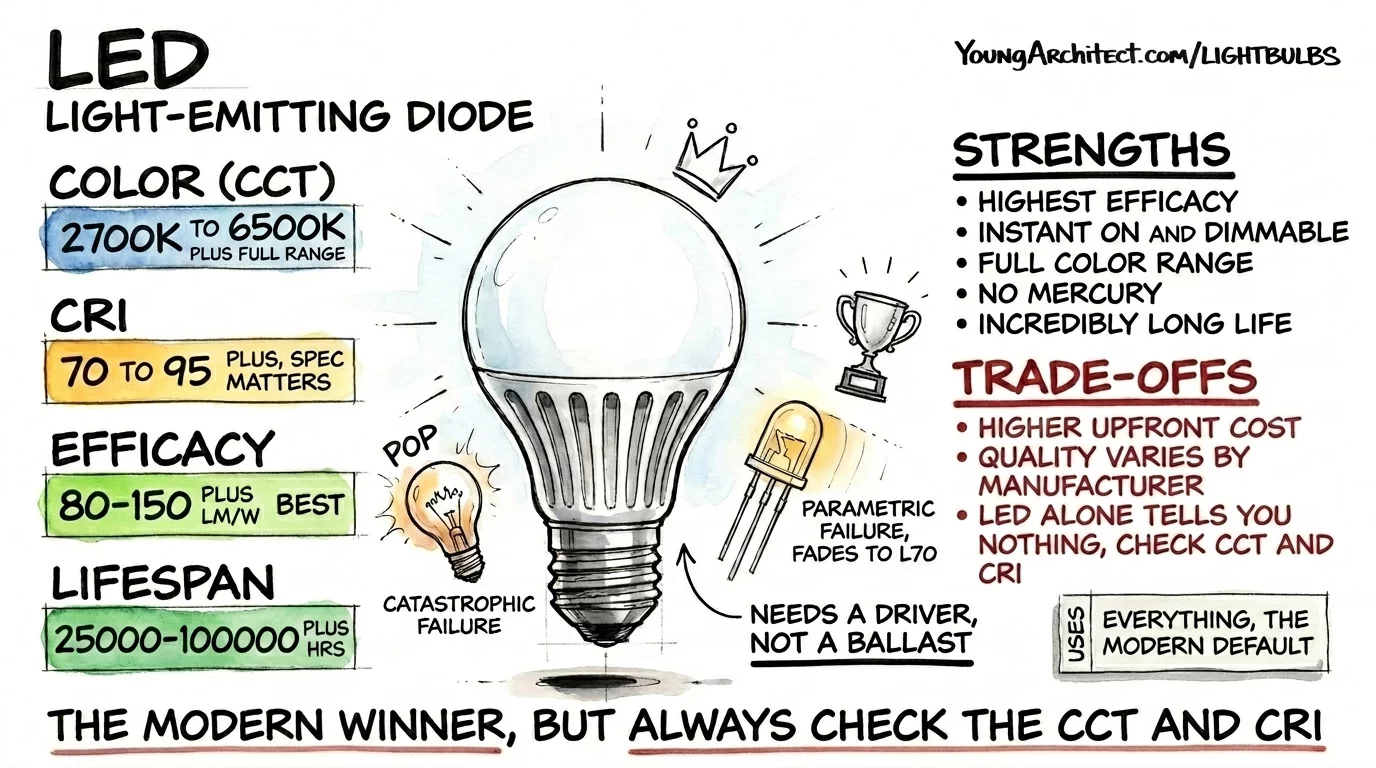
One important detail: LED runs on a component called a driver, not a ballast. Fluorescent needs a ballast. LED needs a driver. They are not interchangeable, and that distinction matters when you’re retrofitting an existing fluorescent fixture or detailing the electrical side of a new one.
How LEDs Fail (It’s Different)
LED also “dies” differently than other lamp types.
An incandescent bulb just pops when its filament breaks. That’s catastrophic failure: the circuit is dead and the light is done.
LEDs don’t do that. Instead, they slowly fade over time while still turning on. That’s called parametric failure.
When you see an LED fixture rated for “50,000 hours,” that’s not when it stops working. That’s when it has faded to 70 percent of its original brightness. The industry calls that measurement L70. The light is still on. It’s just not delivering what it used to.
The Catch
LED’s upfront cost is higher than other technologies, though the energy savings pay it back quickly. And quality varies enormously between manufacturers. This is the big one.
Just seeing “LED” on a spec sheet tells you nothing about whether it’s actually good light. A cheap LED fixture can have garbage CRI and weird color shifts.
You still have to check the color temperature and the CRI on every fixture you’re evaluating. LED is a technology, not a quality guarantee.
Lighting is one of the building systems topics we go deep on inside Building Systems 101 at the Young Architect Academy, covering everything from fixture cut sheet analysis to how lighting coordinates with types of HVAC systems and other mechanical equipment in real projects.
Lumens vs Watts and Luminous Efficacy
LED is the reason the entire lighting industry stopped talking about watts and started talking about lumens.
For decades, you shopped for a light bulb by wattage. You wanted bright, you grabbed a 100-watt bulb. That system worked because when every bulb was incandescent, watts and brightness were roughly proportional.
Then LED came along and broke that system completely.
A 10-watt LED can produce the same brightness as a 60-watt incandescent. Suddenly watts told you nothing about how much light you were actually getting, because two bulbs at the same wattage could produce wildly different amounts of light depending on the technology.
So the industry switched to comparing luminous efficacy: the amount of light you get for each watt of power you put in. Lumens per watt.
And note the word: efficacy, not efficiency. Efficiency is a percentage. Efficacy is a ratio of two different units, lumens out per watt in. Small vocabulary distinction, but it’s the precise term.
Here’s the number that really lands.
An incandescent bulb gives you about 15 lumens per watt. A good LED gives you 100 or more.
That’s nearly seven times the light for the exact same amount of electricity.
Seven times. That single number is the reason LED took over the entire industry in about a decade.
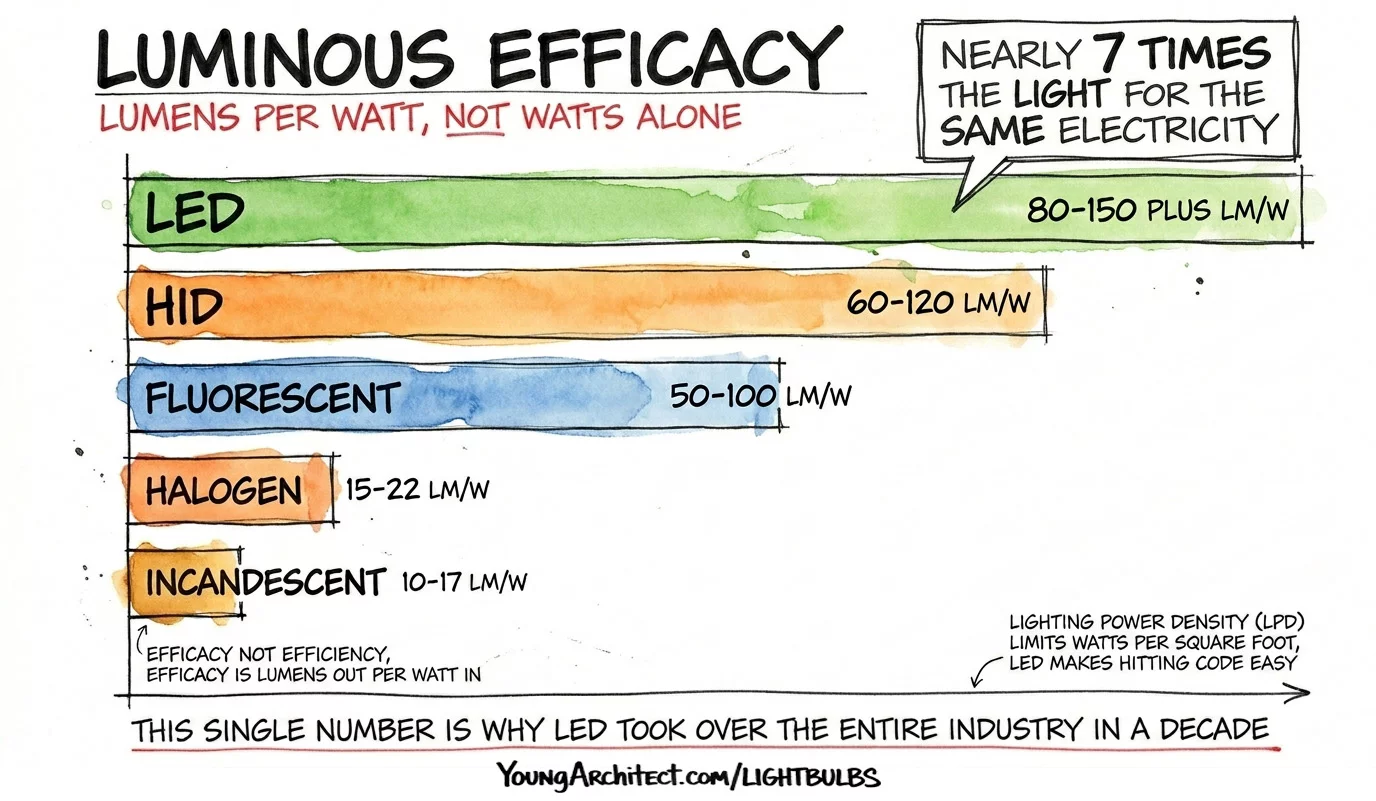
There’s a code angle here too. Energy codes like ASHRAE 90.1 limit how many watts of lighting you’re allowed per square foot of building area. That limit is called Lighting Power Density, or LPD. Because LED produces so much light per watt, meeting those LPD requirements is significantly easier with LED than with any older technology.
The DOE’s Building America guide on high-efficiency lighting covers efficacy ranges across different lamp types and how the industry shifted from watts to lumens per watt.
Choosing the Right Light for Any Space
You understand the two numbers. You’ve met all the players. So how do you actually pick?
The good news is that for new construction, the answer is almost always LED. The real decision isn’t which technology. It’s which color temperature and which CRI.
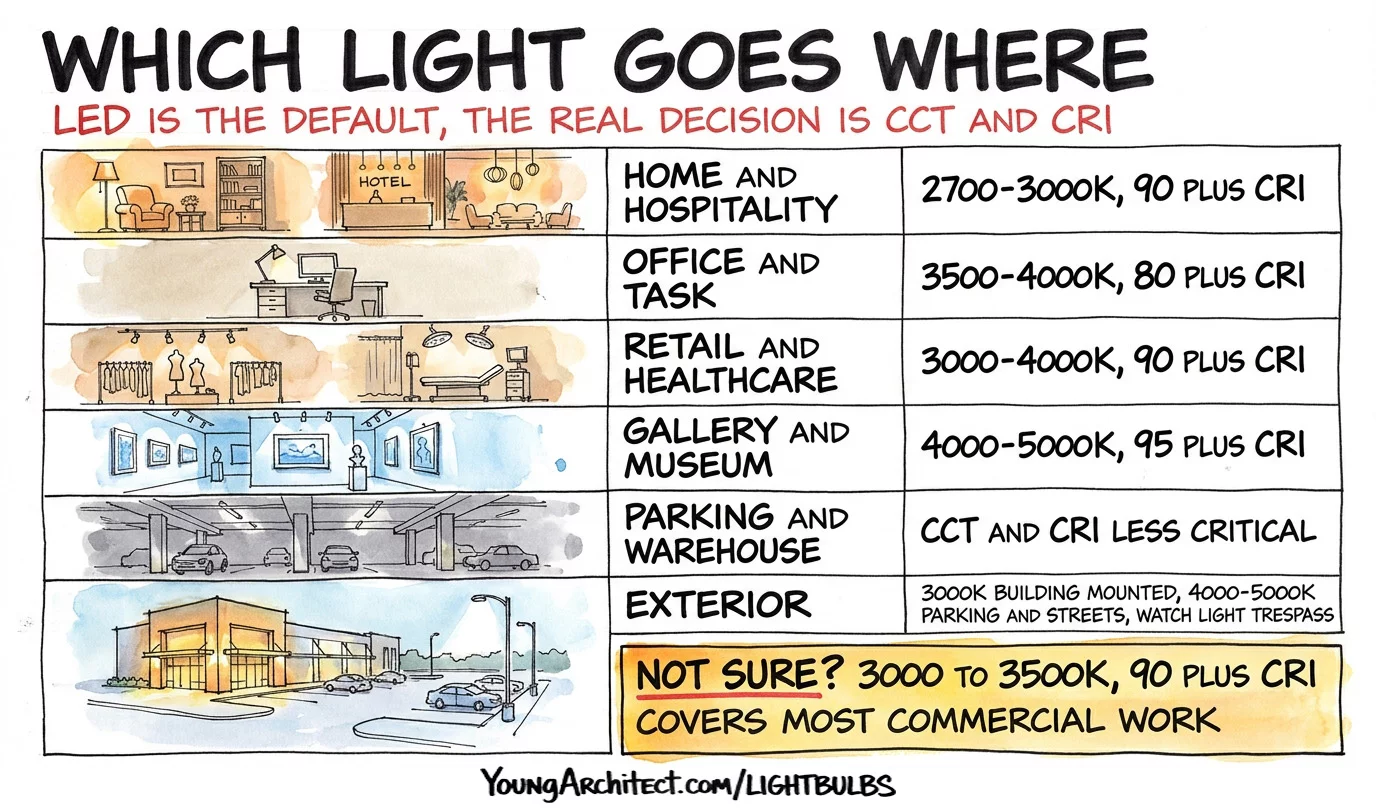
For new construction, the breakdown looks like this:
- Home, hotel, anywhere cozy: LED at 2700K to 3000K, 90+ CRI. Warm, accurate, flattering to skin tones and furnishings.
- Office and task spaces: LED at 3500K to 4000K, 80+ CRI. Cool enough to keep people alert, accurate enough for everyday work.
- Retail and healthcare (color matters): LED at 3000K to 4000K, 90+ CRI. Products need to look like themselves. Skin tones need to look natural.
- Gallery or museum: LED at 4000K to 5000K, 95+ CRI. You want the best color accuracy you can get.
- Parking garage or warehouse: LED. CCT and CRI barely matter here. You just need to see.
- Exterior: Warmer 3000K for building-mounted lighting (welcoming feel). Cooler 4000K to 5000K for parking lots and streets (visibility). And anytime you’re lighting near residential areas, watch for light trespass, keeping your light on your property and out of someone’s bedroom window.
The renovation scenario keeps coming up too. You walk into an existing building and you might find fluorescent or HID already in the ceiling. Your job is to recognize what’s there and decide what replaces it.
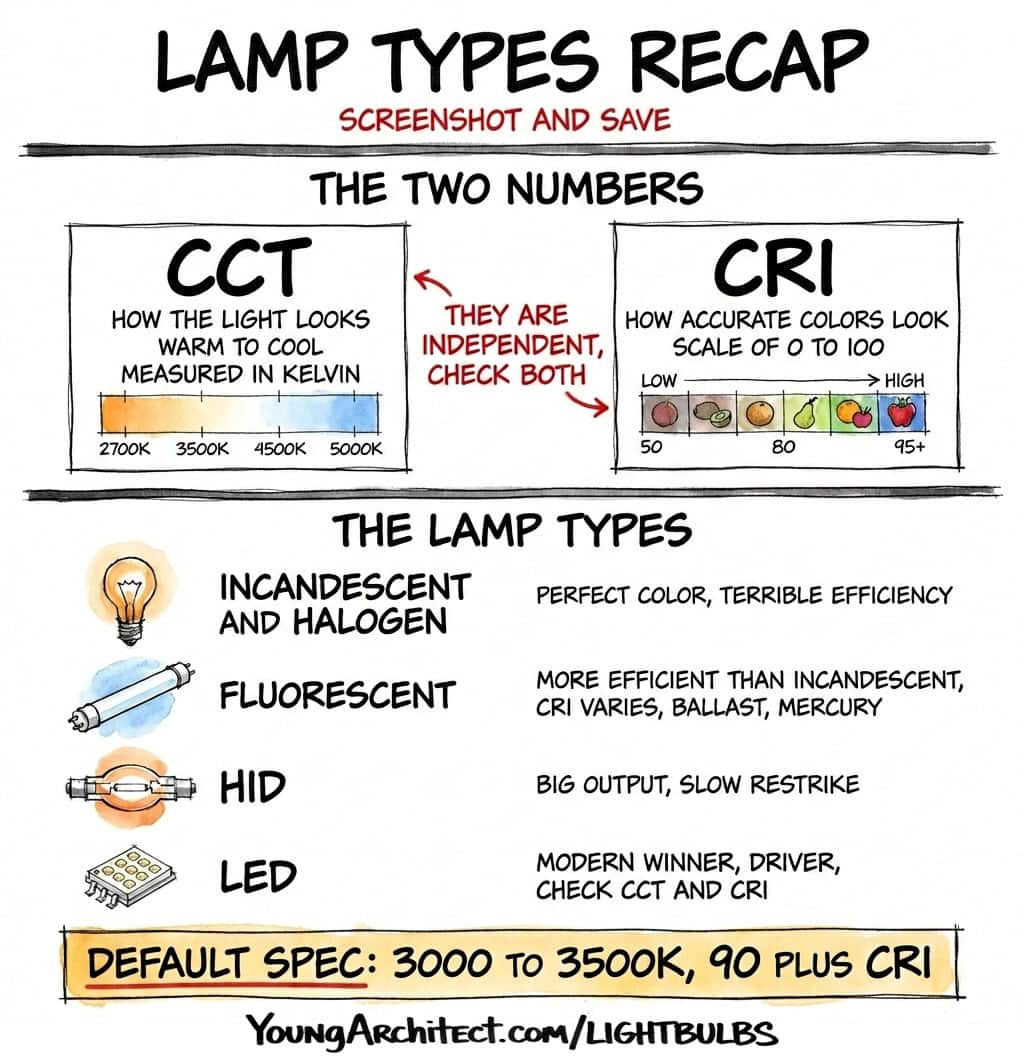
If you only remember one default spec, make it this: 3000K to 3500K, 90+ CRI. That combination covers most commercial work and it’s a safe landing spot when you’re not sure what to specify.
Lamp Types and Professional Practice
NCARB’s published objectives for PPD and PDD reference material selection and building systems integration. Lighting falls squarely in that territory. Here are the distinctions that connect directly to how those objectives are structured.
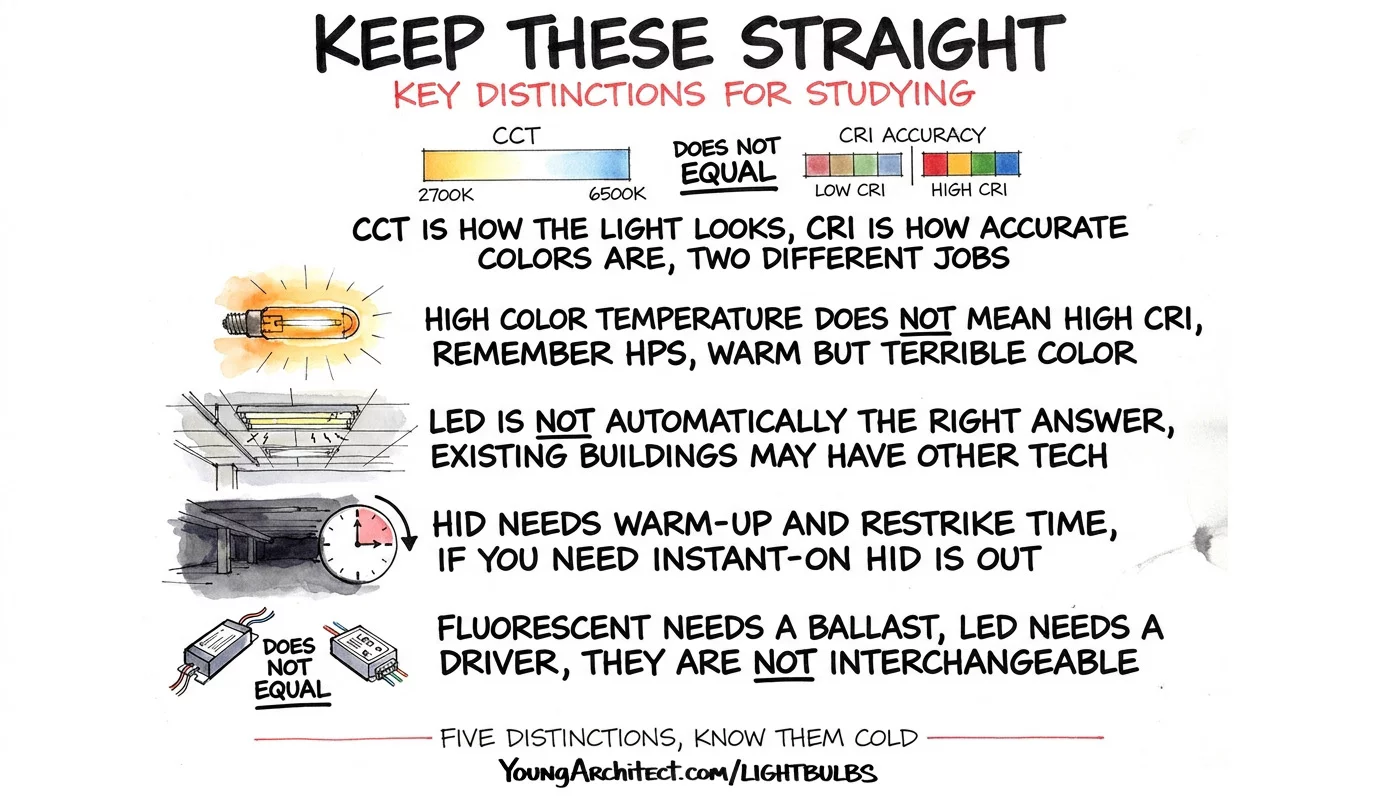
CCT and CRI are not the same thing. Color temperature is how the light looks. CRI is how accurate colors are under that light. Two different numbers doing two different jobs. Mixing them up is the most common error.
High color temperature does not mean high CRI. The high-pressure sodium lamp proved that. Warm appearance and terrible color rendering can absolutely coexist. Always check both numbers independently.
LED is not automatically the right answer. On new construction, it almost always is. But if a scenario involves an existing building, the lighting system might be fluorescent, HID, or something else entirely. You need to know the whole family of lamp types to make informed decisions about replacements and retrofits.
HID has a warm-up and restrike limitation. If a space needs light the instant the switch is flipped, HID is out. That 15 to 20 minute restrike delay after a power interruption is a practical constraint that eliminates HID from a lot of applications.
Fluorescent needs a ballast. LED needs a driver. They are not interchangeable components. When retrofitting fluorescent fixtures to LED, the ballast has to be replaced with a driver. That’s a real coordination item on renovation projects.
These are the practical tradeoffs that matter in professional work, and they align directly with what NCARB’s published objectives for PPD and PDD are pointing toward. Our PPD 101 and PDD 101 courses cover them in depth.
Come Study With Us at the Young Architect Academy

Lighting is one of those topics where understanding the fundamentals changes how you look at every project. Inside Building Systems 101, there’s a practice problem where you put three real fixture cut sheets side by side and figure out which one to spec based on efficacy and color quality. That’s the exact skill you’d use on a real project.
The course also covers lighting distribution patterns, how light actually leaves a fixture and spreads through a space, plus building acoustics, HVAC systems, and the rest of the building systems that architects coordinate every day.
Building Systems 101 is one of the courses inside the ARE 101 Membership. One membership gets you access to everything: Building Systems 101, PPD 101, PDD 101, and the rest of the academy.
And if you want more than study materials, if you want coaching, a study plan, and real accountability, check out ARE Boot Camp. You get a personalized weekly study curriculum, daily study groups with other candidates, and the structure to actually finish.
Frequently Asked Questions
What is the difference between CCT and CRI?
CCT (correlated color temperature) describes how warm or cool a light appears, measured in Kelvin. CRI (color rendering index) measures how accurately colors show up under that light, on a scale of 0 to 100. The two are completely independent. A warm light can have terrible CRI, and a cool light can have excellent CRI. Always check both numbers.
What color temperature is best for an office?
Most offices use 3500K to 4000K, which falls in the cool white range. This color temperature supports alertness and task performance without feeling clinical. For residential or hospitality spaces, 2700K to 3000K creates a warmer, more relaxed feel. The general rule: warm for comfort, cool for task, daylight (5000K+) for color accuracy.
What does CRI 80 vs CRI 90 look like?
At 80 CRI, colors appear acceptable but slightly flat. Skin tones may look slightly off and vibrant colors lose some richness. At 90+ CRI, colors look natural and accurate. Skin tones appear healthy, clothing looks true to color, and food looks appetizing. The difference is most noticeable in retail, healthcare, and any space where people evaluate color.
What is the difference between a ballast and a driver?
A ballast regulates electrical current for fluorescent lamps. A driver regulates current for LED fixtures. They are not interchangeable. Fluorescent fixtures need ballasts, LED fixtures need drivers, and swapping one for the other requires replacing the component. This distinction matters when retrofitting existing fluorescent fixtures with LED technology.
Why did lumens replace watts for comparing light bulbs?
Watts measure energy consumption, not brightness. When every bulb was incandescent, watts and brightness were proportional, so shopping by wattage worked. LED changed that because a 15-watt LED produces the same brightness as a 100-watt incandescent. Lumens measure actual light output, making them the accurate way to compare brightness across different types of light bulbs.
Types of Light Bulbs Quiz Time: