
What Is the NCIDQ Certification?
The NCIDQ (National Council for Interior Design Qualification) is the professional certification exam for interior designers, administered by CIDQ. Earning your NCIDQ Certificate proves you have the knowledge and competency to protect public health, safety, and welfare through the practice of interior design.
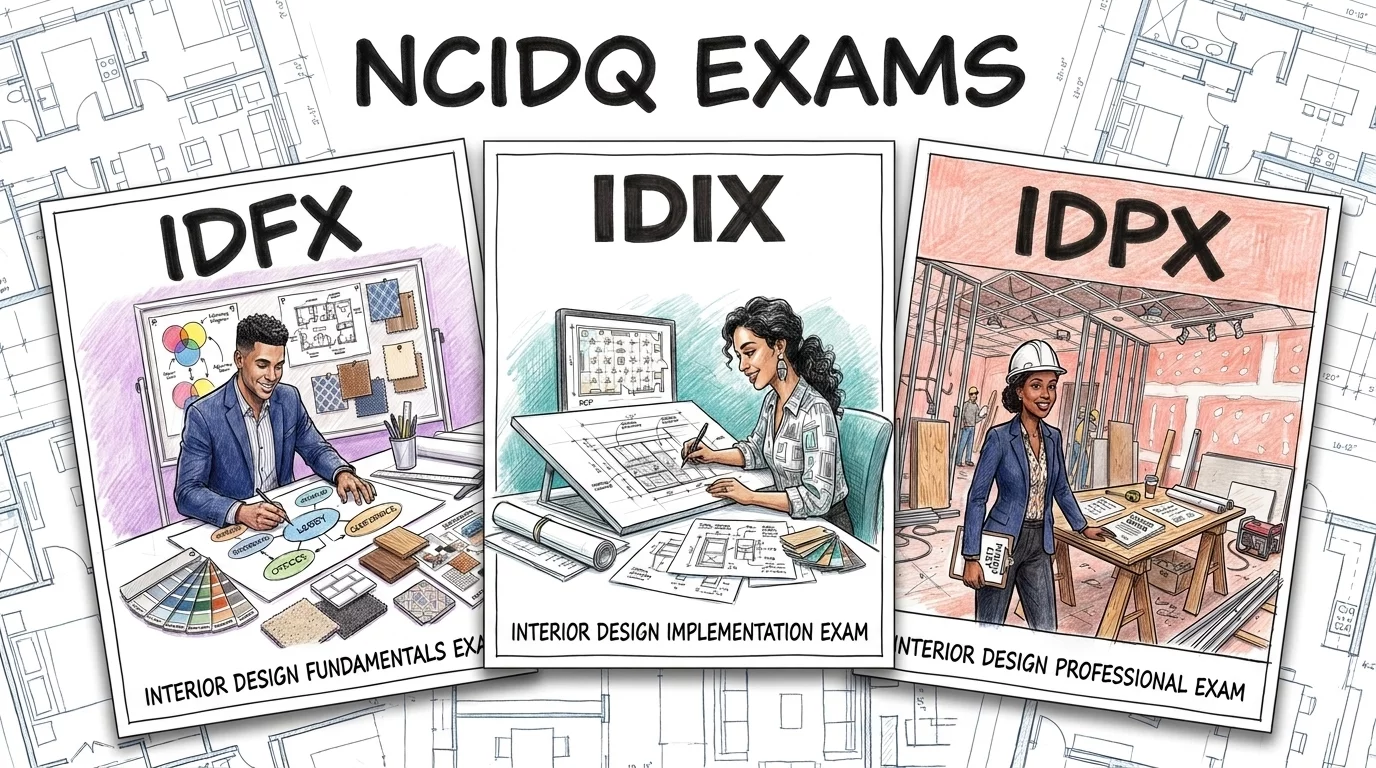
The NCIDQ is made up of three separate exams:
- IDFX (Interior Design Fundamentals Exam)
- IDIX (Interior Design Implementation Exam)
- IDPX (Interior Design Professional Exam)
You need to pass all three to earn the NCIDQ Certificate. To sit for the exams, you’ll need a qualifying interior design education and, for most routes, supervised work experience. Many states and Canadian provinces require the NCIDQ Certificate for licensure or registration as an interior designer.
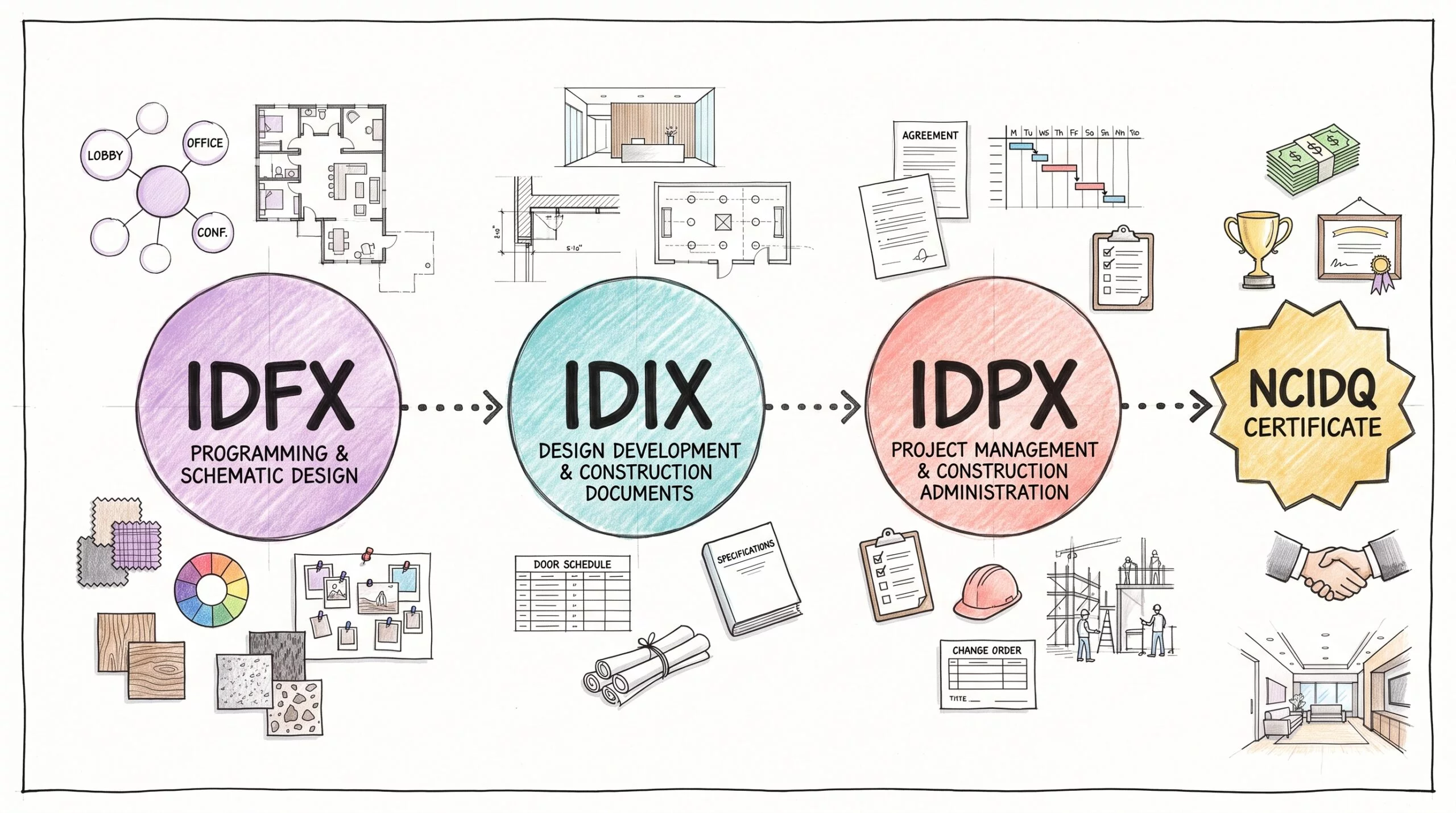
Here’s the big picture: Each exam covers a different stage of the interior design project lifecycle. Think of it as following a project from the very first site visit all the way through construction closeout.
IDFX covers the early phases (programming and schematics). IDIX picks up where IDFX leaves off (design development and construction documents). IDPX covers the professional practice side (contracts, construction, and project closeout).
Understanding the project lifecycle is the key to understanding these exams. The three exams aren’t random collections of topics. They mirror how a real interior design project actually unfolds. When you see it that way, studying becomes a lot more intuitive.
Three Exams at a Glance
| IDFX (Fundamentals) | IDIX (Implementation) | IDPX (Professional) | |
|---|---|---|---|
| Full Name | Interior Design Fundamentals Exam | Interior Design Implementation Exam | Interior Design Professional Exam |
| Duration | 3 hours | 4 hours | 3 hours |
| Questions | 115 | 130 | 115 |
| Content Areas | 6 | 5 | 5 |
| Design Phases | Programming & Schematic Design | Design Development & Construction Docs | Construction Admin & Project Management |
| Topics | Programming, site analysis, space planning, materials, schematics | Codes, construction documents, specifications, consultant coordination | Feasibility, budgeting, contracts, construction admin, closeout |
All three exams use multiple question types: Multiple Choice, Drag and Place, Fill in the Blank, and Hot Spot. Each exam includes vignettes (scenario-based question sets with 3-5 questions per scenario).
Exams are offered twice a year during a spring cycle and a fall cycle.
IDFX: Interior Design Fundamentals Exam
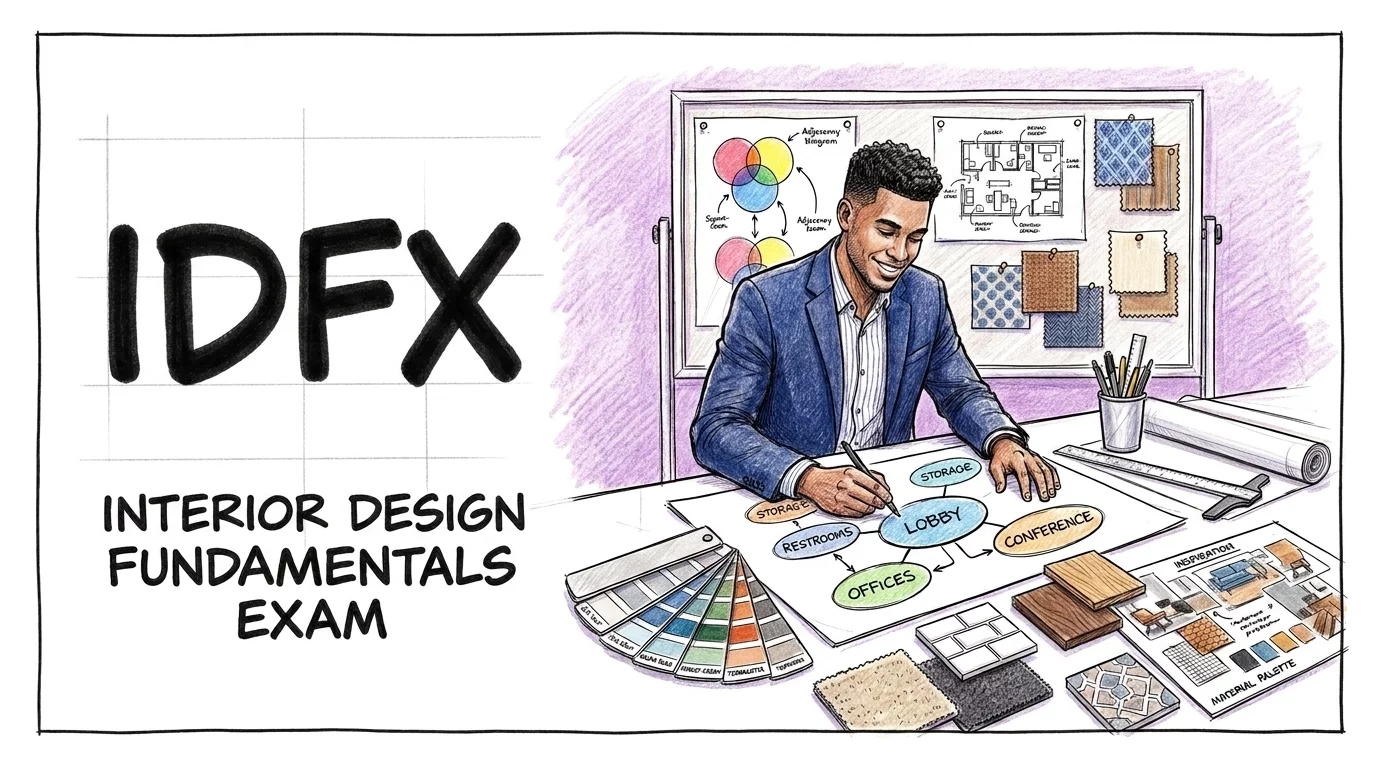
Where every project begins. The IDFX tests your understanding of the early phases of interior design: programming, conceptual design, and schematic design.
This is where you assess existing conditions, analyze the site, determine what the client needs, and start translating those needs into a design. You’re working with adjacency diagrams, bubble diagrams, space plans, and material selections.
You’re performing initial code analysis and thinking about how the building works before you start drawing details.
The six content areas on the IDFX:
- Existing Conditions (14%) – Site analysis, building evaluation, initial code review
- Pre-Design (15%) – Evidence-based design, sustainability, universal design, design intent
- Programming (16%) – Validating the program, creating diagrams, determining user needs
- Space Planning (19%) – Floor plans, circulation, life safety, structural limitations
- Preliminary FF&E and Finishes (16%) – Material selection, furniture planning, sourcing
- Schematics (20%) – Refining design intent, code review, visualization
IDFX is the only exam you can take without work experience. Students in their final year of a qualifying interior design degree program can take the IDFX through Route 2, Part 1. This makes it a smart first step while you’re still in school or building your experience hours.
Exam details: 3 hours, 115 questions (15 are unscored pre-test questions). Pass rate has averaged around 53% over recent testing cycles. Scored on a scale of 200 to 800 with a passing score of 500.
Our Free ARE Podcast has IDFX study content you can use right now.
Topics that apply directly to the IDFX include:
- Occupancy classifications and construction types
- ADA accessibility and door clearance requirements
- Types of insulation and building envelope performance
- Foundation types and structural systems
- Gross, rentable, usable, and net area calculations
- Passive heating and cooling strategies
- Lighting, lamp types, and foot candle calculations
- Building acoustics, STC, IIC, and NRC ratings
All free, all available today.
Browse IDFX Podcast Episodes →
IDIX: Interior Design Implementation Exam
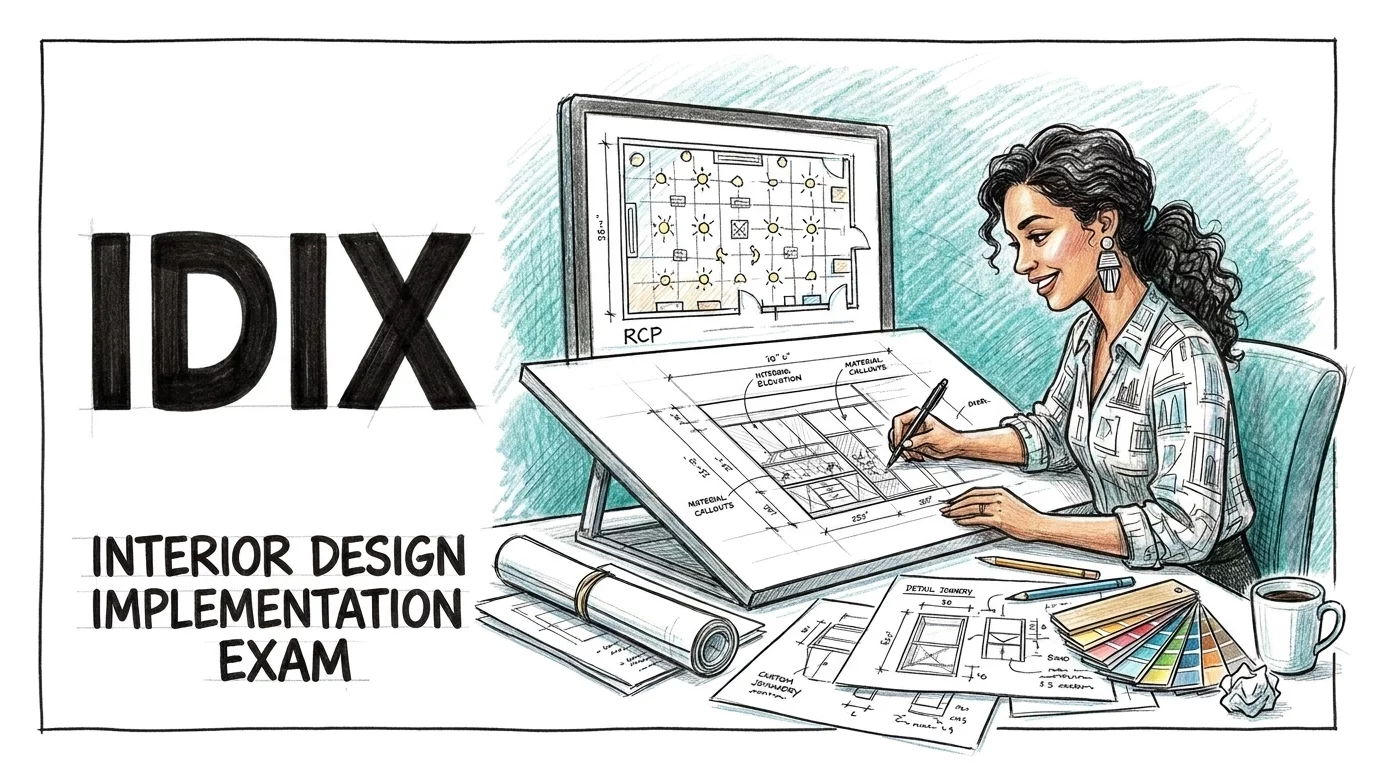
Turning the design into documents. The IDIX tests your ability to take a design concept and develop it into a fully coordinated set of construction documents.
This is the production side of interior design. You’re developing details, sections, elevations, and reflected ceiling plans. You’re writing specifications, coordinating with consultants (engineers, lighting designers, AV specialists), and making sure every piece of information is communicated clearly in the documents.
Codes and life safety run through everything you do here.
The five content areas on the IDIX:
- Codes and Life Safety (16%) – Egress, fire ratings, occupancy loads, code review
- Integration and FF&E (19%) – Building systems, finish plans, furniture specifications
- Construction Documents (32%) – Details, elevations, demolition plans, RCPs, construction plans
- Consultant Drawing Coordination (18%) – Coordinating with engineers, power/data plans, signage
- Construction Specifications and Schedules (15%) – Spec writing, door/finish/equipment schedules
Construction Documents is the largest section at 32%. This is where CIDQ puts the most weight, and it makes sense. The ability to produce clear, accurate, and coordinated construction documents is at the core of protecting health, safety, and welfare. If you’re going to focus your study time anywhere on this exam, start here.
The IDIX replaced the old PRAC (Practicum) exam starting in 2026. Case studies are gone. The new format uses vignettes (scenario-based question sets) across all three exams instead.
Exam details: 4 hours, 130 questions (15 are unscored pre-test questions). Pass rates have ranged from 54% to 69% over recent testing cycles. Scored on a scale of 200 to 800 with a passing score of 500.
Already have free ARE Podcast episodes covering many IDIX topics.
Topics that apply directly to the IDIX include:
- Means of egress, travel distance, and egress calculations
- Fire rated walls, fire barriers, and fire partitions
- Construction specification types and spec writing
- Smoke and heat detectors
- Vapor barriers, air barriers, and moisture control
- Sealant types, backer rod, and joint design
- Plumbing fixtures and plumbing valves
- Types of HVAC systems
- Electrical fundamentals and lighting calculations
Browse IDIX Podcast Episodes →
IDPX: Interior Design Professional Exam
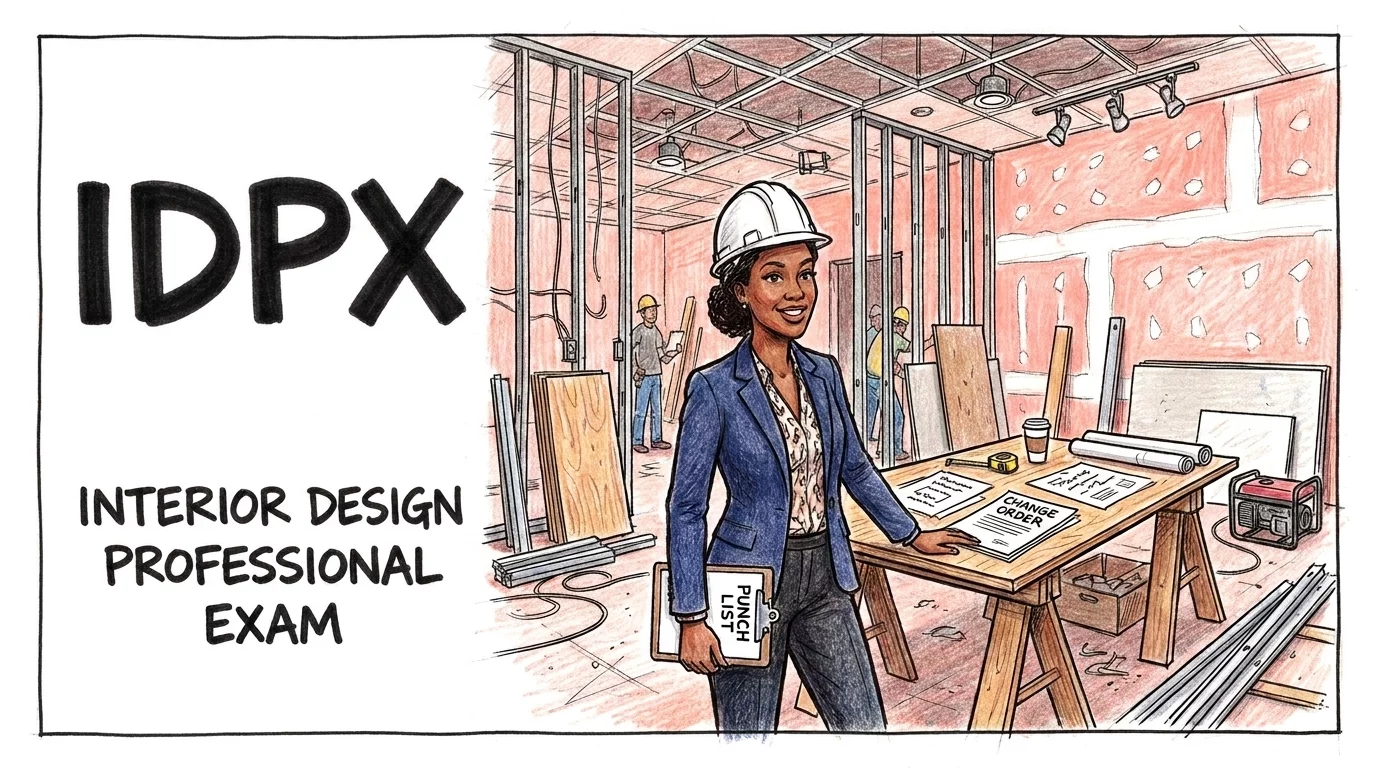
Managing the project from contracts through closeout. The IDPX tests the business and professional practice side of interior design. This is where you prove you can manage a project, not just design one.
You’re evaluating feasibility, managing budgets and schedules, navigating contracts and procurement, facilitating the construction process, performing site observations, and conducting project closeout.
This exam covers the skills that separate a designer from a licensed professional.
The five content areas on the IDPX:
- Feasibility Studies (17%) – Project feasibility, stakeholder identification, team management
- Scheduling and Budgeting (17%) – Project schedules, cost estimating, value engineering
- Contracts, Procurement, and Permitting (28%) – Bid process, contracts, approvals, permits
- Construction Process (21%) – Submittals, RFIs, change management, shop drawings
- Site Observation and Close-Out (17%) – Site visits, punch lists, closeout procedures
Contracts, Procurement, and Permitting is the largest section at 28%. Understanding how contracts work, how the bid process functions, and how approvals flow through a project is heavily weighted on this exam. If you’ve been through the construction administration process on real projects, a lot of this will feel familiar.
There’s significant overlap with the ARE here. If you’ve studied for or passed the architect exam (especially PjM and CE), you’ll recognize many of these topics. Submittals, RFIs, change orders, pay applications, substantial completion vs. final completion. The concepts are the same; the NCIDQ just frames them from the interior designer’s perspective.
Exam details: 3 hours, 115 questions (15 are unscored pre-test questions). Pass rates have ranged from 56% to 65% over recent testing cycles. Scored on a scale of 200 to 800 with a passing score of 500.
The IDPX has the most overlap with our free ARE Podcast.
If you’ve ever listened to our episodes on professional practice and construction administration, you’ve already been studying IDPX material without realizing it. Topics that apply directly to the IDPX include:
- AIA B101 owner-architect agreement
- Construction cost estimates and hard costs vs. soft costs
- Project delivery methods (DBB, design-build, CMAR)
- Construction bidding process and procurement
- Construction submittals, RFIs, and change orders
- Construction observation and site visit documentation
- Claims, disputes, and liquidated damages
- Project closeout, punch lists, and substantial completion
Browse IDPX Podcast Episodes →
Who Can Take the NCIDQ?
CIDQ offers two routes to sit for the exams:
Route 1: Apply for all three exams at once. You need a qualifying interior design education AND the required work experience. Your eligibility period is 10 exam administration periods (about 5 years to pass all three).
Route 2 (Two Parts):
- Part 1 (IDFX Only): For candidates who meet the education requirement but don’t yet have the work experience. You can take the IDFX while still in school or building your hours. Eligibility period is 4 exam administration periods (about 2 years).
- Part 2 (IDIX & IDPX): Once you’ve passed the IDFX and completed your work experience, apply for the remaining two exams. Eligibility period is 10 exam administration periods.
You can take the exams in any order. But if you want to follow them in design phase order (the way a project actually flows), the sequence is: IDFX first, then IDIX, then IDPX.
Exams are offered twice per year during a spring cycle and a fall cycle. You can take one, two, or all three exams in a single cycle.
Scoring: All three exams are scored on a scale of 200 to 800. The passing score is 500. Official score reports are available approximately 6-8 weeks after the exam window closes.
Want Free NCIDQ Study Content?
We regularly publish new content covering building codes, construction documentation, professional practice, and the other topics tested across the NCIDQ exams.
Join our email list to get free study tips, new podcast episode alerts, and exam prep content delivered to your inbox.
Why Young Architect?
We’ve spent nearly a decade helping people pass high-stakes licensing exams. Our ARE courses have helped thousands of architects get licensed, and our CSI courses have expanded that same approach to construction industry certifications.
There’s massive overlap between the ARE and the NCIDQ. Building codes, construction documents, specifications, professional practice, contracts, project management. We’ve already built deep content libraries covering these topics, and interior designers have been using our podcast episodes and blog posts to supplement their NCIDQ study.
That’s not a coincidence. When you teach people to actually understand how buildings get designed, documented, and built, the material crosses professional boundaries.
The concepts don’t change just because you’re an interior designer instead of an architect. The codes are the same. The contracts work the same way. The construction process follows the same sequence. That’s why our content works for NCIDQ candidates, and that’s why we’re here.