
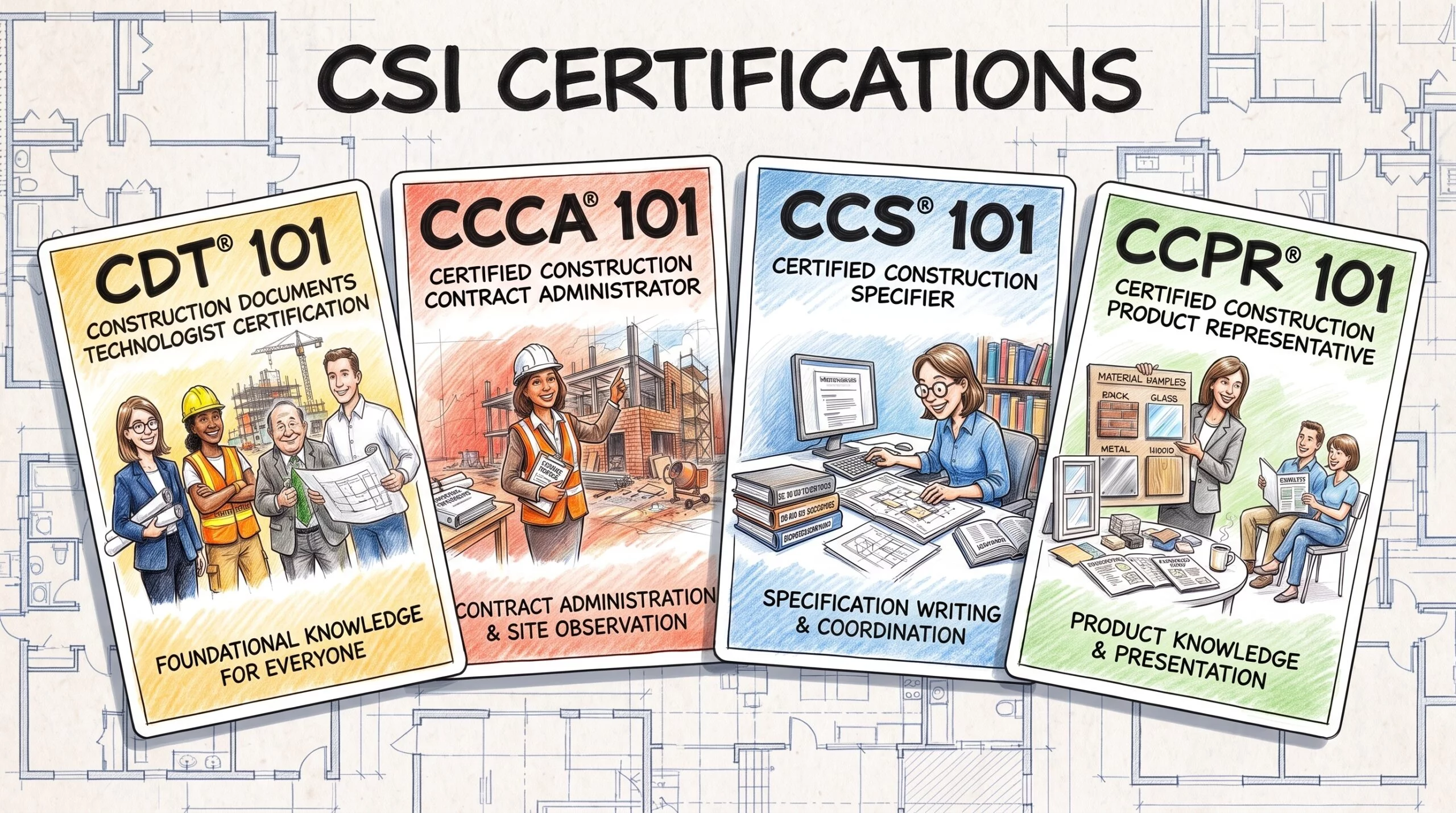
What Is CSI Certification?
The Construction Specifications Institute (CSI) is the construction industry’s authority on construction documentation and communication. Founded in 1948, CSI created and maintains the standards the whole industry runs on, including MasterFormat®, the system used to organize construction specifications.
CSI offers four professional certifications that prove you understand how construction projects actually work, from the documents to the people to the process. Earning one tells employers, architects, contractors, and clients that you speak the language of the built environment.
Here’s how the four certifications fit together:
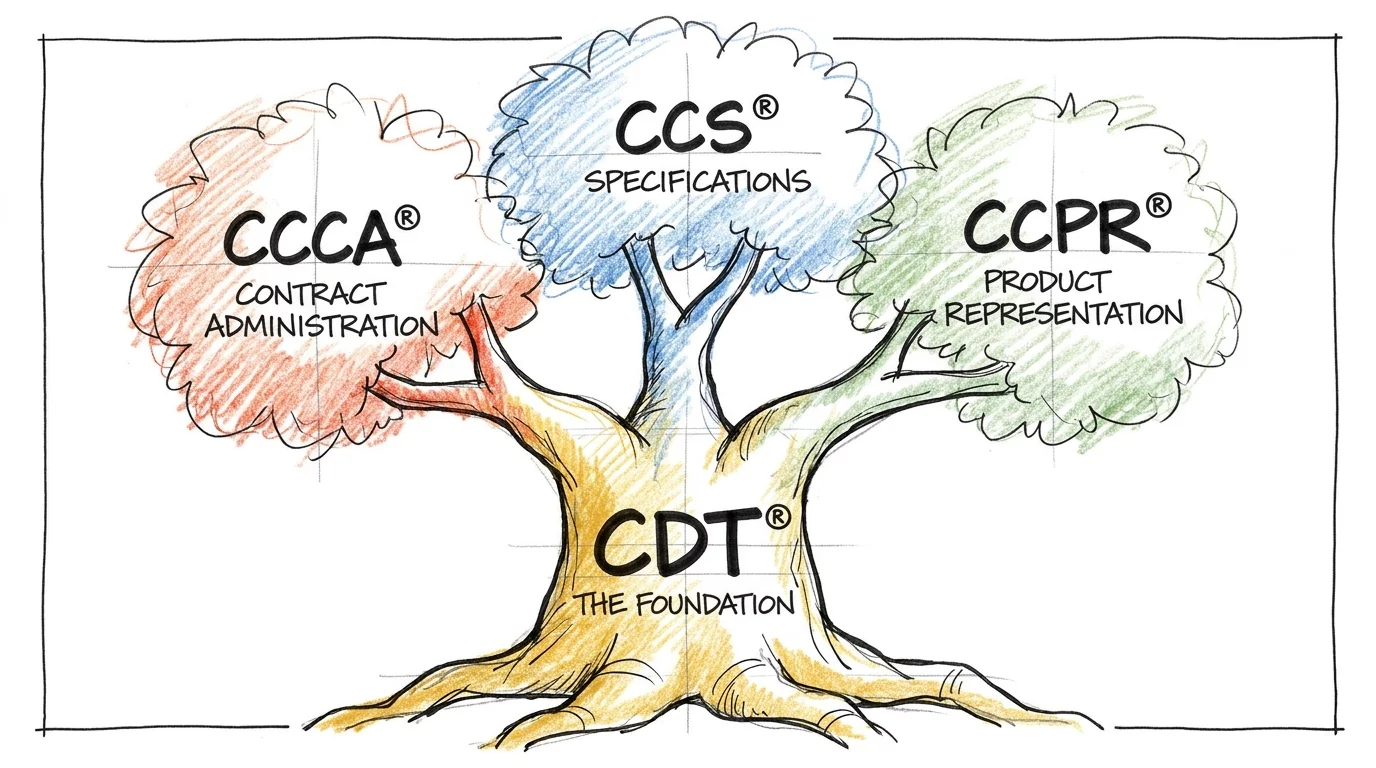
CDT® is the foundation. Everyone starts here. It covers the entire project lifecycle and how all the pieces and people fit together. Earning your CDT® is the first step, and it opens the door to the three advanced certifications.
The three advanced certifications each go deep on one specialty:
- CCCA® zooms into construction contract administration
- CCS® zooms into writing construction specifications
- CCPR® zooms into representing construction products
Think of CDT® as the trunk of the tree and CCCA®, CCS®, and CCPR® as the three branches. You build the foundation first, then specialize in the direction that fits your career.
Our CSI exam prep courses are built by registered architects who make this material approachable. Each course supplements CSI’s official study guides, teaching you the concepts so you actually understand the material instead of just memorizing it. Pick your certification below to learn more.
CDT® 101: Construction Documents Technologist
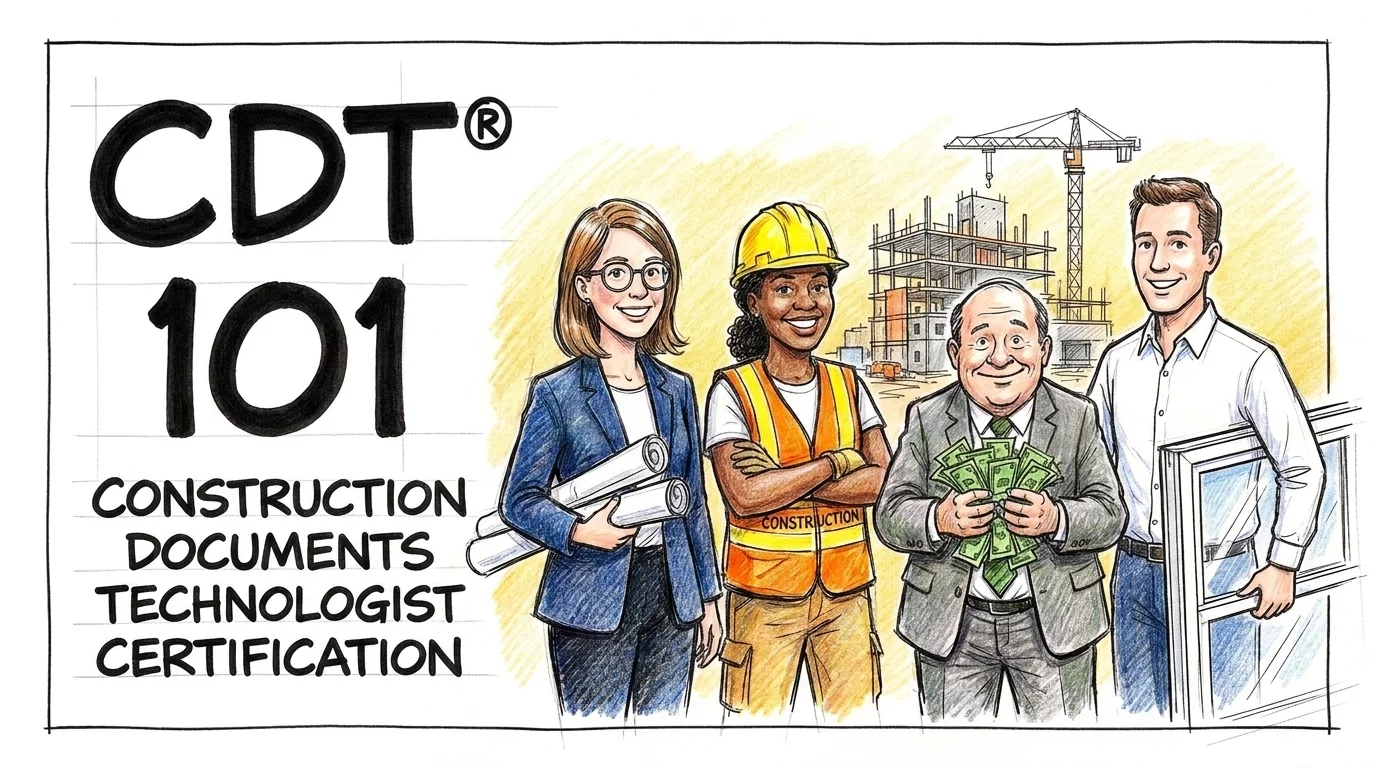
Start here. The CDT® is the foundation of the entire CSI certification program and the prerequisite for the advanced certifications. It covers the whole project lifecycle, from concept to closeout, and teaches you the roles, phases, and documents that every construction project runs on.
Who it’s for: Everyone in the industry. Architects, engineers, contractors, product reps, specifiers, owners, and anyone who works with construction documents.
New to the CDT®? Start with our free CDT® webinar for a no-pressure introduction to the certification and how to get started.
Explore CDT® 101 → Watch the Free CDT® Webinar →
CCCA® 101: Certified Construction Contract Administrator
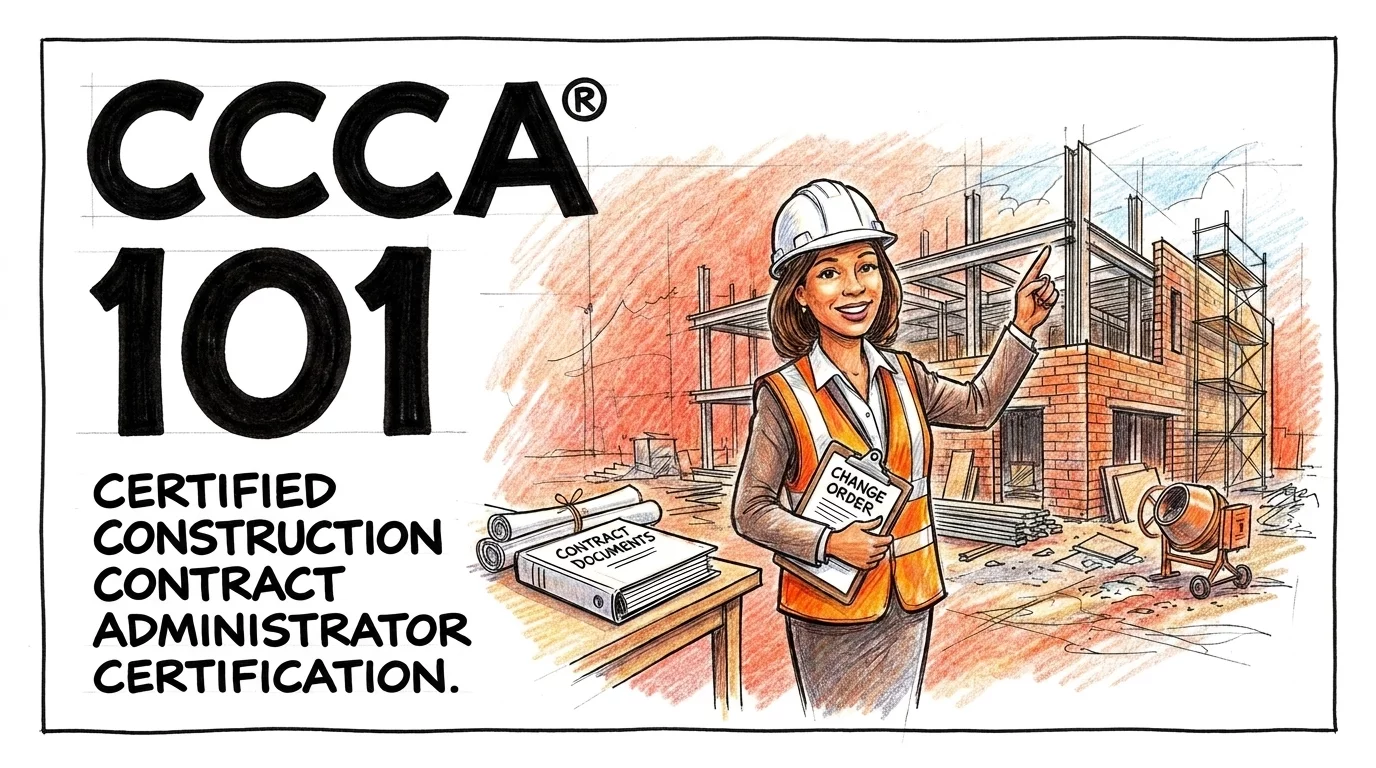
Master the construction phase. The CCCA® goes deep on construction contract administration, the documentation, communication, and processes that keep a project running smoothly from bid to closeout. Submittals, change orders, RFIs, site observations, claims, and closeout.
Who it’s for: Architects, engineers, construction managers, contractors, project engineers, and anyone who administers construction contracts.
Requires your CDT® first.
CCS® 101: Certified Construction Specifier
Master the specifications. The CCS® goes deep on developing, writing, and managing construction specifications, the written half of the construction documents that governs what actually gets built. Research, product evaluation, coordination, and production of the project manual.
Who it’s for: Specifiers, architects, engineers, designers, and technical professionals who write or coordinate construction specifications.
Requires your CDT® first.
CCPR® 101: Certified Construction Product Representative
Master product representation. The CCPR® goes deep on the product representative role, becoming the trusted advisor design teams rely on. It covers relationship building, pre-design, the design phase, procurement, and construction support, so you understand how your products fit into every project phase.
Who it’s for: Manufacturer’s reps, architectural sales reps, technical reps, product consultants, and territory managers.
Requires your CDT® first.
Not Sure Where to Start?
Start with our free CDT® webinar. It’s a no-cost, no-pressure way to understand the CSI certifications and figure out which path fits your career. We’ll walk you through what the CDT® is, how the certifications connect, and how to get started.
Once you’re ready to prepare for the exam, CDT® 101 is the place to start. It’s the foundation everyone builds on, and it’s required before the advanced certifications.