
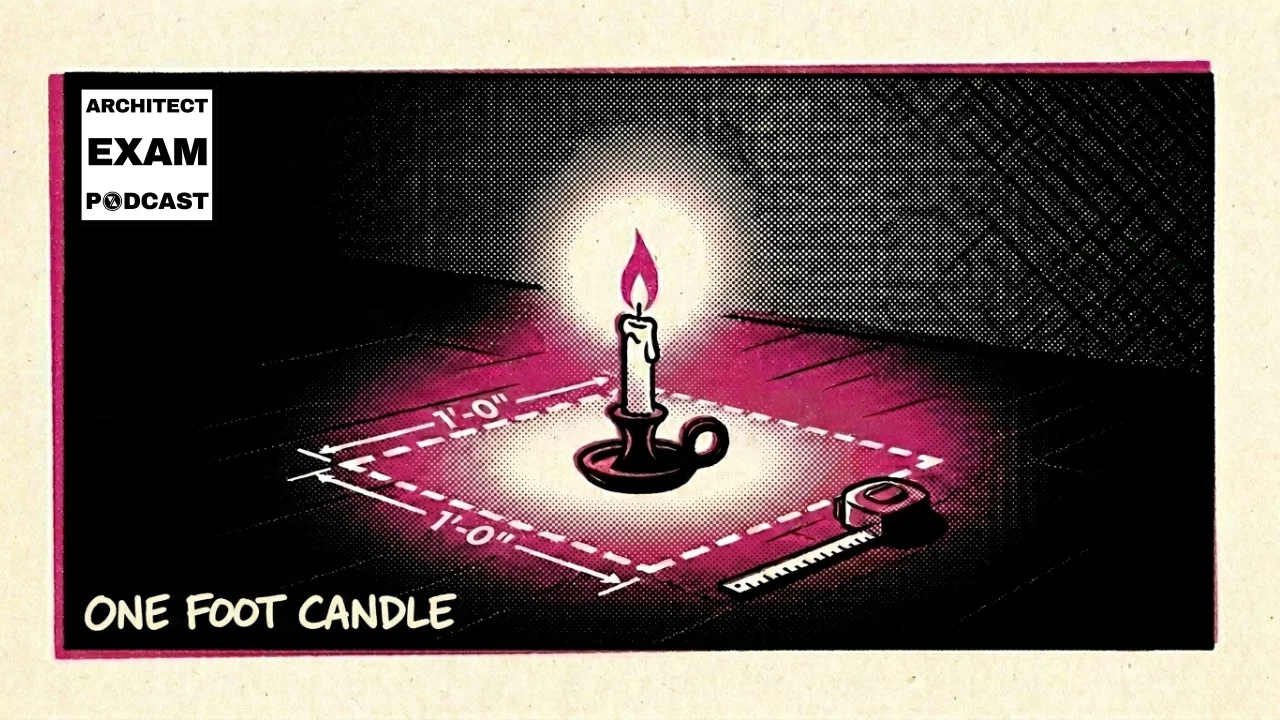

Fifty foot candles. That number shows up in every lighting specification you will ever read. But what is a foot candle, actually? How is it different from a lumen? And what does luminance have to do with why a room can have plenty of light and still feel wrong? Lighting has four core measurements, and they all connect in one logical chain. This post follows that chain from the light source to your eye, covering candelas, lumens, foot candles, lux, and luminance.
This podcast is also available on YouTube, Spotify, and Apple Podcasts
How Light Is Measured
Lighting vocabulary gets confusing fast, but here is the good news. All four core measurements connect to each other in a logical sequence. Once you see the chain, the individual pieces make sense.
One analogy is going to carry us through the entire post. A garden hose.
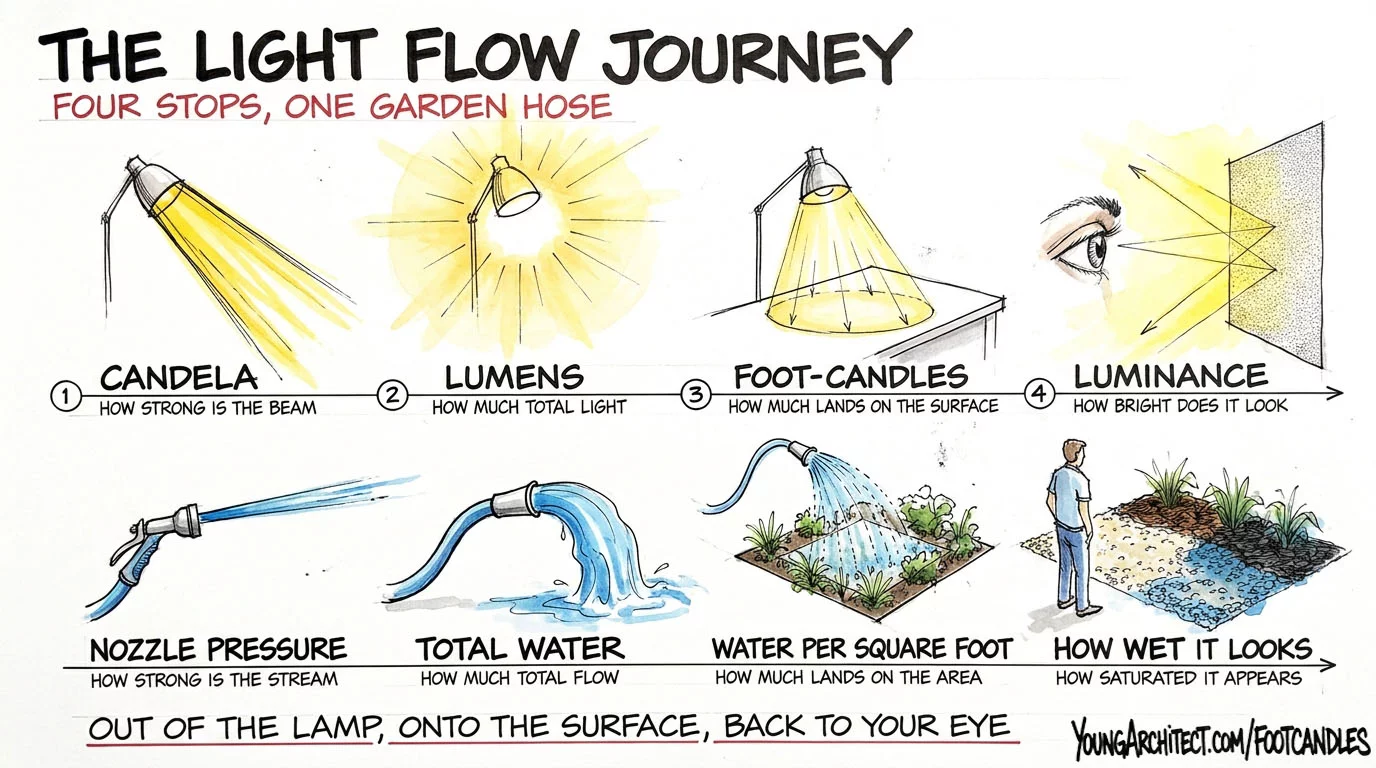
We are going to follow the water from the moment it leaves the hose all the way to the point where you are standing in the garden looking at how wet everything is. Four stops along the way, and each stop has a different name.
Stop 1: How strong is the water coming out of the nozzle in one specific direction? That is candela.
Stop 2: How much total water is flowing out of the hose in every direction? That is lumens.
Stop 3: How much water is actually landing on each square foot of your garden? That is foot candles.
Stop 4: How wet does the garden look to you standing there? That depends on whether you planted white gravel or dark mulch. That is luminance.
Four stops. Four measurements. One hose.
Candela and Luminous Intensity
First stop on the garden hose. We are at the nozzle, looking at how hard the water is shooting in one specific direction.
In lighting, this is measured in candelas. Candela tells you how strong the light is in a particular direction. Not how much total light there is, just how intense the beam is pointing one way.
Think about the difference between a flashlight and a bare light bulb.
You could give them both the exact same amount of energy. But the flashlight concentrates all of its power into a tight beam aimed at the wall. The bare bulb scatters its light in every direction, so in any single direction it is actually pretty weak.
Same energy, completely different intensity in any one direction.
A spotlight and a table lamp can use the same wattage and feel completely different. The spotlight is aiming all its candelas at one spot. The table lamp is throwing them everywhere. One feels like a laser, the other feels like a glow.
You might see the word candlepower in older references. That is the old term. Candela is the modern SI unit. Same concept, updated name.
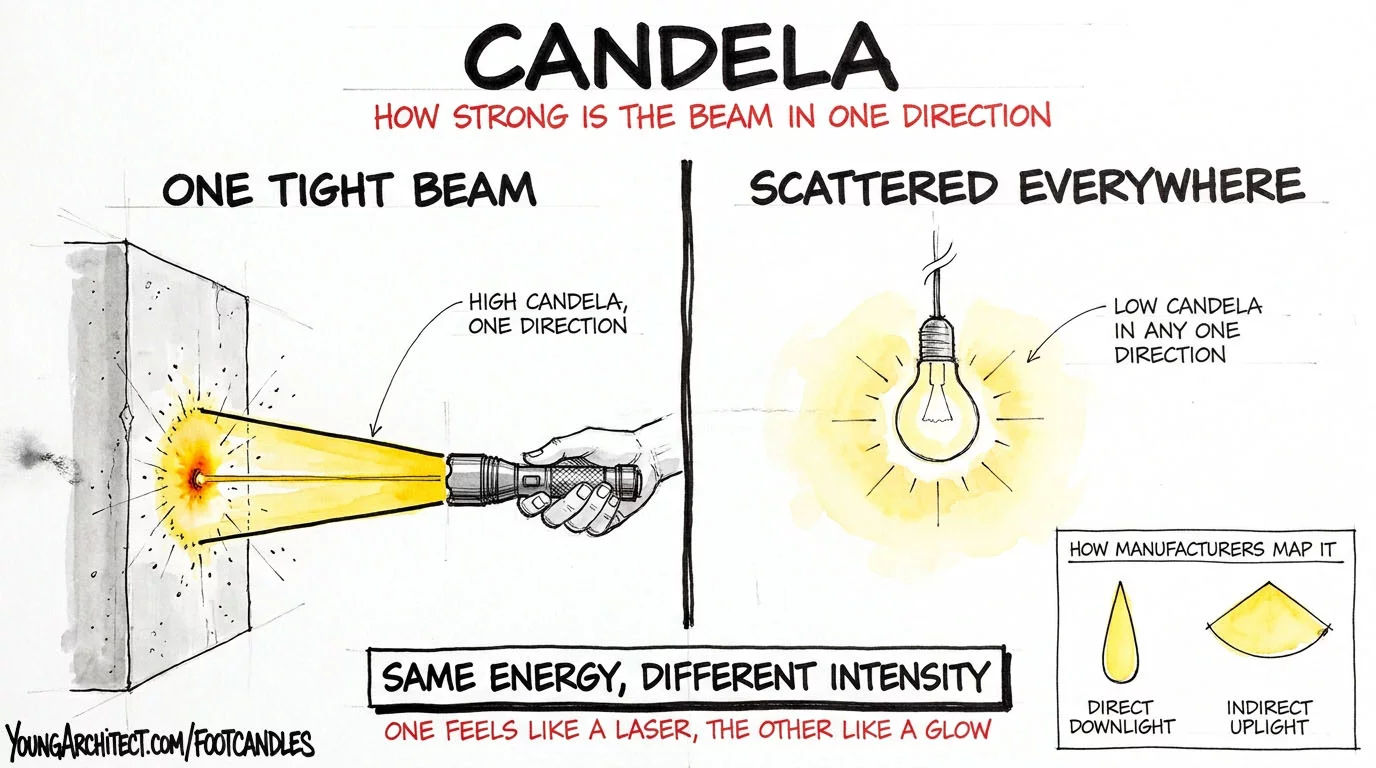
One quick practical note. Manufacturers map how a fixture distributes its candelas using something called a candela distribution curve. It is a polar graph, basically a shape radiating out from the center of the fixture.
If that shape looks like a narrow teardrop hanging straight down, it is a direct downlight. If it looks like an umbrella opening upward, it is an indirect uplight that bounces light off the ceiling.
The shape tells you where the light goes.
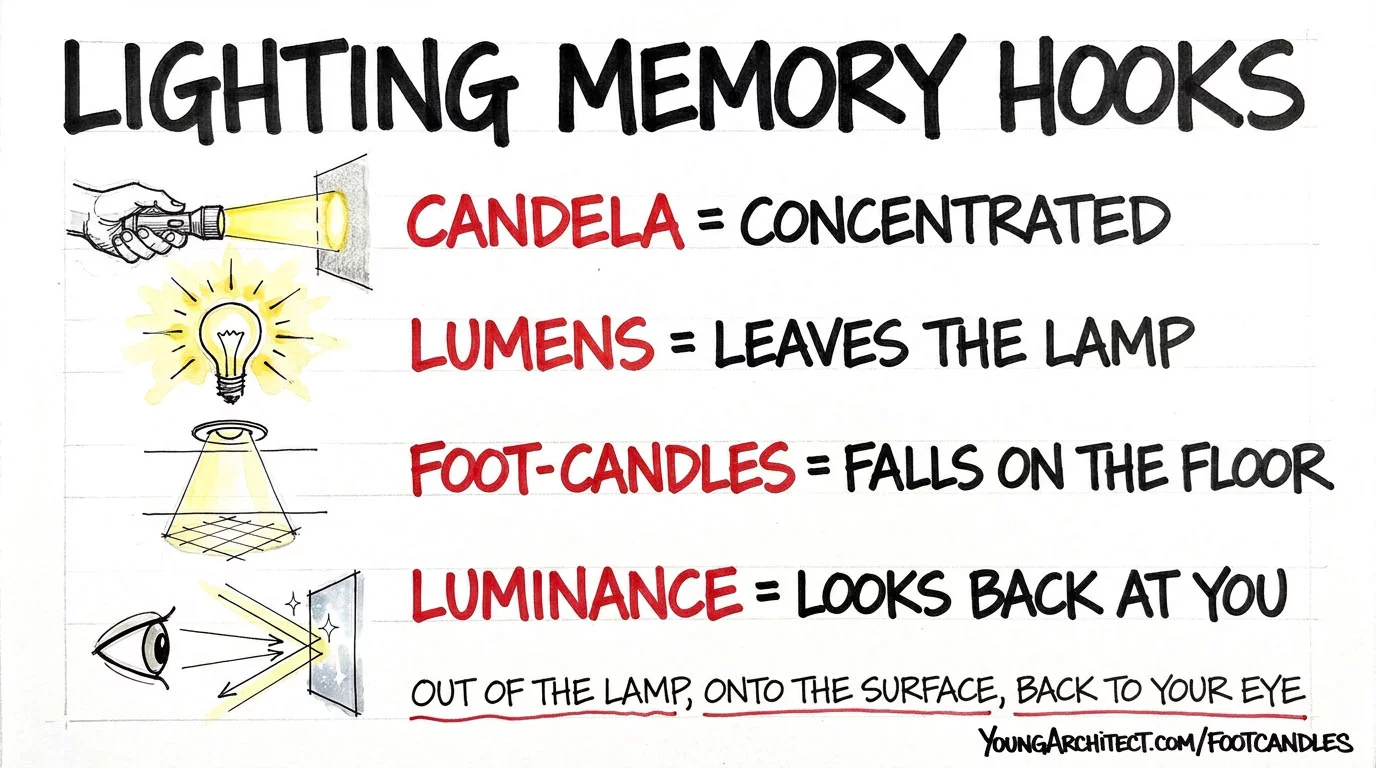
Memory hook: Candela = Concentrated. How strong is the beam in one direction?
Lumens and Luminous Flux
Second stop on the garden hose.
We have been looking at how hard the water shoots in one direction. Now zoom out and look at the total water flowing out of the hose in all directions combined. Not where it is going, just how much there is.
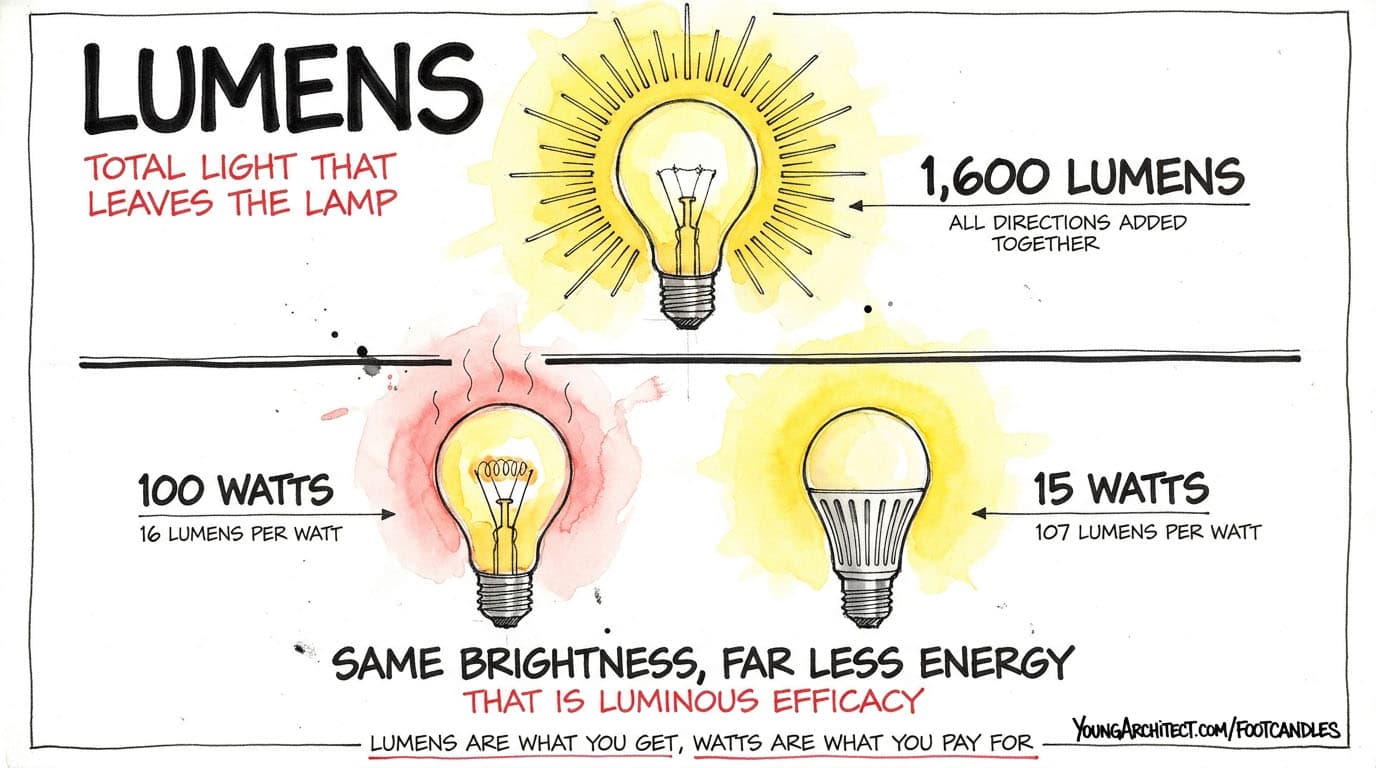
In lighting, this is lumens. Lumens measure the total light output from a source, also called luminous flux. Every direction added together.
If candela is the pressure at the nozzle aimed one way, lumens is the entire volume of water coming out of the hose regardless of where it is pointed.
When you walk into a store and pick up a light bulb, the lumens number on the box tells you how bright that bulb is. The watts number tells you how much energy it uses. Those are two completely different things.
Memory hook: Lumens = Leaves the lamp. Total output, all directions combined.
Lumens vs Watts
For decades, everyone shopped for light bulbs by wattage. You wanted a bright bulb, you bought a 100-watt. You wanted something softer, you grabbed a 60-watt.
That worked fine when every bulb was incandescent, because the relationship between watts and brightness was pretty consistent.
Then LED came along and changed everything.
A 15-watt LED can produce the same 1,600 lumens as a 100-watt incandescent. Same brightness, a fraction of the energy.
Suddenly watts became meaningless as a way to compare brightness, because two bulbs using the same wattage could produce wildly different amounts of light. DOE’s guide on high-efficiency lighting covers this shift in detail, including how LED technology achieves dramatically higher output per watt.
The ratio of lumens to watts is called luminous efficacy. And make a note of that word. Efficacy, not efficiency.
Efficiency is a unitless percentage: energy in versus energy out. Efficacy is a ratio of two different units: lumens of visible light out per watt of electrical power in.
It is a small distinction, but it is the precise term the industry uses. For more on how LED efficacy compares across different lighting technologies, DOE’s LED Basics resource breaks down the numbers.
Lumens tell you what you are getting. Watts tell you what you are paying for it.
What Are Foot Candles
Third stop on the garden hose. This is the big one. Foot candles are the measurement you will encounter most when studying lighting.
So far we have been at the source. Candelas told us how strong the beam is in one direction. Lumens told us how much total light the source produces.
Now we are leaving the source behind and going to the other end of the room. The desk. The floor. The surface where someone is actually trying to see something.
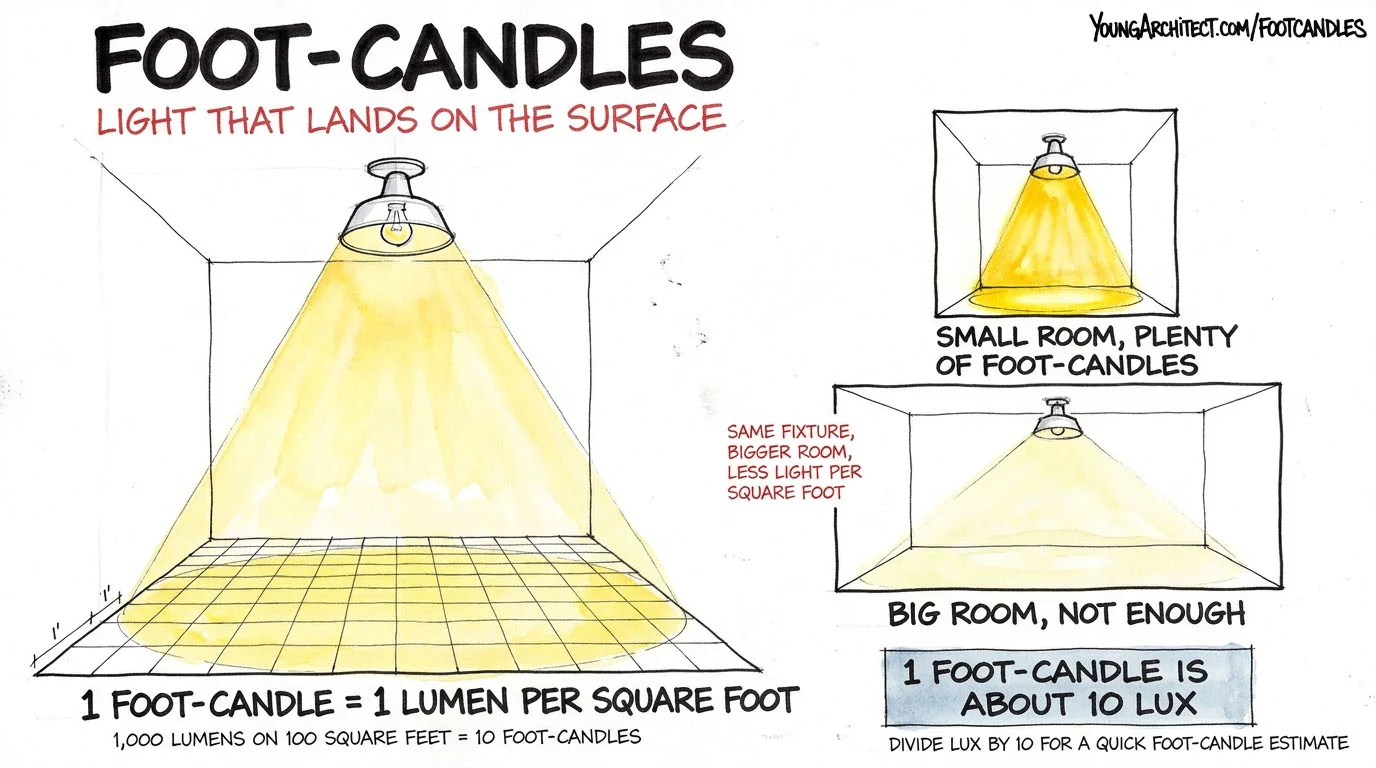
Foot candles measure how much light actually arrives at a surface. Not what the lamp puts out, but what the desk, the floor, the task surface actually receives.
Back to the garden hose.
Lumens is the total water flowing out of the hose. Foot candles is how much of that water lands on each square foot of your garden.
Take the same hose and aim it at a small garden bed, and each square foot gets drenched. Aim it at a huge backyard, and each square foot barely gets a sprinkle. Same water, completely different result depending on how big the area is.
Light works the same way. Same fixture, small room, plenty of foot candles at the desk. Same fixture, giant conference room, not nearly enough.
The definition is simple.
One foot candle = one lumen per square foot.
If a fixture puts out 1,000 lumens and all of that light lands on a 100-square-foot surface, the math is straightforward. 1,000 divided by 100 gives you 10 foot candles.
In reality, it never works that cleanly because not all the light from a fixture makes it to the work surface. Some hits the ceiling, some gets absorbed by the walls, some gets lost to dirt on the fixture over time. But the core concept is just lumens divided by area.
This is what lighting standards are built on. When a specification says “this office needs 50 foot candles at desk height,” it is telling you how much light needs to arrive at the desk surface. The Lighting Design Lab’s footcandle guide is a widely referenced resource for IES recommended levels by space type.
Foot Candles to Lux Conversion
Lux is the metric version of foot candles. One lux equals one lumen per square meter instead of per square foot.
The exact conversion is 1 foot candle = 10.76 lux. For quick mental math, round it to 10.
Use 10 for quick estimates. Use 10.76 when precision matters.
If a value is given in lux, divide by 10 for a rough foot candle number. If it is given in foot candles and needs to be converted to lux, multiply by 10. Same concept, different units, easy conversion.
Memory hook: Foot candles = Falls on the floor. Light arriving at the surface.
This is the foundation we build on inside our courses at Young Architect. If you want coaching and a structured study plan, the ARE Boot Camp gives you weekly accountability and a community.
If you prefer self-paced, the ARE 101 Membership gives you access to every course for one monthly price, including Building Systems 101 where we take these lighting concepts deeper.
Illuminance vs Luminance
Last stop on the garden hose. This one feels different from the first three, because up to now we have been following the light in one direction: from the source, through the room, onto the surface.
Now we turn around and look the other way.
Luminance is about what comes back. It is what your eye actually sees when it looks at a surface.
The technical units are candelas per square meter (cd/m²), also called nits. In imperial units, it is foot-lamberts.
If those terms look unfamiliar, here is how to keep them straight:
- Light arriving at a surface (illuminance): foot candles (imperial) or lux (metric)
- Light leaving a surface (luminance): foot-lamberts (imperial) or nits / cd/m² (metric)
Same pattern. Two pairs. Imperial and metric for each direction of travel.
Back to the garden hose one last time.
You have watered two garden beds with the exact same amount of water. One bed has white gravel. The other has dark mulch.
Same water, same soaking. But the white gravel looks way wetter because it reflects the moisture back at you. The dark mulch absorbed everything and looks practically dry.
Same input, different appearance, all because of what the surface does with the light it receives.
A white wall and a dark charcoal wall can receive the exact same 50 foot candles of light. But the white wall appears much brighter because it reflects most of that light back toward your eye. The dark wall absorbs most of it and looks dim.
The foot candles are identical. The luminance is completely different.
The concept underneath is this: the brightness you perceive from a surface comes down to how much light hits it multiplied by how reflective the surface is. A white wall that reflects 90% of the light bounces back most of what hits it and reads as very bright. A dark gray wall that reflects only 30% looks dramatically dimmer under the same lighting.
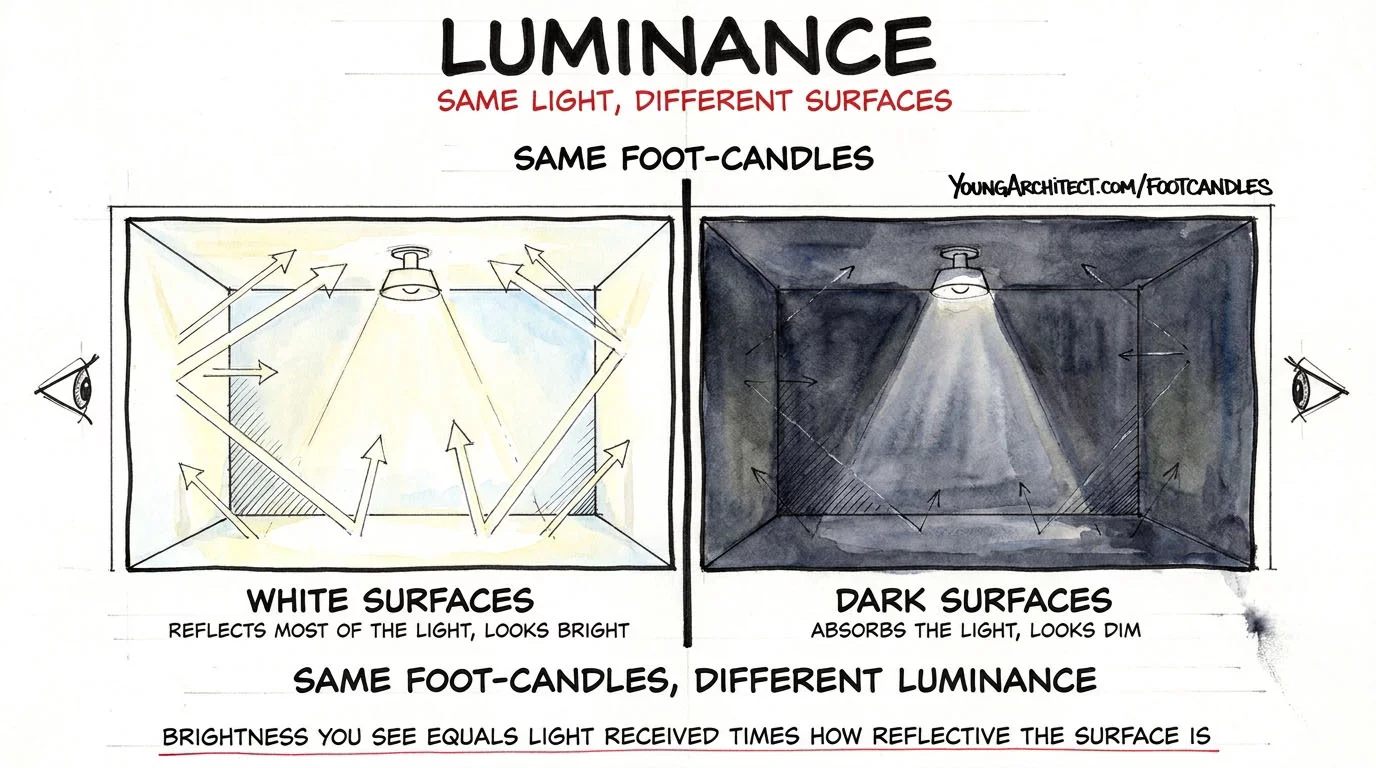
That is why a room with perfectly adequate foot candles can still feel dark if every surface is charcoal gray. And why a room with moderate lighting can feel almost blindingly bright if everything is glossy white tile and polished concrete.
The light level is the same. The surfaces are doing completely different things with it.
Direct and Reflected Glare
Why does luminance matter for design? Two words. Glare and comfort.
There are two types of glare.
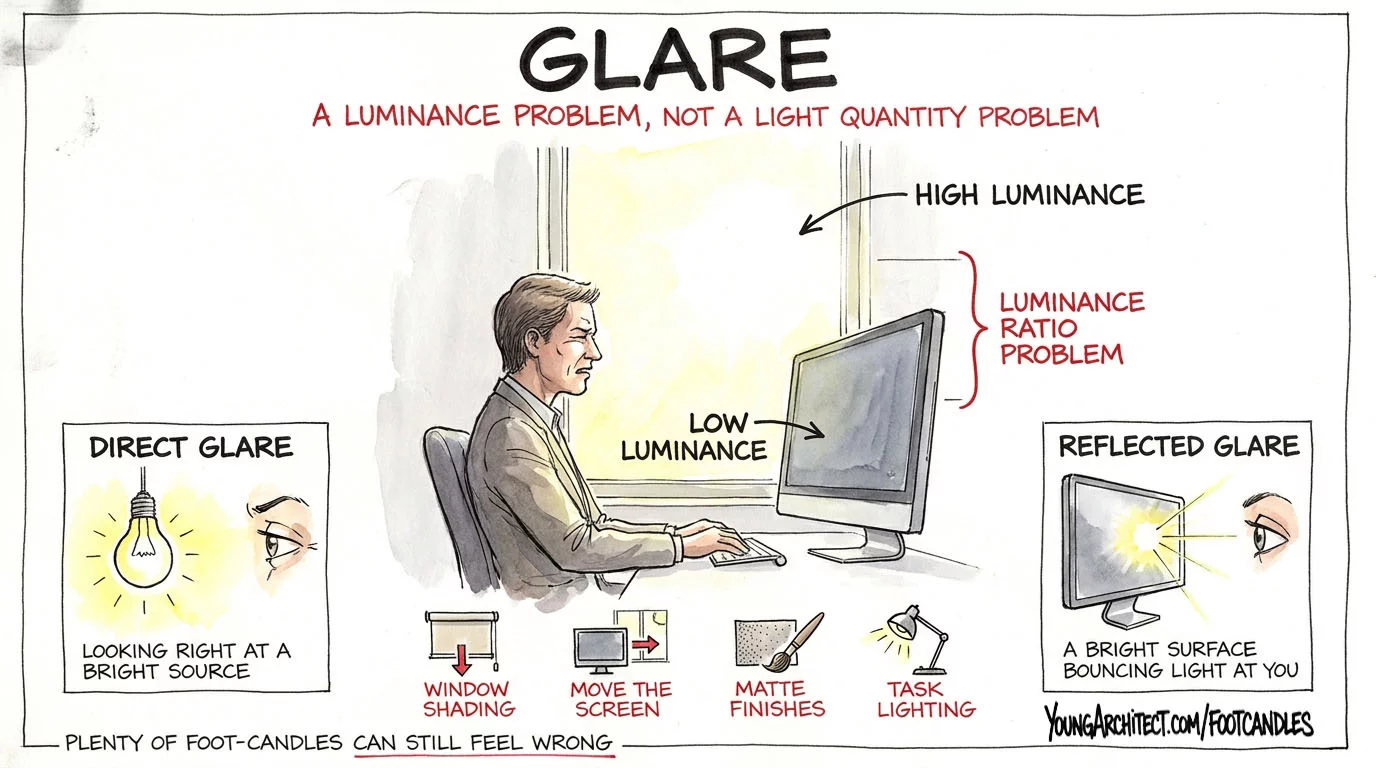
Direct glare is when you are looking at a bright source itself: a bare bulb with no shade, an unshielded window on a sunny day.
Reflected glare is when a bright surface bounces light into your eyes: overhead fluorescents reflecting off a glossy computer monitor, a polished conference table throwing light straight into your face.
Both are luminance problems.
Here is the classic scenario that ties it all together.
Imagine an office with a big window behind someone’s computer screen. The window has very high luminance because the sky is bright. The computer screen has much lower luminance.
Your eyes are constantly trying to adjust between the two extremes. It is uncomfortable, it causes eye strain, and it makes the screen harder to read even though the room has plenty of foot candles.
That is a luminance ratio problem. And it is a design problem the architect can solve.
The solutions are architectural: window shading, screen placement, matte surface finishes, or task lighting that brings the screen brightness closer to the surrounding surfaces. The architect controls luminance through material and finish selection, and that connects directly to evaluating environmental quality in a space.
Memory hook: Luminance = Looks back at you. Brightness as your eye perceives it.
From Lumens to Luminance: The Complete Chain
Four stops, four measurements, one chain.
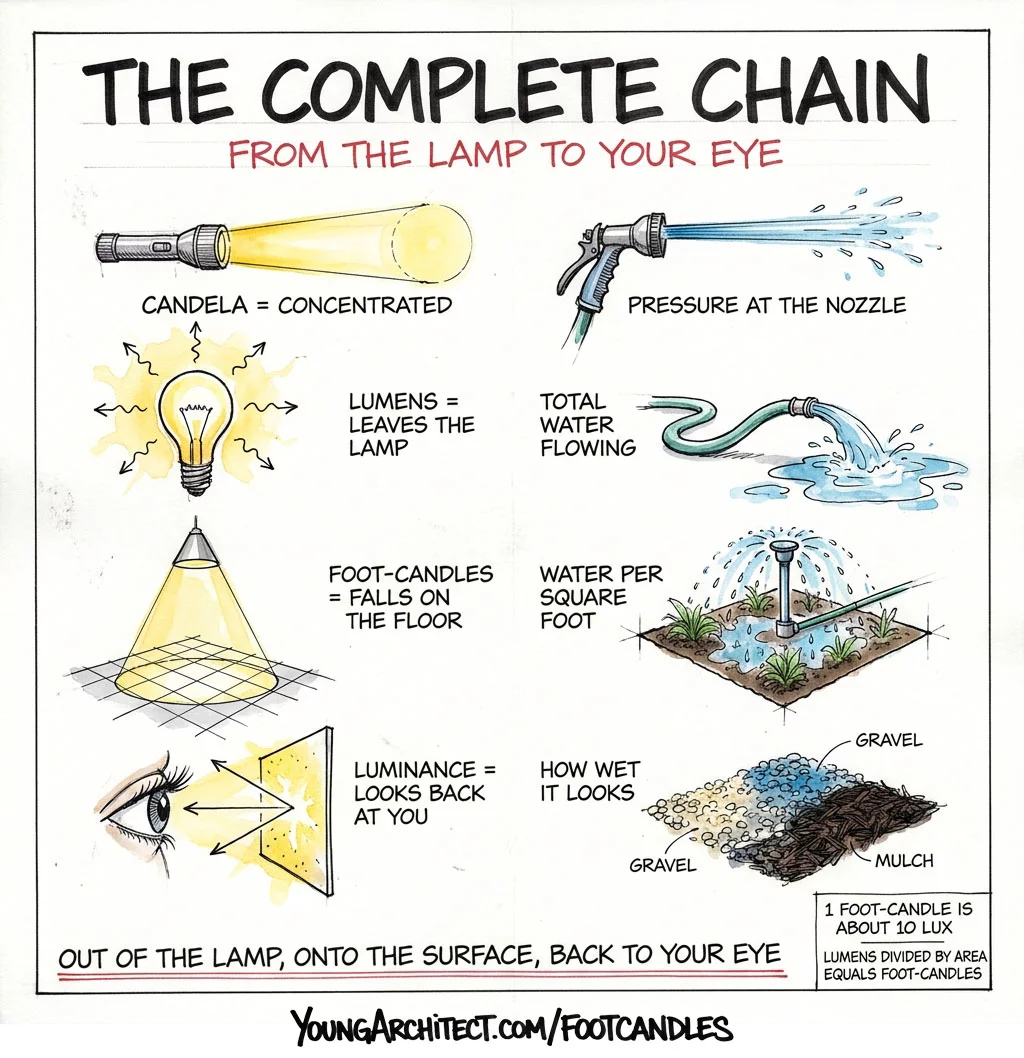
It starts at the source. The lamp produces light with a certain intensity in each direction. That is candelas. The concentrated beam.
Add up all those candelas in every direction and you get the total light output. That is lumens. What leaves the lamp.
Those lumens travel through the room and land on surfaces. The amount of light that arrives on each square foot of surface is measured in foot candles. Or if you are using metric, lux. What falls on the floor.
And then the surface takes that light and reflects some of it back toward your eye. How bright the surface appears to you depends on both the foot candles it received and how reflective it is. That perceived brightness is luminance. What looks back at you.
Out of the lamp, onto the surface, back to your eye.
The garden hose, one last time. Candela is the water pressure at the nozzle aimed in one direction. Lumens is the total water flowing out of the hose. Foot candles is how much water lands on each square foot of garden. And luminance is how wet the garden looks to you standing there, which depends on whether you planted white gravel or dark mulch.
Quick conversions:
- 1 foot candle ≈ 10 lux
- Lumens ÷ area = foot candles
- Brightness you see = foot candles x surface reflectance (a white wall reflects about 90%, a dark wall about 30%)
Lock these in. Four measurements, four memory hooks.
- Candela = Concentrated. The strength of the beam in one direction.
- Lumens = Leaves the lamp. Total light output in all directions.
- Foot candles = Falls on the floor. How much light arrives at the surface.
- Luminance = Looks back at you. How bright the surface appears to your eye.
The chain: out of the lamp, onto the surface, back to your eye.
How Lighting Terms Show Up on the ARE
NCARB’s published objectives for PPD and PDD reference environmental quality and building systems performance. Here are the key distinctions worth locking in.
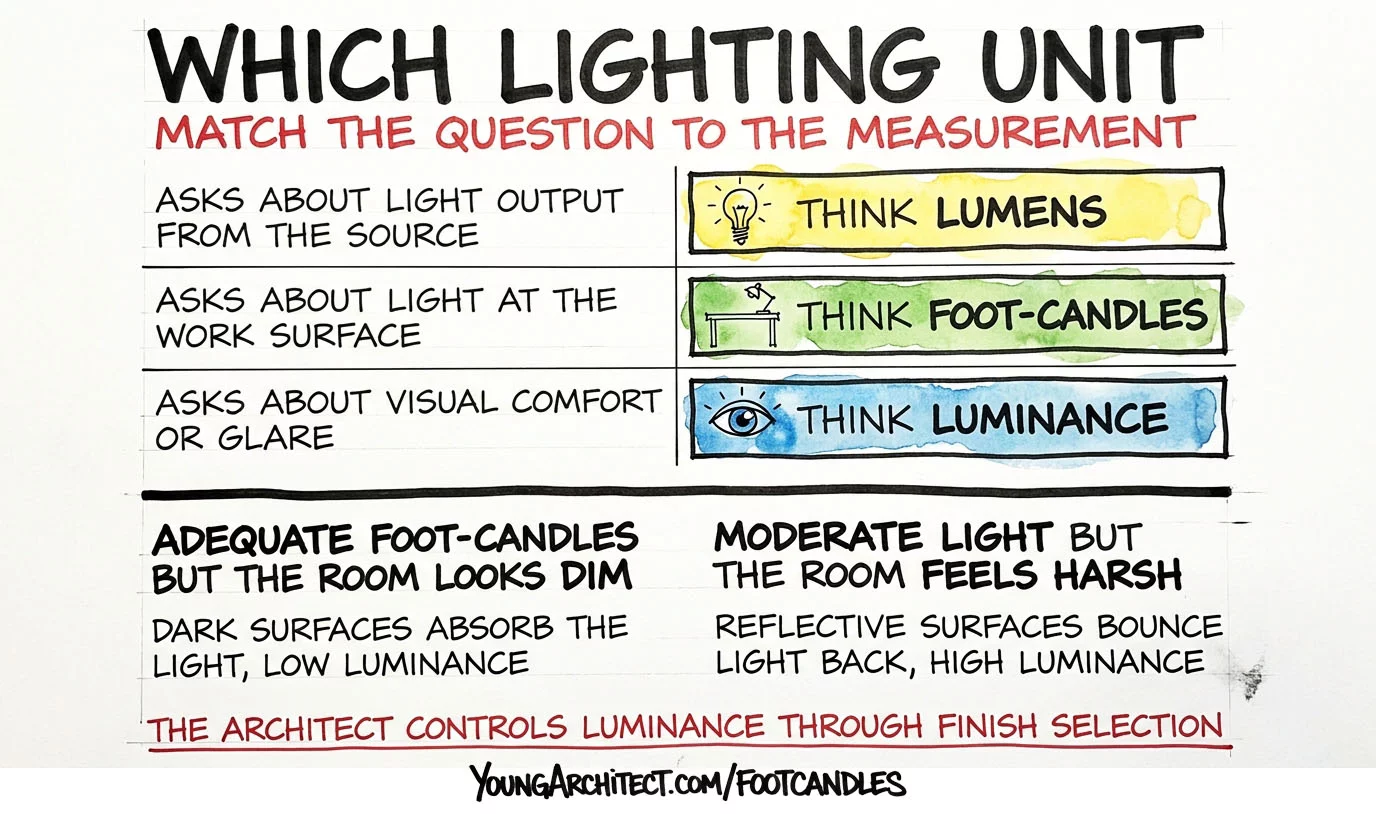
If a situation involves light output, you are in lumens territory. What is leaving the source.
If it involves light arriving at a work surface, that is foot candles or lux. What is landing on the desk.
If it involves visual comfort, glare, or why a space feels uncomfortable even though there is plenty of light, that is luminance. What is bouncing back at the eye.
If you need to evaluate glare, the answer lives in luminance, not illuminance. Glare is a brightness perception problem, not a light quantity problem.
A room can have perfectly appropriate foot candle levels and still have a terrible glare problem because of reflective surfaces or uncontrolled bright windows. The foot candles might be fine. The luminance ratios are what is causing the discomfort.
One more distinction. If a room has adequate foot candles but still appears dim, think about the surfaces. Dark finishes absorb light instead of reflecting it. The light is there. The surfaces are eating it. Same foot candles, low luminance, room appears dark.
And the flip side: if every surface is white with polished floors, the luminance goes way up. Even moderate foot candles can feel harsh in a space that reflects almost everything back at you.
The architect controls this through finish selection.
Everything we covered in this post is the foundation that every other lighting topic builds on. If you want to go deeper, this is exactly what we break down inside Building Systems 101 at the Young Architect Academy.
The ARE Boot Camp is a coaching program that gives you a structured study plan, weekly accountability, and a community of candidates working through the exams alongside you. It is more than study materials. It is the structure that keeps you actually studying.
If you prefer to go self-paced, the ARE 101 Membership gives you access to every course we offer for one low monthly price, cancel anytime. For this topic specifically, Building Systems 101 covers lighting, HVAC, and building systems performance, PPD 101 covers environmental systems and design integration, and PDD 101 covers building systems detailing.
Now go pass this exam.
Frequently Asked Questions
How many foot candles does an office need?
A general office typically needs 30 to 50 foot candles at desk height. Detailed task work like drafting or detailed inspection may require 75 to 100 foot candles. These recommended levels come from IES (Illuminating Engineering Society) standards and are based on how much visual detail the tasks in the space demand. Higher visual accuracy needs more light at the surface.
What is the difference between lumens and foot candles?
Lumens measure the total light output from a source in all directions combined. Foot candles measure how much of that light actually arrives at a surface. One foot candle equals one lumen per square foot. A fixture’s lumen rating tells you what it produces. Foot candles tell you what the surface receives. The distinction matters because the same fixture produces very different foot candle levels depending on room size and layout.
How do you convert foot candles to lux?
Multiply foot candles by 10 for a quick estimate, or by 10.76 for an exact conversion. To convert lux to foot candles, divide by 10 (or 10.76 for precision). Both units measure illuminance: foot candles use square feet, lux uses square meters. The quick “multiply or divide by 10” method is accurate enough for most practical situations.
What is the difference between illuminance and luminance?
Illuminance measures how much light arrives at a surface, measured in foot candles or lux. Luminance measures how bright that surface appears to your eye, which depends on both the illuminance and how reflective the surface is. A white wall and a dark wall receiving the same 50 foot candles will have very different luminance because the white wall reflects most of the light back while the dark wall absorbs it.
What is luminous efficacy?
Luminous efficacy is the ratio of light output (lumens) to energy input (watts), measured in lumens per watt. It tells you how efficiently a light source converts electricity into visible light. A 100-watt incandescent bulb produces about 16 lumens per watt. A 15-watt LED produces about 107 lumens per watt. Same brightness, dramatically different efficacy, which is why the industry shifted from watts to lumens as the way to compare bulbs.