



















ARE 5.0 Project Planning and Design Exam Prep

Master Project Planning and Design and Pass the PPD Exam

We break down one of the most technical ARE exams into clear, manageable concepts so you can walk into the PPD exam fully prepared and confident.

*Pictures of our actual students

Our Students Are Now Registered Architects at These Firms:

Pass the PPD Exam With a Complete Understanding of Design Integration

PPD is one of the hardest ARE exams because it covers everything — site analysis, building systems, structural concepts, codes, and sustainability — all at once.

Our proven approach teaches you how these systems connect, so you’re not just memorizing facts. You’re learning to think like an architect making real design decisions.

Picture yourself walking into the PPD exam knowing exactly how to approach every question.

That’s exactly what happens.

PPD Topics You'll Master:

Site analysis and design including solar path, wind, topography, and climate considerations

Sustainable design principles and how to apply them to building orientation, envelope, and systems selection

Building codes applied to design including occupancy, egress, fire separation, and accessibility

Selecting mechanical, electrical, and plumbing systems based on function, cost, and programmatic needs

Structural system selection and its impact on building configuration and layout

Integrating all building systems spatially and functionally into the architectural design

Project costs and budgeting including evaluating design alternatives and preliminary cost estimates

Your Complete PPD Exam Toolkit

Everything you need to master Project Planning and Design and pass the PPD exam.

Expert-Led Video Instruction

18+ hours of clear, focused video lessons taught by Layla Qarout. Every topic is covered the way NCARB tests it.

Strategic Practice Questions

500+ practice questions designed to test your understanding of PPD concepts, not just your ability to memorize facts.

Flashcards

375+ flashcards to reinforce key PPD terms, systems, and design concepts so they stick when it counts.

NCARB Objective Coverage

Every lesson is aligned to NCARB's official PPD exam objectives so you know exactly what's covered and nothing gets missed.

Building Systems Deep Dive

PPD is heavy on systems integration. We cover MEP, structural, envelope, and specialty systems the way the exam actually tests them.

Full ARE 101 Membership Access

PPD 101 is included in the ARE 101 Membership. You also get access to every other ARE course, Building Codes 101, and Mechanical Systems 101.
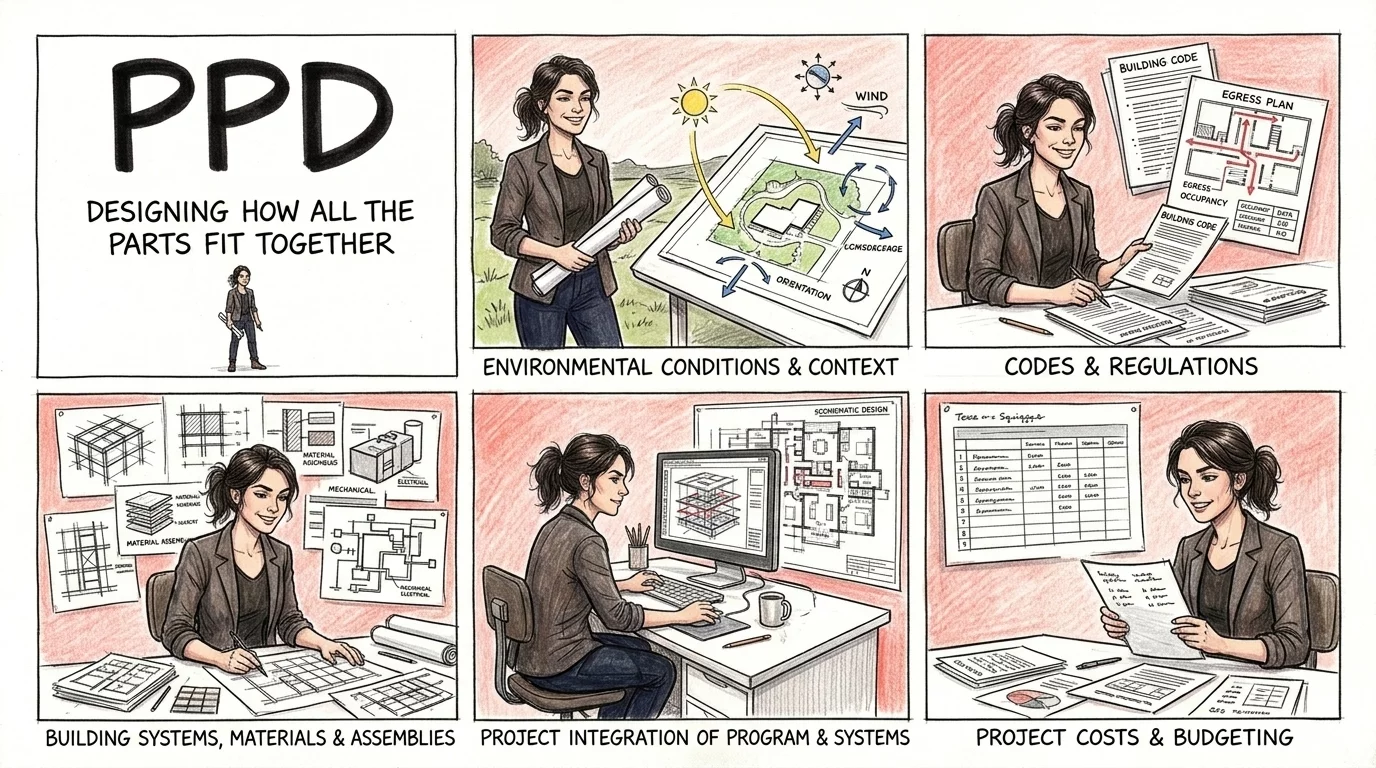

PPD exam sections: environmental context, codes, building systems, project integration, and costs

What Our Customers Our Saying About PPD 101

PPD 101 Is Just the Beginning

Get PPD 101 Plus Every ARE Course You Need

 When you join the ARE 101 Membership, you don’t just get PPD 101. You get access to our complete ARE exam prep library — every division, every course, all in one place.

ARE Practice Management 101 (PcM)

ARE Project Management 101 (PjM)

ARE Construction & Evaluation 101 (CE)

ARE Programming & Analysis 101 (PA)

ARE Project Development & Documentation 101 (PDD)

ARE Project Planning & Design 101 (PPD)

Building Codes 101

Mechanical Systems 101

AIA Contracts 101

PPD overlaps heavily with both Building Codes 101 and Mechanical Systems 101. Both of those courses are included in the membership and are designed to reinforce exactly what the PPD exam tests. You’re not buying one course — you’re getting the full ecosystem.

ARE 101 Course Membership

Ideal for independent learners

$129/mo

Includes: 

7-day money-back guarantee badge for ARE 101 Membership Study materials

Try ARE 101 Risk-Free for 7 Days

We're confident you'll love our approach to PcM prep. If you're not completely satisfied within your first week, just contact our support team and we'll process your full refund. No questions asked.
ARE 101 Course Membership

Over 140 hours of video lessons, 2,000+ practice questions, and everything you need to pass all ARE exams.

Click any course below to see what's included

Meet Your PPD Instructor

Learn From Someone Who Knows This Exam


Layla Qarout, PhD, AIA, WELL AP, ARE instructor

Layla Qarouts
PhD, AIA, WELL AP, CTD

Layla is a licensed architect with deep expertise in building systems, codes, and the technical content that defines the PPD exam. She teaches the way the exam actually tests — focused on understanding and application, not shortcuts or memorization tricks. Layla's lessons are clear, direct, and built around what you actually need to know to pass.

Your PPD Success Starts Here

Join thousands of ARE candidates who’ve used this comprehensive approach
to pass the ARE.

Frequently Asked Questions About PPD 101 and the PPD Exam

Get answers to common questions about the Project Planning and Design course.

FAQ:

The PPD exam is one of six divisions of the ARE 5.0, NCARB’s Architect Registration Exam. It tests your ability to make design decisions across site analysis, building systems, structural concepts, building codes, and environmental systems. PPD covers the design phase of a project — from schematic design through design development — and is widely considered one of the hardest ARE exams because of how much content it covers.

The PPD exam is 5 hours long with 120 questions. It includes both standalone multiple-choice questions and case study sections where you apply your knowledge to a project scenario.

Most candidates study 100 to 200 hours for the PPD exam depending on their professional experience. PPD covers the widest range of technical content on the ARE, so give yourself enough time to work through site analysis, structural systems, MEP systems, building codes, and envelope design. Don’t rush this one.

PPD is generally considered harder than PDD because it covers a much wider range of topics. PPD tests design-level decision making across every building system, while PDD focuses more on construction documentation and specifications. Many candidates save PPD for last because of its breadth. (See also: how PA, PPD, and PDD connect)

Start with NCARB’s published PPD exam objectives. Key study areas include site analysis and design, structural system selection, building envelope performance, HVAC and mechanical systems, plumbing and electrical systems, fire protection, building codes at the design level, and preliminary cost estimating. Focus on understanding how these systems interact — the PPD exam tests design decision-making, not just memorization. The ARE 101 Membership covers all of it.

PPD (Project Planning and Design) focuses on the design phase — selecting systems, making site decisions, and integrating code requirements into a design. PDD (Project Development and Documentation) picks up where PPD leaves off and focuses on documenting that design through construction drawings and specifications. They overlap significantly, especially in building systems and codes.

Yes. Building codes are a major part of the PPD exam, and PPD 101 covers code application at the design level — occupancy classifications, egress requirements, fire separation, accessibility, and energy codes. For even deeper coverage, Building Codes 101 is included in the ARE 101 Membership and was specifically built to support PPD, PA, and PDD candidates.

Not required, but highly recommended. PPD is heavy on mechanical, electrical, and plumbing systems, and Mechanical Systems 101 goes deeper on MEP content than PPD 101 alone. Both courses are included in the ARE 101 Membership, so you have access to both from day one.

NCARB doesn’t require a specific order, but many candidates find it helpful to take PA before PPD since PA covers programming and site analysis that feeds directly into PPD content. PDD often comes after PPD because the two exams are closely related. Ultimately, the best order depends on your professional experience and where you feel most confident starting.

Most ARE prep focuses on memorization and passing. We focus on understanding — because that’s how the exam actually works. PPD tests your ability to apply knowledge to realistic design scenarios, not just recall facts. PPD 101 is built around NCARB’s official objectives, taught by a licensed architect, and designed to prepare you for both the exam and real professional practice.

Your PPD Success Starts Here

Join thousands of ARE candidates who’ve used this comprehensive approach to pass the ARE.

PcM 101

The business side of architecture nobody taught you in school, broken down objective by objective.

What’s inside:

  • 17+ hours of video, organized by NCARB objective
  • 490+ practice questions sorted into beginner, intermediate, and hard
  • 60 financial calculation questions plus 6 deep dive videos on the math
  • 15 case studies built like the real ones, with reference documents
  • The AHPP reading chart plus companions that show you how to get the most out of each reading
  • 200+ flashcards
  • AIA Contracts 101, covering the contracts PcM actually tests

PjM 101

Everything that happens after the client signs, broken down objective by objective. PcM is how you run the business. PjM is how you run the project.

What’s inside:

  • 16+ hours of video, organized by NCARB objective
  • 300+ practice questions sorted into beginner, intermediate, and hard
  • 15 case studies built like the real ones, with reference documents
  • The AHPP reading chart plus companions that show you how to get the most out of each reading
  • AIA Contracts 101, covering the contracts PjM leans on hardest

CE 101

What the architect actually does once construction starts, broken down objective by objective. Submittals, site visits, change orders, payment, and closeout, all governed by A201.

What’s inside:

  • 15+ hours of video, organized by NCARB objective
  • 200+ practice questions sorted into beginner, intermediate, and hard
  • 15 case studies built like the real ones, with reference documents
  • The AHPP reading chart plus companions that show you how to get the most out of each reading
  • AIA Contracts 101, where A201 gets taught article by article

PA 101

Before anybody designs anything, somebody has to figure out what the problem actually is. PA is site analysis, codes and zoning, and building the program, broken down objective by objective.

What’s inside:

  • 14+ hours of video, organized by NCARB objective
  • 240+ practice questions sorted into beginner, intermediate, and hard
  • 2 case studies built like the real ones, with reference exhibits you have to read
  • 260+ flashcards
  • Building Codes 101, where the code and zoning material gets taught from the ground up

PPD 101

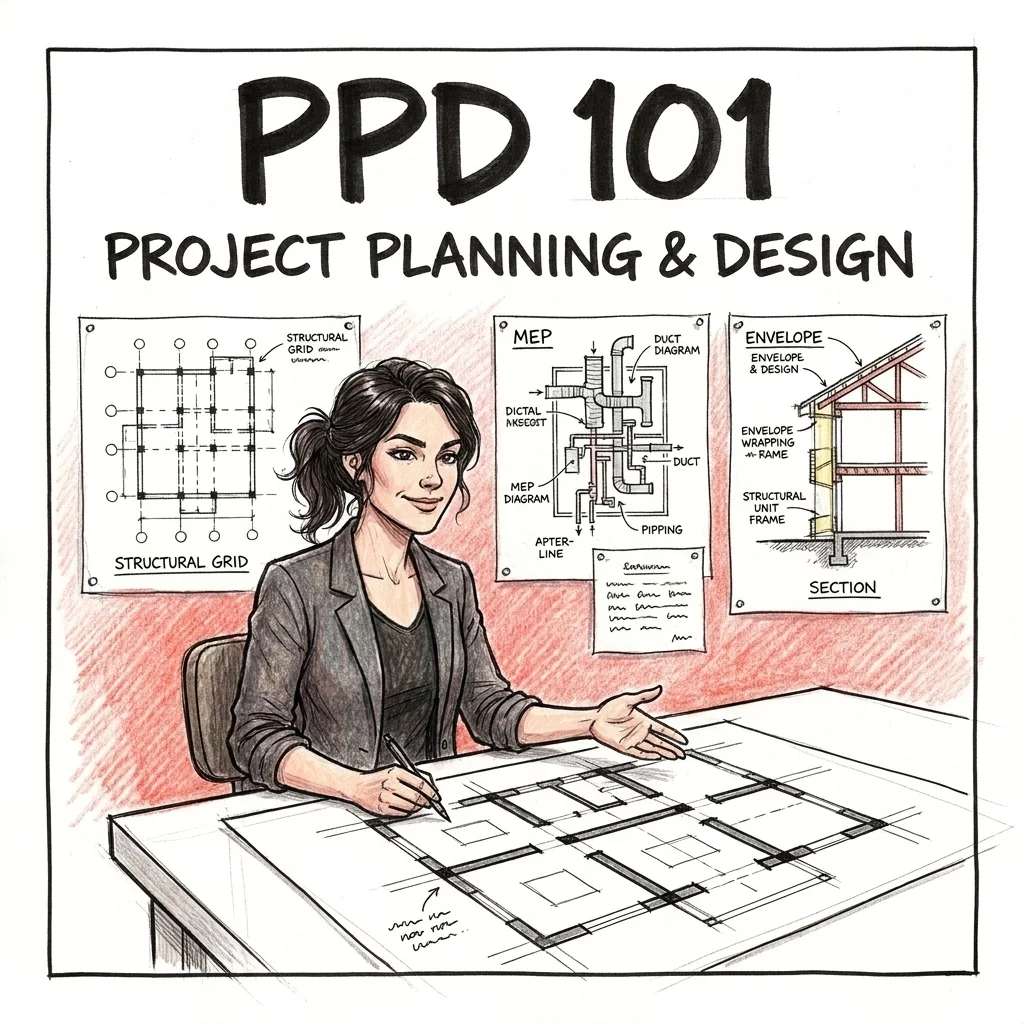
The program is set. PPD is where you actually design the building: the structure, the envelope, the systems, and making all three agree.

What’s inside:

  • 18+ hours of video, organized by NCARB objective
  • 500+ practice questions sorted into beginner, intermediate, and hard
  • 375+ flashcards
  • Building Systems 101, covering the systems PPD asks you to select and size
  • Building Codes 101, covering the code questions that run through the whole division

PDD 101

The design is settled. PDD is about turning it into drawings, details, and specifications somebody can actually build from.

What’s inside:

  • 16+ hours of video across 17 objectives
  • 500 practice questions sorted into beginner, intermediate, and hard
  • 250+ flashcards organized by section and level
  • Building Systems 101, covering the systems PDD asks you to detail and coordinate
  • Building Codes 101, covering the code questions that run through the whole division

Mechanical 101

Plumbing, lighting, fire protection, electrical, conveying, acoustics, sustainability, and mechanical. You don’t need to be a master plumber, you need to be a master coordinator.

What’s inside:

  • 24+ hours of video across 8 system modules
  • Plumbing, lighting, fire and life safety, electrical, conveying, acoustics, sustainability and energy, and mechanical systems
  • Every video flags which ARE objectives it connects to
  • Built to support PPD, PDD, and PA, where the systems questions actually show up

Codes 101

Occupancy, heights and areas, construction types, rated walls, egress, and fixture counts, taught from the ground up. Not a tour of the IBC, an actual working knowledge of it.

What’s inside:

  • 4.5+ hours across three live workshop sessions, with candidates working real problems out loud
  • Occupancy classification and why the stringency rankings are built the way they are
  • Building heights and areas, and how to read all three tables against a construction type
  • The five construction types and the five rated wall types, sorted by where each one stops
  • Means of egress, occupant load, and sizing stairs and doors
  • Plumbing fixture counts
  • 180+ practice questions sorted into beginner, intermediate, and hard
  • Flashcards covering code vocabulary across all three levels
  • Built to support PA, PPD, and PDD, where the code questions actually show up

AIA Contracts 101

The contracts define how a huge number of processes on a project actually work. Which means a lot of exam questions that don’t sound like contract questions are contract questions. That’s why we built an entire course to sit alongside PcM, PjM, and CE. Once you understand how the contracts work, everything else gets a lot easier. This is the most thorough resource anywhere for understanding AIA contracts for the architect exam.

What’s inside:

  • 15 hours of video, organized by contract document instead of by exam division
  • B101 and A201 in depth, article by article, the two documents everything else is built on
  • A101, C401, A701, A305, A133, the G-series forms, and the IPD family
  • Built to be watched with the contract open in front of you