
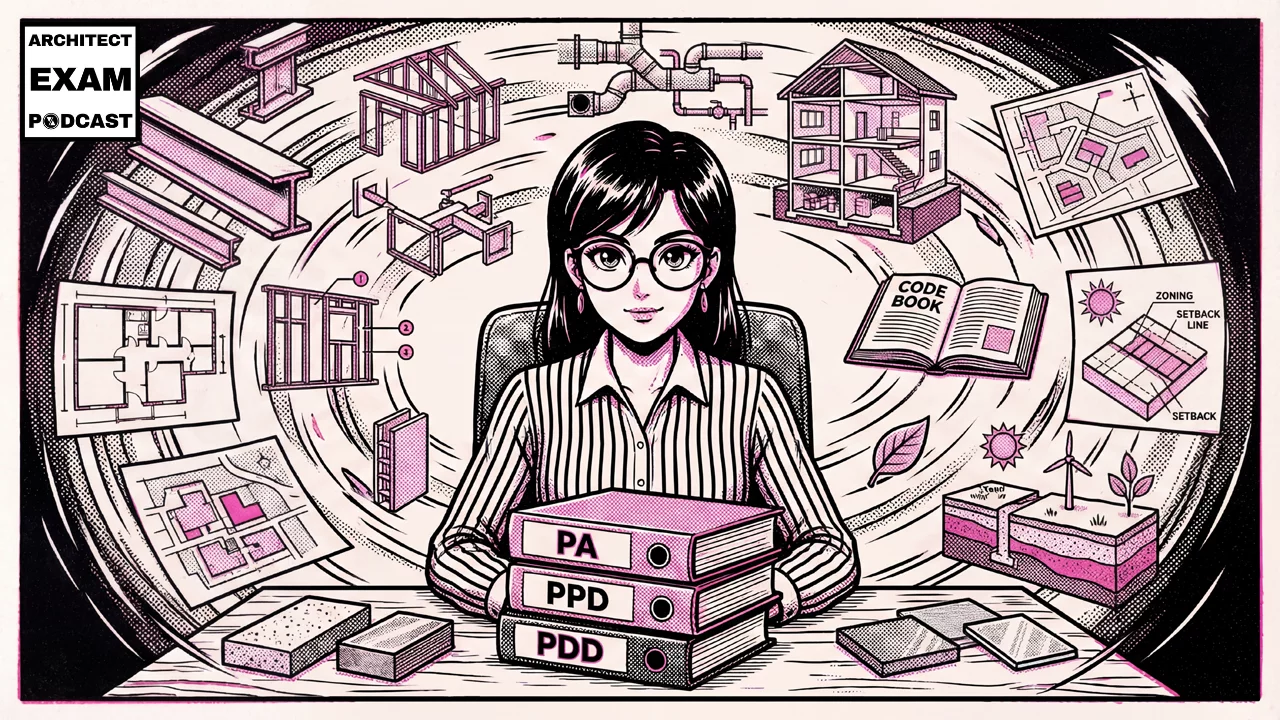
The ARE technical exams (PA, PPD, and PDD) test your ability to define, design, and document a building project. This guide breaks down what each exam actually covers, how they connect, and why understanding the difference between PA, PPD, and PDD before you start studying will save you serious time.
This podcast is also available on YouTube, Spotify, and Apple Podcasts
The Problem With How People Study for Technical Exams
A common issue we see at Young Architect Academy is students telling us that something in our content is “wrong,” only to discover that the conflict isn’t with us.
It’s between what another ARE prep company taught them and what NCARB actually says in their exam objectives.
This happens constantly with PA, PPD, and PDD.
Someone will insist that a certain topic belongs on PPD when NCARB’s objectives clearly place it on PDD.
Or they’ll think PA doesn’t cover something that it absolutely does.
Every time, we pull up the objectives, walk through them together, and the response is the same: “Oh. That makes so much more sense now.”
The root of the problem? Most candidates study what their prep company tells them rather than going directly to the source. And by the time that information gets filtered through someone else’s interpretation, things get mixed up.
If you’re not studying NCARB’s objectives, you’re not actually studying for the architect exam.
…instead you’re studying someone else’s version of what they think is on the ARE exams.
That applies to every ARE exam, but it’s especially true for the technical exams, because PA, PPD, and PDD share so many of the same topics. If you don’t understand how NCARB draws the lines between them, you’re going to study the wrong things for the wrong test.
So before you crack open a single flashcard, let’s make sure you understand what you’re walking into.
Building on the Pro Practice Foundation
If you’ve been following our recommended ARE exam order, you’ve already completed PcM, PjM, and CE. If you haven’t, go check out our breakdown of how the pro practice exams work together and start there.
The pro practice exams gave you the administrative and business foundation for how projects work. Contracts, team roles, communication, construction administration. That’s the framework everything else sits on.
The technical exams build directly on top of that. PA, PPD, and PDD are about the design and documentation side of the same process. You’re applying technical knowledge within the professional context you already learned.
But here’s the thing. When you move from pro practice to technical exams, you’re starting over in a lot of ways. The content is completely different. The study strategies are different. The way questions are structured is different.
Don’t assume that because you passed three exams, the next three will feel the same. They won’t.
Why These Exams Feel So Overwhelming
Here’s something most people don’t realize.
PPD and PDD are each like six exams disguised as one.
Both PPD and PDD are a structures exam.
A building systems exam.
A materials, methods, and assemblies exam.
A codes exam.
A site planning exam.
And they even throw in pro practice questions at times.
That’s not an exaggeration. Back in ARE 4.0, there were separate individual tests for most of those topics. When NCARB moved to ARE 5.0, they consolidated all of those subjects into just two exams.
That’s why these exams feel so massive in scope. You’re not studying for one subject. You’re studying for a whole collection of subjects that all have to come together.
And to make it even trickier, most of the topics are the same between PPD and PDD. It’s the same information. But each exam looks at it from a completely different perspective, with a different interest in why certain information matters.
Understanding that distinction is the key to everything.
The Framework: Define It. Design It. Document It.
In our pro practice post, we used a trick where you flip the exam names around to see what they’re really about. Same idea applies here.
Programming and Analysis? You’re analyzing a program.
Project Planning and Design? You’re planning and designing a project.
Project Development and Documentation? You’re developing and documenting a project.
These three exams follow the design process from start to finish. They move in order, just like a real project does.
Here’s the framework:
PA is “Define it.”
PPD is “Design it.”
PDD is “Document it.”
PA figures out what the project needs to be. PPD turns those requirements into a design. PDD takes that design and turns it into documents that someone can actually build from.
The difference between these exams isn’t what topics they cover. Site, codes, building systems, sustainability, and cost show up on all three. The difference is where you are in the project when you’re dealing with those topics.
Once this clicks, studying gets a lot clearer.
PA: Programming and Analysis
PA zooms all the way out and asks, “Before we design anything, what do we need to know?”
This exam is about the pre-design phase of a project. You’re gathering information, analyzing the site, understanding the codes, and building the program. You’re not making design decisions yet. You’re defining the problem so clearly that when you sit down to design, you actually know what you’re designing for.
The biggest themes are site evaluation, codes and regulations, and building programming.
On the site side, you’re figuring out what the site offers you and what it takes away. Natural features, constraints, environmental conditions, and anything that could limit where or how the building gets developed.
On codes, you’re identifying what applies to this project. Zoning, building codes, accessibility, local requirements. But here’s the key: on PA, you’re identifying these things. You’re not applying them to a design yet. That comes later on PPD.
Building programming is actually the biggest part of PA. This is where you’re analyzing spatial requirements, adjacencies, how spaces relate to each other, and whether the project is even feasible within the budget and schedule. You’re also reviewing and interpreting reports and documentation. Can you read all of this information and make sense of what it’s telling you?
PA is about asking questions, not answering them with design.
Quick example. An architect is evaluating a site’s soil conditions to determine if the project is feasible. That’s PA. If the architect is deciding where to put the building based on those soil conditions, that’s PPD. See the difference?
One more thing. PPD and PDD build directly off of what you learn studying for PA. The knowledge you gain from site analysis, codes, programming, and feasibility is the foundation that everything else relies on. If you try to jump into PPD or PDD without that groundwork, you’re going to feel lost. Not because those exams are impossible, but because you skipped the setup.
The PA exam on NCARB’s site breaks this into four sections. Read those objectives before you study anything else.
PPD: Project Planning and Design
If PA defines the problem, PPD creates the solution.
You’ve done your analysis. You know the site, the codes, the program, the budget, the schedule. Now you’re making design decisions.
PPD covers schematic design and early design development. You’re asking, “Given everything we know, what’s the best design solution?”
PPD focuses on three main areas: applying codes to the design, selecting building systems, and integrating everything into a building configuration.
On codes, the shift from PA to PPD is critical. PA identified which codes apply. PPD takes those codes and applies them to the design. You’re not just listing code requirements anymore. You’re figuring out how they shape the building. How does the occupancy classification affect the layout? How do means of egress requirements influence your floor plan?
On building systems, this is a huge part of PPD. You’re selecting the structural system, the MEP systems, the materials and assemblies. And you need to understand how each selection impacts the design and how they all work together.
Then there’s the integration piece, which is the heart of PPD. You need to pull everything together. Program, codes, systems, site, materials. And resolve the building configuration. How does a change in one system affect another system? That kind of ripple effect thinking is what PPD is all about.
Here’s where PA and PPD overlap and where people get confused. Both exams deal with site, codes, and program. But PA is analyzing and identifying. PPD is applying and deciding.
Quick example. PA identifies that the site is in a flood zone. PPD determines how to elevate the building and orient it to respond to that constraint.
The PPD exam on NCARB’s site lays out exactly what they expect you to know.
PDD: Project Development and Documentation
PA defines the problem. PPD creates the solution. PDD makes it real.
PDD covers design development and construction documents. You’re asking, “We know what we want to build. Now how does it actually go together, and how do we put it on paper so someone can build it?”
At this stage, you’re dealing with three main areas: resolving systems at the detail level, construction documentation, and specifications.
On systems, you’re no longer selecting them like you did on PPD. You’re resolving and detailing them. That means getting into the component level. Sizing things. Detailing connections. Figuring out what happens where systems intersect and resolving those conflicts.
Construction documentation is a massive part of PDD. How do you assemble a set of drawings? What’s the right documentation approach for the project? And what happens when things change midway through? Scope changes, value engineering, owner comments. How do those changes affect the documents?
Then there are specifications and the project manual. This is entirely PDD territory. Understanding how to write specs using CSI MasterFormat, what goes into a project manual, and how it all coordinates with the drawings.
Codes show up again on PDD, but at the detail level. PA identified which codes apply. PPD applied them to the design. PDD makes sure the details and documentation actually comply.
And PDD tests your understanding of construction cost estimates and how the documents you produce directly affect what things cost to build. If your details are unclear or your specs are sloppy, that shows up in change orders and cost overruns during construction.
Where PPD and PDD overlap is around systems, materials, and codes. But PPD is selecting and configuring. PDD is detailing, sizing, coordinating, and documenting.
Quick example. PPD selects a steel structural system. PDD details the connections, sizes the members, and coordinates where the ductwork runs between the beams.
The PDD exam on NCARB’s site is your starting point.
How PA, PPD, and PDD Flow Together
Let’s bring it all together with a single exterior wall assembly and walk through how each exam approaches it differently.
On PA, you’re analyzing the climate data and site conditions to figure out what kind of wall the project needs. What does this environment demand? What are the thermal requirements? What are the moisture concerns? What does the code say about fire resistance for this construction type? PA is asking you to define what the wall needs to do.
On PPD, you’re deciding. The wall is going to be a cavity wall with brick veneer. You’ve selected the system, you know how thick it is, you know how it works with the structure, and you understand how it responds to the site conditions you identified on PA. PPD is asking you to design the wall.
On PDD, you’re drawing the wall section detail. You’re specifying the brick ties, the flashing at the window head, the type of insulation, the vapor barrier. You’re figuring out exactly how this wall gets built. PDD is asking you to document the wall.
Same wall. Same project. Three completely different conversations.
When you understand that flow, it becomes easier to mentally organize where things belong when you’re studying. If a topic is about gathering information and analyzing feasibility, that’s PA. If it’s about making design decisions and selecting systems, that’s PPD. If it’s about detailing, sizing, and putting it on paper, that’s PDD.
Study Strategies for the Technical Exams
Study Hard for PA First, But Don’t Get Stuck There
PA is where you start with the technical exams, and a lot of people underestimate it. After passing three pro practice exams, you might feel like you’ve got momentum. But when you get to the technical exams, you’re starting over from scratch. It’s all new information, and the strategy is very different.
Study hard for PA. Really hard.But here’s the important part.
If you don’t pass PA on the first try, don’t keep retaking it.
Let it go. Move on to PPD and PDD.
There is a ton of overlap between PA and PPD especially, and you’d be surprised how much studying for PPD actually strengthens your PA knowledge. Make PA your last exam if you need to. Come back to it after you’ve passed PPD and PDD. It’ll make a lot more sense the second time around.
Get Your Reps In
The technical exams require a different kind of studying than the pro practice exams. You need to understand how things actually work. How mechanical systems move air through a building. How structural loads travel to the foundation. How building codes interact with each other.
You’re not going to understand that stuff the first time you read about it. It takes repetition. Seeing the same concept from different angles, from different materials, from different sources.
Think of it like lifting weights. If the goal is to lift 100 pounds, you start by learning to lift 25 pounds really well. You nail that down first. Then you add more. Everything is a stepping stone.
You might even have to take these exams multiple times. That’s okay. Each attempt is another rep.
Your Best Study Materials Aren’t ARE Study Materials
If you’re only using one prep company and nothing else, you’re not seeing these concepts from enough perspectives.
Some of the best ways to study for the technical exams? Read actual drawings and specifications. Open up Graphic Standards, or Heating Cooling Lighting, or The Architect’s Studio Companion. Watch YouTube videos about how building systems work. Open a set of specifications and read through them.
Find the gaps in your knowledge and go fill them with whatever resource makes it click. And when you understand the NCARB objectives, it empowers you to know exactly what you’re looking for.
Check out our guide on creating a realistic ARE study schedule if you need help building out your timeline.
Use the Wall Assembly Test
Take any building element (a roof, a foundation, a stairwell, whatever) and ask yourself three questions:
What does PA want me to know about this? (Define it.)
What does PPD want me to know about this? (Design it.)
What does PDD want me to know about this? (Document it.)
If you can answer all three clearly, you understand how these exams work. If you can’t, you know exactly where to focus your studying.
Your Homework Assignment
At the top of this blogpost download the free study notes and open book homework assignment.
Here’s what we want you to do.
Go to NCARB’s website, find the ARE 5.0 Guidelines, and print out the exam content for PA, PPD, and PDD. Just those three. Don’t print the whole thing. NCARB updates their policies regularly, but the exam content and objectives only change about every ten years. Those are the pages that matter.
Read through them, mark them up, and then answer the open book quiz in the study notes. It’s going to ask you to compare how topics like codes, building systems, site conditions, and cost show up differently across all three exams.
This is the kind of work that most people skip. And it’s exactly why most people feel confused about what they’re studying for. This is how you actually learn the difference.
Ready to Go Deeper?
Understanding PA, PPD, and PDD is the first step. Now it’s time to dig in.
If you’re looking for ARE study materials built around NCARB’s objectives, check out our courses at Young Architect Academy. We’ve got courses for all three technical exams, and because of the overlap we just talked about, everything is part of the ARE 101 membership. A course like Building Codes 101 was built to be used across PA, PPD, and PDD, because codes show up on all three exams at different levels. It doesn’t make sense to split that up.
And if you want structured coaching with accountability, weekly meetings, and support until you’re fully licensed, check out ARE Boot Camp.
Don’t forget, we have a companion post breaking down the pro practice exams. If you haven’t read PcM, PjM, and CE: Know the Difference Before You Study, make sure you check that out too.
Now go print those objectives and do the homework.
Let’s get you licensed.