
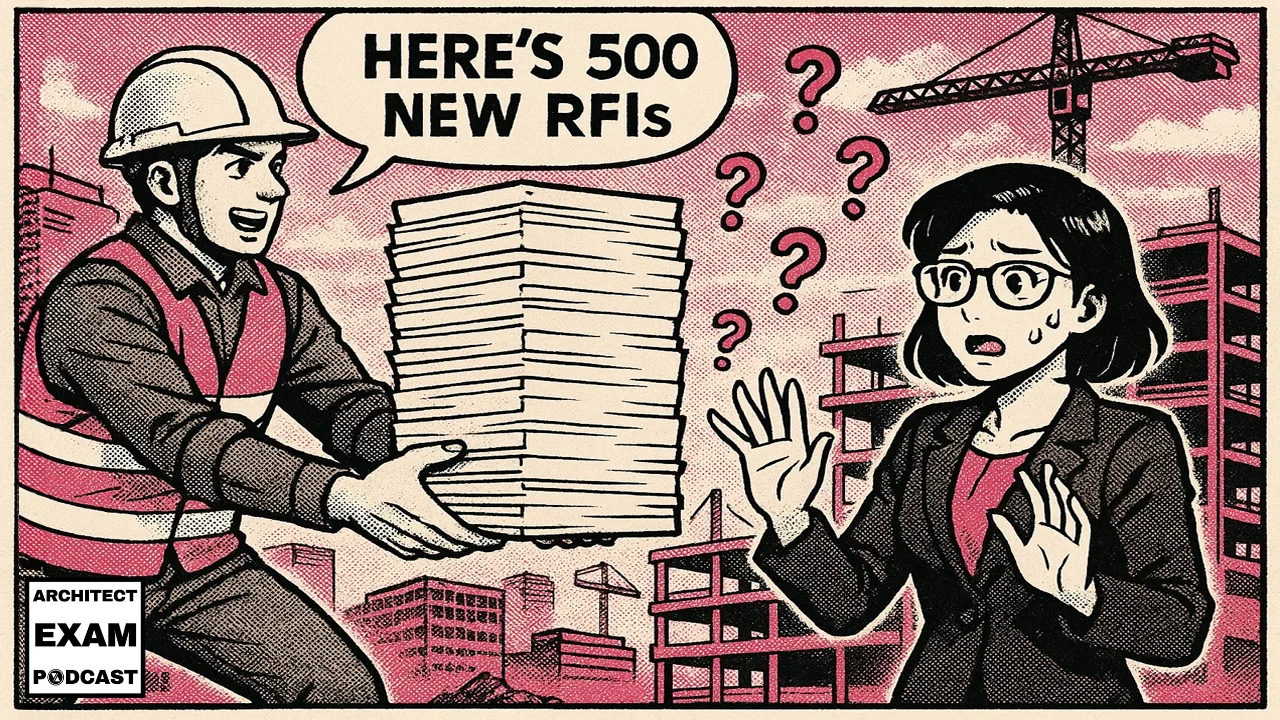

The RFI meaning in construction is straightforward: it stands for Request for Information. An RFI in construction is a formal document used during the building process to clarify unclear, missing, or conflicting information in the contract documents. This guide breaks down the full RFI meaning, the RFI process from start to finish, when to use them, when not to, and the critical differences between RFIs and other construction documents like change orders and submittals. Essential knowledge for ARE candidates and construction professionals alike.
This podcast is also available on YouTube, Spotify, and Apple Podcasts
RFI Meaning and Definition
A Request for Information (RFI) is a formal document used during the construction process to ask for clarification about something in the contract documents. The RFI acronym stands for Request for Information, and it’s the official means of communication for getting answers when something in the drawings or specifications isn’t clear.
The keyword here is formal. An RFI isn’t a quick text message or a casual conversation at the job site. It’s an actual documented request that becomes part of the project record.
When things go sideways later and everyone’s trying to figure out who said what, that RFI log becomes critical evidence.
The American Institute of Architects has a standard form for RFIs called the AIA G716. You don’t need to memorize the form number for the exam, but you should know that standardized formats exist.
If you want a deeper understanding of how AIA documents work together during construction, our AIA Contracts 101 course covers the full suite of contract forms and how they connect. The whole point of standardized RFI forms is to make sure everyone asks questions in a clear, organized way.
Who sends RFIs?
Most commonly, the contractor sends RFIs to the architect. Technically, any party on the project can submit one. You might see RFIs going from subcontractors to the general contractor, or even from the owner to the design team.
Why do RFIs exist?
You use a request for information when there’s:
- Unclear information in the contract documents
- Missing information that should have been included
- Conflicting information between drawings and specifications
On a large project, you might see 500 to 1,000 RFIs before construction wraps up. That’s 500 to 1,000 opportunities for miscommunication, delays, and finger-pointing if they’re not handled properly.
Here’s what matters most: an RFI shouldn’t be the first step to finding an answer. It’s the last resort when you, or the contractor, have scoured the documents and genuinely can’t find what you need.
If the answer is sitting on page 3 of the specifications, that’s not an RFI situation. The reader just needs to take a closer look at the specs.
The RFI Process: How a Request for Information Works
The RFI process follows a clear sequence from start to finish. Understanding this workflow matters for both practice and the ARE exam.
It starts when the contractor identifies an issue in the contract documents. Maybe something is unclear, missing, or conflicting. Before writing the RFI, the contractor should do their due diligence and confirm the answer isn’t already sitting somewhere in the drawings or specs.
Once confirmed, the contractor writes the RFI using the project’s standardized form, referencing the specific drawing sheet, detail number, or specification section where the problem exists. They submit it to the architect, typically through the construction manager or owner’s representative depending on the project structure.
The architect reviews the request and coordinates with consultants if it involves structural, mechanical, electrical, or other discipline-specific work. The architect then responds within the timeframe specified in the contract, usually 6 to 10 days.
The response gets logged in the project’s RFI tracking system, and work proceeds based on the clarification provided. If the answer triggers a change in scope, cost, or schedule, that gets handled through the proper change order process, not through the RFI itself.
RFI procedures are typically outlined in Division 01 General Requirements of the project specifications, which establishes the rules for how all project communication and documentation gets handled.
When to Use an RFI in Construction
So when is a request for information actually the right call? Let’s break down the legitimate reasons:
Design Clarifications
This is the most common reason for an RFI in construction. Maybe there’s a conflict between two different drawing sheets. The architectural drawings show a wall in one location, but the structural drawings show a column in the same spot. That’s a legitimate RFI situation.
Incomplete Plans
Sometimes there’s a detail reference that doesn’t actually exist in the rest of the drawings. Or the specifications mention a finish material but there’s no indication of where it goes. These are gaps in the contract documents that need to be filled before work can proceed.
Conflicting Information
The plans say one thing, the specs say another. Or two different consultants have details that don’t work together.
Understanding the relationship between drawings and specifications helps you identify these conflicts. This happens more than you’d think, and it’s exactly what the RFI process is designed to address.
Material Substitutions
The specifications may call for a specific product, but that product has been discontinued or has a six-month lead time. The contractor needs to know if they can substitute something else. That question gets asked through a formal request for information.
Site Conditions That Don’t Match Drawings
Let’s say you get out to the site and there’s a utility line that wasn’t shown on the plans. Or the existing building has a condition that doesn’t match what the drawings indicated.
You can’t just make assumptions about how to proceed. You need clarification and to officially request it via an RFI.
Code Compliance Questions
Maybe the inspector has a question about whether something meets the building code. Maybe there’s been a code update since the documents were issued. These questions often get formalized as RFIs.
Having a solid understanding of building codes and regulations helps you navigate these situations effectively.
The common thread here is that these are all legitimate information gaps. These aren’t questions where the answer is already sitting in the contract documents. These are real problems that need real answers before construction can move forward.
When NOT to Use an RFI
Here’s where it gets tricky, and this is where people get really questioned on the ARE exam. You need to understand what RFIs are not for.
Not for Documenting Construction Progress
That’s what site observation reports and meeting minutes are for. Don’t use RFIs to communicate “Hey, we finished the concrete pour.” That’s not what they’re designed for.
Not for Requesting Change Orders or Scope Changes
This is a huge one. An RFI asks a question. It doesn’t authorize any changes to the contract sum or the project schedule.
If you need to change the scope or the budget, you need a change order, not an RFI.
Not for General Communication
If you just want to tell someone something or have a casual conversation, send an email or pick up the phone.
RFIs are formal, documented requests that require formal, documented responses. They take time and they get logged into the project record. Don’t clog up the RFI process with stuff that doesn’t belong there.
Not for Information Already in the Contract Documents
If the answer is sitting right there in the drawings or specifications, it’s not a valid RFI. The contractor has a responsibility to read and understand the documents before asking questions.
Not for Means and Methods
The contractor is responsible for figuring out how they’re going to build something. You don’t get to ask the architect “How should I sequence my concrete pours?” or “What scaffolding should I use?”
That’s like asking your GPS not just where to go, but what shoes to wear for the drive. That is clearly not its job.
Not a Substitute for Submittals
If you need to submit shop drawings or product data for approval, that goes through the submittal process, not the RFI process. These are two completely different workflows with different purposes.
Understanding these boundaries is critical, especially for the Construction and Evaluation exam. NCARB will absolutely test you on the difference between an RFI and other construction administration documents.
RFI vs Other Construction Documents
This is exam gold right here. NCARB loves to test whether you understand the distinctions between all these different documents. Let’s break them down one by one.
RFI vs Submittal
An RFI is a question. A submittal is information provided for approval.
With an RFI, you’re asking for clarification about something in the contract documents. With a construction submittal, you’re showing the architect what you plan to use and asking if it’s acceptable.
Totally different purposes, totally different workflows.
RFI vs ASI (Architect’s Supplemental Instruction)
Here’s the key difference: direction of communication.
An RFI comes from the contractor to the architect. It’s asking a question.
An ASI goes the other direction. It’s an instruction from the architect to the contractor, providing additional information or clarification.
RFIs ask questions. ASIs tell the contractor what direction to take.
RFI vs RFP
The RFI vs RFP question comes up constantly, especially on exam day, because these two terms look and sound almost identical. But they happen at completely different stages of a project and serve completely different purposes.
An RFI (Request for Information) happens during construction when the contractor needs clarification about something in the contract documents. The drawings and specs already exist. The contractor just needs help understanding them.
An RFP (Request for Proposal) happens much earlier, typically during the bidding or procurement phase. This is when the owner or project team sends out a formal request asking contractors, consultants, or vendors to submit a proposal for the work. The RFP outlines the project scope, requirements, and evaluation criteria, and the respondents submit their qualifications, approach, and pricing.
Think of it this way: an RFI says “help me understand what you drew.” An RFP says “tell me what it would cost to build this.” One is a question about existing documents. The other is a solicitation for new proposals. Don’t let that one letter trip you up on exam day.
RFI vs Change Order
This distinction is critical for the exam and in everyday practice.
Think of it like this:
- An RFI is asking “What did you mean by this?”
- A change order is asking “Can I do something different than what we agreed to?”
One is a question about the existing plan. The other is a request to modify the plan.
Here’s what matters for the exam: an RFI does not authorize any changes in cost or time. It’s just asking for information. A construction change order, on the other hand, formally modifies the contract sum or the contract time. Completely different legal documents with completely different implications.
RFI vs Construction Change Directive
A Construction Change Directive (CCD) is when the owner or architect directs the contractor to make a change, and they’ll figure out the cost implications later. CCDs are used in time-sensitive situations where you can’t afford to wait for a fully negotiated change order. The work needs to happen now, and the money gets sorted out after the fact.
An RFI is just asking for information. It’s not directing anyone to do anything. It doesn’t authorize work, it doesn’t commit to costs, and it doesn’t modify the contract.
A CCD, by contrast, is a direct order to proceed with changed work even before the price is agreed upon.
The memory aid: RFIs ask, ASIs tell, Change Orders modify, and CCDs direct.
The pattern across all of these is that RFIs are questions, not directives. They don’t authorize changes, they don’t provide instructions, they don’t modify the contract. They ask for clarification. That’s it.
Quick Reference: RFI vs Other Documents
| Document Type | Direction | Purpose |
| RFI | Contractor → Architect | Asks for clarification on contract documents |
| ASI | Architect → Contractor | Provides additional information or instruction |
| Change Order | Owner/Architect/Contractor | Authorizes changes to cost or schedule |
| Submittal | Contractor → Architect | Proposes products or shop drawings for approval |
| RFP | Owner → Contractor | Requests pricing proposal during procurement |
| CCD | Owner/Architect → Contractor | Directs a change before cost is finalized |
RFI Form: What’s Actually on the Document
Whether you’re using the AIA G716 or a digital RFI template built into construction management software, every RFI form captures the same core information.
A typical RFI form includes the project name and number, a sequential RFI number, the date submitted, the name of the contractor or party asking the question, and a clear description of the issue.
It also includes references to the specific drawing sheets or specification sections involved, a suggested resolution if the contractor has one, and a required response date. There’s a dedicated response section where the architect documents their answer, plus space for attachments like photos or marked-up drawings.
Many contractors and construction management platforms use their own digital RFI forms these days, but the information captured is essentially the same regardless of format. The form exists so that every request for information follows a consistent structure that’s easy to track, easy to answer, and easy to reference later if a dispute comes up.
RFI Log: Tracking Questions Across the Project
Every RFI gets logged and numbered sequentially throughout the life of the project. The RFI log tracks who submitted each request, when it was submitted, who it was sent to, when the response was due, when it was actually answered, and whether the status is open, closed, or pending.
This log becomes a critical part of the project record. On large projects, the RFI log can run into hundreds of entries.
Proper RFI management keeps the project moving and prevents issues from falling through the cracks. If something gets lost or forgotten, it’s not just an inconvenience. It can lead to construction claims and disputes that cost everyone time and money.
For the exam, remember that RFI tracking is part of the larger construction administrative procedures that govern how projects move from documents to completed buildings.
How to Write an Effective RFI
Writing a good RFI is a skill, and it’s one that separates smooth-running projects from ones that get bogged down in endless back-and-forth.
Here’s the process:
- Identify the issue
- Reference the exact document location where the problem exists
- Describe the problem clearly in plain language
- Propose a solution if you have one
- State the impact and deadline if the question isn’t answered promptly
That’s it. If every RFI followed those five steps, projects would run significantly smoother. But not all RFIs are created equal, so let’s look at what separates the good ones from the bad ones.
Characteristics of a Bad RFI
A bad RFI is vague and lifeless. It may ask something useless like “What do you want us to do about the wall?”
Which wall? What’s wrong with it? Is it on fire? Are we even talking about the same building? A question that vague just creates three more questions.
Bad RFIs also:
- Assume the recipient has prior knowledge of what’s going on without providing context
- Lack supporting documentation like photos, marked-up drawings, or sketches
- Don’t specify what decision or information is actually needed, leaving the architect guessing what the contractor really wants to know
Characteristics of a Good RFI
A good RFI has a clear, specific question that anyone could understand. You should be able to hand it to someone who’s never been to the site and they’d understand what’s being asked.
Good RFIs:
- Reference exact locations in the contract documents. They say things like “Drawing A3.2, Detail 5, Grid Line B” or “Specification Section 09 91 00, paragraph 2.3.” They point you to exactly where the issue is.
- Include supporting visuals. Photos of the actual site condition. Marked-up drawings showing the conflict. Sketches illustrating the question. Anything that helps communicate the issue clearly.
- Propose a solution when possible. Instead of just asking “What should we do?” they say “Here’s what we’re seeing, here’s what we think makes sense, does that work?” That makes the whole process more efficient.
- State the impact if not resolved quickly. They might say “We need an answer by Friday or we’ll have to delay the drywall installation.” That helps everyone understand the urgency.
The difference between a good RFI and a bad one often determines whether a project runs smoothly or gets bogged down in endless back-and-forth. Taking the time to write clear, complete RFIs saves everyone time and money in the long run.
The Architect’s Role in Responding to RFIs
Now let’s flip to the other side. The architect’s RFI response matters just as much as the quality of the request itself.
Response Time Expectations
The industry average for responding to an RFI is somewhere between 6 to 10 days. That can vary based on complexity. A simple color selection might get answered in a day. A complex structural question might take longer because you need to coordinate with the engineer.
Many contracts now specify response times for RFIs. The contract might say the architect has 7 days to respond, or 10 days, or whatever the parties agreed to. That creates a clear expectation and helps keep the project moving.
What Happens When Architects Don’t Respond
When an architect doesn’t respond to an RFI, they’re basically ghosting the contractor. Just like in other contexts, ghosting doesn’t make the problem go away. It only makes it worse.
The contractor still needs an answer. The schedule keeps moving. And now there’s frustration building on top of the original problem. That unanswered RFI doesn’t vanish. It turns into a very expensive issue down the road.
This is a huge liability issue. When an architect doesn’t respond to a request for information, the contractor is stuck waiting for answers and direction. They can’t move forward, the schedule gets delayed, and everybody starts looking for someone to blame.
If there’s a lawsuit later, those unanswered RFIs are going to be exhibit A. Understanding how unanswered documentation leads to claims and disputes is critical for both practice and the exam.
The Architect’s Responsibilities
When responding to RFIs, architects are doing more than just answering questions. They’re:
- Protecting the owner’s interests
- Maintaining the design intent
- Creating documentation that could end up being evidence in a dispute
Here’s what’s really important: an architect cannot authorize changes in scope or cost through an RFI response. If your answer to an RFI is going to result in more work or more money, you can’t just say “yes, do that.” You have to go through the proper change order process.
The architect also needs to coordinate with consultants when necessary. If the question involves structural, mechanical, electrical, or any other consultant’s work, you need to loop them in.
The AIA C401 consultant agreement establishes the communication protocols between architects and their consultants, which directly affects how RFI responses get coordinated. You can’t make engineering decisions that aren’t in your scope of expertise.
Good vs Poor Architect Responses
A poor response is vague and doesn’t really answer the question. Or it says something like “Use your best judgment.”
That sounds helpful but actually means “I don’t want to commit to an answer, so if this goes wrong, it’s your problem.” That’s not guidance, that’s just passing the buck.
Poor responses also fail to address whether there’s any cost or schedule impact. The contractor needs to know if this answer is going to affect the project budget or timeline.
A good response directly answers the specific question that was asked. It’s clear, documented, and actionable.
Good responses:
- Address cost and schedule implications. The architect might say “This clarification should not impact cost or time” or “This may result in additional cost. Please submit a proposal.”
- Happen within the timeframe specified in the contract
- Provide enough detail that the contractor can actually proceed with the work
RFIs on the ARE Exam
RFI concepts show up most heavily in the Construction and Evaluation (CE) division, but they can appear across multiple exams. Project Management tests some of this material. Even Practice Management might touch on the liability aspects.
Here’s what you need to remember for exam day:
RFIs are for clarification, not changes. They ask questions. They don’t authorize work. If you need to change something, you need a change order.
Know the differences between RFIs and other construction administration documents. RFI versus submittal. RFI versus ASI. RFI versus change order. RFI versus RFP. The exam will test these distinctions repeatedly.
Understand who can initiate RFIs. While it’s most commonly from contractor to architect, technically any party can submit one. Don’t get tripped up thinking only contractors can ask questions.
Recognize good versus poor RFI practices. Good RFIs are specific, documented, and include supporting information. Poor RFIs are vague and lack context.
Remember that unanswered RFIs create liability. The architect has a duty to respond. Ignoring RFIs is not an option.
Understand that RFIs cannot authorize cost or schedule changes. That’s outside the scope of what an RFI is designed to do. If the answer requires additional money or time, that needs to go through proper change management.
If you’re preparing for the CE exam, our CE 101 course has several hundred practice questions covering RFIs, how they’re used properly, how to respond to them, and how to log and track them throughout a project.
Frequently Asked Questions About RFIs
What does RFI stand for in construction?
The RFI acronym stands for Request for Information. It’s a formal document used during construction to ask for clarification about the contract documents.
What is the RFI process in construction?
The RFI process starts when the contractor identifies unclear, missing, or conflicting information in the contract documents. They write a formal request referencing the specific drawing or specification section, submit it to the architect, and the architect responds within the contract timeframe, typically 6 to 10 days. The response gets logged in the project RFI log and work proceeds based on the clarification provided.
Can an RFI change the project cost or schedule?
No. An RFI only asks for clarification. It does not authorize any changes to the contract sum or contract time. Any cost or schedule changes require a formal change order.
What is an RFI form?
An RFI form is the standardized document used to submit a request for information during construction. It typically includes the project name, RFI number, date, description of the question, referenced contract documents, a proposed solution, required response date, and space for the architect’s response. The AIA G716 is the industry-standard RFI form published by the American Institute of Architects.
What’s the difference between an RFI and a submittal?
An RFI asks a question seeking clarification. A submittal provides information (like shop drawings or product data) for the architect’s review and approval. Different purposes, different processes.
What is the difference between an RFI and an RFP?
This is one of the most common RFI vs RFP questions in construction. An RFI (Request for Information) asks for clarification about existing contract documents during construction. An RFP (Request for Proposal) asks contractors or consultants to submit a pricing proposal during the procurement phase before construction begins. They happen at completely different stages of a project and serve different purposes.
How long does an architect have to respond to an RFI?
Industry average is 6 to 10 days, but many contracts specify exact response deadlines. Check your contract documents for the required timeframe on your project.
Take Your RFI Knowledge Further
RFIs might not be the most glamorous topic in architecture, but they’re absolutely critical in practice and they’re definitely tested on the exam.
The key is understanding that RFIs are part of a larger communication and documentation system during construction. They’re not casual questions. They’re legal documents that might end up in front of a judge someday. Treat them that way.
When you understand the purpose of RFIs, when to use them, when not to use them, and how they differ from other documents, you’re going to pick up points on test day and handle these situations confidently in practice.
If you want to take your understanding of construction administration even further, check out our CE 101 course. We’ve got several hundred practice questions covering RFIs, submittals, change orders, and every other document you’ll encounter during the Construction and Evaluation exam. This is exactly the kind of targeted practice you need.