

Understanding the financial structure of construction projects is essential for architects. Whether you’re managing a client’s budget expectations, leading your first project, or preparing for the ARE, knowing the difference between hard costs vs soft costs is crucial.
Most budget overruns and client disappointments stem from confusion about these cost categories and their implications. This guide breaks down everything you need to know about hard costs vs soft costs, the financial backbone of every construction project.
This podcast is also available on YouTube, Spotify, and Apple Podcasts
What Are Hard Costs in Construction?
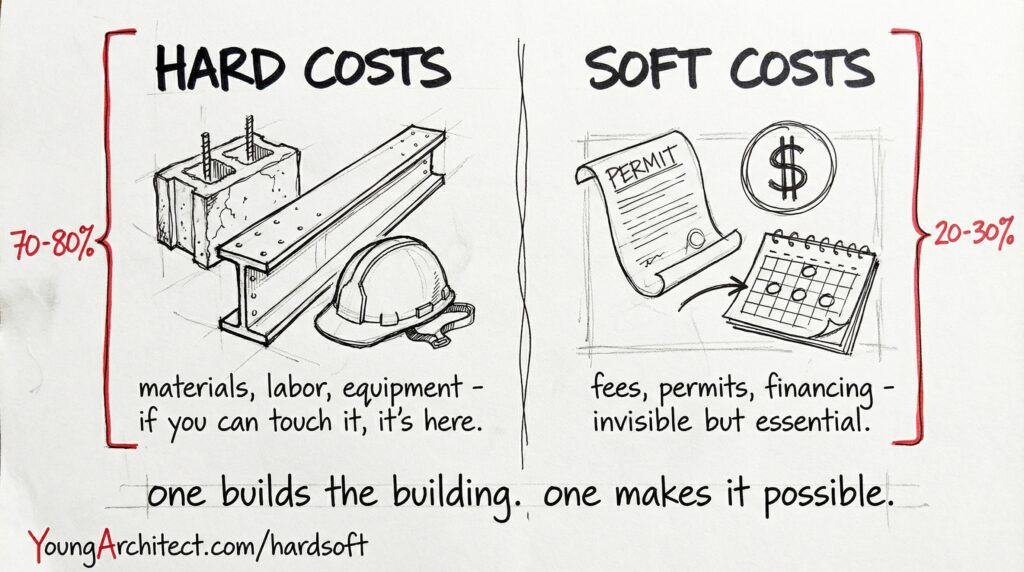
Hard costs are the tangible, physical expenses that directly create the actual building. This includes materials like concrete, steel, and lumber, plus labor, equipment rental, and everything else that physically goes into the structure.
If you can touch it or see it in the finished building, it’s a hard cost.
Some straightforward examples:
- The concrete in your foundation
- The steel beams supporting your structure
- The hourly wages paid to construction workers
- The HVAC equipment and ductwork
- The flooring materials and paint
Hard Cost Examples and Typical Percentages
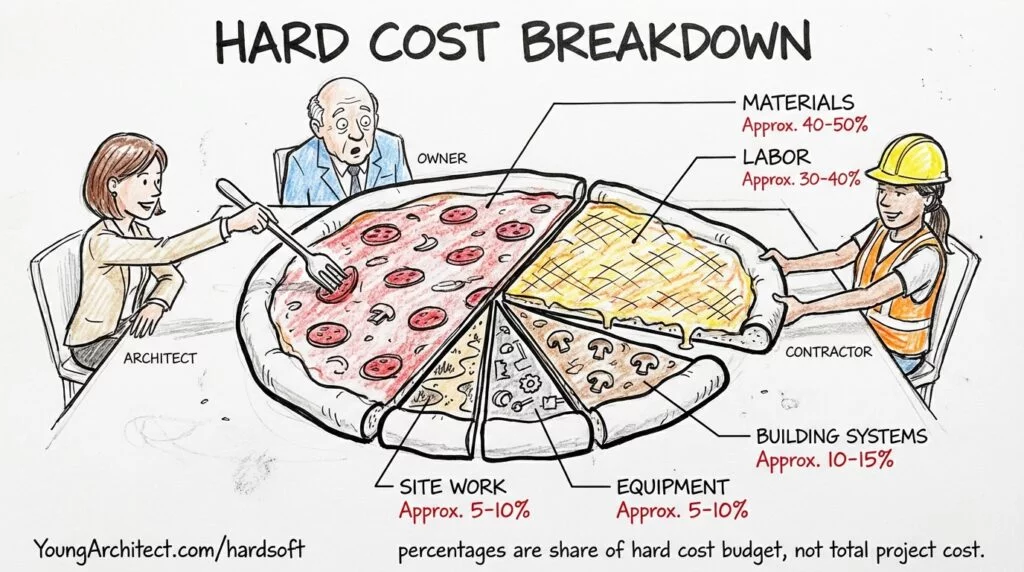
The percentages below represent a share of the hard cost budget, not the total project cost. That distinction matters, especially on the exam.
Construction materials — typically 40-50% of hard costs:
- Foundation and structural elements (concrete, steel, wood framing)
- Exterior envelope (cladding, roofing, windows, doors)
- Interior finishes (drywall, flooring, ceiling systems, paint)
- Material shipping and delivery costs
Labor — usually 30-40% of hard costs:
- General labor costs
- Skilled trades (electricians, plumbers, HVAC specialists)
- Wages, benefits, and overtime
- Labor burden costs
Equipment and temporary facilities — about 5-10% of hard costs:
- Heavy machinery (bulldozers, cranes, excavators)
- Scaffolding, formwork, temporary power
- Tools and specialized equipment
- Equipment maintenance and fuel
Site work:
- Excavation and grading
- Utilities and connections
- Landscaping and hardscaping
Building systems:
- HVAC systems and controls
- Electrical infrastructure
- Plumbing and fire protection
- Technology and security systems
If your client wants to “save money” by cutting hard costs, they’re literally taking pieces out of their building.
What Are Soft Costs in Construction?
The soft costs definition is straightforward: soft costs are the intangible, indirect expenses that don’t become part of the physical building but are necessary to make the project happen. They cover the management, legal, financial, and administrative layers of a project.
Understanding the soft costs meaning matters because these expenses occur before, during, and after construction, and they add up fast.
Hard costs build the actual structure. Soft costs make it legal, possible, and done right.
Soft Cost Examples and Typical Percentages
Design and engineering fees — usually 8-15% of total project costs:
- Architectural services (schematic design through construction administration)
- Engineering disciplines (structural, MEP, civil)
- Specialty consultants (acoustics, lighting, sustainability)
- For a detailed breakdown of how these fees are structured, see how architect fees are calculated under AIA B101.
Permits and regulatory fees — can be 3-5% of project costs in some jurisdictions:
- Building permits
- Impact and connection fees
- Zoning and environmental approvals
- Inspection costs
Land acquisition:
- The actual cost of the land itself, often one of the largest soft costs an owner carries
- Real estate due diligence and title work
Legal and accounting services:
- Contract preparation and review
- Legal work related to land acquisition and closing
- Tax planning and reporting
Financing costs — often overlooked but substantial on longer projects:
- Construction loan interest (this one adds up quietly over the life of the project)
- Loan origination fees and points
- Appraisal and financial due diligence fees
Construction loan interest is the stealthy ninja of soft costs. Silent but deadly to your budget. While everyone’s focused on the drama of steel prices, interest is quietly emptying your wallet in the background.
Insurance and bonds:
- Builder’s risk insurance
- Professional liability insurance for architects and risk management
- Performance and payment bonds that protect construction projects
Project management:
- Owner’s representative fees
- Construction management services
- Administrative and coordination costs
Marketing and leasing (for commercial projects):
- Marketing materials and campaigns
- Broker commissions
- Lease-up costs
One quick note on two items that trip people up on the exam: moveable furniture (FF&E) is typically a soft cost or a separate owner’s budget item, while built-in casework is a hard cost. And contingencies are usually split — a hard cost contingency for construction unknowns and a soft cost contingency for design and administrative unknowns. See our post on construction contingency for a full breakdown.
Many clients don’t realize how substantial soft costs can be. They focus on the construction contract number and get blindsided by the cumulative weight of all these “invisible” expenses. It’s your job to help them see the full picture early.
Construction Budget: Where Hard and Soft Costs Fit
When you talk about total project cost, you’re talking about hard costs and soft costs combined. Neither category alone tells the whole story.
Understanding how these costs move through the project timeline is just as important as knowing the definitions. The construction cost estimates you produce at each phase reflect a different mix of hard and soft spending depending on where you are in the process.
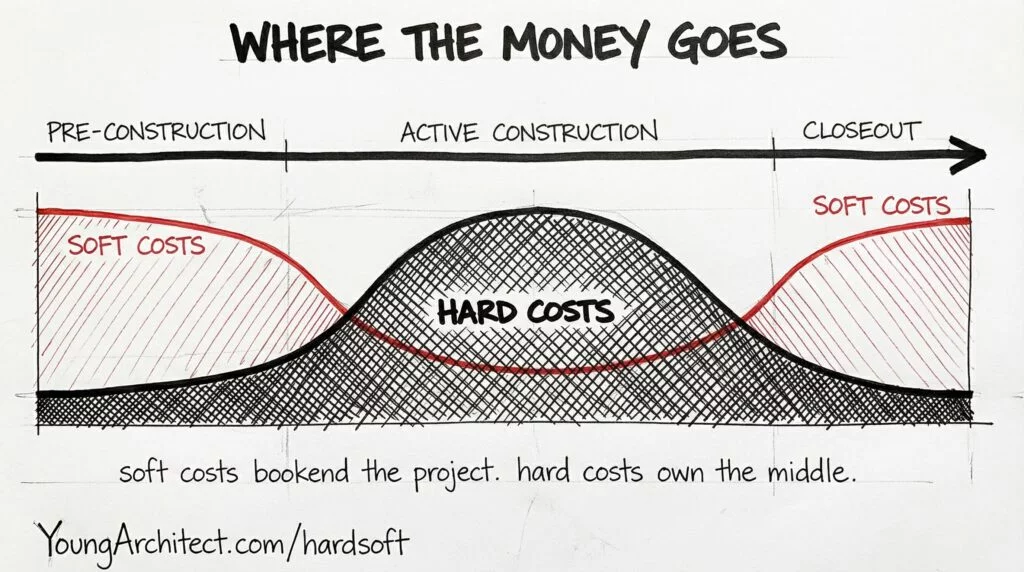
Think of it as a bookend effect. Soft costs are heavy on both ends of the project. Hard costs spike in the middle.
Here’s how that plays out:
- Early phases (pre-construction): Spending is almost entirely soft costs. Design fees, feasibility studies, permits, financing setup, land acquisition. The physical building doesn’t exist yet.
- Active construction: Hard costs dominate. This is the S-curve spike. Materials, labor, and equipment all hitting at once. Hard costs start slow during site prep, peak during framing and systems rough-in, then taper off during finish work.
- Closeout and occupancy: Soft costs return. Commissioning, punch list administration, closeout documentation, legal close-out, and for commercial projects, leasing and marketing costs kick in.
One thing that catches owners off guard: soft costs don’t pause while construction is happening. Loan interest keeps accruing. Insurance premiums keep running. Project management fees continue. The meter doesn’t stop just because the workers are on site.
For a deeper look at how estimates evolve across these phases and what accuracy ranges to expect at each stage, the WBDG cost estimating guide is a solid reference.
Typical Budget Ratios by Project Type
The general rule of thumb:
hard costs make up about 70-80% of the total project budget, with soft costs accounting for the remaining 20-30%. But that ratio shifts significantly depending on project type.
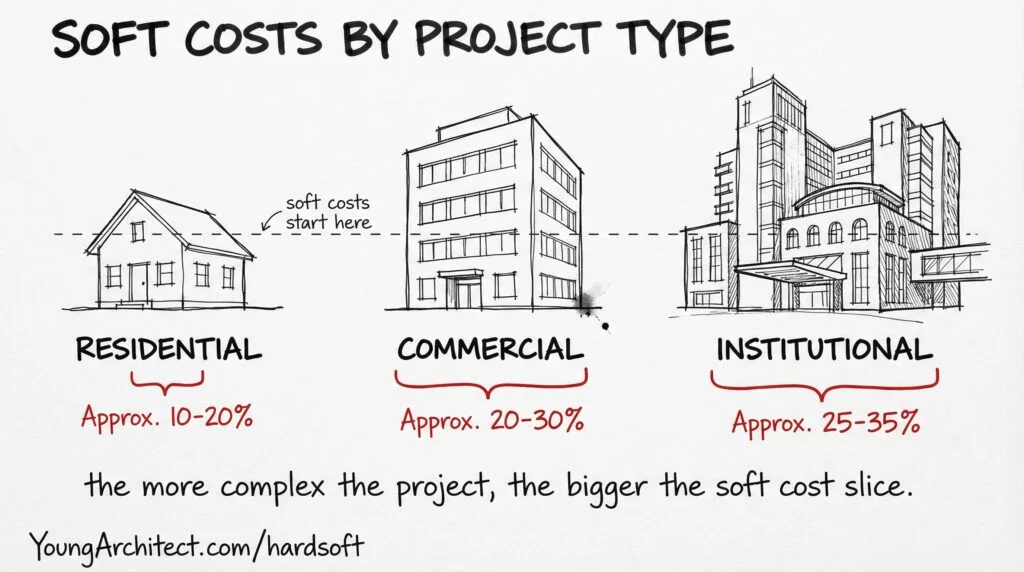
Residential projects — soft costs typically around 10-20%:
- Simpler designs and shorter project timelines
- Less complex regulatory requirements
- Smaller project teams overall
- Note: custom homes with complex designs and high-end finishes can push this percentage higher
Commercial projects and institutional clients — soft costs typically 20-30%:
- More complex regulatory requirements and longer approval processes
- Higher financing costs due to larger loans and longer durations
- Marketing and leasing expenses add up quickly on commercial projects
Institutional projects (hospitals, schools, government buildings) — soft costs can reach 25-35%:
- Complex designs requiring specialized consultants
- Multiple stakeholders and lengthy approval processes
- Stricter regulatory requirements across the board
- Extensive commissioning and closeout documentation requirements
By the time you’ve finished navigating the approval committees, stakeholder reviews, and regulatory agencies for a hospital project, you could have designed and built three houses, written a novel, and learned to play the banjo.
Construction Cost Breakdown by Project Phase
It’s not just about the final ratio. It’s about understanding when each type of cost hits. The construction cost breakdown shifts dramatically across project phases.
- Programming and schematic design: Almost entirely soft costs. Design fees, feasibility studies, early financing, land costs. This is also where the PA exam focuses. NCARB tests your understanding of these early soft costs heavily, including feasibility analysis and initial budget establishment.
- Design development and construction documents: Still mostly soft costs, but hard cost planning ramps up. Detailed estimates start getting real.
- Active construction: Hard costs dominate. This is the peak of the S-curve.
- Project closeout: Soft costs return. Commissioning, warranty administration, closeout documentation, and for commercial projects, leasing and occupancy costs. See our guide on project closeout for everything that happens at this stage.
Managing Hard and Soft Costs Effectively
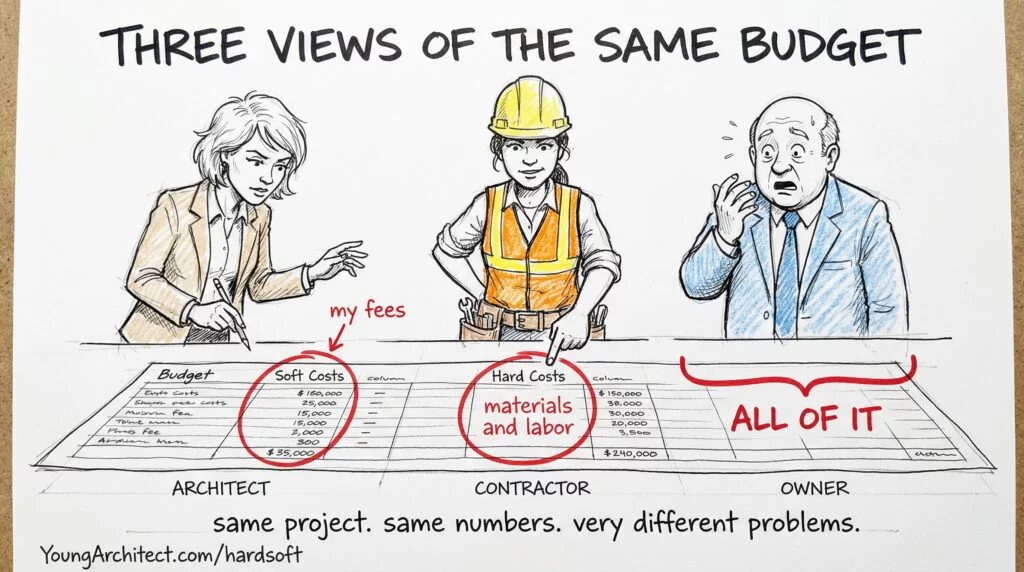
Different project stakeholders experience these costs very differently.
Understanding each perspective makes you a better architect and a better collaborator.
From the architect’s perspective:
- Your fees are a soft cost to the project, but your design decisions directly drive hard costs
- You’re responsible for helping owners establish realistic budgets from day one
- Every design change you make has a cost impact on both sides of the ledger
- For guidance on how this responsibility is framed in your contract, see AIA’s guidance on designing to budget
Value engineering often starts with good intentions but ends with phrases like, “Do we really need fire sprinklers on the upper floors? People can just run downstairs, right?” No, Bob. Just… no.
From the contractor’s perspective:
- Contractors primarily manage hard costs directly
- They submit bids based on detailed material and labor estimates
- They focus intensely on construction efficiency and productivity
- They coordinate with the design team on issues that affect costs
From the owner’s perspective:
- Owners bear responsibility for the entire project budget, hard and soft combined
- They must secure financing to cover all costs, not just construction
- Many first-time owners don’t fully appreciate the magnitude of soft costs until they’re deep into a project
Many first-time clients think construction is like ordering from Amazon. Just click what you want and it shows up at your door. Then they meet their first building inspector and realize it’s more like negotiating with a DMV employee who’s also a part-time building code philosopher.
Proven Strategies for Managing Both Cost Types
Thorough early planning and accurate estimating:
- Create detailed cost breakdowns by category from the start
- Use historical data and industry benchmarks to anchor your numbers
- Get expert input on soft cost estimates before setting client budgets
Realistic contingency planning for construction projects:
- Set aside 5-10% for new construction hard costs
- Budget 10-20% for renovation hard costs
- Maintain separate contingencies for hard and soft costs. They behave differently and should be tracked separately.
The word “contingency” comes from the Latin word for “the money you’ll definitely need but didn’t think you would.” OK, that’s not true, but it should be.
Clear communication between all parties:
- Hold regular budget review meetings throughout the project
- Develop cost reports that show both hard and soft expenses side by side
- Maintain a transparent construction change order process that accounts for all cost impacts
- Understand how liquidated damages work. Project delays don’t just affect the schedule, they keep soft cost meters running.
Regular quality assurance and quality control monitoring:
- Track expenditures against budget in real-time
- Forecast final costs based on current data, not original estimates
- Take corrective action early. Problems are always cheaper to fix before they compound.
- Proper construction submittals management is a soft cost activity that directly protects against expensive hard cost mistakes
- For a deeper look at cost management during construction, the WBDG construction phase cost management guide covers change order tracking, bid analysis, and the full cost data loop.
I once had a client who wanted to “save money” by cutting construction administration services, a soft cost. Six months later, when the contractor installed the wrong windows because no one was reviewing submittals, the hard cost to replace them far exceeded what the CA services would have cost.
Hard Costs and Soft Costs on the ARE
This topic isn’t limited to one exam. Hard costs vs soft costs appear across all six ARE divisions, each testing it from a different angle.
Practice Management (PcM) — budget concepts, fee structures, and financial management at the firm level. See PcM 101 for full coverage.
Project Management (PjM) — project budgets, cost control, and resource allocation on individual projects. See PjM 101 for full coverage.
Programming and Analysis (PA) — early phase cost estimation, feasibility studies, and budget establishment. PA heavily tests early soft costs: land costs, feasibility, and initial financing. See PA 101 for full coverage.
Project Planning and Design (PPD) — cost implications of design decisions and value engineering approaches.
Project Development and Documentation (PDD) — constructability and cost considerations at the detail and documentation level.
Construction and Evaluation (CE) — cost control during construction, change order management, and how delays affect total project cost.
In real-world practice, you’ll use this knowledge for:
- Client budget conversations — explaining soft costs early prevents sticker shock later
- Fee proposals and contract negotiations — understanding where your fees sit in the overall budget helps you communicate your value clearly
- Project budget development and monitoring — structured cost breakdowns and milestone reviews keep projects on track
Understanding costs won’t win you design awards, but it might help you stay in business long enough to win them later.
Putting Hard Costs and Soft Costs Together
Hard costs and soft costs are two sides of the same coin. You can’t have a successful project without both. Hard costs create the physical building. Soft costs make it legal, managed, and possible.
Key takeaways:
- Hard costs are tangible and visible in the finished building, typically 70-80% of the total project budget
- Soft costs are intangible but absolutely necessary, typically 20-30% of the total project budget
- The ratio shifts by project type. Residential runs leaner on soft costs; institutional projects run higher.
- Soft costs bookend the project. Heavy at the start, returning at closeout, with hard costs spiking in between.
- Early planning and clear communication are the most effective tools for managing both
If you want structured guidance on putting all of this into practice for the ARE, ARE Boot Camp walks candidates through financial concepts like this alongside every other exam topic, with accountability, live coaching, and a clear roadmap. For self-paced study, the ARE 101 Membership covers these concepts across all six divisions with hundreds of practice questions.
For related reading, check out our posts on construction contingency and construction bonds.
Frequently Asked Questions
What are soft costs in construction?
Soft costs in construction are the non-physical expenses required to plan, finance, manage, and complete a building project. They include architectural and engineering fees, building permits, insurance premiums, construction loan interest, legal fees, and project management costs. While you can’t see them in the finished building, soft costs typically represent 20-30% of the total project cost and are essential to making the project happen.
What is the typical ratio of hard costs to soft costs?
Hard costs typically make up 70-80% of the total project cost, with soft costs accounting for the remaining 20-30%. This ratio varies by project type. Residential projects tend to have lower soft costs (10-20%), while institutional projects like hospitals and schools can see soft costs reach 25-35% due to complex design requirements, multiple approval processes, and extended timelines.
Is insurance a hard cost or a soft cost?
Insurance is a soft cost. Both builder’s risk insurance during construction and professional liability insurance for the design team are classified as soft costs because they don’t become part of the physical building. Insurance premiums are paid throughout the project lifecycle and are considered indirect expenses that support the project without appearing in the finished structure.
What is the difference between hard costs and soft costs in a construction budget?
Hard costs are the tangible, physical expenses that create the actual building, including materials like concrete and steel, construction labor, equipment, and building systems. Soft costs are the intangible expenses required to make the project possible, including design fees, permits, financing, insurance, and project management. Both are essential components of a complete construction budget.
Are architect fees a hard cost or a soft cost?
Architect fees are a soft cost. All design and engineering fees fall under soft costs because they represent professional services, not physical construction. Architect fees typically range from 8-15% of total project costs depending on project complexity, scope of services, and fee structure.