
Discover why CDT® certification is becoming the strategic advantage for ARE candidates seeking to accelerate their licensing journey. This industry-recognized credential fills critical knowledge gaps, builds professional confidence, and provides the comprehensive project delivery understanding that architecture school often misses.
This podcast is also available on YouTube, Spotify, and Apple Podcasts
CDT® certification is one of the smartest moves an Architect Registration Examination (ARE) candidate can make during their licensing journey. Offered by the Construction Specifications Institute (CSI®), the Construction Documents Technologist credential covers the complete lifecycle of a construction project, and if you’ve already studied for PcM, PjM, and CE, you likely know 70-80% of the CDT® content before you ever open a study guide.
This post breaks down what CDT® certification actually covers, how it overlaps with the ARE, and when to fit it into your path toward licensure.
Free CDT® Webinar: Watch the Recording or Register for the Next Session
Join Michael and Emily for a live CDT® webinar to discuss the upcoming CDT® testing cycle.
We cover CDT® fundamentals, career benefits, and insider success strategies to help you pass faster and easier.
Watch the Recording or Register for the Next Session
Missed the live session? Register anyway and we’ll email you the recording so you can watch on your own time.
What Is CDT® Certification?
CDT® stands for Construction Documents Technologist, a certification offered by the Construction Specifications Institute (CSI®). But don’t let the name fool you. It’s not just about writing construction specifications.
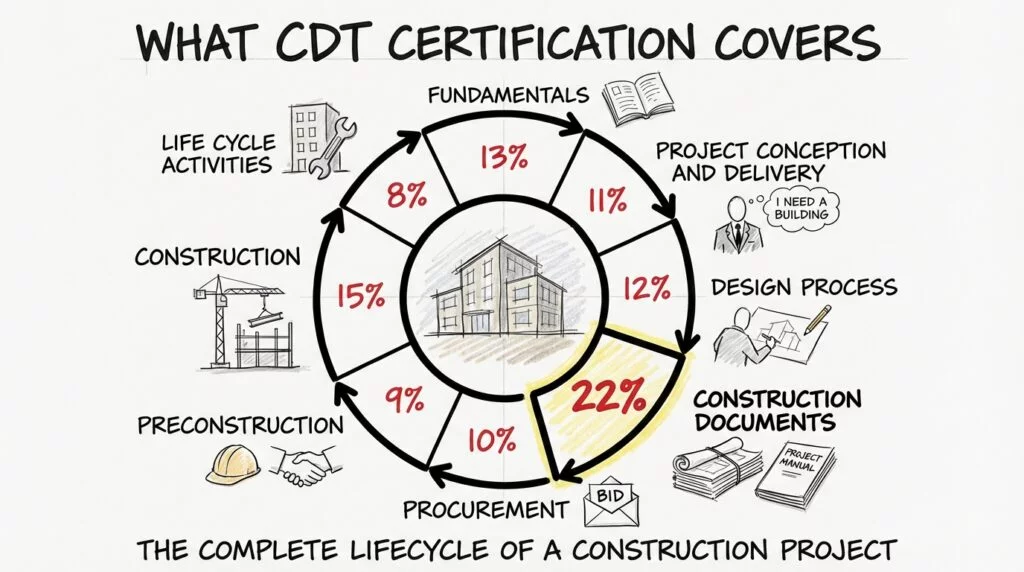
The CDT® covers the entire lifecycle of a construction project. From the moment an owner decides to build through programming, design, documentation, bidding, construction quality management, occupancy, and building removal.
It also covers project delivery methods, meaning what type of contract and team structure is needed for different project and client types (public, private, commercial, residential).
Most importantly, it focuses on the roles, relationships, and responsibilities of every party involved in a project. Architects, engineers, contractors, owners, suppliers, and everyone who touches the building throughout its life. Knowing who is responsible for what makes your job expectations, and everyone else’s, crystal clear.
The CDT® was specifically created to get everyone in the construction industry speaking the same language and following consistent standards. Many industry professionals believe anyone in the building industry should get this certification, and we agree. It’s not just for architects.
For ARE candidates specifically, it provides baseline knowledge that’s essential for effective communication and collaboration on every project. These skills will serve you throughout your career.
Curious about why ALL architecture professionals should pursue CDT® certification? My detailed video explains how this credential benefits anyone who works in architecture or construction, regardless of your licensure status or career intentions.
What the CDT® Exam Covers
The CDT® exam is organized into 8 knowledge domains, each weighted differently:
- Fundamentals (13%)
- Project Conception and Delivery (11%)
- Design Process (12%)
- Construction Documents (22%, the heaviest weighted domain)
- Procurement (10%)
- Preconstruction (9%)
- Construction (15%)
- Life Cycle Activities (8%)
Construction Documents carries the most weight at 22%, but the exam tests your understanding across the full project lifecycle. You’ll need to know how projects are organized using CSI MasterFormat®, how teams communicate during construction, and how the entire delivery process connects from start to finish.
If you’re looking for a structured way to prepare, our CDT® 101 course covers all 8 domains with practice questions, graphics, and interactive content designed to make studying effective and engaging.
Benefits of CDT® Certification for ARE Candidates
For ARE candidates specifically, the CDT® certification offers several key advantages:
- Fills knowledge gaps not typically addressed in architecture school. Schools focus heavily on schematic design while neglecting other critical project phases. The CDT® gives ARE candidates a comprehensive understanding of the entire project delivery process and helps bridge the gap between design and construction.
- Creates a consistent framework for understanding project delivery. This gives you a structured approach and common vocabulary that standardizes processes across the industry. That shared understanding makes you immediately more effective when collaborating with different teams, answering RFIs, reviewing construction submittals, processing payment applications, and completing project closeout procedures.
- Builds confidence during your licensing journey. Many architects who have earned this certification report wanting to know even more. They bring that knowledge to job sites and interactions with consultants. This confidence boost can be invaluable for ARE candidates facing exam challenges.
- Develops product knowledge expertise that’s rarely taught in formal education. The CDT® equips you with the knowledge to properly research, evaluate, and compare building products and materials. This helps you make more informed specification decisions and better communicate requirements to contractors.
- Connects you with professionals across the building industry. Many project managers, suppliers, and building representatives hold this certification. This expands your network beyond just architects, which is particularly valuable early in your career.
How CDT® Certification Overlaps with the ARE
Here’s the stat that gets ARE candidates’ attention: studying for PcM, PjM, and CE covers about 80% of what you’ll need for the CDT®.
That’s not a coincidence. Both NCARB and CSI build their testing heavily around AIA contract documents, which creates a shared foundation between the two exams.
Here’s how the overlap breaks down by ARE division:
- PcM (Practice Management) overlaps with CDT® content on project delivery methods, business operations, and how firms are structured to deliver projects.
- PjM (Project Management) maps to CDT® topics around contracts, consultant coordination, team management, and scope control.
- CE (Construction & Evaluation) maps directly to CDT® domains covering construction administration, submittals, RFIs, change orders, and closeout procedures.
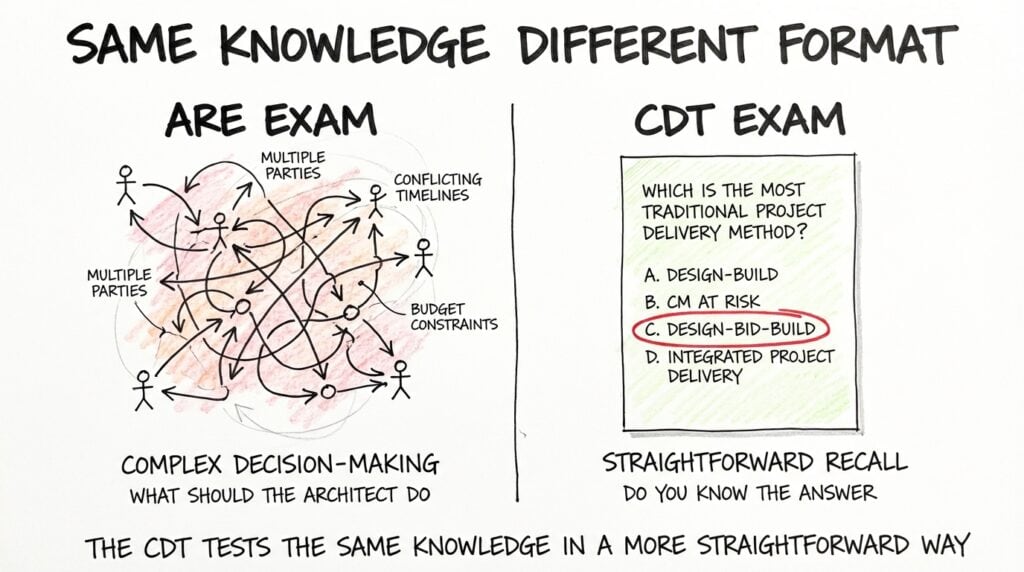
The testing format is also more straightforward. The ARE uses complex scenarios that require synthesis, professional judgment, and multi-step decision-making. The CDT® focuses on clear understanding of concepts and relationships.
For example, the ARE might present a change order scenario involving multiple parties, conflicting timelines, and budget constraints, then ask you to determine the architect’s best course of action. The CDT® is more likely to ask you to identify the correct sequence of a change order or which party is responsible for initiating it.
Many ARE candidates find this format refreshing after months of wrestling with ARE-style questions.
The core study resource for the CDT® is the Project Delivery Practice Guide (PDPG). It outlines every step of the project process in a way that many experienced architects say they’ve never seen so clearly articulated, even in architecture school. This resource alone provides ARE candidates with invaluable knowledge for both the CDT® and their future practice.
When Should ARE Candidates Take the CDT® Exam?
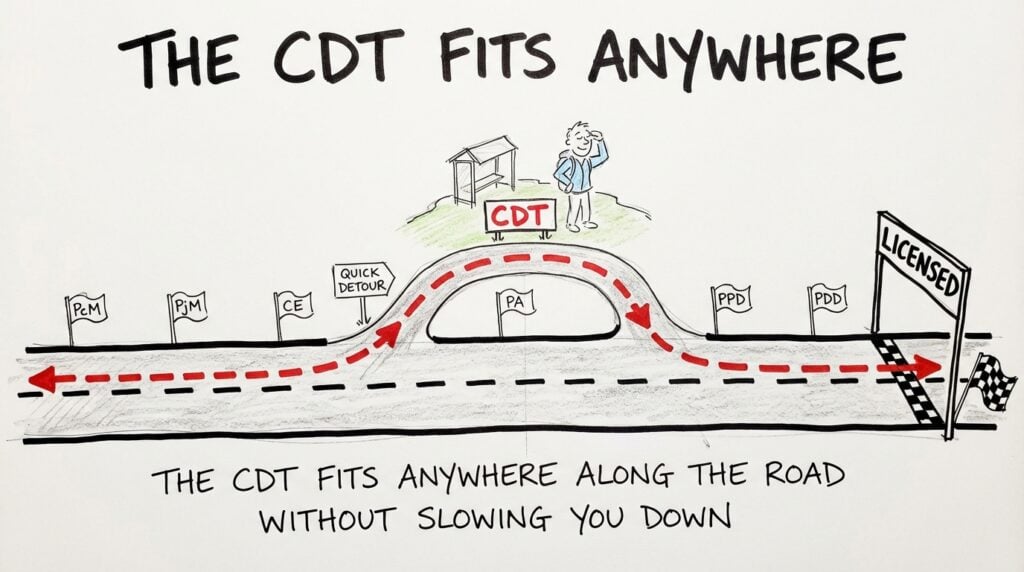
The perfect scenario would be before starting your ARE journey. But the priority is usually getting licensed first, and that’s understandable.
Many successful ARE candidates integrate CDT® preparation while working through their ARE divisions. I’ve seen ARE Boot Campers pass the CDT® with just a few weeks of focused study, pairing it with what they’ve already learned for their ARE divisions. This makes it a manageable addition to your licensing journey.
A CDT® Success Story
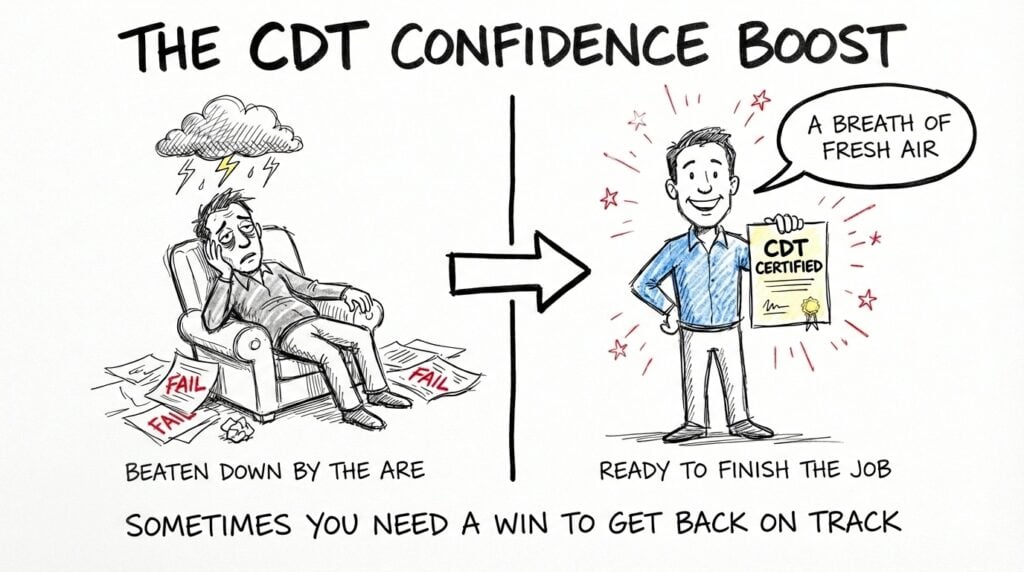
One ARE Boot Camp member shared that he took the CDT® between his final two ARE divisions. After feeling beaten down by failed attempts, the CDT® provided a confidence boost at a critical moment.
“The CDT® was a breath of fresh air. I walked in, took the test, thought it was easy, and found out I passed. It blew me up and gave me the motivation to wrap up my architect exams.”
For many ARE candidates, this refreshing change of pace can be exactly what you need to break through mental barriers and reignite motivation for the final push toward licensure.
CDT® Certification Exam Details: Cost, Timing, and How to Register
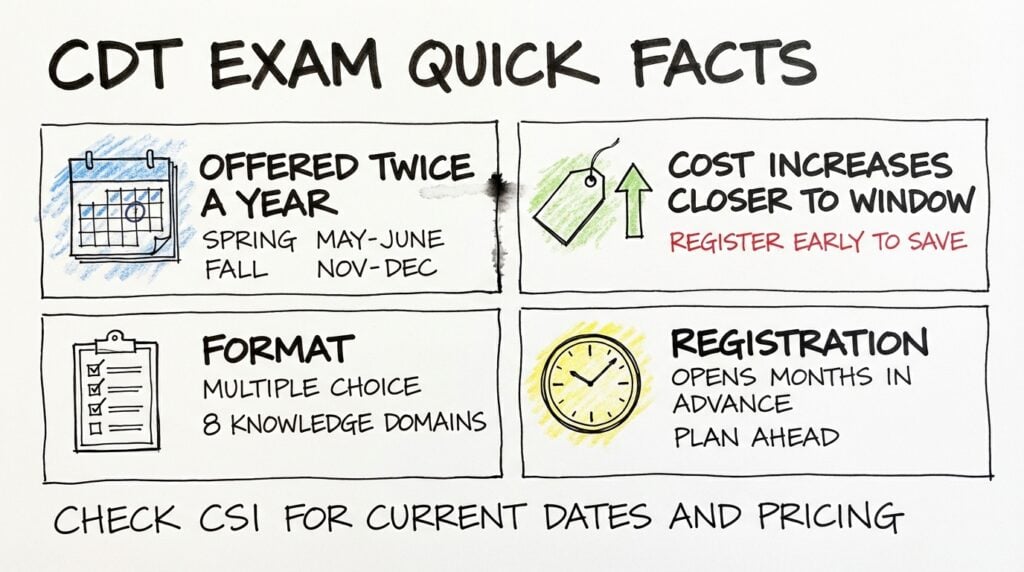
The CDT® exam is offered twice a year: spring (May-June) and fall (November-December). Unlike the ARE, you register months in advance, and costs increase as the testing window approaches. For ARE candidates already familiar with test scheduling, this is an important difference to plan for.
For current registration fees and testing dates, check CSI’s official CDT® certification page. Pricing changes each cycle, so CSI’s site is always the most accurate source.
The investment is modest compared to ARE exam fees, and many candidates find it well worth the cost for the credential and the knowledge it provides.
CDT® 101 Course
After seeing so many of our ARE Boot Campers pursue their CDT® certification and consistently mention the lack of quality study materials, we decided to take action.
As seasoned veterans of creating effective ARE study resources, we developed CDT® 101, a comprehensive course featuring practice questions, graphics, and interactive elements specifically designed to make CDT® studying engaging and effective.
We created our course from scratch based on the testing criteria provided by CSI. This is the same approach we use for our ARE 101 courses. While many CDT® courses presented by CSI chapters use standardized slides often presented by people who didn’t create the content, we built ours with the same diligence and attention to detail that’s made our ARE prep materials so effective.
Our practice questions are deliberately challenging, even harder than the actual exam, similar to our ARE prep approach. This ensures you’re well-prepared for test day. Every week my inbox fills with excited messages from ARE Boot Campers celebrating their CDT® success.
Why CDT® Certification Can Be a Welcome Break for ARE Candidates
- Much of the content feels familiar if you’ve studied for PcM, PjM, and CE
- The straightforward testing format is refreshing after complex ARE scenarios
- Many candidates already know many answers before even studying
- It provides a rare “slam dunk” opportunity during your licensing journey
- The confidence boost can be invaluable for returning to ARE divisions
Is CDT® Certification Worth It for ARE Candidates?
For ARE candidates, the CDT® certification is more than just another credential. It’s a strategic investment in your professional development and a powerful complement to your licensing journey.
As a baseline of knowledge for everyone in the construction industry, it bridges gaps between design and execution that architecture school often misses.
Whether you’re midway through your ARE divisions or just starting to think about licensure, the CDT® offers ARE candidates valuable perspective, a confidence boost, and a deeper understanding of how buildings come together from concept to completion.
If you’re ready to go further after CDT®, CCCA® 101 builds on that foundation with a deep focus on construction contract administration. I pursued CDT® and then CCCA® myself, and the progression made each step easier because the knowledge compounds.
Just getting started on your licensing journey? The ARE 101 Membership gives you access to all of our ARE study materials in one monthly subscription, covering every division from PcM through PDD.
FAQ: CDT® Certification for ARE Candidates
What is CDT® certification?
CDT® stands for Construction Documents Technologist, a certification offered by the Construction Specifications Institute (CSI®). It covers the complete lifecycle of a construction project from programming through building removal, including project delivery methods, construction documents, procurement, and the roles and responsibilities of every party on the project. It’s not just about writing specifications.
How much does CDT® certification cost?
Registration fees vary by cycle and increase as the testing window approaches. CSI® offers early registration pricing, so signing up sooner saves money. For current pricing, visit CSI’s official CDT® certification page. The investment is modest compared to what you’ll spend on ARE exam fees.
How hard is the CDT® exam?
Most ARE candidates find the CDT® format more straightforward than the ARE. The exam relies on concept recall and understanding relationships between project parties, rather than the complex scenario-based synthesis found on NCARB exams. If you’ve already studied for PcM, PjM, and CE, you’ll recognize the majority of the content.
When is the CDT® exam offered?
The CDT® exam is offered twice a year: spring (May-June) and fall (November-December). Registration opens months in advance, and costs go up the closer you get to the testing window. Check CSI’s website for current cycle dates and deadlines.
Should ARE candidates get CDT® certified?
Yes, especially if you’ve completed or are actively studying for PcM, PjM, and CE. The content overlap is significant, the exam format is more straightforward, and earning the credential adds a professional certification to your resume while you’re still working toward licensure. Many ARE candidates also find that passing the CDT® provides a much-needed confidence boost during the licensing process.