

Learn the difference between owner’s consultants and architect’s consultants, including where the liability falls, what coordination actually requires, and how to protect yourself on the ARE and in practice.
This podcast is also available on YouTube, Spotify, and Apple Podcasts
Two Types of Consultants on Every Project
Here’s a scenario that plays out on projects all the time.
You’re in the middle of design. Everything is humming along. Your consultants are coordinated, deadlines are being met, and life is good.
Then the owner calls and says,
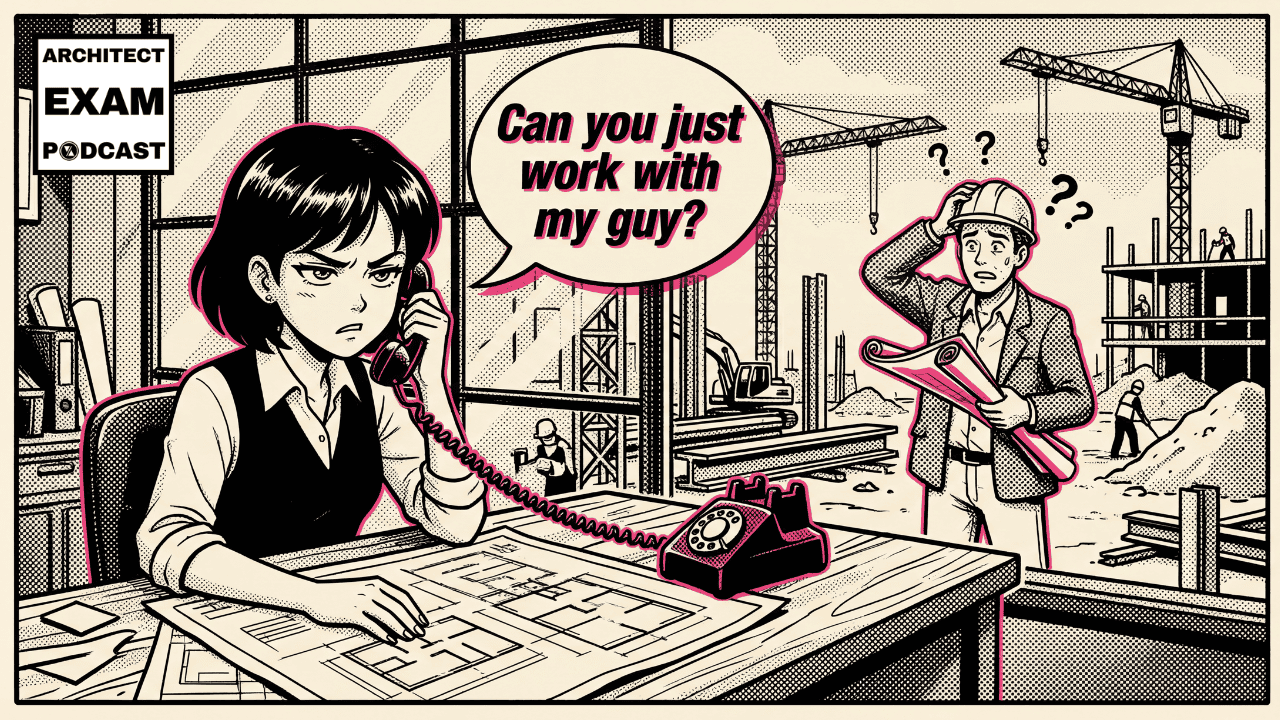
“Hey, I’ve got my own kitchen designer. She’s going to send you her drawings. Can you just work them into your blueprints?“
And you’re standing there thinking… okay, wait.
Whose consultant is this? Who’s paying her? If her drawings are wrong, is that my problem? And what exactly does “work them in” mean?
If you’ve ever had that moment of confusion, you’re not alone. And if you’re studying for the ARE, this is one of those topics that sounds simple on the surface but has some real teeth when you dig in.
Let’s clear it up.
The Architect’s Team
When you take on a project as the architect, you hire consultants. Your standard team typically includes a structural engineer, MEP engineers, and a civil engineer.
This is your team. They work under your contract through the AIA C401 architect-consultant agreement.
You direct their work, you’re responsible for coordinating what they produce, and if something goes wrong with their documents, that comes back to you.
The Owner’s Team
But the architect isn’t the only one hiring consultants on a project. The owner hires consultants too.
Think about it. Surveyors, geotechnical engineers, hazardous material specialists, elevator consultants, pool designers, custom kitchen companies, interior designers the owner already has a relationship with.
These are all people the owner brings to the project independently of the architect.
The “Existing vs Proposed” Framework
Here’s the easiest way to remember who hires who.
Think of it as existing versus proposed.
The owner’s consultants deal with what’s already there.
The land. The soil. The property lines. The environmental hazards. This is the stuff that existed on site before the architect ever showed up. The owner bought that land, and everything on it and in it is their responsibility.
The architect’s consultants design what’s going to be there.
The structure. The electrical, plumbing, and mechanical systems. The building itself. That’s the proposed work. That’s the architect’s team.
- Existing conditions = owner’s consultants.
- Proposed work = architect’s consultants.
If you remember nothing else from this post, remember that.
The Custom Work Caveat
This framework holds up really well for the core building, but sometimes the owner brings in specialists for custom work that falls outside the standard scope.
An AV consultant for a conference center. An acoustic engineer for a concert hall. A food service designer for a commercial kitchen.
Those people are designing proposed work, but they’re still on the owner’s team because the owner hired them.
So the “existing vs proposed” framework gets you most of the way there, but when in doubt, always come back to the real question: who hired them?
That’s what determines the liability.
Quick Reference: Architect’s Consultants vs Owner’s Consultants
| Feature | Architect’s Consultant (e.g., Structural Engineer) | Owner’s Consultant (e.g., Geotech Engineer) |
|---|---|---|
| Contract | AIA C401 (with Architect) | Direct contract with Owner |
| Liability | Flows up to the Architect | Stays with the Owner |
| Payment | Paid by Architect (passed through from Owner) | Paid directly by Owner |
| Coordination | Managed by Architect | Coordinated by Architect |
Why the “Who Hired Them” Question Changes Everything
This isn’t just a helpful way to organize things in your brain. There’s a real reason this distinction exists, and it comes down to liability.
If the architect’s structural engineer makes a mistake on the design, the architect is liable. That’s your consultant, your contract, your problem.
But if the owner’s geotechnical engineer provides bad soil data? The owner deals with that.
The architect is protected from that liability because they didn’t hire that consultant. The owner did.
Whoever holds the contract holds the liability.
That firewall only works if the lines stay clean. And that’s why understanding who hired who matters so much.
Hard Rules That Are Not Gray Areas
Let’s be very clear about something.
Architects do NOT hire geotechnical engineers.
Architects do NOT hire surveyors.
Architects do NOT hire hazardous material consultants.
Those are existing site conditions and the owner’s responsibility. Period. The owner bought that land. The soil conditions, the property boundaries, the environmental hazards – those belong to the owner.
If the architect hires the geotech and there’s a foundation issue because of bad soil data?
Congratulations, the architect just took on liability for the earth itself.
And here’s what makes that even worse. Most architect professional liability insurance policies have specific exclusions for pollution, ground conditions, and environmental hazards.
So if the architect hires the geotech and something goes wrong, not only are you liable, your insurance might not even cover it.
You’re liable without a safety net. That is liability you should never, ever carry.
Basic Coordination vs the Supplemental Upgrade
So if the owner’s consultants aren’t your people, what exactly is your job when it comes to them?
This is where it gets interesting and where a lot of people get tripped up.
Basic Coordination: Part of the Gig
Under the owner-architect agreement, coordinating with the owner’s consultants is a basic service. That means it’s already baked into what the architect is expected to do. You don’t get extra money for it. It’s part of the gig.
And coordination in this context means exactly what it sounds like. You receive their information and incorporate it into the project. You make sure their work doesn’t conflict with yours. You communicate on timelines and deliverables. You’re basically making sure all the puzzle pieces fit together.Here’s a simple example.
The owner hires an elevator consultant. Your job is to make sure you’ve left the right shaft dimensions in your drawings. You coordinate with them to make sure everything lines up. That’s basic coordination.
But here’s the key thing. If the owner’s kitchen designer is late? That’s the owner’s problem, not yours. You coordinated. You did your part. You don’t chase down the owner’s people on your own dime. That’s not what basic services covers.
The Supplemental Upgrade: When the Owner Wants More
Sometimes the owner wants more than basic coordination. Sometimes the owner says,
“Hey, I’ve got six consultants on this project and I want you to be the central hub for all of them. I want you to be the project quarterback.”
That’s a different conversation.
If the contract hasn’t been signed yet then that’s a supplemental service. Extra scope, extra responsibility, and extra compensation.
With the supplemental upgrade, you’re chasing the owner’s consultants for their drawings. You’re integrating their schedule into your master schedule. You’re policing their deadlines. You’re acting as the communication hub for people you didn’t even hire.
Owners will sometimes casually say, “Just manage my guy.” But here’s a vocabulary lesson that might save you on the exam and protect you in practice.
Coordinate vs Manage: Words That Matter
The word you want in your head is always coordinate, never manage.
Coordinate means you’re working with them.
Manage means you own them. And you don’t own them. The owner does.
In contract language, what you’re providing is enhanced coordination. You’re coordinating their process. But you are not responsible for their product.
And when the owner casually asks you to “handle” their consultant, here’s what that conversation should sound like:
“I’m happy to coordinate their drawings into our set as part of our basic services.
Since they’re under contract with you, I can’t direct their staff or guarantee their deadlines.
If you’d like me to take over full management and scheduling of their work, we can look at that as a supplemental service.”
Clear. Professional. And it protects you.
Coordinate the Process, Never Own the Product
This distinction is worth its own section because it’s that important.
You can coordinate their process – timelines, deliverables, communication flow.
You cannot take responsibility for their product – the actual work they produce.
The moment you cross that line, you’ve taken on liability that doesn’t belong to you.
Don’t Be a Hero
Here’s the scenario. The owner hires an AV consultant, and that consultant is slow. Unresponsive. The project is falling behind because you’re waiting on their stuff.
And you’re sitting there thinking, “I’ll just fix their drawings real quick. I’ll clean up their mistakes so we can keep this thing moving.”
Do not do that.
The moment you start correcting the owner’s consultant’s work, you may have just assumed liability for it. You touched it, you might own it. That’s scope creep at best and a lawsuit at worst. And if you didn’t hire them, you likely don’t have the legal right to alter their instruments of service in the first place. Their drawings are their intellectual property.
Never seal (stamp) the owner’s consultant’s work.
Your seal means your responsibility. If you put your stamp on someone else’s product, you just made it yours. That’s a massive liability risk and a classic ARE trick question.
What to Do Instead
Flag it. Go to the owner and say, “Your consultant is behind. Here’s how it’s impacting the schedule. You need to deal with this.”
Let the owner handle their consultant. That’s their job. Your job is to coordinate, not to rescue.
The Owner’s Responsibility for Existing Conditions
Before the architect even starts designing, the owner is responsible for providing certain information about the project site.
Surveys. Legal descriptions of the property. Geotechnical reports. Hazardous material assessments.
All of that existing condition information? That’s on the owner to provide.
Reasonable Reliance
Under AIA B101 Section 3.1.2, the architect is entitled to rely on the accuracy and completeness of owner-provided information.
You don’t have to go out and re-measure the property lines. You don’t have to hire your own surveyor to double-check. The owner provided it, and you can trust it.
Trust But Don’t Be Blind
You can rely on the technical accuracy of what the owner gives you. But you cannot ignore something that is obviously wrong.
If the survey says the lot is 500 feet wide and you drive out there and can clearly see it’s maybe 50 feet, you can’t just shrug and say, “Well, the survey said so.” If the surveyor misses an obvious power line that you clearly saw during your site visit, you can’t claim “reliance” later.
You’re still a licensed professional. You notice red flags and you raise them. This ties directly to your standard of care obligations. Seeing a glaring error and ignoring it falls below the level of professional competence expected of a licensed architect.
So the standard is trust but don’t be blind. Rely on the owner’s information, but if something looks clearly off, say something.
This ties right back into everything we’ve been talking about. The owner is responsible for the existing conditions. The architect relies on that information to do the design. And if there’s a problem with the owner’s data, that liability sits with the owner – not the architect – as long as you didn’t ignore something obviously wrong.
How Owner’s Consultants Show Up on the ARE
This topic could realistically show up on any division of the Architect Registration Examination. The owner could have consultants involved in any phase of the project. A surveyor during pre-design. A kitchen consultant during design development. An elevator installer during construction. It’s not limited to one exam.
But it’s especially relevant for three divisions.
Practice Management (PcM) tests your understanding of contract structure and who’s responsible for what. And here’s a concept worth understanding for PcM: an owner hiring their own consultant is a form of risk allocation. The owner is choosing to retain the risk of the soil conditions (geotech) or the property boundaries (survey) rather than paying the architect a fee to manage that risk. Understanding this as a risk transfer concept helps you frame exam questions correctly.
Project Management (PjM) focuses on coordinating all these players during the design phases. You need to know the difference between basic coordination and supplemental services, and what falls within your scope.
Construction & Evaluation (CE) tests how you navigate the information flow between everyone on the project during construction. Owner’s consultants don’t disappear once construction starts – you’re still coordinating with them throughout.
A Quick Terminology Note
On the exam, owner’s consultants are often referred to as “consultants hired under separate agreements.” If you see the word “separate” in a question about consultants, your liability firewall alarm should go off. That’s NCARB’s way of signaling that this person is not under your contract and the liability boundaries are different.
The Study Tip That Changes Everything
When you see a question about consultants on the exam, your first thought should always be: who hired them?
That one question changes everything about what the architect’s responsibilities are.
If the architect hired them, you’re responsible. If the owner hired them, you coordinate, and the liability stays with the owner.
Keep these three frameworks in your head:
- Existing vs proposed – tells you who likely hired them
- Process vs product – tells you what you’re responsible for
- Who hired them – tells you where the liability falls
Take Your Contract Knowledge Deeper
Understanding owner’s consultants is just one piece of the contract puzzle. If you want to see how the AIA C401, B101, and A201 all connect and work together across every phase of a project, check out our AIA Contracts 101 course at Young Architect Academy. We break down every major contract document in real-world terms so you actually understand why these provisions exist, not just what they say.
And if you’re ready for the full coaching experience with accountability, community, and a clear roadmap through all six ARE divisions, take a look at ARE Boot Camp. We connect contract knowledge like this to every exam so you see the bigger picture.