
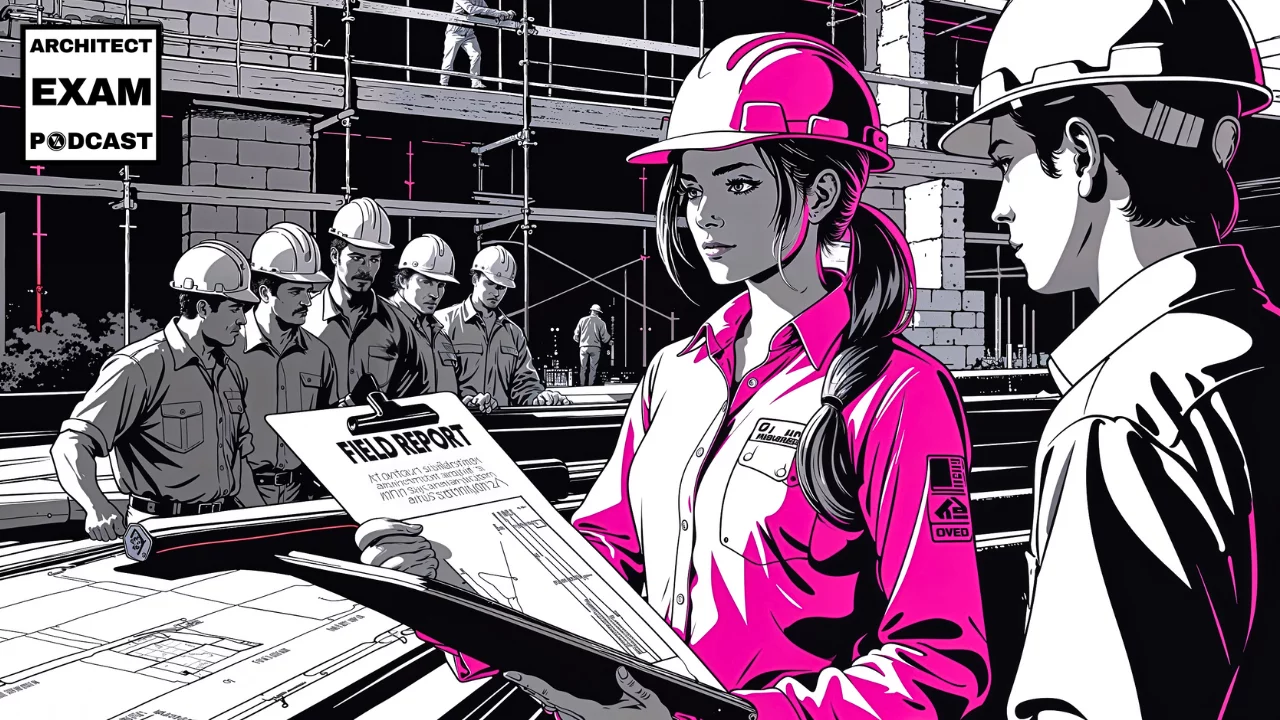
Construction observation is the heart of the architect’s role during construction. It’s where you shift from designer to project advocate, visiting the site, evaluating the work, and making sure what’s being built matches what was designed. This guide breaks down everything you need to know about construction observation, including site visits, construction field reports, the critical difference between design intent and means and methods, and how to evaluate work on site.
This podcast is also available on YouTube, Spotify, and Apple Podcasts
What Is Construction Observation?
Construction observation is the process of visiting a construction site to evaluate whether the work is being performed in general conformance with the contract documents. The architect observes the work. The architect does not supervise the contractor’s day-to-day activities. Every observation gets documented in field reports that become part of the permanent project record.
According to NCARB, the Construction & Evaluation exam focuses on construction contract administration, support of the construction process, and evaluation of completed projects. The CE exam is divided into four sections:
- Section 1: Preconstruction Activities (17-23%)
- Section 2: Construction Observation (32-38%)
- Section 3: Administrative Procedures and Protocols (32-38%)
- Section 4: Project Closeout and Evaluation (7-13%)
Section 2 is the largest section of the CE exam. You’re going to see more questions about construction observation than anything else in this division.
This section covers three objectives:
- Objective 2.1 (13-17%): The architect’s role during construction activities
- Objective 2.2 (13-17%): Evaluating construction conformance with contract documents, codes, and regulations
- Objective 2.3 (3-7%): Determining construction progress
I always tell ARE candidates that real-world architecture experience doesn’t automatically give you an advantage on most parts of the ARE. But construction observation is one area where field experience genuinely helps. If you’ve spent time on construction sites and dealt with these issues firsthand, you’ll have an intuitive grasp of many concepts tested here.
If you’re preparing for the ARE, our ARE 101 Membership provides comprehensive materials organized by these sections and objectives.
The Architect’s Role During Construction Observation
This is where the rubber meets the road. The architect’s role during construction observation comes down to knowing what’s yours, what’s the contractor’s, and where the line is. Understanding these boundaries is essential for both the CE exam and real-world practice.
Observation vs Inspection: Know the Difference
This is one of the most important distinctions in construction administration. Architects observe. They do not inspect.
Observation means evaluating work for general conformance with the contract documents.
Inspection implies a more thorough examination and carries a higher standard of care.
Why does this matter? Because using the word “inspection” in your documentation can create liability exposure. Inspection implies a level of guarantee that the standard of care doesn’t support. Think of yourself as a wildlife photographer documenting the construction habitat, not the zookeeper telling the animals what to do.
There is one exception worth knowing for the exam. Under AIA B101, the architect does perform “inspections” at two specific milestones: to determine the date of Substantial Completion and to determine Final Completion. Everywhere else, it is strictly observation.
Design Intent vs Means and Methods
One of the most critical distinctions in construction observation is understanding the difference between design intent and means and methods.
Design intent is WHAT is to be built. That’s the architect’s domain.
Means and methods is HOW it’s built. That’s the contractor’s domain.
Think of the architect as a cookbook author who specifies the ingredients and what the final dish should look like, but the chef (contractor) decides which pots to use and the specific cooking techniques to employ.
Or think of it this way: the architect designs the destination and route on a map, but the contractor chooses the vehicle and driving techniques to get there.
In practical terms, you might specify a paint color and the finish quality, but the contractor decides the application method, number of coats, and the specific equipment used.
It’s like telling your teenager to clean their room without specifying whether they use a vacuum or a shovel. As long as it meets your standards in the end, the method is up to them.
On the CE exam, questions will test whether you can identify what’s in the architect’s lane vs the contractor’s lane. If you can keep this distinction clear, you’ll avoid a lot of traps.
The Architect’s Responsibilities on Site
During construction observation, the architect is responsible for:
- Making regular visits based on the project’s complexity
- Observing work for conformance with the contract documents
- Documenting observations in field reports
- Communicating issues to the owner and contractor
- Following up on action items from previous visits
- NOT supervising day-to-day construction activities
That last point deserves emphasis. The architect’s role during construction observation is to evaluate what’s being built, not to direct how it’s being built.
The Contractor’s Responsibilities to the Architect
The contractor also has specific responsibilities that flow toward the architect:
- Submitting shop drawings and samples for review
- Preparing and submitting change orders
- Providing applications for payment
- Creating and updating the schedule of values
- Providing construction and payment schedules
- Responding to the architect’s field reports and directives
- Obtaining construction bonds as required by the contract
Limits of the Architect’s Authority
Understanding the boundaries of your authority during construction observation is critical for both the exam and practice. Here’s where the lines are:
- You can reject non-conforming work
- You can interpret contract documents as defined in the drawings and specifications
- You have no authority over safety procedures
- You have no authority to stop the work
- You can approve minor changes, but significant changes typically require owner approval
Two of those deserve extra attention.
Stopping the work is solely the owner’s right under A201 Section 2.4. If the architect sees a major issue, the correct move is to reject the non-conforming work and advise the owner. The architect does not stop construction.
Safety on site is the contractor’s responsibility. If you see a safety violation, report it to the contractor immediately and document it. But do NOT tell the contractor how to fix the safety issue. That would cross into means and methods territory and shift liability onto you.
For a deeper dive into these A201 provisions, AIA’s guide to the A201 General Conditions covers the relationships between parties, including the architect’s observation responsibilities and limits of authority.
Construction Field Reports
A construction field report is a written record of the architect’s observations during a construction site visit. It’s not a personal diary. It’s an official project document that serves as legal protection for all parties.
Every field report should include:
- Date and time of the visit
- Weather conditions
- Trades on site and areas visited
- Work observed and progress since the last visit
- Issues identified and any non-conforming work
- Action items and follow-up from previous visits
- Photo documentation
The AIA G711 form is the standard template for an architect field report.
An important detail: field reports must be distributed to the owner, the contractor, and relevant consultants. This establishes the official project record and keeps all parties informed of site conditions.
Weather documentation might seem like a small detail, but it can be critical. If you’re later asked to assess a failing roof membrane, and your field observation report shows it was raining on the installation day, you now have documentation that installation shouldn’t have taken place in those conditions. That explains issues like poor adhesion and bubbling in the membrane.
Creating a consistent documentation system, even something as simple as a standardized site visit report template with project-specific checklists, can make a world of difference when disputes arise months later.
Documentation is your best friend on a construction site. Your second-best friend? The food truck that shows up on Fridays. But seriously, thorough documentation has saved more architectural careers than coffee.
Evaluating Construction Conformance
Construction observation is about verification. You’re making sure that what’s being built matches what was designed and specified.
Analyzing Completed Work Against Requirements
When evaluating work during a construction site visit, you’ll be:
- Comparing installed work to drawings and specifications
- Checking dimensions, materials, and installations
- Verifying systems integration and performance
- Using various testing and inspection procedures
During site visits, bring the right tools: a tape measure, a camera, and your specifications. These are your verification tools and your best defense against potential issues.
Identifying Non-Conforming Construction
Identifying non-conforming work is a critical skill during construction observation. You need to:
- Recognize common construction defects
- Use effective visual inspection techniques
- Properly document any non-conformance in your observation report
- Follow communication protocols for reporting deficiencies
- Establish follow-up procedures to verify corrections are made
When you find something that doesn’t conform, document it immediately and clearly. This isn’t about catching someone doing something wrong. It’s about ensuring the owner gets exactly what they contracted for.
Even catching a small issue early can save significant time and money compared to discovering it near project completion.
Unforeseen Conditions and Material Substitutions
Unforeseen conditions are practically guaranteed on any project. You’ll need to evaluate different types, whether subsurface issues, existing building conditions, or others, and assess their impact on code compliance, quality, and program requirements. Understanding how contingency funds are managed helps when these surprises hit the project budget.
Material substitutions are another reality of construction. When evaluating substitutions, your understanding of different specification types becomes crucial for determining what’s truly “equal” in performance and quality.
When a contractor proposes a substitution, you’ll need to:
- Apply criteria for “or equal” determinations
- Verify code compliance of substituted materials
- Compare performance characteristics
- Evaluate aesthetic impacts
- Assess sustainability implications
Coordinating with Consultants
Construction observation isn’t a solo effort. Coordination with your consultants is essential for comprehensive evaluation:
- Conducting joint site visits with engineering consultants
- Following established communication protocols
- Resolving conflicting observations
- Integrating consultant findings into your overall assessment
- Working effectively with the owner’s separate consultants
One important note: while the architect coordinates the consultants, each consultant remains responsible for their own discipline. If a structural engineer observes a defect in the steel framing, the architect doesn’t override that observation. The architect facilitates communication of that rejection to the contractor.
Site observation requirements and protocols can vary significantly between public and private projects, with public projects often having more rigorous documentation requirements and structured procedures.
If you’re preparing for CE, our CE 101 course provides detailed breakdowns of construction observation protocols with practice questions specifically focused on Section 2.
Determining Construction Progress
Construction observation also requires evaluating whether the project is on track, both in terms of physical completion and financial progress.
Reviewing Work Against the Construction Schedule
When reviewing work against the construction schedule, you need to:
- Understand different types of construction schedules
- Verify that milestones are being met
- Track progress using established methodologies
- Review schedule updates
- Identify any schedule slippage that might impact project completion
An important distinction for the exam: the contractor submits the construction schedule to the architect for information, not for approval. The architect reviews it to ensure it meets the contract time, but approving the schedule could make the architect liable for the contractor’s sequence of work.
Understanding the Critical Path
Understanding critical path impacts is crucial for evaluating construction progress. You should know:
- The basics of the Critical Path Method (CPM)
- How to distinguish between critical and non-critical activities
- The concept of float and its implications
- Different types of delays: excusable, non-excusable, and compensable
- How to document and address delays
Keep in mind: the contractor owns the schedule and the float. The architect analyzes the critical path to evaluate the validity of time extension claims, not to tell the contractor how to reorganize their sequencing.
For more on how contract time connects to substantial completion, understanding these schedule concepts helps you evaluate whether delays are impacting the project’s finish date.
The Schedule of Values and Payment Applications
The schedule of values is your financial roadmap for the project. When a contractor submits a payment application, you need to verify that the work is actually in place before approving payment.
If they claim they’re 75% complete on framing but you can see they’re only at 50%, that’s a problem. Keeping the schedule of values accurate ensures everyone gets paid fairly for work that’s actually been completed.
You need to:
- Understand the purpose and structure of a schedule of values
- Assess percentage completion for payment applications
- Ensure the schedule of values has an appropriate level of detail
- Detect front-loading and other payment issues
- Maintain proper documentation for any payment disputes
Common Construction Observation Mistakes
Here are the mistakes that trip up candidates on the exam and architects in the field:
Confusing observation with supervision. Architects observe for general conformance. They do not supervise the work. That’s the contractor’s job. If a question on the exam asks what you should do about a contractor’s daily operations, the answer is almost always “that’s not your responsibility.”
Overstepping into the contractor’s means and methods. Remember those analogies. Focus on the recipe, not how the chef chooses to stir the pot. The moment you start directing how work gets done, you’re assuming liability you shouldn’t be carrying.
Not documenting construction site visits properly. Field reports, photos, and communication logs create a record of your observations and decisions. When architects don’t document site visits properly, it leads to “he said, she said” situations that are completely avoidable.
Failing to coordinate with specialty consultants. Construction observation isn’t a one-person job. Your structural, mechanical, and electrical consultants need to be part of the observation process, and their findings need to be integrated with yours.
Improperly dealing with safety issues. If you see something unsafe on site, you have a responsibility to report it to the contractor. But you do NOT have the authority to stop work, and you should NOT tell the contractor how to fix the safety issue.
Not understanding the limits of your authority. Know what you can and cannot approve. Know what requires owner input. Know what’s outside your scope entirely. The exam loves testing these boundaries.
How to Study for Construction Observation on the CE Exam
The Construction & Evaluation division requires a different approach than design-focused exams. In our CE 101 course at Young Architect Academy, we provide:
- Two detailed construction & evaluation case studies that walk through real-world scenarios
- Flashcards to help you memorize key construction observation concepts
- In-depth breakdowns of construction observation protocols
- A special AHPP Companion document to help you navigate the Architect’s Handbook of Professional Practice for each objective
- Over 200 practice questions with 71 specifically focused on Section 2 construction observation
- Video tutorials breaking down each construction observation objective in detail
We don’t just sell one-off courses. Our ARE 101 Membership gives you access to all of these materials because there’s a lot of overlap between different exams. When you’re studying for CE, you’ll also benefit from our AIA Contracts 101 and our Building Codes 101 courses.
Beyond our courses, I recommend these additional study methods:
- Review all the AIA contract documents, especially A201, B101, and the G711-G714 series
- Practice reading and evaluating construction schedules
- Learn about building codes related to construction observation, especially construction types, egress, and fire safety
- Find construction observation documents from real projects in your office or online
- Create practice field reports based on construction photos
- Review schedule of values and payment applications
- Read the Architect’s Handbook of Professional Practice chapters on construction observation and administration
- Study the Project Delivery Practice Guide (PDPG) construction observation chapters
- If possible, accompany experienced architects on actual construction observation visits
If you’re also pursuing CCCA® certification, these same A201 observation principles and the means and methods distinctions are foundational for that exam as well.
Remember, we’re not studying just to pass an exam. We’re studying to be better, more responsible architects and ethical practicing licensed professionals.
Conclusion
Section 2: Construction Observation makes up almost 40% of the CE exam questions. It’s all about balancing oversight with contractor autonomy: being present and vigilant without overstepping your role.
Understanding the architect’s responsibilities during construction observation is crucial. Know what to observe, how to document it, and when to escalate issues.
The distinction between design intent and means and methods is essential for maintaining the right relationship with the contractor and staying within your scope of authority.
And documentation is your best defense. From construction field reports to photos to communication logs, thorough documentation is your protection and the project’s best record.
Understanding construction observation properly prepares you for the punch list process and project closeout that follow in later stages.
Ready to master construction observation and the entire Construction & Evaluation exam? Join hundreds of successful candidates in our ARE Boot Camp, an online study group for structured guidance and accountability, or access our self-paced CE 101 course for comprehensive study materials.
What is construction observation?
Construction observation is the process of visiting a construction site to evaluate whether the work is being performed in general conformance with the contract documents. The architect observes the work but does not supervise the contractor’s day-to-day activities. Observations are documented in field reports that become part of the project record.
What is the difference between observation and inspection in construction?
Observation means evaluating work for general conformance with the contract documents. Inspection implies a more thorough examination and a higher level of guarantee. Architects observe; they do not inspect. This distinction matters because inspection carries a higher standard of care and greater liability exposure.
What is a construction field report?
A construction field report is a written record of the architect’s observations during a site visit. It typically includes the date, weather conditions, trades working on site, work observed, issues identified, and action items. Field reports serve as legal documentation and are part of the project record. The AIA G711 form is the standard template.
What does means and methods mean in construction?
Means and methods refers to how the contractor chooses to build the project, including construction techniques, equipment, sequences, and procedures. The architect specifies what is to be built (design intent), but the contractor decides how to build it (means and methods). The architect has no authority over or responsibility for the contractor’s means and methods.
What should an architect look for during a construction site visit?
During a site visit, the architect should observe work for general conformance with the contract documents, check that specified materials are being used, verify dimensions and locations match the drawings, note the weather and trades on site, photograph work in progress, and identify any non-conforming work. The architect should not direct workers or supervise construction activities.