

Building code compliance is one of the most important skills you’ll develop as an architect, and it shows up early on the PA exam. Section 2 covers codes and regulations, and it accounts for 16-22% of your entire exam score. Before you can program a building, you need to know which codes apply, what they require, and how they interact with each other.
This podcast is also available on YouTube, Spotify, and Apple Podcasts
Think about it: You can design the most beautiful, innovative building in the world, but if it doesn’t comply with building codes, accessibility requirements, and local regulations, it’s just an expensive piece of art.
This is why NCARB dedicates a significant chunk of the PA exam to codes and regulations. Understanding how to navigate and apply these requirements separates real architects from dreamers with drafting skills.
Whether you’re dealing with occupancy classification, construction types, or complex ADA compliance, this section will teach you not just what the codes say, but how to think like an architect who can balance compliance with great design.
Understanding the ARE Structure
Before we dive into the specifics of the PA exam’s codes and regulations, let’s talk about how the ARE is organized. The exam follows a hierarchical structure:
- ARE 5.0 consists of six “Exams” (or divisions)
- Each Exam consists of multiple “sections”
- Each Section consists of several “objectives”
- The “questions” on each exam are written based on all the information above
The six exams split into two groups. The three professional practice exams cover PcM, PjM, and CE. The three technical exams cover PA, PPD, and PDD.
Here’s the thing:
If you’re not studying NCARB’s objectives, you’re not actually studying for the architect exam.
You’re just hoping for the best with some random study materials.
Each objective represents real-world skills that practicing architects use daily, especially when it comes to building code compliance. This is exactly what our ARE 101 Course Membership teaches: how to align your study approach with what NCARB is actually testing.
Programming & Analysis Exam Overview
NCARB describes the Programming & Analysis division this way:
This division will assess objectives related to the evaluation of project requirements, constraints, and opportunities.
The division will focus on issues related to programming, site analysis, and zoning and code requirements.
Candidates must demonstrate an understanding of and abilities in project type analysis, the establishment of qualitative and quantitative project requirements, evaluation of project site and context, and assessment of economic issues.
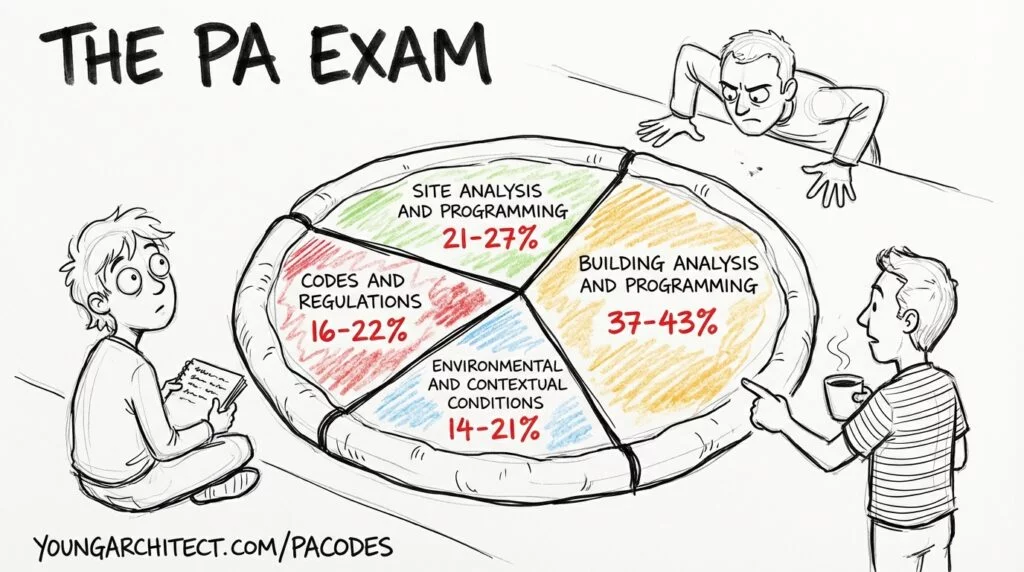
The PA exam covers four distinct sections:
- SECTION 1: Environmental & Contextual Conditions 14-21%
- SECTION 2: Codes & Regulations 16-22%
- SECTION 3: Site Analysis & Programming 21-27%
- SECTION 4: Building Analysis & Programming 37-43%
Notice that Section 4 actually carries the heaviest weight, but Section 2 is still crucial because building codes and regulations impact every other aspect of architectural programming.
You can’t properly analyze environmental conditions without understanding zoning requirements. You can’t integrate building systems without knowing fire resistance ratings and code requirements.
And you certainly can’t program spaces without understanding occupancy classification and means of egress requirements.
Section 2: Codes and Regulations Overview
NCARB defines this section with characteristic precision:
In this section, you’ll look at the codes and regulations appropriate to the initial analysis and programming phase of a project.
This isn’t about memorizing code sections or becoming a walking encyclopedia of regulations. It’s about understanding how codes and regulations actually work in practice:
- How do you identify which codes apply to your project?
- How do you translate those requirements into actual design criteria?
- How do you apply those criteria to real design solutions?
As we discuss in our Programming & Analysis 101 course, the beauty of building codes is that they’re not arbitrary rules designed to make your life difficult. They’re carefully crafted requirements based on decades of building performance, safety research, and hard-learned lessons.
This section tests three specific objectives, each building on the previous one to create a complete picture of how architects work with codes and regulations in real practice.
Objective 2.1: Identify relevant code requirements for building and site types
As an architect, you need to be able to determine and understand the codes and regulations that govern a specific project type and geographic region.
This includes distinguishing relevant accessibility and ADA requirements, applicable building and energy codes, and sustainability-related standards and guidelines.
It’s important to conduct an initial code analysis to understand how the codes will affect a project’s design.
This objective represents 5-9% of the entire PA exam, making it the foundation everything else builds on. You can’t apply codes correctly if you don’t know which ones apply in the first place.
Understanding Early Code Research
This objective is all about early code research that prevents project disasters down the road.
This isn’t about memorizing every fire rating or exit width. This is about understanding which codes apply to your specific project type and location, and how those codes will shape your programming decisions.
It’s like how a detective gathers all the clues and information before trying to solve a case. You collect all the evidence upfront rather than discovering crucial facts halfway through.
The “Big Three” Codes
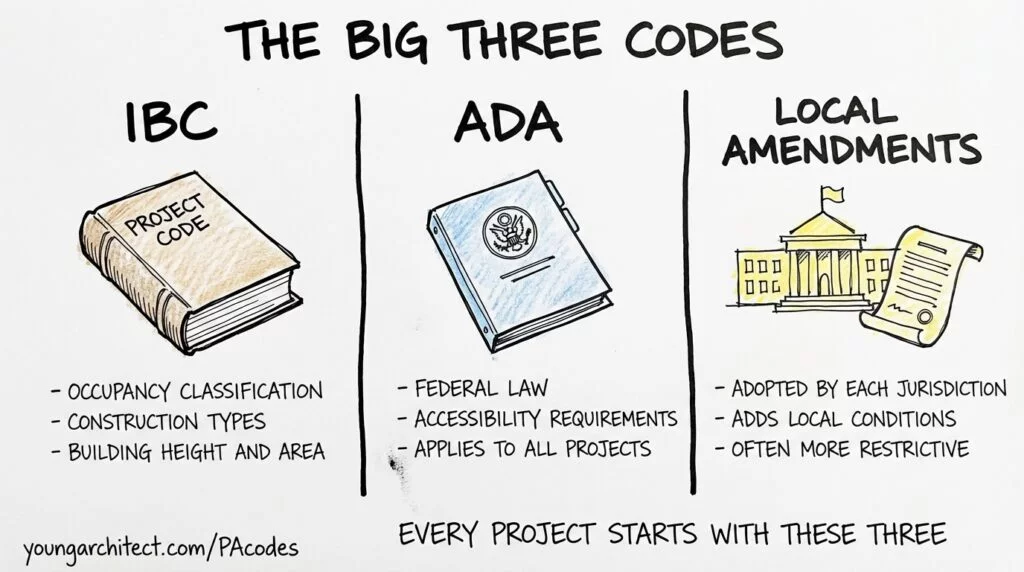
The key concept here is what we call the “Big Three” codes that show up on almost every project:
1. International Building Code (IBC)
This is your foundation document that covers occupancy classification, construction types, building heights, and areas.
For architectural programming, this is huge because your occupancy classification drives so many space requirements.
Modern building codes developed from decades of real-world failures and hard-learned lessons. Understanding that history helps you see why these requirements exist, not just what they say.
2. Americans with Disabilities Act (ADA)
This is federal accessibility law, and it’s not optional. ADA compliance affects everything from your parking ratios to your restroom layouts to your corridor widths.
3. Local Amendments and Variations
Most jurisdictions adopt the IBC, but they often add their own modifications based on local conditions.
This is where our Building Codes 101 course really helps. You need that solid foundation in occupancy classification and construction types before tackling PA.
The Critical Principle
Here’s the critical principle that trips up a lot of people:
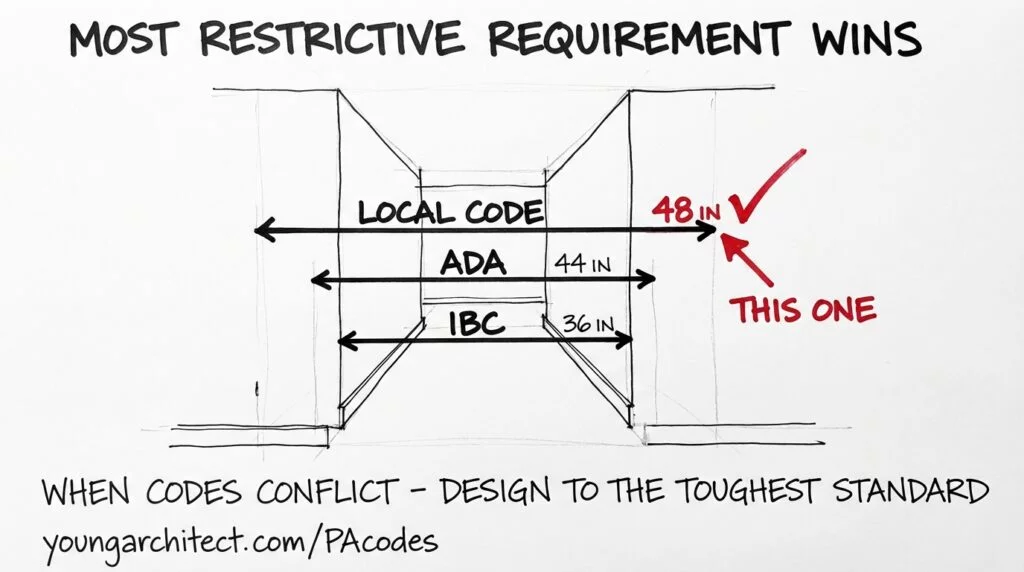
When codes conflict, the most restrictive requirement wins. Always.
If the IBC says you need 36 inches for an accessible route, but local building codes require 42 inches, you’re designing for 42 inches.
The beauty of doing this analysis during programming is that you can make informed decisions about space allocation, circulation patterns, and even building orientation before you start designing.
We walk through exactly this process in our PA 101 course, where a case study shows how code research influences programming decisions from day one.
Objective 2.2: Identify relevant zoning and land use requirements
You need to be able to determine and understand requirements that limit the extent of site and building development.
This includes issues like setbacks, footprint limitations, maximum building heights, FAR, parking requirements, easements, and other zoning and land use regulations.
Recognizing situations where a special exception or variance is suitable and understanding the process for approval are also included in this objective.
This objective, representing 5-9% of the entire PA exam, bridges the gap between knowing which codes apply and actually using them to drive design decisions.
Site Constraints That Shape Design
This objective is all about site constraints that shape your building before you even start designing. It’s understanding what you CAN build versus what you WANT to build.
An important distinction to keep in mind: zoning controls what you’re allowed to build on a site (use, density, size), while building codes control how you build it (life safety, fire protection, egress). Both shape your project, but they come from different places and serve different purposes.
While building codes tell you how to construct safely, zoning requirements tell you what you’re allowed to put where, how big it can be, and how it needs to relate to property lines and neighboring buildings.
It’s like playing Tetris, but the game board has rules about where certain pieces can go.
Floor Area Ratio, Setbacks, and Zoning Limits
These are the hard constraints that define your building envelope:
- Setbacks determine how close you can build to property lines
- Height limits cap how tall your building can be
- Floor Area Ratio (FAR) controls the total building area relative to your lot size
Here’s a quick floor area ratio calculation to show how this works. If you have a 10,000 square foot lot with a FAR of 2.0, your maximum allowable building area is 20,000 square feet.
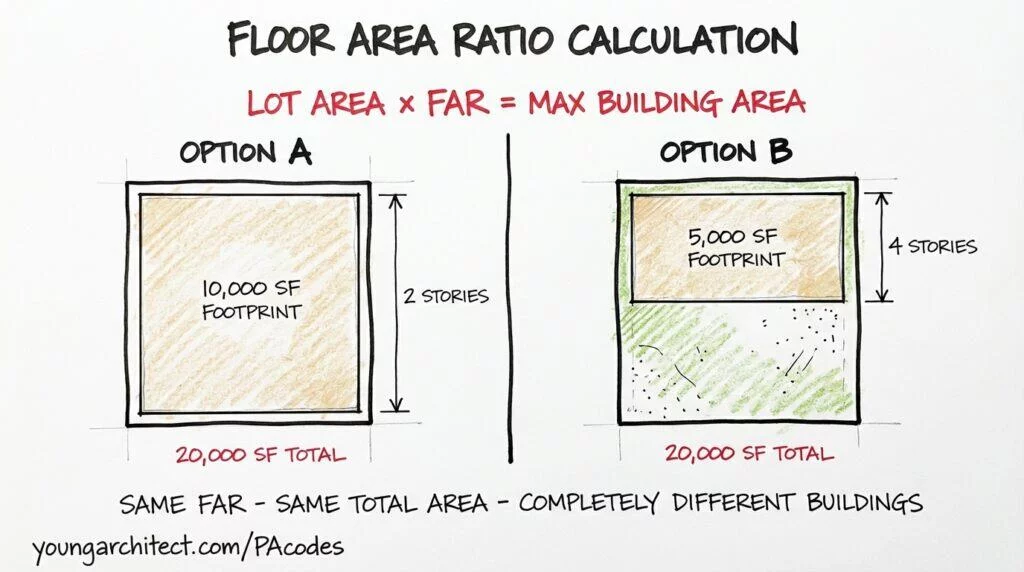
You could build a two-story building that covers the entire lot, or a four-story building that covers half the lot.
The math is simple, but the strategy is what matters. How do you distribute that allowable area to best serve your program?
These zoning constraints also affect project feasibility and construction cost estimates. The size and shape of what zoning allows directly impacts your budget before you ever start designing.
Parking and Use Requirements
Parking requirements are often more complex than people realize:
- Different uses have different ratios
- Reductions available for transit-oriented development
- Mixed-use projects have special considerations
Variances and Conditional Use Permits
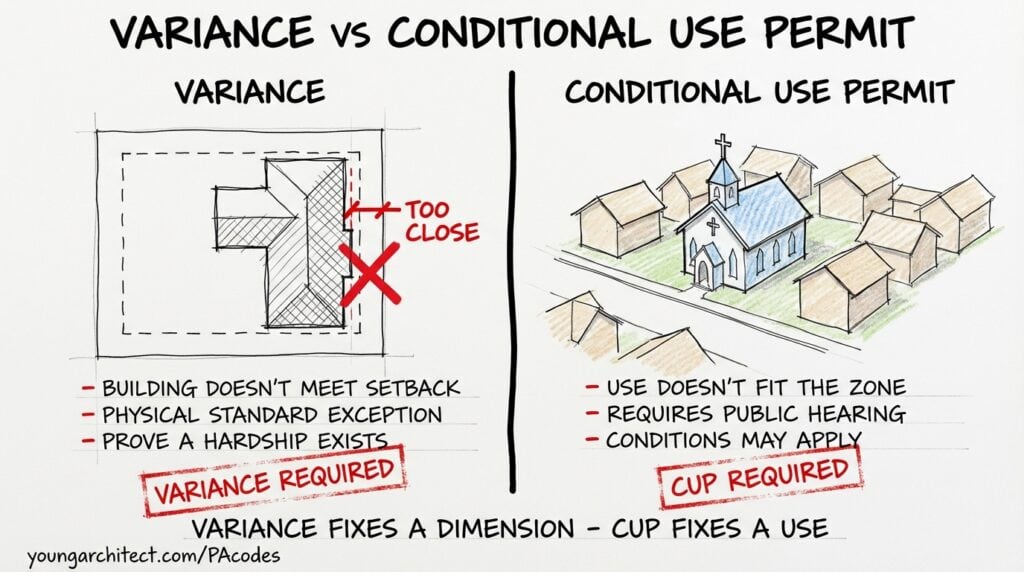
Sometimes the standard rules don’t fit your project. That’s where zoning exceptions come in:
A zoning variance is a formal exception to a specific zoning requirement, like a setback distance or a height limit. A variance typically requires the applicant to demonstrate a hardship, like an unusually shaped lot or significant topography, that prevents normal development under the existing rules.
A conditional use permit allows a land use that isn’t automatically permitted in a zoning district but can be approved under specific conditions. If your proposed building program includes a use that doesn’t fit neatly into the base zoning, like a church in a residential zone or a drive-through in a commercial district, a conditional use permit provides a path to approval, typically through a public hearing.
Think of asking for a variance like asking your professor for an extension on a final paper. You better be prepared to explain why your situation is unique and won’t set a bad precedent.
Zoning Impact on Programming
If you’re programming a mixed-use building, you need to understand how different zones treat that mixing of uses.
Early zoning analysis helps you work with constraints instead of fighting them. Many projects spend weeks on design concepts that were never going to get approved because they didn’t understand the codes and regulations limitations upfront.
Objective 2.3: Identify relevant local and site-specific requirements
You will need to determine and understand specialty regulations that apply to a particular site.
These may include requirements about wetlands, flood plains, design overlay districts, or historic preservation.
This is the smallest objective in terms of exam percentage (3-7%), but it covers some really important concepts about the special circumstances that make each site unique.
Every Site Tells Its Own Story
This objective is about when standard codes and zoning don’t tell the whole story. Every site has its own unique conditions and constraints that you need to understand before programming.
It’s like every site tells its own story, and you need to read that story before you start writing your design narrative.
Environmental and Historic Constraints
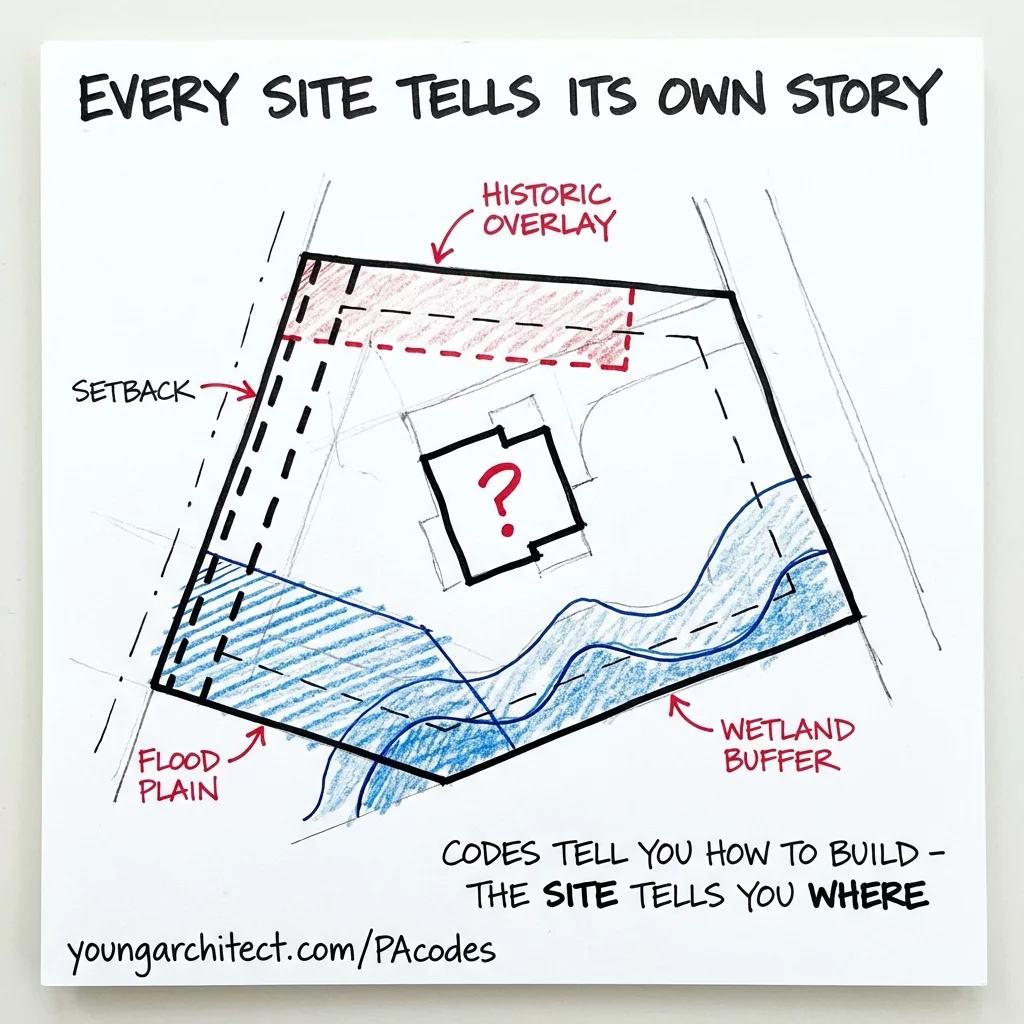
The key areas break down into three main categories:
Environmental Constraints
Federal and state protections that affect your building program:
- Wetlands require buffers and mitigation. You can’t just build over them.
- Flood plains affect foundation design, parking layouts, and ground floor programming.
- Environmental impact considerations for site development.
Historic Preservation Requirements
Specialized standards for historic buildings and districts:
- Secretary of Interior Standards outline four approaches: preservation, rehabilitation, restoration, and reconstruction.
- Each approach has different implications for programming.
- Rehabilitation is most relevant for programming because it involves fitting new functions into historic fabric.
It’s like renovating your grandmother’s house. You have to respect what came before while making it work for today.
Design Overlay Districts
Special zoning areas with additional aesthetic requirements:
- Coastal communities with required architectural styles
- Downtown districts with specific materials and building heights
- Community character preservation requirements
The key insight here is that every site tells a story, and part of programming is understanding that story before you start designing.
Environmental conditions, historic preservation, community character: these all become programming parameters that work alongside codes and regulations.
Study Mistakes That Trip Up PA Candidates
Based on years of helping architects prepare for this exam, here are the most common mistakes that trip up candidates:
1. Trying to memorize codes instead of understanding concepts
People think they need to know every fire resistance rating and exit width, when really this section is about understanding which codes apply and when to research them during programming.
2. Not understanding the “most stringent code wins” principle
They’ll focus on the IBC requirements and completely miss that there’s a local building codes amendment that’s actually more restrictive.
3. Treating zoning as something to deal with later
Instead of integrating it into early programming. Zoning requirements aren’t red tape. They’re fundamental design parameters that should shape your programming from day one.
4. Confusing programming-phase knowledge with construction-phase knowledge
This section isn’t testing whether you can detail a fire-rated assembly. It’s testing whether you understand when fire separation requirements apply and how that affects your programming.
5. Not connecting codes to occupancy types
Your building function drives almost everything else in terms of regulatory requirements, but people study these as separate topics.
6. Overlooking ADA as separate from building codes
ADA compliance is federal law that applies regardless of which building code your jurisdiction adopts. Understanding that distinction is crucial.
7. Assuming all sites are the same
Every site has unique conditions: environmental constraints, historic significance, local design requirements. These aren’t obstacles. They’re part of the design brief.
8. Understanding FAR conceptually but struggling with the calculations
The math isn’t hard, but you need practice applying it to different scenarios.
9. Focusing only on the IBC and missing other code types
Sometimes NFPA applies, sometimes there are energy codes, sometimes there are specialized standards for your building type.
10. Not understanding the difference between variances and conditional use permits
They’re both ways to work outside standard zoning, but they apply in different situations and have different approval processes. A variance addresses a physical standard like a setback. A conditional use permit addresses the type of use. Getting these confused on the exam costs you points.
What we’ve noticed is that people who make these mistakes are usually trying to memorize information instead of understanding the underlying principles. The exam tests your ability to apply building code compliance knowledge, not recite facts.
Studying for PA Section 2
Given that this section represents 16-22% of your PA exam score, developing a solid study strategy is crucial for success.
Our Course Coverage
At Young Architect Academy, we’ve created a comprehensive approach in our Programming and Analysis 101 course. This course has over 8 hours of video content discussing each objective, about 260+ practice questions, including two detailed case studies that walk you through real programming scenarios.
Ready to master PA Section 2? Our Programming & Analysis 101 course breaks down every objective with real case studies, practice scenarios, and expert guidance. You’ll learn how to integrate codes and regulations into your programming methodology from day one.
We wouldn’t recommend tackling PA without first getting solid in building codes. Our Building Codes 101 course gives you that foundation in occupancy classification, construction types, and fire separations. We created Codes 101 to cover PA, PPD, and PDD together because there’s so much overlap between those three exams.
Need accountability and community support? Our ARE Boot Camp provides 10 weeks of intensive coaching with structured curriculum, weekly live meetings, and ongoing support until you pass all six exams. Get the guidance and accountability that makes the difference between studying and actually passing.
The courses work together perfectly. Codes 101 gives you the foundation, then PA 101 shows you how to apply that knowledge in specific programming scenarios.
Beyond Our Courses: Study Recommendations
Here are 6 essential study strategies for mastering PA Section 2:
1. Master the “Big Three” Codes
Get familiar with the IBC structure, especially chapters 3, 5, and 6. Understand the difference between ADA compliance standards and ANSI requirements. Research what local amendments apply in your area.
2. Practice FAR and Zoning Calculations
Find real zoning ordinances online and work through development scenarios. The math is straightforward, but you need to understand how it affects programming decisions.
3. Study Real Projects in Your Area
Look up zoning maps and find examples of projects that needed variances or conditional use permits. Understanding the approval process helps you recognize when these tools are appropriate.
4. Understand Occupancy Types Inside and Out
This drives everything else in building codes. Practice identifying occupancy classification for different building scenarios.
5. Learn Historic Preservation Basics
The Secretary of Interior Standards outline four approaches: preservation, rehabilitation, restoration, and reconstruction. Know when each applies and how they affect programming.
6. Work Through NCARB Practice Questions
The PA exam practice exam has excellent examples that show you exactly how these concepts get tested. These practice questions are gold. They show you the level of detail NCARB expects.
If you’re not sure which exam to take first or how to build an ARE study schedule that actually works, start there before diving into any single section.
Remember: we’re not studying just to pass an exam. We’re studying to become better architects. This codes and regulations knowledge serves you throughout your entire career and makes you more confident in early project phases. Make sure to use multiple study methods rather than relying on just one approach to master these concepts.
Frequently Asked Questions About Building Codes on the PA Exam
What is building code compliance in architecture?
Building code compliance means designing a building that meets all applicable codes, standards, and regulations for its location and use type.
For most projects, that starts with identifying the International Building Code (IBC) requirements for occupancy and construction type, along with ADA accessibility standards and any local amendments that are more restrictive.
Compliance isn’t a final checklist. It’s an ongoing part of the design process from programming through construction documents.
What is floor area ratio and how is it calculated?
Floor area ratio (FAR) is a zoning tool that controls the total buildable square footage on a site relative to the lot size.
To calculate FAR, multiply the lot area by the FAR number. For example, a 10,000 square foot lot with a FAR of 2.0 allows up to 20,000 square feet of building area.
That area can be distributed across multiple floors: a two-story building covering the full lot or a four-story building covering half of it.
What is a conditional use permit and when is it required?
A conditional use permit (CUP) allows a land use that isn’t automatically permitted in a zoning district but can be approved under specific conditions.
If your proposed building program includes a use that doesn’t fit neatly into the base zoning, like a church in a residential zone or a drive-through in a commercial district, you’ll likely need a CUP.
The approval process typically involves a public hearing, and conditions may be attached that affect your design or operations.
What is the difference between a variance and a conditional use permit?
A zoning variance is an exception to a specific dimensional or physical zoning requirement, like a setback or height limit. A conditional use permit addresses the type of use being proposed, not the physical standards.
If your building is too close to the property line, you need a variance. If your proposed use isn’t permitted by right in that zone, you need a conditional use permit.
Both require approval from a zoning board or planning commission.
How does building code compliance affect the PA exam?
On the PA exam, building code compliance is tested in Section 2, which covers 16-22% of the total score.
NCARB tests your ability to identify which codes apply to a project, understand how they shape programming decisions, and recognize when zoning exceptions like variances or conditional use permits are appropriate.
You’re not expected to memorize specific code sections. You’re expected to understand how to use codes as a design tool from the earliest phases of a project.
Putting It All Together
Codes and regulations represent a significant portion of the PA exam for good reason. They’re fundamental to everything architects do.
Whether you’re planning a small residential addition or a major commercial complex, your ability to identify applicable requirements, determine design criteria, and apply those criteria to design solutions affects project success, public safety, and your professional liability.
Mastering PA Section 2 isn’t just about passing this portion of your exam, though that 16-22% of your score certainly matters. It’s about developing the systematic thinking and practical knowledge that will serve your entire architectural career.
The architects who excel at codes and regulations aren’t the ones who memorize every requirement. They’re the ones who understand how to navigate complex regulatory environments, balance competing requirements, and find design solutions that achieve both compliance and design excellence.
Your journey to architectural licensure represents an investment in developing these essential skills. Take the time to truly understand building code compliance, practice applying it to real scenarios, and develop the confidence to tackle any regulatory challenge your future practice might present.
Ready to dive deeper? Check out our Programming & Analysis 101 course and get the foundation you need with Building Codes 101.
Both are included in our ARE 101 Course Membership along with all our other ARE prep resources.
Want personalized guidance and accountability?
Join our ARE Boot Camp for 10 weeks of structured curriculum, weekly coaching calls, and ongoing support until you pass all six exams. Stop studying alone and start passing with confidence.