
Test taking strategies are the difference between candidates who walk out of the testing center confident and candidates who studied just as hard but felt blindsided by how the questions were worded. If you’re preparing for the Architect Registration Exam, this guide walks you through exactly how to read ARE exam questions strategically, catch qualifier words, and use multiple choice strategies to eliminate wrong answers even when you’re not 100% certain.
This podcast is also available on YouTube, Spotify, and Apple Podcasts
The Test Taking Problem ARE Candidates Face
You’ve put in the work:
- Studied building codes or project delivery methods until you could recite them in your sleep
- Mastered the concepts of AIA contracts inside and out
- Completed hundreds of practice questions
- Properly covered each exam objective to make sure NCARB can’t surprise you with unknown content
But you walk out of your exam feeling like you just played some kind of twisted guessing game instead of demonstrating what you actually know about architecture.
Here’s the thing: knowing the content isn’t enough to pass ARE questions.
I’ve seen brilliant people fail these exams repeatedly, not because they lack knowledge, but because they don’t know how to analyze questions strategically.
If you think about it, all NCARB is really testing is your ability to:
- Read the question
- Think about it
- Choose the right answer
Whether you’re taking your first ARE exam or you’re frustrated after a failed attempt, mastering test taking strategies and following a realistic ARE study schedule will transform your exam performance.
These same techniques will make you better in the office when you’re interpreting building codes, reviewing RFIs, or communicating with clients about complex issues.
Let’s break down exactly how to beat ARE exam questions even when you’re not 100% sure of the answer.
Why Smart People Still Mess Up ARE Questions
I’ve been helping candidates since 2013, and I see this pattern constantly: brilliant people fail these exams not because they lack knowledge, but because they don’t know how to read questions strategically.
Here’s what’s actually happening:
Test anxiety changes how your brain processes information. You start second-guessing things you normally know without thinking.
I remember working with one ARE Boot Camp student who could explain building code requirements in detail during our study sessions. She had years of practice experience and genuinely understood the concepts.
But she failed Practice Management twice because she kept misinterpreting what the questions were actually asking.
That’s not a knowledge problem. That’s a studying the wrong way problem.
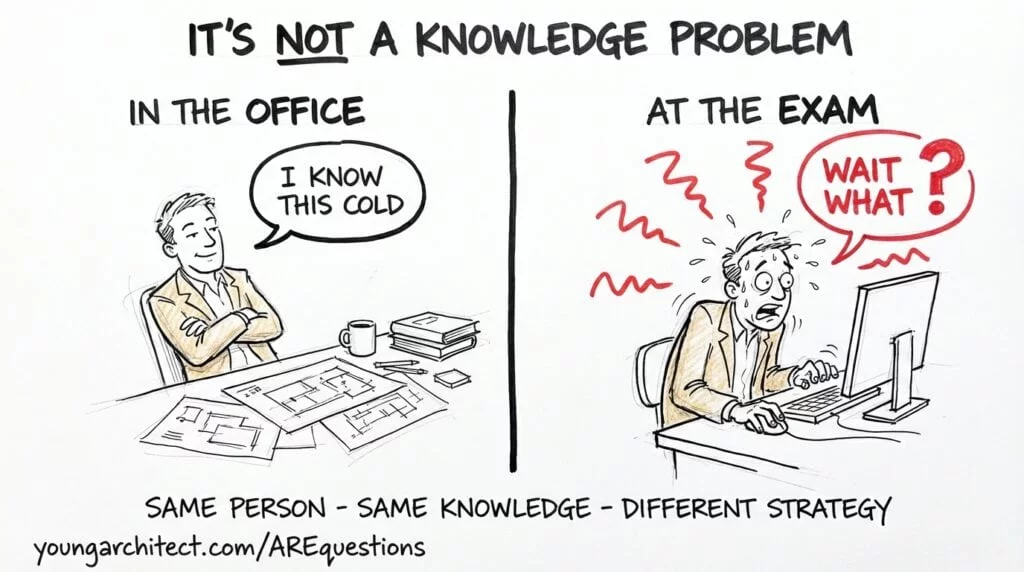
The confidence-performance connection is huge. When you don’t trust your preparation and your process, your brain can’t access what you know effectively.
ARE exam prep must include practicing question analysis, not just memorizing facts.
Because here’s what most exam prep fails to acknowledge: NCARB is testing your professional judgment under pressure, not perfect recall of information.
How to Read ARE Exam Questions Strategically
Let me show you how NCARB actually structures these questions, because once you see the pattern, everything becomes clearer.
Most ARE exam questions follow this format:
- They give you an elaborate scenario
- They provide context that sounds important
- Then they ask you the actual question
The critical thing to understand is that what’s really being tested usually appears in that final sentence.
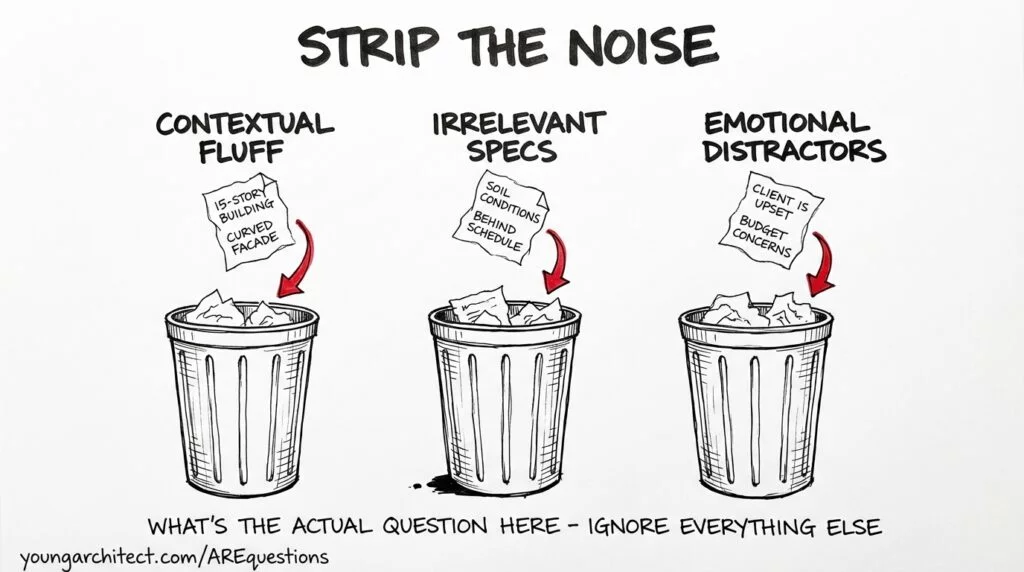
Here’s what trips up candidates: NCARB loves adding details that sound crucial but aren’t needed. That elaborate setup? Pure noise you need to strip away.
For example, they’ll tell you about a three-story commercial building with curved facades, mention that the project is behind schedule due to soil conditions, and talk about the client’s budget concerns.
But then the actual question asks about proper protocol for handling a discrepancy between structural and architectural drawings.
Three Types of Distracting Information
- Contextual fluff – Background that sounds realistic but doesn’t help solve the problem
- Irrelevant specs – Technical details that sound important but don’t relate to what’s tested
- Emotional distractors – Timeline pressures or drama that aren’t relevant to the core issue
How to Cut Through the Noise
Read the question twice.
On your first read, get the general situation.
On your second read, focus only on what they’re actually asking you to determine.
Cross out or mentally ignore details that don’t directly relate to the final question. In the example above, you’d focus on “discrepancy between structural and architectural drawings” and ignore everything about curved facades and schedule delays.
The question to always ask yourself:
“What’s the actual question here?”
The Five Qualifier Words That Change Everything
Let me tell you about the most expensive word I ever missed on an exam.
I was taking Programming and Analysis, completely confident in my answer, when I realized I’d missed the word “LEAST” in the question. I had picked what I thought was the right answer based on my knowledge, which was exactly wrong because I missed that one crucial word.
The five qualifier words you absolutely must watch for: MOST, LEAST, FIRST, BEST, and PRIMARY.
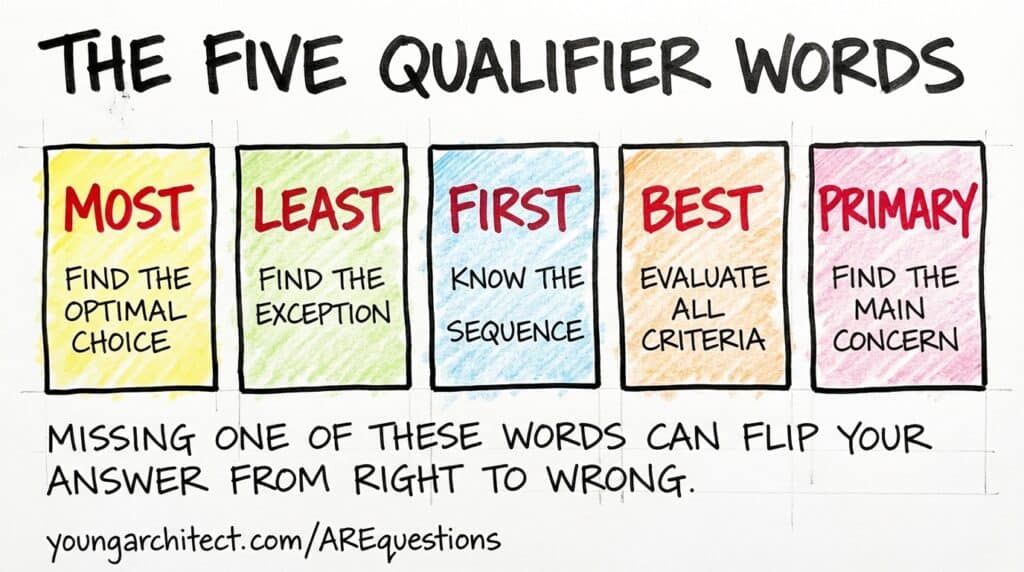
Each one tests something different:
- MOST – Compare valid options to find the optimal choice. The others aren’t wrong, one is just more right.
- LEAST – Find the exception or worst option among reasonable choices.
- FIRST – Know proper sequence and process priorities. This usually tests chronological project phases or procedural order, so if an answer is a great idea but happens at the wrong stage, it’s wrong.
- BEST – Evaluate solutions against multiple criteria for optimal approach.
- PRIMARY – Distinguish main concerns from secondary issues.
Sometimes the “BEST option” really means “the best of several bad options.” Don’t overthink it. All the choices might be problematic, and your job is picking the least problematic one.
If you swapped out that qualifier word, the same question could have a completely different correct answer. That’s how powerful these words are.
Always mentally acknowledge these qualifier words when you see them. Take an extra second to make sure you’ve processed what they’re really asking for.
Multiple Choice Strategies: Eliminating Wrong Answers
Even when you’re not completely confident about the correct answer, you can often eliminate your way to success. This technique completely changed my approach to difficult questions.
Pattern Recognition
Group similar answers together.
If three options discuss structural safety and one talks about aesthetics, that outlier is either correct or a clear distractor. Either way, it narrows your focus.
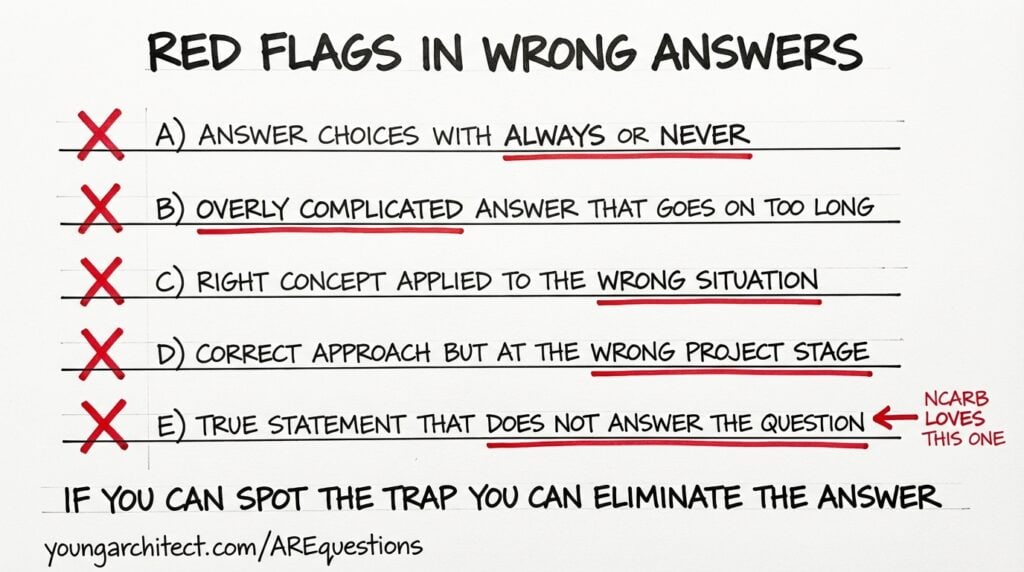
Red Flag Phrases That Signal Wrong Answers
Watch for these patterns in answer choices:
- “Always” or “never” – Architecture rarely works in absolutes
- Overly complex language – The straightforward answer is usually correct
- Right concept, wrong context – A correct approach applied to the wrong situation
- Right approach, wrong timing – A good idea at the wrong project stage
- True but irrelevant – A factually correct statement that doesn’t answer the specific question being asked. NCARB loves this one. The answer is 100% accurate, it just has nothing to do with what they asked you.
When You’re Down to Two Answers
When you’re stuck between two options that both seem reasonable, look for the one that’s more precise or comprehensive. Often the correct answer will be more specific about the actual issue being tested.
You can also verify your choice by reverse engineering the logic.
After you select an answer, quickly ask yourself: “If this answer is correct, does it make sense with everything I know about this topic?”
Sometimes that quick gut check catches mistakes you might have made.
Time Management for Maximum Performance
All these test taking strategies only work if you have enough time to apply them. Poor time management is one of the biggest reasons candidates fail ARE questions.
Here’s the strategy that transformed my exam performance:
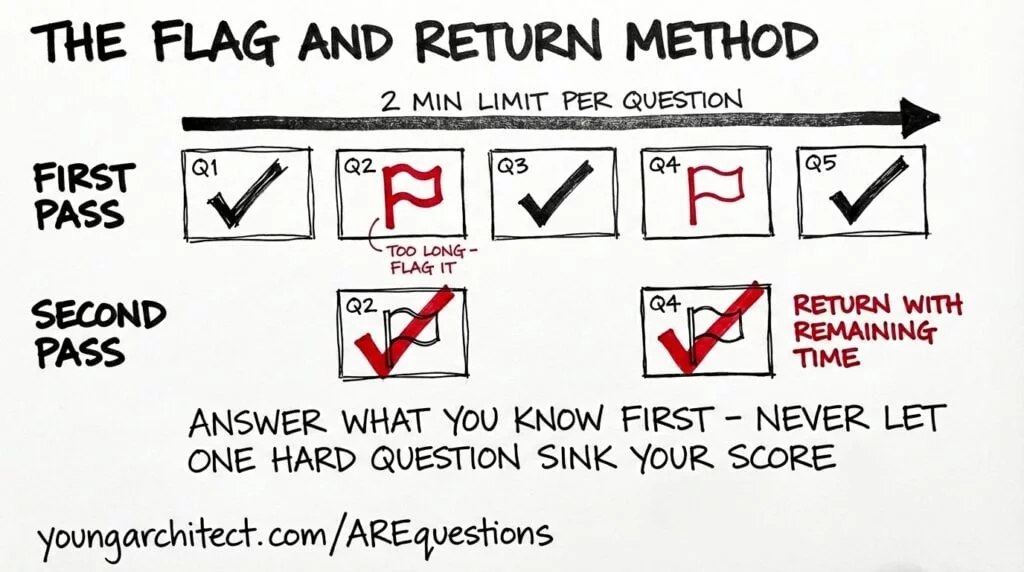
The flag-and-return method
Set a two-minute limit per question on your first pass. If it’s taking longer, flag it and move on immediately.
Complete all the questions you’re confident about first. This builds momentum and ensures you get all your “easy points.”
Then return to your flagged questions with whatever time remains, when the pressure is lower and you can think more clearly.
The key is not constantly checking the clock and panicking about time. When you know you have a systematic approach, you can focus your mental energy on actually analyzing the questions instead of worrying about whether you’ll finish.
Putting It All Together: A Real ARE Exam Question Example
These test taking tips work together as a system. Let me walk you through exactly how I’d approach a typical question using every technique we’ve covered.
Read the question below and try to answer it yourself before scrolling to the breakdown.
The Scenario
An architect is providing construction administration services for a 15-story commercial office building in a coastal high-wind zone. The project is currently two weeks behind schedule. During a recent site visit, the client expressed concerns about the long-term energy efficiency of the building’s envelope. The contractor submits a shop drawing for the curtain wall system that shows a deviation in the structural anchoring bracket, which differs from the original architectural details.
The Question
What is the PRIMARY action the architect should take regarding this submittal?
A) Reject the submittal immediately because it deviates from the architectural design intent.
B) Forward the submittal to the structural engineer to verify the bracket’s load capacity.
C) Request a revised glazing specification from the manufacturer to address the client’s energy efficiency concerns.
D) Review the submittal for aesthetic conformance and instruct the contractor to submit a change order for the bracket modification.
The Breakdown
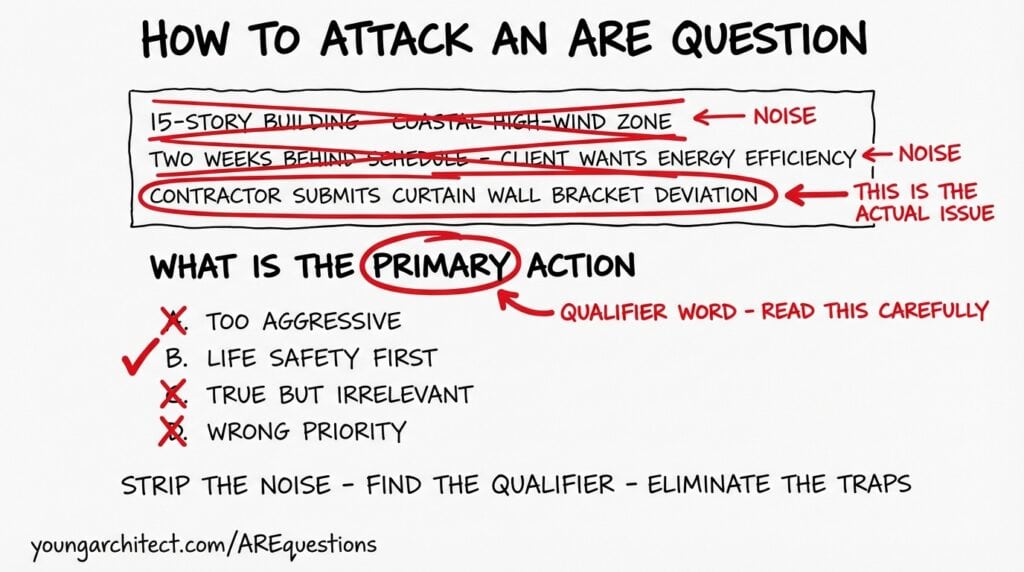
Step 1: Read the question twice.
First read gives me the general situation: reviewing curtain wall shop drawings during CA. Second read focuses on what they’re actually asking: what’s the primary action regarding a structural deviation?
Step 2: Identify the qualifier word.
“PRIMARY” is the key word here. They want me to prioritize among valid concerns, not just find a correct answer.
Step 3: Recognize key contextual clues.
“Coastal high-wind zone” isn’t fluff. It’s telling me what to prioritize. “Deviation in the structural anchoring bracket” is the actual issue.
Step 4: Cross out the noise.
- “15-story” – height doesn’t change the answer here
- “Two weeks behind schedule” – emotional distractor, irrelevant to the submittal question
- “Client’s energy efficiency concerns” – real concern, wrong context for this question
Step 5: Apply strategic elimination.
- Option A: Rejecting immediately is too aggressive. The deviation might be acceptable, but you won’t know without consulting the engineer.
- Option C: This is the true but irrelevant trap. Energy efficiency is a legitimate concern, but it has nothing to do with the structural bracket deviation in this specific submittal.
- Option D: Aesthetic conformance matters, but it’s not the PRIMARY concern when a structural detail has changed in a high-wind zone.
Step 6: Make the strategic choice.
The answer is B. A structural deviation in a coastal high-wind zone is a life safety issue. The architect’s primary action is forwarding the submittal to the structural engineer to verify the bracket’s load capacity before anything else.
This is exactly how professional judgment works in practice. All four options represent things an architect might do at some point, but the life safety issue takes priority given the specific context.
Frequently Asked Questions
What are the most important test taking strategies for multiple choice exams?
The five most effective test taking strategies for multiple choice exams are:
- Read the question twice before looking at answers
- Identify qualifier words like MOST, LEAST, FIRST, BEST, and PRIMARY
- Eliminate obviously wrong answers first
- Flag uncertain questions and return to them
- Verify your final answer by reverse engineering the logic
Practice applying all five consistently and they become automatic.
What qualifier words should I watch for on ARE exam questions?
The five qualifier words that change how you interpret an ARE question are MOST, LEAST, FIRST, BEST, and PRIMARY.
Missing one of these words can flip your answer from right to wrong. Always read the question twice and mentally acknowledge the qualifier before looking at the answer choices.
How do I handle ARE exam questions I don’t know the answer to?
Use the flag-and-return method. Set a two-minute limit per question on your first pass. If a question is taking too long, flag it and keep moving.
Complete the questions you’re confident about first, then return to flagged questions with whatever time remains. This keeps your momentum and prevents one hard question from eating into time you need for easier ones.
If you struggle with exam anxiety, check out our guide on managing test day pressure for additional strategies.
How many practice questions should I do before the ARE?
There’s no magic number, but the quality of practice matters as much as quantity.
The most effective ARE practice questions explain why incorrect answers are wrong, not just what the right answer is. This trains you to analyze questions rather than memorize facts.
The ARE 101 Membership includes 1,300+ practice questions built around this approach, with detailed explanations for every answer choice.
Master ARE Questions with the Right Practice and Support
The test taking strategies that transform your ARE performance: strip away the noise, watch qualifier words, use strategic elimination, manage time with flag-and-return, and practice consistently.
These test taking skills build with practice. The more you apply these exam strategies during study sessions, the more natural they become during the actual exam.
But here’s the key:
The only way these strategies become automatic is by applying them to real practice questions under exam-like conditions. If your practice questions don’t show you why wrong answers are wrong, you’re missing the most important part of the drill.
If you’re serious about passing your exams, you have two proven paths:
ARE Boot Camp is our structured 10-week program that breaks studying down into small, manageable pieces. You’ll get personal coaching, weekly live sessions, and ongoing support until you pass ALL your exams. Perfect if you want accountability and a clear roadmap to success. Learn more about how ARE Boot Camp works and what makes it different from self-study.
ARE 101 Course Membership gives you immediate access to over 100 hours of content and 1,300+ ARE practice questions to master the test-taking strategies we discussed in this article. New content added weekly. Ideal for self-guided learners who want comprehensive prep materials.
Our practice questions don’t just give you the answer. Each one is a masterclass in teaching the concepts behind the answer, why the incorrect choices are wrong, and how the topic connects back to each NCARB exam objective.
Haven’t decided which exam to take first? Don’t let that slow you down. And if you’ve been putting off your exams entirely, it’s worth reading about the real cost of delaying your license.
Whether you choose structured coaching or self-paced learning, you’ll have the tools and practice you need to walk into your testing center with confidence.