
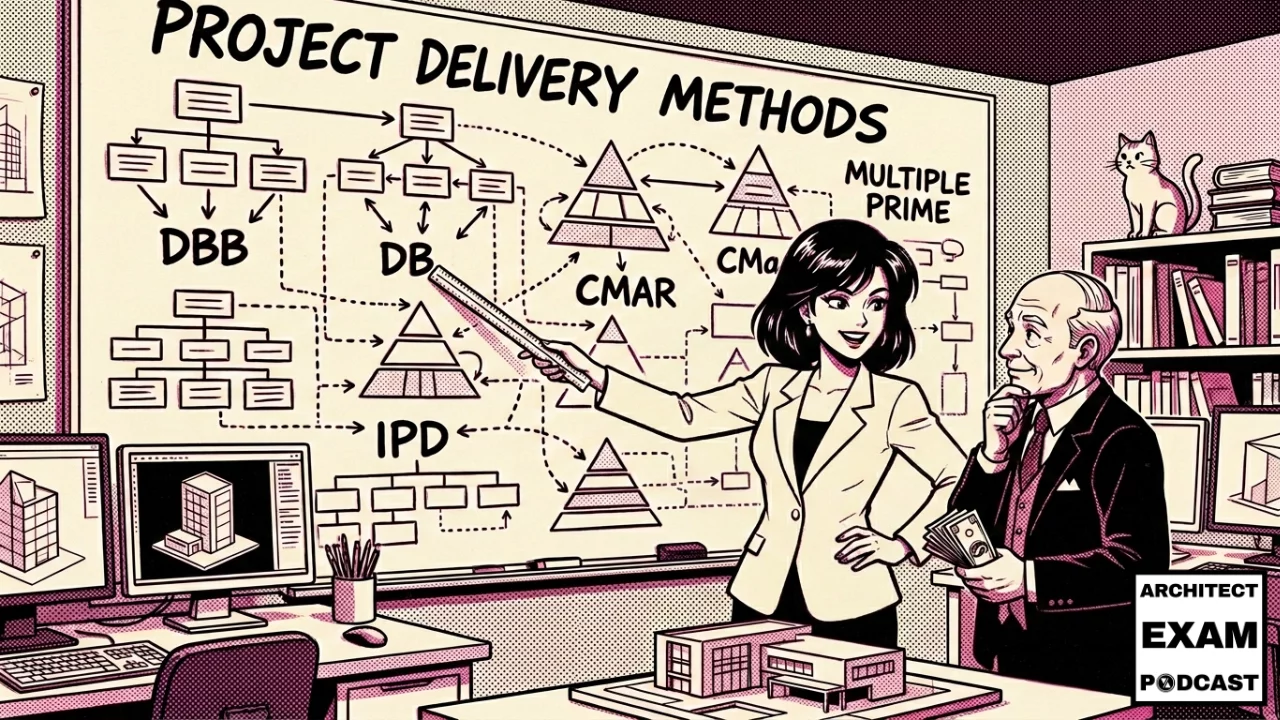

Project delivery methods define the contractual relationships between the owner, the architect, and the contractor on every construction project. This post breaks down all the major construction delivery methods, from Design-Bid-Build to CMAR to Integrated Project Delivery, so you understand who holds the contracts, who holds the risk, and how the architect’s role changes across each one.
This podcast is also available on YouTube, Spotify, and Apple Podcasts
What Are Project Delivery Methods
Every construction project needs someone to design it and someone to build it.
A project delivery method defines the contractual relationships between the owner, the architect, and the contractor. Who has contracts with whom. Who takes on the risk. How the whole process flows from start to finish.
There are several different delivery methods, and each one creates a different structure for how a project gets designed, bid, and built. The major ones we’ll cover are:
- Design-Bid-Build (DBB) — the traditional method
- Design-Build (DB) — one team, one contract
- Construction Manager at Risk (CMAR) — the CM becomes the builder
- Construction Manager as Agent (CMa) — the CM stays an advisor
- Multiple Prime Contracts — the owner acts as their own GC
- Integrated Project Delivery (IPD) — shared risk, shared reward
As you work through each method, keep two questions in the back of your mind. These are the two questions that cut through the confusion every time:
1. Who holds the contracts with the subcontractors?
2. Who holds the risk when things go wrong?
If you can answer those two questions for each delivery method, you have a strong foundation for understanding the differences between them.
The AIA/AGC Primer on Project Delivery is a great foundational reference if you want to go even deeper.
Why This Shows Up on the ARE
There are specific exam objectives about project delivery methods on three different ARE exams.
The Practice Management (PcM) exam tests you on which delivery method fits a given project
The Project Management (PjM) exam tests you on how the contracts and documentation change based on the delivery method
The Construction and Evaluation (CE) exam tests you on how the architect’s role during bidding and construction shifts depending on the method
And here’s what a lot of candidates miss. Even the technical exams that don’t have a specific objective about delivery methods, like PA, PPD, and PDD, still assume you understand this stuff.
A question about building systems or site design could easily be wrapped in a CMAR or Design-Build scenario. If you don’t understand the delivery context, you might miss the question even though it’s technically about something else entirely.
Project delivery methods are also heavily tested on the CDT® certification exam, and it’s consistently one of the most difficult topics for CDT candidates. That’s actually one of the reasons why so many ARE candidates pick up their CDT while studying for the ARE. You’re already learning this material, so you might as well get credit for it.
Learn it once, and it keeps paying off across every exam you take.
Design-Bid-Build (DBB)
The first delivery method is Design-Bid-Build. This is the traditional method. The one that’s been around the longest.
If nobody specifies a delivery method, Design-Bid-Build is usually the default.
The name tells you exactly how it works. You design it. You bid it. You build it. Three phases, in that order. No overlap.
Here’s how it plays out:
- The owner hires the architect first
- The architect designs the entire project through construction documents
- Once the design is completely done, the project goes out to bid
- Contractors look at the finished documents and compete on price (usually the low bidder wins)
- The owner hires the selected contractor under a separate contract
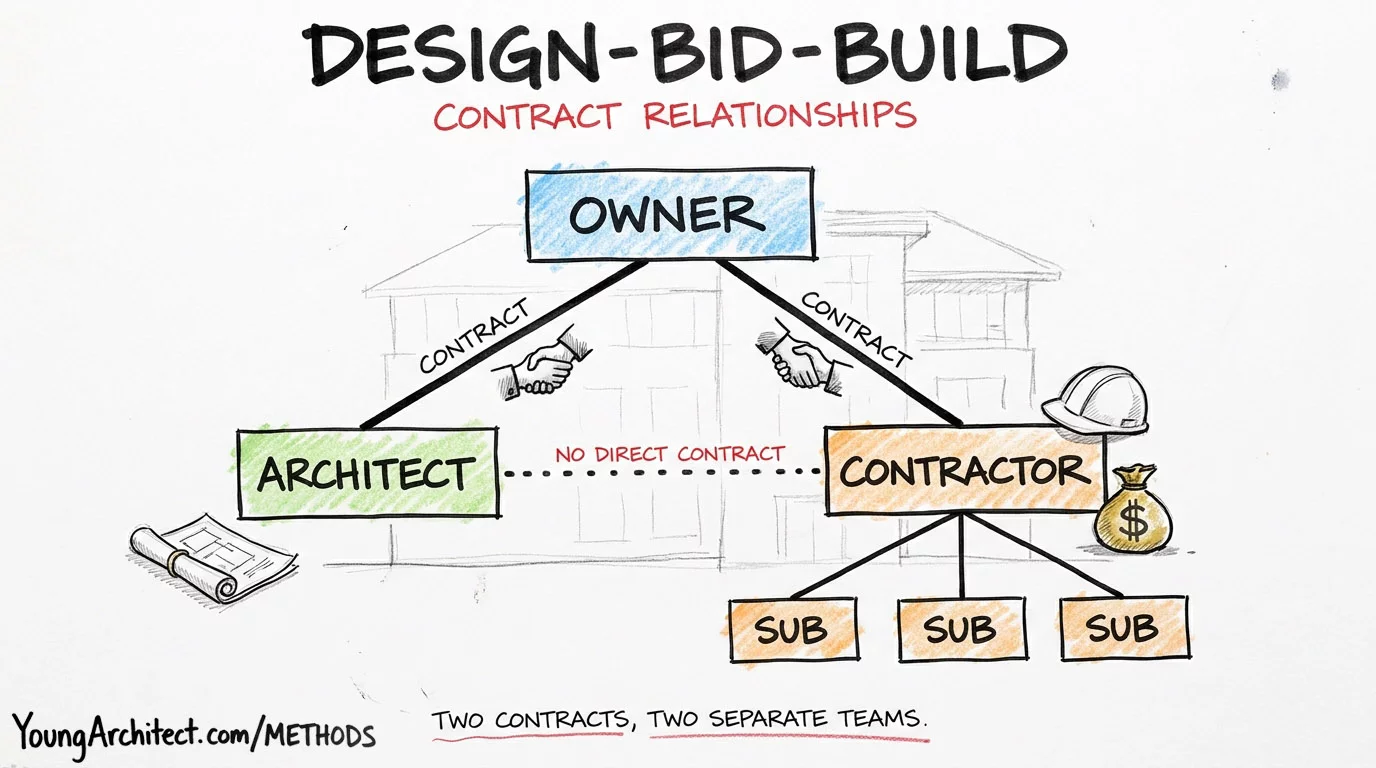
So in Design-Bid-Build, the owner ends up with two separate contracts. One with the architect. One with the contractor.
The architect and the contractor do not have a contract with each other.
This is important. In Design-Bid-Build, the architect acts as the owner’s advocate during construction. The architect is watching out for the owner’s interests, making sure the design intent is being followed, and helping administer the construction contract.
That advocacy role is a big deal, and it’s something that changes depending on the delivery method. Keep that in mind as we go.
The AIA contract documents that support Design-Bid-Build include the A101 (owner-contractor agreement), B101 (owner-architect agreement), and A201 (general conditions). We walk through each of these contracts article by article in our AIA Contracts 101 course.
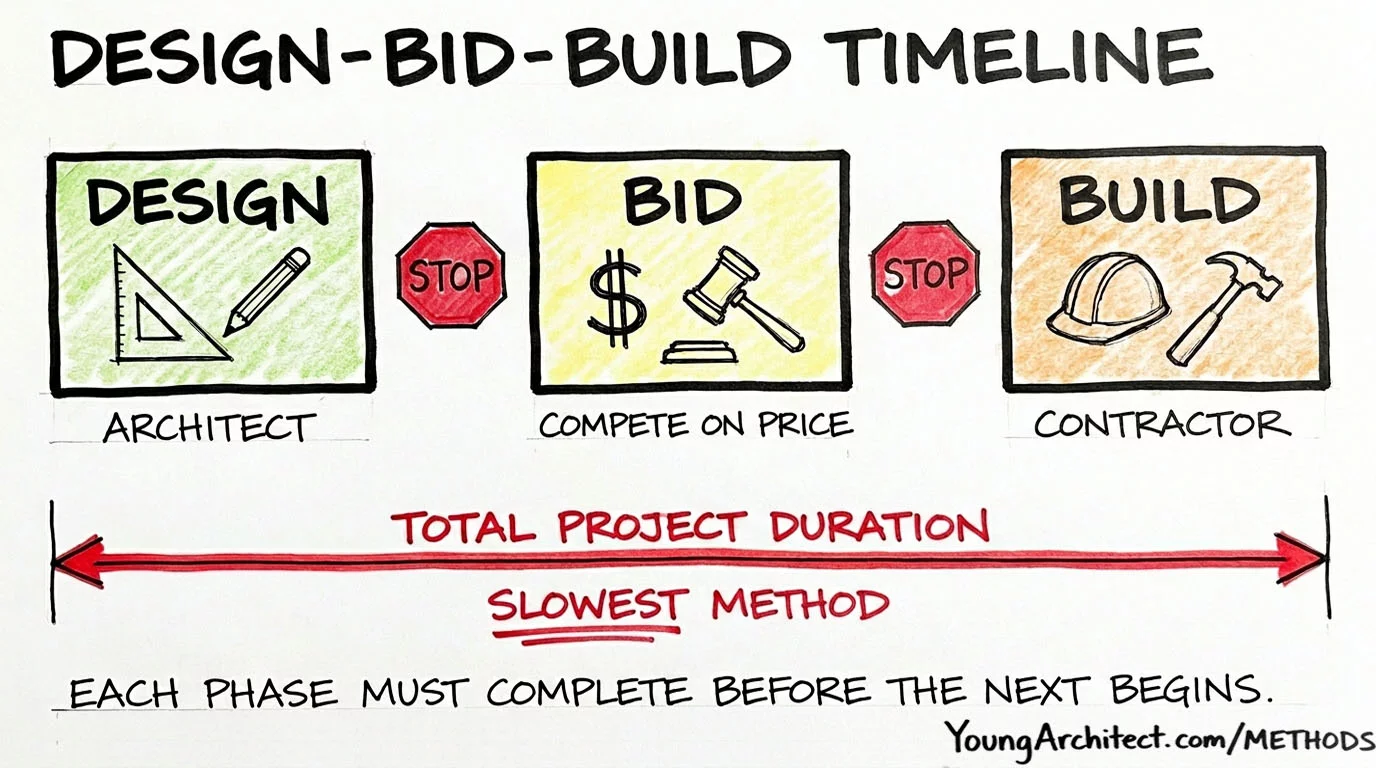
Because everything happens in sequence, Design-Bid-Build is the slowest delivery method. You can’t start building until the design is 100% complete and the bidding process is finished.
For public works projects, this method is often required by law because of competitive bidding requirements.
Design-Bid-Build Pros and Cons
The strengths of Design-Bid-Build:
- Competitive bidding tends to keep construction costs down
- Roles are clearly defined and well understood
- Required by law for many public and government projects
- The architect maintains a direct relationship with the owner as their advocate
The trade-offs:
- Slowest method because everything happens one step at a time
- The contractor has zero input during design, which means constructability issues can show up later
- The separation between design and construction teams can lead to more construction change orders
- The owner doesn’t know the actual construction cost until bidding is complete
Who holds the risk?
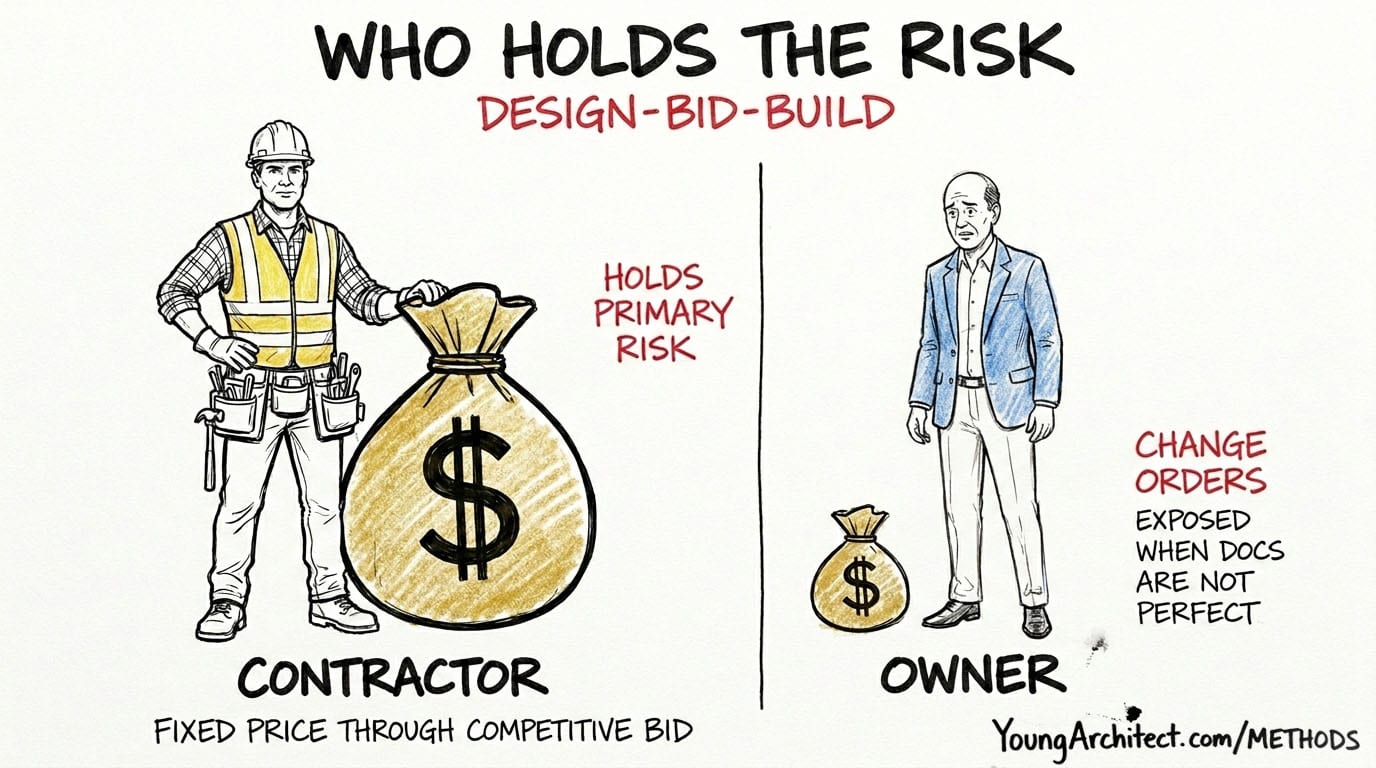
Think of risk as a bag of money that’s needed to solve the problems when things go wrong on a project. Because things always go wrong. The question is, whose money is it?
In Design-Bid-Build, the contractor holds the primary risk through the competitive bid and the fixed price contract. But the owner is still exposed to change orders if the documents aren’t perfect. And since the contractor had no input during design, there’s a higher chance of those change orders showing up.
Design-Build (DB)
Design-Build flips the script on everything we just talked about.
In Design-Build, the owner hires one entity, called the design-builder, for both design and construction. One contract. One team.
The design-builder is typically a contractor who hires the architect as a subconsultant.
If you’re wondering how the design-builder knows what to design when the owner doesn’t have their own architect, the owner typically provides project requirements or performance criteria upfront. Things like the program, the budget, the schedule, and the design goals. That gives the design-builder a clear starting point.
The AIA contract that supports Design-Build is the A141.
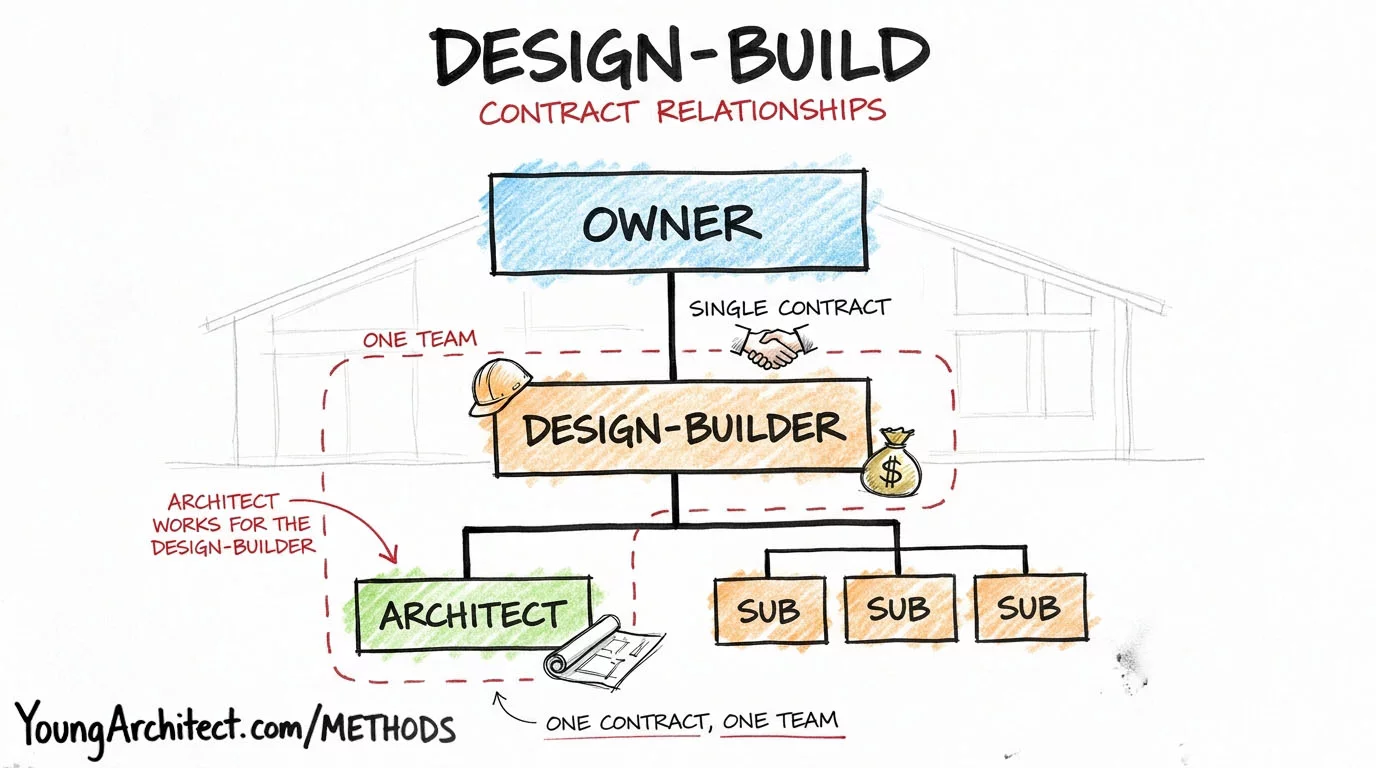
The Architect’s Role in Design-Build
Here’s the big shift you need to understand for the ARE.
In Design-Bid-Build, the architect works directly for the owner. In Design-Build, the architect works for the contractor.
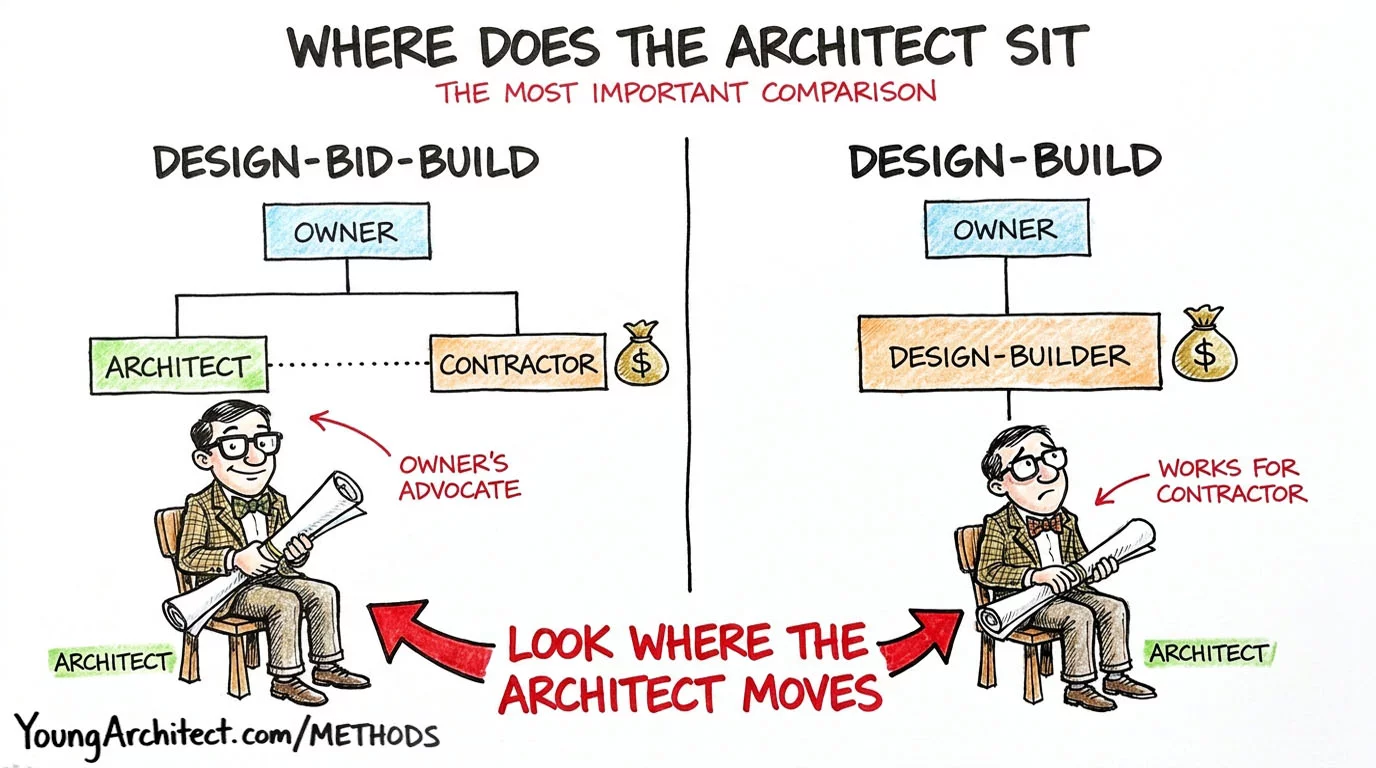
Look at where the architect moves. In Design-Bid-Build, the architect is right next to the owner with a direct contract. In Design-Build, the architect is underneath the design-builder.
That changes everything about the architect’s role. Their loyalty. Who they owe their professional duty to. This concept gets tested heavily on the ARE, so make sure you understand it.
For more on how the architect-consultant relationship is structured in this context, that’s worth understanding as well.
You can also learn more about how the Design-Build Institute of America defines and explains the design-build process.
Fast-Tracking in Design-Build
Because design and construction are under one roof in Design-Build, the two phases can overlap. You can start building parts of the project while other parts are still being designed. This is called fast-tracking, and it’s one of the biggest advantages of Design-Build.
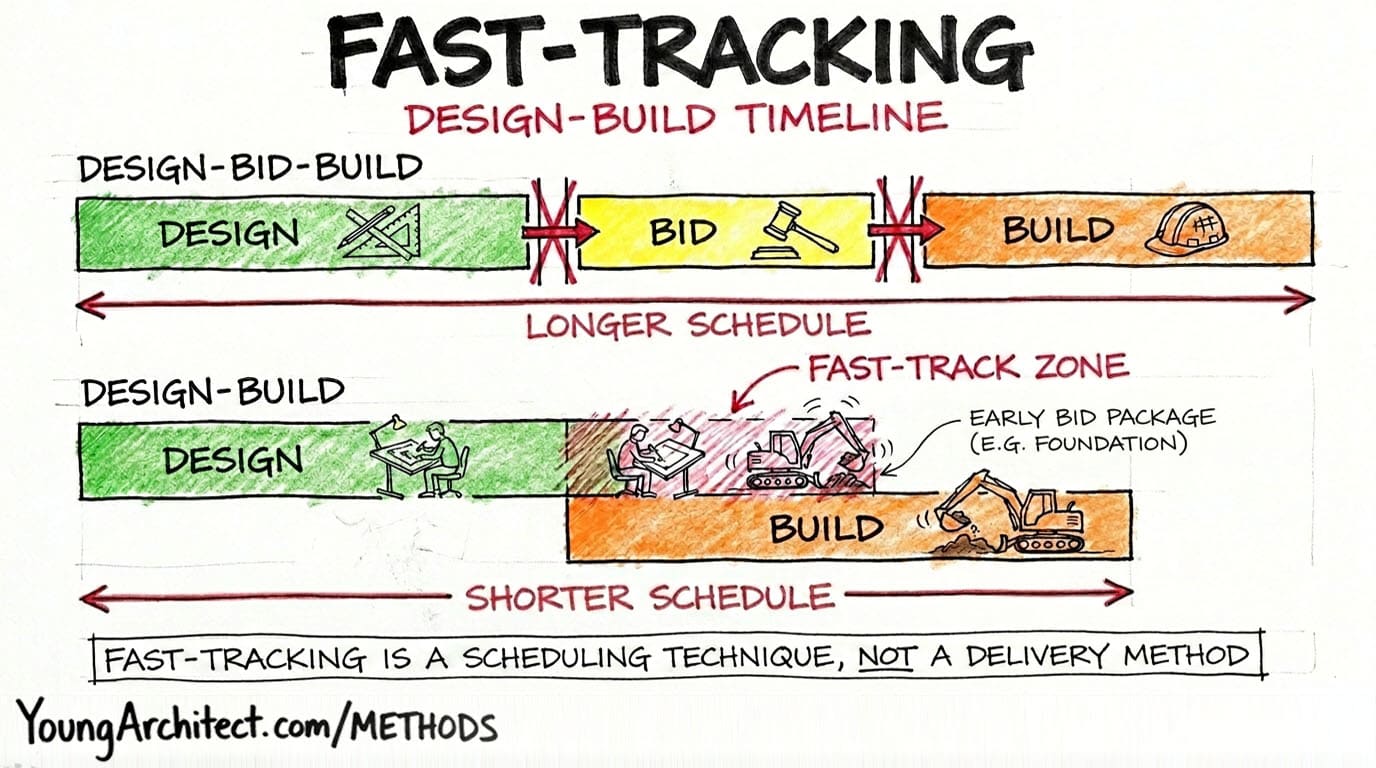
Now, a clarification that trips up a lot of candidates.
Some study materials list fast-tracking as a project delivery method. It’s not. Don’t fall for that on the ARE.
Fast-tracking is a schedule compression technique. It’s the “how fast,” not the “who signs what.” A delivery method defines the contracts and relationships. Fast-tracking just means you’re overlapping phases to save time.
The reason people get confused is that fast-tracking is basically impossible in Design-Bid-Build. The whole point of DBB is that the design has to be 100% complete before you put it out to bid. You can’t bid a fixed price on a half-finished set of drawings.
But in Design-Build, fast-tracking works perfectly because the designer and builder are on the same team. They don’t need a complete, legally binding set of construction documents to start work. They coordinate internally.
And as we’ll see in the next section, CMAR is also a great environment for fast-tracking.
Progressive Design-Build
Progressive Design-Build is a newer approach that adds a safety net to the traditional Design-Build model.
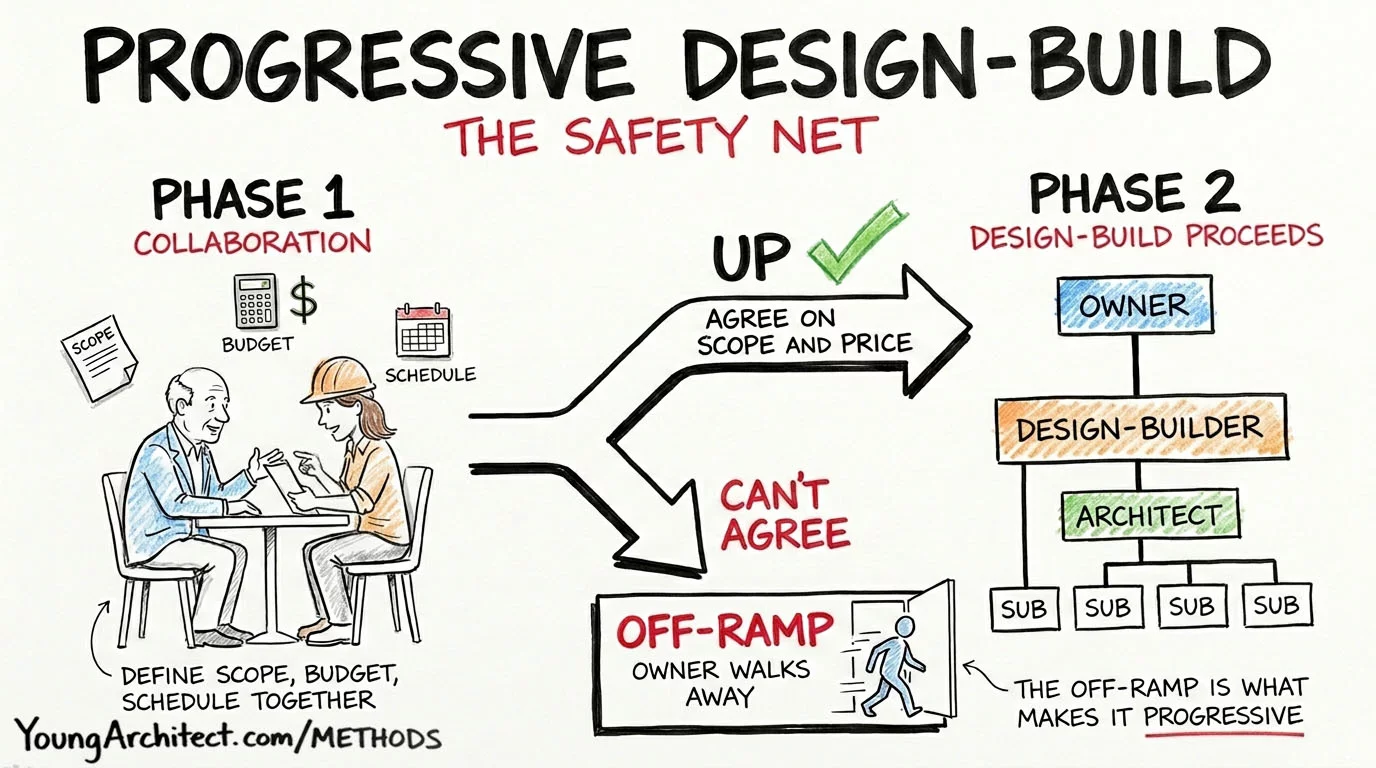
Instead of committing to the full project upfront, the owner and design-builder work together through an initial phase to develop the scope, budget, and schedule collaboratively.
At the end of that first phase, if both parties agree on the scope and price, they move forward into full design and construction.
But if they can’t agree, there’s an off-ramp. The owner can walk away before committing to construction. That off-ramp is the key feature. It reduces the risk of jumping into a traditional Design-Build contract all at once.
Design Assist
Design Assist is when specialty subcontractors, like a curtain wall contractor or an MEP sub, are brought in during the design phase to give input on their specific trade.
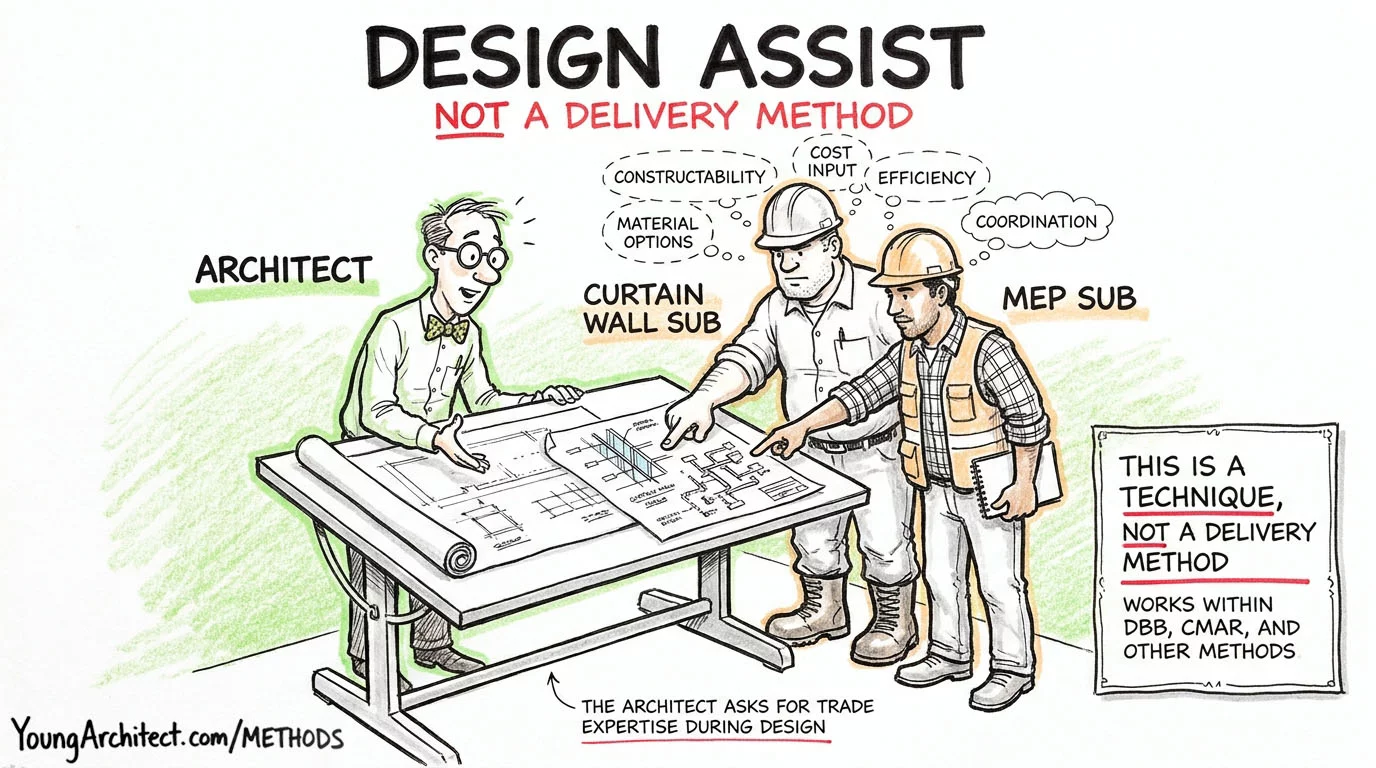
This input improves constructability, helps catch cost issues early, and leads to better coordination between what gets designed and what actually gets built.
Design Assist isn’t a delivery method on its own. It’s a technique that can be used within other delivery methods like Design-Bid-Build or CMAR.
Bridging
Bridging gives the owner more control over the design within a Design-Build framework.
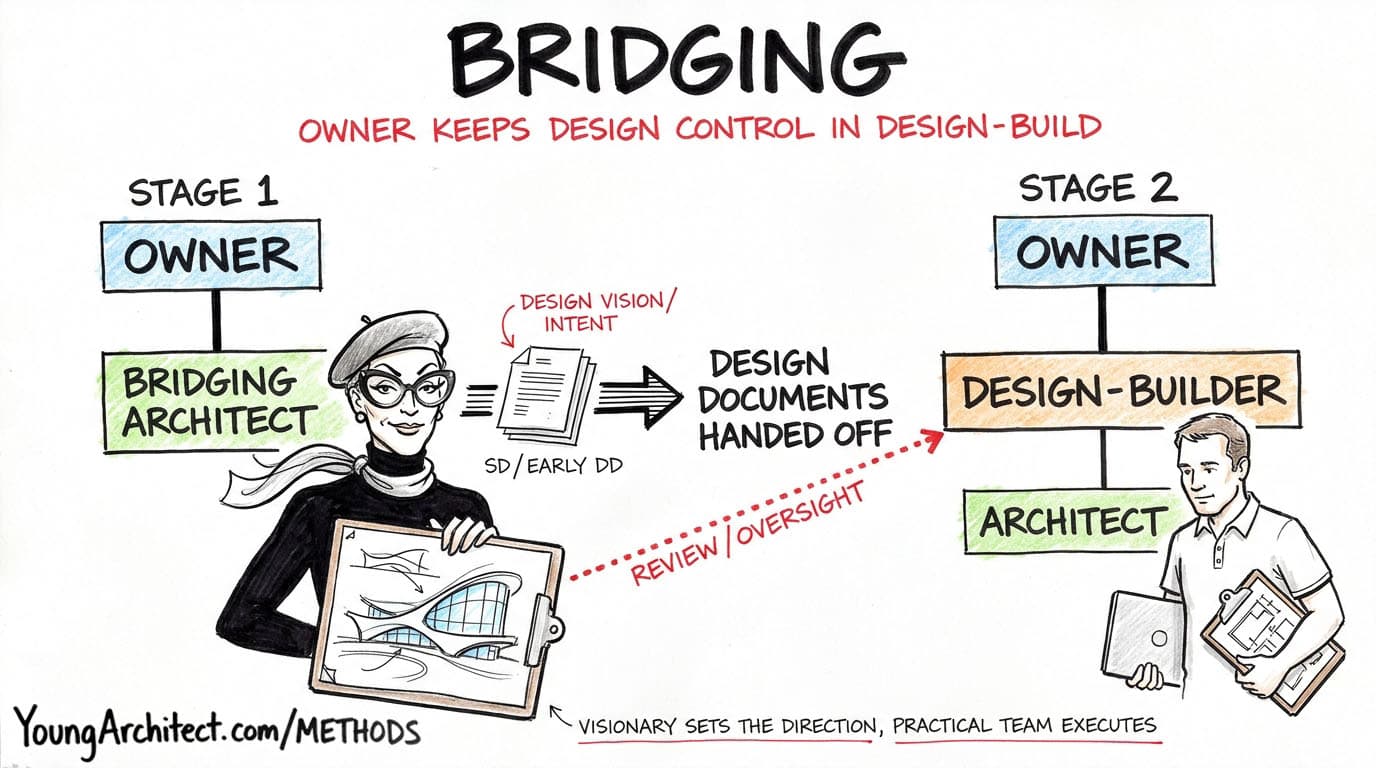
The owner hires an architect to develop partial design documents, usually through schematic design or early design development. Then those documents get handed to a design-builder to finalize and construct.
The owner’s original architect might stay on as a bridging architect to review the design-builder’s work and make sure the original design intent is carried through.
It’s a hybrid approach. The owner gets the speed and single-point responsibility of Design-Build, but with more influence over the early design decisions.
Design-Build Pros and Cons
The strengths of Design-Build:
- Single point of responsibility for the owner
- Streamlined communication with one team
- Contractor input during design means fewer surprises and fewer change orders
- Fast-track delivery is possible because design and construction overlap
The trade-offs:
- No competitive bidding, so the owner might pay more upfront
- The owner has less control over the design process
- The architect’s independence can be compromised since they’re working for the contractor, not the owner
Who holds the risk? The design-builder. One entity, one contract, one bag of money.
Construction Manager at Risk (CMAR)
This is the one that confuses everybody. So let’s take our time and break it down carefully.
Construction Manager at Risk is also called CMAR or sometimes CMc (Construction Manager as Constructor).
In CMAR, the owner hires both an architect and a construction manager under two separate contracts. The architect has a direct contract with the owner. The CM has a direct contract with the owner.
So far, it looks a lot like Design-Bid-Build.
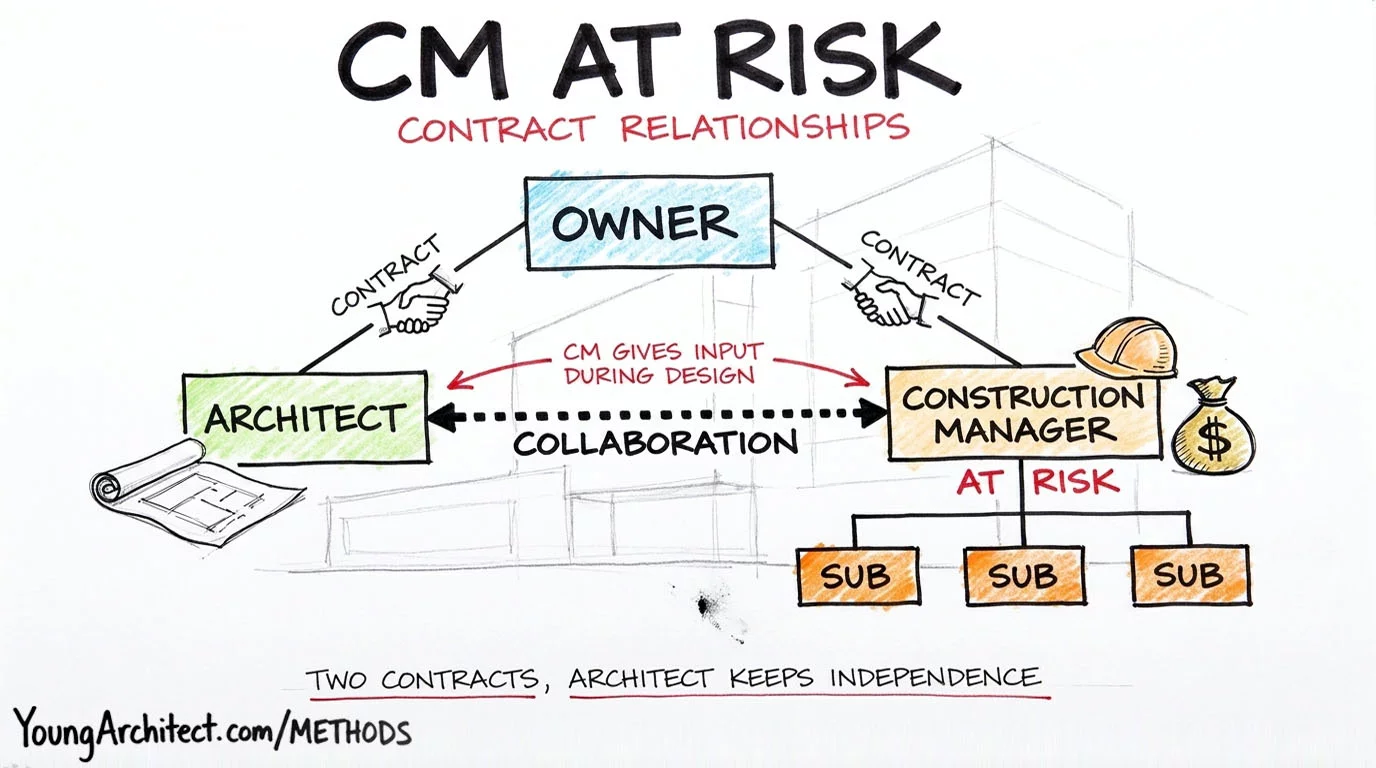
But here’s what makes CMAR different.
The CM starts out as a consultant during the design phase. They’re sitting at the table with the architect and the owner, giving input on cost, schedule, and constructability. This is the preconstruction phase, and at this point, the CM is just advising. They’re not building anything yet.
The AIA contracts that support CMAR include the A133 (owner-CMc agreement for a GMP) and the A134. We cover these contracts in detail in our AIA Contracts 101 course alongside the A101 and B101 families.
What Is a GMP Contract
At some point during design, usually around 60 to 90 percent complete, the CM provides something called a Guaranteed Maximum Price. A GMP.
The GMP contract is exactly what it sounds like. It’s the maximum amount the project will cost. The CM is guaranteeing that number.
The CMAA’s Owner’s Guide to Project Delivery Methods provides a good owner-perspective breakdown of how the GMP fits into the CM at Risk structure.
The Phase Shift
Here’s the critical part.
The moment that GMP is signed, the CM’s role changes. They go from being a consultant to essentially becoming the general contractor. They hold all the subcontracts. They manage construction. They’re running the job.
That signature on the guaranteed maximum price is the trigger for the entire shift.
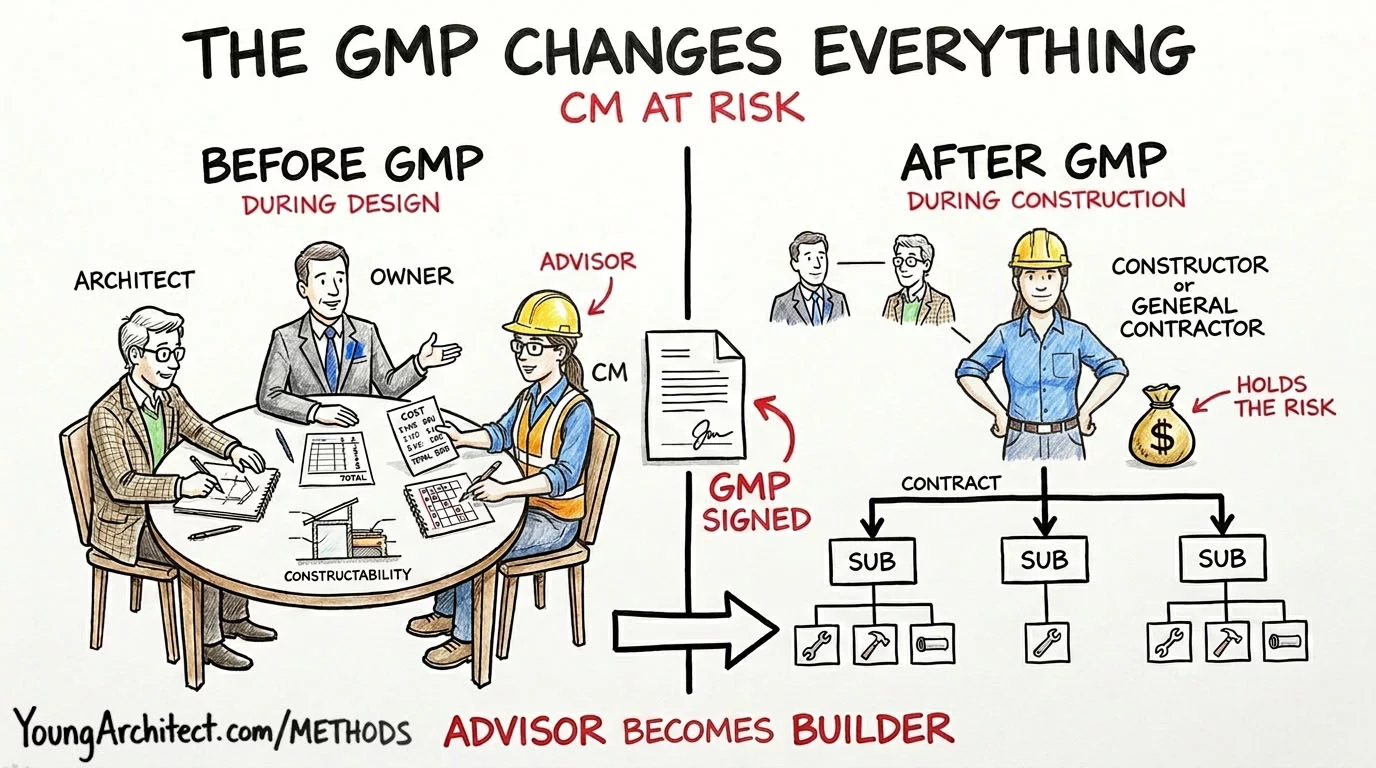
That’s why it’s called “at risk.”
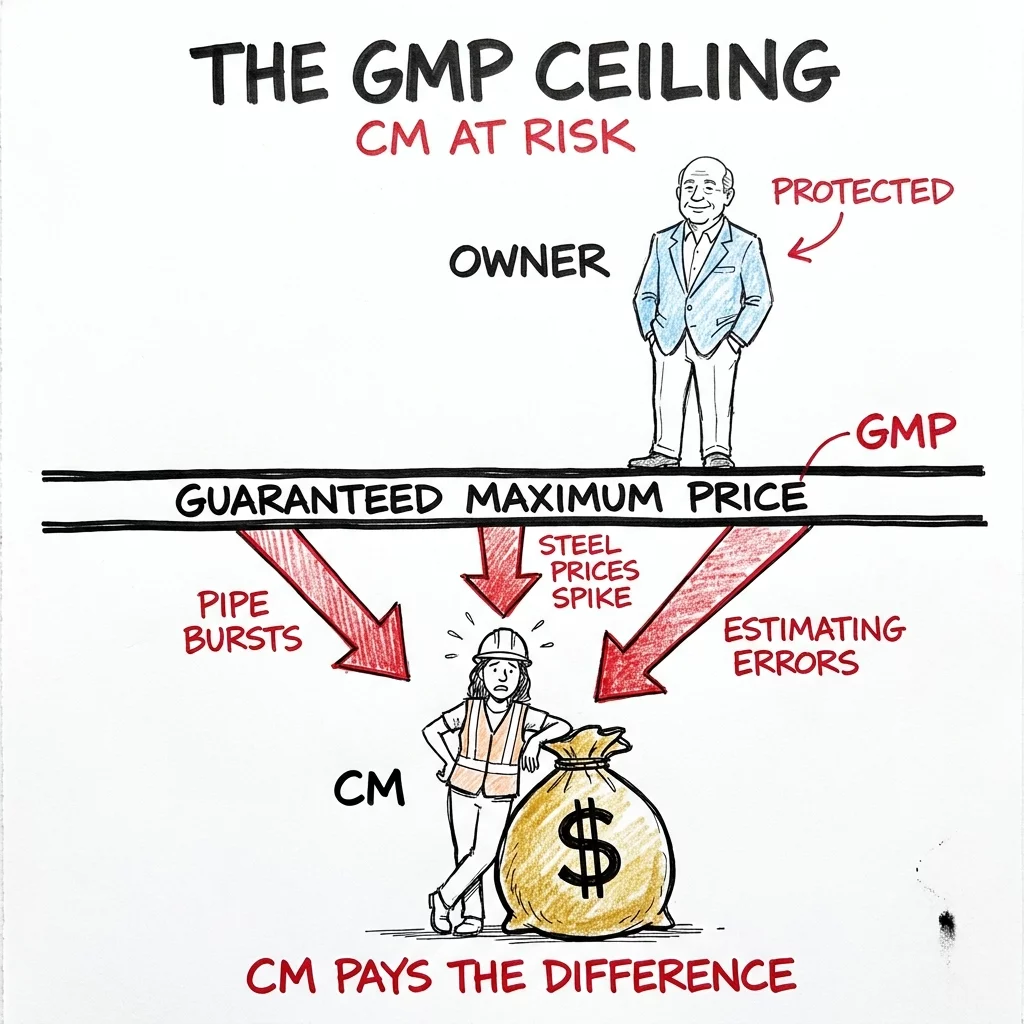
The CM is taking a financial risk by guaranteeing that price. If costs go over the GMP, if a pipe bursts or the price of steel skyrockets, the CM pays the difference out of their own pocket. Not the owner. The CM holds the risk.
What the GMP Does and Doesn’t Cover
One important caveat.
The GMP protects the owner against the CM’s estimating errors and bidding overruns. It does not protect against owner-driven scope changes.
If the owner decides halfway through construction to add another floor to the building, that’s a change order and the owner is paying for it. The GMP is not a magic shield against all cost increases. Just the ones that are the CM’s responsibility.
On the flip side, if the project comes in under the GMP, those savings are typically shared between the owner and the CM. That shared savings incentive is built into most GMP contracts and gives the CM motivation to find efficiencies without cutting quality.
The GMP also includes a contingency built into the guaranteed number. This contingency covers the unknowns that the CM anticipates but can’t fully price yet at the time the GMP is established. As the project progresses and those unknowns get resolved, unused contingency often becomes part of the shared savings.
It’s worth understanding how the GMP contract relates to other contract risk tools like liquidated damages, which address what happens when projects run late rather than over budget.
CMAR Pros and Cons
Here’s what makes CMAR attractive compared to Design-Build.
The architect keeps their direct contract with the owner. The architect maintains their advocacy role. They share some responsibilities with the CM, like cost estimating and value engineering, but the architect is still independently looking out for the owner’s interests.
You get the collaboration of having a contractor at the table during design, just like Design-Build. But you also get the architect independence of Design-Bid-Build. That’s why a lot of people see CMAR as a best-of-both-worlds approach.
The strengths of CMAR:
- Early cost certainty through the GMP
- Contractor input during design improves constructability
- Architect keeps their independent role and direct owner contract
- Fast-track delivery is possible through phased bid packages. The architect finishes the structural drawings first, the CM bids out the foundation and steel and starts building, while the architect is still finishing the interiors and MEP design. That’s fast-tracking in action through phased bidding, and CMAR is built for it.
The trade-offs:
- More complex contractually than DBB or DB
- No full competitive bidding the way there is in Design-Bid-Build
- The whole thing depends on picking a really good CM. If you choose the wrong construction manager, it can fall apart.
Who holds the risk? The CM, through the GMP.
Construction Manager as Agent (CMa)
We just talked about Construction Manager at Risk, where the CM eventually becomes the builder. Now let’s look at the other side of the coin.
Construction Manager as Agent, sometimes called CM-Adviser or CM-Agency, is a completely different relationship.
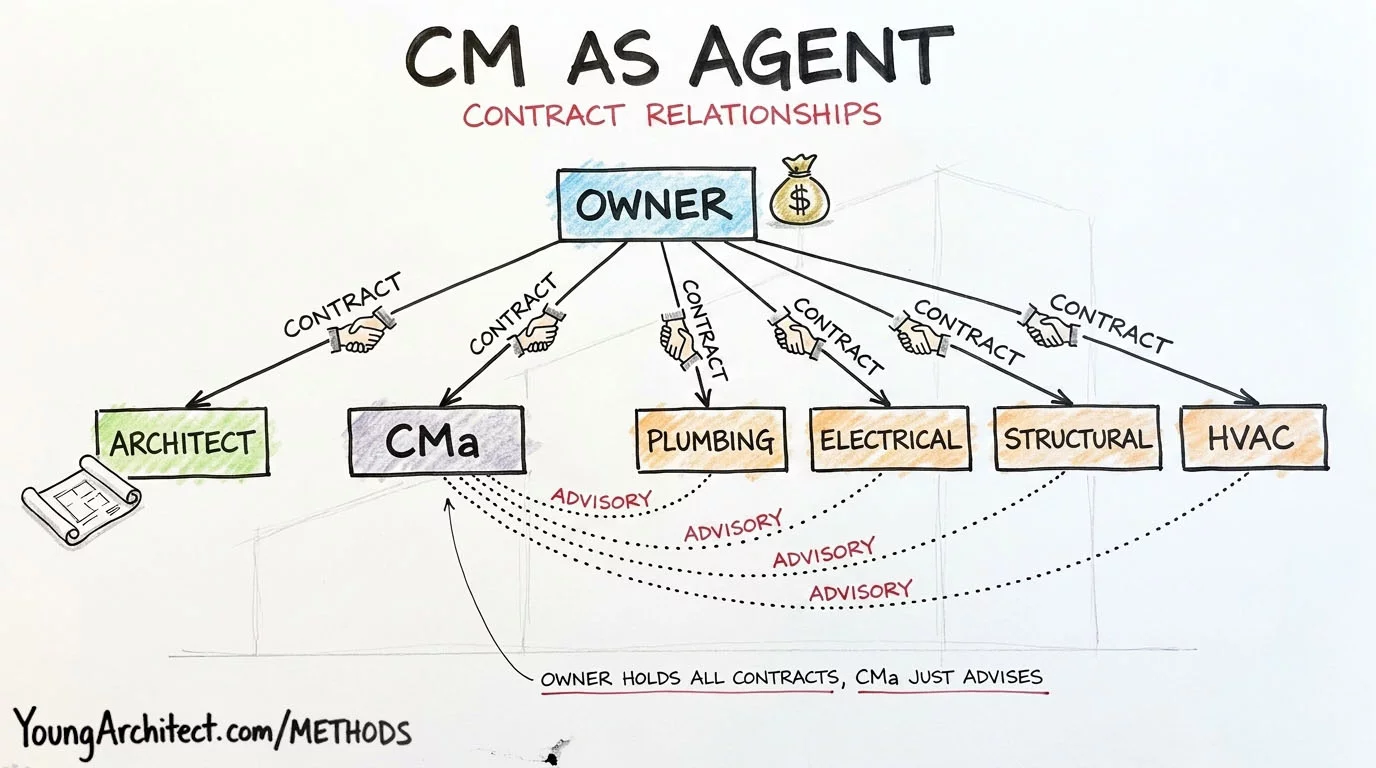
The owner hires a CM as a pure consultant. The CM advises. They coordinate. They manage on behalf of the owner.
But the CM never becomes the contractor. They never hold subcontracts. They never provide a GMP. They never step onto the field.
The owner contracts directly with the trade contractors. The CMa is there to help the owner make good decisions and keep the project on track. The AIA contract that supports this arrangement is the A132.
One thing worth noting for the ARE. Construction Manager as Agent is technically a form of project management, not a project delivery method in the strictest sense. The AIA and AGC make this distinction. A CMa can actually be layered on top of other delivery methods. You could have a CMa advising the owner on a Design-Bid-Build project, for example.
CMa Pros and Cons
Who holds the risk? The owner. There’s no GMP. The owner holds all the contracts. If something goes wrong financially, it’s on the owner.
The strengths of CMa:
- The owner gets expert advice from someone who exclusively serves their interests
- The CMa has a fiduciary relationship with the owner
- The owner keeps full control over all contracts
The trade-offs:
- The owner takes on all the risk
- This method really only works for a sophisticated, experienced owner who knows what they’re doing
- Managing all those separate contracts is a lot of work
CM at Risk vs CM as Agent
Here’s a metaphor that makes the difference stick.
Construction Manager as Agent is like hiring a coach who stays on the sideline. They’re calling plays. They’re giving advice. But they never step onto the field.
Construction Manager at Risk is like hiring a player-coach. They start on the sideline giving advice during design. But once that GMP is signed, they suit up and get on the field. They’re playing the game now.
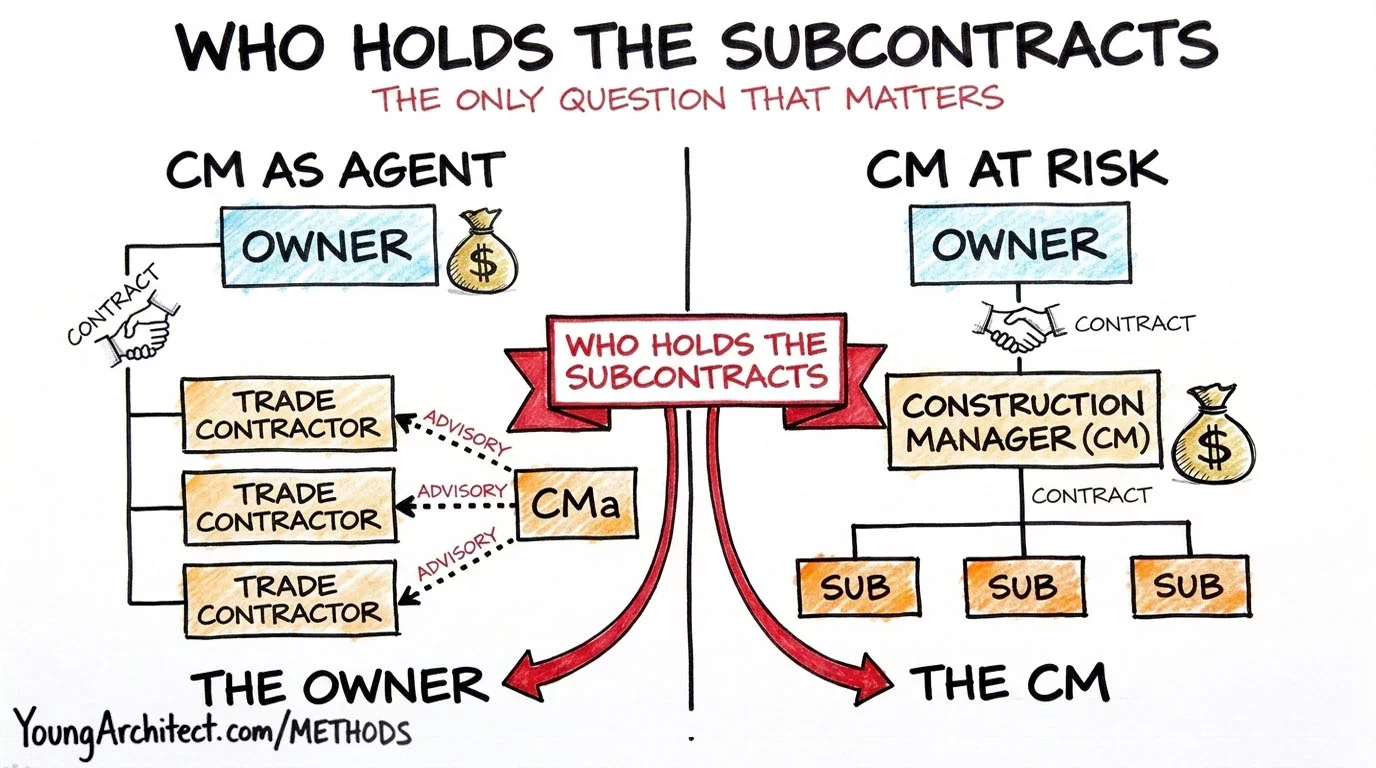
The core distinction comes down to one question: who holds the subcontracts?
In CMa, the owner holds all the contracts directly with the trade contractors. The CMa has only advisory lines, no contractual connection to the trades.
In CMAR, the CM holds all the subcontracts after the GMP is established. The CM has solid contract lines down to every sub.
The CMa and Multiple Prime Connection
CMa often works hand-in-hand with Multiple Prime Contracts, which we’ll cover next.
If you’re paying close attention, you might be thinking, “Didn’t she just describe the same thing? In CMa, the owner holds all the contracts directly with the trades. In Multiple Prime, the owner holds all the contracts directly with the trades. Are they the same thing?”
They’re not.
Multiple Prime is the vehicle. CMa is the driver.
Multiple Prime is the contracting structure. It’s the decision to split the project into separate contracts for plumbing, electrical, structural, and so on.
CMa is the management role. It’s the consultant hired to coordinate that structure.
They usually go together, but they’re two different things.
Multiple Prime Contracts
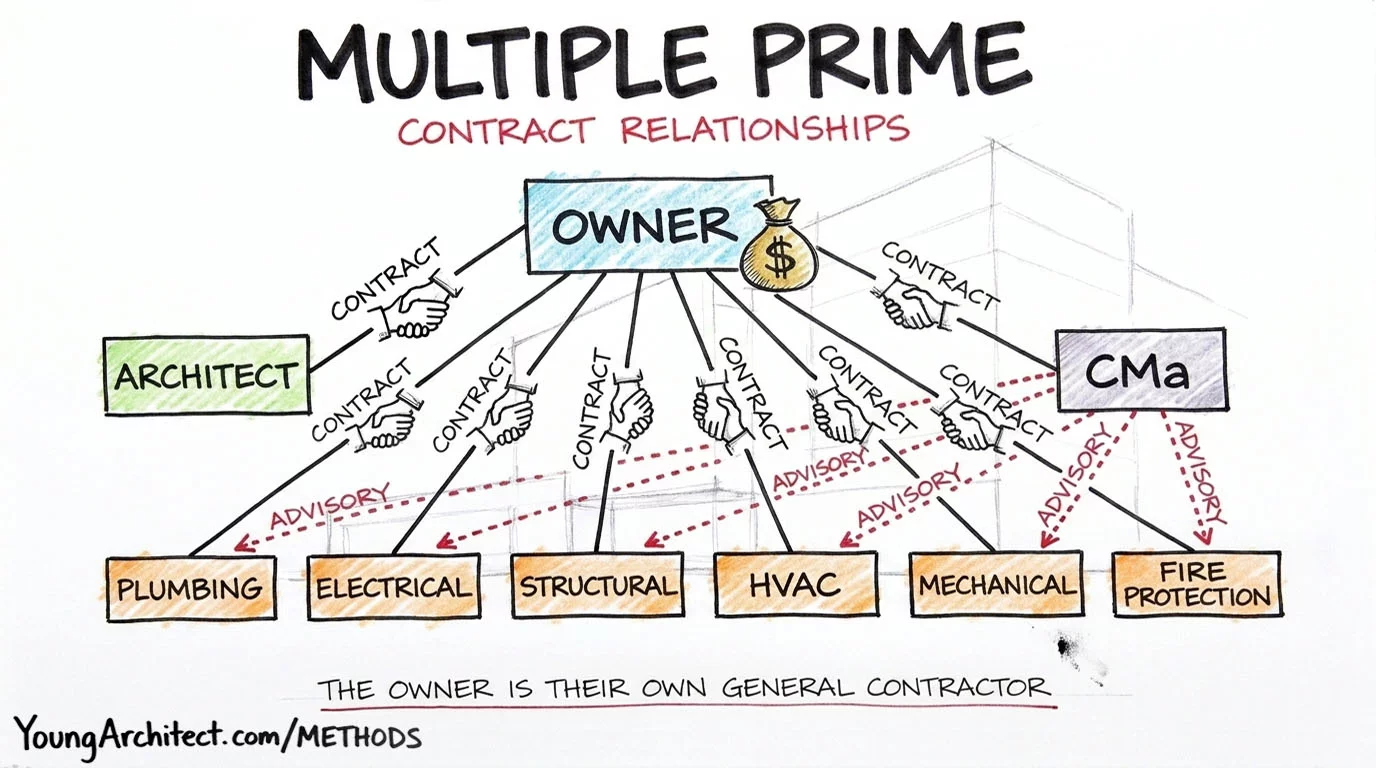
In Multiple Prime, the owner contracts directly with multiple trade contractors. One contract for plumbing. One for electrical. One for structural. One for HVAC. And so on.
The owner is essentially acting as their own general contractor.
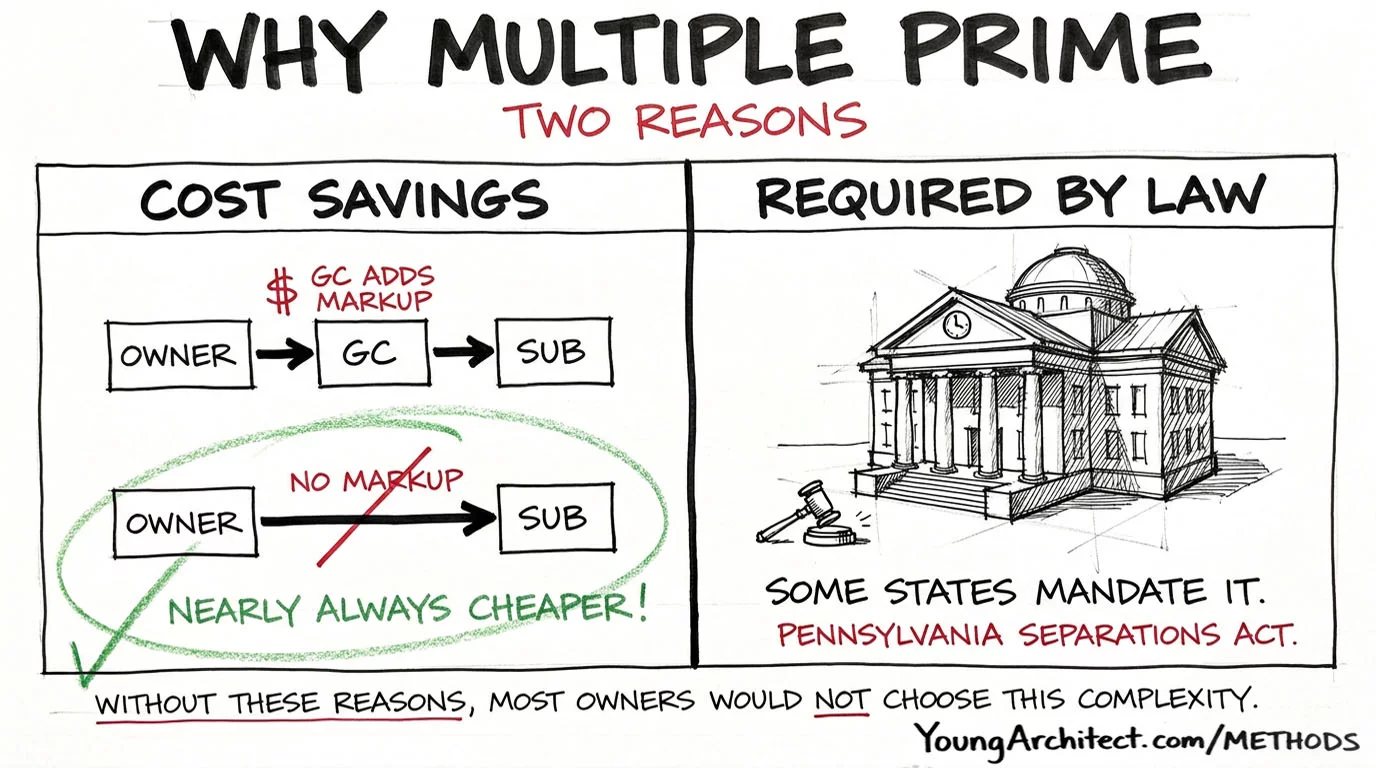
Why would anyone choose to do this?
Multiple Prime Pros and Cons
The strengths:
- Cost savings. When a general contractor hires subcontractors, they add their own fee on top. With Multiple Prime, the owner goes direct, and that markup goes away. On a big project, that can mean real savings.
- Required by law in some places. Pennsylvania, for example, has the Separations Act that mandates Multiple Prime delivery for state-funded projects.
The trade-offs:
- If one trade falls behind schedule and delays another, the owner is the one who has to sort it out
- Lots of coordination, lots of contracts, and lots of potential for finger-pointing
- This approach really only works for sophisticated owners or when paired with a CMa to manage the complexity
Multiple Prime is often paired with a Construction Manager as Agent to help coordinate all those separate contractors.
Understanding how procurement complexity increases with Multiple Prime also connects to concepts like OFCI (owner furnished, contractor installed), where splitting responsibilities between owner and contractor adds another layer of coordination.
Who holds the risk? The owner. Completely.
Integrated Project Delivery (IPD)
All of the methods we’ve covered so far have some version of a hierarchy. The owner is at the top, and everyone else is arranged below them in some structure.
Integrated Project Delivery flips that entire concept on its head.
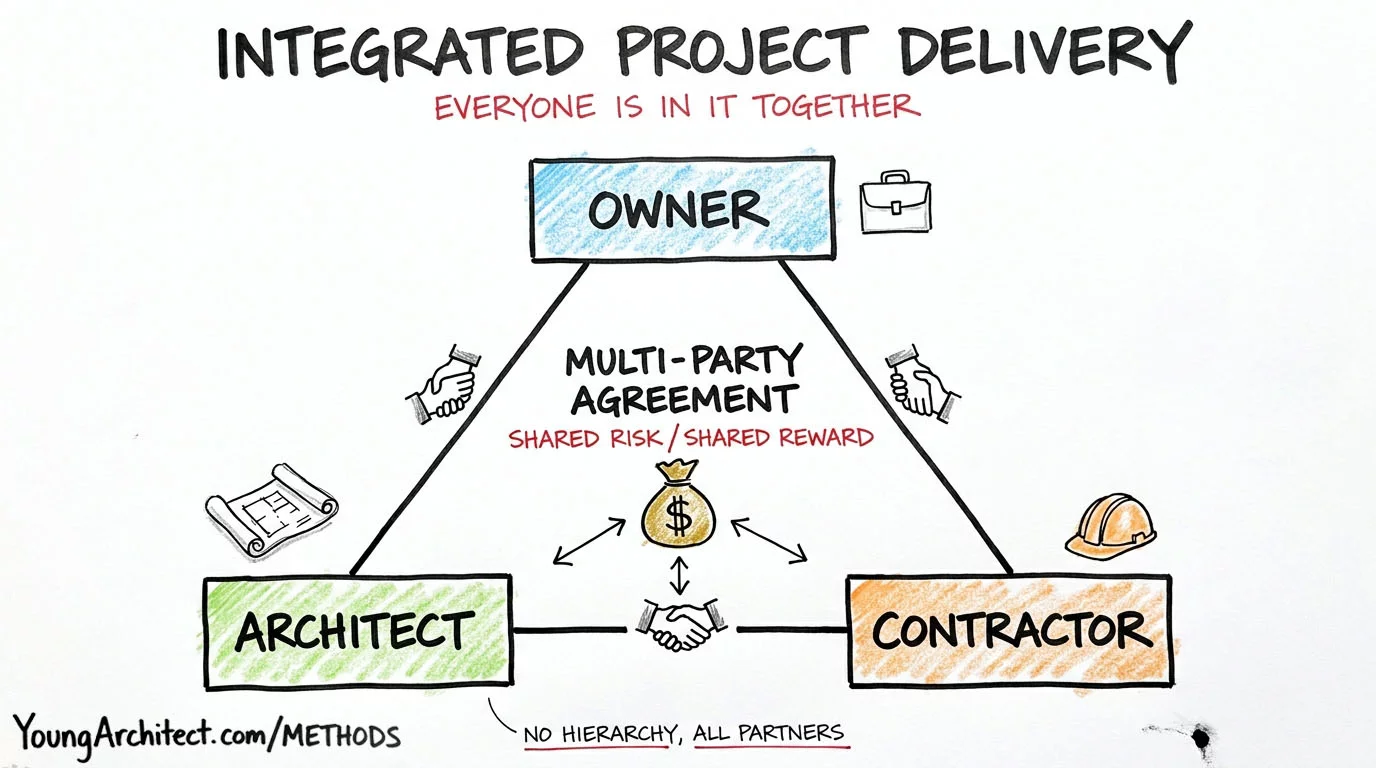
IPD uses a multi-party agreement signed by at least three key parties: the owner, the architect, and the contractor. All three sign one agreement. And in that agreement, they all share the risk and the reward.
If the project saves money, everyone shares the savings. If the project goes over budget, everyone shares the pain.
There’s no hierarchy. No silos. The owner, architect, and contractor work together as equal partners from day one.
The AIA contracts that support IPD include the C191 and C195.
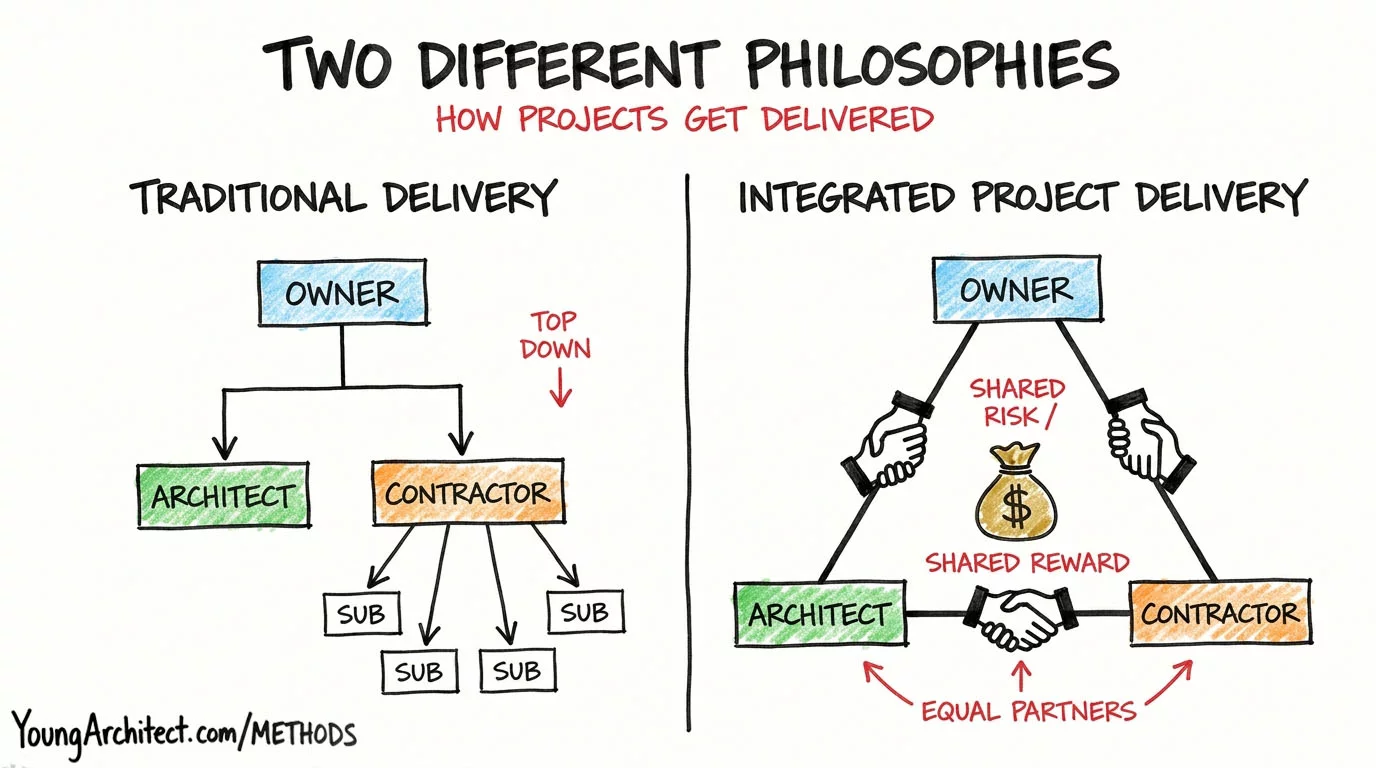
Look at how different this structure is. Every other method has a top-down structure. IPD is a circle. Or a triangle. Everyone is connected to everyone else with equal weight.
Studies have shown that IPD produces really good project outcomes. Better on-time and on-budget performance. Less conflict because everyone’s incentives are aligned.
But IPD hasn’t taken off the way the industry predicted ten or fifteen years ago. There are real reasons for that:
- It requires enormous trust between all the parties
- The multi-party contracts are complex and unfamiliar to a lot of firms
- Traditional insurance and bonding structures just aren’t set up for a shared risk model
Where IPD has gained the most traction is in healthcare construction, where projects are so complex and coordination-heavy that the collaborative model really shines. But outside of healthcare, it’s still a small percentage of overall projects.
Understanding how construction claims and disputes get resolved is important context here, because IPD’s shared risk structure fundamentally changes the dispute dynamic compared to traditional adversarial delivery methods.
Who holds the risk? Everyone. Shared among all parties.
Design-Build vs Design-Bid-Build
These are the two most common project delivery methods, and the ARE frequently tests the differences between them. Here’s how they compare:
Contract Structure
Design-Bid-Build uses two separate contracts: owner-architect and owner-contractor. Design-Build uses a single contract between the owner and the design-builder.
Architect’s Role
In Design-Bid-Build, the architect works directly for the owner as their advocate. In Design-Build, the architect works for the design-builder (the contractor), which shifts their loyalty and professional obligations.
Speed
Design-Bid-Build is sequential. Design must be 100% complete before bidding, and bidding must finish before construction starts. Design-Build allows fast-tracking because design and construction are under one roof and can overlap.
Cost Certainty
In Design-Bid-Build, the owner doesn’t know the construction cost until bids come in after design is complete. In Design-Build, the owner and design-builder can work toward a target price throughout the process.
Competitive Bidding
Design-Bid-Build uses competitive bidding, which tends to drive costs down. Design-Build typically does not, since the owner selects the design-builder based on qualifications and proposal rather than lowest price.
Owner Control
Design-Bid-Build gives the owner more control over design through a direct relationship with the architect. Design-Build gives the owner less control since the architect reports to the design-builder.
Risk Allocation
In Design-Bid-Build, the contractor holds primary risk through the fixed price, but the owner is exposed to change orders. In Design-Build, the design-builder holds the risk as the single responsible entity.
How to Choose the Right Project Delivery Method
Choosing a project delivery method comes down to the two questions we introduced at the beginning of this post.
Who holds the contracts with the subcontractors?
- Design-Bid-Build: the general contractor
- Design-Build: the design-builder
- CMAR: the construction manager (after the GMP is set)
- CMa: the owner
- Multiple Prime: the owner
- IPD: shared collaborative structure
Who holds the risk when things go wrong?
- Design-Bid-Build: the contractor, through the fixed price bid
- Design-Build: the design-builder
- CMAR: the CM, through the GMP
- CMa: the owner
- Multiple Prime: the owner
- IPD: risk is shared among all parties
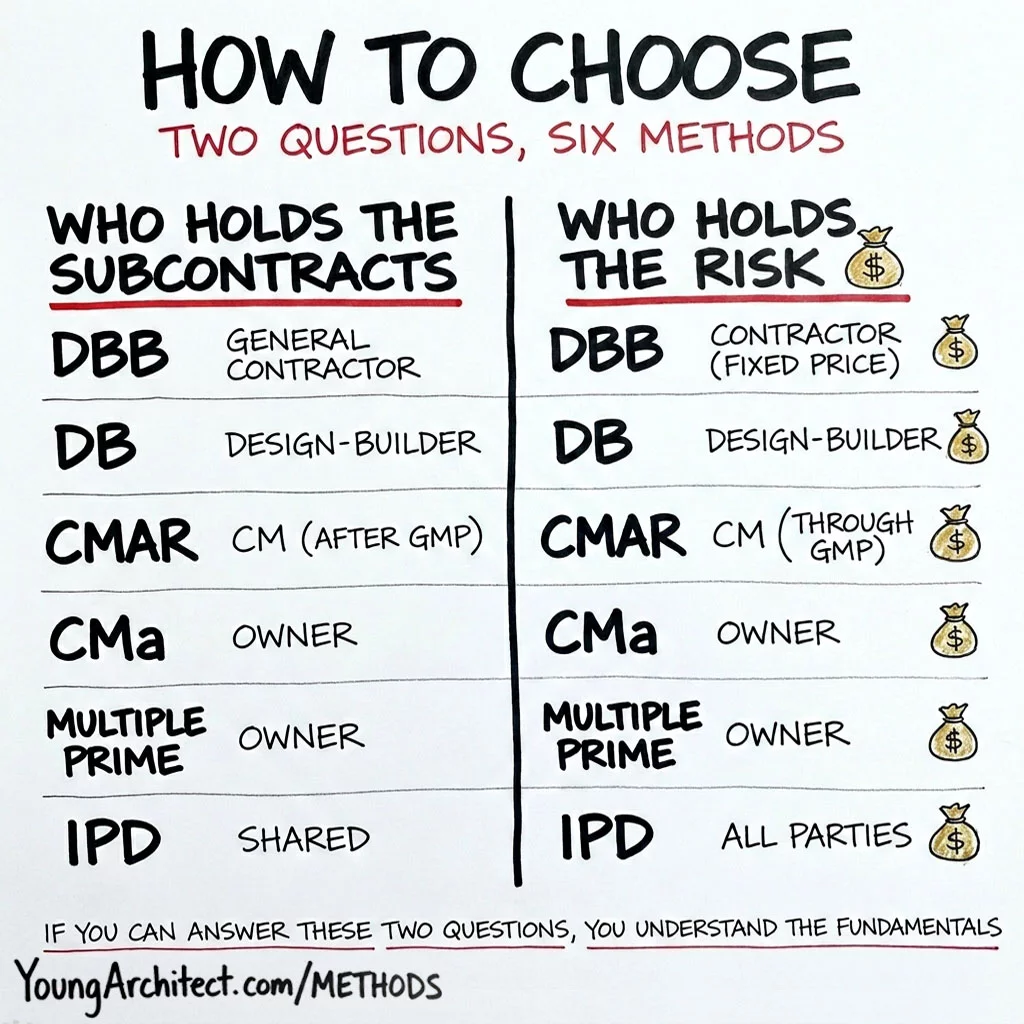
If you can answer those two questions for each delivery method, you understand the fundamentals.
Now put yourself in the owner’s shoes and match the method to the scenario:
- A public school project with a tight budget and legal requirements? Probably Design-Bid-Build.
- A fast-track private hospital that needs early cost certainty? Maybe CMAR or IPD.
- An owner who wants one team, one contract, and speed? Design-Build.
The delivery method you choose affects everything downstream. How you bid. How you document. How you administer construction. And what your role as the architect looks like.
Understanding how architect fees and contractor payment methods work across different delivery structures is another important piece of the puzzle.
For a solid external overview of all these methods, Procore’s construction project delivery methods overview is a good reference.
Ready to Study This for Your Exams?
Inside our ARE 101 Course Membership, we unpack project delivery methods across multiple courses:
- PcM 101 teaches you how to analyze which delivery method fits a given project scenario
- PjM 101 walks you through how the contracts and documentation change based on delivery method
- CE 101 breaks down how the architect’s role during bidding and construction shifts depending on which method was chosen
And if you want guided coaching through the entire ARE process, that’s what ARE Boot Camp is for. It’s a ten-week coaching program with a community of candidates all working through the exams together.
What are the four main project delivery methods?
The four most commonly referenced project delivery methods are Design-Bid-Build, Design-Build, Construction Manager at Risk (CMAR), and Construction Manager as Agent (CMa). Beyond those four, Multiple Prime Contracts and Integrated Project Delivery (IPD) are also used but are less common across the industry.
What is the difference between CMAR and CMa?
Think of it like a player-coach versus a sideline coach. In CMAR, the construction manager starts as an advisor during design, then provides a Guaranteed Maximum Price and takes over as the builder who holds all subcontracts and assumes financial risk. In CMa, the construction manager stays in a purely advisory role throughout the entire project. They never hold subcontracts and never take on construction risk. The owner retains all contracts and all risk.
What is a GMP contract in construction?
A Guaranteed Maximum Price (GMP) contract is an agreement where the construction manager sets a ceiling on the total project cost and guarantees the project won’t exceed that amount. If actual costs run higher than the GMP, the CM absorbs the difference. If the project finishes under the GMP, the savings are typically shared between the owner and the CM as an incentive for efficiency.
Is fast-tracking a project delivery method?
No. Fast-tracking is a schedule compression technique where design and construction phases overlap to reduce the overall project timeline. It works well within Design-Build and CMAR because the builder is involved during design and can begin construction on completed portions while other parts are still being designed. Fast-tracking is generally not compatible with Design-Bid-Build, which requires complete documents before bidding begins.
Which project delivery method is required for public projects?
Design-Bid-Build is the most common delivery method for public projects and is legally mandated in many jurisdictions because of competitive bidding requirements. In addition, some states require Multiple Prime delivery for state-funded construction. Pennsylvania’s Separations Act is the most well-known example, requiring separate prime contracts for general, plumbing, HVAC, and electrical work on publicly funded projects.