One of the biggest challenges of the architect exam isn’t the content. It’s all the reading. Active reading strategies can transform how you study, helping you retain more, read faster, and actually understand what you’re studying instead of just staring at pages.
This podcast is also available on YouTube, Spotify, and Apple Podcasts
Why Reading Is the Hardest Part of Exam Prep
If you’re studying for the ARE, you already know this.
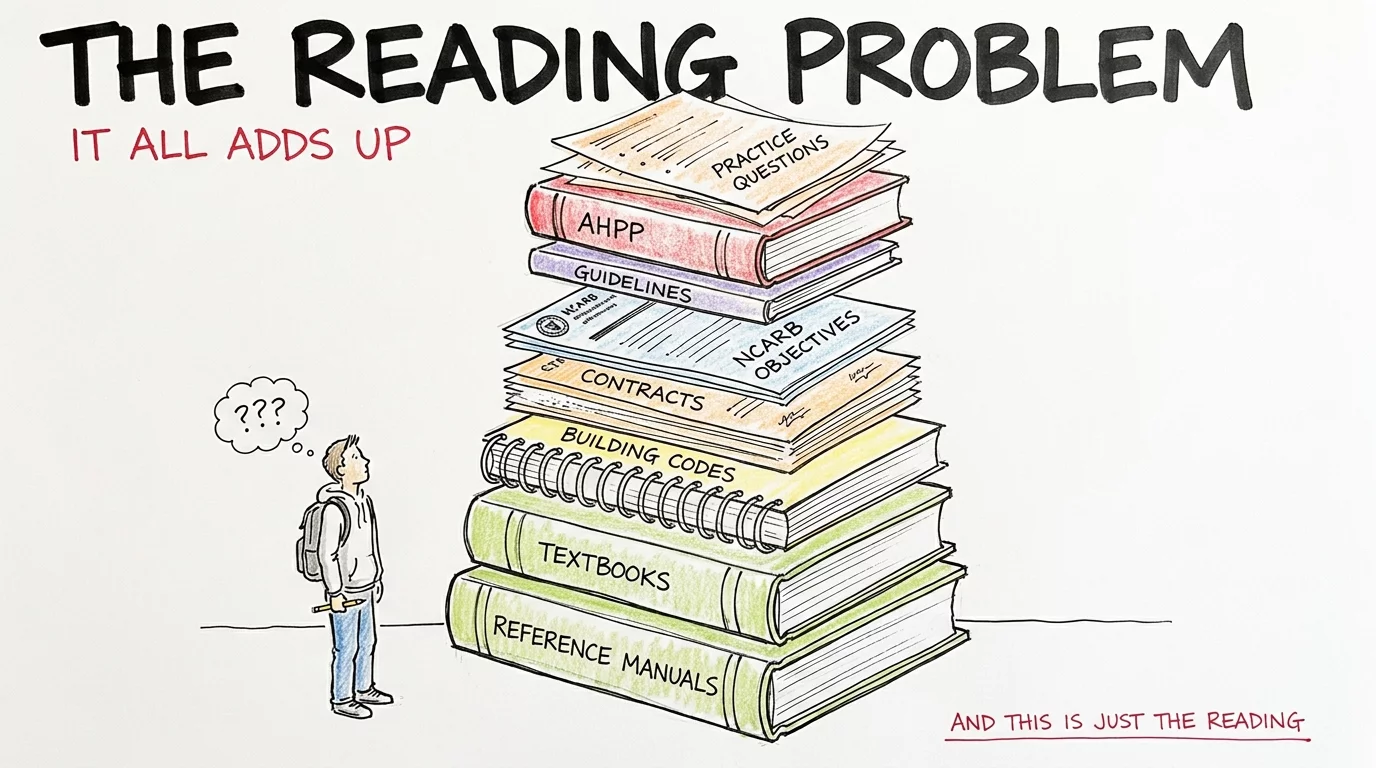
There are textbooks. There are contracts. There are NCARB objectives and guidelines. There are practice questions. There are building codes and reference manuals.
It all adds up. And most candidates aren’t ready for it.
I’ll be honest with you. I’m probably the last person who should be giving reading advice.
I was a special ed kid for reading and writing. I have ADHD. I’m a visual learner. I loved books as a kid, but I wanted to see pictures and diagrams and charts. That’s part of why I got into architecture. My brain works in three and four dimensions.
Reading was always really tough for me.
But here’s the thing. I figured it out. And if I can figure it out, you can figure it out too.
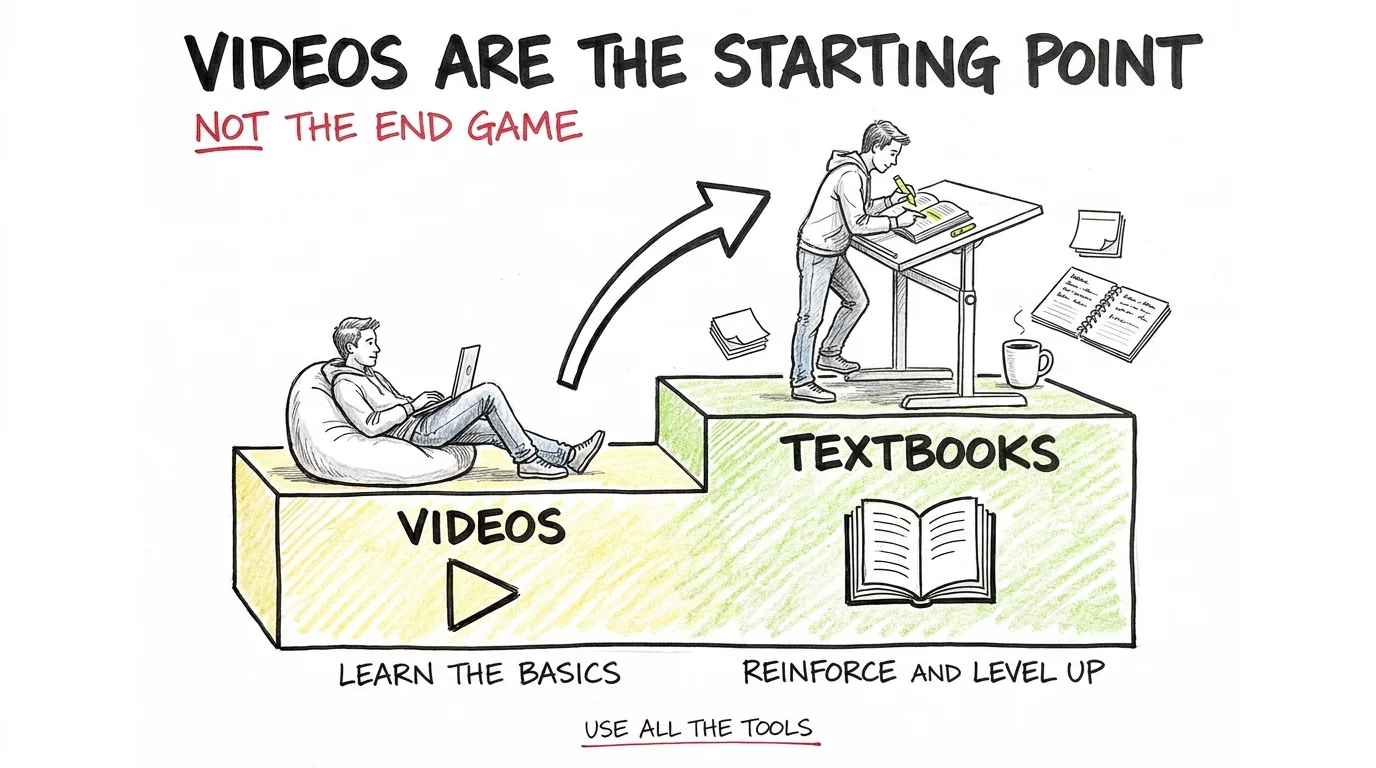
Now, some prep companies out there will tell you to skip the reading and just watch their videos. And look, videos are helpful. We make video content. I believe in video content.
But videos are the starting point, not the end game.
Let a video teach you the basics, then use the textbooks to reinforce what you learned and take your knowledge to the next level.
Use all the tools. But if you can learn how to read effectively, it becomes a superhero power.
One of our ARE Boot Camp students was telling me about another prep company she was using, and she said that most of their practice questions were videos. A video would read the question to her, then she’d pick an answer, and then another video would reread the question and give a one to two minute explanation.
Think about that. The videos are reading the questions to you.
If you can’t read practice questions yourself, how are you going to sit down on exam day and read a hundred questions?
And let’s take it a step further.
If you can’t read a textbook about how to practice architecture, how are you going to read a 700-page project manual on a construction site when there’s an issue and you need to find the solution?
It’s the same skill. We’re taking a test about protecting the health, safety, and welfare of the public. Reading is not optional. It’s part of the job.
Reading is a muscle. And it is in every candidate’s best interest to practice exercising that muscle as much as you can. Whether you’re just starting to figure out how to study for the architect exam or you’re deep into your creating a realistic ARE study schedule, building your reading skills will accelerate everything else.
And if you’ve ever been told you’re a “visual learner” and used that as a reason to avoid reading, check out our post on why relying on one study method doesn’t work. The research might surprise you.
Reading for Understanding, Not Memorization
Here’s where a lot of people go wrong.
They sit down with a textbook and try to memorize everything. They read a page and think, “I don’t remember any of that. What’s wrong with me?”
Nothing is wrong with you.
There’s a big difference between reading to understand and reading to memorize. And you should be reading to understand.
Contracts are a great example.
A lot of people look at AIA contracts, immediately get intimidated, and think they need to memorize exactly what the contract says. Word for word.
That’s not what NCARB is testing.
NCARB doesn’t care about your ability to memorize contract language. They care about your ability to understand what the contract says, so that when you make a decision, that decision is aligned with how things work.
You don’t need to memorize what the contract says. You need to understand what the contract means.
If you want to build a real foundation with contract language, our AIA Contracts 101 course breaks down the major AIA documents in a way that focuses on understanding, not memorization.
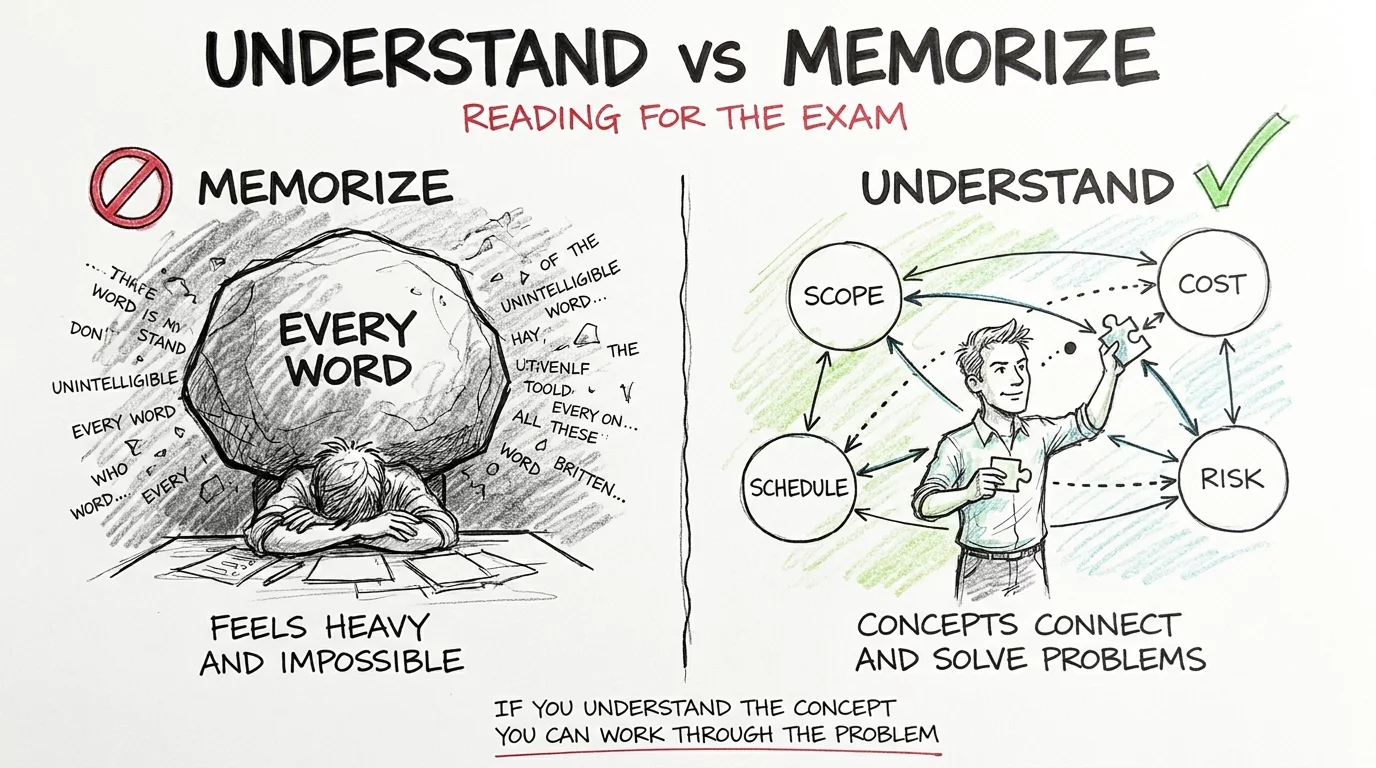
Memorizing feels heavy. A lot of people think they need to memorize the entire AHPP and it feels like this impossible mountain to climb.
But if you focus on understanding the concepts and the theory and how things work, now you can use that knowledge to solve problems.
Think about it this way. You read a chapter and you got a pretty good understanding of how it works. Now you go to solve a problem and it’s not exactly the same as it was in the textbook. You didn’t memorize the chapter. But you understood the concept. You know if this is true, then that is true, and you can work your way through it and solve the problem.
That’s what we’re trying to get to here.
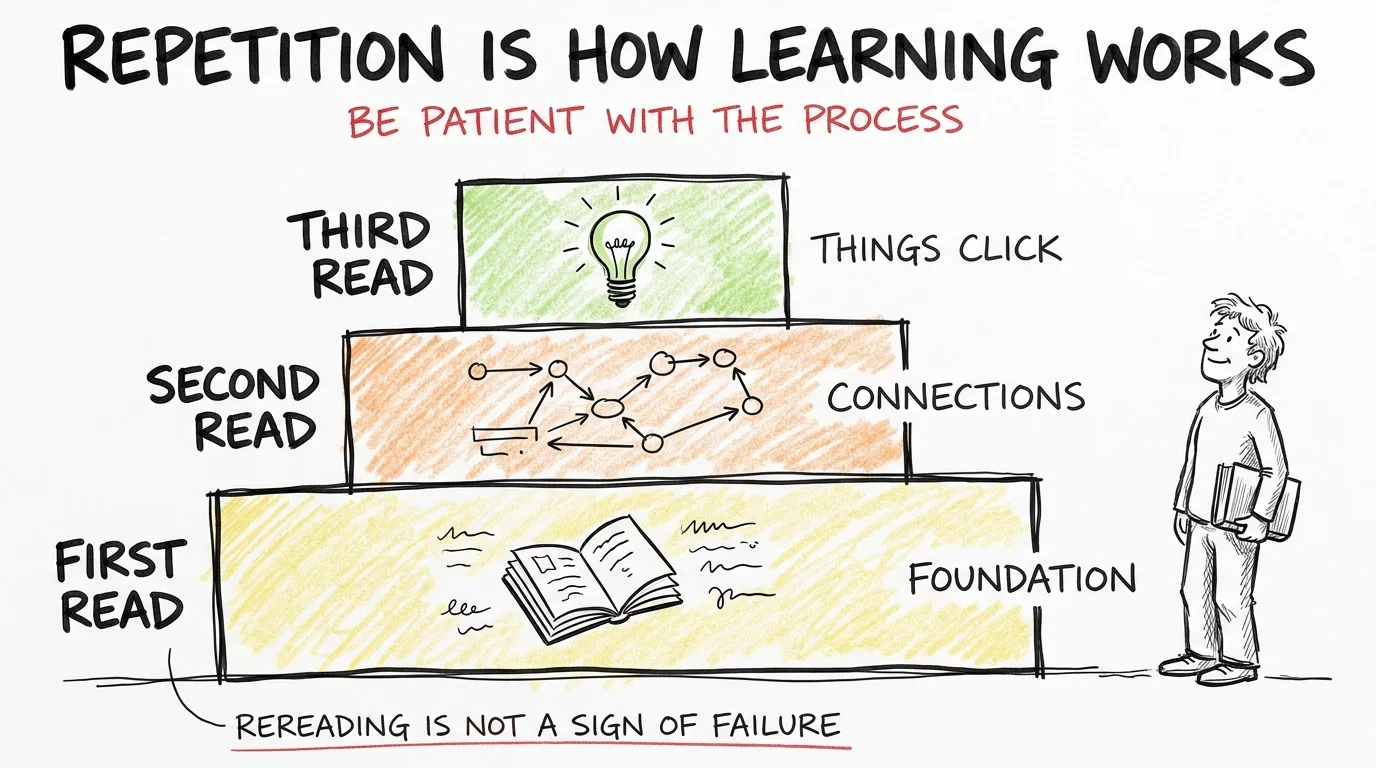
And here’s the other thing. Just because you read about something once doesn’t mean you’re going to be an expert on it.
It takes repetition.
You’re going to need to keep coming back to the material and rereading it. That’s not a sign that you’re failing. That’s just how learning works.
- First read: You get the foundation.
- Second read: You start to see connections.
- Third read: Things start to click.
Be patient with that process.
Active Reading Strategies That Work for Exam Prep
Alright, let’s get into the practical stuff.
Study skills researchers call this active reading, and it works. These are things that have helped me and things I’ve seen work with hundreds of Boot Camp students over the years.
Preview Before You Dive In
Don’t blindly march into a reading.
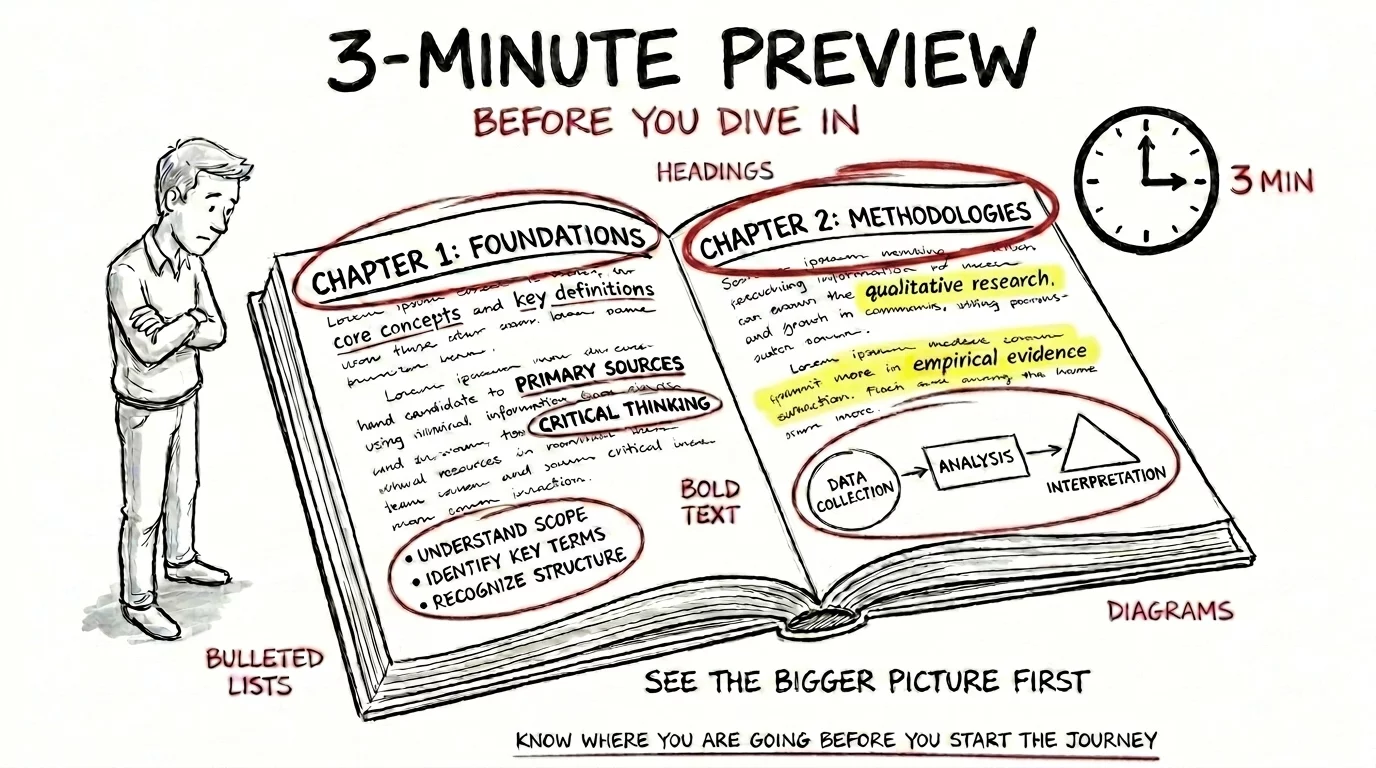
Before you give something your full, focused attention, take three minutes and see what’s actually there first.
- What are the headings?
- How many pages is it?
- Are there any pictures or diagrams?
- What’s the overall structure?
Spend three minutes getting the bigger picture so you don’t feel like you’re going on a journey with no end destination.
It makes a huge difference.
Start with Vocabulary
This is a big one.
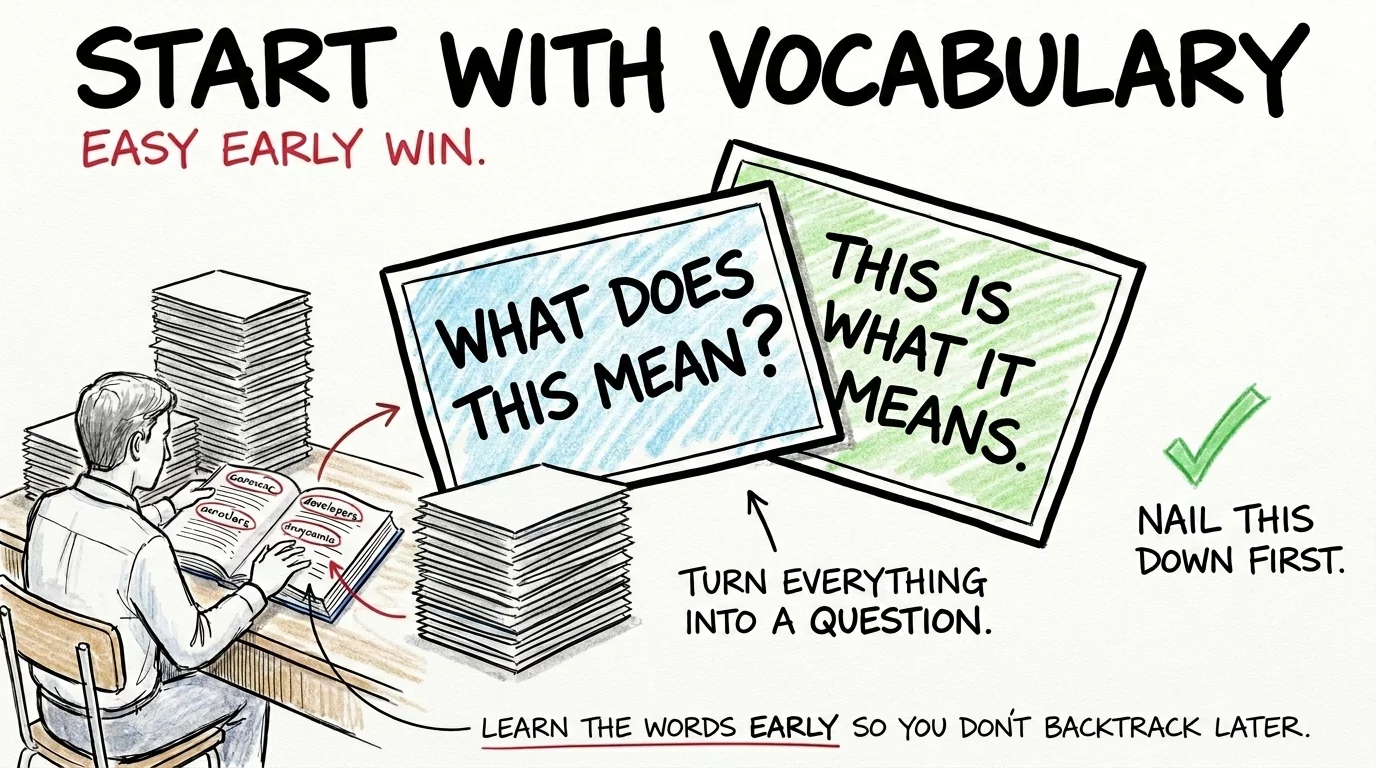
Every single exam has its own set of vocabulary words that are exclusive to that test. Words that you’re going to see in the study materials, on the exam, everywhere.
Make that the first thing you nail down. It’s an easy early win.
Put your vocabulary on flashcards. And make them by hand if you can.
I went to architecture school in an era when we did a lot of hand drawing and model building, and studying for these exams can feel like a lot of busy work. But the one thing you can get creative with is how you study. Spending a few minutes making flashcards by hand, physically creating something you can touch and flip through, just feels good. It gives you the feeling of making something amongst all the busy work.
Look everything up early so that when you get deeper into the content later, you’re not backtracking and having to look up a thousand things. It’s an easy win early on and it sets you up for success.
Read with a Pen in Your Hand
This is a huge one for me.
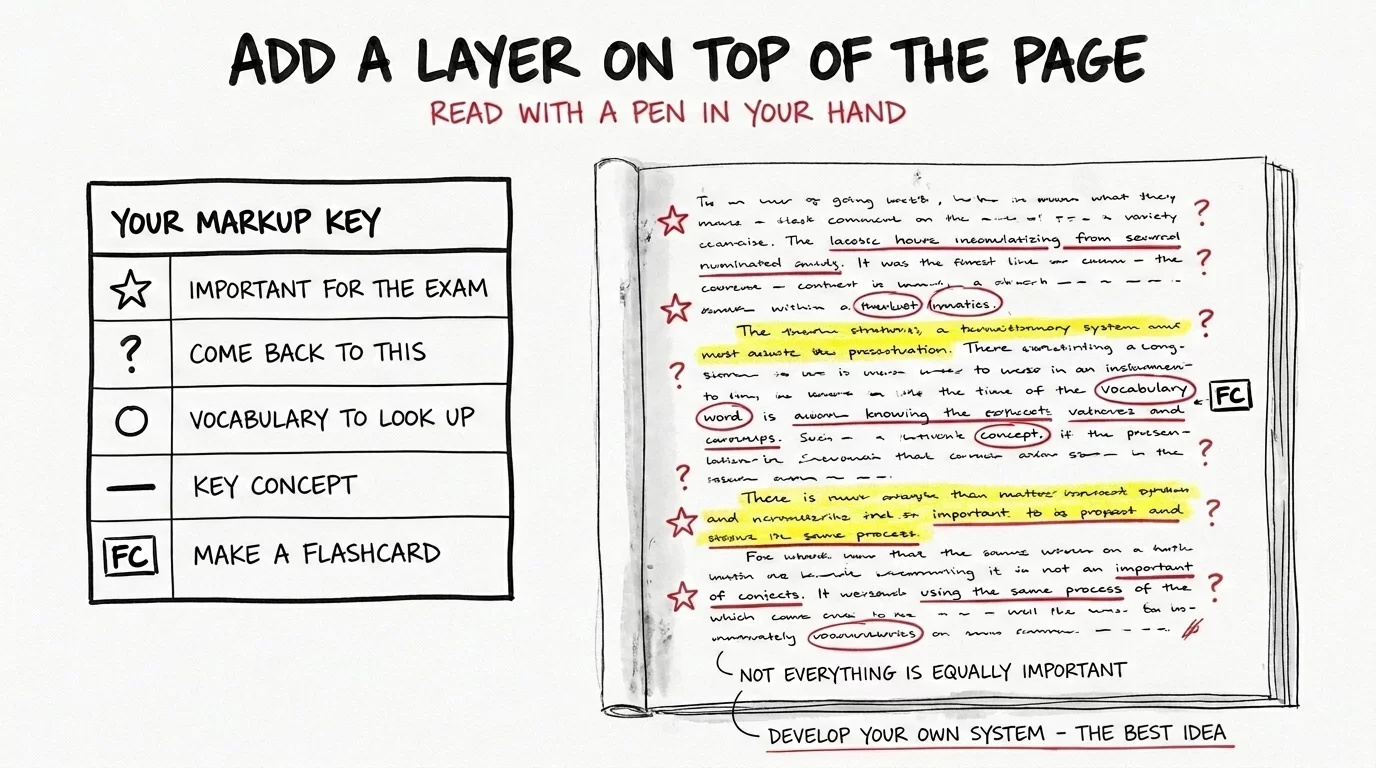
When I look at a big page of text, I get lost. I see a big block of letters. What I need to do is draw on top of it.
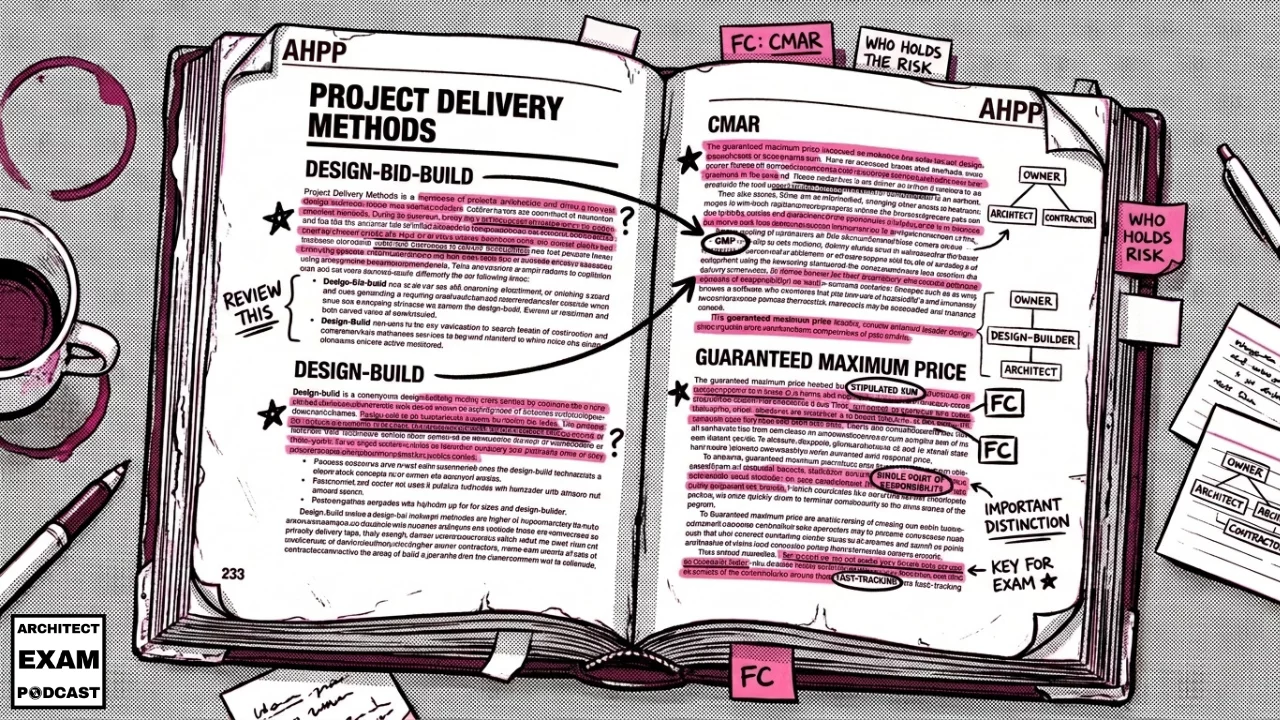
I underline, I highlight, I put boxes and circles and stars.
- Stars mean this is important for the exam.
- Question marks mean I need to come back to this.
- Circles around vocabulary I need to look up.
- Underlines for key concepts.
- FC means make a flashcard.
The way I think about it is, my job is to add another layer of information on top of what’s already there on the page.
I assume that I’m going to have to come back to this later and look for what’s important. And by filtering everything through the lens of “what is important here,” it almost tricks my brain into identifying what actually matters.
Not everything on the page is equally important. The process of marking it up helps you start to see what is.
Here’s the thing. You need to develop your own system for this. There’s no right or wrong way to do it.
I had a woman in my Boot Camp who used color coding when she was reading the contracts:
- One color every time the contract mentioned time
- A different color for someone’s responsibility
- A third color for general things to pay attention to
That was her system. It worked for her. Your system might look completely different, and that’s fine.
The point is, get a pen in your hand and start marking things up. Figure out what works for you.
How to Read a Textbook (Especially the AHPP)
You don’t need a hardcopy of every single textbook. And I don’t endorse anyone using pirated PDFs. If you didn’t pay for it, you shouldn’t have it.
But if you don’t have a lot of experience reading textbooks on a screen, now’s not the time to start.
This is especially true for the Architects Handbook of Professional Practice.
That book is essential for the first three exams, the PcM, PjM, and CE. The inconvenience of not being able to quickly flip the pages, mark it up, highlight it, and see what’s there is just not worth the money you’d save by using a PDF.
That’s actually a requirement for our pro practice ARE Boot Camp. You have to have a hardcopy of the AHPP because the program moves fast and you’re going to immediately handicap yourself if you don’t have a real book to work with.
If you’re starting with the pro practice exams, check out our PcM 101 course, which walks through the AHPP content chapter by chapter.
And after that, everyone kind of figures out their own study methods. But most people I see finishing these exams? They’re using real books. That’s not a coincidence.
The AHPP covers everything from project delivery methods to risk management to consultant coordination. It’s dense material, and the active reading strategies in this post are exactly how you tackle it without getting overwhelmed.
Building Reading Stamina Over Time
Let me talk about something I think is overhyped when it comes to reading for these exams.
Speed reading.
I tried it. I wasted a lot of time on a speed reading course and it didn’t help me.
The reason is simple. I already struggled with reading to begin with. The answer wasn’t to learn someone else’s system for reading faster. The answer was to just get comfortable with reading and figure out my own system.
It’s not about reading faster. It’s about building reading stamina.
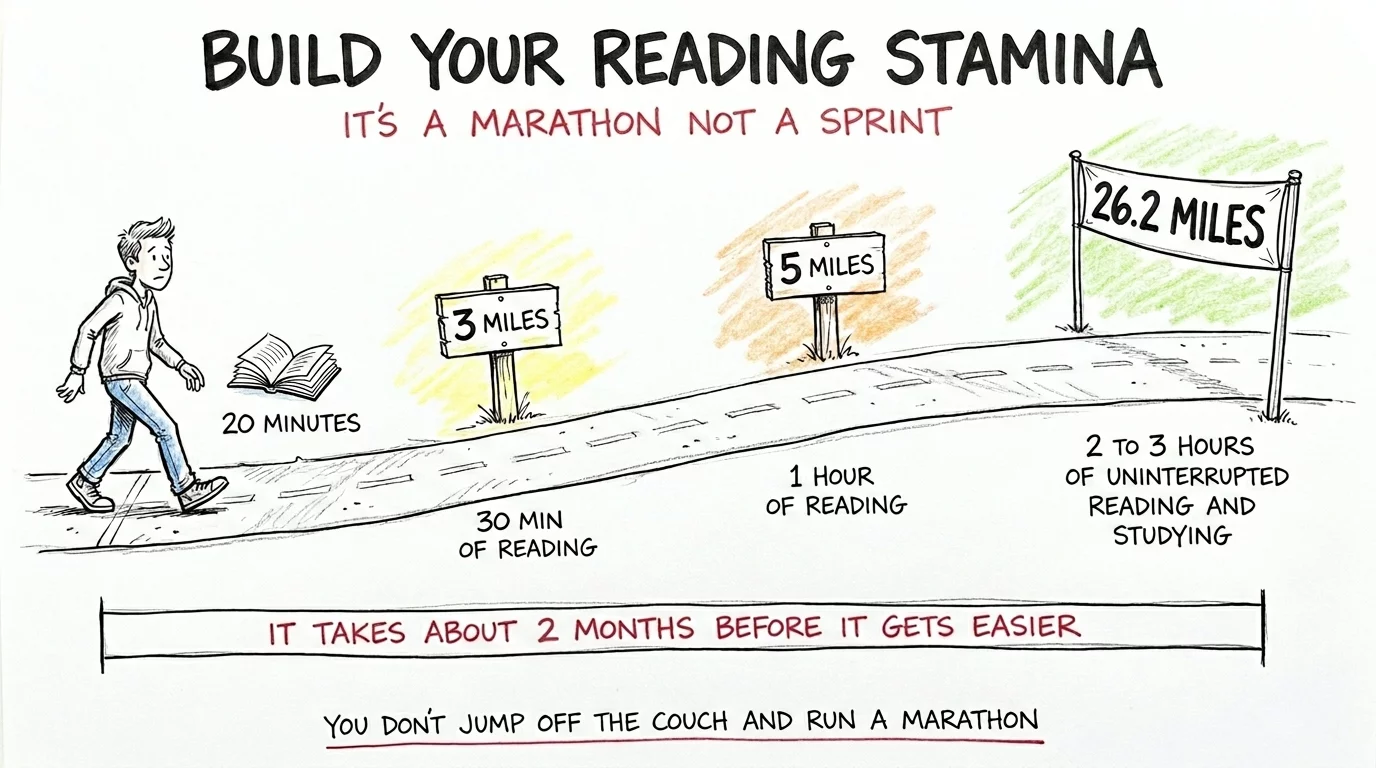
Think of it like training for a marathon. You don’t jump off the couch and run 26 miles. You run three miles. Then you run five miles. And then after months of consistency and training, you build up to running the marathon.
Reading for these exams works the same way.
That’s why I tell my Boot Campers to start reading Harry Potter books before the program even begins.
Not because Harry Potter is on the exam. But because sitting quietly and reading for an hour, hour and a half, two hours is a skill that needs to be built up over time. You’re training the muscle.
From 10 years of experience coaching people for the ARE, it takes about two months of daily studying before things really start to get easier.
The first few weeks are going to be tough. But it gets better. I promise you it gets better.
And here’s something I do with my Boot Camp students that might sound a little weird.
I have them brainwash themselves.
I tell them, say it out loud:
“I love the Architects Handbook of Professional Practice. This is an amazing resource. The AIA did an amazing job creating this book. It’s going to help me pass my first three exams and then it’s going to help me start an architecture firm. It’s going to change my life.”
Whether you believe it or not, it is in your best interest to believe it. Because if the goal is to do this quickly and efficiently, the faster you figure out the reading stuff, the easier everything gets.
A lot of people get stressed out when they study for their first exam because of all the reading. And that makes sense. The muscle’s not strong yet.
It takes time. It takes practice. It takes patience. But the more you do it, the easier it gets.
Just keep showing up.
Why Text-to-Speech Apps Won’t Replace Reading
Speechify, audiobooks, turning your textbooks into audio. These tools are fine for small efficiency gains.
But they’re not a substitute for actually reading.
Here’s why.
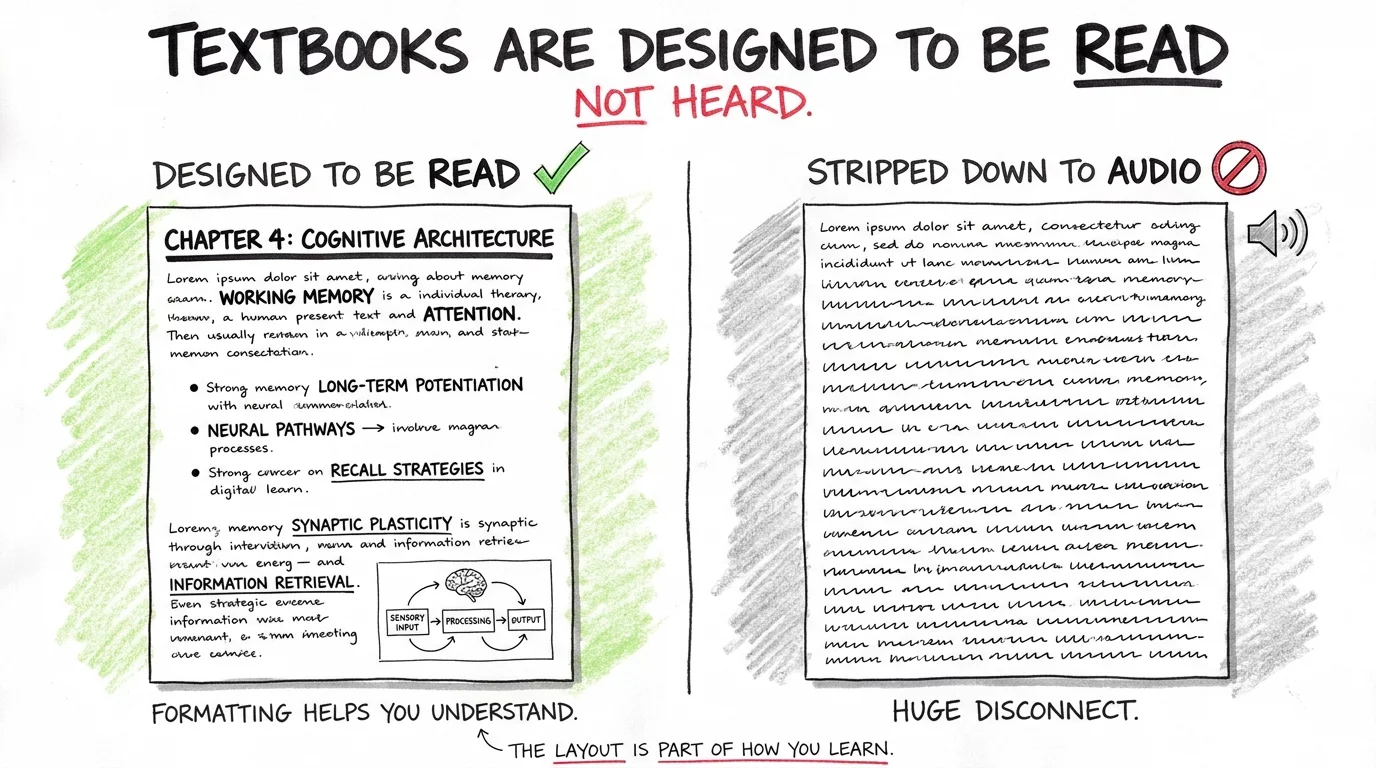
Textbooks are designed to be read. When you read something in a book, the way it’s laid out on the page helps you understand:
- The headings tell you what’s coming
- The bold text tells you what matters
- The bulleted lists organize complex information
- The white space gives your brain room to process
When you strip all of that away and have a robot read it to you like a script, there’s a huge disconnect.
This blog post and the podcast episode it’s based on are a perfect example.
They’re two different pieces of content on two different platforms in two different mediums. When I write something for you to read, the visual layout helps you track it. The headings, the bold text, the white space on the page. But when I write something for you to listen to, it needs verbal transitions between topics to help you follow along.
It’s a completely different style of writing.
So taking your textbooks and throwing them into an app and having a robot read them to you? It doesn’t translate the same way.
This is kind of my same take on AI tools in general right now. They’re great for small productivity wins, but they’re not a substitute for doing the actual work.
People are always looking for a magic bullet or some kind of workaround, and it’s just easier to accept that it’s going to take some time to get better at reading.
Reading for the ARE When English Is Your Second Language
I want to talk to the ESL candidates for a minute, because I know a lot of you reading this right now, English is your second language.
And I just want you to know something. English is my first and only language, and I still have no idea what NCARB is trying to say half the time.
If you’re reading the ARE Guidelines and wondering, “What does this even mean?” You’re not alone. That’s everybody.
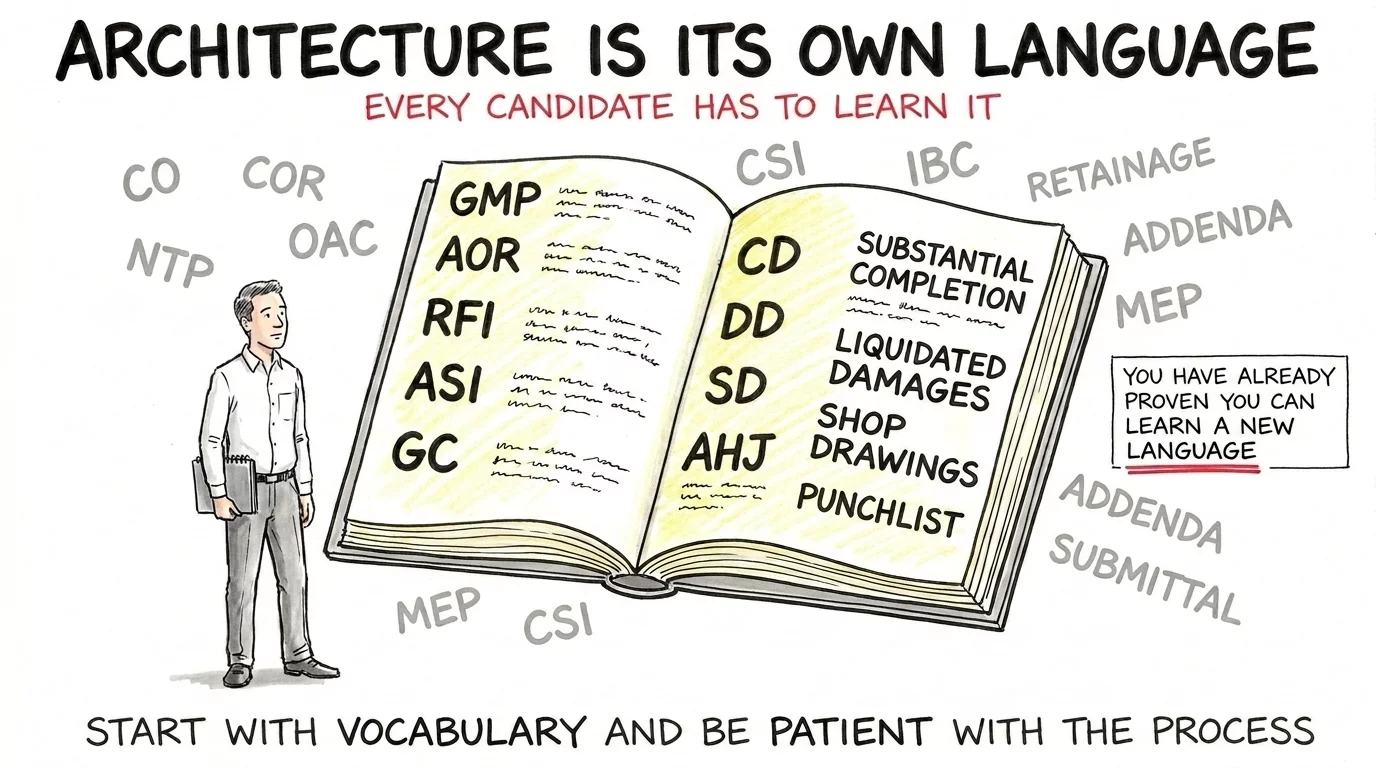
Architecture has its own language. It’s full of acronyms and specialized terms, and every single candidate has to learn it regardless of their first language.
And here’s what I’ve seen happen over and over again in our Boot Camp. Someone starts the program and their English is not so great. Fast forward two years and they’re wrapping up their exams and their English has drastically improved.
It happens all the time.
It takes between 800 and 1,300 hours to pass all six divisions of the ARE. That is a massive amount of reading. That is a massive amount of built-in English practice.
You’re not at a disadvantage. You already speak multiple languages, and that alone is a skill. You just have to be patient with the process. Lots of ESL candidates on the path to becoming a licensed architect figure this out. You will too.
And the vocabulary tip from earlier? That applies especially to you. Start with the vocab. It’ll make everything else easier.
One more tip for ESL candidates. Try reading the same section twice.
- First pass: Skim for the structure. What is this section about? What are the main ideas? Don’t worry about understanding every word.
- Second pass: Read for the detail. This is where things start to click.
How to Focus While Reading for Exam Prep
Your ability to focus is going to play a really big part in how well you read.
Sitting quietly for an hour, hour and a half, two hours, and actually focusing on what you’re reading? That becomes a superhero power.
Here are a few things that help:
- Designate a consistent study space. Your brain starts to associate that space with focus. Use the same spot every time.
- Put your phone in another room. Not on silent. Not face down. In another room. If it’s within reach, you’ll reach for it.
- Use timed study sessions. Set a timer for 25 or 30 minutes of focused reading, then take a short break. Build up from there.
- Eliminate distractions before you start. Don’t wait until you’re trying to read to realize the TV is on in the next room.
If you’ve never looked into meditation, I’d encourage you to research it. I’m not going to go deep on it here, but learning how to quiet your mind and focus ties directly into your ability to sit down and read effectively.
Reading with ADHD
It’s not about willpower. It’s about having a system.
I have ADHD and reading was always tough for me. But I figured it out.
The active reading strategies in this post, the previewing, building vocabulary first, reading with a pen in your hand, building stamina gradually, are especially helpful for ADHD readers because they break reading into smaller, more active tasks.
When you’re just staring at a page of text, your brain has nothing to grab onto. But when you have a pen in your hand and a markup system to follow, you’re giving your brain a job. You’re turning passive reading into something active.
The three-minute preview gives you a roadmap. The vocabulary gives you a head start. The annotation system keeps your hands and brain engaged.
Focus is a muscle. Work it.
How Young Architect Can Help
Reading is one of those skills that touches every single part of your ARE journey. And that’s exactly why we built tools to help.
For the pro practice exams, we created reading companions for the Architects Handbook of Professional Practice inside our ARE 101 course membership.
They’re like a guide that walks alongside you as you read. Each reading companion includes:
- A short summary of the chapter
- A longer, detailed summary
- The key vocabulary so you don’t have to stop and look things up
- Review and reflect questions that help you know what to look for before you even start reading
It’s designed to soften the blow of diving into a big textbook, especially if you’re just getting started.
And if you’re interested in the full coaching experience, our ARE Boot Camp is a ten-week pro practice program where we start reading immediately. Day one. Hardcopy AHPP required.
Because the faster you figure out the reading, the faster everything else falls into place.
Frequently Asked Questions
How do you get better at reading for professional exams?
Start with active reading strategies like previewing the material, building vocabulary first, and annotating as you read. Reading for exams is a skill that improves with consistent practice. Most candidates find it takes about two to three months of regular studying before reading starts to feel easier. Focus on understanding concepts rather than memorizing word for word.
How long does it take to build reading stamina for studying?
Most people need about two to three months of consistent daily reading before it starts to feel natural. Start with shorter sessions of 20 to 30 minutes and gradually build up to one or two hours. Think of it like training for a marathon. You build endurance over time, not overnight.
Is speed reading effective for exam prep?
Speed reading is generally not effective for exam prep. Professional exams test your understanding of complex material, and rushing through it defeats the purpose. Instead of reading faster, focus on reading more effectively by using active reading strategies like previewing, annotating, and building vocabulary before you start.
Should I use text-to-speech apps to study?
Text-to-speech apps can help in small doses, but they are not a substitute for actually reading. Textbooks are designed to be read visually. The formatting, headings, bold text, and layout all help you process information. When you strip that away and listen to a robot read it, there is a disconnect between the content and how your brain processes it.
How do ESL candidates handle all the reading for the architect exam?
Start with vocabulary. Architecture has its own language full of acronyms and specialized terms, and every candidate has to learn it regardless of their first language. It takes between 800 and 1,300 hours to pass all six divisions of the ARE, and that is a massive amount of built-in English practice. Many ESL candidates see significant improvement in their English over the course of studying.