

Plumbing valves are one of those topics that sounds intimidating until someone actually breaks it down. Whether you’re studying for the ARE, preparing for the CDT, or just trying to understand the different types of valves in building systems, you need to know what each valve does and when it gets used. This guide covers every major type of plumbing valve you’ll encounter, organized by function so you can actually make sense of it all.
This podcast is also available on YouTube, Spotify, and Apple Podcasts
What Are Plumbing Valves?
Every valve in a plumbing system falls into one of a few categories based on its job. Once you understand those categories, you don’t need to memorize a giant list. You just need to understand what each one is doing.
There are dozens of types of water valves out there, but they all come back to a few core functions.
Here are the four main categories:
- Stop valves are like a light switch. On or off. Nothing in between.
- Regulating valves are like a dimmer switch. You can dial in exactly how much flow gets through or manage pressure automatically.
- One-way valves are like a one-way street. Flow only goes one direction.
- Specialty valves are like a thermostat. They monitor the system and respond automatically. No human needed.
That’s the framework. Now let’s break each one down.
Stop Valves: Controlling the Flow
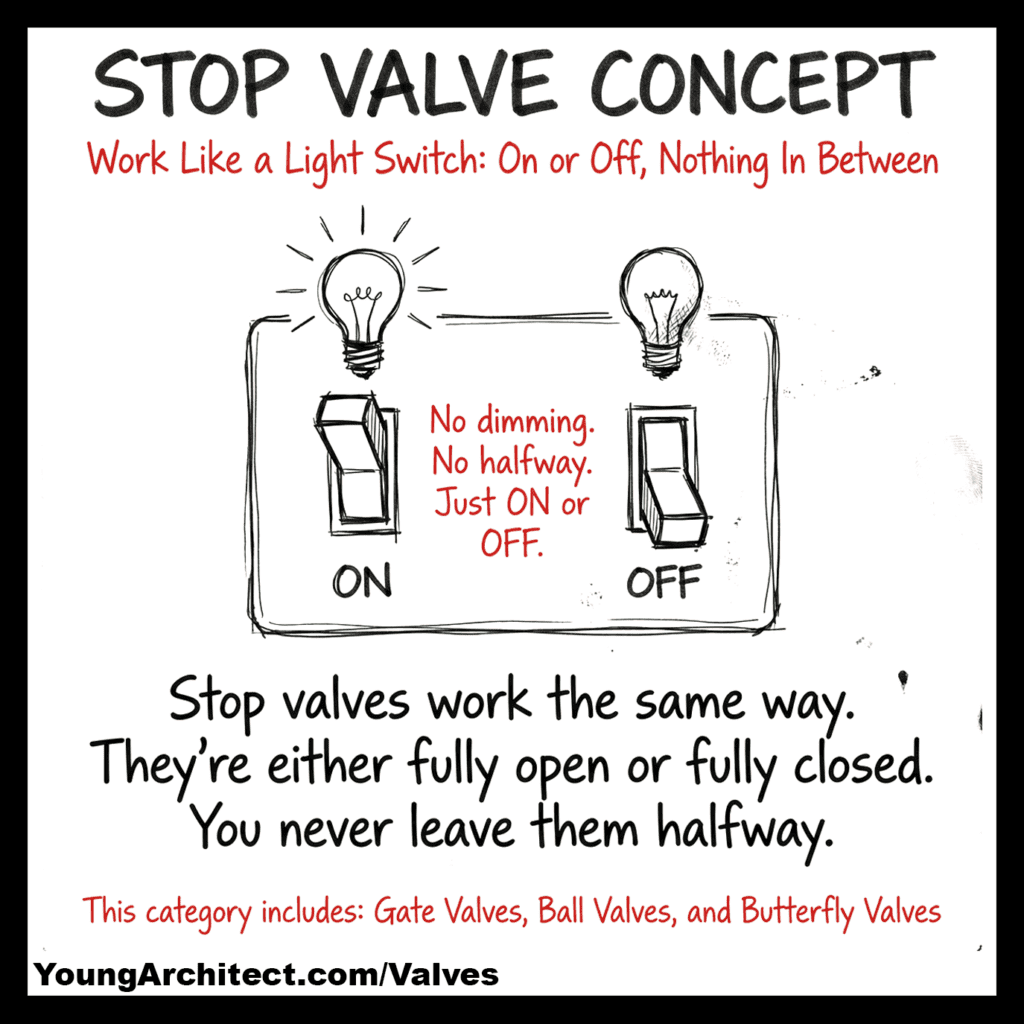
Stop valves are your light switches. They’re either fully open or fully closed. No in-between.
You’ll also hear these called shutoff valves or isolation valves depending on the context, but the function is the same.
Gate Valve
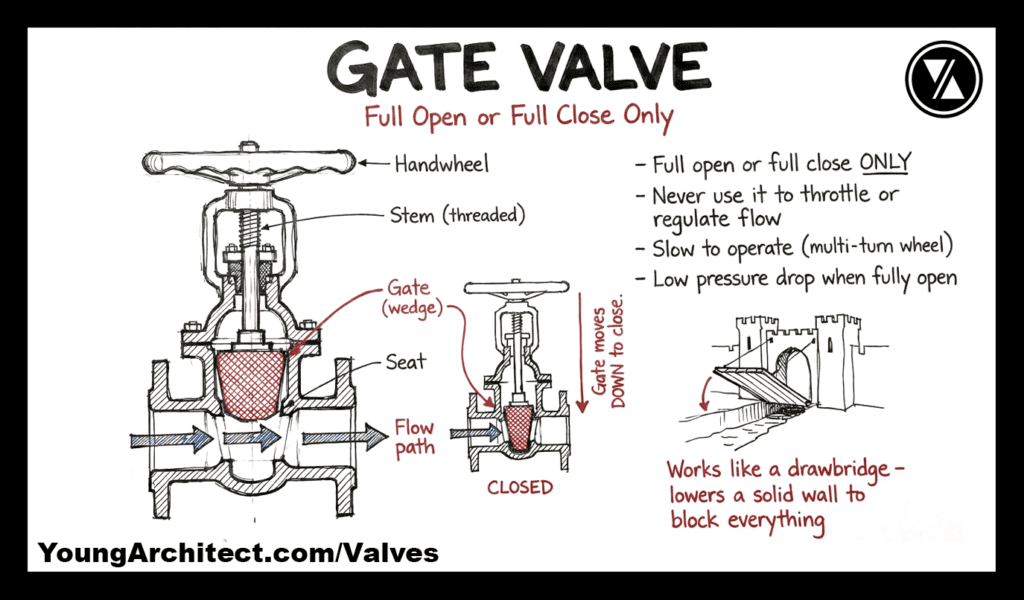
The gate valve is one of the most common water valves in plumbing systems. Inside, there’s a flat wedge that drops down into the pipe to block the water. When it’s open, the wedge lifts completely out of the way, giving you full, unrestricted flow.
Think of it like a drawbridge. When the bridge is up, the path is completely clear. Ships pass through like nothing’s there. But when it lowers down, it’s a solid wall. Nothing’s getting through.
That’s the big advantage of a gate valve. When it’s open, it’s like it’s not even there. Full clearance. It’s a true full-bore valve.
But gate valves are slow to operate. You have to turn the handwheel multiple turns to open or close them.
And they are strictly on or off. You do not use a gate valve to partially control flow. If you leave it halfway open, the water rushing past that wedge will erode it over time and damage the valve.
You wouldn’t leave a drawbridge halfway down, right? Same idea.
Full open or full closed.
That’s it.
Ball Valve
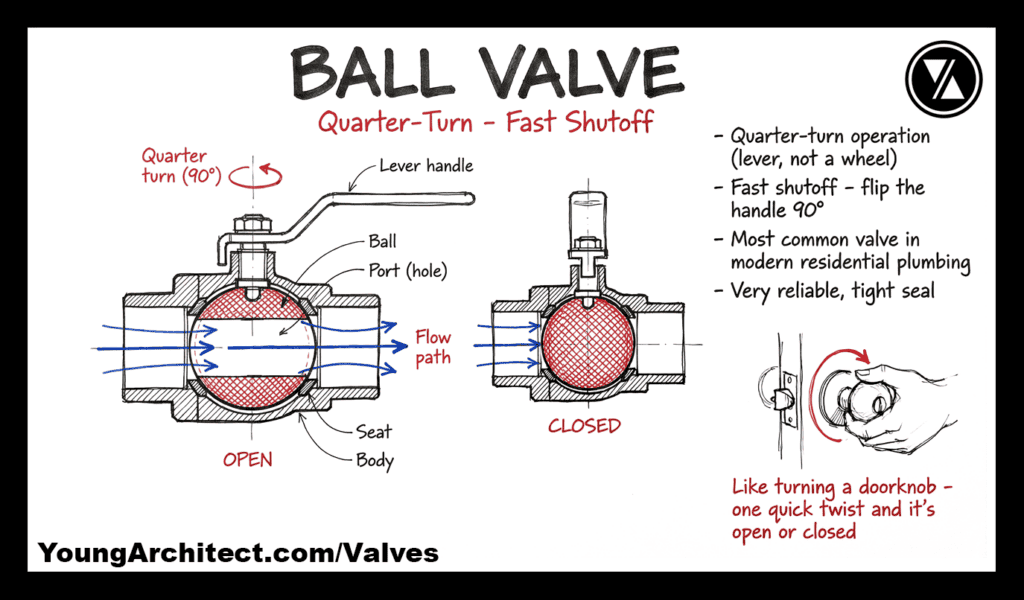
The ball valve takes a completely different approach. Inside, there’s a hollow ball with a hole through the middle. When the hole lines up with the pipe, water flows through. Turn the handle 90 degrees, and the solid part of the ball blocks everything.
That’s a quarter-turn operation. One quick motion and you go from fully open to fully closed.
Think of it like turning a doorknob. One quick twist and it’s done. Open or closed. No cranking, no waiting.
Ball valves are fast, create a tight seal, and they’re extremely durable. You’ll see them throughout residential and commercial plumbing systems wherever you need a reliable shutoff.
And here’s a practical bonus: the handle position gives you an instant visual indicator. Handle in line with the pipe means open. Handle perpendicular means closed. No guessing.
One thing to be aware of: because ball valves close so quickly with that quarter-turn action, they can contribute to water hammer in some systems. Water hammer is that loud banging sound you hear when flowing water gets stopped suddenly, creating a pressure shockwave in the pipes. In systems where water hammer is a concern, engineers may spec water hammer arrestors near quick-closing valves to absorb that shock.
For a deeper look at what causes water hammer and how to prevent it, check out ASPE’s breakdown of water hammer in plumbing systems.
Butterfly Valve
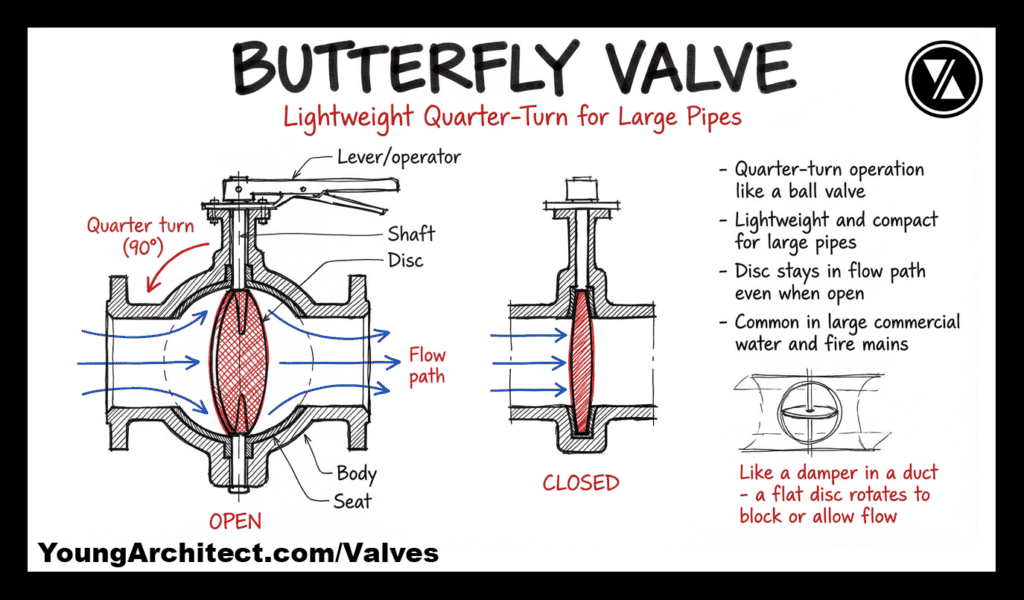
The butterfly valve is a big deal in commercial and institutional buildings, especially for large-diameter piping.
Inside, there’s a flat disc mounted on a shaft that runs through the center of the pipe. When the disc turns parallel to the flow, the valve is wide open. Rotate it 90 degrees and the disc sits perpendicular, blocking everything.
If you’ve ever worked with ductwork, think of a damper. A flat disc that rotates to either block or allow flow. That’s exactly how a butterfly valve works, just with water instead of air.
Now you might be thinking that sounds a lot like a ball valve. And you’re right. They’re both quarter-turn valves. Quick to operate.
But here’s the key difference.
Ball valves work great for smaller pipe sizes. But as pipe diameters get bigger, ball valves get bulky and expensive. A butterfly valve stays slim and compact no matter how big the pipe gets.
That’s why butterfly valves dominate in large-diameter plumbing and mechanical systems. You’ll find them on main water supply lines, on pump connections, and throughout mechanical rooms in commercial buildings. They’re also common in mechanical piping systems controlling chilled water, hot water, and condenser water loops.
But here’s what makes the butterfly valve extra versatile.
Unlike a gate valve, which is strictly on or off, a butterfly valve can also be used for throttling. You can partially open that disc to regulate how much water flows through.
So in large-diameter piping, a butterfly valve can do double duty. It can shut off flow completely or modulate it. That makes it more flexible than a gate valve and more practical than a globe valve when you’re dealing with big pipes.
Gate Valve vs Ball Valve
Since both gate valves and ball valves are stop valves, this comparison comes up constantly, both in practice and on the ARE exam.
Both are designed for on/off control. Neither is meant for throttling. But the differences matter:
- Operation speed: Ball valves are quarter-turn (fast). Gate valves require multiple turns (slow).
- Visual indicator: Ball valve handles show open/closed position at a glance. Gate valves don’t give you that quick visual read.
- Flow restriction: Gate valves provide true full-bore flow with almost no resistance when open. Ball valves are close but the ball’s bore is slightly smaller than the pipe in standard (reduced-port) models.
- Size range: Ball valves dominate in smaller to mid-range pipe sizes. For very large pipes, butterfly valves typically replace both.
- Durability: Both are durable, but ball valves tend to hold up better in systems that get cycled frequently.
In modern plumbing systems, ball valves have largely replaced gate valves as the standard stop valve. Gate valves are more common in older buildings and larger water main applications.
Now those are your main stop valves. Gate, ball, and butterfly.
All of them can stop flow, but they each do it differently. The gate valve is the slow and steady workhorse. The ball valve is the quick shutoff for smaller pipes. And the butterfly valve is the compact, efficient choice for large-diameter piping, with the added bonus that it can also regulate flow.
Regulating Valves: Adjusting the Flow
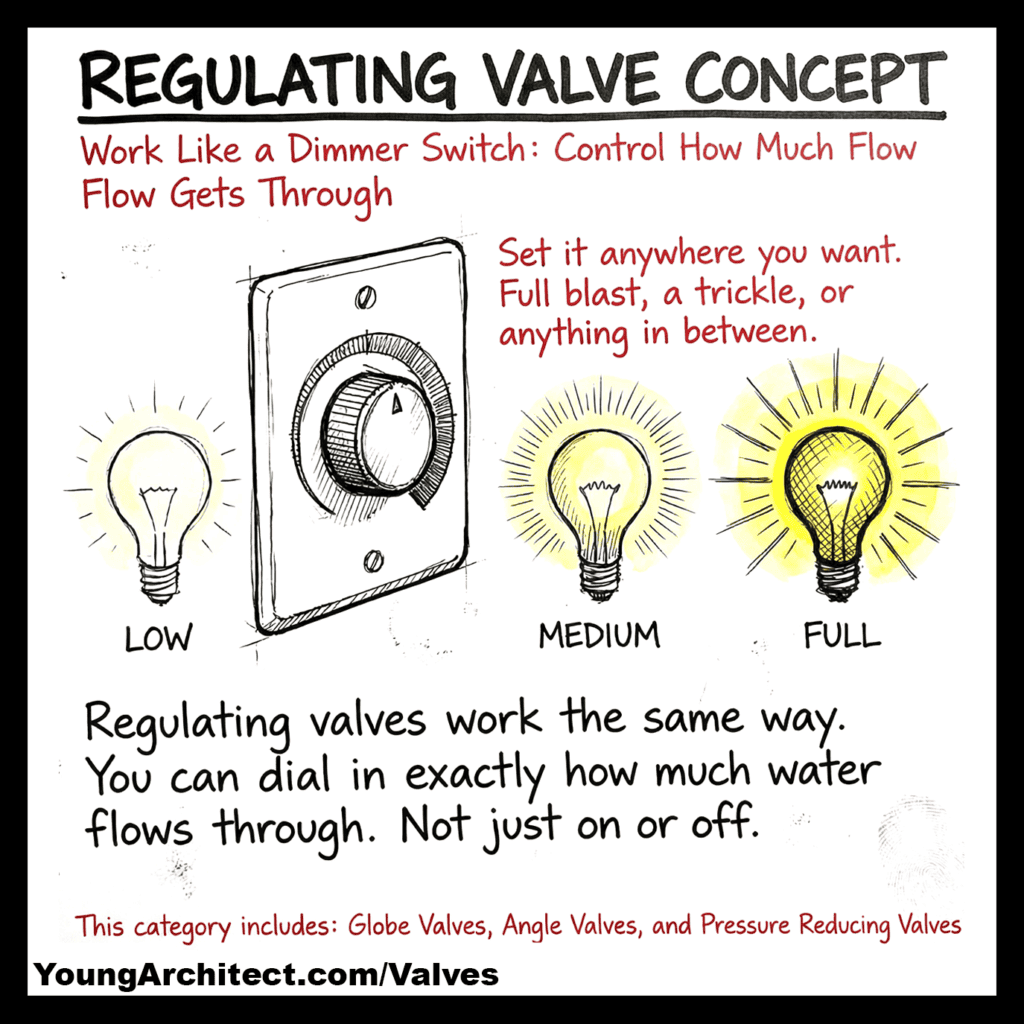
If stop valves are a light switch, regulating valves are the dimmer switch.
They don’t just stop or start flow. They control it. They let you dial in exactly how much water passes through a pipe, or they automatically manage pressure for you.
This is the kind of mechanical systems knowledge that shows up when you’re studying building systems for the ARE, particularly on the PPD exam where you need to select the right plumbing systems for a project.
Globe Valve
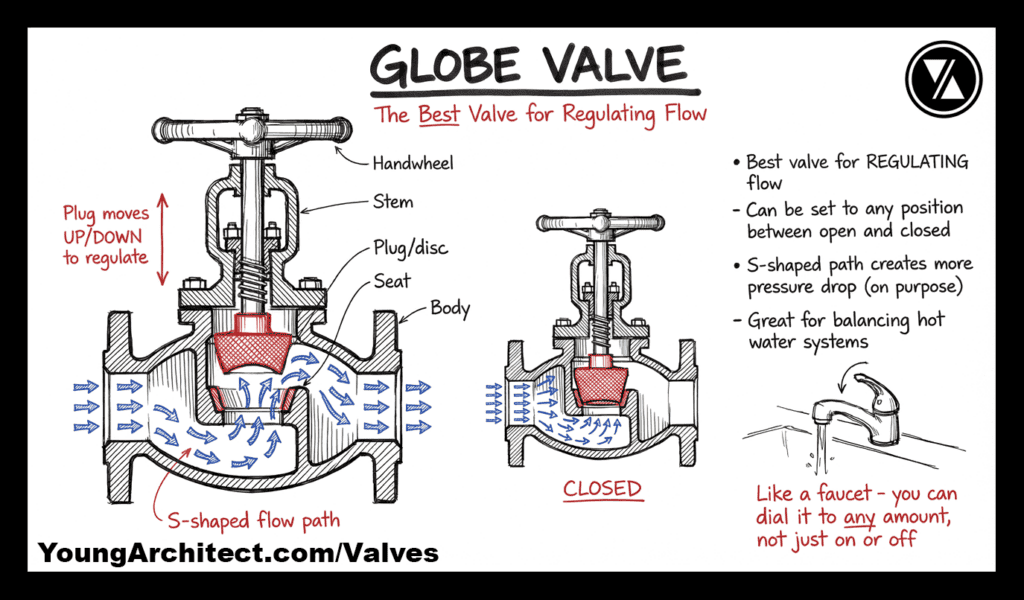
The globe valve is your workhorse for throttling. If you need to control exactly how much water flows through a pipe, this is your answer.
Inside, there’s a disc that moves up and down against a seat. The more you open it, the more water gets through. The more you close it, the more you restrict the flow.
And unlike a gate valve, you can leave a globe valve partially open. That’s literally what it’s designed for. It’s a true throttling valve.
Think about a faucet. You can dial it to any amount, not just on or off. A little trickle, a steady stream, full blast. That’s throttling.
A globe valve does the same thing inside a building’s plumbing system. Same concept, just engineered for a much bigger job.
The trade-off? Globe valves create more friction and pressure drop than a gate valve because of how the water has to change direction inside the valve body. The flow path isn’t straight through. It follows an S-shaped curve, going up and over the seat.
If you need flow control, you use a globe valve. If you need full flow with minimal restriction, you go with a gate valve. Different tools for different jobs.
Globe valve vs gate valve is a common comparison, and the answer is simple. Globe valves regulate. Gate valves isolate. One controls how much. The other controls whether or not.
Angle Valve
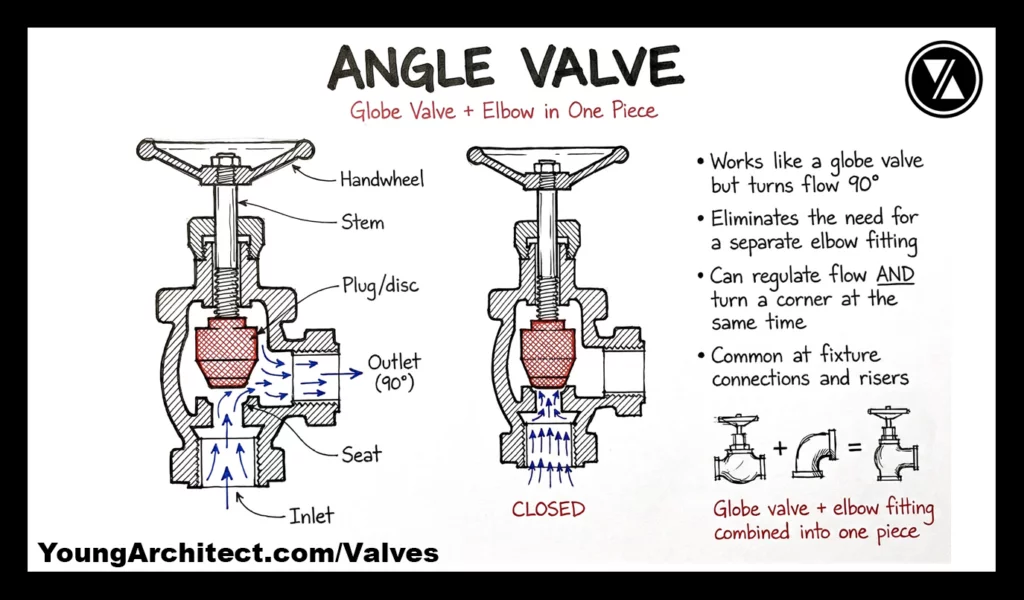
The angle valve is basically a cousin of the globe valve.
It works the same way internally with the same disc-and-seat mechanism for throttling flow. But the difference is the inlet and outlet are at 90 degrees to each other instead of in a straight line.
Why does that matter?
Because sometimes your piping layout needs to make a turn anyway. Instead of using a globe valve plus an elbow fitting, you can use a single angle valve that does both jobs. It controls the flow and changes direction at the same time.
One fitting, two jobs.
You’ve probably seen angle valves without realizing it. Those small chrome valves under your sink or behind your toilet that connect the water supply line? Those are angle valves.
They’re also used in larger commercial applications wherever the piping layout calls for a direction change at a control point.
Angle valves actually create less pressure drop than a standard globe valve because the flow only changes direction once instead of following the S-curve path inside a globe valve body.
Pressure Reducing Valve (Water Pressure Regulator)
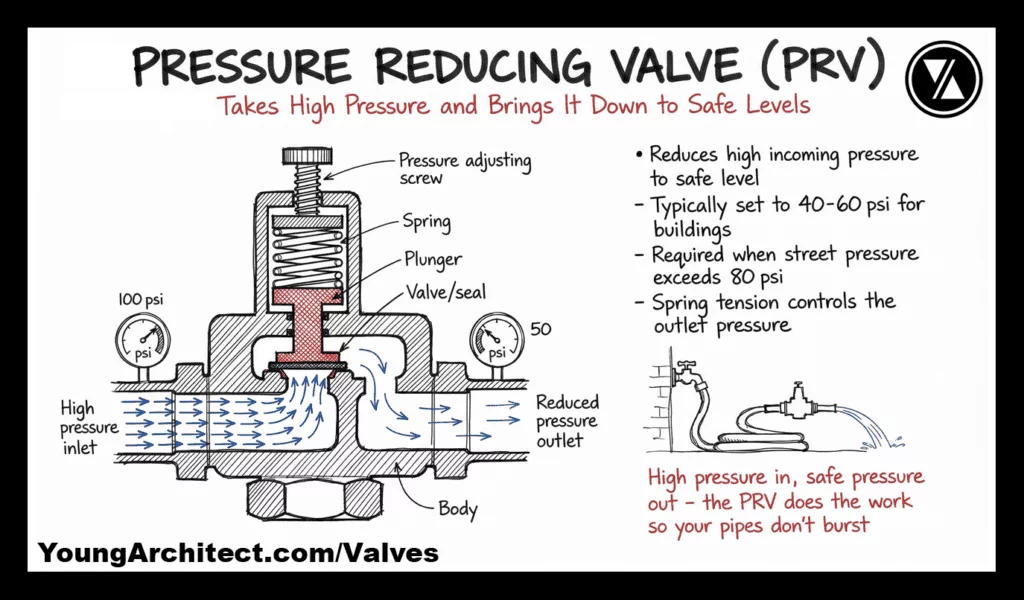
The pressure reducing valve, also called a PRV or water pressure regulator, is the last of our regulating valves, and it’s a really important one.
This valve works automatically. You don’t turn a handle. You set the desired outlet pressure, and the valve does the rest.
Think of it like a bouncer at a club. The city sends water at whatever pressure it wants, and the PRV is standing at the door saying, “You’re coming in at 50 psi. I don’t care what’s happening out there.”
It doesn’t matter how wild things are on the street. Inside, the pressure stays calm and controlled.
Here’s why this matters.
Water comes into a building from the municipal supply at whatever pressure the city provides, and sometimes that pressure is way too high for the fixtures inside. Too much pressure can damage pipes, fittings, and fixtures. It causes water hammer and wastes water.
So a water pressure regulator sits on the main supply line where it enters the building and automatically reduces that pressure to a safe, consistent level.
Most PRV valves are set to deliver somewhere between 40-60 psi on the building side.
Building codes require a PRV in plumbing systems when incoming pressure exceeds certain thresholds.
The International Plumbing Code sets a maximum allowable pressure of 80 psi at any fixture. So if you’re studying for the PDD exam, know that pressure reducing valves aren’t optional in many situations. They’re code-mandated.
Exam Tip: Be careful with the acronym “PRV.” In the industry, PRV almost always means pressure reducing valve. But some exam questions or field conversations use those same letters loosely to mean pressure relief valve. If you see “PRV” on a question, read the full context carefully. A pressure reducing valve manages constant incoming pressure. A pressure relief valve is a safety device that activates in emergencies. Don’t let three letters trick you.
So those are your regulating valves. Globe valves and angle valves for manual flow control. PRVs for automatic pressure management. Now let’s move on to the next category, and honestly, this one might be the most important for code compliance.
Understanding regulating valves is part of the bigger picture of how construction specifications define product requirements for plumbing systems. When an engineer specs a globe valve versus a gate valve, that choice gets documented in the project manual and carries through the entire construction process.
If you’re working toward your CDT certification, this is exactly the kind of specification knowledge the exam tests.
One-Way Valves: Preventing Reverse Flow
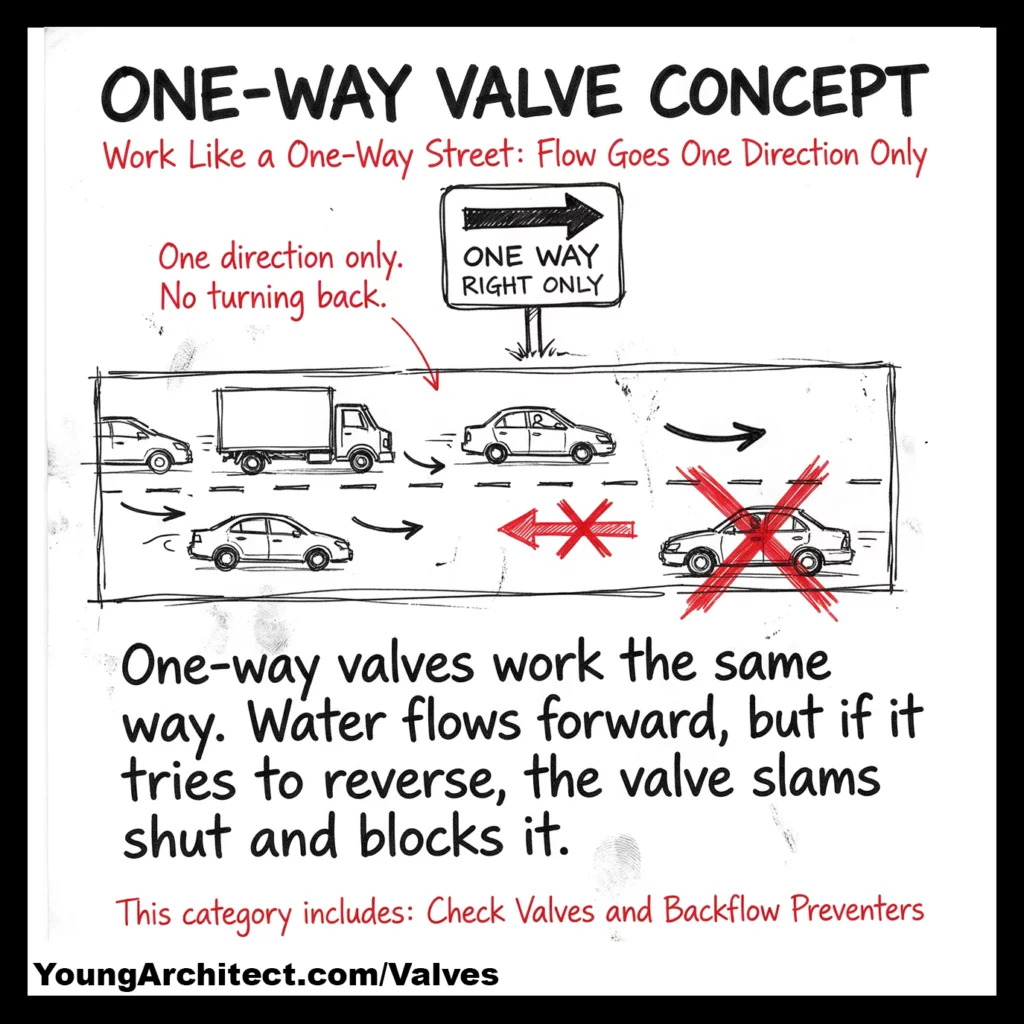
One-way valves only allow water to flow in one direction. They’re all about protection.
Protecting the potable water supply. Protecting equipment. Keeping contaminated water from flowing backwards into clean water.
This is where code compliance gets serious, and understanding different plumbing valves and their protective functions becomes critical.
Check Valve
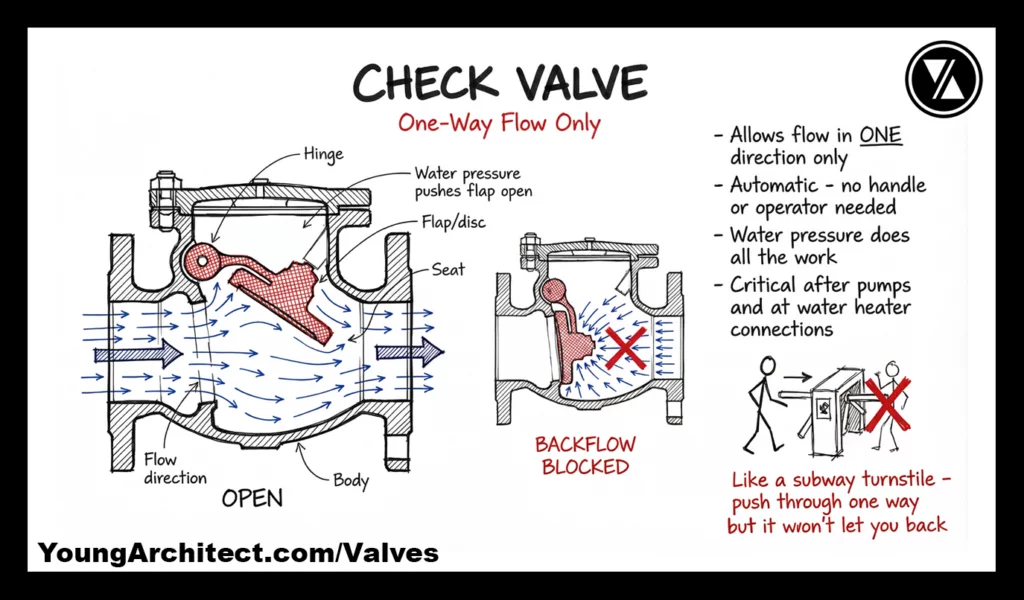
The check valve is the simplest version. Inside, there’s a flap or disc that opens when water pushes through in the right direction. But if water tries to flow backwards, that flap closes and blocks everything.
No handle. No motor. It’s completely automatic.
Think of it like a subway turnstile. You push through in one direction, no problem. Try to go backwards and it locks up. You’re not getting through.
So what does a check valve do? It prevents backflow. That’s it. Simple, reliable, and completely passive.
There are several common types of check valves you should know:
- Swing check valve: Uses a hinged disc that swings open with flow and swings shut when flow reverses. Most common in horizontal pipe runs. Simple and reliable.
- Spring check valve: Uses a spring-loaded disc that requires forward pressure to open. Closes faster than swing check valves, which helps prevent water hammer. Works in any orientation (horizontal, vertical, or angled).
- Double check valve: Two check valves in series within a single body. Provides redundant backflow protection. Required by code in certain cross-connection situations.
You’ll see check valves on pump discharge lines to prevent backflow when the pump shuts off, on water heater supply lines, and anywhere the system needs to ensure water only moves in one direction.
Backflow Preventer
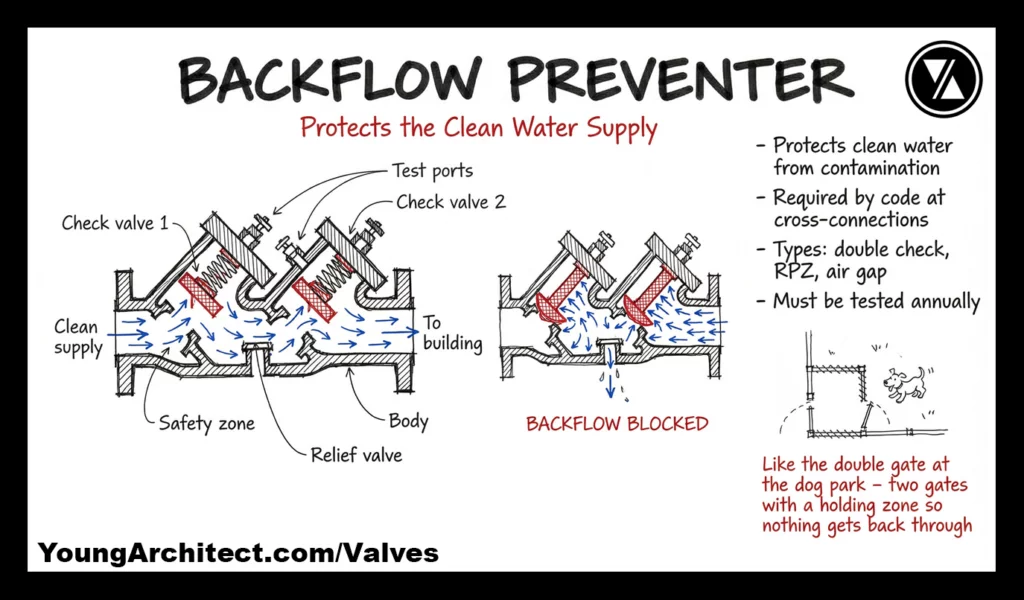
The backflow preventer takes the check valve concept to a whole other level.
A basic check valve is fine for simple situations. But when you’re protecting the public water supply from contamination, building codes require something much more robust.
A backflow preventer is a critical specified product that goes through the submittal review process just like any other piece of equipment, and for good reason. These are life safety devices.
Think of it like the double gate at a dog park. You know how there are two gates with a holding zone in between? You go through the first gate, it closes behind you, and then you open the second gate. That way even if one gate fails, there’s still a barrier. Nothing gets back through.
A backflow preventer works the same way. It typically combines multiple check valves with test ports so the device can be inspected and certified regularly. Some types also include a relief valve as an extra layer of protection.
If there’s ever a sudden drop in pressure in the water main, like if a fire hydrant gets opened down the street, that pressure drop can create suction that pulls water backwards through the system.
This is called back-siphonage.
Without a backflow preventer, contaminated water from a building could get sucked back into the public drinking water supply. Yeah, that’s as bad as it sounds. The EPA has documented numerous real-world contamination incidents caused by unprotected cross-connections in their Cross-Connection Control Manual.
The most common backflow preventer in commercial buildings is the RPZ valve, which stands for reduced pressure zone backflow preventer.
The RPZ assembly has two check valves with a pressure-monitored relief valve between them. If either check valve fails, the relief valve dumps water rather than allowing contamination to reach the potable supply. It’s testable, maintainable, and code-required at high-hazard cross-connections.
Backflow prevention isn’t optional. Codes take it very seriously, and it shows up on the Construction & Evaluation exam because you need to understand where these devices are required and why.
Check Valve vs Backflow Preventer
This distinction matters because they’re solving the same problem at different levels of protection.
A check valve is a passive, mechanical device that prevents reverse flow. It’s simple, reliable, and doesn’t require maintenance or testing. But it’s a single point of failure. If the disc gets stuck or debris holds it open, backflow can occur.
A backflow preventer provides redundant protection with multiple check valves, includes test ports for required annual inspections, and in the case of RPZ assemblies, has a relief valve that provides a fail-safe.
Building codes require backflow preventers at cross-connections where potable water could come in contact with non-potable sources.
Simple way to remember it: check valves prevent backflow. Backflow preventers guarantee it.
Specialty Valves: Purpose-Built Protection
If stop valves are the light switch, regulating valves are the dimmer switch, and one-way valves are the one-way street, then specialty valves are the thermostat.
They monitor conditions in the system and respond automatically. No human needed. One releases dangerous pressure. The other controls water level. What ties them together is they’re self-regulating. They watch, they respond, they do their job on their own.
Pressure Relief Valve
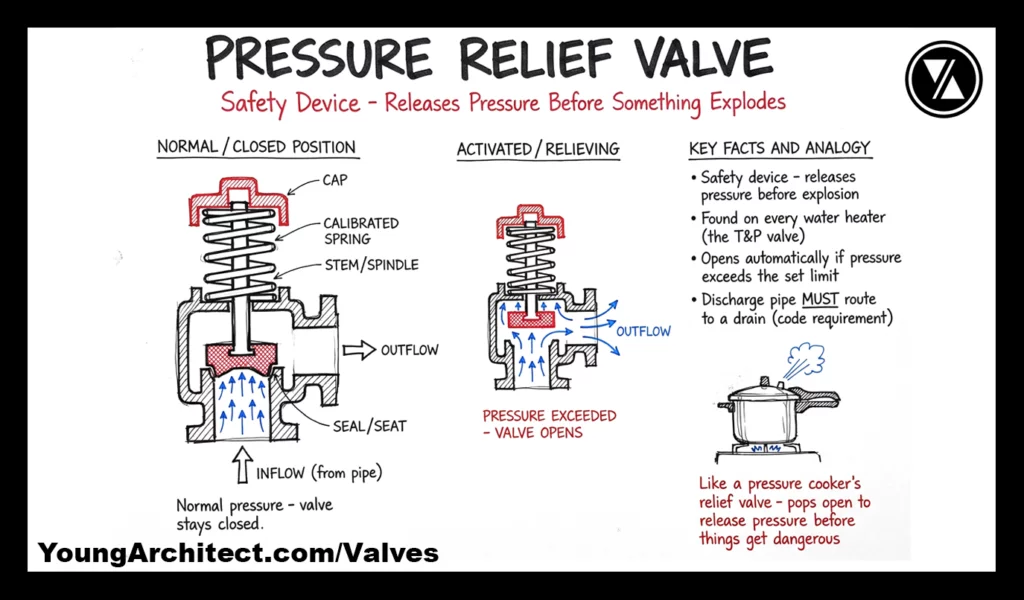
The pressure relief valve is a safety device, plain and simple.
If pressure inside a system builds up beyond a safe limit, this valve automatically opens to release that pressure before something fails. Once the pressure drops back to a safe level, it closes again.
Think of a pressure cooker’s relief valve. When pressure builds up too high inside, that little valve on top pops open to release steam before things get dangerous. A pressure relief valve in a plumbing system does the exact same thing. It’s the last line of defense.
The most common pressure relief valve in buildings is the T&P valve (temperature and pressure relief valve), found on every water heater.
The water heater pressure relief valve opens if either temperature or pressure inside the tank exceeds safe limits. If you’ve ever noticed a small valve on the side of a water heater with a pipe running down to the floor, that’s the T&P valve, and it’s there for a very important reason.
You’ll also find pressure relief valves on boilers and any closed system where pressure can build up. A boiler pressure relief valve works the same way but is typically rated for higher pressures and temperatures.
These water pressure relief valves are required by code on every pressurized heating or hot water system. No exceptions.
Don’t confuse a pressure relief valve with a pressure reducing valve (water pressure regulator). A pressure reducing valve works continuously to manage incoming pressure. A pressure relief valve sits there doing nothing until an emergency, then opens to prevent a dangerous failure. Two very different jobs.
Float Valve
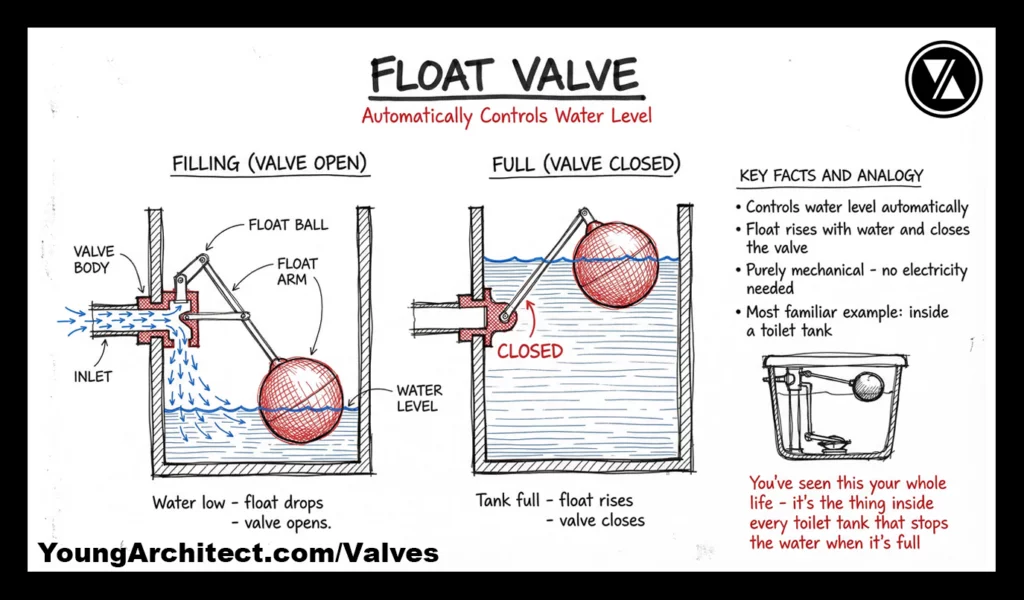
The float valve is the simplest and most elegant valve on this list. And honestly, my favorite.
You’ve actually seen this one in action even if you didn’t know the name. It’s the mechanism inside a toilet tank that controls the fill level.
I know, I know. We went from complex building systems to a toilet. But nobody gives a crap about the float valve, and they really should.
There’s a float that rises with the water level. When the water reaches the right height, the float triggers the valve to shut off. When the water drops, like after a flush, the float drops and the valve opens to refill the tank.
It’s a beautifully simple piece of engineering. Completely mechanical and self-regulating. No electronics, no programming. Just buoyancy and a lever.
Beyond bathrooms, float valves show up in cooling towers, storage tanks, and rooftop tanks in larger buildings. Anywhere you need to automatically maintain a specific water level without electronic controls, a float valve gets the job done.
Plumbing Valves Quick Reference
| Valve Type | Category | How It Works | Best For |
|---|---|---|---|
| Gate Valve | Stop | Wedge drops into pipe | Full-bore on/off shutoff |
| Ball Valve | Stop | Quarter-turn ball with hole | Fast, reliable shutoff |
| Butterfly Valve | Stop / Regulating | Disc rotates on center shaft | Large pipe isolation + throttling |
| Globe Valve | Regulating | Disc moves up/down on seat | Throttling and flow control |
| Angle Valve | Regulating | Globe mechanism at 90 degrees | Flow control + direction change |
| PRV | Regulating | Auto-adjusts to set pressure | Reducing incoming water pressure |
| Check Valve | One-Way | Flap opens with flow, closes on reverse | Preventing backflow |
| Backflow Preventer | One-Way | Multiple checks + test ports | Code-required supply protection |
| Pressure Relief | Specialty | Opens at pressure limit | Emergency pressure release |
| Float Valve | Specialty | Buoyant float controls fill | Maintaining water levels |
Plumbing Valves and the ARE Exam
If you’re studying for the ARE, plumbing valves show up on both the Project Planning & Design (PPD) and Project Development & Documentation (PDD) exams, but from different angles.
PPD is where you select plumbing systems. PPD Objective 3.1 tests your ability to evaluate mechanical, electrical, and plumbing systems and choose the right ones based on function, cost, size, and programmatic needs. That means understanding why you’d pick a ball valve over a gate valve, or when a butterfly valve makes more sense than either one. Valve selection is system selection.
PDD is where you size, specify, and document those systems. PDD Objective 1.2 focuses on determining the size of plumbing system components, and PDD Section 3 covers the project manual and specifications where valve products actually get documented. Understanding how plumbing systems work at the component level is essential here.
Here’s what to focus on for exam prep:
Know the categories, not just the names. If a question describes a valve’s function, you should be able to identify the type. If it names a valve, you should know what it does.
Understand when codes require specific valves. PRVs for high incoming pressure. Backflow preventers at cross-connections. T&P valves on water heaters. Code-mandated plumbing valves come up regularly.
Know where valves appear in the documents. Plumbing valves are specified in Division 22 (Plumbing) under MasterFormat. Valves used in mechanical piping systems fall under Division 23 (Heating, Ventilating, and Air Conditioning).
The valve schedule, pipe diagrams, and riser diagrams all show valve locations and types. And the procedures for how those specifications get administered on the project, from submittal requirements to product substitutions, are governed by Division 01 General Requirements.
Understand the comparison pairs. Gate valve vs ball valve. Globe valve vs gate valve. Check valve vs backflow preventer. Pressure reducing valve vs pressure relief valve. These distinctions test whether you actually understand the systems.
Valve knowledge connects to larger building systems concepts. When you understand how valves control flow, pressure, and direction, you’re building the foundation for understanding entire plumbing systems.
This is exactly the kind of systems thinking that the ARE 101 courses and PDD 101 are designed to build.
Frequently Asked Questions About Plumbing Valves
What does a check valve do?
A check valve allows water to flow in one direction only and automatically closes to prevent reverse flow. It’s a passive device with no handle or operator. Check valves protect plumbing systems from backflow caused by pressure changes, pump failures, or gravity.
What is the difference between a gate valve and a ball valve?
Both are stop valves designed for on/off control. A gate valve uses a handwheel that raises or lowers a wedge, taking multiple turns to open or close. A ball valve uses a quarter-turn handle that rotates a ball with a hole through it. Ball valves are faster and give you a visual indicator of position. Gate valves are more common in older systems.
What is a PRV in plumbing?
A PRV, or pressure reducing valve, automatically lowers incoming water pressure from the municipal supply to a safe level for your building. Also called a water pressure regulator, a PRV typically reduces pressure from 80-150 psi down to 40-60 psi. PRVs are installed on the main water line where it enters the building.
How does a backflow preventer work?
A backflow preventer uses multiple check valves and a relief valve to stop contaminated water from flowing backward into the clean water supply. Unlike a simple check valve, a backflow preventer is testable and maintainable. The most common type in commercial buildings is the reduced pressure zone (RPZ) assembly.
What is the difference between a pressure relief valve and a pressure reducing valve?
A pressure reducing valve works continuously to lower incoming water pressure to a safe level. A pressure relief valve only opens when pressure exceeds a dangerous set point, releasing water or steam to prevent failure. The most common pressure relief valve is the T&P valve on water heaters.