

Learning how to become an architect in the US means completing four key steps: earning an accredited degree, gaining real-world experience, passing the Architect Registration Exam (ARE), and paying your licensing fees. Here’s everything you need to know about the path to becoming a licensed architect.
This podcast is also available on YouTube, Spotify, and Apple Podcasts
What Does an Architect Actually Do?
Before we talk about how to become an architect, let’s clear something up.
Most people think architects spend all day dreaming up cool buildings and drawing pretty pictures. I hear it almost weekly. Someone will tell me, “I thought about becoming an architect, but…” and then give me a reason they didn’t pursue it.
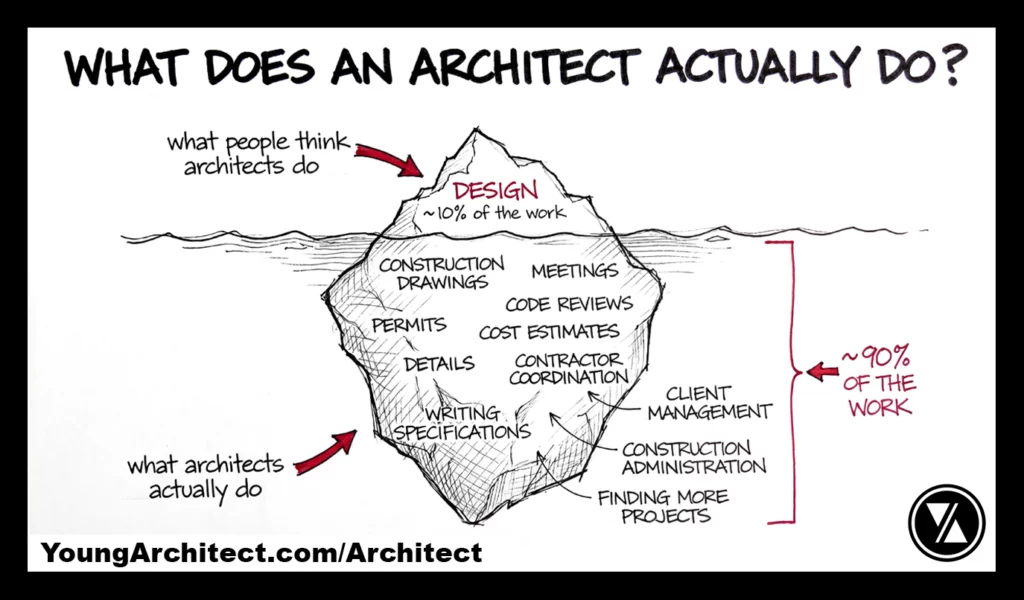
The reality? The typical day of a practicing architect looks more like this:
- Working on construction drawings
- Attending meetings (lots of meetings)
- Checking their staff’s work
- Invoicing clients
- Reviewing contractor work so they can get paid
- Managing clients and employees
- Sometimes worrying about finding the next project
Sure, designing is part of an architect’s day. But it’s really just a small piece of every project.
I once completed a project that was designed by 3 people sitting around a conference table for 2 hours. The design was good, simple, and effective.
After we solved the design problem…
the next 11 months were spent fine tuning that design, creating construction drawings, specifications, details, getting cost estimates, solving code issues, obtaining building permits, supporting the contractor during construction, responding to unforeseeable conditions, and coordinating furniture, IT, and moving consultants.
A 2 hour design meeting translated into 11 months of execution.
Designing the project is usually the shortest phase. Maybe 10% of the total effort. Executing the design is really the bulk of the work, closer to 90%.
So if you’re interested in becoming an architect, know that the profession is about a lot more than just design. And that’s actually what makes it so interesting.
Is Becoming an Architect Hard? (Yes, and It’s Worth It)
Let’s be honest. Becoming an architect is not easy.
The education is long. The experience requirements are significant. And then you have to pass a 6-part licensing exam on top of everything else.
There’s no shortage of articles on the web listing the many great reasons NOT to become an architect. And architecture careers are definitely not for everyone.
But here’s what I tell our students at Young Architect Academy:
Rather than focusing on the time, money, and energy, think of it as an investment.
It’s a lot easier to show up every day when you know you’re working toward something big. Every hour you put into this process is an investment in your career, your earning potential, and your professional future.
Successful architects have all made incredible sacrifices and worked extremely hard to get where they are.
The most important skill isn’t being a great artist or a genius designer.
It’s persistence. Drive. The willingness to do the hard work day after day.
Everything else can be learned along the way.
So yes, it’s hard. But for those willing to put in the work, it is absolutely worth it.
How Long Does It Take to Become an Architect?
This is one of the most common questions I get, and the honest answer is: it depends.
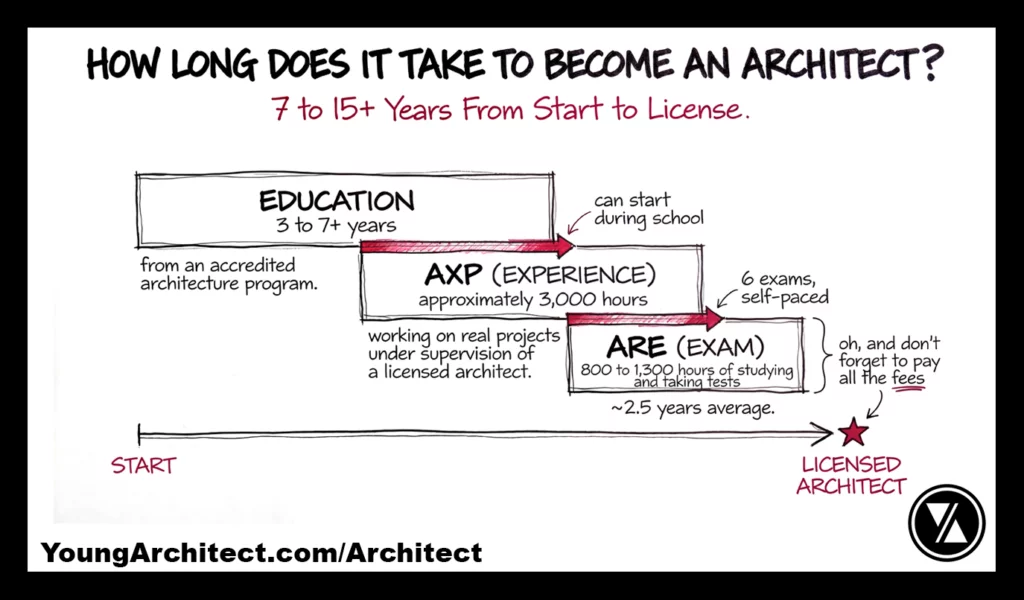
The realistic timeline from starting school to getting your architecture license is somewhere between 7 and 15+ years. Here’s how that breaks down:
- Education: 3 to 7+ years depending on which degree path you choose (more on that below)
- Architectural Experience Program (AXP): Approximately 3,740 hours of documented work experience. Some of these hours can overlap with school.
- Architect Registration Exam (ARE): Most people take about 2.5 years to pass all six exams. That translates to roughly 800 to 1,300 hours of studying, preparing, and testing.
- Fees and Final Requirements: State board applications, NCARB record fees, and any additional state requirements add time to the process as well.
Some people move through this faster. Some take longer.
There’s no single “right” timeline, but knowing what you’re looking at upfront helps you plan.
The key is to treat each step as part of a larger investment in your career rather than looking at the total number of years and feeling overwhelmed. Break it into phases and focus on the step in front of you.
The Architecture Industry is Huge
Here’s something most people don’t realize about architecture. The word architecture is as broad a category as music is.
We call it music, but there are so many subcategories. Classical, country, or even something really specific like east coast straight edge hardcore from the 80s.
Just like music, there are a million little niches within architecture that an architect could specialize in:
- Residential
- Industrial
- Sustainability
- Hospital and healthcare design
- CAD and rendering
- Engineering specialties
- Interiors
- Waterproofing
- Building envelope
- Historic preservation
- Masonry
- And this list goes on and on
What I love most about the architecture industry is that it is so vast. There is plenty of work for everyone to thrive using whatever skills, talents, and interests they may have.
And here’s something else worth knowing.
Not every job in this industry requires a licensed architect.
But having an architecture license never hurts, and architectural training is incredibly valuable no matter where you end up.
People with architecture backgrounds work as contractors, owner’s representatives, product representatives, professors, and in dozens of other roles. The education and training you receive in architecture opens doors far beyond traditional practice.
Architecture is a Regulated Profession
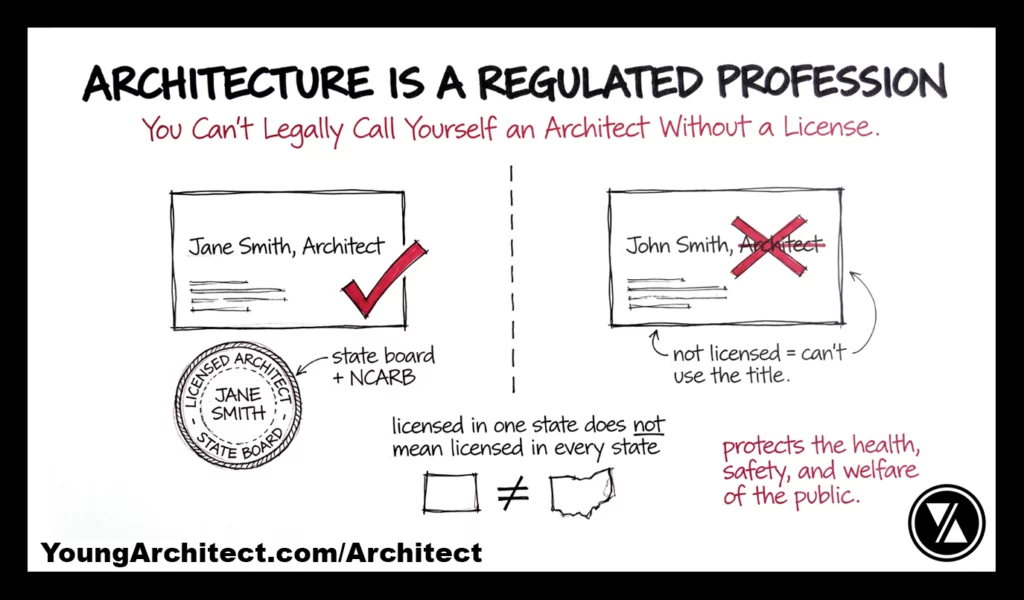
Did you know it is technically illegal to call yourself an architect in the US if you do not have an active license?
This surprises a lot of people, but it makes sense when you think about it. Architects carry a tremendous amount of responsibility protecting the health, safety, and welfare of the public.
If someone hasn’t fulfilled the requirements, they should not be calling themselves an architect, especially if they are living in the US.
Here’s how it works:
- You need an active license with both your state board and the National Council of Architectural Registration Boards (NCARB)
- A licensed architect in New York is not automatically licensed in California. You need a separate license for each state where you want to practice.
- State architectural licensing boards regularly take action against unlicensed individuals calling themselves architects or practicing without a license
So what can unlicensed people call themselves?
Designers, project managers, job captains, or any number of other titles. But the word “Architect” or any derivative of it is off limits.
Many states don’t even allow unlicensed people to use the term “Architectural Designer.”
Now, having an architecture license is not a requirement for having a successful career in architecture. Most people graduate from architecture school and build very successful careers without obtaining their license.
But if you want to call yourself an architect, stamp drawings, and take on the full professional responsibility of the role, licensure is the path.

How to Become an Architect: 4 Steps to Licensure
Becoming a licensed architect in America is a 4-part process. This process is lengthy and no easy feat. But it is not impossible, and the rewards of becoming a licensed architect are well worth the investment.
Let’s break each step down.
Step 1: Earn an Accredited Architecture Degree
For licensure in most states, you need a professional degree in architecture from a school accredited by the National Architectural Accrediting Board (NAAB). There are currently over 100 architecture programs to choose from across the country.
Three professional architecture degrees are available:
- Bachelor of Architecture (B.Arch) requires a minimum of 150 credit hours. This is typically a 5-year program that students enter directly out of high school.
- Master of Architecture (M.Arch) requires a minimum of 168 credit hours, with at least 30 at the graduate level. This is the path for students who earn a 4-year undergraduate degree first, then complete a 2-3 year graduate program.
- Doctor of Architecture (D.Arch) requires a baccalaureate degree or 120 undergraduate credit hours plus a minimum of 90 graduate credit hours.
Can you become an architect without one of these degrees? It is possible. Some people become licensed architects through alternative paths, though that process is more complex and varies by state.
The best way to learn more about this is to contact NCARB directly.
Step 2: Complete the Architectural Experience Program (AXP)
The Architectural Experience Program (AXP) is the apprenticeship requirement of becoming a licensed architect.
AXP requires the completion of approximately 3,000 hours of documented work experience across 6 different categories.
The purpose is to make sure candidates gain real professional experience, knowledge, and skills while working on actual projects.
This isn’t theoretical. You’re applying what you learned in school to real buildings with real budgets and real consequences.
Here’s what you need to know about AXP:
- You must work under the direct supervision of a licensed architect
- All hours must be on real projects
- Your work must be paid. Unpaid internships are heavily frowned upon in the architecture profession and do not qualify for AXP credit.
- You can start logging AXP hours while still in school in some cases, which helps speed up the overall timeline
Candidates most commonly complete their AXP hours working within architecture firms, where they assist on design projects, prepare construction documents, research building codes, and gain exposure to all phases of practice.
For the most current AXP requirements, always check NCARB’s AXP page directly since these requirements can change.
Step 3: Pass the Architect Registration Exam (ARE)
The Architect Registration Exam (ARE) is required in all 54 US jurisdictions. It’s the final knowledge test standing between you and your architecture license.
The ARE is broken down into six divisions:
- Practice Management (PcM) covers starting and running an architecture business, including accounting, HR, business operations, and ethics
- Project Management (PjM) covers managing all the moving parts of a project, including schedules, budgets, coordination, and AIA contracts
- Programming and Analysis (PA) covers understanding the problem a design will solve, including programming, codes, site analysis, and building systems
- Project Planning and Design (PPD) covers the early schematic design phase, including codes, structures, building systems, and site planning
- Project Development and Documentation (PDD) covers the construction documents phase, focusing on detailing, documentation, and specifications
- Construction and Evaluation (CE) covers construction contract administration, including bidding, RFIs, change orders, closeout, and AIA contracts
Each exam includes multiple choice and case study questions. Case studies provide reference material you can use to look up answers during the test.
The ARE is a self-guided process. You study and take the exams on your own schedule.
Its currently taking people approximately 800 to 1,300 hours of studying, preparing, and testing to complete all six exams. Some people finish all six in under a year, but most take about 2.5 years to complete the process.
Studying for the architect exam is completely different from every other exam you’ve studied for. Often, just getting started is the hardest part because people don’t know what they don’t know.
That’s exactly why I built Young Architect Academy (this website).
After going through the ARE process myself and struggling, I created the largest ARE prep platform in the country to help candidates pass their exams faster and with less stress. Everything on this site exists because I’ve been where you are.
Since 2015 we have offered an ARE Boot Camp Coaching Program designed to give you a clear roadmap, accountability, and support throughout the entire process.
And for self-paced study, the ARE 101 courses cover every division with video content, practice questions, and case studies.
If you’re trying to figure out the best order to take your ARE exams, that’s one of the most important strategic decisions you’ll make. And if procrastination is holding you back, you’re not alone, but every month of delay costs you time and opportunity.
The key is to create a realistic study schedule and treat the ARE like the career investment it is.
Step 4: Pay the Fees and Get Licensed
You can complete your education, finish your AXP hours, and pass all six ARE exams. But if you don’t pay the fees and handle the paperwork, you’re still not a licensed architect.
This step is often overlooked, but it matters.
Here’s what’s typically involved:
- Paying your NCARB record fees
- Paying your state board registration fees
- Completing any additional state-specific requirements (some states require interviews or supplemental exams)
Registration requirements vary between states, so it’s important to check with your specific state board to understand exactly what’s needed in your jurisdiction.
Once you’re licensed, continuing education is required to keep your license active. This is an ongoing commitment throughout your career.
Final Thoughts
Becoming an architect is a long journey. It takes years of education, thousands of hours of real-world experience, and a serious commitment to passing the licensing exams.
But it’s also an incredible profession.
The architecture industry is constantly changing, growing, and creating new opportunities. Technology continues to reshape how we practice. And the skills you develop through this process, problem solving, critical thinking, communication, and technical knowledge, are valuable in ways that extend far beyond architecture.
If you’re just starting to explore this career path, I hope this gives you a clear picture of what’s ahead. It’s not easy, but nothing worth doing ever is.
And if you’re already on the path and working toward your architecture license, check out the ARE Boot Camp for structured coaching and support, or explore the ARE 101 courses to start studying at your own pace.
The investment is worth it. I promise.