


Understanding concrete slab types is one of those topics that shows up constantly on the ARE and trips up a lot of candidates. This guide breaks down six structural systems, from one-way solid slabs to waffle slab construction, so you can quickly identify the right system on exam day and in practice.
This podcast is also available on YouTube, Spotify, and Apple Podcasts
One-Way vs Two-Way Concrete Slabs: The Shape Test
Before we get into specific concrete slab types, there’s one concept that governs everything. If you remember nothing else from this post, remember the shape of the bay.
Look at your bay and ask yourself: is it more rectangular or more square?
If the bay is rectangular (long and narrow), you’re looking at a one-way slab. The load takes the easy route and only travels across the short distance to the nearest supports.
If the bay is more square, you’ve got a two-way slab. The load spreads out in both directions toward all four supports.
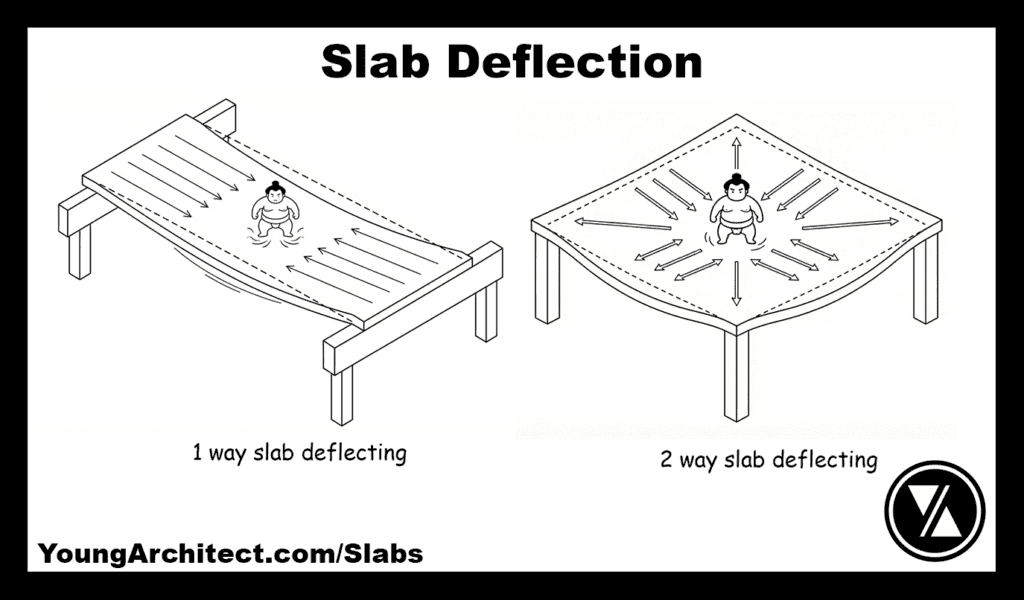
Here’s a memory trick. Two-way has “two” in it. Think of the two sides being almost equal, like a square. One-way goes in one direction, so it’s rectangular.
Want to get technical? Take the long dimension and divide it by the short one. If that number is greater than 2, it’s one-way. If it’s 2 or less, it’s two-way. But looking at the shape will get you there most of the time.
Think of it like a diving board versus a trampoline.
A diving board is long and narrow. When you stand on it, it bends in one direction. That’s a one-way slab bending into a cylindrical shape.
A trampoline is roughly square. When you jump on it, it stretches in all directions. That’s a two-way slab bending into a dish shape.
One more thing to lock in. In a one-way slab, the main slab reinforcement runs perpendicular to the beams. In a two-way slab, reinforcement runs in both directions.
If you want to see these structural systems illustrated with incredible clarity, Francis Ching’s Building Construction Illustrated is one of the best resources out there.
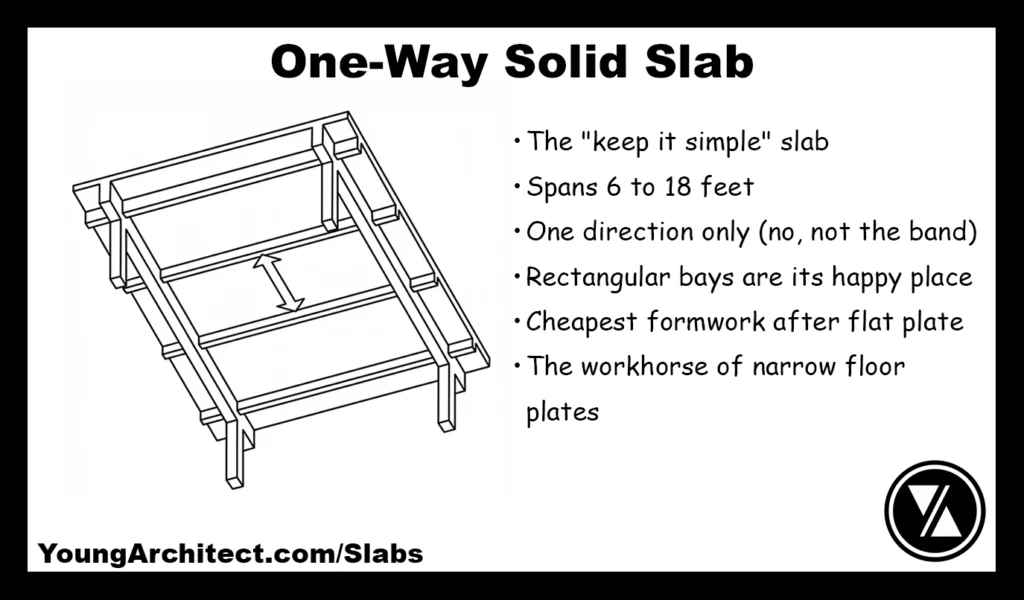
One-Way Solid Slab
The one-way solid slab is your bread and butter. The simplest concrete slab type you’ll encounter.
It’s a solid sheet of reinforced concrete slab supported on two opposite sides, usually by parallel beams or walls. The load travels in one direction only, across the short span.
Think of a small footbridge. It spans from one bank to the other and doesn’t care about what’s happening on the sides. The load goes straight across.
When do you use One-Way Solid Slab?
When your space is rectangular and your spans are short. One-way solid slabs are economical for spans between 6 to 18 feet. You’ll find them in residential construction, narrow floor plates like hotels and dorms, and small-span commercial spaces.
How do you spot it on the ARE exam?
Beams running in one direction only. The slab spans between those beams. Rectangular shape, beams on two sides. One-way solid slab.
The concrete slab thickness stays relatively thin since you’re only spanning short distances. But what happens when 18 feet isn’t enough? You can’t just keep making the slab thicker forever. That’s where we add ribs.
ARE Exam Reminder: Rectangular bay + beams on two parallel sides + short spans (6-18 ft) = one-way solid slab. Load travels one direction across the short span.
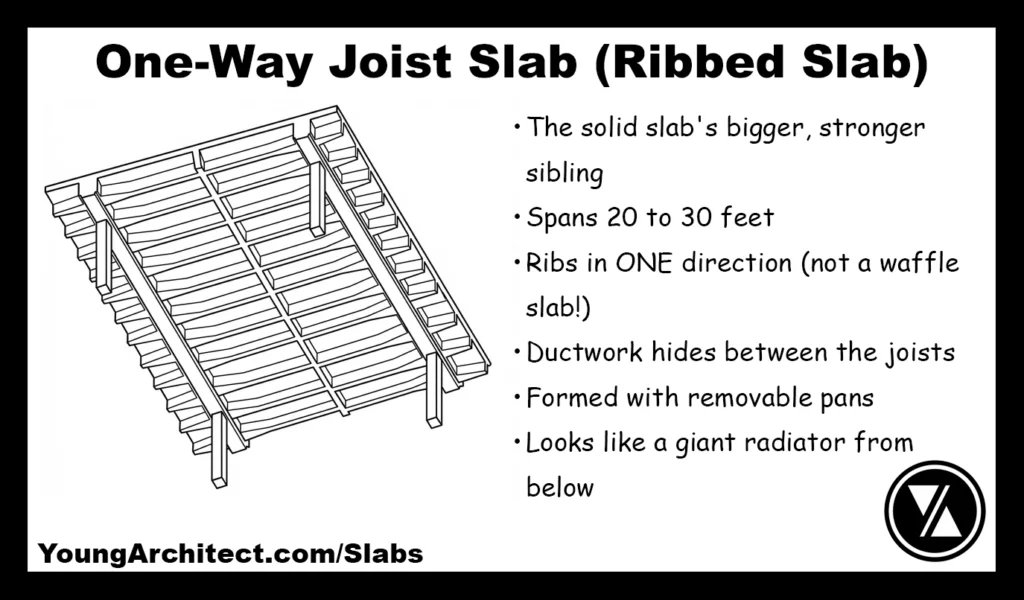
One-Way Joist Slab (Ribbed Slab)
The one-way joist slab, also called a ribbed slab, is still a one-way system. Still rectangular. But instead of a solid pancake of concrete, we create ribs that run in one direction.
If you looked up at this ceiling, it would almost look like a giant radiator. Long, deep grooves running in one direction with flat areas between them. The ribs are formed during slab construction using removable pans.
Why build it this way?
You get more structural depth without all that extra concrete weight. The ribs act like a series of small beams built into the slab. You get the strength where you need it, but you remove the heavy concrete where it isn’t doing any work.
It’s the efficient version of a one-way slab. Same logic, longer spans.
A one-way joist slab handles spans of 20 to 30 feet with medium to heavy loads. You’ll see them in warehouses, office buildings, and anywhere you need longer spans than a solid slab can handle.
Another advantage: the spaces between the ribs allow for mechanical integration. You can run ductwork and pipes between the joists, keeping floor-to-floor height manageable.
The exam loves this distinction. They’ll show ribs and ask if it’s a joist slab or a waffle slab. Here’s how to tell instantly:
- Ribs in ONE direction = one-way joist slab
- Ribs in TWO directions = waffle slab
The slab formwork for a one-way joist is more complex than a solid slab because of those pan forms, but still far simpler than a waffle slab. Keep that in mind when questions reference construction costs.
ARE Exam Reminder: Rectangular bay + ribs in ONE direction + spans 20-30 ft = one-way joist slab. Don’t confuse with waffle slab. Count the rib directions.
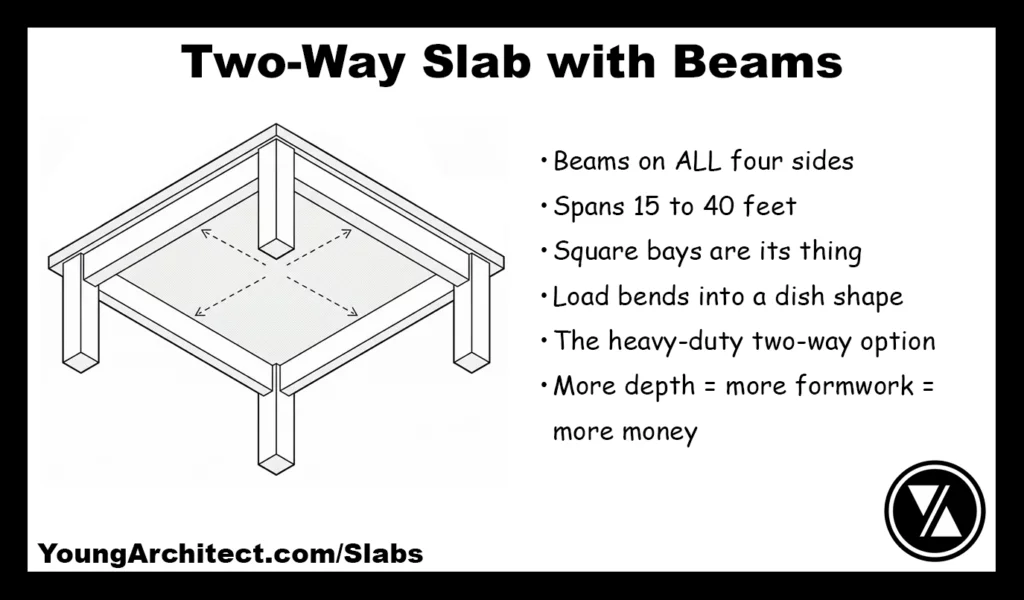
Two-Way Slab with Beams
Now we’re in two-way territory. The bay is more square, and loads travel in both directions.
The two-way slab with beams is the heavy-duty version of two-way structural systems. You’ve got beams on all four sides of the slab panel. The floor slab spans between those beams in both directions, bending into a dish shape under load.
This structural slab system works for spans between 15 to 40 feet, which makes it versatile. You’ll find it in office buildings, residential buildings, and commercial structures.
How do you identify it Two-Way Slab with Beams?
Beams on all four sides. A grid-like pattern of supports. Reinforcement in both directions. That’s your two-way slab with beams.
The disadvantage is deeper structural depth because of those beams hanging down below the slab. More slab formwork complexity means more cost. When you’re thinking about hard costs versus soft costs on a project, those deeper beams add up in both material and labor.
What if we want to get rid of those beams entirely? Support the concrete slab directly on columns with nothing in between? That gives us the cleanest ceiling possible, but creates some challenges.
ARE Exam Reminder: Square bay + beams on ALL FOUR sides + spans 15-40 ft = two-way slab with beams. Look for the grid pattern of supports.

Two-Way Flat Plate
Here’s how to remember this one. Think about a dinner plate. It’s just flat. Nothing fancy. No raised sections. Just a flat surface.
That’s a flat plate slab. A two-way concrete slab supported directly by columns. No beams. No thickened areas. Just a slab of uniform thickness sitting right on top of the columns.
Look up at the ceiling and you see a perfectly flat surface. Nothing hanging down. It’s the cleanest-looking concrete floor slab you can build.
When do you use it?
Apartments. Condos. Hotels. Dormitories. Hospitals. Office buildings. Anywhere you want maximum ceiling height and a clean, unobstructed ceiling. Flat plates work for lighter loads and spans of 12 to 24 feet.
Developers love flat plates because the slab formwork is just flat plywood. Simplest and cheapest formwork of any system. Quick to build, lower labor cost.
But here’s the critical concept: punching shear.
Think about a woman in stiletto heels walking across a lawn. Those heels sink right into the grass because all her weight is concentrated on two tiny points.
That’s what happens at the column in a flat plate. All the load concentrates where slab meets column. The column wants to punch right through the slab like a hole punch through paper. This limits how much load a flat plate can handle and how far it can span.
ARE Exam Reminder: No beams + uniform slab thickness + clean ceiling + spans 12-24 ft + lighter loads = flat plate. If the question mentions heavy loads or longer spans, flat plate is NOT the answer.

Flat Slab with Drop Panels
A flat slab is basically a flat plate’s bigger, stronger sibling. It’s still a beamless system with the concrete slab supported directly on columns. But now we’ve added drop panels or column capitals or both.
Drop panel: a thickened portion of the slab right around the column. Look up and you see a thick square pad surrounding each column, then thinner slab everywhere else.
Column capital: a widened, flared top of the column that spreads out where it meets the slab.
Why add these?
Remember the stiletto heel problem? Drop panels are like putting a piece of plywood under those heels. You spread the load over a bigger area so it doesn’t punch through.
Drop panels increase the shear strength right where you need it, reduce the bending moment, and stiffen the whole system. You get better load transfer and can actually reduce concrete slab thickness elsewhere.
Flat slabs handle spans of 20 to 40 feet and heavier loads. Common applications include office buildings and parking garages.
The tradeoff? You lose that perfectly clean ceiling. The slab formwork gets more complex at drop panel locations. But you can handle more load and span farther, and that often matters more than aesthetics in a parking structure.
ARE Exam Reminder: Heavier loads + spans 20-40 ft + parking structures + punching shear concerns = flat slab with drop panels, NOT flat plate.
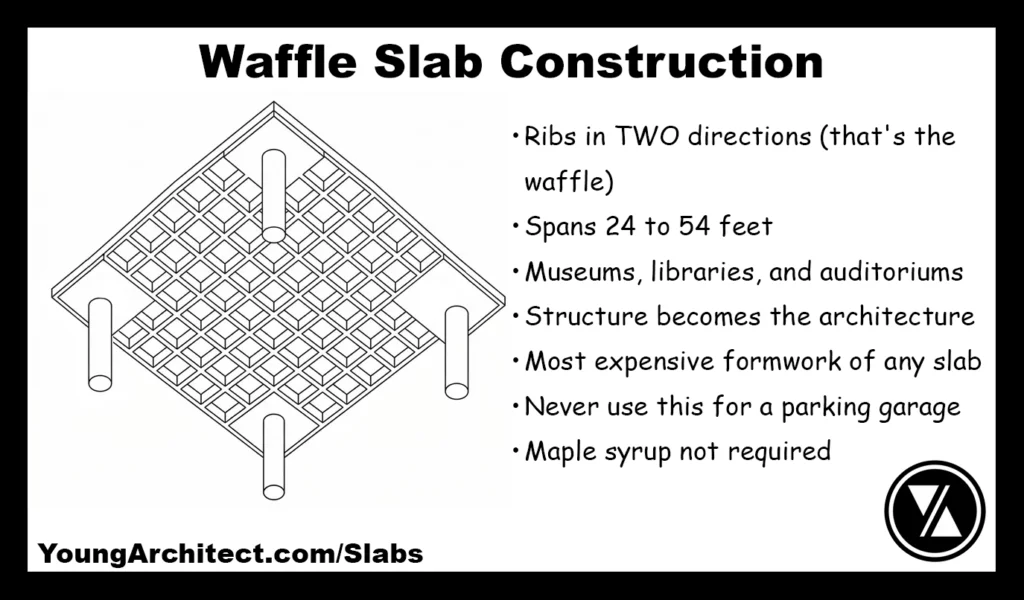
Waffle Slab Construction
The waffle slab, also called a two-way joist slab, is a two-way ribbed slab with ribs running in both directions. That creates the distinctive grid pattern on the underside. Flat on top, waffle pattern on the bottom.
Just look at it. All those individual dome forms, that complex grid pattern. You can tell the slab formwork is going to be complicated. And complicated formwork means expensive labor.
So when do you actually use one?
When the client wants architectural expression. When they want the structure visible as a design feature. When budget allows for something special.
Think museums. Libraries. Auditoriums. Airport terminals. Train stations. Theaters. Buildings where that exposed waffle ceiling becomes part of the design. Very mid-century modern.
Waffle slabs span 24 to 54 feet. That’s serious distance.
When do you NOT use one?
If the ceiling doesn’t need to look good, skip it. If budget is tight, skip it. You would never use a waffle slab for a parking structure. That would be wildly overbuilt. You’d use a flat slab with drop panels instead. Same long spans, way less cost.
Why does the waffle pattern work? Think of corrugated cardboard. A flat piece of paper flops right over. But that waffle structure makes it incredibly stiff without adding much weight. The ribs provide strength while reducing overall weight, and because they run in two directions, loads distribute efficiently both ways.
Other considerations: greater floor-to-floor height needed, most expensive slab formwork of any concrete slab system, specialized crews required, and limited flexibility for future modifications.
ARE Exam Reminder: Long spans (24-54 ft) + architectural expression + museums/auditoriums + budget allows = waffle slab. Key distinction: one-way joist = ribs in ONE direction, waffle slab = ribs in TWO.
Concrete Slab Quick Reference Chart
| System | Span Range | Best For | Watch Out For |
| One-Way Solid Slab | 6-18 ft | Simple spans, rectangular bays, residential | Limited span capability |
| One-Way Joist Slab | 20-30 ft | Longer rectangular spans, mechanical integration | More complex formwork than solid slab |
| Two-Way Slab with Beams | 15-40 ft | Square bays, versatile loading | Deeper structural depth, beams visible |
| Flat Plate | 12-24 ft | Clean ceilings, apartments, hotels | Punching shear, limited to lighter loads |
| Flat Slab with Drop Panels | 20-40 ft | Heavier loads, parking garages | Drop panels visible, more complex formwork |
| Waffle Slab | 24-54 ft | Architectural expression, museums, long spans | Most expensive formwork, specialized labor |
Choosing the Right Concrete Slab System
Here’s a quick decision framework you can use on the exam.
Step 1: Look at the bay shape.
Rectangular? One-way system. More square? Two-way.
Step 2: If it’s one-way, how long is the span?
- Short spans, 6-18 feet, lighter loads? One-way solid slab.
- Longer spans, 20-30 feet? One-way joist slab.
Step 3: If it’s two-way, are there beams?
- Beams on all four sides? Two-way slab with beams. 15-40 feet.
- No beams? Move to Step 4.
Step 4: No beams? Check loads and spans.
- Light to moderate loads, up to 24 feet? Flat plate. Think dinner plate.
- Heavier loads, 20-40 feet, parking garages? Flat slab with drop panels.
- Long spans up to 54 feet, architectural expression? Waffle slab.
Formwork cost ranking (the exam loves this):
Flat plate (cheapest) → Two-way with beams → One-way joist → Waffle slab (most expensive)
Understanding which structural system fits which scenario shows up regularly on the Project Planning and Design (PPD) and Project Development and Documentation (PDD) exams. Pairing this knowledge with an understanding of construction types gives you a much stronger foundation for those divisions.
Study Structural Systems for the ARE
Structural systems like concrete slabs are a big part of the PPD and PDD divisions on the Architect Registration Examination. If you want to go deeper with practice questions and detailed exam strategies, check out PA 101 at Young Architect Academy. We cover concrete slab types, structural system selection, and a lot more in the kind of detail that actually prepares you for exam day.
And if this episode helped you, take a second and follow the show. Share it with someone else studying for the ARE. That’s how we keep reaching more candidates.
Let’s get you licensed.