

Understanding the types of insulation is one of the most tested topics on the ARE, and for good reason. Insulation affects everything from energy performance to moisture management to fire safety. This post breaks down every major insulation type you need to know, from fiberglass batts to spray foam to rigid board, and shows you how they all work together in real wall assemblies.
How Heat Transfer Works in Buildings
Before you can really understand insulation, you need to understand what it’s actually doing.
Insulation has one job. It slows down heat transfer.
Heat always wants to move from the warm side to the cold side, and insulation is what gets in the way. There are three ways heat moves through a building, and each one matters when you’re selecting insulation materials.
Let me explain all three with one trip to a pizza shop.
You walk into a pizza restaurant and the first thing you notice is the big brick oven in the back. You’re not touching it. There’s no hot air blowing at you. But you can feel the heat hitting your face from across the room.
That’s radiation. Heat transferred through electromagnetic waves, no physical contact required.
Now you sit down and your pizza arrives. You open the box and a rush of steam and hot air rises up into your face.
That’s convection. Heat moving through air circulation. The hot air inside the box is rising and carrying heat upward.
Then you do what everyone does. You grab a slice and take a bite way too early. The hot melted cheese makes direct contact with the roof of your mouth and burns it.
That’s conduction. Heat moving through direct contact between two materials.
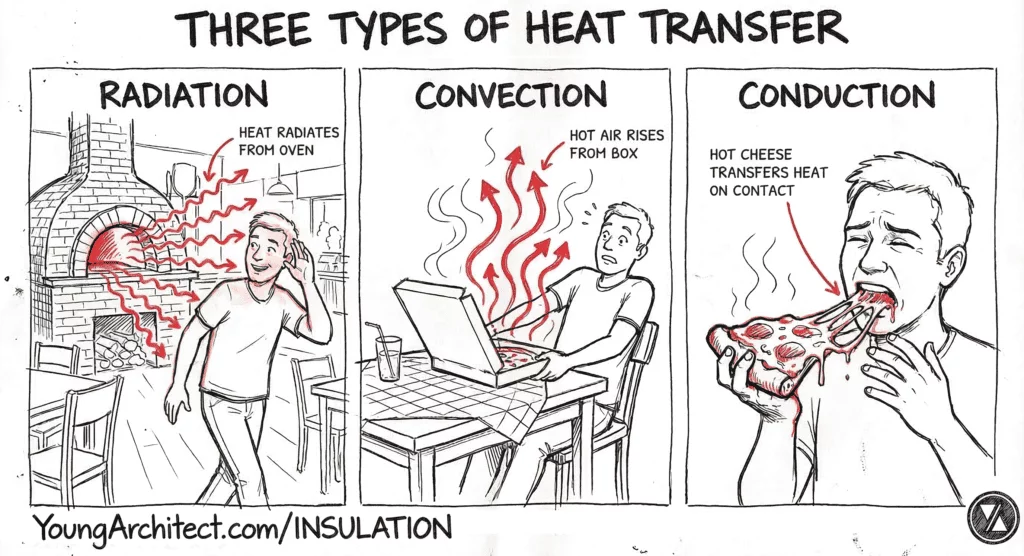
Radiation, convection, conduction. Three types of heat transfer, one pizza experience.
Now that same physics applies to your building envelope.
- Radiation is the sun beating down on a dark roof membrane, transferring heat directly to the surface. This is why radiant barriers exist.
- Convection is what happens when you have an oversized wall cavity with insulation that doesn’t fill it completely. Warm air rises, cool air drops, and you get a looping effect where air circulates inside the cavity and carries heat right past your insulation.
- Conduction is what happens every time heat travels through a solid material, like a metal stud in an exterior wall. Heat from the warm interior travels right through that stud to the cold exterior. This is the whole reason thermal bridging is such a big deal.
You’ve heard of R-value before. A higher R-value means more resistance to heat flow. That part is simple.
But R-value alone doesn’t tell you the whole story. Installation quality, moisture exposure, and thermal bridging can all dramatically reduce how your insulation actually performs in the real world.
A wall that’s rated R-19 on paper might perform way below that if the installation is sloppy or if heat is bypassing the insulation through the framing.
If you want to go deeper on how heat moves through buildings and how Mechanical Systems 101 ties into all of this, that course walks through heat transfer fundamentals step by step.
Fiberglass and Mineral Wool Batt Insulation
Batt and blanket insulation is what most people picture when they think of insulation.
Batts are pre-cut panels. Blankets are continuous rolls. Both are designed to fit between framing members like studs, joists, and rafters.
You’ll find batt insulation in walls, floors, attics, and crawl spaces. Basically anywhere you have a cavity between studs or joists, a batt can go in there.
This includes floor insulation between joists and standard stud wall insulation in both new construction and renovations.
There are two main materials here, and understanding the difference matters.
Fiberglass Insulation
Fiberglass is the most common type of insulation on the market. It’s the cheapest, it’s widely available, and it’s been the go-to for decades.
But it has some weaknesses.
- If you compress it, it loses R-value. Insulation works by trapping tiny pockets of dead air. When you compress a batt, you squeeze those air pockets out, and now instead of insulating, it’s just conducting heat.
- If it gets wet, same problem. Fiberglass absorbs and holds moisture, which destroys its R-value and causes the batt to lose its loft.
- It doesn’t do much for fire resistance or sound control on its own.
Mineral Wool Insulation
Then there’s mineral wool insulation, which you might also hear called rock wool or by the brand name Rockwool (formerly Roxul).
Mineral wool costs more, but it brings some serious advantages.
- Better fire resistance. Mineral wool can withstand temperatures over 2,000°F, making it a natural fit for fire-rated wall assemblies.
- Better sound control. If you’re dealing with party walls between units or anywhere building acoustics and STC ratings matter, mineral wool is the stronger choice.
- Holds its shape. It doesn’t sag or compress as easily as fiberglass.
- Hydrophobic. Mineral wool actually repels water. Water beads off and drains through it, and the batt maintains its structural integrity. Fiberglass does the opposite.
Fiberglass vs Mineral Wool
So when you’re comparing the two, think about what the assembly needs.
- If the question involves fire-rated assemblies, sound-sensitive walls, or anywhere acoustic performance matters, mineral wool is probably your answer.
- If it’s a basic cavity fill with no special requirements and budget is the priority, fiberglass is the economical choice.
Now here’s something the exam loves to test. Installation quality matters enormously with batts.
Gaps, compression, and voids absolutely kill performance. A perfectly rated R-19 batt that’s installed with gaps around wiring and pipes, or compressed to fit behind an electrical box, is going to perform way worse than a lower-rated R-13 batt that’s installed correctly and fills the cavity completely.
One more thing before we move on.
Batt insulation does not stop air movement.
Insulation and air sealing are two different things.
You still need a separate air barrier in the assembly. Don’t make the mistake of thinking that because a cavity is insulated, it’s also sealed. The exam will test you on that distinction.
Loose-Fill and Blown-In Insulation
Batts are great for new construction where you have open cavities to work with. But what happens when you’re dealing with an existing building where you can’t rip open the walls?
That’s where blown-in insulation comes in.
This is loose material that’s literally blown into cavities or onto open surfaces using specialized equipment. The most common materials are cellulose, fiberglass, and mineral wool, all in loose-fill form.
The number one application is attics. Open-blow cellulose or fiberglass across an attic floor is one of the most cost-effective insulation strategies out there.
But blown-in really shines in retrofit situations.
- When you’re working with an existing building and you can’t open up the walls, you can drill small holes and blow insulation into the closed cavities.
- It fills around wiring, pipes, and all those irregular shapes that batts can’t handle cleanly.
- It’s also a strong option for crawl space insulation, basement insulation, rim joists, and anywhere access is limited.
Let me spend a minute on cellulose insulation specifically, because it’s worth understanding.
Cellulose is made from recycled paper treated with fire retardants. In its standard loose-fill form, it works fine but can settle over time, which reduces your coverage.
But there’s a technique called dense pack cellulose where the material is blown at high pressure into closed cavities. The result is significantly better performance because the higher density resists settling and resists air movement within the cavity.
Here’s a tip for your exam.
When you see a question about a historic building or a masonry building where you can’t tear down the walls, dense pack cellulose is almost always the answer. It’s the go-to for retrofitting enclosed cavities without demolition.
So if you’re comparing batt vs blown-in, here’s the key distinction.
- Batts work great in new construction where you have clean, open, regular-shaped cavities.
- Blown-in wins in retrofits, irregular spaces, and anywhere you need insulation to conform to the cavity rather than the other way around.
Spray Foam Insulation: Open Cell vs Closed Cell
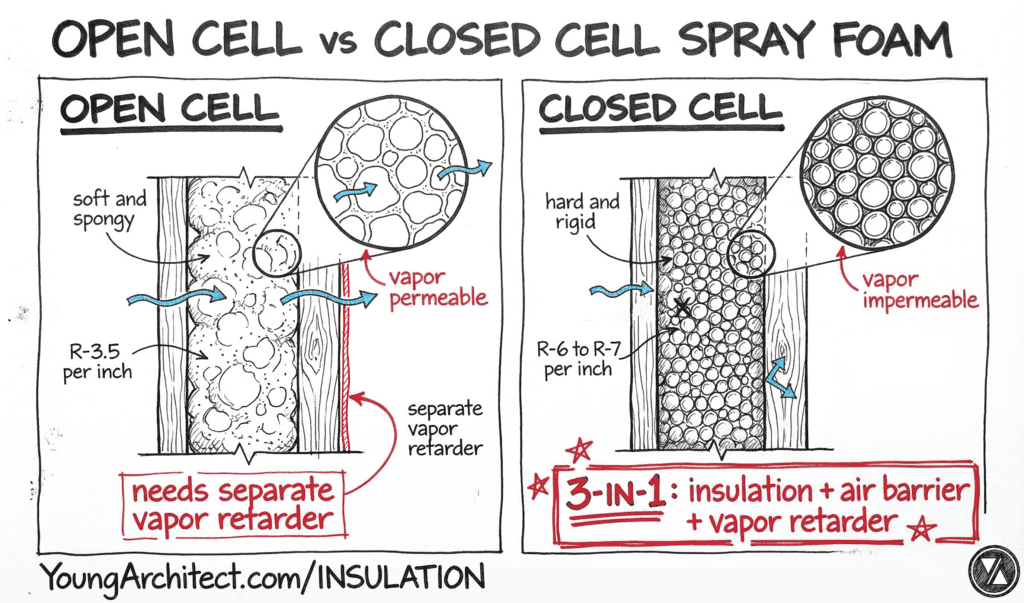
Spray foam insulation is a liquid that’s sprayed onto surfaces where it expands and hardens in place. It conforms to whatever shape it hits, filling every crack, gap, and void.
There are two types of spray foam, and they behave completely differently. The difference starts with how they expand.
Open Cell Spray Foam
Open cell spray foam expands massively, up to about 100 times its liquid size. That’s why it cures into something soft and spongy.
- R-value of about R-3.5 to R-3.7 per inch
- Vapor permeable, which means moisture can pass through it
- Excellent for sound control and sound dampening because of its soft, flexible structure
- The cheaper of the two spray foam options
Because open cell lets moisture through, you still need a separate vapor retarder in cold climate assemblies.
Closed Cell Spray Foam
Closed cell spray foam expands much less, only about 30 times its liquid size. That’s why it cures into something hard, dense, and rigid.
- R-value of about R-6 to R-7 per inch
- Vapor impermeable, meaning moisture cannot pass through it
- Adds structural rigidity to the assembly
- Costs significantly more than open cell
Here’s what makes closed cell so powerful. At the right thickness (typically 1.5 to 2 inches), it can serve as your insulation, your air barrier, AND your vapor retarder all in one material. That’s three functions from a single layer.
With most other insulation types, you need separate materials to handle insulation, air sealing, and vapor control. With closed cell spray foam, one material does all three.
One tradeoff worth noting: closed cell is too rigid to be a good sound dampener. It can actually transmit vibrations. If acoustics matter, open cell is the better choice.
The distinction between open cell and closed cell is one of the most important things you need to understand for the exam. They have opposite vapor behaviors. Mix them up and you’ve changed the entire wall assembly design.
You’ll see spray foam in walls, roof assemblies, and rim joists. Closed cell spray foam is the go-to for rim joist insulation because it seals and insulates simultaneously.
Now let’s talk about cost, because it’s a major factor in material selection.
Spray foam insulation costs significantly more than batts or blown-in. Closed cell is even more expensive than open cell. The material itself costs more, and it requires professional installation with specialized equipment. You can’t DIY this one.
Also, once spray foam is in place, it’s very difficult to remove or modify. If you need to run new wiring or make changes after installation, that’s a real consideration during design.
One more code detail. Spray foam typically requires a thermal barrier like drywall when it’s exposed to interior spaces. You can’t leave it exposed. In situations where drywall isn’t practical, like exposed attic applications, intumescent paint can sometimes serve as an alternative fire-retardant coating to meet code.
If you’re studying building envelope systems and wall assembly details for the ARE, our PPD 101 course walks through exactly this kind of material, step by step, at the level of detail the exam expects.
Rigid Board and Foam Board Insulation
Everything we’ve talked about so far goes inside the wall cavity. Rigid board insulation changes the game because it’s usually applied directly to the exterior.
Rigid board insulation comes in solid panels that are applied to the exterior of sheathing, to foundation walls, below slabs, or in roof assemblies.
You’ll also hear people call it foam board insulation or rigid foam insulation. They’re all talking about the same family of products.
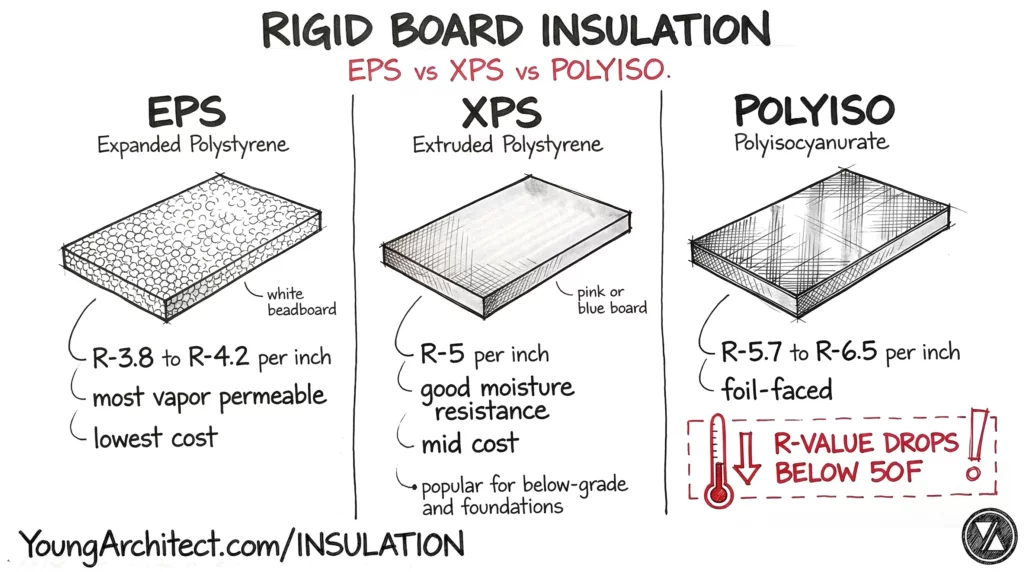
There are three main types, and each one has different strengths.
EPS Insulation (Expanded Polystyrene)
EPS is the white beadboard. You can actually see the individual beads when you look at it.
- The cheapest of the three rigid board types
- The most vapor permeable, which can actually be an advantage in assemblies that need to dry to the exterior
- R-value of about R-3.8 to R-4.2 per inch
XPS Insulation (Extruded Polystyrene)
XPS is the pink or blue board you’ve probably seen at a construction site.
- Good moisture resistance
- R-value of about R-5 per inch
- Costs more than EPS and has a higher environmental impact due to the blowing agents used in manufacturing
- Popular for basement wall insulation and foundation insulation where it’s in contact with the ground
One detail worth knowing: XPS is typically classified as a Class II vapor retarder at 1-inch thickness. It’s not a total vapor blocker like foil-faced polyiso, but it’s much less permeable than EPS.
Polyiso Insulation (Polyisocyanurate)
Polyiso is the foil-faced board, and on paper it looks like the clear winner because it has the highest R-value per inch at around R-5.7 to R-6.5.
But here’s the catch. And this is a classic exam trap.
Polyiso insulation’s R-value drops significantly in cold temperatures, roughly below 50°F. So that amazing R-6.5 you see on the spec sheet? In a cold climate, you’re not getting anywhere close to that.
This completely changes where and how you’d specify polyiso. Getting the insulation material right in your specifications is critical, and if you want to avoid the most common specification writing errors, that post is worth a read.
If the exam question is set in a cold climate and polyiso is one of the answer choices, think twice.
EPS vs XPS Insulation
When you’re comparing EPS and XPS insulation side by side:
- EPS is cheaper and more vapor permeable, which can be an advantage in assemblies that need to dry to the exterior.
- XPS has better moisture resistance, which is why it’s the popular choice for below-grade insulation where it’s in contact with the ground, like basements and foundation systems.
You’ll also see rigid board used as slab insulation, placed on or under concrete slabs to reduce heat loss to the ground.
Continuous Insulation and Thermal Bridging
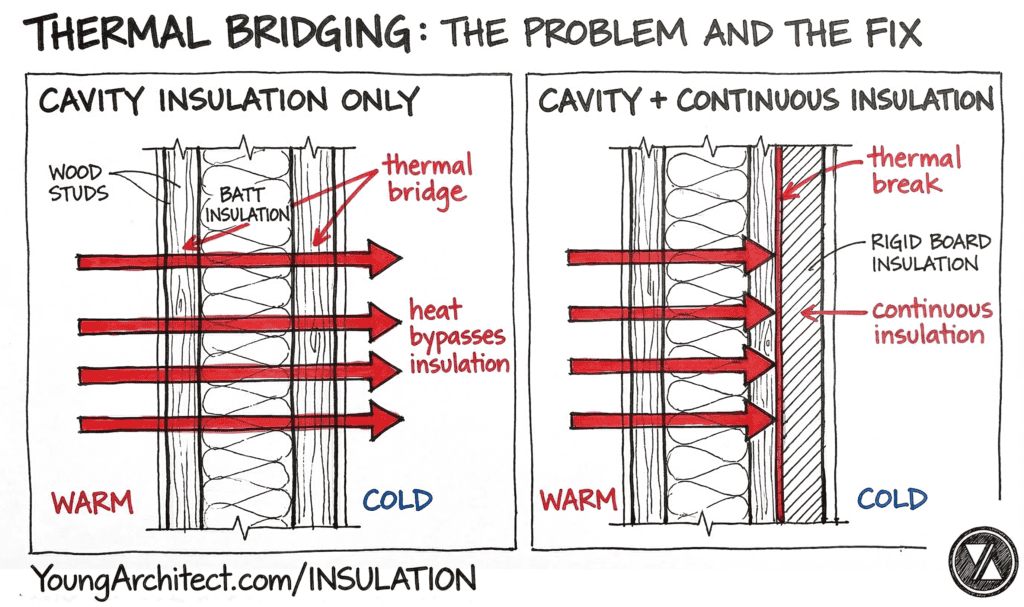
This is where everything comes together. Let me explain why continuous insulation matters so much, because it all comes back to a problem called thermal bridging.
Heat always takes the path of least resistance.
In a typical wood-framed wall, the studs conduct heat much faster than the insulation between them. So even though you’ve got R-19 batts filling every cavity perfectly, heat is still flowing right through the studs.
Every single stud is acting as a thermal bridge. A weak point where heat bypasses your insulation entirely.
A 2×6 wall rated at R-19?
Once you account for thermal bridging at every stud, the actual whole-wall performance might be closer to R-15 or less.
The studs are essentially short-circuiting your insulation. And it gets worse with metal framing. A metal stud wall with R-19 batts can have an effective R-value as low as R-7 because metal conducts heat so much faster than wood.
A thermal break is any material or detail that interrupts the thermal bridge. It breaks the path that heat is using to bypass your insulation.
The most common thermal break in wall assemblies is exterior rigid insulation. By wrapping the outside of the building with a continuous layer of rigid board, you’re putting insulation over the studs, not just between them.
And that’s exactly what continuous insulation is.
Continuous insulation is uninterrupted insulation across the entire building envelope that isn’t broken by framing members.
When you see “ci” on drawings or in exam questions, that’s what it means. The insulation is continuous. It doesn’t stop at every stud.
Energy codes have been pushing harder and harder for continuous insulation, and here’s why.
You simply cannot meet modern energy performance targets with cavity insulation alone. No matter how high you crank the R-value between the studs, you’re still losing heat through the framing. Continuous insulation is the only way to address that.
The highest-performing wall assemblies use both. Cavity insulation handles the space between the framing, and exterior continuous insulation wraps the entire building to eliminate thermal bridges.
This combo approach is the modern high-performance wall. Cavity plus continuous.
The most common application is exterior walls, but you’ll also see continuous insulation on foundations below grade and as continuous roof insulation above the deck.
For a deeper look at how energy codes drive these requirements, our Building Codes 101 course covers IBC and energy code navigation in detail.
If you want to understand how materials respond to temperature changes and why control joints and expansion joints matter in the building envelope, that post connects directly to this topic.
For additional reading on how wall assemblies work and why continuous insulation prevents condensation, check out the Building Science Corporation’s guide to wall assemblies and their resource on how exterior insulation prevents condensation in wall assemblies.
You can also reference the U.S. Department of Energy’s insulation guide for climate zone maps and R-value recommendations, and ENERGY STAR’s recommended R-values by climate zone for a quick lookup table of what’s required in your area.
SIPs, ICFs, and Radiant Barriers
There are a few additional insulation types that show up less frequently on the exam, but you should still be able to recognize them.
Radiant barriers are reflective materials, usually installed in attics in hot climates, that work by reflecting radiant heat rather than resisting conductive heat flow like traditional insulation. They don’t have a traditional R-value. Think of a radiant barrier as a mirror for heat.
But here’s the detail that trips people up. Radiant barriers need an air space to work. If the foil is sandwiched tightly between two solid materials with no gap, it just conducts heat instead of reflecting it.
SIPs (structural insulated panels) are prefabricated panels with a foam core sandwiched between two layers of structural sheathing, usually OSB. You’re getting insulation and structure in one panel. They go up fast and provide excellent air sealing, but they’re not very flexible. Once they’re in place, making modifications like adding a window or running new wiring is not easy.
ICFs (insulated concrete forms) are interlocking foam blocks that get stacked up and then filled with concrete. The foam is the formwork, the insulation, and the finished wall form all in one system. You’ll see ICFs commonly used for foundation walls and sometimes for above-grade construction.
Vapor Barriers and Insulation
I’m not going to go deep on this because we have a full episode coming on water, air, and vapor barriers. But I want to plant this idea right now because it directly connects to everything we just covered.
When you choose an insulation material, you’re not just making a decision about thermal performance. You’re also making a decision about moisture management.
Some insulations are vapor permeable, meaning moisture can pass through them:
- Fiberglass
- EPS
- Open cell spray foam
Others act as vapor retarders or block moisture entirely:
- Closed cell spray foam
- XPS (Class II vapor retarder)
- Foil-faced polyiso
Where you place your vapor retarder relative to your insulation matters enormously. Get it wrong and you can trap moisture inside the wall assembly, which leads to condensation, mold, and long-term damage.
So when you’re studying insulation, don’t just think about R-values and heat flow. Think about which direction moisture needs to move and whether your insulation is helping or blocking that movement.
If you’re getting into construction documentation and how insulation gets detailed and specified in drawings, our PDD 101 course covers that process from start to finish.
Common Insulation Exam Traps
Here are the things that trip people up the most when it comes to insulation on the ARE.
Higher R-value doesn’t always mean better performance. Installation quality and thermal bridging can undermine even the highest-rated insulation. A sloppy R-19 install loses to a clean R-13 install every time.
Open cell and closed cell spray foam have opposite vapor behaviors. Open cell lets moisture through. Closed cell blocks it. Mix them up on the exam and you’ve changed the entire wall assembly design.
Polyiso R-value drops in cold weather. That R-6.5 on the spec sheet is not what you get below 50°F. If the exam question is set in a cold climate and polyiso is an answer choice, think twice.
Continuous insulation is about eliminating thermal bridges, not just adding more R-value. Those are two different problems that require two different solutions. You can’t out-R-value thermal bridging.
EPS, XPS, and polyiso are not interchangeable. Different R-values, different vapor permeability, different moisture resistance, different cost profiles. Know what makes each one unique.
Insulation choice affects the vapor and moisture behavior of the whole assembly. If you’re only thinking about R-value when you select insulation, you’re missing half the picture.
Frequently Asked Questions
What is the difference between fiberglass and mineral wool insulation?
Fiberglass is cheaper and widely available but loses R-value when compressed or wet. Mineral wool (also called Rockwool) has better fire resistance, better sound control, and repels water. Choose mineral wool for fire-rated assemblies or sound-sensitive walls like party walls between units. Choose fiberglass when budget is the priority and there are no special performance requirements.
What is the difference between open cell and closed cell spray foam?
Open cell spray foam is softer, cheaper, and vapor permeable with an R-value of about R-3.5 per inch. Closed cell spray foam is rigid, vapor impermeable, and R-6 to R-7 per inch. At the right thickness, closed cell serves as insulation, air barrier, and vapor retarder in one layer. Open cell still needs a separate vapor retarder in cold climates.
What is the difference between EPS and XPS insulation?
EPS (expanded polystyrene) is the cheaper white beadboard at R-3.8 to R-4.2 per inch. XPS (extruded polystyrene) is the pink or blue board at R-5 per inch with better moisture resistance. EPS is more vapor permeable, which helps assemblies dry. XPS is the popular choice for basement and foundation insulation where ground moisture contact is expected.
Is spray foam insulation better than batt insulation?
It depends on the situation. Spray foam seals and insulates simultaneously with no gaps, and closed cell adds vapor control. But it costs significantly more and requires professional installation. Batts are much cheaper and work well in new construction with clean, regular-shaped cavities. Spray foam wins for air sealing and retrofits. Batts win on cost for standard wall cavities in new construction.
What is continuous insulation and why is it required?
Continuous insulation is an uninterrupted layer of insulation across the building envelope that is not broken by framing members. It’s typically rigid board applied to the exterior of sheathing. Energy codes require it because cavity insulation alone cannot eliminate thermal bridging at studs. You’ll see it noted as “ci” on drawings and in specifications.
Does polyiso insulation lose R-value in cold weather?
Yes. Polyiso has the highest rated R-value per inch at R-5.7 to R-6.5, but that number drops significantly below about 50°F. This is a critical factor when selecting rigid board insulation for cold climate exterior walls. In cold climates, EPS or XPS may actually outperform polyiso despite their lower rated R-values.
What is the best insulation for a crawl space?
It depends on the type of crawl space. For vented crawl spaces, batt or blown-in insulation between floor joists is the standard approach. For conditioned (sealed) crawl spaces, rigid board insulation on the foundation walls is the better strategy. Closed cell spray foam at rim joists handles both insulation and air sealing in one step.
Study Materials for the ARE
If this post helped you and you want to go deeper on building envelope assemblies, wall sections, and all the details that show up on PPD and PDD, check out our PPD 101 and PDD 101 courses.
Both courses are included when you join the ARE 101 Membership, which gives you access to all of our ARE courses in one place. It’s a low monthly price, month-to-month, cancel anytime.
And if you’re someone who needs structure, accountability, and coaching to get through the ARE, that’s exactly what ARE Boot Camp is built for. It’s a 10-week program where we work with you directly to build a study plan, keep you on track, and make sure you actually cross the finish line.