
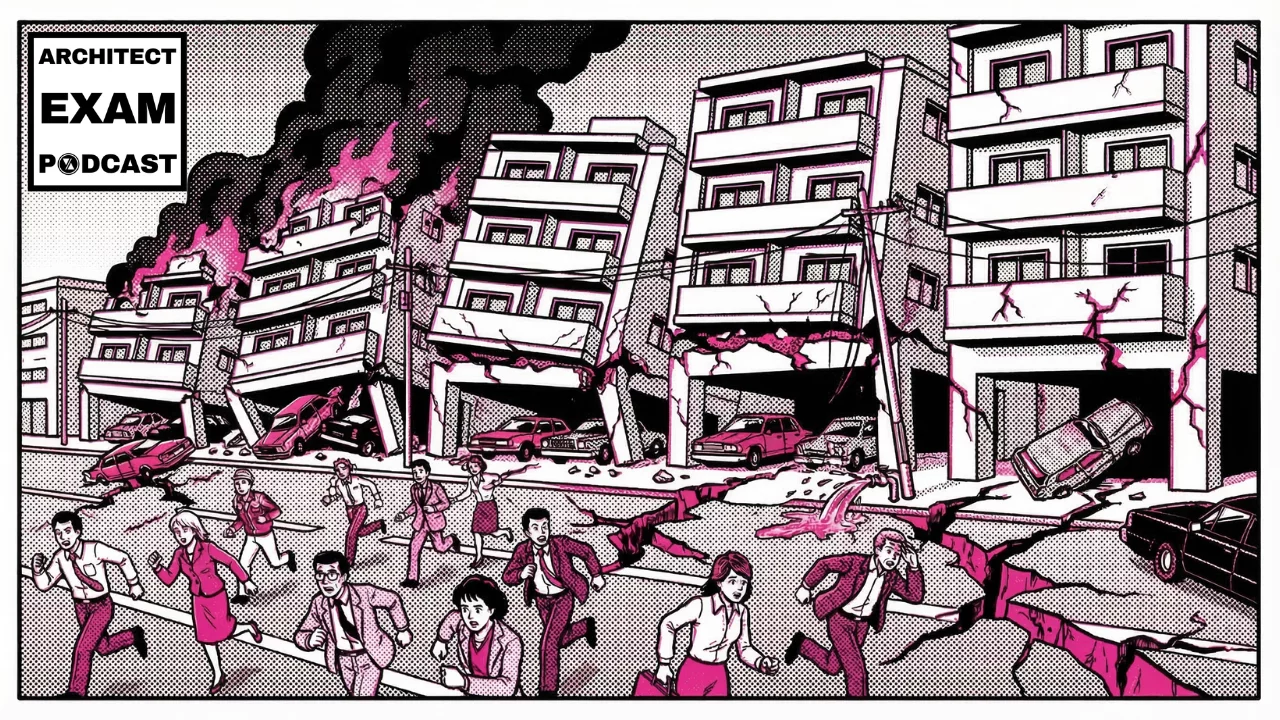

A soft story building has a hidden weakness that earthquakes are designed to find. This post walks through the major seismic irregularities tested on the PPD and PDD exams, including soft stories, weak stories, load path discontinuities, re-entrant corners, and torsion, and shows you how to spot them before NCARB puts them in front of you.
This podcast is also available on YouTube, Spotify, and Apple Podcasts
What Is a Soft Story Building?
Picture this. Two apartment buildings, side by side, same neighborhood in Los Angeles. Same age, same basic construction.
The ground shakes for about twenty seconds.
When the dust settles, one building is still standing. The other has completely pancaked at the ground floor, crushing every car in the parking garage underneath it.
That was the 1994 Northridge earthquake. And those collapsed apartment buildings over ground-floor parking became one of the most studied failures in modern seismic engineering.
So what happened?
A soft story building has a floor that is significantly less stiff than the floors above it. The most common example is a building with an open ground floor, like retail storefronts with floor-to-ceiling glass or a parking garage, with solid apartment or office walls stacked on top.
During an earthquake, the upper floors are stiff. They have walls everywhere bracing them.
But that ground floor with all the openings? It is flexible. It bends way more than the floors above.
That difference in stiffness means the building drift at the ground floor is significantly higher than anywhere else in the building. All the lateral movement concentrates at that one level, and that concentrated drift is what leads to collapse.
The technical threshold is 70 percent. If a story has less than 70 percent of the stiffness of the floor above it, it gets classified as a soft story.
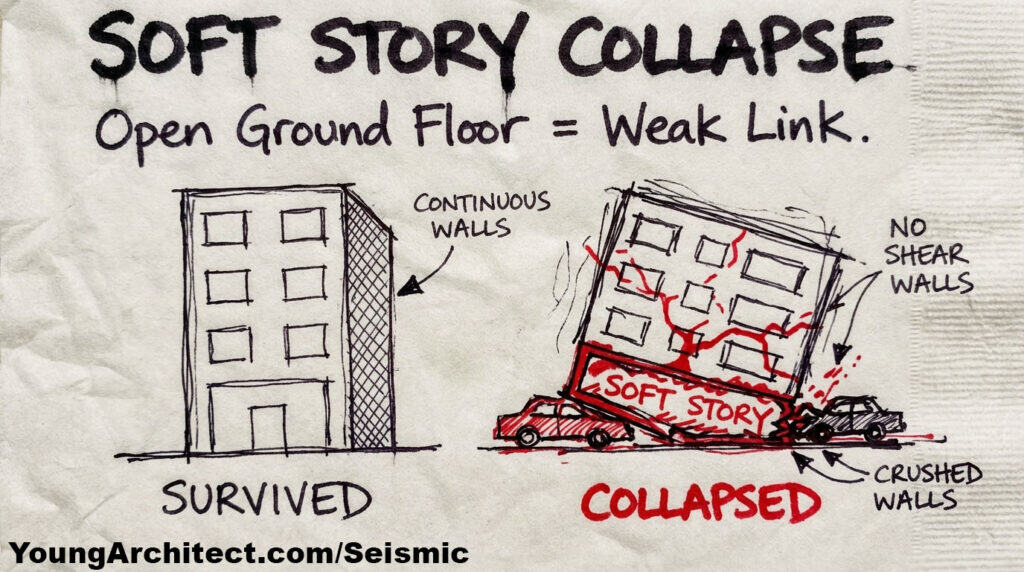
This is exactly what happened across Los Angeles during the Northridge earthquake. Soft story buildings with open ground floor parking collapsed while neighboring buildings with continuous shear walls survived the same shaking.
That earthquake is a major reason we now have modern Seismic Design Categories defined by ASCE 7, the national standard for seismic design loads, and much stricter requirements for how lateral forces travel through a building from the roof to the foundation.
For a deeper look at the earthquake itself, the USGS overview of the 1994 Northridge earthquake covers the scientific data and damage documentation.
Our Building Codes 101 course breaks down how these code requirements connect to the PPD and PDD exams. If you interested how other disasters and famous fires shaped modern building codes, we have a fantastic podcast and article on that.
Always remember:
Earthquakes do not care about your design intent.
They hunt for the weakest link in your structural design.
And in seismic design, those weak links have a name. They are called irregularities.
Soft Story vs Weak Story
This is one of the most confusing distinctions in seismic design, and a lot of ARE candidates mix them up.
A soft story building sounds like it should mean the same thing as a weak story building. They do not. They measure completely different properties of a building.
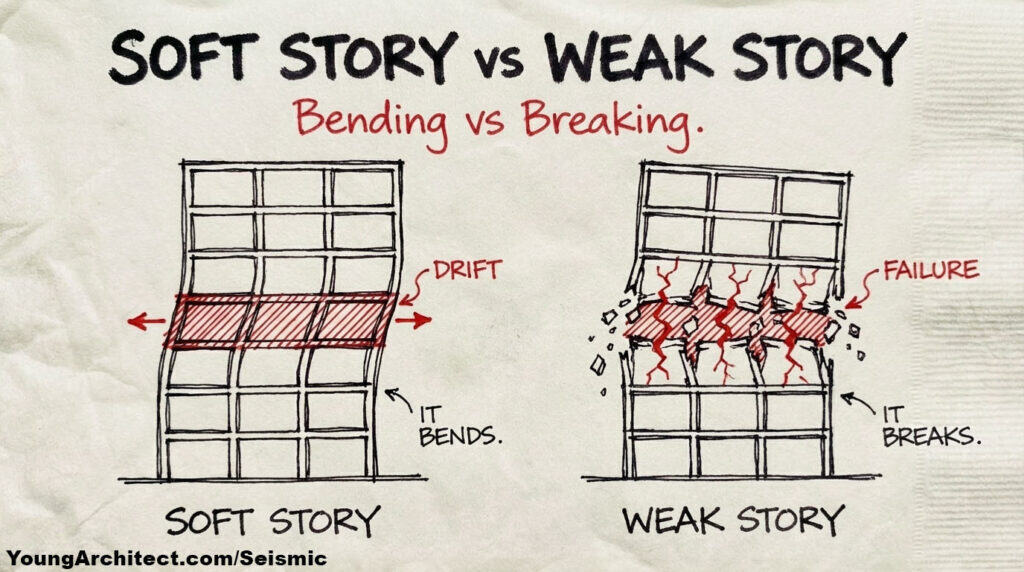
A soft story is a stiffness problem. It is not about strength. It is about how much a floor bends or flexes laterally compared to the floors above it. The floor moves too much. The threshold is 70 percent of the stiffness of the story above.
A weak story is a strength problem. It is about capacity. The floor does not have enough muscle to handle the lateral force being applied to it. A weak story might actually be pretty stiff. It might not bend much at all. But when the forces get high enough, it cannot take the lateral load. The threshold is 80 percent of the strength of the story above.
Here is a simple way to keep them straight. Imagine a table with four legs.
A soft story is like a table where one leg is wobbly. It flexes too easily, the table tilts, but the leg does not break. It just moves too much.
A weak story is like a table where one leg snaps. It might be perfectly stiff. But it does not have the strength to hold the load, and it breaks.
One bends. The other one breaks. That is the difference.
A single story can be soft but not weak, weak but not soft, or both at the same time. They are independent conditions measuring different things. On the exam, NCARB wants you to know which is which.
Geometric and Mass Irregularities
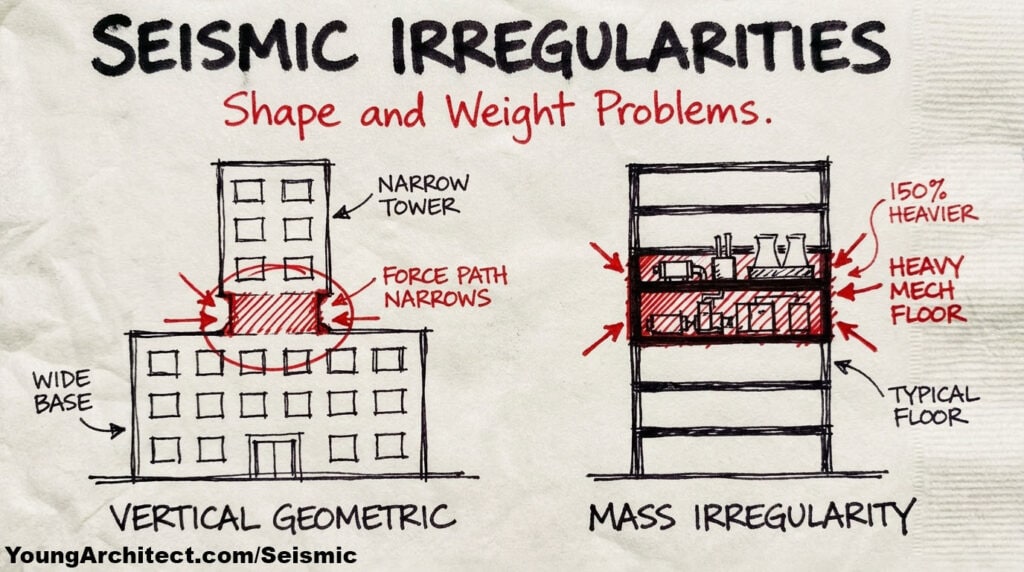
Now that you understand the difference between stiffness and strength, let’s look at two irregularities that are more visual. These are ones you can often spot just by looking at the building’s profile or reading the floor plans.
Vertical Geometric Irregularity
A vertical geometric irregularity is when the lateral force-resisting system changes width dramatically from one floor to the next.
The classic example is a building with a setback.
Think of a wide podium at the base with a narrower tower sitting on top. Or a building that steps back at the upper floors.
The threshold is 130 percent. If the lateral system at one level is more than 130 percent of the width of the level above it, you have a vertical geometric irregularity.
What happens is the force path narrows or widens suddenly at that transition point. The lateral forces are traveling through a wide system, and then they have to squeeze into a narrower one. The building does not handle that transition smoothly, and that is where problems start.
Mass Irregularity
A mass irregularity is when one floor is significantly heavier than the floors next to it.
The threshold is 150 percent. If one floor weighs more than 150 percent of an adjacent floor, that is a mass irregularity.
The most common real-world example is a mechanical floor.
Think about a floor loaded with chillers, boilers, cooling towers, and heavy equipment.
That floor can weigh significantly more than a typical office or residential floor above and below it.
During an earthquake, that heavy floor has more momentum. It wants to keep moving when the floors above and below are trying to change direction. That mismatch creates force concentrations at that level, and the surrounding floors are not designed for that kind of lateral load.
So when you see a building section on the exam and one floor looks noticeably different from the others, whether it is a setback or a mechanical penthouse, that should be a red flag. Understanding how cast-in-place concrete structural systems handle these forces is essential background for this topic.
Load Path and Shear Wall Discontinuities
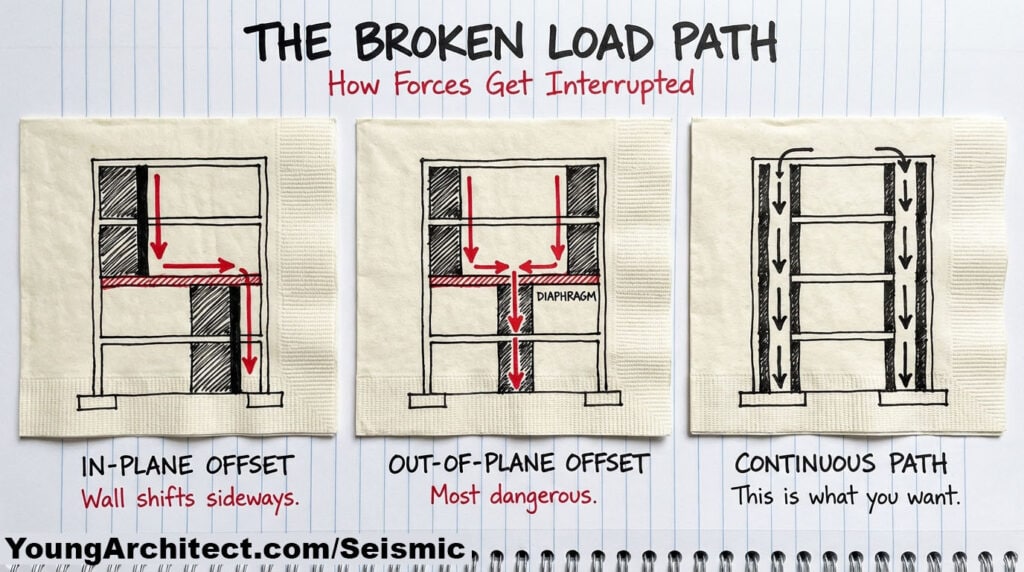
Everything we have talked about so far, soft stories, weak stories, geometric and mass irregularities, those buildings still have a continuous path for forces to travel through. The path might have weak spots or stiff spots or heavy spots, but it is still connected.
Discontinuities are where that path gets interrupted. And that is when things get really dangerous.
How the Clean Load Path Works
Lateral forces from an earthquake or wind need a continuous load path from the roof all the way down to the foundation. Here is how it works:
- Forces hit the building and travel into the floor diaphragm (the horizontal element, your floor slab or roof deck)
- The diaphragm pushes those forces into the vertical elements (your shear walls or frames)
- The vertical elements carry the forces down to the foundation
Roof to diaphragm. Diaphragm to walls. Walls to foundation. That is the chain.
When that chain is unbroken, forces flow smoothly from top to bottom. Every element does its job and hands the load off to the next one.
When the chain breaks, you have a discontinuity. FEMA’s Earthquake-Resistant Design Concepts guide covers the engineering provisions behind how these load paths are designed and evaluated.
In-Plane Discontinuity
An in-plane discontinuity is when a shear wall on an upper floor jumps sideways compared to the wall below it, but stays in the same plane. Think of a wall that shifts over ten feet to the left but is still running the same direction.
The wall is technically in the same plane, but now there is an offset. The forces traveling down that wall have to make a lateral jump at that level, which creates transfer forces the floor structure has to handle.
This is really common when architects want open lobbies at the ground floor but need shear walls on the floors above.
Out-of-Plane Offset
An out-of-plane offset is the most dangerous type of irregularity.
With an out-of-plane offset, the lateral system on one floor does not line up at all with the floor below. The force path is completely interrupted. The wall above has nowhere to go.
When this happens, the floor diaphragm has to act as a bridge. It has to behave like a horizontal beam and drag that lateral load sideways across the floor until it finds the next available shear wall or frame that can pick it up and carry it down to the foundation.
This is where you will hear the terms collector or drag strut.
Think of collectors as structural hands that grab the lateral load and pull it across the diaphragm to the next vertical element. Without those collectors, the building starts to pull itself apart at the seams.
Rigid vs Flexible Diaphragms
The diaphragm is the horizontal element, your floor slab or roof deck, and its job is to distribute lateral forces to the vertical elements like shear walls and frames.
In a perfect world, the vertical elements line up floor to floor and the diaphragm just distributes forces evenly. But when you have an offset, the diaphragm has to work overtime. It is not just distributing anymore. It is transferring forces across the floor to find a new lateral load path.
And the behavior of that diaphragm affects how those forces get distributed:
A rigid diaphragm distributes forces based on the stiffness of the walls.
A flexible diaphragm distributes forces based on tributary area.
That distinction matters for the PPD and PDD exams, and it is worth understanding before you sit down to study.
Discontinuity in Lateral Strength
The last type of discontinuity is a discontinuity in lateral strength, which is essentially an extreme version of the weak story.
The threshold here is 65 percent. If a story has less than 65 percent of the strength of the story above, some building codes prohibit this entirely in high seismic zones. That is how dangerous it is. FEMA’s seismic building codes resource page covers how these provisions get adopted and enforced across different jurisdictions.
Re-Entrant Corners and Torsion
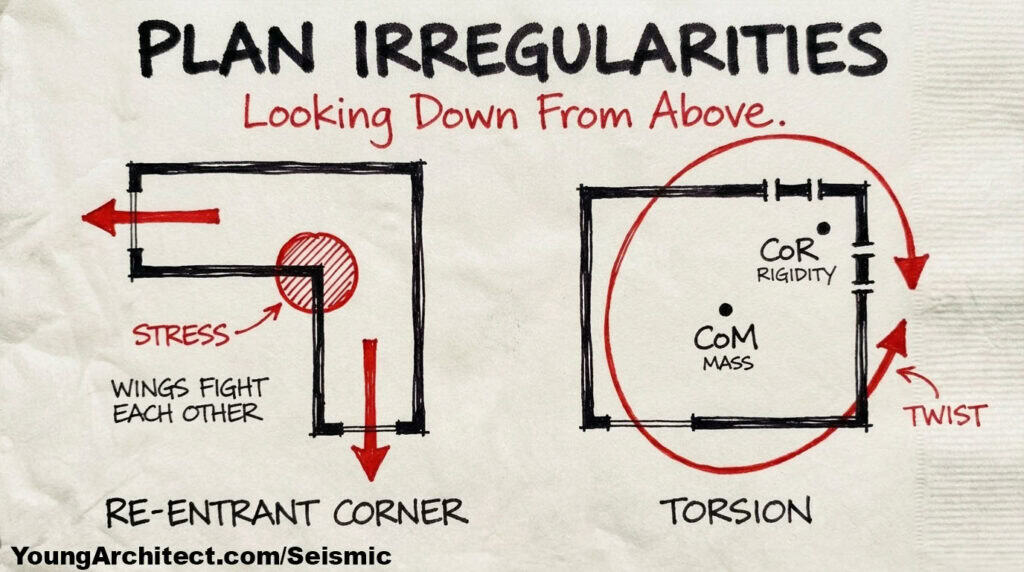
Everything so far has been about what happens vertically, floor to floor. Now let’s flip the perspective and talk about what happens horizontally, in the plan view.
Think of it as looking at the building from a bird’s-eye view.
Re-Entrant Corners
A re-entrant corner is a plan irregularity that shows up in L-shaped, T-shaped, U-shaped, or plus-shaped buildings. Basically any floor plan where the building has wings or extensions that create inside corners.
The problem is that during an earthquake, those wings want to move independently. They do not want to move together as one unified structure. And where the wings connect, at those inside corners, that is where stress concentrates.
Think of holding two rulers together at a right angle and shaking them. They do not want to move as one piece. They want to pull apart at the joint.
Here is the practical takeaway. Architects love L-shaped buildings for courtyards. Earthquakes hate them.
The easiest fix? Do not build one L-shaped building. Build two rectangular buildings and put a gap between them. Cover it with a seismic separation joint, and now each section can move independently without smashing into each other.
Torsional Irregularity
Torsion happens when the center of mass and the center of rigidity do not line up.
The center of mass is where the weight of the floor is concentrated.
The center of rigidity is where the stiffness of the lateral system is concentrated.
When those two points are in different locations, the building does not just sway during an earthquake. It wants to twist.
One side of the building moves more than the other, and that twisting creates additional forces the structure has to handle.
Here is a good way to think about it.
Picture a shopping cart with one stuck wheel. When you push the cart, the center of your pushing force does not line up with the center of resistance from that stuck wheel. So instead of rolling straight, the cart twists. It wants to spin instead of move forward.
Same thing happens to a building. If all your shear walls are on one side and all your open space is on the other, the building is going to want to rotate around the stiff side instead of swaying evenly.
NCARB loves testing this concept on the PPD and PDD exams.
Seismic Irregularities on the ARE
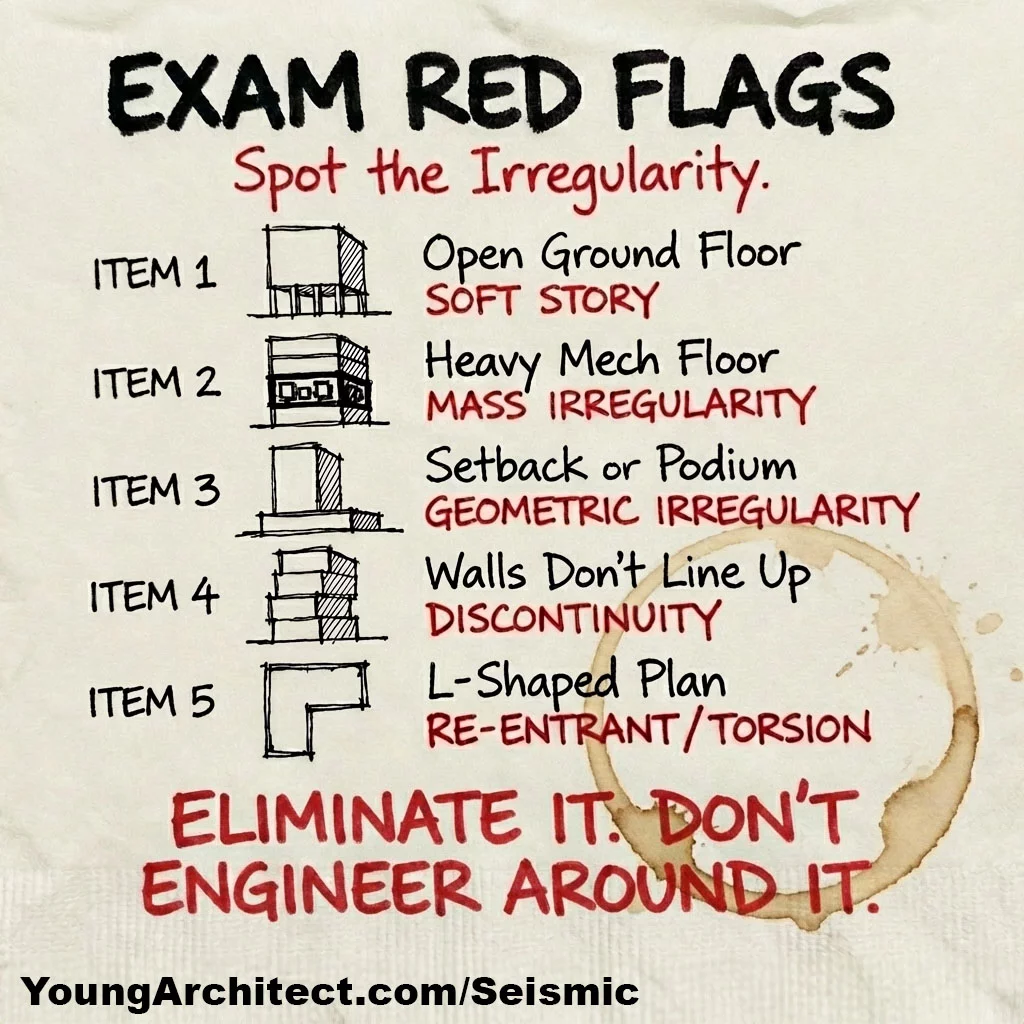
Now you know what all these irregularities are. Let’s talk about how to use this on exam day.
Here is the most important thing to remember. You do not need to design for these irregularities. That is the structural engineer’s job. What NCARB wants from you is the ability to recognize them.
They want you to look at a building scenario, a section, a floor plan, or a description and identify what type of irregularity is present. Then they want you to know the appropriate response.
Red flags to watch for in exam scenarios:
- An open ground floor with lots of glass and no walls? That is a soft story.
- A floor significantly heavier than the floors around it, especially a mechanical floor? That is a mass irregularity.
- A building that steps back or sits a tower on a podium? That is a geometric irregularity.
- Shear walls that do not line up from one floor to the next? That is a discontinuity.
- An L-shaped or irregular floor plan? Think re-entrant corners and torsion.
Irregularity Thresholds Quick Reference
| Irregularity | Type | Threshold |
|---|---|---|
| Soft Story | Stiffness (it bends) | Less than 70% of story above |
| Weak Story | Strength (it breaks) | Less than 80% of story above |
| Vertical Geometric | Shape change | More than 130% width difference |
| Mass | Weight difference | More than 150% of adjacent floor |
| Lateral Strength Discontinuity | Extreme weakness | Less than 65% (may be prohibited) |
Common Fixes
In terms of solutions, there are a few you should know by name:
- Add lateral bracing or stack lateral systems vertically to create a continuous load path
- Create seismic joints to separate an irregularly shaped building into two regular ones
- Moment frames use rigid beam-to-column connections (the joints absorb the force)
- Braced frames use diagonal members to create triangulated support
And here is something to really internalize, because this is how NCARB thinks about it.
Engineers can mathematically solve almost any irregularity. They can design around it with heavier steel, thicker concrete, and more complex connections. But all of that costs more money, more time, and more coordination.
So on the exam, if a question asks for the most cost-effective or most efficient structural layout, the answer is almost always the one that eliminates the irregularity entirely rather than engineering around it.
The architect’s job is to avoid creating the problem in the first place.
And one more thing. If you are working on a project and you recognize one of these irregularities, flag it for your structural engineer early. These are expensive problems to fix later in the design process.
Seismic Design Key Takeaways
Today we covered the major seismic irregularities you need to know for earthquake building design on the ARE:
- Soft story buildings versus weak stories
- Geometric and mass irregularities
- Discontinuities and why a broken load path is the most dangerous thing in seismic design
- Plan irregularities like re-entrant corners and torsion
- How to approach all of this on exam day
The big takeaway? Recognize the irregularity. Know the appropriate fix. And remember that the best structural solution is usually the one that avoids the problem entirely.
If you want to go deeper on structures and seismic design for the ARE, the ARE 101 Membership gives you access to all of our exam prep courses, including structures content as we continue building it out. And if you want the full coaching experience with a study plan, accountability, and someone in your corner until you are licensed, check out the ARE Boot Camp.
Frequently Asked Questions
What is a soft story building?
A soft story building has a floor that is significantly less stiff than the floors above it. The most common example is a building with an open ground floor like retail storefronts or parking, with solid walls on the upper floors. During an earthquake, the flexible ground floor experiences much more building drift than the stiffer upper floors, which can lead to soft story collapse. A story is classified as soft when it has less than 70 percent of the stiffness of the floor above it.
What is the difference between a soft story and a weak story?
A soft story is a stiffness problem. The floor bends too much compared to the floors above it. A weak story is a strength problem. The floor cannot handle the forces being applied to it, even if it does not bend much. One bends, the other breaks. A single story can be soft but not weak, weak but not soft, or both. The soft story threshold is 70 percent stiffness. The weak story threshold is 80 percent strength compared to the adjacent floor.
What is a continuous load path in seismic design?
A continuous load path is the unbroken chain that carries lateral forces from the roof down to the foundation. Forces enter the floor diaphragm, transfer to vertical elements like shear walls or frames, and continue down to the ground. When shear walls do not align from floor to floor, this path gets interrupted, creating a discontinuity that forces the diaphragm and collectors (also called drag struts) to transfer loads sideways to find a new path. Discontinuities are among the most dangerous seismic irregularities.
What is a re-entrant corner in seismic design?
A re-entrant corner is a plan irregularity that occurs in L-shaped, T-shaped, U-shaped, or plus-shaped buildings. The wings of the building want to move independently during an earthquake, and stress concentrates at the inside corners where the wings connect. The most common fix is to separate the building into two rectangular structures with a seismic joint between them, allowing each section to move independently during seismic events.
What is the difference between a moment frame and a braced frame?
A moment frame resists lateral forces through rigid beam-to-column connections. The joints themselves absorb the force. A braced frame uses diagonal members to create triangulated support, transferring lateral loads through tension and compression in the braces. Moment frames allow for more open floor plans but are typically more expensive. Braced frames are stiffer and more economical but require diagonal members that can limit openings. Both are types of lateral force-resisting systems used in seismic design.