

Cast-in-place concrete creates monolithic structural systems by pouring a concrete mix into formwork on-site. This guide covers span limitations, rebar sizing, construction defects like honeycombing, and when to choose concrete over steel or pre-tensioned alternatives for ARE exam success.
This podcast is also available on YouTube, Spotify, and Apple Podcasts
When One Phone Call Stops a Structural Disaster
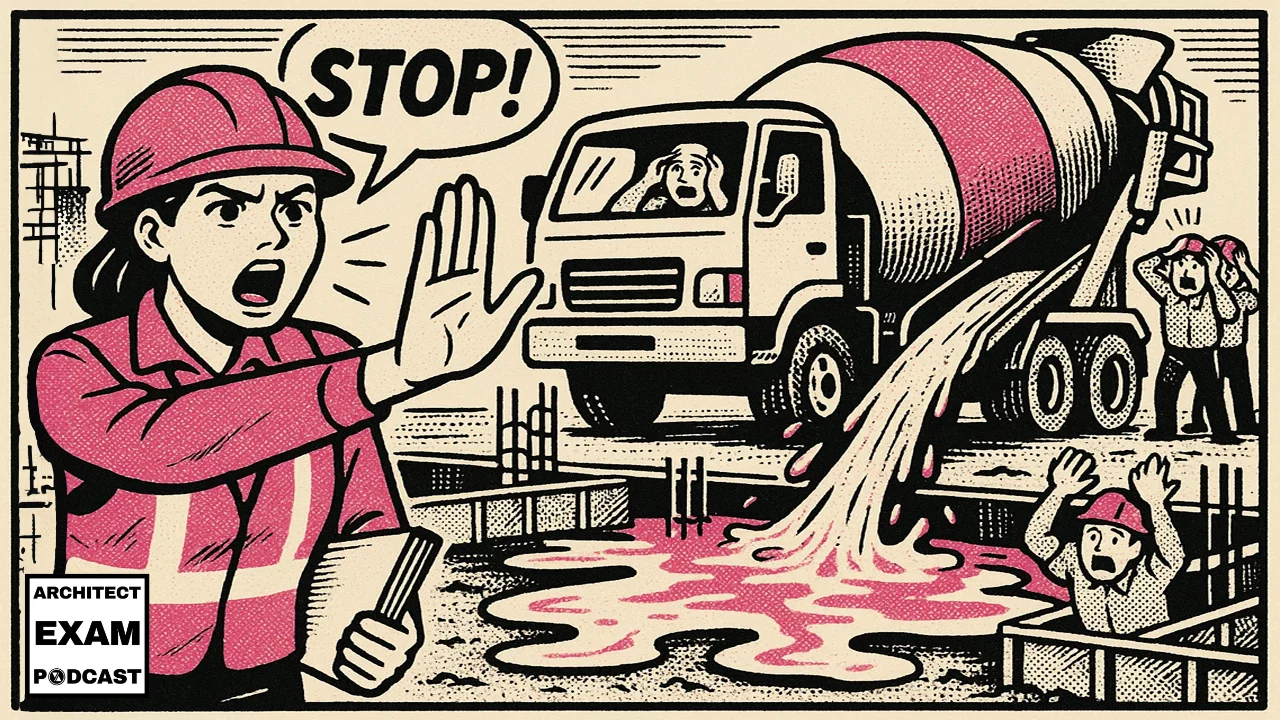
In our podcast about cast-in-place concrete, Emily shares a story from a job site visit that perfectly illustrates why understanding concrete matters.
The concrete trucks rolled up to the site, started pouring, and she could immediately tell something was wrong. The mix was way too watery and visibly wrong. The contractor was about to pour it into the formwork for a critical section of a structural slab.
She stopped the pour, rejected the entire batch, and sent the trucks away. The company used the wrong water proportion in the concrete mix. The concrete company ended up paying to remove what they’d already poured, replace the formwork, and had to redo everything with a proper proportioned mix. That one decision, catching that bad batch before committing to it, prevented what could have been a structural disaster.
This is why concrete knowledge matters. It might not be the glamorous part of architecture, but knowing what to look for during construction observation can save projects from expensive failures.
What Is Cast-in-Place Concrete?
Cast-in-place concrete is a construction method where concrete is poured into formwork, directly on the job site, curing to create monolithic structural elements. Unlike precast concrete systems where elements are manufactured off-site and transported, cast-in-place concrete forms one continuous piece right where it will permanently remain. When done right, cast in place concrete can last 50-75, potentially even 100 years.
This monolithic quality is the system’s greatest strength. When concrete cures as a single unified mass, you get superior structural continuity: Everything is connected, and eEverything is continuous. The perks of cast in place concrete is that there are no joints or connections between separate pieces that could become weak points under stress.
Cast-in-place concrete appears across multiple ARE divisions. You’ll encounter it on PPD when selecting structural systems based on building type and location. It shows up on PDD when detailing structural components and calculating sizes. CE tests your ability to identify non-conforming work during construction observation. And PA includes questions about evaluating existing buildings and structural assessments.
When to Choose Concrete: Hurricanes vs. Earthquakes
Structural system selection isn’t just about what looks good on paper. It’s about matching your system to the specific environmental challenges your building will face based on climate and geographical location.
Wind Resistance and Lateral Forces
Concrete excels in hurricane zones and high wind areas. That monolithic structure we just discussed? It can handle serious lateral forces. When a Category 4 hurricane comes through, a properly designed concrete building holds up remarkably well against sustained wind loads and impact from flying debris.
The mass and continuity of cast-in-place concrete makes it naturally resistant to the uplift and lateral pressures that destroy lighter structures. It’s also inherently fire-resistant, which matters for certain building types and occupancy classifications.
The Seismic Weight Problem
Here’s where it gets interesting. That same weight that makes concrete excellent for hurricanes becomes a serious liability in earthquakes.
Think about the physics: In an earthquake, you’re dealing with inertial forces. The heavier something is, the harder it is to stop once it starts moving. Concrete is heavy, really heavy. All that mass means bigger foundation loads and the potential for brittle failure if the structure isn’t detailed correctly for seismic activity.
The decision framework for PPD case studies: How might a cast in place concrete system show up in practice?
- Building in Miami or the Caribbean where hurricanes are the primary concern? Concrete is a strong choice.
- Building in San Francisco or Los Angeles where seismic activity dominates? Think carefully before selecting concrete, or understand you’ll need extensive seismic detailing.
The location and environmental context should drive your structural system selection, not just cost or familiarity.
Understanding Concrete Span Limitations
Here’s a reality check that surprises many candidates: standard cast-in-place concrete spans for suspended slabs max out at about 20 to 25 feet without needed more intermediate support.
That’s not very far.
This is something you will have to think about what this means for your design. Every 20 to 25 feet, you need a column or a load-bearing wall. That column grid isn’t just a structural consideration. It shapes your entire architectural approach. It affects spatial relationships, open floor plans, and flexibility for future tenant improvements.
If a client wants a 35-foot clear span for an open office layout and you’re committed to concrete, standard cast-in-place won’t work. You’ll need to explore alternatives like post-tensioned systems or reconsider your structural system entirely.
Compare this to steel, which can span much further with appropriate design. Your structural system choice changes what you can actually design. The structure isn’t just holding up the building. It’s shaping what’s possible in the first place.
How Concrete and Rebar Work Together
Concrete and steel reinforcement function as a team where each material handles different types of forces.
Think of concrete and rebar like a doubles tennis team. Concrete covers compression (pushing forces), while rebar covers tension (pulling forces). Neither material can win the match alone. They need each other.
Here’s how this plays out in a real structural element. In a concrete beam spanning between two columns, the top of the beam experiences compression as loads push down. The bottom of the beam experiences tension as it stretches across the span. As a result, concrete handles the compression at the top, while the steel reinforcement handles the tension at the bottom.
Rebar Sizing Basics
Steel reinforcing bars are sized in one-eighth inch increments. This system is straightforward once you know the pattern:
- Number 3 rebar = 3/8 inch diameter
- Number 5 rebar = 5/8 inch diameter
- Number 8 rebar = 1 inch diameter (8/8)
The relationship between size and application is logical. Greater spans and heavier loads require thicker rebar. If you’re spanning 25 feet, you’re using bigger rebar than if you’re spanning 15 feet.
Concrete Cover Requirements
Rebar needs to be properly covered by concrete on all sides. This concrete cover protects the steel from corrosion and provides fire resistance. Typical cover requirements range from 1 to 3 inches depending on the application.
Rebar in a slab or foundation that contacts earth or grade needs extra coverage, typically 3 inches or more. The soil contains moisture and minerals that can corrode unprotected steel over time.
One-Way vs. Two-Way Slabs
You may encounter questions about slab types:
- One-way slabs span in one direction, like a series of beams placed side by side
- Two-way slabs span in both directions, distributing loads differently
Each type has different span capabilities and reinforcement patterns. The choice depends on your column layout and building proportions.
Common Architect Mistakes with Concrete
These errors show up repeatedly on exams because they represent real problems that cause project failures.
Specifying concrete in seismic zones without proper detailing. You can use concrete in earthquake-prone areas, but you can’t spec it the same way you would in Miami. The seismic forces require extensive special detailing, reinforcement patterns, and an understanding of how to prevent brittle failure. This isn’t optional.
Ignoring span limitations during early design. Architects sometimes design beautiful open floor plans with 35-foot clear spans, get everyone excited about them, then discover during structural coordination that standard cast-in-place won’t work. Now someone has to explain why there’s a column in the middle of that gorgeous open concept space. The structural system needs to inform your architecture from day one, not be figured out later.
Poor coordination between rebar placement and MEP penetrations. Mechanical pipes and electrical conduits need to go somewhere, and they can’t pass through your structural reinforcement. When the MEP layout conflicts with the rebar grid, you’re either moving ductwork or adding cost to work around the steel. Early coordination prevents these clashes.
Underestimating curing time in the construction schedule. Concrete needs time to reach design strength. Projects get delayed when someone assumes they can start the next phase three days after a pour when the concrete actually needs 28 days to fully cure. Concrete doesn’t care about your schedule.
Construction Observation: Identifying Concrete Defects
Knowing what to look for during site visits separates competent architects from those who miss critical problems.
Honeycombing
Honeycombing appears when you remove formwork after a pour and see voids and gaps in the concrete surface. It looks exactly like its name suggests, with a porous, honeycomb-like texture where solid concrete should be.
This is non-conforming work, and you need to understand what causes it:
- Improper concrete mix that’s too dry to flow properly into the formwork
- Concrete poured from too high causing the mix to separate as it falls
- Formwork that doesn’t fit together properly allowing concrete to leak out
- Inadequate vibration during placement leaving air pockets trapped
Honeycombing compromises structural integrity because those voids reduce the concrete’s load-carrying capacity.
The Slump Test
A slump test verifies concrete consistency before pouring.
Think of it like checking your batter before baking a cake. If the batter is way too watery, you don’t pour it in the pan and hope for the best. You know something is wrong with the recipe. The slump test works the same way. You test a sample of the concrete batch to verify it meets specifications before pouring it into formwork.
Once concrete is poured and starts curing, you can’t go back. A bad batch means removing everything and starting over. That’s exactly what happened in Emily’s story from the opening. Rejecting that watery batch and sending the trucks away prevented a structural failure that would have been far more expensive to fix later.
There’s also the Kelly Ball test, another method for verifying concrete consistency before placement.
Climate Considerations
Different climates require different approaches:
- Hot climates may require slowing the curing process. Some concrete suppliers add ice to the mix so it doesn’t begin curing during transport to the job site.
- Cold climates require admixtures that help concrete cure properly in freezing temperatures.
The exam won’t test specific regional practices, but it will test whether you understand that climate affects concrete performance.
Identifying Structural Problems After Curing
45-degree diagonal cracks running across a concrete wall often indicate settlement or shear problems. The building is moving in ways it shouldn’t.
Visible rebar through the concrete surface means inadequate cover was provided. This exposes the steel to corrosion and reduces fire resistance.
Spalling is when the concrete surface flakes or breaks away. This typically results from water infiltration, freeze-thaw cycles, or corrosion of the rebar underneath. When rebar corrodes, it expands and pushes the concrete off from the inside.
Cast-in-Place vs. CMU Block
CMU stands for Concrete Masonry Units. Those gray concrete blocks you see stacked on construction sites.
CMU advantages:
- Faster installation than cast-in-place
- Typically lower cost
- Works well for infill walls and partitions
Cast-in-place advantages:
- Monolithic structure with no joints
- Greater design flexibility for complex shapes
- Better performance under lateral loads
CMU can be used structurally, especially for low-rise buildings and load-bearing walls. But here’s a professional perspective worth considering: CMU performs best as infill walls between a structural frame rather than as primary structure.
CMU is an assembly of individual blocks connected by mortar joints. Those joints represent potential weak points. Cast-in-place concrete is one continuous pour with no joints in the structural elements. When lateral loads are a concern, that continuity matters.
The exam wants you to understand when each system is appropriate based on program requirements, budget, and structural needs. There isn’t always one right answer. It depends on the scenario.
Pre-Tensioned vs. Post-Tensioned Concrete
These systems allow concrete to achieve spans that standard cast-in-place simply cannot reach. We’re talking 40 to 50 feet or more without intermediate supports.
The basic principle is the same for both: you use high-strength steel cables under tension to put the concrete into compression. Since concrete handles compression well, this pre-compression counteracts the tension forces that would otherwise limit spans.
Think of a rubber band. If you stretch a rubber band, wrap something around it while it’s stretched, then let go, the rubber band wants to squeeze back. That squeeze creates compression in whatever you wrapped. Pre-tensioning and post-tensioning use this same principle with steel cables and concrete.
Pre-Tensioned Concrete
With pre-tensioning, the cables are stretched before the concrete is poured:
- High-strength steel cables are tensioned between anchor points
- Concrete is poured around the stretched cables
- The concrete cures and bonds to the cables
- The anchors are released
- The cables want to return to their original length but are now bonded to the concrete, putting the entire member into compression
Pre-tensioned elements are typically manufactured in a factory or controlled environment, then transported to the site. This provides excellent quality control but limits you to what can be transported on trucks.
Post-Tensioned Concrete
With post-tensioning, the cables are tensioned after the concrete cures:
- Concrete is poured with ducts or sleeves for the cables
- The concrete cures
- High-strength cables are threaded through the ducts
- The cables are tensioned, putting the cured concrete into compression
Post-tensioning happens on site with cast-in-place concrete. This works better for large slabs and structural elements that would be difficult or impossible to transport.
Quick Comparison: Concrete Systems
| Feature | Standard Cast-in-Place | Pre-Tensioned | Post-Tensioned |
| Max Span (Approx) | 20–25 ft | 40–50+ ft | 40–50+ ft |
| Tensioning | Passive (Rebar only) | Before pouring (Factory) | After curing (On-site) |
| Primary Use | Standard framing, Foundations | Repetitive elements (Beams) | Large slabs, Parking garages |
| Transport | Materials brought to site | Finished pieces trucked in | Materials brought to site |
| Key Advantage | Monolithic / Continuity | Quality Control / Speed | Long Spans / Design Flexibility |
When to Choose Each System
Pre-tensioned makes sense when:
- You can transport the finished elements to the site
- You want factory-controlled quality
- You’re using repetitive structural elements
Post-tensioned makes sense when:
- Elements are too large to transport
- You need the flexibility of cast-in-place construction
- The project requires custom configurations
Think about parking structures that need 50-foot bays so cars can park on both sides of a drive aisle. Standard cast-in-place won’t achieve that span. Post-tensioned concrete makes it possible while still providing concrete’s durability and fire resistance.
Cast-in-Place Concrete on the ARE
Understanding how concrete concepts appear across different exam divisions helps you study strategically.
PPD (Project Planning & Design): System selection questions. Which structural system for this building type in this location? Think through the factors. Hurricane zone plus durability needs points toward concrete. Seismic zone plus long spans might point away from concrete or require acknowledging limitations.
PDD (Project Development & Documentation): Detailing and sizing questions. How do you size beams for these spans? What reinforcement is needed? Remember the relationships between span, beam depth, and rebar size.
CE (Construction & Evaluation): Construction observation questions. What’s wrong with this concrete pour? What caused the honeycombing? Should you accept this batch or reject it? Know what defects look like and what causes them.
PA (Programming & Analysis): Existing building evaluation. Assessing structural systems in buildings being renovated or repurposed.
The key to success isn’t memorizing span tables. It’s understanding why concrete works the way it does. When you understand the relationship between rebar and concrete, the reasoning behind span limitations, and how pre-tensioning creates longer spans, you can work through unfamiliar scenarios logically.
Frequently Asked Questions About Cast-in-Place Concrete
What is the maximum span for standard cast-in-place concrete?
Standard cast-in-place concrete typically maxes out at economical spans of 20 to 25 feet. Spans greater than this usually require deep beams or alternative systems like post-tensioning.
What is concrete honeycombing?
Honeycombing is a construction defect where voids and gaps appear in the concrete surface after formwork is removed. It is caused by poor consolidation, a mix that is too dry (low slump), or leakage of grout through the formwork.
What is the difference between pre-tensioned and post-tensioned concrete?
In pre-tensioned concrete, steel cables are tensioned before the concrete is poured, typically done in a factory. In post-tensioned concrete, cables are tensioned after the concrete has cured on-site. Both methods allow for longer spans than standard concrete.
Why is concrete risky in seismic zones?
Concrete has high mass, which generates significant inertial forces during an earthquake. While it can be used in seismic zones, it requires extensive detailing and confinement of rebar to prevent brittle failure.
What is a concrete slump test?
A slump test measures the consistency and workability of fresh concrete before it sets. It ensures the water-to-cement ratio is correct. A mix that is too watery (high slump) will result in lower strength.
Ready to master structural systems and pass your ARE exams? Check out our comprehensive ARE 101 courses covering all six divisions, or join the ARE Boot Camp for structured coaching and accountability throughout your licensing journey.