
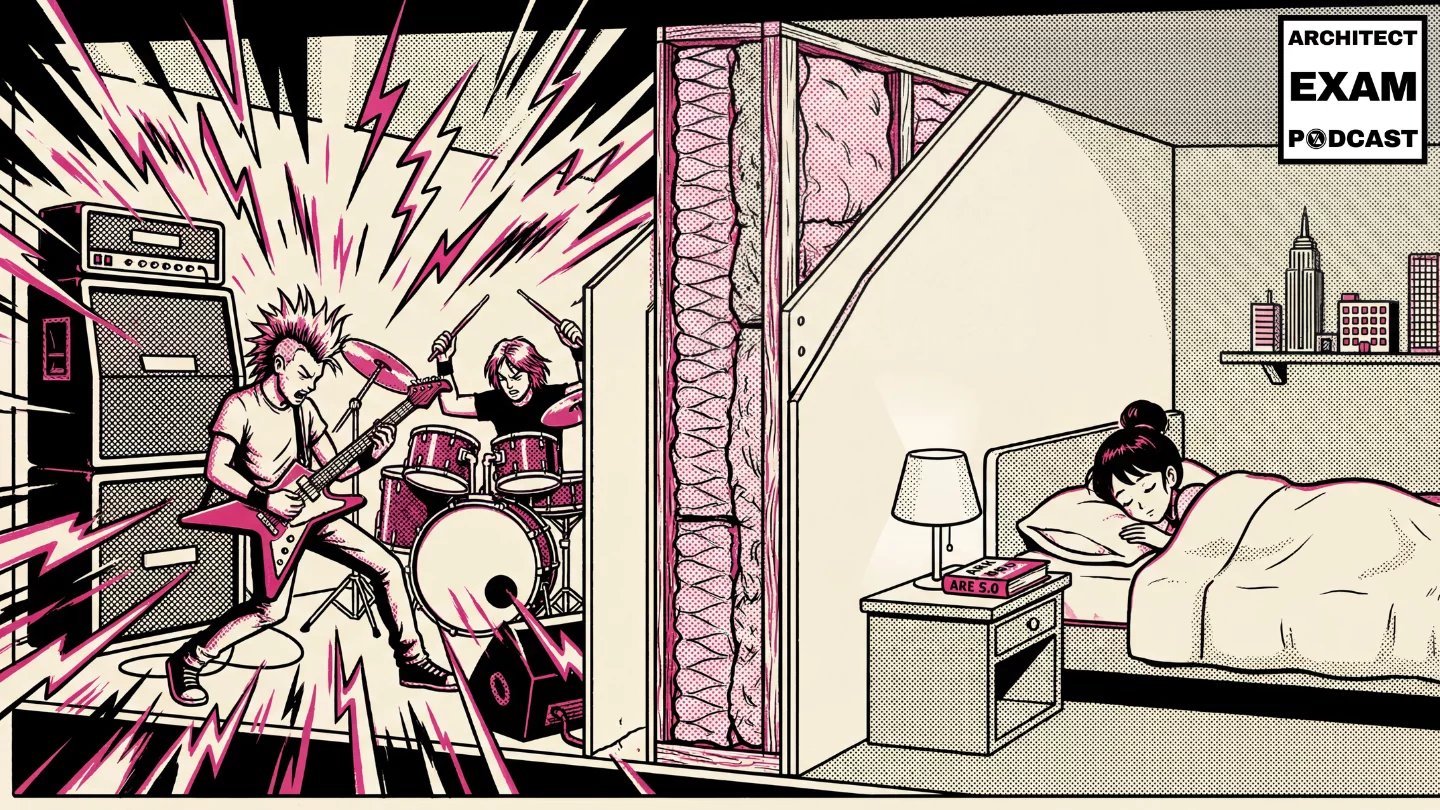

Building acoustics is one of those topics that affects every person inside a building, but most architects don’t think about it until something goes wrong. This guide breaks down everything you need to know about how sound behaves in buildings, including STC ratings, IIC ratings, NRC ratings, decibels, and Hertz. Whether you’re studying for the ARE or working on real projects, understanding acoustics will make you a better architect.
This podcast is also available on YouTube, Spotify, and Apple Podcasts
Why Building Acoustics Matter in Design
Let’s paint a picture.
It’s 11 o’clock at night.
You’re trying to sleep.
And your upstairs neighbor is walking around like they’re wearing concrete boots.
Every single step. Thud. Thud. Thud.
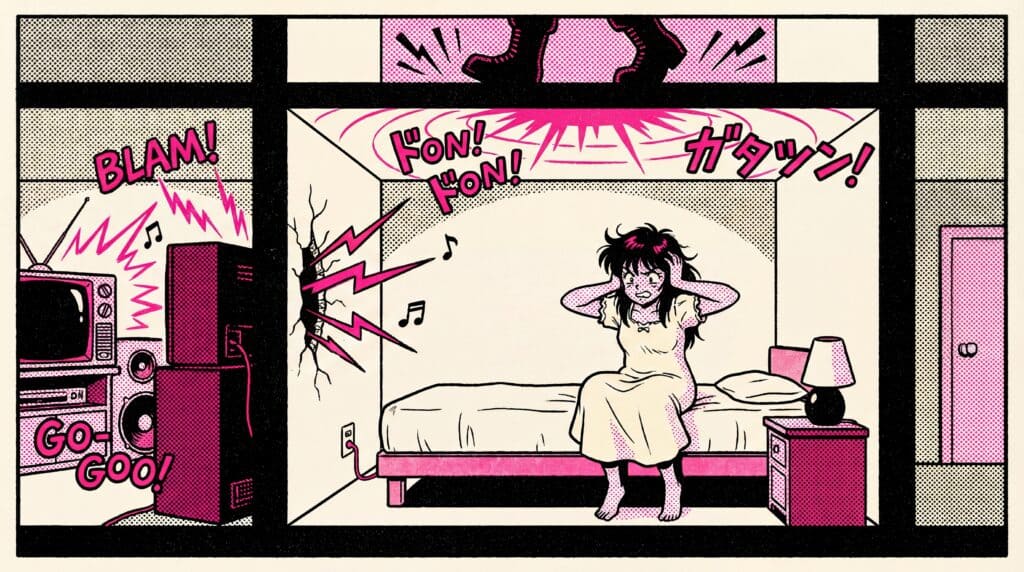
Or maybe it’s your next-door neighbor. You can hear their TV through the wall. Not clearly, but enough that it’s driving you crazy.
As an architect, that’s not just annoying. It’s a design problem.
Somebody made choices about that wall and that floor. Those choices either control sound or they don’t. Essentially, that’s what building acoustics and soundproofing are all about.
Think about the last time you were in a really loud restaurant where you couldn’t hear the person across the table. Or consider a doctor’s office where you could hear the conversation in the next exam room.
Those are acoustic failures. They happen because somebody didn’t think about sound during design. Good acoustic design starts with understanding how sound actually behaves in buildings.
Architectural acoustics covers two fundamentally different strategies.
First is blocking sound between spaces. Keeping your neighbor’s TV noise on their side of the wall. Keeping the conference room conversation from leaking into the hallway.
Second is absorbing sound within a space. Controlling the echo in a big open office. Making sure a classroom doesn’t sound like a cave.
Here’s the core analogy for this entire blogpost.
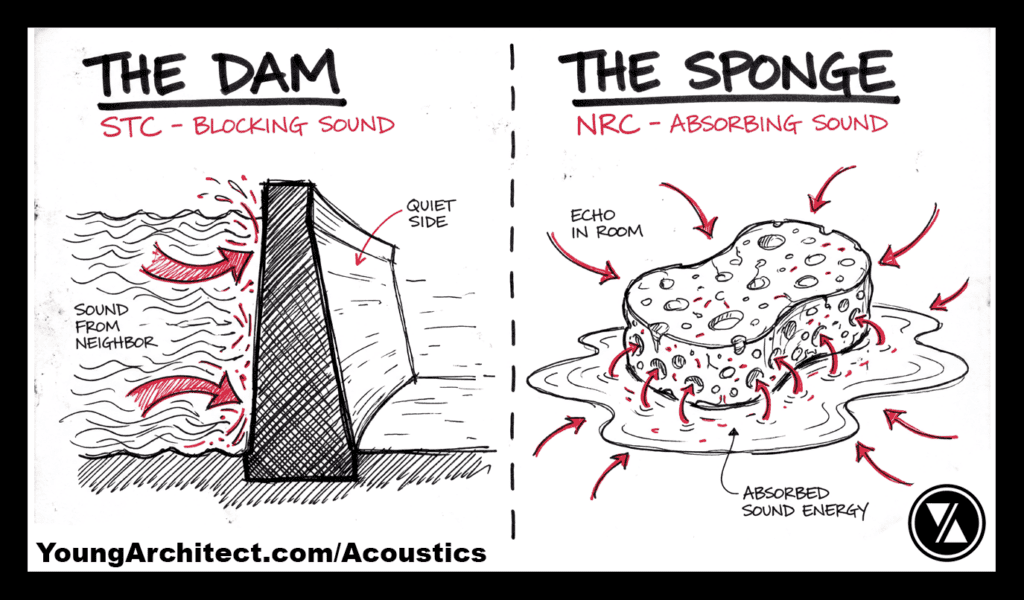
Think of sound like water.
Blocking sound is like building a dam. You’re stopping the water from getting through to the other side.
Absorbing sound is like putting a sponge in a puddle. You’re soaking up what’s already there.
Dam and sponge. Two completely different strategies. Two completely different rating systems. And people confuse them all the time.
Dam blocks. Sponge absorbs.
In other words, everything we’re about to cover falls into one of those two categories.
Decibels and Hertz: How We Measure Sound
Before we get into building ratings and code requirements, we need to understand how sound is actually measured. These two measurements are the foundation of building acoustics, and you’ll see them referenced in every rating system we cover.
Decibels: Measuring Loudness
The unit we use for loudness is called a decibel, abbreviated dB. Simply put, the higher the number, the louder the sound.
Here are some reference points so you can feel the scale. Don’t memorize these. Just get a sense of the range.
Decibel Reference Chart:
| Decibel Level | Example Sound |
| 0 dB | Threshold of human hearing (silence) |
| 20-30 dB | A whisper, quiet library |
| 60 dB | Normal conversation |
| 70-85 dB | Vacuum cleaner, city traffic |
| 120 dB | Rock concert, jet engine |
As you can see, that’s a huge range. From barely hearing anything to actual physical pain.
The decibel scale is logarithmic, not linear.
That word sounds intimidating, but the concept is simple. Think about the Richter scale for earthquakes. A 6.0 earthquake isn’t just a little worse than a 5.0. It’s actually ten times more powerful.
Decibels work the same way.
Here’s the part you actually need to remember.
Every 10 decibel increase sounds roughly twice as loud to the human ear.
That same 10 dB jump is actually ten times more sound energy.
Twice as loud to your ears. Ten times the energy in reality.
Additionally, a 3 dB change is the smallest difference most people can even notice. So when you see a wall assembly improve by just 3 or 5 points, that’s actually meaningful. Small numbers, big impact.
Hertz: Measuring Pitch
While decibels measure how loud a sound is, Hertz (Hz) measures the pitch. How high or how low.
Decibels are the volume knob.
Hertz is the bass and treble knob.
Low frequency, low Hertz. For example, that’s the rumble of an HVAC system. A bass guitar. A subwoofer. You can almost feel those sound waves in your chest.
High frequency, high Hertz. In contrast, that’s a smoke alarm. A whistle. Birds chirping.
Here’s why this matters for the exam.
Low-frequency sounds are the hardest to block. A wall might have an amazing STC rating (we’ll get to STC in a minute), but it can still let the bass from a home theater or a mechanical room bleed right through.
The reason is that STC doesn’t even measure below 125 Hertz. For really low, rumbly sounds, STC doesn’t tell the whole story.
As a result, that’s one of the big reasons you bring in an acoustics consultant for specialized spaces. More on that later.
STC Rating: Blocking Airborne Sound
Now that we understand how sound is measured, let’s build our dam.
STC stands for Sound Transmission Class. It measures how well a wall, floor, or partition blocks airborne sound from passing through to the other side.
Airborne sound is exactly what it sounds like. Voices. Music. TV. A barking dog. Essentially, sound waves that travel through the air and hit a wall.
Higher STC number means better sound blocking. This is the most common soundproofing metric you’ll see in practice and on the exam.
Think of STC like a report card grade for your wall. How good is this wall at keeping sound on its side?
Understanding the STC Scale
Here’s what different STC levels actually feel like in real life.
STC Rating Performance Chart:
| STC Rating | What You’ll Hear |
| STC 33 | Normal conversation clearly heard through the wall |
| STC 40-45 | Loud speech faintly heard, can’t make out words |
| STC 50 | Loud speech barely audible (code minimum) |
| STC 55-60 | Loud speech essentially inaudible |
| STC 60+ | Most noises effectively blocked (high-privacy spaces like theaters, executive offices, hospitals) |
That STC 50 line is particularly important. We’ll come back to it when we talk about code.
IBC Code Requirements for STC
IBC Section 1206 says that walls and floor-ceiling assemblies separating dwelling units from each other, or from public or service areas, must have a minimum STC of 50 when lab tested, or STC 45 when field tested.
That 5-point gap exists because real-world construction is never as perfect as a lab. There are imperfections. Flanking paths. Therefore, the code gives you a 5-point buffer for field conditions.
However, that STC 50 is only half of the code rule. There’s a second half that involves floors, and we’ll get to it in the IIC section below.
If you want to understand how the IBC connects to construction types and assembly requirements more broadly, we have a full breakdown on that topic too.
How to Improve a Wall’s STC Rating
Let’s build a wall together and upgrade it step by step.
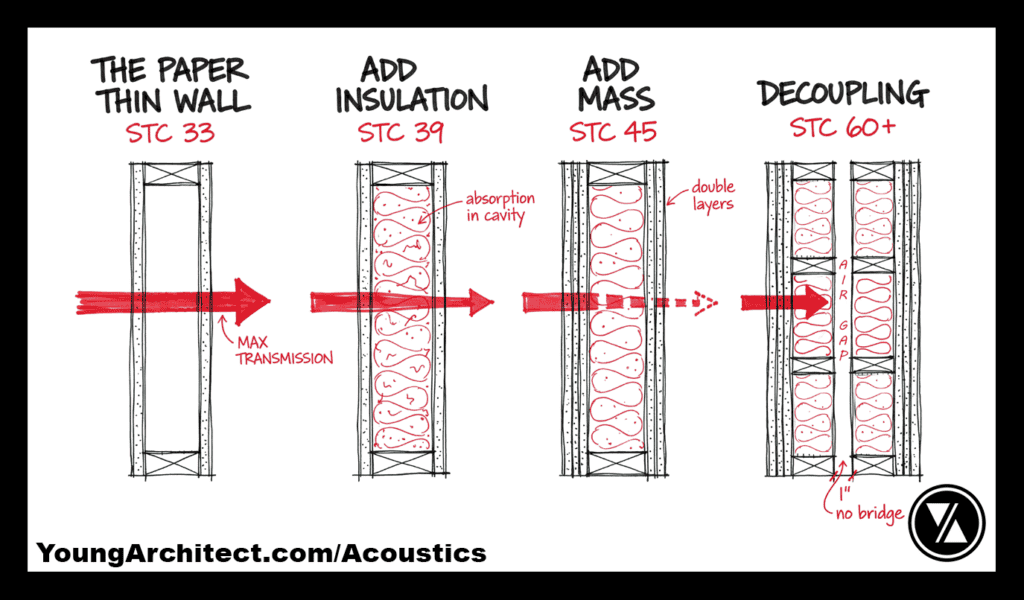
Imagine a basic wood stud wall. Single layer of drywall on each side. No insulation in the cavity. That wall has an STC of roughly 33. You can hear your neighbor’s entire phone conversation. It’s basically doing nothing.
First, add insulation.
Stuff batt insulation into that stud cavity. The insulation absorbs sound energy as the sound waves try to pass through. Just that one move bumps us up to around STC 38 to 40. Better, but still not at code.
Next, add mass.
Swap out half-inch drywall for 5/8-inch, or double up the layers. Heavier things are harder for sound waves to move. It’s easy to shake a thin sheet of paper back and forth, but try shaking a thick piece of plywood. More mass means the sound wave has to work harder to push through. Now we’re climbing toward STC 44 to 48.
Then, switch to metal studs.
Metal studs are thinner and more flexible, which actually helps acoustically. They don’t create as rigid of a path for vibrations to travel through. That flexibility means less energy transfers from one side to the other. We’re pushing toward STC 44 to 50.
Finally, decouple the two sides.
This is where the real soundproofing performance jump happens.
With staggered studs or a double stud wall, we break the direct physical connection between the two sides of the wall.
Think of it like a bridge. Sound needs a continuous physical bridge to travel through a solid. When both sides of the wall are connected to the same studs, that’s a highway for vibrations.
Stagger the studs, and you break that bridge. As a result, vibrations from one side have no direct path to get to the other side.
A staggered stud wall with insulation is one of the most effective soundproofing strategies available, getting you to around STC 55 to 60. A full double stud wall can push past STC 60.
For reference, an 8-inch CMU wall sits around STC 50 to 55.
Wall Upgrade Progression Chart:
| Wall Assembly | Approximate STC |
| Basic wood stud, single drywall, no insulation | STC 33 |
| Add batt insulation | STC 38-40 |
| Add mass (thicker/double drywall) | STC 44-48 |
| Switch to metal studs | STC 44-50 |
| Staggered studs + insulation | STC 55-60 |
| Double stud wall | STC 60+ |
| 8-inch CMU wall | STC 50-55 |
Here’s the important takeaway. You do not need to memorize those numbers.
In practice, you look up assembly ratings in reference materials. What matters is that you understand the strategies that improve STC and why they work.
Every upgrade we walked through used one of these approaches:
Adding mass, adding insulation, creating deeper cavities, decoupling the two sides, sealing penetrations, or using more flexible framing.
If you understand those concepts, you can reason through any question the exam throws at you.
This is exactly the kind of stuff we cover inside our PPD 101 and PDD 101 courses on the Young Architect Academy. Walking through building assemblies, understanding how they perform, and learning how to think through them. If this is clicking for you, you’d get a lot out of those courses.
Penetrations and Flanking: The Weak Links
Now let’s talk about what kills your STC rating.
Penetrations are a huge deal.
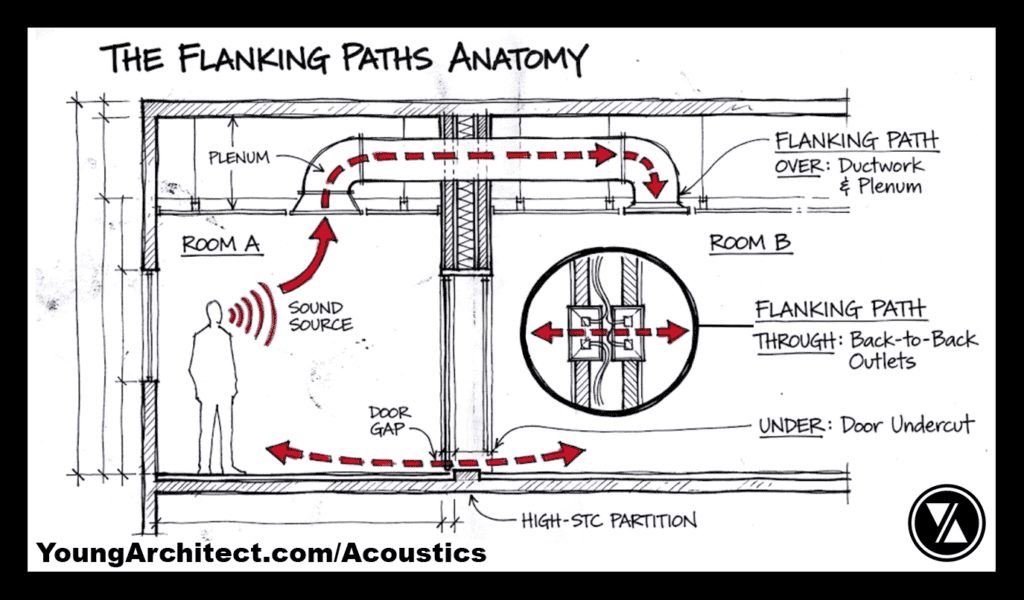
Back-to-back electrical outlets in a party wall. Unsealed pipes running through a rated assembly. Gaps at the top or bottom of a wall that don’t get sealed.
Specifically, the code requires that all penetrations in rated assemblies be sealed, lined, insulated, or otherwise treated to maintain the rating. The same principle applies to fire rated wall assemblies, where penetrations and continuity are equally critical.
Then there’s doors. This is one of the biggest weak points people overlook. For instance, an STC 60 wall with a standard unsealed door (roughly STC 20) effectively drops the whole assembly down to about STC 25. The assembly is only as good as its weakest point. Doors need seals and drop-bottoms to maintain the wall’s rating.
Beyond penetrations, there’s also flanking.
Imagine you’re standing in a room. Look up at the air conditioning vent in the ceiling. Look down at the gap under the door. Then look at the electrical outlet on the wall.
Sound behaves like water under pressure. It finds the easiest way out through those gaps, completely ignoring your beautifully insulated wall.
That’s flanking. Sound goes over the wall through an open plenum. Through the ductwork. Through unsealed joints. Around the edges.
Remember our dam analogy? You can build the most massive dam in the world, but if there’s a trench open on the side, the water just goes around it.
A wall with an STC 60 is useless if sound is flanking around it. Always think about the weakest link.
IIC Rating: Blocking Impact Sound Through Floors
We’re still building our dam, but now we’re moving to the floor. Same idea of blocking sound, but a different type of sound.
Everything we talked about with STC was about airborne sound. Voices, music, TV.
IIC, on the other hand, is about impact sound.
Sound that’s created when something physically hits the structure. Footsteps. Dropped objects. Furniture being dragged across the floor. Kids jumping.
IIC stands for Impact Insulation Class, and it measures how well a floor-ceiling assembly blocks that impact sound from transferring to the space below.
Here’s an easy way to keep them straight.
STC is like noise-canceling headphones for your walls. It blocks the airborne sound.
IIC is like shock absorbers on your car. Instead, it absorbs the vibration before it can travel through the structure.
Higher IIC number means better impact isolation.
Understanding the IIC Scale
IIC Rating Performance Chart:
| IIC Rating | What You’ll Experience |
| IIC 25 | Bare concrete slab, every footstep is miserable |
| IIC 50 | Code minimum, manageable |
| IIC 60 | Most occupants are satisfied |
| IIC 65+ | High performance (luxury condos, nice hotels) |
The IBC Code Requirement: Both Halves of the Rule
Remember how STC 50 was only half the rule? Here’s the other half.
The IBC requires both STC 50 and IIC 50 between dwelling units, or between dwelling units and public or service areas. Lab tested. For field testing, it’s STC 45 and IIC 45.
Here’s an important detail the exam loves to test. This requirement applies between dwelling units. Not within a single unit.
In other words, you don’t need STC 50 between your bedroom and your bathroom in the same apartment. Only between Apartment A and Apartment B, or between an apartment and the hallway.
STC 50 and IIC 50.
Those two numbers travel together on test day. Know them both.
What Affects IIC Ratings
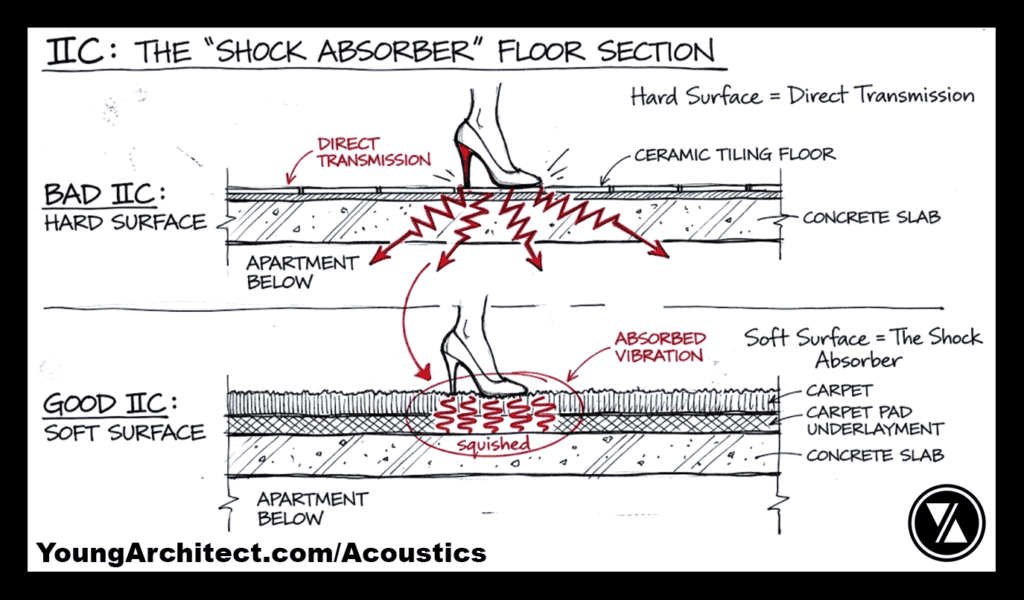
The floor finish makes a massive difference.
Carpet with a good pad on a concrete slab can dramatically improve the IIC.
We’re talking about going from that bare concrete at IIC 25 all the way up to IIC 65 or even 75 just by adding carpet and pad. That’s a huge jump from one material.
However, here’s the flip side.
Hard surfaces like tile, hardwood, and luxury vinyl plank without proper underlayment can absolutely tank your IIC rating.
This is a real-world building acoustics issue that’s getting more common every year. Currently, the trend in design is moving toward hard-surface floors. LVT. Hardwood. Tile. People love the look.
But carpet used to solve the IIC problem almost for free. Now that everyone wants hard floors, designers have to work a lot harder to hit code.
As a result, you need acoustic underlayments, sometimes called soundproof underlayment. Rubber, cork, acoustic mats under the hard flooring. You might also need a resilient channel ceiling or resilient clips on the underside of the floor above.
Additionally, insulation in the joist cavity helps. In some cases, you may even need a fully suspended, decoupled ceiling.
Understanding how floor assemblies, code requirements, and material choices all connect is something we dig into on the Young Architect Academy.
We’ve got a Building Codes 101 course and a Mechanical Systems 101 course in addition to the PPD and PDD content that all tie into this.
The key exam point: for floor-ceiling assemblies in multi-family buildings, you need to think about both STC and IIC. Airborne and impact. A lot of candidates remember one and forget the other.
NRC Rating: Sound Absorption Within a Room
We are done building our dam.
Everything up to this point has been about blocking sound between rooms. Stopping sound from getting from one side to the other.
Now it’s time to pull out the sponge.
NRC stands for Noise Reduction Coefficient, and it measures how much sound a material absorbs versus how much it reflects back into the space. This is where sound absorption becomes the focus instead of sound blocking.
The scale goes from 0 to 1.0. The easiest way to think about it is to simply turn the decimal into a percentage.
NRC 0.85? Think 85 percent. That material is soaking up 85% of the sound that hits it and bouncing 15% back into the room.
- NRC 0.0 means perfectly reflective. Everything bounces back. Zero absorption.
- NRC 1.0 means perfectly absorptive. Everything gets soaked up. Nothing bounces back.
One quick technical note for exam day. NRC is technically an average of how a material performs across four specific mid-range frequencies. For practical purposes though, just think of it as a percentage of sound absorbed.
Reflectors vs. Absorbers
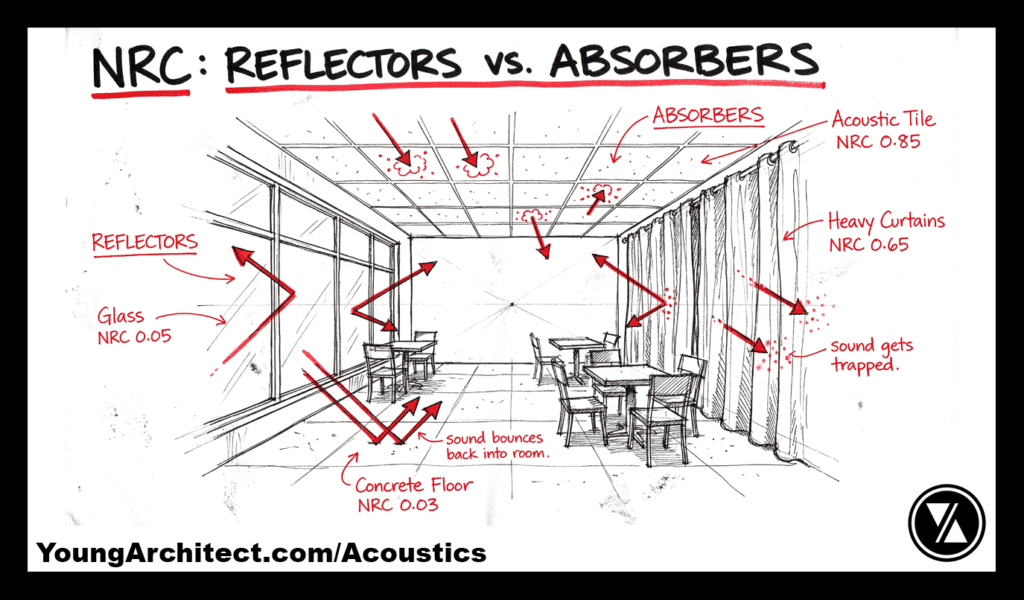
Instead of memorizing which sound absorbing materials have which numbers, just put materials into two groups.
The Reflectors are your hard, dense, smooth surfaces. Painted drywall. Concrete. Brick. Glass. Tile. These materials have NRCs close to zero. They bounce almost all the sound back into the room.
For example, think about a basketball court. Hard wood floor. Painted concrete walls. Metal ceiling deck. You clap your hands and it echoes for days. That’s a room full of reflectors.
The Absorbers are your soft, porous, textured surfaces. Carpet. Acoustic ceiling tiles. Fabric-wrapped panels. Foam panels. Heavy curtains. These have high NRCs, anywhere from 50% to nearly 100% sound absorption.
In contrast, think about a recording studio. Or a carpeted living room with big soft furniture and heavy curtains. You clap your hands and it’s dead. The sound just disappears. That’s a room full of absorbers.
Material Absorption Chart:
| Material Type | NRC Range | Category |
| Painted drywall | 0.05 – 0.10 | Reflector |
| Concrete / Brick | 0.01 – 0.05 | Reflector |
| Glass | 0.05 – 0.10 | Reflector |
| Tile flooring | 0.01 – 0.05 | Reflector |
| Carpet (with pad) | 0.30 – 0.55 | Absorber |
| Acoustic ceiling tiles | 0.50 – 0.90 | Absorber |
| Fabric-wrapped panels | 0.80 – 1.0 | Absorber |
| Heavy curtains | 0.50 – 0.75 | Absorber |
The simple rule: Hard and dense reflects. Soft and porous absorbs.
If you remember that one concept, you can reason through any NRC question without memorizing a single number.
NRC and Reverberation Time
So why do we care about absorption in the first place?
Because NRC directly affects reverberation time, which is how long sound lingers in a room after the source stops. You might see this referred to as RT60 on the exam.
Higher NRC materials in a space means shorter reverberation time, which ultimately means better speech clarity. NRC rates the material. Reverberation time rates the room’s actual performance. They’re connected.
Where NRC Matters Most
NRC matters most in places where speech clarity or noise buildup is a concern. That’s why restaurant acoustics and classroom acoustics are such common design challenges.
The ANSI classroom acoustics standard sets specific reverberation time and background noise requirements for schools, which is a good example of how seriously these issues are taken. Similarly, open offices, conference rooms, and worship spaces all deal with the same issues.
Here is the key takeaway where people get tripped up.
NRC is about controlling sound within a room. Echo. Reverberation. Speech clarity.
STC, on the other hand, is about blocking sound between rooms.
Different problem. Different rating system. Don’t confuse them.
Putting It All Together: STC vs. IIC vs. NRC
Let’s make sure these three building acoustics rating systems are crystal clear.
STC is the dam for your walls. How well does this wall block airborne sound between rooms? Voices. Music. TV. Higher STC, better blocking.
IIC is the dam for your floors. How well does this floor block impact sound from traveling down to the space below? Footsteps. Dropped objects. Higher IIC, better isolation.
NRC is the sponge. How well does this material absorb sound within a room? Echo control. Reverberation. Higher NRC, more absorption.
Acoustics Rating Comparison Chart:
| Rating | What It Measures | Type of Sound | Analogy |
| STC | Sound blocking through walls/floors | Airborne (voices, music) | Dam |
| IIC | Impact isolation through floors | Impact (footsteps, drops) | Dam |
| NRC | Sound absorption within a room | Reflected sound (echo) | Sponge |
Why Sound Absorption and Blocking Are Not the Same Thing
A material can have a high NRC and a terrible STC. Those two things are not related.
For instance, think about an acoustic ceiling tile. It absorbs about 90% of the sound in the room. Amazing sponge. But sound passes right through it to the space above. Terrible dam.
This is actually measured by a rating called CAC (Ceiling Attenuation Class). In offices with drop ceilings where walls stop at the ceiling grid, sound travels up through the tile, over the plenum, and down into the next room. High NRC tiles are often lightweight with low CAC. It’s a classic flanking problem.
Absorption and blocking are not the same thing. The sponge soaks up the puddle. The dam stops the river. A ceiling tile is a great sponge but a terrible dam.
Additional Concepts Worth Knowing
Here are a couple more terms you might encounter.
Transmission Loss. You might see this on the exam. Transmission loss is the actual measured reduction in sound energy as it passes through a barrier at specific frequencies. STC is derived from transmission loss data and then simplified down into one single number. In short, STC is the simple version. Transmission loss is the detailed version.
Lab versus field testing. Lab results are always higher than field results. In a lab, everything is perfectly sealed, perfectly constructed, with no flanking paths. In the real world, however, you’ve got construction imperfections, flanking, and all the messiness of an actual building. That’s why the code gives you that 5-point buffer. STC 50 in the lab, STC 45 in the field.
Common Building Acoustics Mistakes Architects Should Avoid
Code Minimum Isn’t Always Enough
First, understand that an STC 50 wall is the floor, not the ceiling. For luxury condos, high-end hotels, and hospitals where you’ve got HIPAA and speech privacy requirements, you’re going to need higher ratings than code minimum.
The HHS HIPAA speech privacy guidance clarifies what’s expected in healthcare settings, and the acoustic implications go well beyond code minimums. The owner’s expectations and the use of the space should drive the design, not just the code number.
When to Bring in a Specialist
Second, know when to bring in an acoustics consultant. Complex projects, low-frequency concerns like mechanical rooms or home theaters, HIPAA-sensitive healthcare spaces, performing arts venues. All of these need a specialist.
Part of being a great architect is knowing your limits. You don’t need to be an acoustics expert. However, you need to understand building acoustics well enough to know when you need a specialist, and to guide that consultant once they’re on the team.
That’s real professional practice. It’s what it means to be the architect of record.
Five Common Spec Mistakes
Here are five common spec mistakes that show up in practice. Getting these details right during design is important, but so is verifying them during construction through the construction submittals process.
Mistake 1: Relying on carpet for your IIC rating without thinking about what happens when a future owner rips it out and puts in hardwood. Suddenly, your floor doesn’t meet code anymore.
Mistake 2: Back-to-back electrical outlets in a party wall. This is a classic flanking problem. The outlets create a direct path for sound to travel through.
Mistake 3: Not sealing the top and bottom of rated walls. If the wall doesn’t go to the structure above, or if the gap at the bottom isn’t sealed, sound goes right around it. In other words, it’s a trench around the dam.
Mistake 4: Specifying STC for a floor-ceiling assembly but forgetting about IIC. You need both in multi-family. Always.
Mistake 5: Assuming a high NRC ceiling tile means good sound blocking between rooms. It doesn’t. Great sponge. Terrible dam. Remember, sound absorption is not blocking.
Frequently Asked Questions About Building Acoustics
What is the difference between STC and NRC?
STC blocks sound between rooms (the dam). NRC absorbs sound within a room (the sponge). A material can have a high NRC and a terrible STC. Acoustic ceiling tiles are a perfect example.
What is the difference between STC and IIC?
STC measures how well a wall or floor blocks airborne sound like voices and music. IIC measures how well a floor blocks impact sound like footsteps and dropped objects. Both are required by IBC Section 1207 between dwelling units: STC 50 and IIC 50 lab tested, or STC 45 and IIC 45 field tested.
What are the IBC acoustic requirements for dwelling units?
IBC Section 1207 requires STC 50 and IIC 50 (lab tested) or STC 45 and IIC 45 (field tested) between dwelling units. This applies between units, not within a single unit.
How do you improve a wall’s STC rating?
Add mass, add insulation, create deeper cavities, decouple the two sides with staggered or double studs, and seal all penetrations. Understanding these strategies matters more than memorizing specific numbers.
Why is hard-surface flooring a problem for acoustics?
Carpet naturally boosts IIC ratings by absorbing impact energy. Hard floors without proper acoustic underlayment can significantly reduce IIC. With the trend toward hard surfaces, designers need underlayments, resilient channels, and sometimes decoupled ceilings to meet code.
What is flanking in acoustics?
Sound traveling around a barrier rather than through it, via ductwork, above ceiling tiles, under doors, or through unsealed gaps. A perfectly rated wall is useless if flanking paths aren’t addressed.
What is the difference between reverberation and echo?
Both involve reflected sound, but they’re not the same thing. An echo is a distinct, delayed repetition of a sound, like shouting in a canyon and hearing it come back. Reverberation is a buildup of many overlapping reflections that makes sound linger in a space without distinct repetitions. In building acoustics, reverberation time (RT60) is the more common concern, especially in classrooms, restaurants, and offices where speech clarity matters.
Wrapping It Up
Today we covered how sound is measured with decibels and Hertz, the difference between loudness and pitch, and why low-frequency sounds are the hardest to block.
We walked through STC ratings for blocking airborne sound, upgrading a wall step by step. Mass. Insulation. Decoupling. Sealing.
We also covered IIC ratings for blocking impact sound through floors, and why the shift toward hard-surface flooring is making this harder for designers.
Then we learned about NRC ratings for absorbing sound within a room. Hard and dense reflects. Soft and porous absorbs.
Most importantly, you now know the difference between the dam and the sponge. That’s the single most important building acoustics concept from today.
You don’t need to memorize every number we talked about. Instead, you need to understand the concepts and the relationships. That’s what the exam is really testing.
The two numbers that are worth remembering?
Every 10 dB increase sounds twice as loud.
And the IBC requires STC 50 and IIC 50 between dwelling units.
If you want to keep learning this kind of stuff, check out our ARE 101 membership on the Young Architect Academy.
Our PPD 101, PDD 101, Building Codes 101, and Mechanical Systems 101 courses all cover material that connects directly to what we talked about today. Since there’s so much overlap between the exams and our courses, everything is part of one low monthly membership.
And if this episode of The Architect Exam Podcast helped you, share it with someone who’s studying. It truly makes a huge difference.
Good luck studying. You’ve got this.