


Architect salary ranges from under $60,000 to well over $200,000, depending on experience, licensure, location, and specialization. How much do architects make? The average architect salary in the United States sits around $97,000 to $100,000 according to government data, but that number barely scratches the surface. This guide breaks down architect pay at every career stage, what actually moves the needle on compensation, and the one thing high-earning architects figured out that most of the profession missed.
This podcast is also available on YouTube, Spotify, and Apple Podcasts
Here’s the thing about architect salary. It’s terrible. And it’s also incredible.
Both of those are true at the same time, and the difference comes down to one thing that most architects never figure out.
You can find salary data anywhere. Indeed has tables. Glassdoor has tables. AIA publishes tons of compensation data, and the Bureau of Labor Statistics has an entire page dedicated to architects.

What you won’t find on those sites is the logic behind the numbers. The data tells you what architects make. It doesn’t tell you why the range is so wide or what the architects on the higher end figured out that everyone else missed.
So before we get into the numbers, let me ask you a question. How much is a pair of shoes?
Is it five dollars? Fifty dollars? A hundred? Five hundred?
The answer is: it depends.

You can find a pair of shoes at every single one of those price points. But there’s a massive difference between the fifty-dollar pair and the five-hundred-dollar pair.
The materials are different. The craftsmanship is different. The purpose is different. They’re both “shoes,” but they’re not even close to the same product.
Architect salary works the exact same way.
Asking “how much does an architect make” is like asking “how much does a pair of shoes cost.” The answer depends entirely on what kind of architect you’re talking about.
Not all architects are the same, and not all architect salaries are the same. What kind of architect, where they work, what they specialize in, and the value they bring to the table changes everything.
How Much Do Architects Make
According to the Bureau of Labor Statistics, the lowest ten percent of architects earn under approximately $60,000 a year. The top ten percent pull in over $160,000. And the median sits right around $97,000 to $100,000 depending on the source and year.
But that median is almost useless because it hides the enormous range underneath it.
The range is where the real story lives.
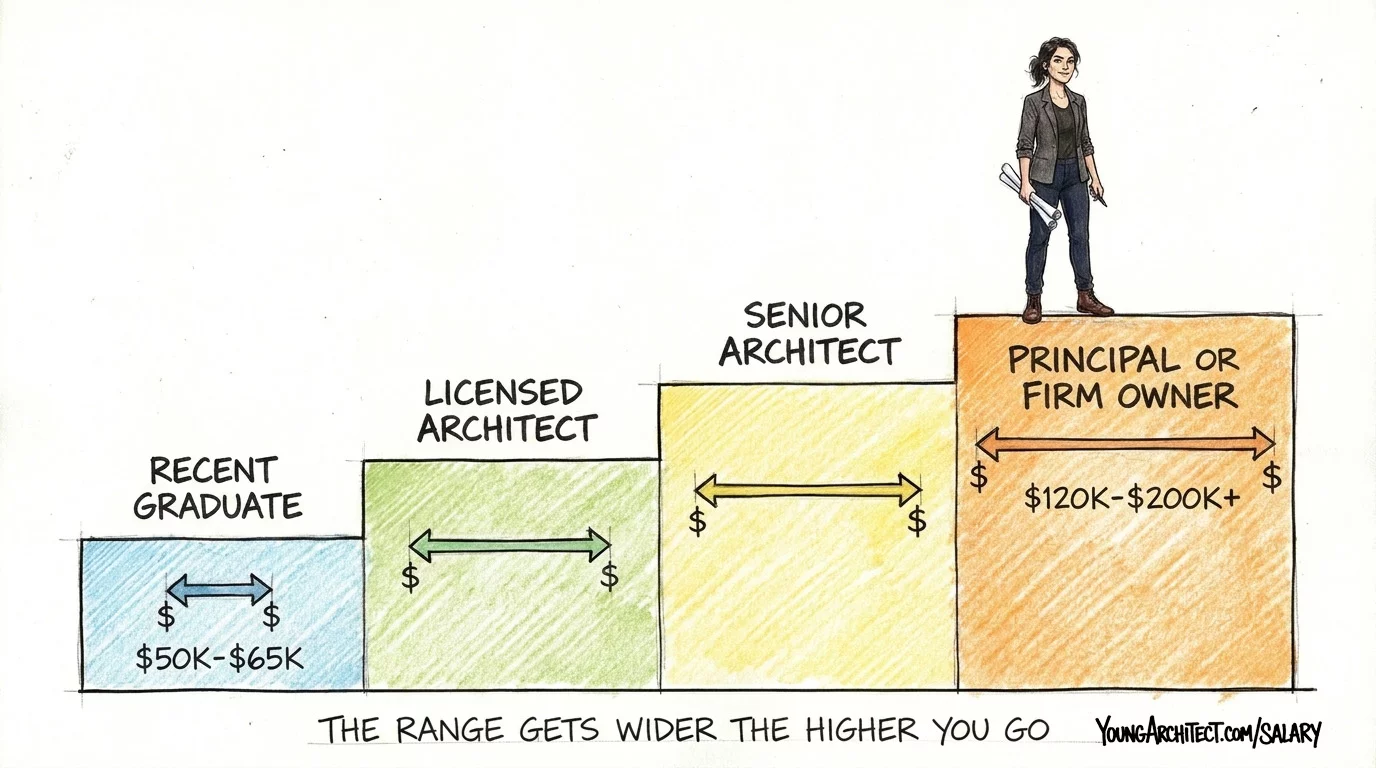
If you’re a recent architecture graduate coming out of school with a bachelor’s or master’s of architecture, you’re probably looking at somewhere in the $50,000 to $65,000 range depending on the market and the firm.
And that’s a tough number to hear, because a lot of architecture students are coming right out of school expecting to make $100,000. Meanwhile, there are people in the firm who’ve been there eight years and aren’t even close to that yet.

That entry-level number stings, but there’s a reason behind it. Recent graduates actually require a lot of training before they start contributing real value.
Architecture school teaches you how to think like a designer. But the day-to-day production skills that keep a firm running take time to develop. Coordinating consultants, producing construction documents, managing deadlines, understanding how the business side actually works.
That starting salary isn’t a firm being cheap. It reflects the reality that the firm is investing in you before you’re generating revenue for them.
Architect Experience Program
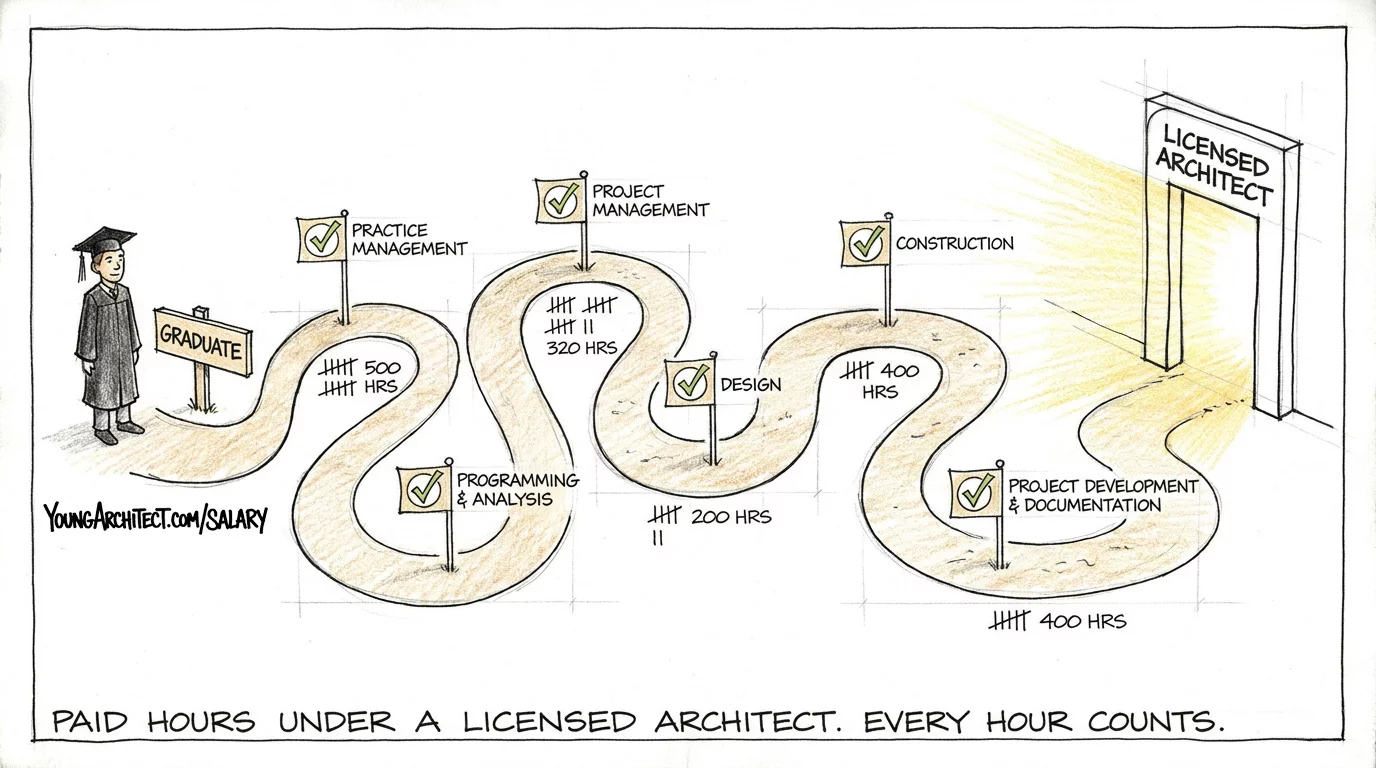
Between graduating and getting your license, there’s a stretch where you’re completing what’s called the AXP, the Architectural Experience Program.
That’s a multi-year experience requirement where you’re working under a licensed architect and logging hours across different areas of practice. Design, project management, construction, programming and analysis. Each category has its own hour requirements.
During this period, you’re earning that entry-level salary while accumulating the hours you need. And to be clear, for core firm experience, these have to be paid hours. NCARB doesn’t recognize unpaid labor inside a standard business.
If you want the full breakdown of what the licensing process looks like step by step, we have a complete guide on becoming an architect that walks through the entire path.
Licensed Architect Salary
In the United States, you are not allowed to call yourself an architect unless you’ve completed the full licensing process. It’s a regulated title.
That process has four steps: education, experience, exams, and fees.

But here’s what a lot of people don’t realize. Licensure is not a requirement to work in the architecture field.
There are plenty of people in architecture who are successful, who do great work, who have long careers, and they’re not licensed. You can absolutely build a career without it.
But there’s another side to that story. Every single day, there are people reaching out who rejected the idea of getting their architecture license for years. And now they’re in a position where not having it is holding them back.
They can’t get promoted. They can’t become a partner. They can’t move to the next level. And they’re realizing they should have done this ten years ago.
Getting your architecture license is the single best investment anyone can make who is serious about a career in architecture. Hands down.
Once you get licensed, your architect salary takes a real jump.
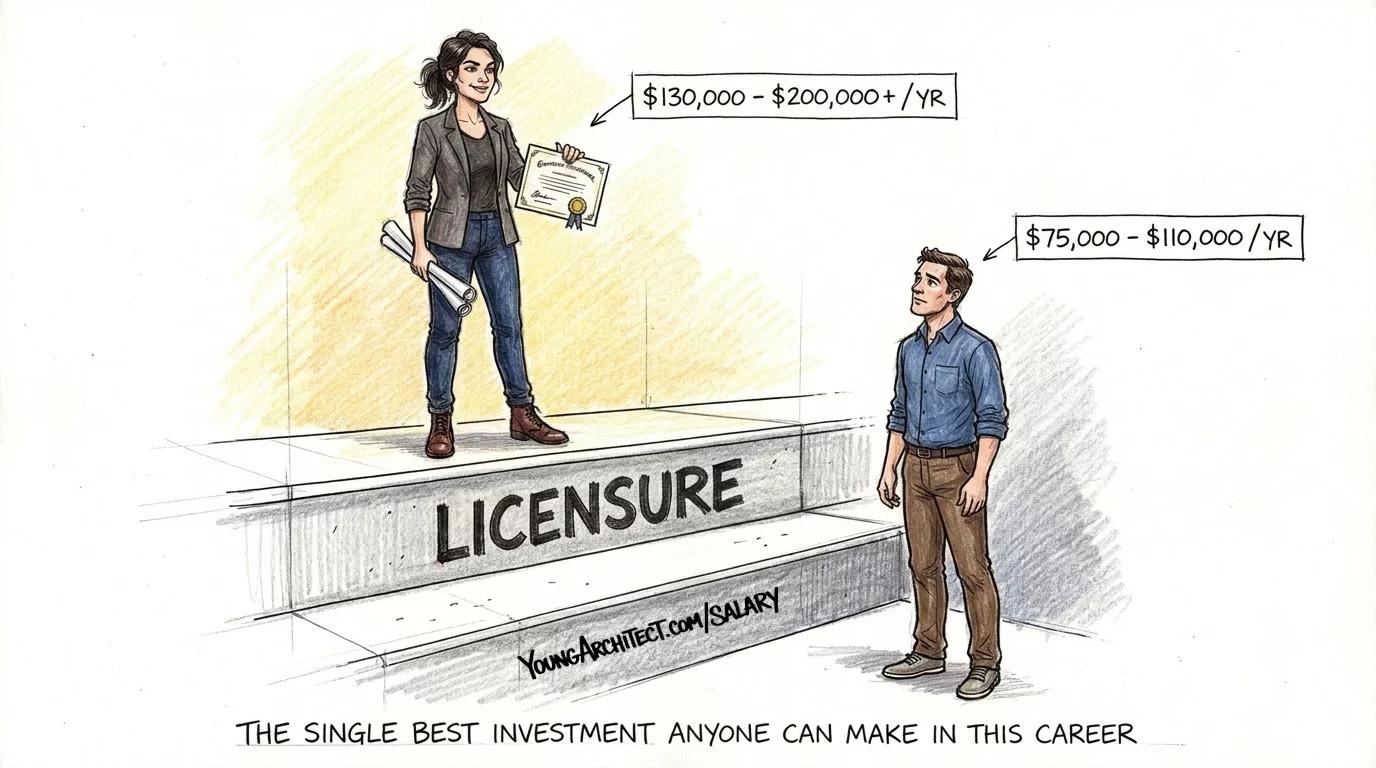
And it’s not just because you can stamp a set of drawings. That’s actually the smallest part of it.
What the license really does is demonstrate that you’ve met every requirement to call yourself an architect. And that credential alone is extremely valuable to companies.
- Firms can charge more for your time on projects
- You qualify for roles and responsibilities that unlicensed staff simply can’t take on
- You become eligible for better positions, better promotions, and better projects
- People take you more seriously as a registered architect versus someone who went to architecture school and has been working in the field without the credential
Fulfilling the licensure requirement speaks volumes. It changes how the industry sees you.
That’s a huge part of what we do at the Young Architect Academy. Helping people get their architecture license as quickly and efficiently as possible through ARE Boot Camp, a coaching program built around structured guidance, accountability, and community.
Think of your architecture license like a retirement account. The best time to start investing was ten years ago. The second best time is right now.
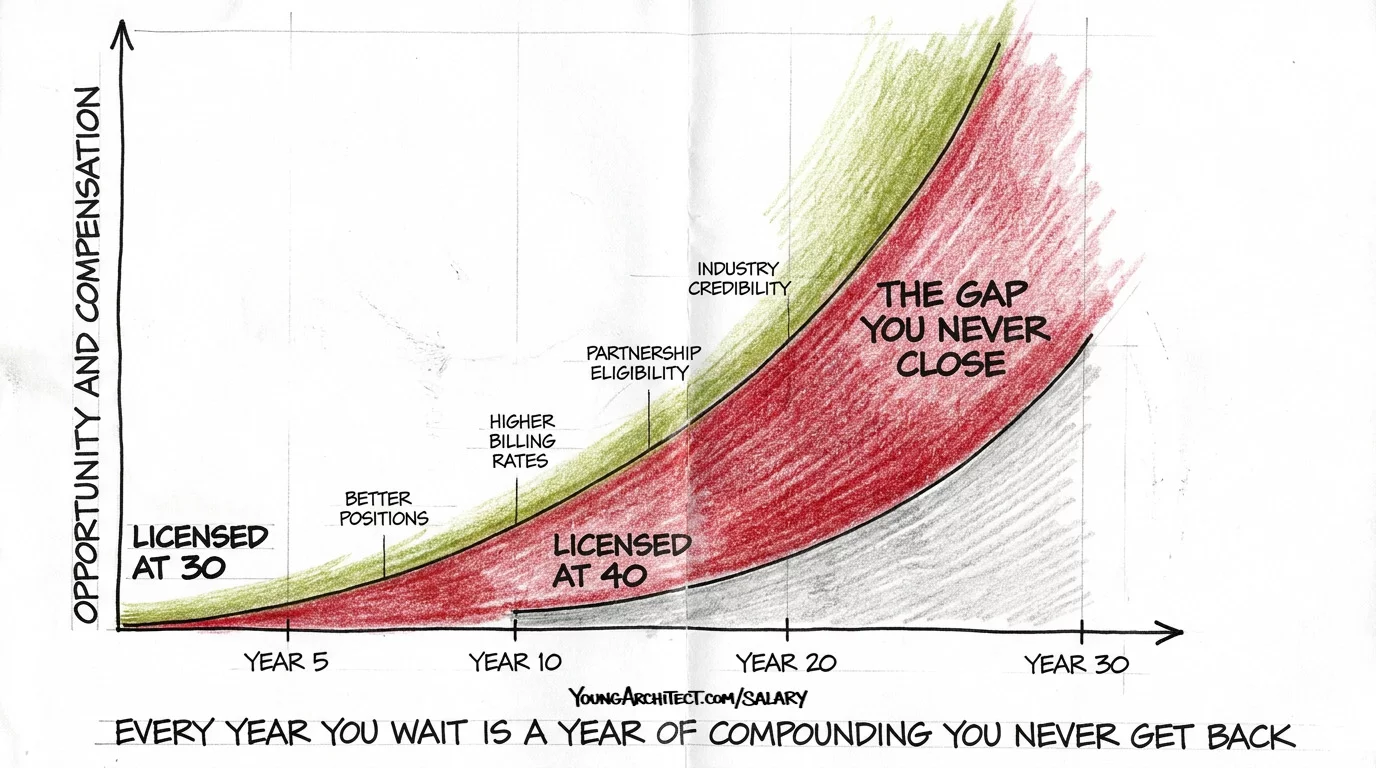
The value of that license compounds over the rest of your career. Every year you wait is a year of compounding you don’t get back.
Better positions. Higher billing rates. Partnership eligibility. Industry credibility. All of it builds on itself over time.
And here’s what never gets acknowledged. The education you get while pursuing your license, the studying, the training, the deeper understanding of how this industry works, that starts making you more valuable to your firm before you even pass your last exam.
The worst thing a young person in this profession can do is say they’re too busy to get licensed right now. Don’t wait.
Senior Architect to Firm Owner
Once you move into a senior or project architect role, the salary range starts to widen significantly.
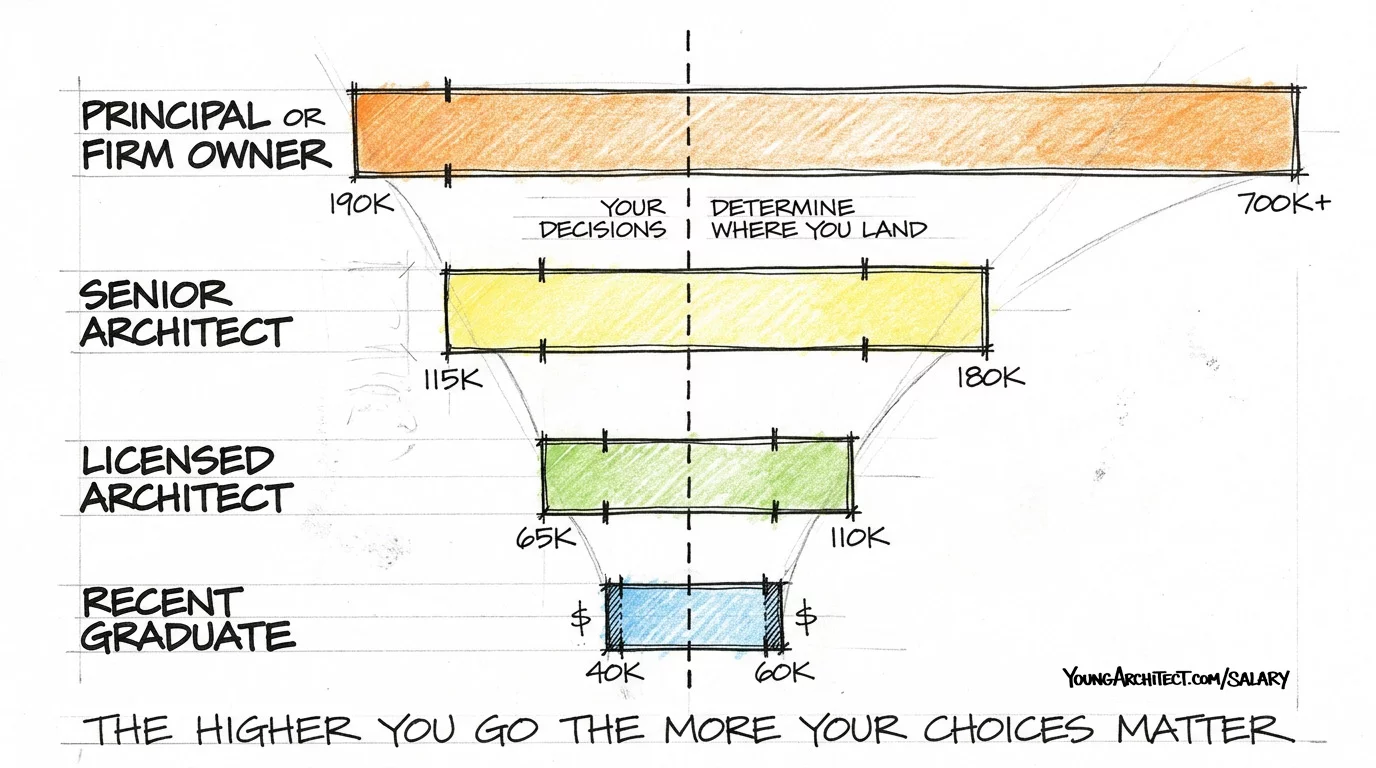
At this stage, what you earn depends a lot less on your title and a lot more on what you bring to the table. Your ability to manage projects, retain clients, and lead teams starts to matter more than how many years you’ve been at the desk.
And at the principal, partner, or firm owner level, the range is the widest of all.
You could be making $120,000 at a small firm or well north of $200,000 at a successful mid-size or large firm. Some firm owners are making considerably more than that.
This is where the math completely changes because it’s not just about salary anymore. It’s about firm revenue, business development, and whether you have an ownership stake in the practice. If you want to understand how architecture firms actually think about compensation, revenue, and profit, our post on architecture firm finances breaks down the full picture from overhead rate to net multiplier.
But here’s the big caveat on all of these numbers. Every single one of them depends on where you live.
Making $100,000 a year in San Francisco or New York is a very different reality than making $100,000 in Kansas City or the rural Midwest.
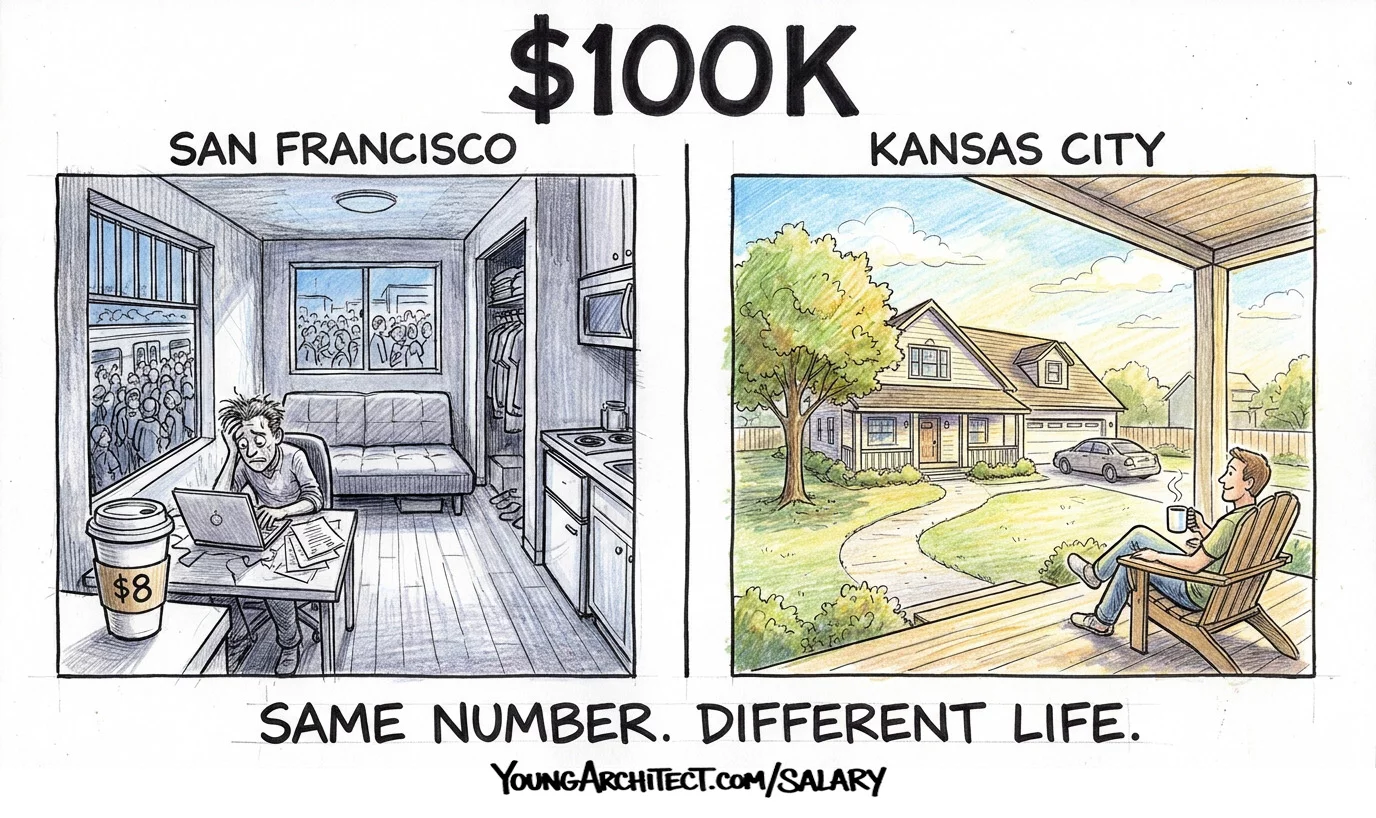
The cost of living is just not the same. So when someone tells you what they make, you have to ask where they live before that number means anything.
These are ballpark ranges to give you a sense of how the profession progresses. They’re not a promise.
Architect Salary by Location
Those salary ranges above are wide for a reason. A licensed architect could be making $70,000 or $110,000. A principal architect salary could be $120,000 or $300,000.
A huge part of what creates that spread is geography and cost of living.
The same job title, the same responsibilities, the same level of experience can pay very differently depending on where you’re located.
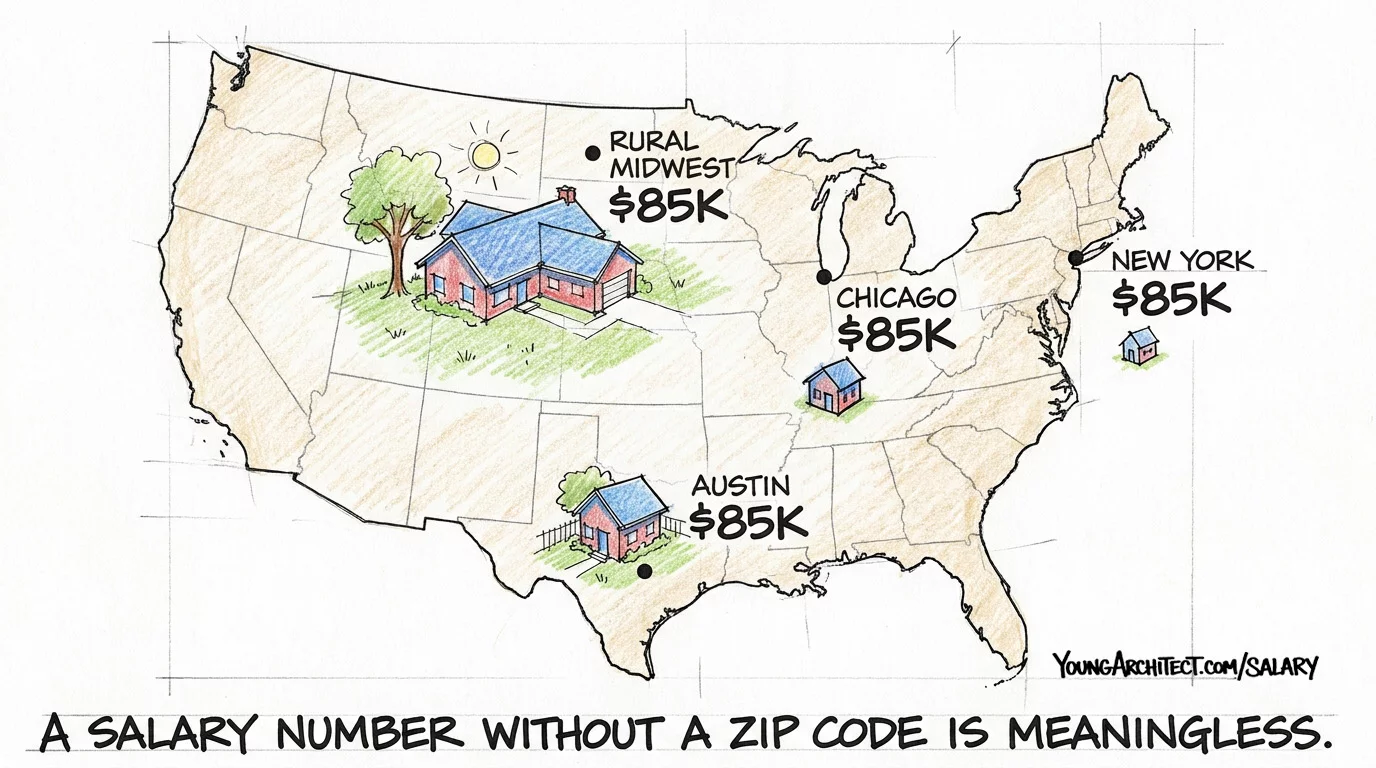
$80,000 in the Midwest might buy you more than $120,000 in San Francisco. Architect salary in California, New York, or other high-cost markets often looks impressive on paper, but the purchasing power tells a different story.
Meanwhile, architect pay in Texas, Florida, or the Midwest might come with a lower number but stretch further in terms of housing, commute, and overall quality of life.
A salary number without a zip code is meaningless.
If you want to benchmark your own architect pay against your region and role, the AIA Salary Calculator is a good starting point.
It’s not just about the number on the paycheck. It’s about what that paycheck buys you.
Small Firm vs. Large Firm Salary
The second major factor that affects architect pay is firm size and type.
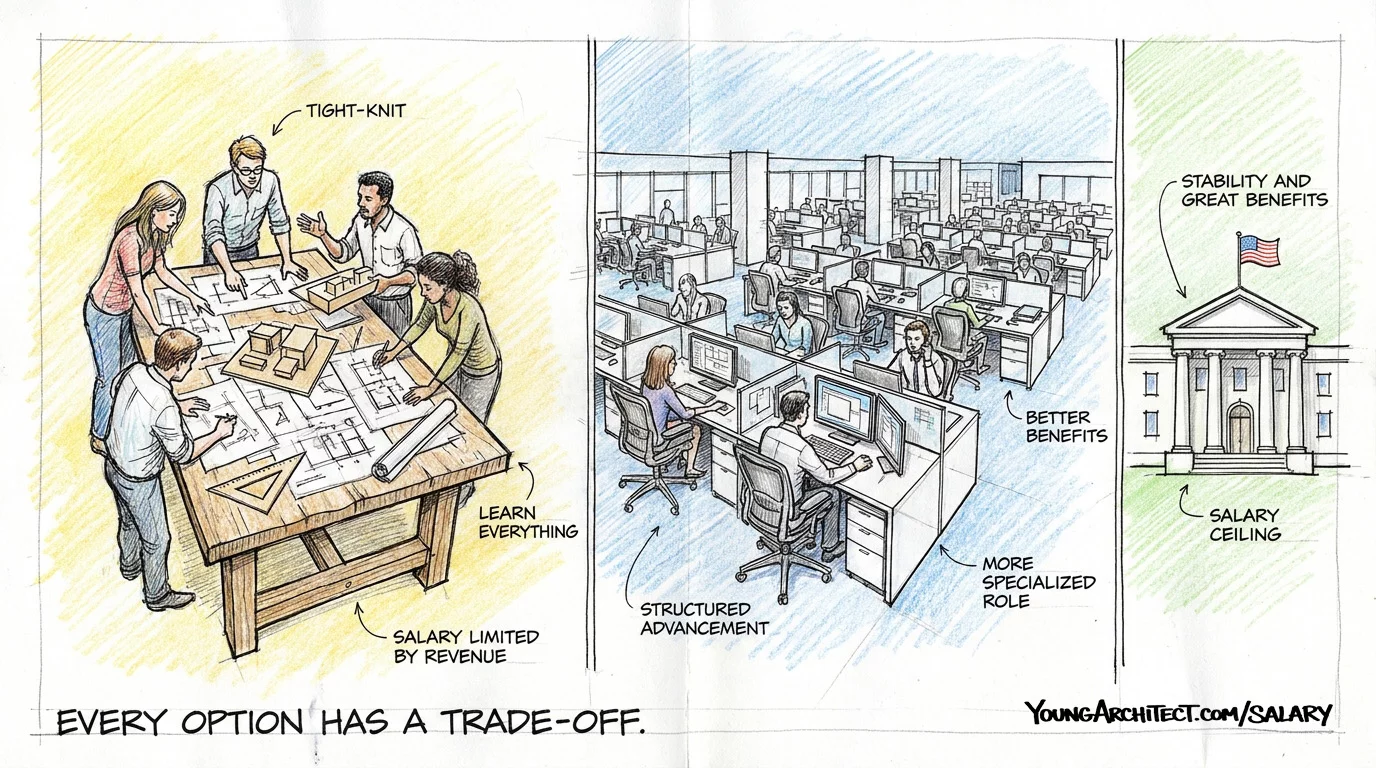
Small firms can be amazing places to learn and grow. You wear a lot of hats, you get exposure to everything, and the principals are right there working alongside you.
But the reality is that sometimes in a small firm there just isn’t a lot of money to pay you a huge salary, even if they want to. The firm’s revenue only goes so far. Everyone is kind of getting by.
Large firms are different. They tend to have:
- More structured salary bands
- Better benefits packages
- More room for advancement
But they also come with more bureaucracy, more layers, and you might be a small cog in a very big machine.
And then there are government positions, which usually trade salary ceiling for stability, great benefits, and predictable hours.
Going from a small firm to working for the government can mean a significant salary increase. But the salary might cap at a certain point. The trade-off is incredible benefits, often the best health insurance available, and a pension if you stay long enough.
So those are the external variables. The things happening around you that affect your architect pay.
But here’s where it gets interesting, because the architects who make the most money figured something out that has nothing to do with geography or firm size. It has to do with what they decided to become.
Do Architects Make Good Money
Here’s the question nobody asks on those salary websites.
Do you make money for your firm, or do you cost your firm money?
That’s really what it comes down to.

Someone who brings in new projects, does billable work efficiently, and gets things done quickly and on budget is always going to out-earn someone who’s just overhead.
And making money for the firm isn’t just about business development and landing new clients.
Protecting the Fee
It’s also about protecting the fee on the projects you already have.
Architecture is compensated in hours. When it takes you four hours to do something that should take one, that’s fee getting burned.

The people who work efficiently and get the work done with care and precision, without wasting billable hours, those people are protecting the firm’s profit. And firms notice.
The value you provide to the client, to the firm, to your boss, that’s what determines your ceiling. Not your title. Not your years of experience. Your value.
And here’s what a lot of people don’t realize about what “value” looks like in architecture.
There’s no shortage of people who want to design a beautiful building. Schools produce thousands of talented designers every year.
But there IS a shortage of people who know how to take that design and actually execute it. Who can produce a complete set of construction documents, manage the coordination, solve the problems that come up, and get the thing built.
Your architect salary is going to reflect which side of that equation you’re on.
The Generalist vs. the Specialist
So how do you become the person who brings undeniable value?
All architects are generalists by default. That’s baked into the education and the licensing process.
The whole point of the architect registration exam is proving that you know enough about structures, mechanical systems, electrical systems, contracts, building codes, and construction to have an intelligent conversation with any engineer or contractor and make the right decision.
Can you sit at the table with all of these different professionals and hold your own? Do you know enough across every discipline to lead a project responsibly?
That generalist foundation is essential. You need it. Every architect needs it.
But here’s the thing. Within that generalist foundation, the architects who earn the most have gone deep on something specific. They’ve become specialists.
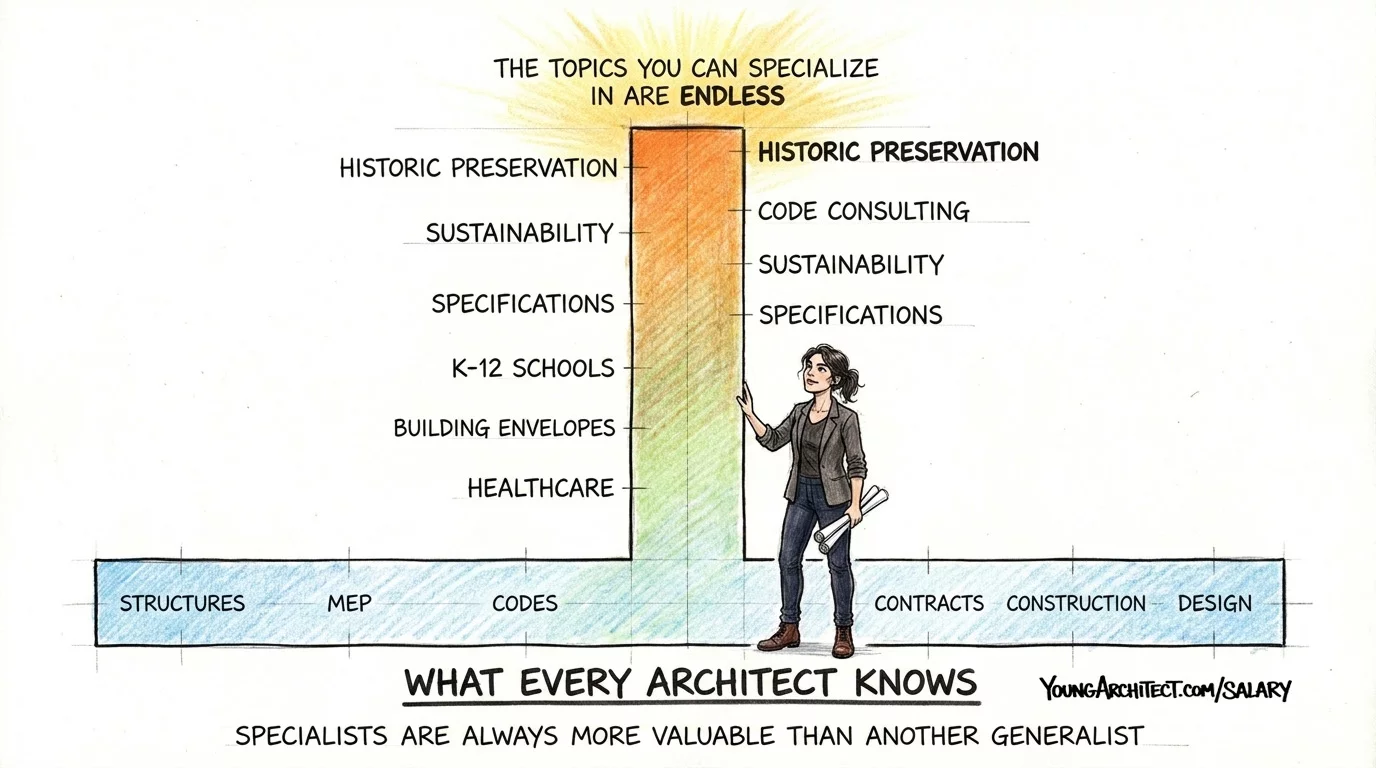
Think of it like a capital letter T.
The wide bar across the top is everything you need to know just to get your license. The broad generalist knowledge that makes you a competent architect. But that vertical line going deep? One specific area where you’ve gone way deeper than everyone else? That’s where your real earning potential lives.
Specialists are always more valuable than another generalist. And the more you become known for being a specialist, the more valuable you become. Your reputation compounds over time.
Types of Architects
The beautiful thing about architecture is that the list of things you could specialize in is almost endless.
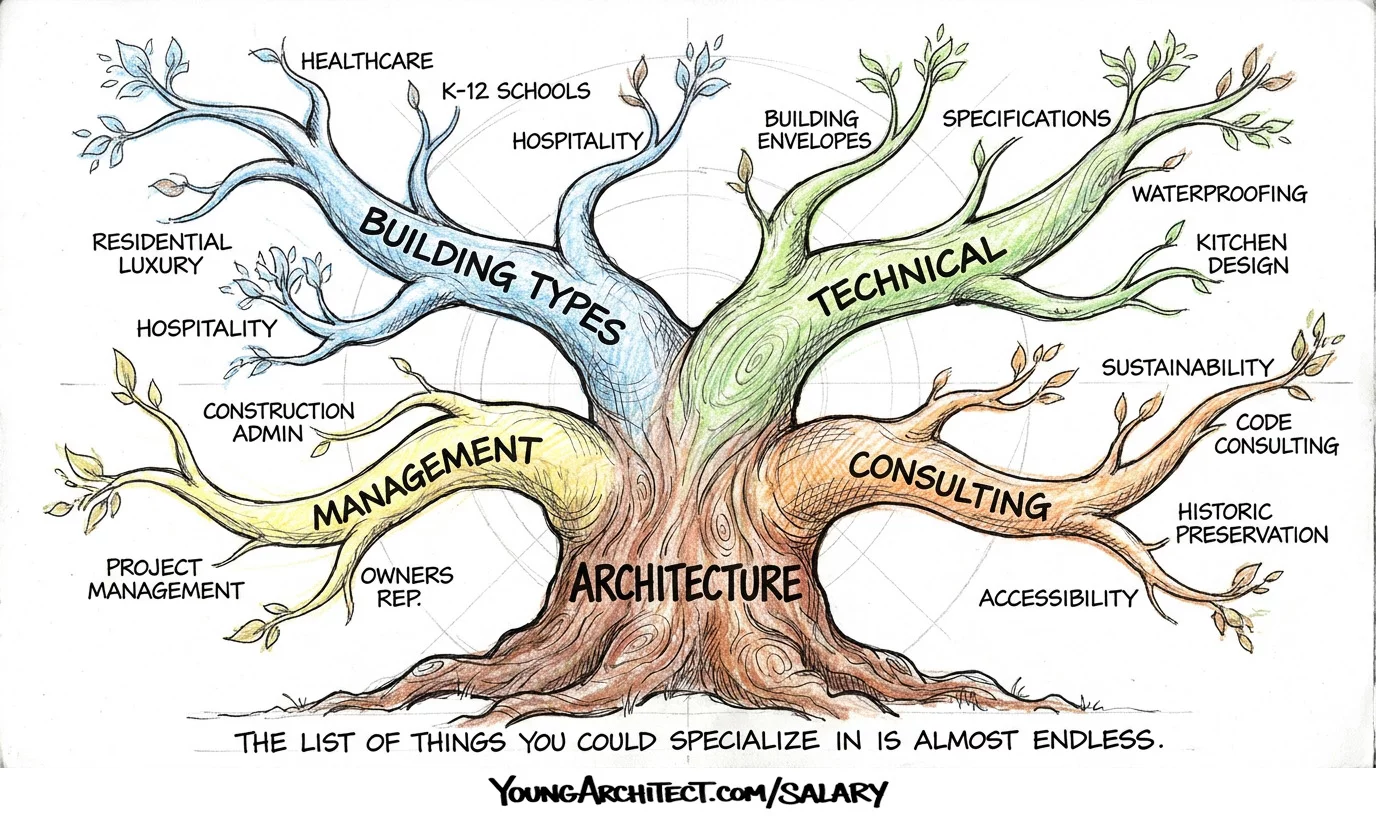
You could become the go-to person for healthcare architecture, or K-12 schools, or residential luxury.
You might fall in love with one specific element, like building envelopes, or accessibility, or waterproofing details.
It could be a building type. It could be one room. There are people who’ve built entire careers around kitchen design.
Historic preservation. Writing specifications. Construction administration. Sustainability consulting. Code consulting. The list is almost endless.
And honestly, you can make a lot of money doing anything if you put all those parts together. Find what you love, figure out how that brings value to the industry, and then put yourself in positions where that value is appreciated and compensated.
The formula works in any profession. But within architecture, the number of paths is enormous.
Architecture Career Paths Beyond the Firm
And here’s something a lot of people miss. Being trained as an architect doesn’t mean you have to work in a traditional architecture firm.
The education prepares you for a lot of different roles, and some of those roles pay better than being the architect of record on a project.
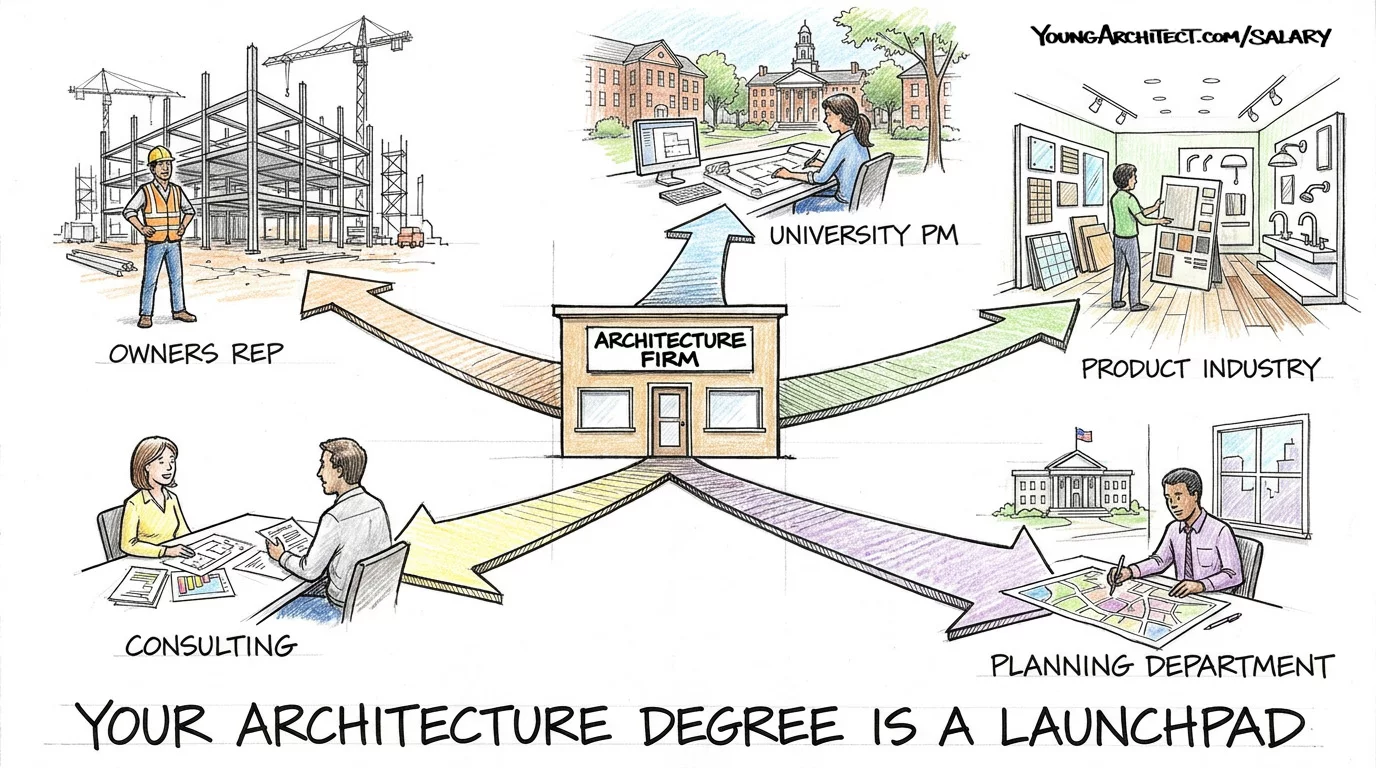
I went from working for small architecture firms to getting laid off at the end of the recession when the firm ran out of work. The local government ended up hiring me as an owner’s representative because I already had so much experience on their projects.
Layla, who hosts many of the podcast episodes, worked for an architecture firm doing high-end medical lab buildings for years before she moved to a university as a project manager overseeing their entire portfolio of building projects.
Architects work in the planning department. They go into the construction product industry. They become consultants. They specialize in areas that don’t exist inside a traditional firm at all.
The point is, being the registered architect of record is not the only career path for someone who’s trained as an architect. And the people who figure that out early tend to have a lot more options when it comes to compensation.
Building a Career Through Specialization
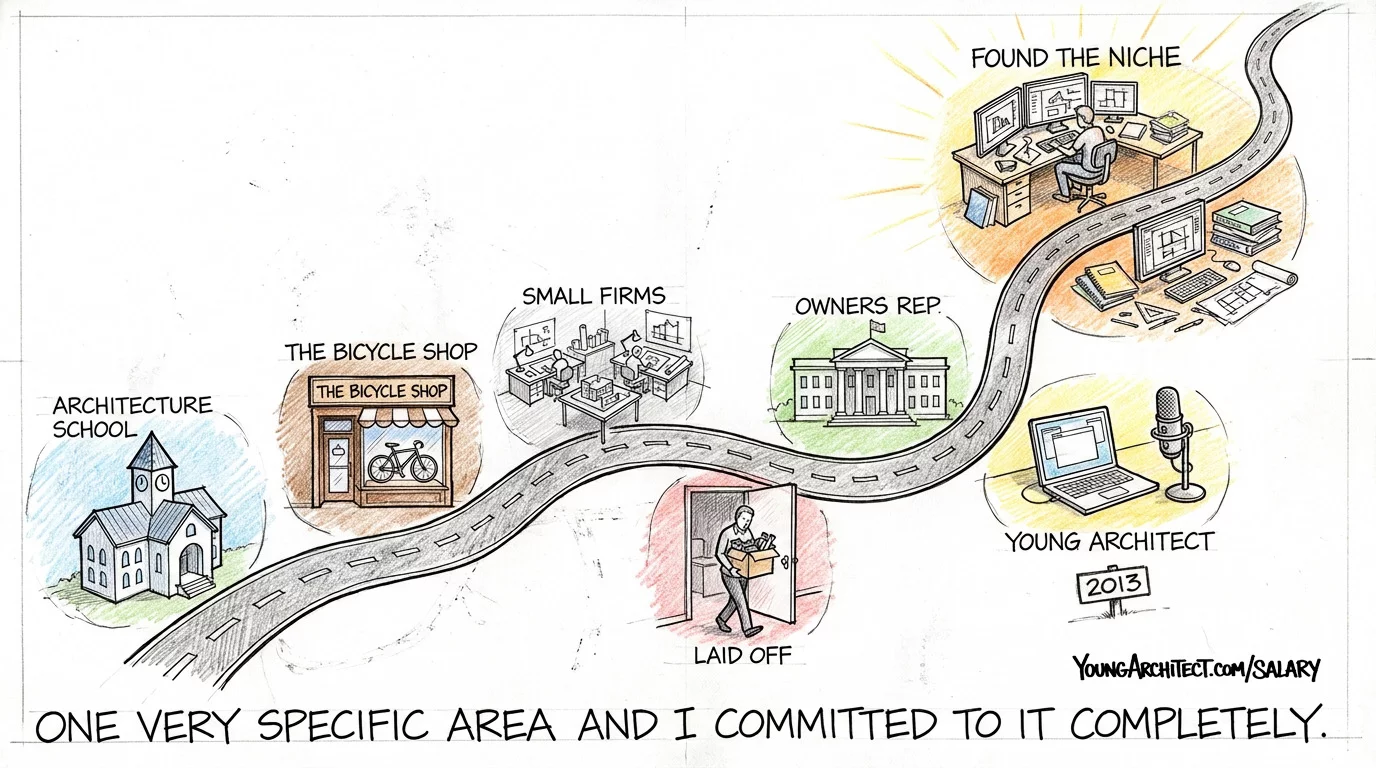
In 2013, I started putting out content helping people pass the Architect Registration Exam. The architect exam became my niche. One very specific area within the enormous world of architecture.
And I committed to it completely.
At this point, I probably know more about the architect exam than anything else in my life. More experience coaching people through the licensing process than anyone I know.
And because of that dedicated expertise over more than a decade, I’ve been able to build a successful business in a space where a lot of people have tried and failed.
There’s one area around architecture that I know more about than anyone else. And it’s the architect exam.
This is a core business. Not a hobby. Not a side hustle. When you become the best at something specific, you get to set the terms.
Nobody should work for free. But when you’re the best at something specific, you don’t have to.
The Bicycle Shop Lesson
The lesson about specialization and hustle didn’t come from an architecture office. It came from a bicycle shop.

During architecture school, I worked in a small-town bicycle shop. And I learned more about how a business actually works from watching that shop owner than I ever did in a classroom.
I watched how the owner built relationships with customers. How he interacted with people who walked through the door. How his ability to hustle was directly connected to how much money he made.
There was no corporate salary structure. There was no annual review.
If the boss hustled, he was rewarded. And if I helped him hustle, I was rewarded too.
That direct connection between effort and reward is something a lot of architects never experience. They’re buried in a salary structure at a firm where their individual contribution is invisible.
Nobody can point to what they specifically brought in or how they specifically moved the needle. And when your contribution is invisible, your salary is going to reflect that.
This applies to every profession, not just architecture.
The more willing you are to hustle, the bigger your salary is going to be. Not grinding 80 hours a week for a boss who doesn’t notice. Building skills that make you impossible to ignore.
That lesson stuck through my entire career, and it’s a big part of why I eventually built my own business instead of staying in someone else’s salary structure.
Architect Salary vs. Other Careers
Salary isn’t just a number. It’s a trade-off.
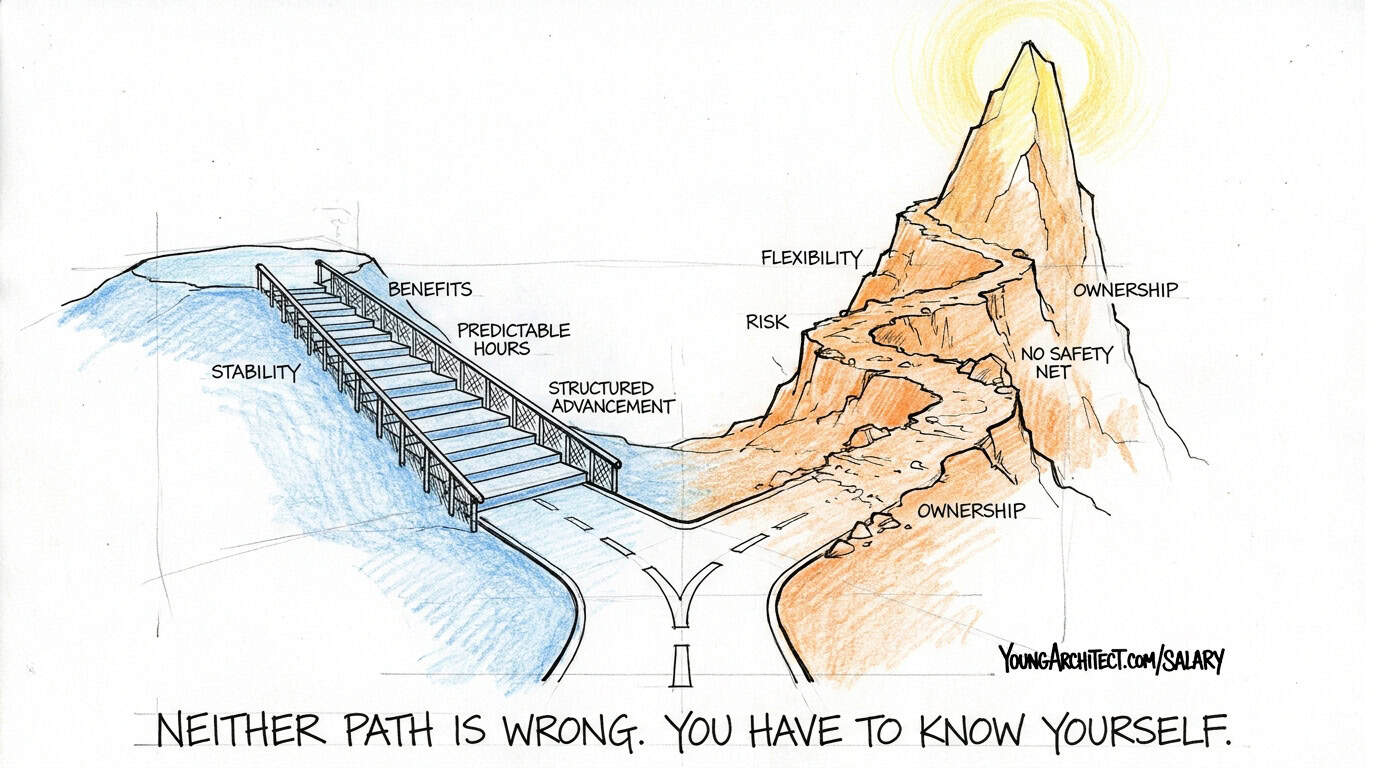
Starting your own business is riskier than climbing the ladder at a corporate firm. There’s no guaranteed paycheck, no benefits handed to you, no safety net.
But more risk generally comes with more reward. That’s true in architecture and it’s true in everything.
Some people are genuinely better suited for corporate. That’s not a criticism. It’s about knowing yourself and what kind of environment brings out your best work.
Architects Are Not Doctors or Lawyers
People love to compare architect salary to what doctors and lawyers make. All three require years of school, professional licensure, and carry serious responsibility.
But that comparison is completely wrong.

Doctors step in when something is broken and fix it. Lawyers step in when there’s a dispute and fight it.
Both of them are crisis managers. That’s not what architects do.
If you have to compare architects to any profession, the closest match is accountants.
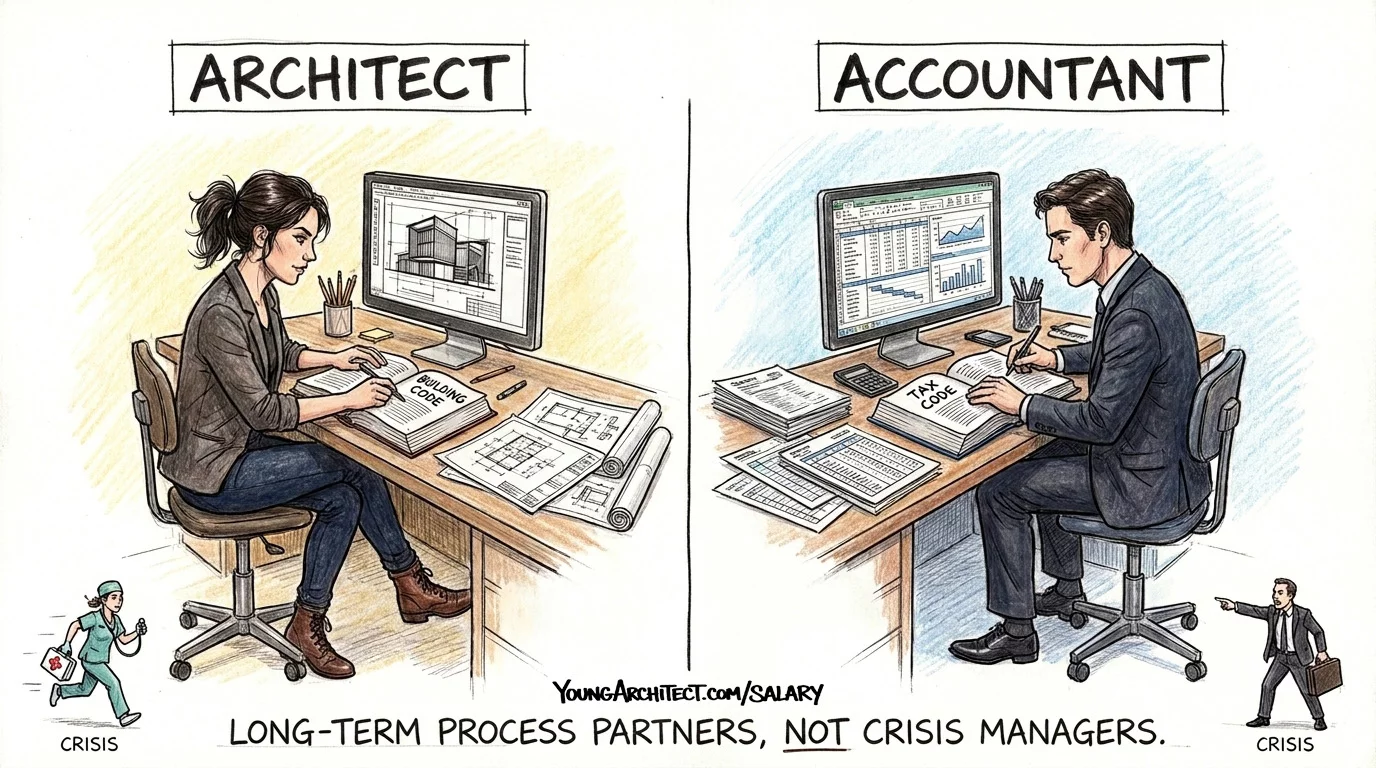
An accountant takes a client’s financial situation, maps it against an incredibly dense book of government tax codes, and spends months building a compliant strategy so the client doesn’t get destroyed by liability.
An architect does the exact same thing, except the code book is the building code and the deliverable is a set of construction documents instead of a tax return.
Architects aren’t crisis managers. They’re long-term process partners who navigate dense regulations on behalf of their clients. If you have to compare architects to any profession, accountants are the closest match.
Both professions take a complex regulatory framework, translate it into a strategy that protects their client, and produce detailed documentation that proves compliance. Neither one is rushing into an emergency room or a courtroom.
That’s what architects actually do. The doctor and lawyer comparison was never the right one.
Salary vs. Fulfillment
Here’s the other thing about architect salary that nobody puts on a chart. It’s not always about the money.
Before going any further: this is not an endorsement of working for free or taking a salary that’s not even a livable wage just so you can work for a famous architect and put their name on your resume. That’s not what this is about.
But salary is one piece of a much bigger picture.
There’s a registered architect who specializes in construction administration. That’s all he does. He’s on construction sites every day and he loves it.
He’s been with his firm for over ten years, and they take good care of him. Could he shop around and probably find another $20,000 to $30,000 a year somewhere else? Probably.
But is it worth the disruption? Probably not.

Architecture is a team sport. You’re working with these people every day, collaborating on projects, solving problems together.
And liking the team you’re on, liking the projects you get to work on, showing up to a place every day where you actually want to be there? That’s priceless.
Sometimes that’s worth more than chasing an extra $20,000 or $30,000 at a company where you’re miserable.
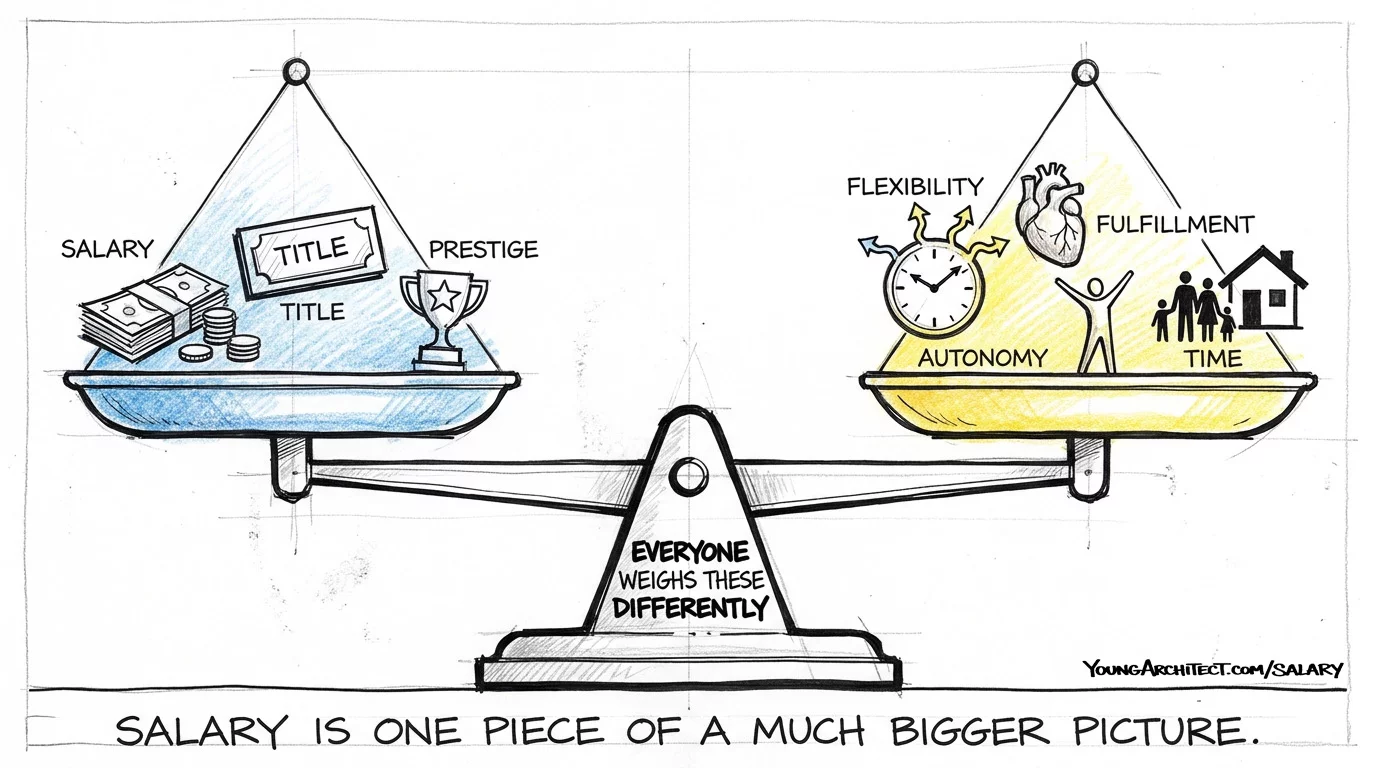
The key is that this was an intentional choice. He looked at the trade-offs and decided what mattered most to him.
That’s very different from being stuck working sixty hours a week as a generalist, getting paid like an intern because you never picked a niche and never positioned yourself for anything better.
One is a choice. The other is a default.
If you’re actively studying for your architecture license, think twice before blowing up your study routine for a modest salary bump. The stability of finishing your exams is worth more than a $10,000 raise at a new firm where you’ll spend six months learning a new system, new people, and new expectations while your study schedule falls apart.
Is Architecture Worth It Financially
So let me bring this full circle and answer the question that’s probably been in the back of your mind since you started reading.
Is architecture actually worth it financially?
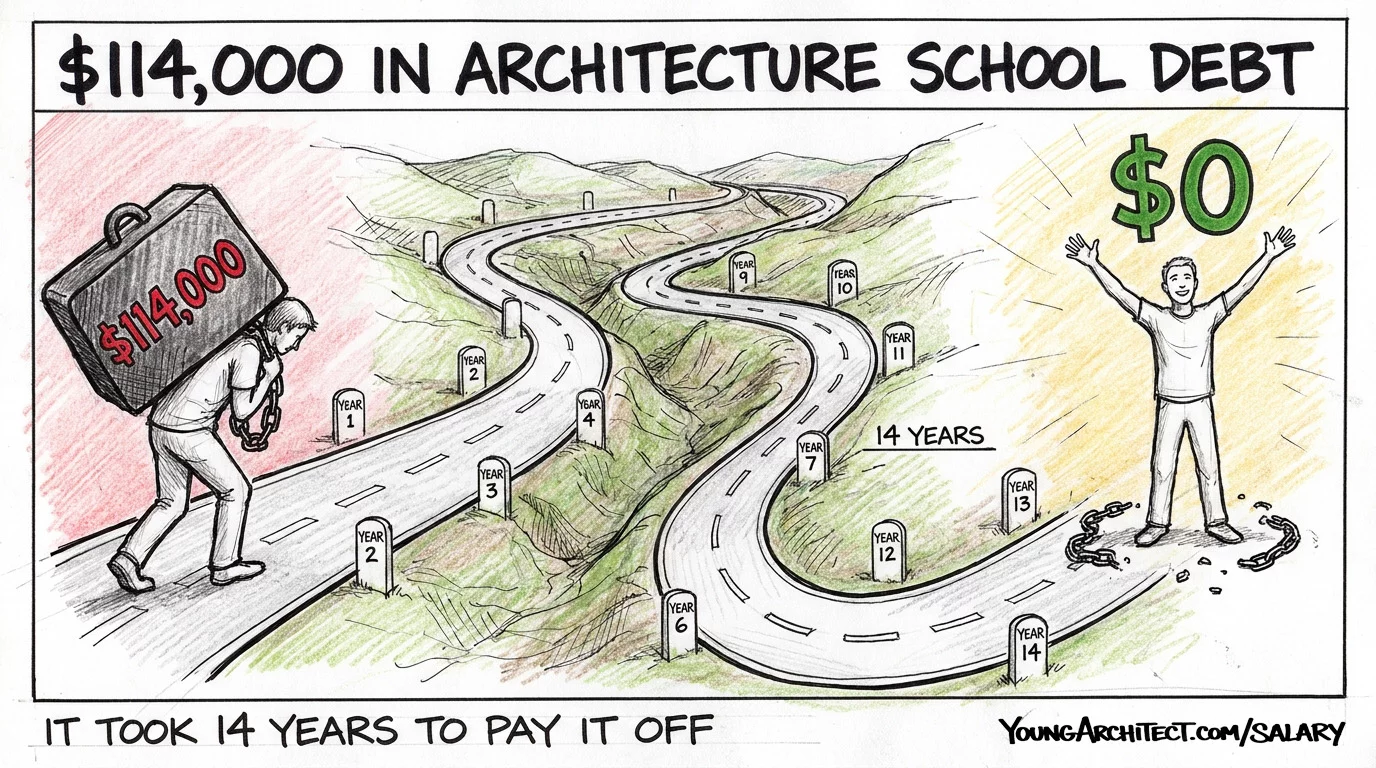
My parents didn’t want me to go to architecture school. Probably because they Googled “architect salary.” Nobody paid for my college education.
So I put myself through architecture school entirely on my own. $114,000 in student loan debt. It took fourteen years to pay it back.
Someone told me early in my career, “Unless you have rich parents, it makes it really hard to be an architect.”
I thought about that for a long time.
And I disagree.
If you work hard, become good at what you do, get known for what you do, take on responsibility, and are willing to take risk, you can make a lot of money in architecture.
Architecture specifically rewards people who find their niche, build their reputation, and aren’t afraid to bet on themselves.
Is an architecture degree worth it? It can be, if you treat it as an investment and not just a piece of paper.
And here’s what makes architecture different from a lot of other professions.

Walking into design studio in architecture school and knowing, before you even knew what the project was, that you were going to work your ass off. And so was everyone else in that room.
Competing. Going above and beyond. Pushing to really understand the problem and take it to the next level.
That willingness to go all in on solving a problem you haven’t even seen yet is what makes architecture unique. It’s a profession that attracts people who don’t do things halfway.
The calling matters. And the people who feel that calling? They tend to figure out the money part eventually, because they bring that same intensity to everything they do.
If you’re serious about your architecture career and ready to get licensed, that’s exactly what we do at the Young Architect Academy.
Our ARE Boot Camp coaching program provides structured guidance, accountability, community, and a clear roadmap to get you through all six divisions of the architect registration exam.
If you prefer self-paced study, the ARE 101 Membership gives you access to our full library of video courses, practice questions, flashcards, and reading companions for every exam division.
And if you’re earlier in your career or just want to understand how the architecture, engineering, and construction industry actually works from end to end, take a look at CDT® certification. We think of CDT as the driver’s license for working in this industry. It teaches you how a project moves from idea to design to construction to occupancy, and it overlaps heavily with the architect exam, especially the pro practice divisions. You can watch our free CDT presentation at youngarchitect.com/cdtwebinar.
How much does an architect make a year?
The median architect salary in the US is approximately $97,000 to $100,000 per year according to BLS data. However, the range is enormous. Entry-level architects typically earn $50,000 to $65,000, while principals and firm owners can earn well over $200,000. Geography, firm size, licensure status, and specialization all affect where you land in that range.
Is an architecture degree worth it?
An architecture degree can be worth it financially if you treat it as an investment and develop a specialization that brings value to the industry. Architects who get licensed, build a reputation in a niche, and position themselves strategically can earn well over six figures. The degree also opens doors beyond traditional architecture firms, including owner’s representation, consulting, and project management roles.
How long does it take to become an architect?
It typically takes 7 to 10 years to become a licensed architect after starting college. That includes a 5-year Bachelor of Architecture or a 4+2-year Master of Architecture program, followed by the multi-year Architectural Experience Program (AXP), and then passing all six divisions of the Architect Registration Exam.
Do architects make good money?
Architects can make very good money, but it depends heavily on what they specialize in and the value they bring. The median salary is around $97,000, but architects who develop a niche specialization, get licensed, and position themselves in high-demand sectors can earn well north of $150,000 to $200,000 or more. The key difference between architects who earn well and those who don’t is almost always specialization over generalization.
Do you need a license to be an architect?
You need a license to legally call yourself an “architect” in the United States because it is a regulated title. However, you do not need a license to work in the architecture field. Many successful professionals work in architecture offices, on construction projects, and in related roles without a license. That said, licensure is the single biggest salary differentiator in the profession and opens doors to higher compensation, partnership eligibility, and career advancement.